Navagraha Stotram: Vyāsa’s Hymn to the Nine Planetary Deities
Synopsis
The Navagraha Stotram, attributed to the sage Vyāsa, honours each of the nine planetary deities of Vedic astrology with one verse, from Sūrya, “radiant as the hibiscus flower”, to Ketu. The closing phalaśruti promises that its recitation pacifies obstacles and the afflictions of the planets.
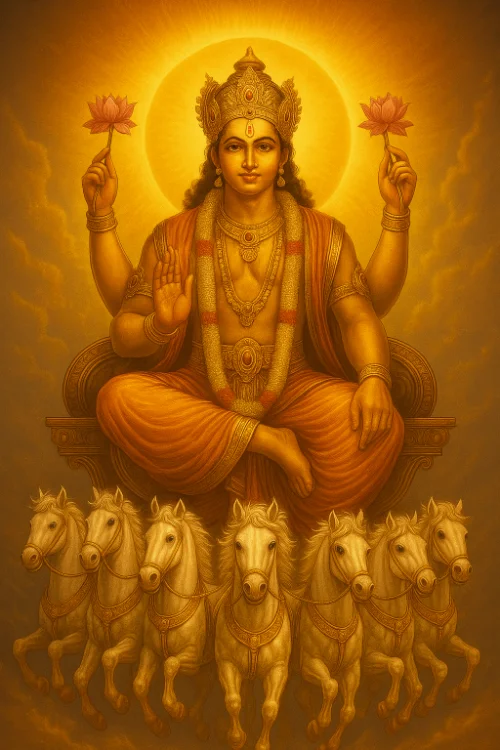
I bow before Sūrya, the maker of day, whose radiance resembles the hibiscus flower, the descendant of Kaśyapa, who shines with extraordinary brilliance, the enemy of darkness and the destroyer of all sins.
दधिशङ्खतुषाराभं क्षीरोदार्णवसम्भवम् । नमामि शशिनं सोमं शम्भोर्मुकुटभूषणम् ॥ २ ॥
I bow to Candra, the Moon, whose radiance resembles yogurt, a white conch, and snow, who arose from the Ocean of Milk, who is known as Śaśin and Soma, and who adorns the crown of Lord Śiva.
I bow to Maṅgala, born from the womb of the Earth, whose brilliance equals that of lightning, who is youthful in appearance and holds a spear in his hand.
I bow to Budha, whose dark complexion resembles the bud of the priyaṅgu plant; who is incomparable in beauty, gentle in nature, and endowed with graceful, benevolent qualities.
देवानां च ऋषीणां च गुरुं काञ्चनसन्निभम् । बुद्धिभूतं त्रिलोकेशं तं नमामि बृहस्पतिम् ॥ ५ ॥
Devānāṁ ca ṛṣīṇāṁ ca guruṁ kāñcanasannibham | Buddhibhūtaṁ trilokeśaṁ taṁ namāmi bṛhaspatim || 5 ||
I bow to Bṛhaspati, the spiritual preceptor of the gods and sages, whose radiance resembles gold; he embodies wisdom and is lord of the three worlds.
I bow to Śukra, whose radiance resembles snow, jasmine blossoms, and white lotus stalks; the supreme preceptor of the Daityas; the expounder of all sacred scriptures; and the descendant of Bhṛgu.
I bow to Śanaiścara, whose appearance resembles dark blue collyrium; the son of the Sun and elder brother of Yama; born of Chāyā and Mārtaṇḍa, the Sun God.
I bow to Rāhu, whose body is only half-formed, who possesses tremendous power, who overwhelms the Moon and the Sun, and who was born from Siṁhikā’s womb.
I bow to Ketu, whose appearance resembles the fiery red palāśa flower; who is the head among stars and planets; fierce in appearance, fierce in nature, and awe-inspiring in his terrifying form.
Phalaśruti
Whoever recites this hymn, uttered from the mouth of Vyāsa, with complete concentration, whether during the day or at night, shall find that obstacles are pacified. For men, women, and kings alike, it destroys bad dreams. It bestows incomparable prosperity, good health, and increased strength and vitality. All afflictions arising from the planets and lunar constellations, as well as misfortunes caused by thieves and fire, shall be pacified. Thus declares Vyāsa; there is no doubt about this.
Navagraha Namaskāra
ॐ आदित्याय च सोमाय मङ्गलाय बुधाय च । गुरुशुक्रशनिभ्यश्च राहवे केतवे नमः ॥
Oṁ ādityāya ca somāya maṅgalāya budhāya ca | Guruśukraśanibhyaś ca rāhave ketave namaḥ ||
Oṁ. Homage to Āditya, the Sun, and to Soma, the Moon; to Maṅgala and to Budha; to Guru, Śukra and Śani; to Rāhu and to Ketu.
One verse that salutes all nine grahas in their customary order: the seven planets of the weekdays from Sunday to Saturday, Sūrya, Candra, Maṅgala (Mars), Budha (Mercury), Guru or Bṛhaspati (Jupiter), Śukra (Venus) and Śani (Saturn), followed by Rāhu and Ketu, the two nodes of the Moon where eclipses happen. Each has his own verse in the Navagraha Stotram above.
Graha means “the one who seizes”: in Jyotiṣa the nine are the powers that take hold of a life, each in his own period, the daśā. The verse is commonly recited before the Navagraha Stotram, and in Navagraha worship as a single salutation to all nine. It is customarily repeated 108 times.