

धन्वन्तरिरुवाच
कल्पान् मृत्युञ्जयान् वक्ष्ये ह्यायुर्दान् रोगमर्दनान् ।
त्रिशती रोगहा सेव्या मध्वाज्यत्रिफलामृता ॥ १ ॥
पलं पलार्धं कर्षं वा त्रिफलां सकलां तथा ।
बिल्वतैलस्य नस्यं च मासं पञ्चशती कविः ॥ २ ॥
रोगापमृत्युबलिजित् तिलं भल्लातकं तथा ।
पञ्चाङ्गं बाकुचीचूर्णं षण्मासं खदिरोदकैः ॥ ३ ॥
Dhanvantarir uvāca
kalpān mṛtyuñjayān vakṣye hy āyur-dān roga-mardanān |
triśatī roga-hā sevyā madhv-ājya-triphala-amṛtā || 1 ||
palaṃ palārdhaṃ karṣaṃ vā triphalāṃ sakalāṃ tathā |
bilva-tailasya nasyaṃ ca māsaṃ pañcaśatī kaviḥ || 2 ||
rogāpamṛtyu-bali-jit tilaṃ bhallātakaṃ tathā |
pañcāṅgaṃ bākucī-cūrṇaṃ ṣaṇmāsaṃ khadirodakaiḥ || 3 ||
Dhanvantari said: I shall teach kalpas — formulations that conquer death, bestow longevity, and crush disease. A preparation consisting of honey, ghee, triphala, and amṛtā should be used; it destroys disease and grants three hundred years.
One may take triphala whole, in a dose of one pala, half a pala, or one karṣa; and one should use nasal administration of bilva oil for a month. By this, the wise man becomes one of five hundred years.
It conquers disease, untimely death, and wrinkles. Likewise, sesame, bhallātaka, and powdered bākucī, with its five parts, should be taken for six months with khadira water.
- kalpa — here means a medicinal formulation or regimen, especially one with rejuvenative, longevity-giving force. In rasāyana contexts, kalpa can refer to a specific method of using a drug over time.
- Kalpa-sāgaraḥ — “Ocean of Kalpas.” The title suggests a large collection or abundance of powerful formulations.
- mṛtyuñjaya — “death-conquering.” It denotes extraordinary longevity, resistance to decay, and the avoidance of premature death.
- āyur-dān — “bestowing life-span.” The formulations are framed as increasing āyus, longevity.
- roga-mardana — “crushing disease.” Disease is not merely soothed but overpowered.
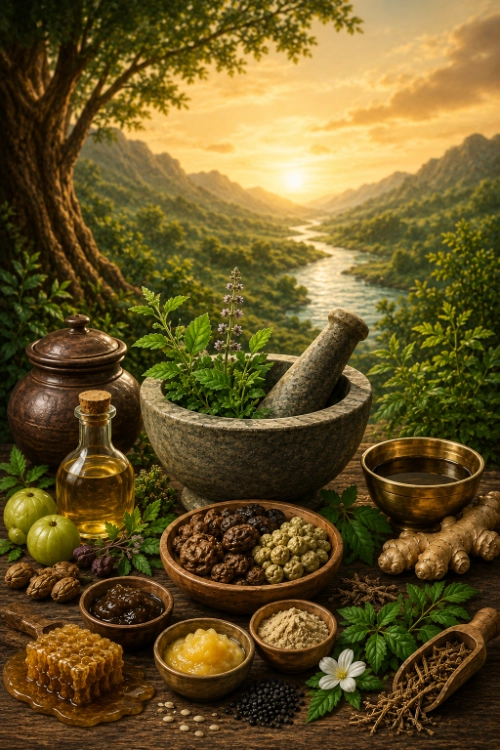
- madhu — honey.
- ājya — clarified butter, ghee.
- triphala — the famous three-fruit formulation: harītakī, bibhitaka, and āmalakī. It is associated with digestion, elimination, rasāyana, and doṣa-balancing.
- amṛtā — literally “immortal” or “nectar-like.” In Ayurvedic materia medica, this is a well-known name for guḍūcī.
- pala / palārdha / karṣa — traditional measures. Pala is a larger unit; palārdha means half a pala; karṣa is a smaller weight. Exact equivalences vary by textual tradition.
- bilva-taila — oil prepared from bilva (Aegle marmelos), used here as nasya, nasal administration.
- nasya — an Ayurvedic nasal therapy, in which medicated oil, ghee, juice, powder, or decoction is administered through the nose.
- rogāpamṛtyu-bali-jit — “conquering disease, untimely death, and wrinkles.” roga — disease. apamṛtyu — premature or untimely death. bali — wrinkles, folds of age. jit — conquering.
- tila — sesame. It may refer to sesame seed or a sesame-based preparation.
- bhallātaka — Semecarpus anacardium, a powerful and potentially caustic medicinal substance in Ayurveda. It requires careful purification and expert use.
- bākucī — Psoralea corylifolia / Cullen corylifolium, an important medicinal plant, especially known in skin-related contexts.
- khadira-udaka — water or decoction of khadira (Acacia catechu), often associated with cleansing, skin disorders, and kapha-pitta conditions.
This chapter begins in the language of rasāyana, rejuvenative medicine. Dhanvantari promises formulations that conquer disease, premature death, and visible aging. The first preparation combines honey, ghee, triphalā, and amṛtā — a classic mixture of nourishment, cleansing, and rejuvenation. The second prescribes triphalā with nasal use of bilva oil, suggesting that longevity is supported not only through ingestion but also through therapies directed to the head and senses. The third introduces stronger substances such as bhallātaka and bākucī, combined with khadira water over six months.