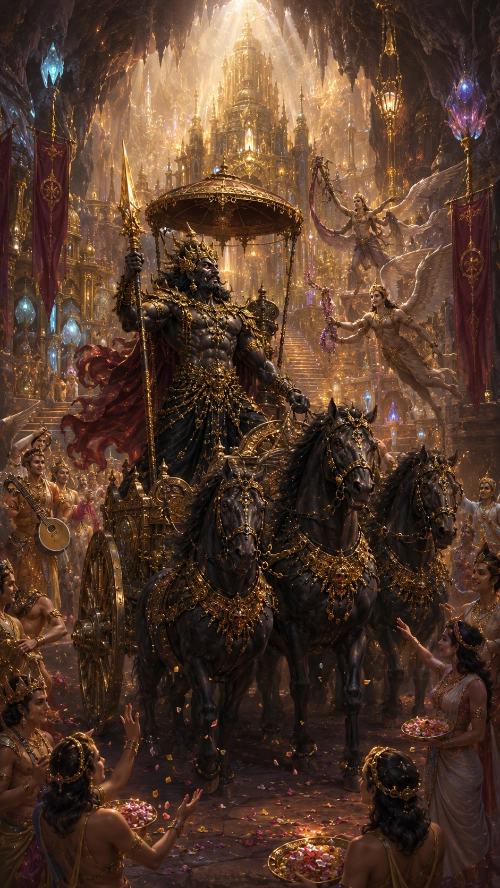
Andhaka’s Defeat of Indra
The tenth chapter of the Vāmana Purāṇa opens with the direct confrontation between Andhaka and Indra. After an exchange of arrows, Indra hurls his thunderbolt, which destroys Andhaka’s chariot, horses, banner, and charioteer. Andhaka nevertheless resists the weapon physically, striking it down with his fist. He then attacks Indra’s elephant, breaking its tusk and battering it until Indra is forced to abandon the battlefield and retreat to Amarāvatī. The defeat of the celestial king marks the first decisive collapse in the gods’ defensive order.
Prahlāda, Yama, and the Seizure of the Staff
The battle then shifts to Prahlāda’s duel with Yama, identified through the patronymics Vaivasvata, Bhāskari, and Ravinandana, all emphasizing his descent from the Sun. Yama destroys Prahlāda’s arrows and releases his terrible staff, which blazes like the fire of cosmic dissolution. Andhaka intervenes at the moment when the Daityas believe Prahlāda is doomed, catches Yama’s weapon in his left hand, and brandishes it triumphantly. Yama, recognizing Andhaka as impossible to restrain, disappears from the battlefield, allowing Prahlāda to devastate the divine army.
Varuṇa’s Counteroffensive
Varuṇa emerges as one of the gods’ most effective combatants. Mounted on the aquatic śiśumāra, he binds Asuras with his nooses and strikes them with his mace. His duel with Virocana develops into a coordinated struggle between warriors and mounts: Virocana breaks the nooses and seizes Varuṇa, while his elephant tramples both the god and his vehicle. Varuṇa eventually overturns the situation by binding Virocana with a great serpent and hurling him, together with the elephant and its driver, into the sky.
The Collapse of the Daitya Reinforcements
When Jambha, Tāra, Vṛtra, Kujambha, and Bala rush to rescue Virocana, Varuṇa defeats them through a rapid sequence of attacks using his noose, palm, foot, and fist. This episode presents him not merely as a water deity but as a complete martial power capable of binding, striking, and physically overwhelming multiple opponents. The Daitya army temporarily loses cohesion and flees, abandoning its weapons. As elsewhere in the chapter, Andhaka responds personally whenever a major divine warrior threatens the stability of the Asura forces.
Andhaka Overcomes Varuṇa, Agni, and Vāyu
Andhaka breaks Varuṇa’s noose, seizes his mace, and throws both weapons back at him, forcing Varuṇa to retreat into the ocean. The narrative then introduces the combined elemental power of Agni and Vāyu. Fanned by the Wind, Agni burns the Asura army, wounds Maya with a spear, and seizes Śambara by the throat with consuming flame. Maya, the architect of the Dānavas, symbolically represents constructed form, while Agni embodies the force that destroys all material structures. Once again, Andhaka intervenes and defeats the divine power that the other Asuras cannot resist.
The Rout of the Celestial Order
Andhaka strikes Agni first in the body and then upon the head with his iron club, forcing the Fire-god to flee in fear. His victory then expands beyond individual combat. With his arrows, Andhaka turns away Vāyu, Soma, Sūrya, the Sādhyas, Rudras, Aśvins, Vasus, and great serpents. The phrasing suggests effortless superiority: merely being touched by one of his arrows is sufficient to make major divine beings retreat. The chapter thus depicts not only the defeat of several gods but the disintegration of coordinated celestial resistance.
Universal Sovereignty and the Court at Aśmaka
After conquering the divine army together with Indra, Yama, Soma, and the Rudras, Andhaka descends to earth and transforms military victory into imperial rule. He makes earthly kings tributaries and brings the whole world of moving and unmoving beings under his authority. He then establishes himself at Aśmaka in Pātāla, where Gandharvas, Vidyādharas, Siddhas, and Apsarases gather to attend him. The transfer of celestial attendants to an Asura court completes the temporary inversion of the cosmic hierarchy: Andhaka no longer appears merely as a victorious warrior, but as a universal sovereign whose power extends across heaven, earth, and the subterranean realms.