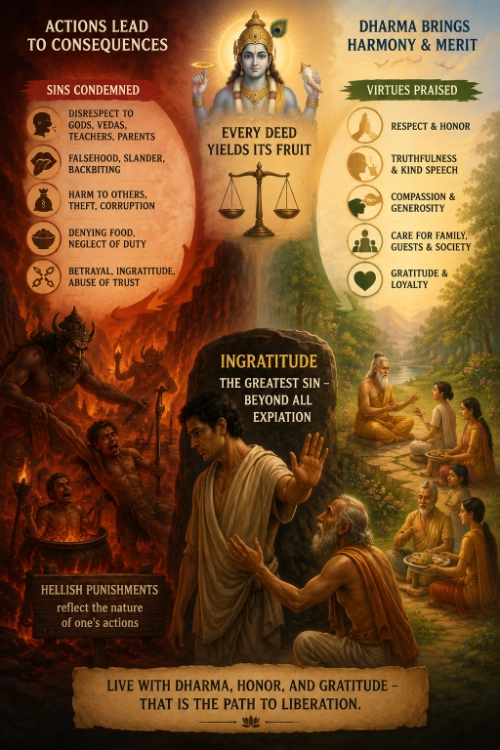
Actions and Their Corresponding Consequences
Chapter 12 presents a systematic catalog of actions that lead beings to particular hells. The sages explain that infernal suffering is not arbitrary: each soul experiences the fruit of its own conduct. The offenses include contempt for the Vedas, gods, teachers, parents, and sacred traditions; obstruction of sacrifice and charity; disruption of families and friendships; ritual negligence; theft; corruption; false testimony; cruelty; and betrayal of trust.
Karmic Correspondence
Many punishments reproduce the structure of the original offense. Slanderers have their tongues pulled out, those who listen approvingly to religious abuse have burning spikes driven into their ears, and those who insult revered persons with their feet are bound and scorched from the feet upward. Those who divide relationships are sawn apart, while people who corrupt sacred meals or deny food to others are punished through hunger, foul substances, or the forced consumption of their own flesh.
Food, Hospitality, and Household Duty
The chapter places particular emphasis on the ethics of food. A householder must feed deities, guests, dependants, children, parents, servants, visitors, and other living beings before eating himself. Refusing to share food with a needy traveling companion, distributing unequal portions among people seated together, or abandoning destitute relatives during a famine is considered a serious violation of social and religious responsibility.
Sacred Trust and Public Order
A second major theme is the misuse of entrusted authority. The text condemns those who misappropriate deposited property, accept bribes, give false evidence, corrupt assemblies, unjustly confine others, exploit people through improper labor, or abandon someone who has sought protection. Destroying wells, reservoirs, temples, monasteries, assembly halls, gardens, and public water stations is similarly punished because such acts damage institutions that sustain the wider community.
Ritual and Social Transgressions
The chapter also reflects the legal and ritual values of its historical setting. It censures the commercialization of Soma and Vedic learning, neglect of daily and occasional rites, improper acceptance of ritual fees, pollution of water, prohibited sexual conduct, adultery, abandonment of the sacred fire or teacher, and grave crimes such as killing a Brāhmaṇa, stealing gold, drinking forbidden liquor, and violating the teacher’s marriage-bed. The most serious offenders pass successively through Mahāraurava, Tāmisraka, Andhatāmisra, Asipatravana, Ghaṭīyantra, and Taptakumbha.
Ingratitude as the Supreme Moral Failure
The chapter culminates in an extended series of superlative comparisons: Viṣṇu among gods, Gaṅgā among rivers, Garuḍa among birds, Ananta among serpents, Manu among Smṛtis, and the Sun among luminous beings. The rhetorical purpose is finally revealed when the ungrateful person is declared foremost among sinners. Even offenses such as killing a Brāhmaṇa or a cow may have prescribed expiations, but the text claims that no expiation exists for one who deliberately nullifies the good done by a friend or benefactor. Ingratitude is therefore treated as the destruction of the reciprocity upon which family, hospitality, teaching, protection, charity, and social trust depend.