

Seven Cirañjīvīs
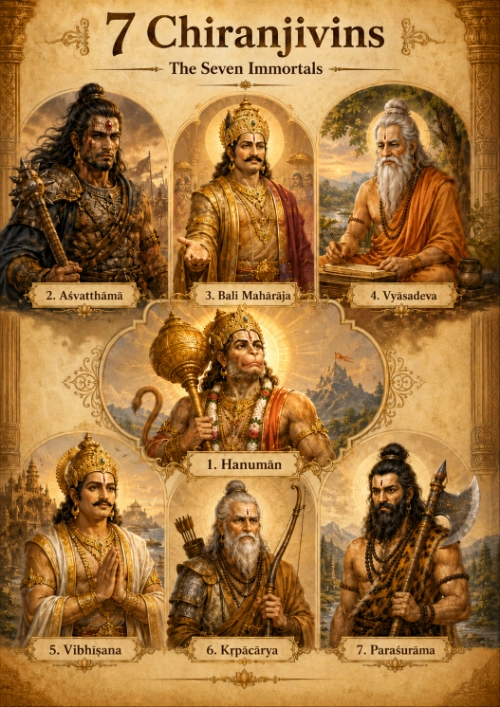
Seven Eternal Beings
These are the traditional seven Cirañjīvins — exceptionally long-lived beings who continue beyond an ordinary human lifespan. Cirañjīvin literally means “long-lived”; their continued existence is not always presented as the same kind of absolute immortality.
Hanumān
Hanumān is the son of the wind-god Vāyu and the foremost servant of Śrī Rāma. In the Rāmāyaṇa, he crosses the ocean to Laṅkā, discovers Sītā, reassures her that Rāma is coming, and carries news between them. He represents perfect devotion, strength, humility, intelligence, and selfless service.
Aśvatthāmā
Aśvatthāmā is the son of Droṇācārya and an exceptionally powerful warrior in the Mahābhārata. After Duryodhana’s defeat, he attacks the sleeping Pāṇḍava camp and kills Draupadī’s sons. Kṛṣṇa then curses him to wander alone for three thousand years, afflicted by disease and excluded from human society. His long life is therefore portrayed primarily as a punishment, not a blessing.
Aśvatthāmā’s inclusion among the eternal Cirañjīvins comes from later tradition; the Mahābhārata itself specifies a period of three thousand years for his wandering.
Bali Mahārāja
Bali is the virtuous Daitya king and Prahlāda’s grandson. When Viṣṇu appears as the dwarf Vāmana and asks him for three steps of land, Bali gives his promise. After Vāmana covers the worlds with two steps, Bali offers his own head for the third rather than break his word. He is subsequently given residence in Sutala under Viṣṇu’s protection. Bali represents generosity, truthfulness, humility, and complete surrender to God.
Vyāsadeva
Vyāsa — more fully Kṛṣṇa Dvaipāyana Vyāsa — is the great sage associated with arranging and transmitting Vedic knowledge and composing the Mahābhārata. Within the epic’s genealogy, he is also the father of Dhṛtarāṣṭra, Pāṇḍu and Vidura. He repeatedly advises the Kuru family and acts as a spiritual guide during its crises. Vyāsa represents sacred knowledge, memory, authorship and preservation of dharma.
Vibhīṣaṇa
Vibhīṣaṇa is Rāvaṇa’s younger brother. Although born among the Rākṣasas, he condemns Rāvaṇa’s abduction of Sītā and repeatedly advises him to return her to Rāma. When Rāvaṇa refuses, Vibhīṣaṇa leaves Laṅkā and joins Rāma. After Rāvaṇa’s defeat, Rāma crowns him king of Laṅkā. He represents choosing dharma over family loyalty when one’s family acts unrighteously.
Kṛpācārya
Kṛpa, or Kṛpācārya, is the son of the sage Śaradvān. He becomes a respected teacher and military instructor at the Kuru court and teaches the royal princes. During the Kurukṣetra war, he fights on the Kaurava side, but he is one of the very few major warriors to survive. He represents discipline, learning, endurance, and continuity between generations.
Paraśurāma
Paraśurāma — “Rāma with the axe” — is the son of Jamadagni and Reṇukā and is regarded as an avatāra of Viṣṇu. After the murder of his father, he wages repeated campaigns against oppressive Kṣatriya rulers. He later becomes renowned as a master of divine weapons and teaches warriors such as Karṇa.
In the later Kalki Purāṇa tradition, Paraśurāma remains alive to instruct the future avatāra Kalki in scripture, dharma, and martial knowledge.