

10 Mental Sons of Brahmā
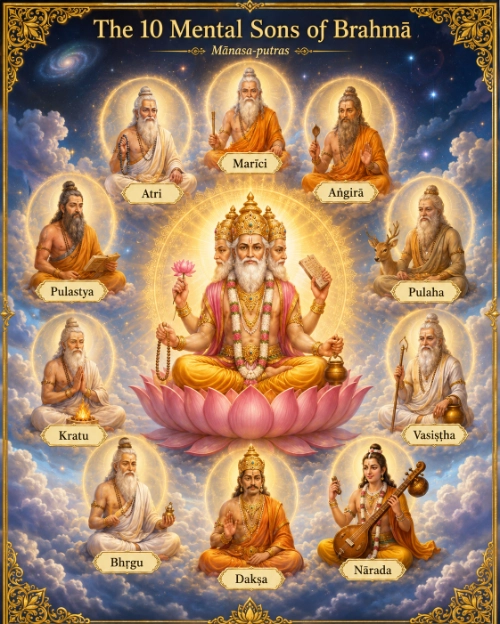
Brahmā’s Ten Mind-Born Sons: the Mānasa-Putras and Their Lineages
Brahmā’s ten mind-born sons — the mānasa-putras — and the lineages, teachings and conflicts that descend from them.
- Marīci
- Atri
- Aṅgirasa
- Pulastya
- Pulaha
- Kratu
- Bhṛgu
- Vasiṣṭha
- Dakṣa
- Nārada
According to Śrīmad-Bhāgavatam 3.12.22, the complete list is:
marīcir atry-aṅgirasau
pulastyaḥ pulahaḥ kratuḥ
bhṛgur vasiṣṭho dakṣaś ca
daśamas tatra nāradaḥ
Marīci, Atri, Aṅgirā, Pulastya, Pulaha, Kratu, Bhṛgu, Vasiṣṭha, Dakṣa and, as the tenth, Nārada.
Śrīmad-Bhāgavatam 3.12.22
What does “mental sons” mean?
The Sanskrit expression commonly used is mānasa-putra, “a son produced from the mind.” These beings were not born through ordinary sexual reproduction. Brahmā manifested them by his will and spiritual or creative power so they could help populate and organize the universe.
Nevertheless, the Bhāgavatam gives each of them a symbolic bodily origin:
- Nārada appeared from Brahmā’s deliberation.
- Dakṣa appeared from his thumb.
- Vasiṣṭha from his breath.
- Bhṛgu from his touch or skin.
- Kratu from his hand.
- Pulaha from his navel.
- Pulastya from his ears.
- Aṅgirā from his mouth.
- Atri from his eyes.
- Marīci from his mind.
Thus, “mental sons” is a general designation for Brahmā’s directly manifested sons; strictly speaking, only Marīci is specifically said here to have appeared from the mind.
These ten should also not be confused with the four Kumāras—Sanaka, Sanandana, Sanātana and Sanat-kumāra—who were another, earlier group of Brahmā’s mind-born sons.
Biographies of Brahmā’s ten sons
1. Marīci
Marīci was manifested directly from Brahmā’s mind. His name means something like a ray of light, which suits his position near the beginning of creation. He is one of the great primordial ṛṣis and is frequently counted among the great progenitors or Prajāpatis.
Marīci married Kalā, a daughter of Kardama Muni. Their principal son was Kaśyapa, one of the most important progenitors in all Purāṇic genealogy. They also had a child named Pūrnimā or Pūrnimān. The Bhāgavatam says that their descendants spread throughout the world.
Kaśyapa married several daughters of Dakṣa. Through these marriages came many classes of beings—including devas, Dānavas, Daityas, birds, serpents, animals and aquatic creatures. Consequently, Marīci stands near the head of an enormous genealogical tree containing both divine and apparently demonic families.
Marīci is not primarily remembered for a single dramatic adventure. His importance is cosmological and genealogical: through Kaśyapa, he became an ancestor of an immense portion of the universe’s population.
2. Atri
Atri was manifested from Brahmā’s eyes. He is described as one of the foremost persons learned in spiritual knowledge. Following Brahmā’s command to participate in creation, Atri married the celebrated Anasūyā.
Atri and Anasūyā went to Mount Ṛkṣa and performed severe austerities. Atri desired a son equal to the Supreme Lord and meditated with such intensity that Brahmā, Viṣṇu and Śiva all appeared before him.
Anasūyā subsequently gave birth to three extraordinary sons:
- Soma, associated with Brahmā;
- Dattātreya, a manifestation of Viṣṇu;
- Durvāsā, associated with Śiva.
Of these, Dattātreya became famous as an avatāra, yogī and teacher of transcendental knowledge. He instructed personalities such as Yadu, Alarka, and Prahlāda. Durvāsā became famous for his immense ascetic power, quick temper and the spiritual lessons that arose whenever someone encountered him. Soma became associated with the moon, vegetation, ritual offerings and the nourishment of living beings.
Atri therefore represents austerity, contemplation and pure determination. Through him, the three great cosmic functions represented by Brahmā, Viṣṇu and Śiva entered his family.
3. Aṅgirā
The name in the note is written Aṅgirasa, but the personal name in this verse is normally given as Aṅgirā or Aṅgiras. He was manifested from Brahmā’s mouth, suggesting a connection with sacred speech, Vedic knowledge and priestly instruction.
His wife was Śraddhā, whose name means faith. She gave birth to four daughters—Sinīvālī, Kuhū, Rākā and Anumati—and two renowned sons:
- Utathya
- Bṛhaspati, the spiritual teacher of the devas.
Aṅgirā plays an especially important role in King Citraketu’s history. Citraketu possessed enormous wealth and many wives but had no child. Aṅgirā arranged for the king to receive a son, warning indirectly that the child would bring both happiness and sorrow. The jealous co-wives eventually poisoned the child.
When Citraketu collapsed in grief, Aṅgirā returned with Nārada. Together they taught the king that bodily relationships are temporary and that the soul passes through many births. This tragedy became the turning point through which Citraketu attained profound spiritual realization.
Aṅgirā thus appears not merely as a ritual priest but as a teacher who uses life’s reversals to lead a person from material attachment to spiritual understanding.
4. Pulastya
Pulastya was manifested from Brahmā’s ears. This may symbolically connect him with hearing and transmitting sacred knowledge.
He married Havirbhū, another daughter of Kardama Muni. Their sons included:
- Agastya, the celebrated sage;
- Viśravā, a powerful ascetic and progenitor.
Viśravā became the father of several extremely different personalities. Through Iḍaviḍā he fathered Kubera, lord of the Yakṣas and guardian of wealth. Through Keśinī he fathered:
- Rāvaṇa
- Kumbhakarṇa
- Vibhīṣaṇa
Pulastya was therefore the grandfather of both the tyrant Rāvaṇa and the righteous Vibhīṣaṇa. This illustrates an important Purāṇic principle: a great spiritual lineage does not remove individual freedom. Saintly and demonic dispositions can appear within the same family.
Pulastya also appears as an authoritative transmitter of Purāṇic knowledge. Most notably for the Vāmana Purāṇa, much of the work is presented as a conversation in which Pulastya instructs Nārada.
His biography unites two apparently opposite roles: he is a peaceful sage and transmitter of sacred history, yet through his descendants he is also connected with the central conflict of the Rāmāyaṇa.
5. Pulaha
Pulaha was manifested from Brahmā’s navel. Compared with Pulastya or Nārada, fewer dramatic stories are preserved about him. His importance lies primarily in his position as an ancient Prajāpati, ascetic and founder of a spiritual lineage.
His wife was Gati, whose name can mean movement, course or spiritual destination. Their three sons were:
- Karmaśreṣṭha
- Varīyān
- Sahiṣṇu
All three are described as great sages.
Pulaha was associated with the sacred hermitage called Pulahāśrama, situated by the Gaṇḍakī River. After renouncing his kingdom, Mahārāja Bharata retired there. He lived alone, collected flowers, tulasī leaves, roots and fruits, and worshipped the Supreme Lord. The Bhāgavatam describes Pulahāśrama as a place where Hari becomes especially accessible to His devotee.
Pulaha therefore represents the quieter side of the ancient sages: the establishment of holy places, disciplined family lineages and secluded devotional practice.
6. Kratu
Kratu was manifested from Brahmā’s hand. The Sanskrit word kratu can indicate determination, sacrificial power or an act of worship. His origin from the hand is therefore appropriate: the hand represents action and the practical performance of sacrifice.
Kratu married Kriyā, whose name means action or sacred activity. She gave birth to sixty thousand Vālakhilya sages. The Bhāgavatam describes them as spiritually advanced sages whose bodies shone with the brilliance of their spiritual realization.
Other traditional accounts portray the Vālakhilyas as minute in physical size but immense in austerity. The contrast teaches that spiritual power is not determined by bodily stature.
Kratu himself has relatively little independent narrative biography. His significance is carried through his name, his ritual associations and his extraordinary ascetic descendants. He personifies sacred action performed with determination.
7. Bhṛgu
Bhṛgu was manifested from Brahmā’s touch or skin. He founded the influential Bhṛgu or Bhārgava lineage.
His wife was Khyāti. Their children were:
- Dhātā
- Vidhātā
- a daughter named Śrī, described as devoted to the Supreme Lord.
The wider Bhṛgu dynasty included renowned figures such as Mārkaṇḍeya, Śukrācārya, and, in a later generation, Paraśurāma, who is therefore frequently called Bhārgava Rāma.
Bhṛgu’s most famous personal episode concerns a dispute among sages over whether Brahmā, Śiva or Viṣṇu was supreme. Bhṛgu tested each of them:
- He deliberately failed to honor Brahmā.
- He rejected Śiva’s embrace and insulted him.
- He entered Vaikuṇṭha and kicked Viṣṇu on the chest.
Rather than retaliating, Viṣṇu rose, bowed to Bhṛgu and asked whether the sage’s foot had been hurt. Overwhelmed by Viṣṇu’s humility and tolerance, Bhṛgu concluded that Viṣṇu occupied the supreme position.
Bhṛgu can sometimes seem severe or provocative, but his actions often reveal others’ inner qualities.
8. Vasiṣṭha
Vasiṣṭha was manifested from Brahmā’s breath or vital air. He became one of the most celebrated Vedic sages and was especially associated with royal instruction, sacrificial priesthood and the Solar dynasty.
His wife is called Ūrjā in one genealogy and is identified with the famous Arundhatī. They had seven sons:
- Citraketu
- Suroci
- Virajā
- Mitra
- Ulbaṇa
- Vasubhṛdyāna
- Dyumān
Other sons, headed by Śakti, were born through another line.
Vasiṣṭha served as a family priest and spiritual adviser to kings descended from Manu. For example, he performed sacrifices for Vaivasvata Manu and served as the priest of kings of the Ikṣvāku dynasty. King Nimi also requested him to preside over a great sacrifice.
Purāṇic accounts sometimes describe more than one manifestation or birth of Vasiṣṭha. After one conflict, he is said to have appeared again through Mitra and Varuṇa in connection with Urvaśī. Such repeated appearances are common in accounts of primordial sages who function in different ages and cosmic cycles.
Vasiṣṭha represents the ideal of the royal spiritual counselor: a sage who guides rulers without seeking political power himself.
9. Dakṣa
Dakṣa, whose name means capable, skillful or expert, was manifested from Brahmā’s thumb. His principal duty was to increase the population, and he became one of the foremost Prajāpatis.
Dakṣa had numerous daughters whom he married to sages, devas and other progenitors. Through them, many classes of living beings appeared. His most famous daughter from his earlier life was Satī, who married Lord Śiva.
Dakṣa disapproved of Śiva’s unconventional appearance and behavior. When Śiva did not rise to honor him at a great assembly, Dakṣa publicly insulted him and later organized a sacrifice from which Śiva was deliberately excluded. Satī attended the sacrifice, heard her husband insulted, and relinquished her body. Śiva’s follower Vīrabhadra then devastated the sacrifice and severed Dakṣa’s head.
The story did not end with Dakṣa’s destruction. Śiva agreed that Dakṣa should be restored to life with the head of a goat. After awakening, Dakṣa became humbled, completed the sacrifice, and returned to the religious path.
Dakṣa later appeared again as the son of the Pracetās and Māriṣā. In that life he again undertook the task of populating the worlds.
His relationship with Nārada reveals a fundamental tension. Dakṣa wanted his sons, the Haryaśvas and Śavalāśvas, to produce descendants. Nārada instead awakened their desire for liberation, and they abandoned worldly life. Dakṣa consequently cursed Nārada never to remain in one place.
Dakṣa is not simply a villain. He represents organization, reproduction, ritual order and worldly responsibility, but his story warns that pride can corrupt even sacred duty.
10. Nārada
Nārada was manifested from Brahmā’s deliberation, described as the best or most refined part of Brahmā. Unlike most of his brothers, whose work was to populate the universe, Nārada’s task was to awaken devotion and liberate souls from material entanglement.
The Bhāgavatam also records Nārada’s life in a previous cosmic age. He had been born as the young son of a maidservant. During the rainy season, his mother served traveling saintly devotees, and the boy associated with them, heard their teachings and accepted the remnants of their food.
After his mother died from a snakebite, the young Nārada understood the event as an opportunity to seek God. He traveled north, entered a forest, and meditated beneath a tree. The Lord briefly appeared within his heart and then disappeared, increasing his longing. At the end of that life, he received a spiritual body suitable for traveling throughout the universe as the Lord’s servant.
In his present role, Nārada travels freely between worlds, traditionally carrying his vīṇā and glorifying the Lord. He repeatedly appears at decisive moments:
- He instructed Vyāsa to compose literature centered fully on devotion to the Supreme Lord.
- He protected the pregnant Kayādhu and instructed her unborn son Prahlāda in bhāgavata-dharma.
- Together with Aṅgirā, he delivered King Citraketu from grief and attachment.
- He redirected Dakṣa’s sons from material propagation toward spiritual liberation.
Nārada may sometimes seem to create disturbances, but his interventions expose hidden attachments and advance the spiritual lives of everyone involved. His apparent “curse” to wander suited his mission: because he cannot remain in one place, he carries bhakti throughout the universe.
Their collective purpose
The ten sons represent different dimensions of Brahmā’s secondary creation:
- Marīci, Pulastya, Pulaha, Kratu, Bhṛgu and Dakṣa chiefly establish genealogies and populate the worlds.
- Atri, Aṅgirā and Vasiṣṭha combine family life with austerity, knowledge and spiritual instruction.
- Nārada provides the essential counterbalance: he reminds the universe that creation and family expansion are not ends in themselves.
Dakṣa fills the worlds with living beings; Nārada teaches those beings how to become free. Together, the ten represent both the continuation of material creation and the path leading beyond it.