

The Sons of Daśaratha
Birth, Brotherhood, Marriage, and Lineage
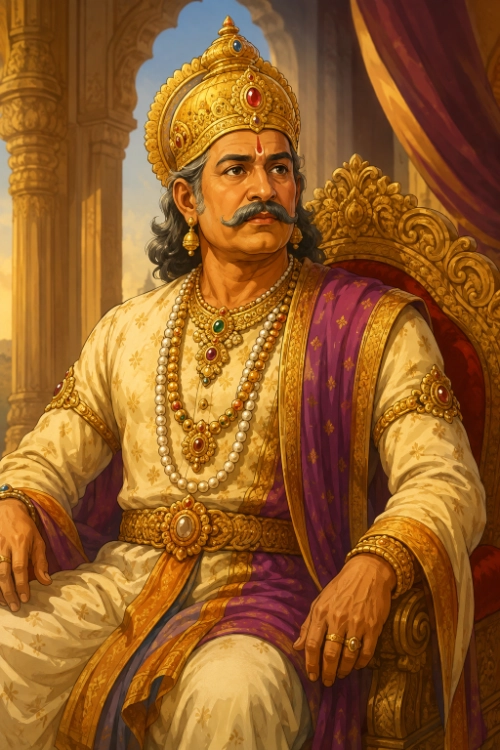
King Daśaratha Mahārāja, ruler of Ayodhyā and descendant of the ancient Ikṣvāku dynasty, had four celebrated sons through his three principal queens.
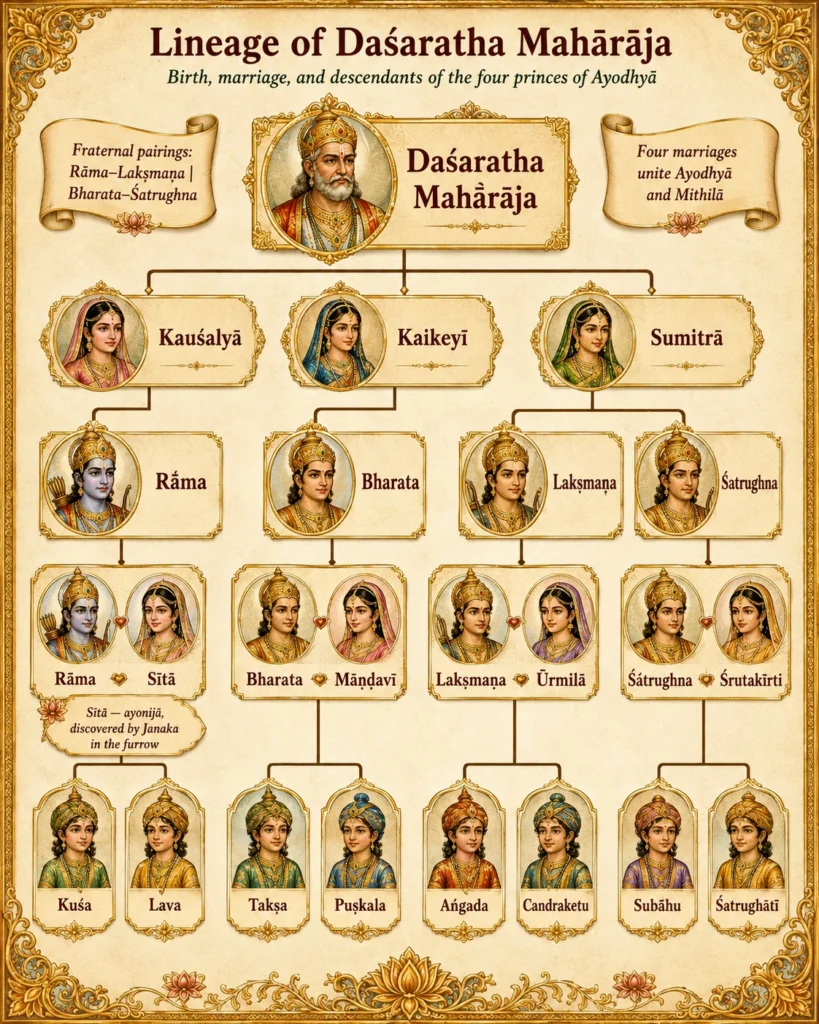
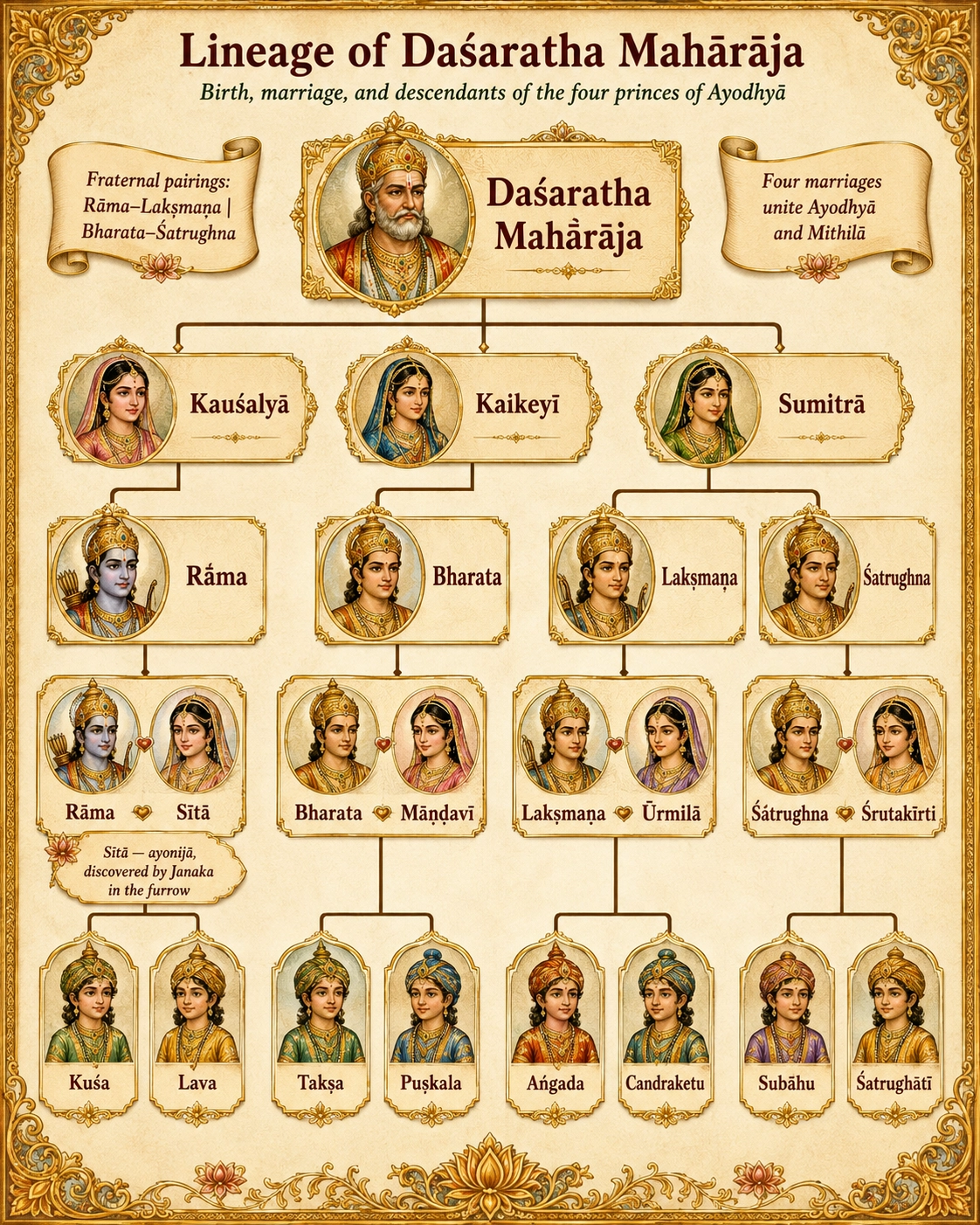
Three queens, four princes, four marriages and eight grandsons on one sheet.
The Vālmīki Rāmāyaṇa, however, presents these births as considerably more than ordinary dynastic succession. They follow Daśaratha’s great sacrifice for obtaining sons and are embedded within the larger divine purpose that leads ultimately to the destruction of Rāvaṇa.
The four brothers subsequently marry four closely related princesses of Mithilā:
Thus the story presents not merely four marriages, but a carefully structured union between the Ikṣvāku house of Ayodhyā and the Videha house of Mithilā.
Daśaratha’s Sacrifice and the Birth of the Four Princes
Daśaratha had long remained without a male heir. The Bālakāṇḍa therefore describes elaborate sacrificial rites under the guidance of the sage Ṛśyaśṛṅga, culminating in the rite intended to obtain sons.
Ṛśyaśṛṅga assures the king:
भविष्यन्ति सुता राजंश्चत्वारस्ते कुलोद्वहाः ।
bhaviṣyanti sutā rājaṁś catvāras te kulodvahāḥ
“O King, four sons will be born to you, bearers of your dynasty.”
Vālmīki Rāmāyaṇa, Bālakāṇḍa 1.13.46
The births therefore fulfil both Daśaratha’s personal desire for heirs and the larger destiny of the Ikṣvāku dynasty.
1. Rāma — Son of Kauśalyā
After the completion of the sacrifice and the passing of six seasons, Rāma is born to Queen Kauśalyā on the ninth lunar day of the bright half of Caitra.
The epic declares:
प्रोद्यमाने जगन्नाथं सर्वलोकनमस्कृतम् ।
कौसल्याजनयद्रामं सर्वलक्षणसंयुतम् ॥
prodyamāne jagannāthaṁ sarvalokanamaskṛtam
kausalyājanayad rāmaṁ sarvalakṣaṇasaṁyutam
“Kauśalyā gave birth to Rāma, the Lord of the world, honoured by all the worlds and endowed with every auspicious characteristic.”
Bālakāṇḍa 1.18.10
The following verse explicitly connects him with Viṣṇu and identifies him as the delight of the Ikṣvāku dynasty.
Thus Rāma is simultaneously:
- Daśaratha’s eldest son and heir,
- a prince of the Ikṣvāku line,
- and, on the theological level of the narrative, the manifestation of the divine purpose centered upon Viṣṇu.
2. Bharata — Son of Kaikeyī
Bharata is born to Queen Kaikeyī:
भरतो नाम कैकेय्यां जज्ञे सत्यपराक्रमः ।
साक्षाद्विष्णोश्चतुर्थभागः सर्वैः समुदितो गुणैः ॥
bharato nāma kaikeyyāṁ jajñe satyaparākramaḥ
sākṣād viṣṇoś caturthabhāgaḥ sarvaiḥ samudito guṇaiḥ
“To Kaikeyī was born Bharata, whose power was founded in truth, endowed with every virtue and described as a portion of Viṣṇu.”
Bālakāṇḍa 1.18.13
The fractional language concerning Viṣṇu in this section has produced different theological interpretations, and it need not be understood as a literal mathematical division of the divine being. What is unmistakable is that Vālmīki places all four brothers within the sacred framework surrounding Rāma’s appearance.
Bharata later becomes one of the epic’s supreme examples of fraternal loyalty and renunciation of power. Although the kingdom could have become his, he refuses to usurp Rāma’s rightful position and governs only as Rāma’s representative during the exile.
3–4. Lakṣmaṇa and Śatrughna — Sons of Sumitrā
Queen Sumitrā gives birth to two sons:
अथ लक्ष्मणशत्रुघ्नौ सुमित्राजनयत्सुतौ ।
वीरौ सर्वास्त्रकुशलौ विष्णोरर्धसमन्वितौ ॥
atha lakṣmaṇaśatrughnau sumitrājanayat sutau
vīrau sarvāstrakuśalau viṣṇor ardhasamanvitau
“Then Sumitrā gave birth to the two sons Lakṣmaṇa and Śatrughna, heroic and skilled in every weapon, and connected with the divine manifestation of Viṣṇu.”
Bālakāṇḍa 1.18.14
The text therefore gives Sumitrā a unique position among Daśaratha’s queens: she is the mother of two of the four princes.
More importantly, Vālmīki immediately organizes the brothers into two particularly intimate pairs.
The Two Great Fraternal Pairs
The four brothers love one another, but the Rāmāyaṇa emphasizes two especially powerful relationships: Rāma ↔ Lakṣmaṇa, and Bharata ↔ Śatrughna. This structure is already established in their childhood.
Of Lakṣmaṇa, the text says:
लक्ष्मणो लक्ष्मिसम्पन्नो बहिः प्राण इवापरः ।
lakṣmaṇo lakṣmisaṁpanno bahiḥ prāṇa ivāparaḥ
“Lakṣmaṇa was like another life-breath of Rāma existing outside his body.”
Bālakāṇḍa 1.18.29
This is an extraordinarily strong description. Lakṣmaṇa is not merely Rāma’s younger brother or military companion; Vālmīki portrays him almost as Rāma’s external life itself.
The text even says that Rāma would neither sleep comfortably nor eat fine food without Lakṣmaṇa.
Their relationship later defines the exile: Lakṣmaṇa voluntarily abandons royal comfort and follows Rāma into the forest for fourteen years.
Bharata and Śatrughna
Vālmīki gives a parallel description of the younger pair:
भरतस्यापि शत्रुघ्नो लक्ष्मणावरजो हि सः ।
प्राणैः प्रियतरः नित्यं तस्य चासीत् तथा प्रियः ॥
bharatasyāpi śatrughno lakṣmaṇāvarajo hi saḥ
prāṇaiḥ priyataraḥ nityaṁ tasya cāsīt tathā priyaḥ
“Śatrughna was always dearer than life to Bharata, and Bharata was equally dear to him.”
Bālakāṇḍa 1.18.32
The architecture of the four brothers is therefore deliberate: Rāma is accompanied especially by Lakṣmaṇa; Bharata is accompanied especially by Śatrughna. This pattern persists through much of the epic.
The Four Brides of Mithilā
The marriages occur after Rāma breaks the great bow preserved in the court of King Janaka.
The four marriages are not independent arrangements made at different times. They become a single dynastic alliance linking Daśaratha’s four sons with four closely related princesses of the Videha royal house.
The relationships are:
The symmetry is striking: the four sons of Daśaratha become joined to four women belonging to the same extended Mithilā dynasty.
Sītā — The Ayonijā Daughter of Janaka
Sītā requires an important qualification.
She is Janaka’s daughter in every meaningful dynastic and paternal sense, but the Rāmāyaṇa explicitly states that she was not biologically born from a woman’s womb.
Janaka explains that while he was ploughing the sacrificial ground, she appeared from the earth:
अथ मे कृषतः क्षेत्रं लाङ्गलादुत्थिता मम ।
क्षेत्रं शोधयता लब्ध्वा नाम्ना सीतेति विश्रुता ॥
atha me kṛṣataḥ kṣetraṁ lāṅgalād utthitā mama
kṣetraṁ śodhayatā labdhvā nāmnā sīeti viśrutā
“While I was ploughing the sacrificial field, she arose from the furrow made by the plough. Having found her while preparing the field, she became renowned by the name Sītā.”
Bālakāṇḍa 1.66.13–14
Her name is therefore deeply meaningful: sītā means a furrow made by a plough.
Janaka continues:
भूतलादुत्थिता सा तु व्यवर्धत ममात्मजा ।
वीर्यशुल्केति मे कन्या स्थापितेयमयोनिजा ॥
bhūtalād utthitā sā tu vyavardhata mamātmajā
vīryaśulketi me kanyā sthāpiteyam ayonijā
“Having arisen from the earth, she grew up as my daughter. This daughter of mine, not born from a womb, was established as one whose bride-price would be heroic strength.”
Bālakāṇḍa 1.66.14–15
The crucial word is ayonijā: a- = not, yoni = womb, jā = born — hence “not womb-born.”
Janaka therefore resolves that Sītā will be given only to a man capable of demonstrating extraordinary vīrya, heroic strength. Rāma fulfils this condition by lifting and breaking the great bow.
Rāma and Sītā — Sahadharmacārī
At the wedding, Janaka addresses Rāma with one of the most famous marriage verses in Sanskrit literature:
इयं सीता मम सुता सहधर्मचरी तव ।
प्रतीच्छ चैनां भद्रं ते पाणिं गृह्णीष्व पाणिना ॥
iyaṁ sītā mama sutā sahadharmacarī tava
pratīccha caināṁ bhadraṁ te pāṇiṁ gṛhṇīṣva pāṇinā
“This is Sītā, my daughter, your companion in dharma. Accept her; may good attend you. Take her hand in your hand.”
Bālakāṇḍa 1.72.17
The expression sahadharmacārī is especially important. It means approximately “one who walks together with you in dharma.”
Sītā is therefore introduced not simply as Rāma’s wife or consort but as his partner in the life of dharma.
That description anticipates the entire epic. When Rāma is banished, Sītā insists that her place is with him in the forest. Marriage is represented as shared participation in destiny, obligation, hardship, and sacred duty.
Lakṣmaṇa and Ūrmilā
Janaka next gives Ūrmilā to Lakṣmaṇa:
लक्ष्मणागच्छ भद्रं ते ऊर्मिलामुद्यतां मया ।
प्रतीच्छ पाणिं गृह्णीष्व मा भूत्कालस्य पर्ययः ॥
lakṣmaṇāgaccha bhadraṁ te Ūrmilām udyatāṁ mayā
pratīccha pāṇiṁ gṛhṇīṣva mā bhūt kālasya paryayaḥ
“Come, Lakṣmaṇa; may good be yours. Receive Ūrmilā whom I offer, and take her hand without delay.”
Bālakāṇḍa 1.72.18
Ūrmilā subsequently occupies a quieter place in the narrative than Sītā. Her marriage, however, makes the structure especially elegant: the two brothers Rāma and Lakṣmaṇa marry the two women of Janaka’s immediate household, Sītā and Ūrmilā.
Bharata and Māṇḍavī
Janaka then addresses Bharata:
गृहाण पाणिं माण्डव्याः पाणिना रघुनन्दन ।
gṛhāṇa pāṇiṁ māṇḍavyāḥ pāṇinā raghunandana
“O descendant of Raghu, take the hand of Māṇḍavī in your own hand.”
Bālakāṇḍa 1.72.19
Māṇḍavī is the daughter of Kuśadhvaja, Janaka’s younger brother. She is therefore closely related to Sītā and Ūrmilā within the royal house of Mithilā.
Śatrughna and Śrutakīrti
Finally Janaka addresses Śatrughna:
श्रुतकीर्त्या महाबाहो पाणिं गृह्णीष्व पाणिना ।
śrutakīrtyā mahābāho pāṇiṁ gṛhṇīṣva pāṇinā
“O mighty-armed one, take Śrutakīrti’s hand in your hand.”
Bālakāṇḍa 1.72.20
Śrutakīrti is likewise a daughter of Kuśadhvaja. Thus the four marriages form one integrated familial arrangement rather than four unrelated unions.
Vālmīki summarizes:
चत्वारस्ते चतसृणां वसिष्ठस्य मते स्थिताः ।
catvāras te catasṛṇāṁ vasiṣṭhasya mate sthitāḥ
“Those four stood joined with the four women according to the direction of Vasiṣṭha.”
Bālakāṇḍa 1.72.22
The princes then circumambulate the sacred fire and complete the marriage rites.
Two Royal Houses Become One Family
The four marriages create an important dynastic bridge:
Ayodhyā                 Mithilā
House of Ikṣvāku / Raghu   ↔   House of Videha / Janaka
This is significant because both dynasties symbolize ancient models of royal dharma. Daśaratha’s house produces Rāma, the paradigmatic righteous king. Janaka’s house is associated with wisdom, detachment, sacrifice, and dharmic kingship.
The marriage of Rāma and Sītā therefore joins two of the epic tradition’s most prestigious royal lineages. The simultaneous marriages of all four brothers expand this connection from one royal couple into an alliance between entire families.
The Next Generation
The Uttarakāṇḍa extends the genealogy into another generation.
A source-critical qualification is useful here: the later succession passages explicitly identify the princes as sons of the respective brothers, but they do not always repeat the mothers’ names. The maternal associations shown above follow the marriages established earlier in the Bālakāṇḍa.
Rāma’s Sons — Kuśa and Lava
Rāma and Sītā’s sons are the famous Kuśa and Lava.
Their importance exceeds ordinary genealogy because Vālmīki teaches them the Rāmāyaṇa itself. They become the first singers and transmitters of the story of Rāma.
The poem introduces them as:
कुशीलवौ तु धर्मज्ञौ राजपुत्रौ यशस्विनौ ।
kuśīlavau tu dharmajñau rājaputrau yaśasvinau
“Kuśa and Lava were righteous, renowned royal princes.”
Bālakāṇḍa 1.4.5
The genealogy therefore becomes self-referential: Rāma’s own sons become transmitters of Rāma’s story.
Near the conclusion of the Uttarakāṇḍa, Rāma establishes Kuśa in Kosala and Lava in Northern Kosala.
Bharata’s Sons — Takṣa and Puṣkala
The Uttarakāṇḍa explicitly identifies Bharata’s sons:
भरतस्यात्मजौ वीरौ तक्षः पुष्कल एव च ।
bharatasyātmajau vīrau takṣaḥ puṣkala eva ca
“The heroic sons of Bharata were Takṣa and Puṣkala.”
Uttarakāṇḍa 7.90.16
They subsequently become rulers of newly established political centers following Bharata’s campaigns.
Their names became associated in later tradition with Takṣaśilā and Puṣkalāvatī, though such historical-geographical identifications should be distinguished from what the epic itself explicitly establishes.
Lakṣmaṇa’s Sons — Aṅgada and Candraketu
Rāma addresses Lakṣmaṇa concerning his two sons:
इमौ कुमारौ सौमित्रे तव धर्मविशारदौ ।
अङ्गदश्चन्द्रकेतुश्च राज्यार्हौ दृढधन्विनौ ॥
imau kumārau saumitre tava dharmaviśāradau
aṅgadaś candraketuś ca rājyārhau dṛḍhadhanvinau
“These two princes of yours, O son of Sumitrā—Aṅgada and Candraketu—are learned in dharma, mighty bowmen, and worthy of kingship.”
Uttarakāṇḍa 7.92.2
The passage therefore securely establishes Aṅgada and Candraketu as Lakṣmaṇa’s sons.
This Aṅgada should not be confused with Aṅgada the Vānara prince, son of Vāli, who is a completely different person.
Śatrughna’s Sons — Subāhu and Śatrughātī
The Uttarakāṇḍa also describes Śatrughna installing his two sons as rulers:
ततः पुत्रद्वयं वीरः सोऽभ्यषिञ्चन्नराधिपः ।
सुबाहुर्मधुरां लेभे शत्रुघाती च वैदिशम् ॥
tataḥ putradvayaṁ vīraḥ so ’bhyaṣiñcan narādhipaḥ
subāhur madhurāṁ lebhe śatrughātī ca vaidiśam
“Then the heroic king consecrated his two sons: Subāhu received Madhurā, while Śatrughātī received Vaidisha.”
Uttarakāṇḍa 7.98.9
The second name appears as Śatrughātī in the nominative form; it may also be represented lexically as Śatrughātin.
The Complete Family Structure
The genealogy can therefore be summarized:
Daśaratha + Kauśalyā
└── Rāma + Sītā
    └── Kuśa and Lava

Daśaratha + Kaikeyī
└── Bharata + Māṇḍavī
    └── Takṣa and Puṣkala

Daśaratha + Sumitrā
├── Lakṣmaṇa + Ūrmilā
│   └── Aṅgada and Candraketu
└── Śatrughna + Śrutakīrti
    └── Subāhu and Śatrughātī
The Deeper Structure of the Four Brothers
The genealogy becomes much more meaningful when read structurally. The four sons are not simply interchangeable royal princes.
The brothers therefore embody complementary expressions of loyalty and service. Their natural pairings are:
Yet all four remain united as sons of Daśaratha and members of one dharmic royal house.
The Central Idea
The family of Daśaratha is one of the great organizing structures of the Rāmāyaṇa. It begins with a king desperately seeking heirs.
The birth of four sons fulfils that dynastic need, but their lives transform the event into something much larger.
The four princes become linked to four women of the Videha royal house. Two powerful dynasties are joined. The brothers form distinctive bonds of devotion to one another. Their marriages continue the dynasty through another generation. And through Kuśa and Lava, the descendants of Rāma themselves become custodians of the story in which their family history is preserved.
The structure may therefore be understood on several levels at once:
For this reason, “the sons of Daśaratha” are not merely four names in a family tree.
They constitute one of the principal architectures of the entire epic.
Note on textual numbering. Sarga and verse numbers differ slightly among the Northern and Southern recensions, the Baroda Critical Edition, Gītā Press editions, and modern electronic texts. For example, the famous wedding passage beginning iyaṁ sītā mama sutā is numbered Bālakāṇḍa 72.17 in several widely used Sanskrit editions, while some translations and traditional arrangements number the surrounding material differently. The Sanskrit wording itself is stable enough for the genealogical points discussed above.