

The Vānara and Ṛkṣa Heroes of Rāma
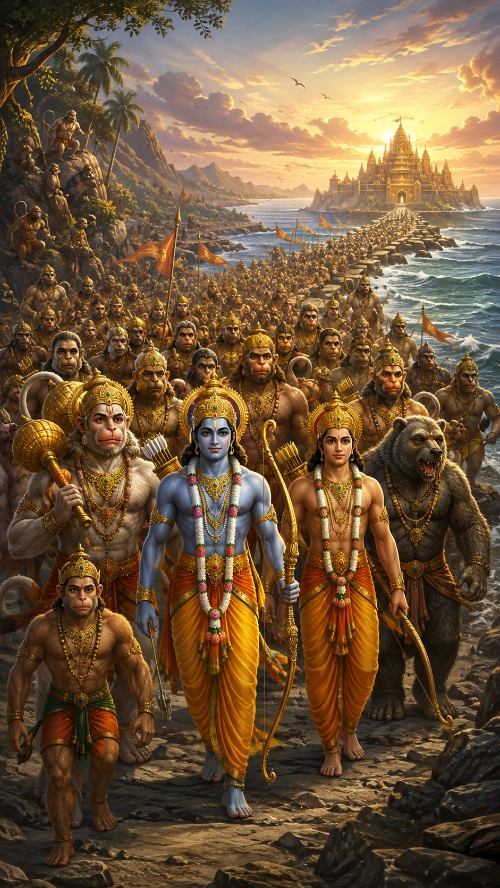
The Great Allies of the Rāmāyaṇa
The army that assists Rāma in the search for Sītā and the war against Rāvaṇa is commonly called the “monkey army.” This is convenient, but it oversimplifies the world described by the Vālmīki Rāmāyaṇa.
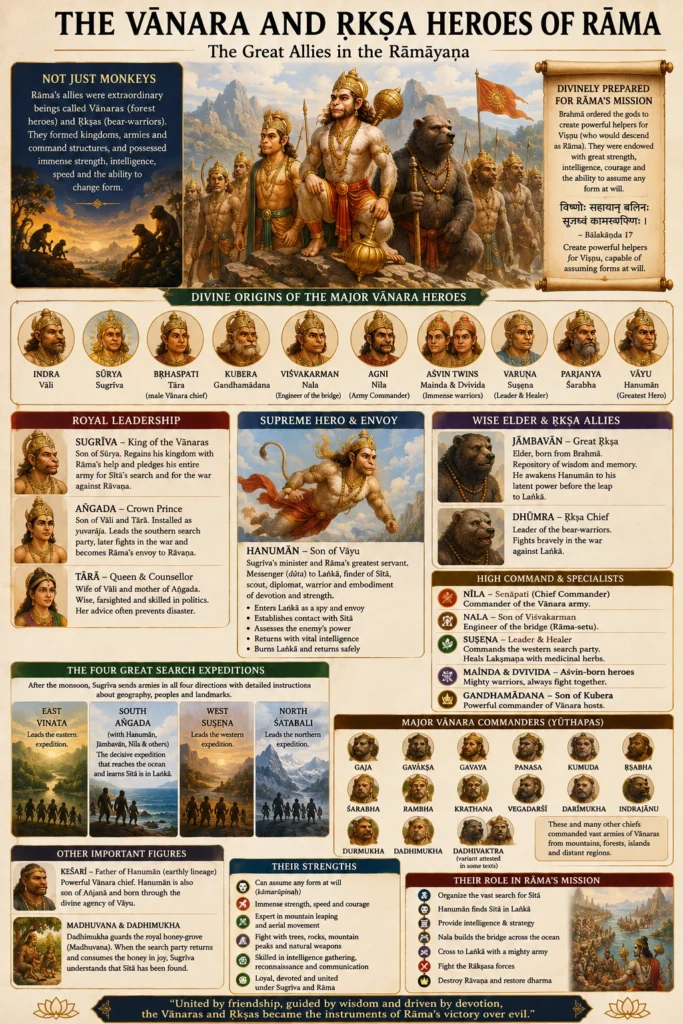
Divine fathers, royal leadership, high command, the four expeditions and the yūthapas on one sheet.
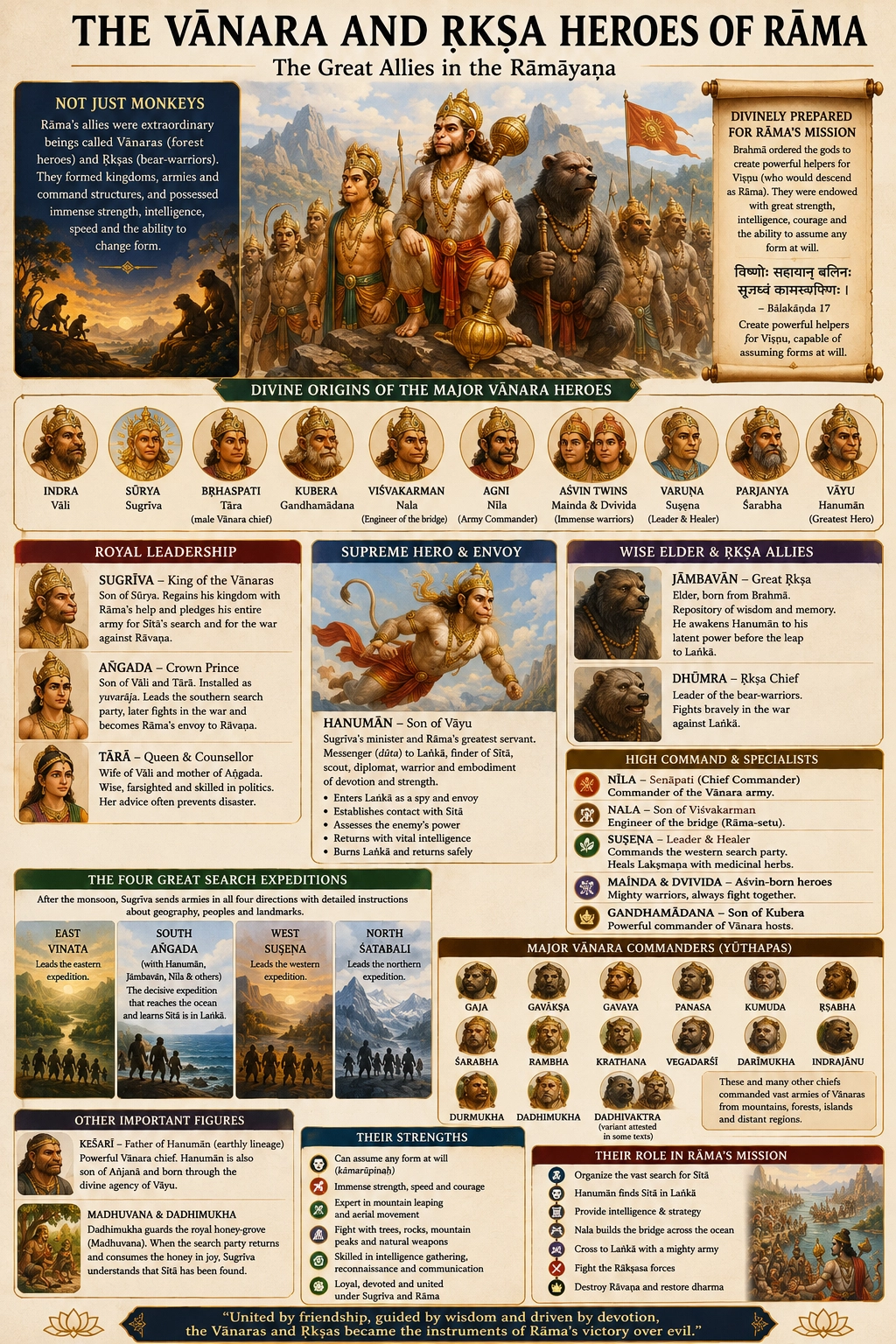
The Sanskrit epic speaks primarily of Vānaras and kapis, extraordinary forest beings who possess organized kingdoms, armies, intelligence, language, political institutions, and—in many cases—superhuman strength and the ability to change form. They are joined by Ṛkṣas, the great bear-warriors, whose most famous representative is Jāmbavān.
Thus a more accurate heading is: The Vānara and Ṛkṣa Allies of Rāma.
Their most important representatives include Sugrīva, Hanumān, Aṅgada, Jāmbavān, Nala, Nīla, Mainda, Dvivida, Suṣeṇa, Gandhamādana, Tāra, Keśarī, Vinata, Panasa, Gaja, Gavākṣa, Gavaya, Śarabha, Kumuda, Ṛṣabha, Rambha, Krathana, Śatabali, Vegadarśī, Dhūmra, Dadhimukha, and numerous other Vānara and Ṛkṣa chiefs.
These figures are not merely anonymous soldiers. The Rāmāyaṇa depicts them as kings, princes, generals, engineers, physicians, scouts, diplomats, intelligence gatherers, troop-commanders, and heroic champions.
The Divine Origin of Rāma’s Vānara Allies
One of the most important passages concerning the Vānaras occurs very early in the Bālakāṇḍa. When Viṣṇu is to descend as Rāma, Brahmā commands the gods to create powerful allies capable of assisting him. The purpose of their birth is therefore directly connected with the destruction of Rāvaṇa.
The text describes the beings to be produced as:
विष्णोः सहायान् बलिनः सृजध्वं कामरूपिणः ॥
viṣṇoḥ sahāyān balinaḥ sṛjadhvaṁ kāmarūpiṇaḥ
“Create powerful helpers for Viṣṇu, capable of assuming forms at will.”
Vālmīki Rāmāyaṇa, Bālakāṇḍa 17
The description continues by emphasizing extraordinary qualities such as courage, intelligence, speed, knowledge of warfare, and immense strength.
The key expression कामरूपिणः — kāmarūpiṇaḥ means “capable of assuming whatever form they desire.” Thus the Vānaras of the epic should not simply be imagined as ordinary zoological monkeys. They inhabit a category of their own.
Celestial Fathers of the Great Vānara Heroes
The traditional Bālakāṇḍa account assigns divine origins to many of the most important Vānara commanders. The scheme is approximately:
Jāmbavān belongs to a somewhat different category. The traditional account connects his origin directly with Brahmā, famously associating his appearance with Brahmā’s yawn.
The point of this genealogy is theological rather than merely biological. Rāma’s army has been prepared in advance by the celestial world.
The gods cannot themselves simply destroy Rāvaṇa because of the particular conditions of his boon. Instead, divine power enters the world through beings whose outward form does not belong to the categories against which Rāvaṇa sought protection.
Sugrīva — King and Political Ally of Rāma
Sugrīva is the central political leader of the Vānara alliance. He is the younger brother of Vāli and eventually becomes king of Kiṣkindhā.
His alliance with Rāma is based upon mutual obligation:
- Rāma helps Sugrīva regain his kingdom from Vāli.
- Sugrīva pledges the resources of the Vānara world to the search for Sītā.
Sugrīva’s importance should therefore not be reduced to “monkey king.” He functions as sovereign, military organizer, intelligence coordinator, commander of a vast confederation of Vānara chiefs, and Rāma’s principal political ally.
Once his kingship is restored, he summons Vānaras from mountains, forests, islands, and distant regions. The search for Sītā becomes a large-scale coordinated intelligence operation.
Aṅgada — Crown Prince of the Vānaras
Aṅgada is the son of Vāli and Tārā. After Vāli’s death, Sugrīva becomes king, but Aṅgada is installed as युवराज — yuvarāja, “crown prince” or “heir-apparent.”
This is important because Aṅgada represents continuity between the royal house of Vāli and the restored kingship of Sugrīva. He becomes one of the most important young leaders in the army.
Aṅgada:
- leads the southern search party;
- accompanies Hanumān and Jāmbavān;
- participates in the discovery of information leading toward Laṅkā;
- fights in the war;
- and later enters Rāvaṇa’s court as Rāma’s envoy.
His embassy to Rāvaṇa demonstrates that Vānara leadership includes diplomacy as well as warfare.
Hanumān — The Supreme Individual Hero of the Vānara Army
Among all the Vānaras, Hanumān becomes the greatest individual servant of Rāma. The epic repeatedly associates him with Vāyu, the wind-god. Hence his celebrated epithets मारुतात्मज — mārutātmaja, “son of Māruta,” and वायुपुत्र — vāyuputra, “son of Vāyu.”
Hanumān combines abilities that elsewhere appear distributed among many different characters:
- exceptional intelligence;
- knowledge of language;
- diplomacy;
- physical strength;
- shape-changing;
- reconnaissance;
- strategic judgment;
- courage;
- restraint;
- devotion;
- and enormous speed.
He is not merely Rāma’s strongest warrior. He is also one of the epic’s greatest intelligence agents and diplomats.
Hanumān as Messenger
Hanumān’s crucial title is दूत — dūta, “messenger” or “envoy.” He enters Laṅkā not simply to attack it but to:
- locate Sītā;
- determine whether she is alive;
- establish contact without frightening her;
- convince her that he genuinely represents Rāma;
- assess Laṅkā’s defenses;
- return with reliable intelligence.
The Sundarakāṇḍa is therefore as much a story of reconnaissance, judgment, communication, and intelligence gathering as one of supernatural strength.
Jāmbavān — The Great Ṛkṣa Elder
Jāmbavān must be distinguished from the Vānaras. He is the great Ṛkṣa, or bear-chief. He represents age, experience, memory, strategic judgment, and wise counsel.
His greatest contribution occurs when the southern search party reaches the ocean and realizes that someone must leap across it to Laṅkā. Hanumān possesses the necessary power, but he has not yet fully awakened to it. Jāmbavān reminds him of who he is.
Thus one of the most decisive moments in the entire Rāmāyaṇa does not involve Jāmbavān defeating an enemy himself. His role is to awaken another hero to his own capacity. This makes Jāmbavān the archetypal elder counsellor of the Vānara alliance.
Nīla — Commander of the Vānara Army
Nīla holds an especially important military position. The Yuddhakāṇḍa identifies him as सेनापति — senāpati, “commander of the army.”
Thus Nīla is not merely one famous Vānara among many. He belongs to the highest level of Sugrīva’s military hierarchy. The traditional divine genealogy makes him a son of Agni, the fire-god.
Nīla participates prominently in troop deployment, the march toward Laṅkā, battle formations, and direct combat with the Rākṣasas.
Nala — Engineer of the Bridge to Laṅkā
Nala has one of the most specialized roles in the entire army. He is described as a son of Viśvakarman, divine architect and craftsman.
When Rāma’s army reaches the ocean, the problem is not primarily military. It is engineering. An enormous army must cross from the mainland to Laṅkā.
Nala announces his inherited technical ability and takes charge of constructing the bridge. The famous Rāma-setu therefore represents not merely miraculous assistance but organized labor under the direction of a specialist engineer.
Thousands of Vānaras gather trees, boulders, rocks, timber, and other materials. Nala directs their placement.
Thus the Vānara alliance includes not merely warriors but technical expertise and engineering organization.
Mainda and Dvivida — The Aśvin-Born Pair
Mainda and Dvivida repeatedly appear together. The traditional Bālakāṇḍa makes them sons of the divine Aśvin twins. They are therefore themselves a paired set of heroes.
Both possess extraordinary strength and participate prominently in the war in Laṅkā. Their repeated pairing suggests that they function almost as a combat brotherhood, analogous in structural terms to other paired heroes in Sanskrit epic literature.
Gandhamādana — Son of Kubera
Gandhamādana is another major Vānara commander. The traditional divine genealogy connects him with Kubera, also called Dhanada, lord of wealth and ruler of the Yakṣas.
Gandhamādana commands powerful Vānara forces and participates in the advance and battle against Laṅkā.
He should not be confused with Mount Gandhamādana, which bears the same name in Sanskrit cosmography and epic geography.
Suṣeṇa — Commander, Elder, and Healer
Suṣeṇa deserves far more attention than he usually receives. He is one of the senior Vānara leaders and is connected by marriage with Sugrīva’s royal family. The Rāmāyaṇa calls him Sugrīva’s श्वशुर — śvaśura, father-in-law.
Suṣeṇa also commands the western search expedition for Sītā.
During the war he performs another highly specialized role. When Lakṣmaṇa and other warriors are gravely wounded, Suṣeṇa acts as a medical authority, identifying the need for powerful medicinal herbs and directing Hanumān toward the mountain where they can be obtained. He subsequently administers the medicine.
Suṣeṇa therefore occupies several roles: senior Vānara chief, member of the royal family, search-party commander, battlefield adviser, and healer.
Tāra — A Male Vānara Chief
The name Tāra requires careful distinction from Tārā.
These are not the same person. Because English transliteration often drops long vowels, modern lists frequently merge Tāra and Tārā into a single figure. A source-critical article should keep them separate.
Tārā — Queen, Diplomat, and Political Intelligence
Although she is not part of the male commander list, Tārā deserves mention because she is one of the most intelligent political figures in the Kiṣkindhā narrative.
She repeatedly demonstrates strategic foresight, diplomatic skill, emotional intelligence, political judgment, and knowledge of consequences.
She warns Vāli against rashly confronting Sugrīva after Rāma has become his ally. Her warning proves correct.
Thus the political world of the Vānaras is not exclusively male. Tārā is one of its most perceptive statesmen.
Keśarī — Father of Hanumān in the Earthly Lineage
Keśarī is associated with Hanumān’s terrestrial family. Hanumān’s mother is Añjanā, while Vāyu provides the divine agency connected with his birth.
Keśarī is therefore remembered as Hanumān’s paternal figure or earthly father, while Hanumān simultaneously bears the divine identity Mārutātmaja, son of Māruta.
This kind of dual genealogy—earthly parentage combined with divine generation—is common in epic heroic traditions. Keśarī himself is also portrayed as a powerful Vānara chief.
The Four Great Search Expeditions
Sugrīva’s organization of the search for Sītā demonstrates the sophistication of Vānara leadership. Instead of sending the entire army in one direction, he divides the search across the geographical world. Four major expeditions are organized.
East — Vinata
Vinata commands the eastern search. Sugrīva gives detailed geographical instructions concerning rivers, kingdoms, mountains, islands, distant peoples, and the eastern limits of the world.
Vinata is therefore more than a warrior. He is a regional expedition commander.
South — Aṅgada and the Great Southern Party
The southern expedition becomes the decisive one. Its leading members include Aṅgada, Hanumān, Jāmbavān, Nīla and other great Vānara heroes.
It is this group that eventually learns from Sampāti that Sītā is in Laṅkā. The southern search then culminates in Hanumān’s leap across the ocean.
West — Suṣeṇa
The western expedition is commanded by Suṣeṇa. Again, Sugrīva provides elaborate geographical information.
The four-direction search therefore reveals that Sugrīva’s kingdom possesses not only manpower but extensive geographical intelligence.
North — Śatabali
The northern search is entrusted to Śatabali, another major Vānara chief. He commands a large force through the northern regions. Śatabali later participates in the military campaign as well. He should therefore be added to any extended list of Rāma’s Vānara allies.
Gaja, Gavākṣa, and Gavaya
Three important commanders frequently appear in proximity:
These three should be included in a comprehensive list.
Gaja or Gaya?
Your original list contained Gaya. For a list based primarily upon the Vālmīki Rāmāyaṇa, the safer reading is Gaja. The name Gaja repeatedly occurs among the major Vānara commanders. Forms such as Gaya occur in other retellings and parallel epic traditions, including material related to the Rāma story outside Vālmīki.
Gavākṣa
Gavākṣa is particularly well attested. He appears in the political world surrounding Sugrīva, in search operations, among the great commanders, and in the war against Laṅkā.
His name literally has the familiar Sanskrit sense of “window” or “bull’s eye” in other contexts, but here it functions as a proper name.
Kumuda
Kumuda is another important Vānara yūthapa. The term यूथप — yūthapa means approximately “leader of a troop,” “chief of a band,” or “commander of a host.”
Kumuda commands his own Vānara forces and later participates prominently in the war.
Ṛṣabha
Ṛṣabha should also be added. He is a senior Vānara commander entrusted with an important position during the army’s advance toward Laṅkā.
The word ṛṣabha literally means “bull” and metaphorically can signify strength or excellence. Within the narrative it is his personal name.
Panasa
Panasa is another important yūthapa. He appears among the major Vānara troop-commanders and participates in the campaign against Laṅkā. He should remain in the list.
Rambha
Rambha is correctly included, but a clarification is necessary. This Rambha is a male Vānara commander.
He should not be confused with Rambhā, the famous female Apsaras. The difference is easily obscured when diacritics are omitted.
Śarabha
Śarabha is one of the Vānaras given divine ancestry in the traditional Bālakāṇḍa, where he is associated with Parjanya, the rain deity. He later appears among the great Vānara fighters.
Krathana, Rather Than Kratha
Your original list has Kratha. For a Vālmīki-based presentation the fuller form Krathana is preferable. The Yuddhakāṇḍa describes:
क्रथनो नाम यूथपः
krathano nāma yūthapaḥ
“a troop-chief named Krathana.”
Vālmīki Rāmāyaṇa, Yuddhakāṇḍa
Thus Krathana should replace Kratha unless a particular recension or source explicitly gives the shorter form.
Vegadarśī
Vegadarśī is another senior Vānara who deserves inclusion in an extended catalogue. He repeatedly appears with major figures such as Jāmbavān and Suṣeṇa and participates in the fighting at Laṅkā.
His name combines ideas of vega, speed, force, momentum, and darśin or darśī, seeing, perceiving — especially suitable for a martial hero.
Dadhimukha
Dadhimukha is one of the more memorable secondary Vānara figures. He is closely related to Sugrīva and serves as guardian of the royal honey-grove, Madhuvana.
When the southern search party returns after Hanumān has successfully found Sītā, the ecstatic Vānaras enter Madhuvana and consume its honey. Dadhimukha attempts to stop them.
When he reports the destruction to Sugrīva, Sugrīva immediately realizes something important: the search party would never dare behave so exuberantly unless Sītā had been found.
Thus even this apparently comic episode functions as an indirect intelligence signal.
Dadhivaktra and Dadhimukha
Your original list contained Dadhivaktra. This name does occur in traditional textual material connected with the Vānara chiefs, but it should not automatically be equated with Dadhimukha. The safest presentation is:
The two names may reflect related traditions, but they should not simply be collapsed without textual evidence.
Dhūmra — Another Ṛkṣa Chief
Like Jāmbavān, Dhūmra complicates the heading “monkeys of Rāma.” Dhūmra is associated with the Ṛkṣas, the bear-warriors.
Thus at least two important figures in the commonly reproduced “Vānara list” are technically not Vānaras: Jāmbavān and Dhūmra. This is another reason to prefer Vānara and Ṛkṣa Allies of Rāma.
Other Important Vānara Chiefs
A truly extended catalogue should also include figures such as Darīmukha, Indrajānu, Durmukha, Śarabha, Kumuda, Ṛṣabha, Gavaya, Śatabali, Vegadarśī and Dadhimukha.
The Rāmāyaṇa contains many more named yūthapas than a short popular list normally preserves. It is therefore misleading to speak of one definitive list containing only twenty or thirty Vānaras. Sugrīva commands an enormous confederation of chiefs.
Understanding the Vānara Military Hierarchy
Several Sanskrit titles help clarify the organization of the army.
This vocabulary reveals a genuine military-political hierarchy, not an undifferentiated swarm of animals.
Their Weapons
The Vānara army is unusual because its heroes are frequently described as fighting without conventional manufactured weapons. Instead they seize trees, rocks, mountain peaks, boulders, trunks, branches, and even sections of the landscape. This emphasizes their immense physical power.
The Rākṣasas often fight with bows, arrows, swords, maces, spears, and celestial missiles. The Vānaras answer with natural force.
This creates one of the visual contrasts characteristic of the Yuddhakāṇḍa: manufactured weapons of Laṅkā versus the elemental strength of the forest army.
The Vānaras as Intelligence Network
The search for Sītā reveals another major aspect of their role. Sugrīva’s forces possess knowledge of distant geography, rapid communication, scouting ability, regional commanders, reconnaissance, long-distance mobility, and mechanisms for reporting information back to the king.
Hanumān is the supreme example. His mission combines reconnaissance, infiltration, communication, psychological judgment, enemy assessment, and return reporting.
The Vānara army should therefore be understood not only as Rāma’s military force but also as his intelligence and reconnaissance network.
The Vānaras as a Confederation
The Rāmāyaṇa repeatedly describes Vānara chiefs arriving with their own enormous forces. This suggests that Sugrīva’s army is best conceived as a confederation of regional Vānara hosts.
Each great yūthapa commands his own followers. Sugrīva unites them beneath his kingship and directs them toward one common objective: the recovery of Sītā and the defeat of Rāvaṇa.
Thus the army is simultaneously political, military, regional, hierarchical, and divinely prepared.
Corrected Core List
For a concise but source-conscious list, I would use:
Royal Leadership
- Sugrīva — king of the Vānaras; son of Sūrya
- Aṅgada — crown prince; son of Vāli and Tārā
- Tārā — queen and major political counsellor
Supreme Hero and Envoy
- Hanumān — son of Vāyu; Sugrīva’s minister; Rāma’s messenger and greatest Vānara hero
Senior Ṛkṣa Allies
- Jāmbavān — great bear-chief and elder
- Dhūmra — Ṛkṣa leader
High Command and Specialists
- Nīla — senāpati, commander of the Vānara army
- Nala — son of Viśvakarman; engineer of Rāma-setu
- Suṣeṇa — senior chief, western search commander, healer
- Mainda — Aśvin-born hero
- Dvivida — Aśvin-born hero
- Gandhamādana — major commander, traditionally son of Kubera
Major Commanders
- Tāra — male Vānara chief; distinct from Tārā
- Keśarī — Hanumān’s earthly paternal figure and Vānara chief
- Gaja
- Gavākṣa
- Gavaya
- Panasa
- Kumuda
- Ṛṣabha
- Śarabha
- Rambha
- Krathana
- Vegadarśī
- Dadhimukha
- Darīmukha
- Indrajānu
- Durmukha
Search Expedition Leaders
- Vinata — eastern expedition
- Aṅgada — principal leader of the southern expedition
- Suṣeṇa — western expedition
- Śatabali — northern expedition
Variant or Textually Qualified Names
The Central Idea
The allies of Rāma should not be understood simply as an army of fantastic monkeys. The Rāmāyaṇa presents a much richer structure. They are a divinely prepared alliance of extraordinary forest beings whose abilities complement one another.
Vinata, Suṣeṇa, Śatabali, and Aṅgada organize continent-scale search expeditions. Mainda, Dvivida, Gandhamādana, Gavākṣa, Gaja, Gavaya, Kumuda, Panasa, Ṛṣabha, Śarabha, and the other troop-chiefs provide the enormous fighting strength required for the assault upon Laṅkā.
Their different functions together form a remarkably complete war effort: leadership, diplomacy, intelligence, reconnaissance, engineering, medicine, logistics, military command, and heroic combat.
This is why the Vānara army is central to the theology of the Rāmāyaṇa. Rāma is divine, but the destruction of Rāvaṇa is accomplished through cooperation.
The gods prepare the allies. Sugrīva unites them. Jāmbavān awakens Hanumān. Hanumān finds Sītā. Nala builds the bridge. The commanders bring the army across the sea. And thousands of Vānara and Ṛkṣa warriors fight beside Rāma until Laṅkā falls.
The story therefore presents one of the great themes of the epic: divine purpose is accomplished through the courage, intelligence, loyalty, and specialized service of many different beings.
Principal Scriptural Sections
- Vālmīki Rāmāyaṇa, Bālakāṇḍa 17 — divine creation and celestial ancestry of the Vānara heroes.
- Kiṣkindhākāṇḍa — Sugrīva, Vāli, Aṅgada, Tārā, the Vānara kingdom, assembly of commanders, and search expeditions.
- Kiṣkindhākāṇḍa, search chapters — Vinata, Aṅgada, Suṣeṇa, Śatabali, Jāmbavān, Hanumān, and the directional search parties.
- Sundarakāṇḍa — Hanumān’s mission to Laṅkā and the return through Madhuvana.
- Yuddhakāṇḍa — Nīla as commander, Nala and the bridge, major Vānara troop-chiefs, Suṣeṇa as healer, and the war against Rāvaṇa.