

The Rākṣasas Killed at Laṅkā
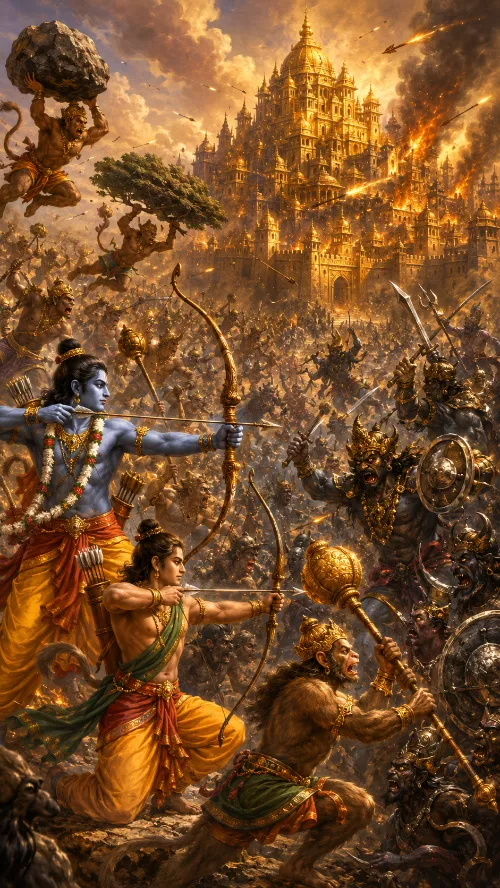
Major Rākṣasa Warriors Killed in Rāma’s Campaign Against Laṅkā
The war for Laṅkā in the Vālmīki Rāmāyaṇa is not simply a final duel between Rāma and Rāvaṇa. The Yuddhakāṇḍa depicts the progressive destruction of an entire Rākṣasa military hierarchy: field commanders fall first, followed by members of Rāvaṇa’s family, elite champions, Indrajit, and finally Rāvaṇa himself.
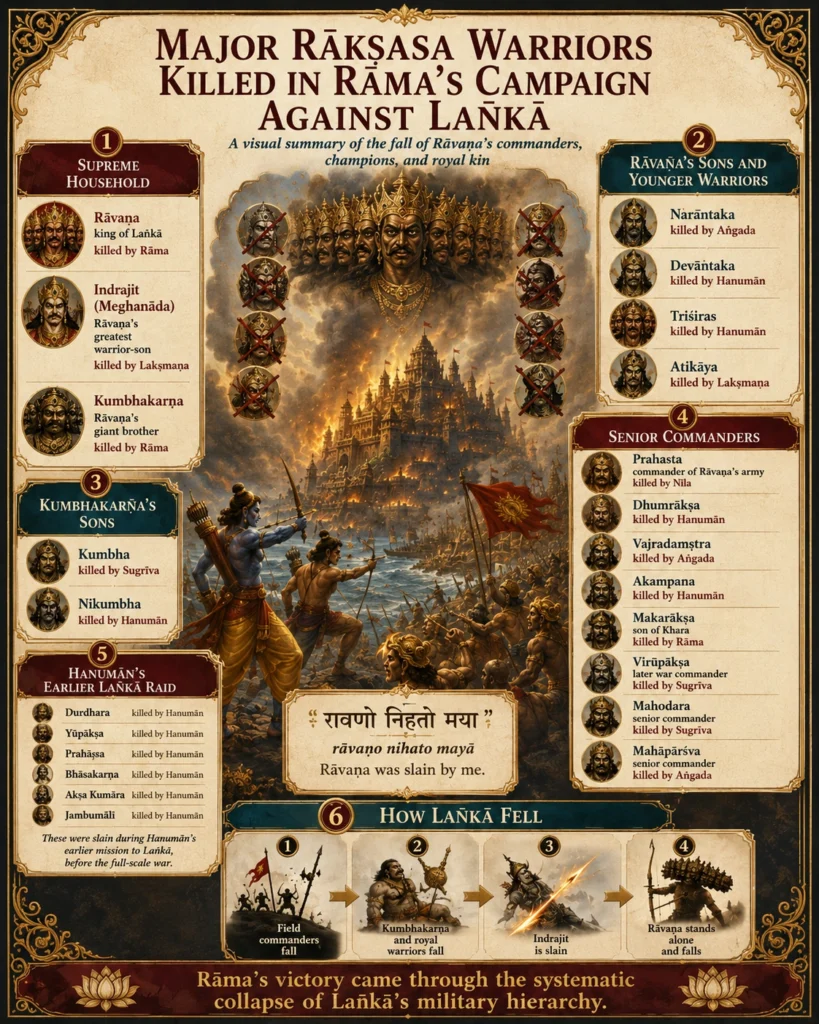
Household, commanders, Hanumān’s raid and the four-stage collapse on one sheet.
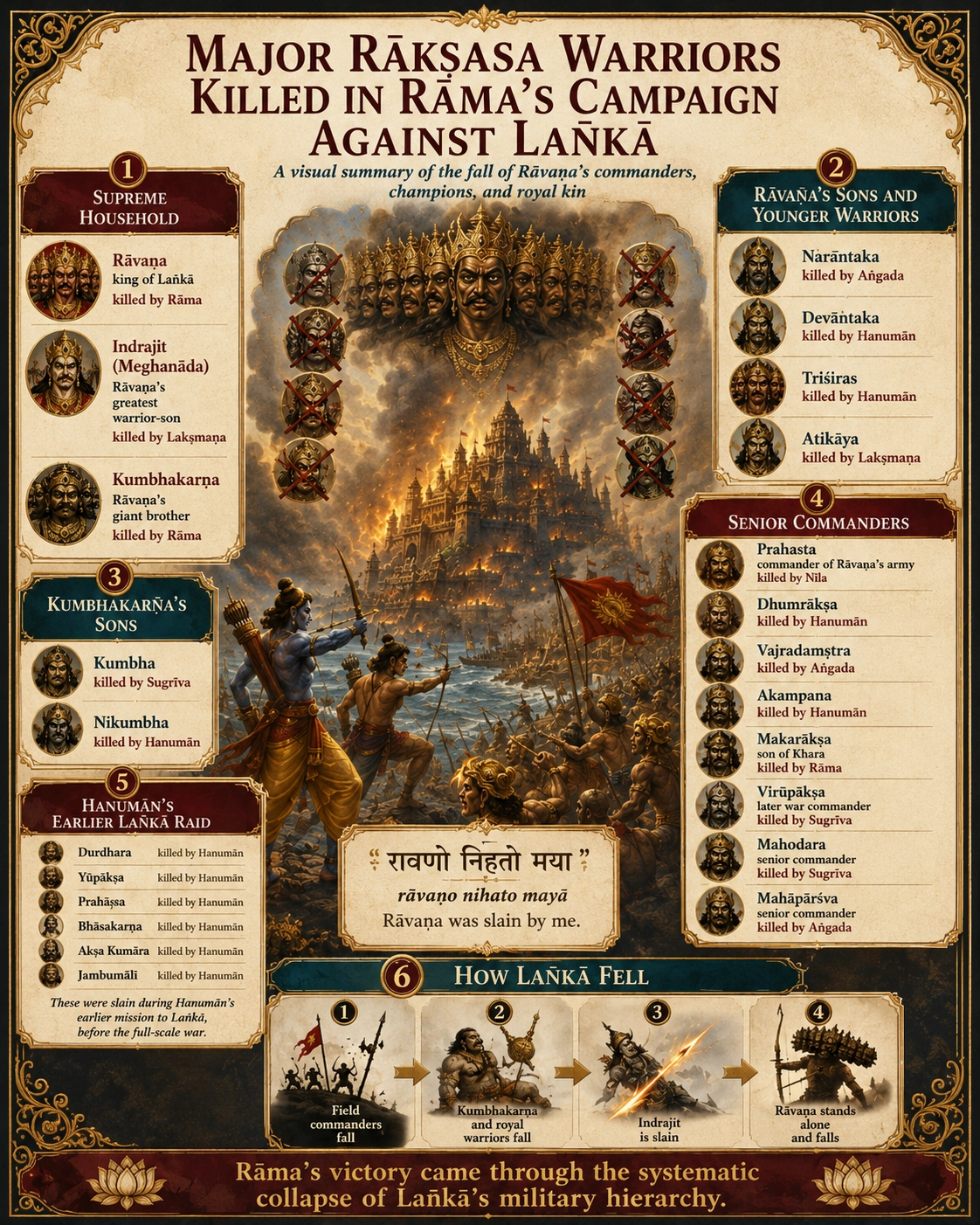
For this reason, the most accurate heading is not merely “demons killed in battle,” but Major Rākṣasa Warriors Killed in Rāma’s Campaign Against Laṅkā.
The Sanskrit term rākṣasa should preferably be retained rather than automatically translated as “demon.” In the Rāmāyaṇa, the Rākṣasas constitute a complex class of beings with kingdoms, families, political institutions, armies, priests, ministers, warriors, and differing moral characters. Vibhīṣaṇa himself, for example, is a Rākṣasa but becomes one of Rāma’s principal allies.
Among the most important warriors killed on Rāvaṇa’s side are Rāvaṇa, Indrajit, Kumbhakarṇa, Prahasta, Dhūmrākṣa, Vajradaṁṣṭra, Akampana, Narāntaka, Devāntaka, Triśiras, Atikāya, Kumbha, Nikumbha, Makarākṣa, Virūpākṣa, Mahodara, and Mahāpārśva.
Several additional Rākṣasas — including Praghasa and Bhāsakarṇa — are killed earlier by Hanumān during his first mission to Laṅkā and should be distinguished from casualties of the later full-scale war.
Rāma’s Own Roll-Call of the Fallen
One of the most valuable passages occurs after the victory. As Rāma and Sītā fly away from Laṅkā in the Puṣpaka-vimāna, Rāma points out the battlefield and names the great Rākṣasas who died there.
The traditional text reads:
अत्र दत्तवरः शेते प्रमाथी राक्षसेश्वरः ।
तव हेतोर्विशालाक्षि रावणो निहतो मया ॥
atra dattavaraḥ śete pramāthī rākṣaseśvaraḥ |
tava hetor viśālākṣi rāvaṇo nihato mayā ||
“Here lies Rāvaṇa, lord of the Rākṣasas, the mighty oppressor upon whom boons had been bestowed. For your sake, O large-eyed one, he was slain by me.”
Rāma continues:
कुम्भकर्णोऽत्र निहतः प्रहस्तश्च निशाचरः ।
धूम्राक्षश्चात्र निहतो वानरेण हनूमता ॥
kumbhakarṇo ’tra nihataḥ prahastaś ca niśācaraḥ |
dhūmrākṣaś cātra nihato vānareṇa hanūmatā ||
“Here Kumbhakarṇa was slain, and Prahasta the night-roaming Rākṣasa; here Dhūmrākṣa was slain by the Vānara Hanumān.”
Then:
विद्युन्माली हतश्चात्र सुषेणेन महात्मना ।
लक्ष्मणेनेन्द्रजिच्चात्र रावणिर्निहतो रणे ॥
vidyunmālī hataś cātra suṣeṇena mahātmanā |
lakṣmaṇenendrajic cātra rāvaṇir nihato raṇe ||
“Here Vidyunmālī was slain by the great Suṣeṇa; and here Indrajit, Rāvaṇa’s son, was slain in battle by Lakṣmaṇa.”
The catalogue continues with Virūpākṣa, Mahāpārśva, Mahodara, Akampana, Triśiras, Atikāya, Devāntaka, Narāntaka, Kumbha, Nikumbha, Vajradaṁṣṭra, Makarākṣa, and many others.
This passage is especially useful because it functions almost as the epic’s own post-war register of major casualties.
Chapter numbering varies substantially between recensions. This retrospective passage appears as Yuddhakāṇḍa 123 in several traditional electronic editions, but considerably earlier in the Critical-Edition-derived GRETIL text.
1. Rāvaṇa — Killed by Rāma
Rāvaṇa is naturally the final and most important casualty. He is not merely the king whom Rāma must defeat. By the final stage of the war he has already watched nearly every protective layer of his kingdom disappear:
- Prahasta has fallen;
- Kumbhakarṇa has fallen;
- many of his sons have fallen;
- Kumbha and Nikumbha have fallen;
- Indrajit has fallen;
- his senior commanders have fallen.
Only then does the final confrontation reach its culmination. Rāma himself later summarizes the outcome simply:
रावणो निहतो मया
rāvaṇo nihato mayā
“Rāvaṇa was slain by me.”
Rāvaṇa’s death therefore represents not an isolated victory but the collapse of the entire military and political system that had sustained his rule.
2. Indrajit / Meghanāda — Killed by Lakṣmaṇa
Indrajit, also known as Meghanāda, is arguably the most dangerous warrior on Rāvaṇa’s side. He is Rāvaṇa’s son and is famous for having conquered Indra — hence the title Indrajit, “conqueror of Indra.”
His greatest advantage is not simply physical strength. He is a master of celestial weapons, ritual warfare, illusion, invisibility, missile combat, and psychological deception. He repeatedly brings Rāma’s forces close to disaster.
Eventually Lakṣmaṇa confronts him in one of the longest and most important duels of the war. The post-war summary explicitly states:
लक्ष्मणेनेन्द्रजिच्चात्र रावणिर्निहतो रणे
lakṣmaṇenendrajic cātra rāvaṇir nihato raṇe
“Here Indrajit, son of Rāvaṇa, was slain in battle by Lakṣmaṇa.”
Indrajit’s death is a strategic catastrophe for Laṅkā. After he falls, Rāvaṇa loses the one warrior who had repeatedly demonstrated the ability to defeat Rāma’s army through supernatural warfare.
3. Kumbhakarṇa — Killed by Rāma
Kumbhakarṇa, Rāvaṇa’s gigantic brother, is one of the most formidable beings in the epic. His participation requires an extraordinary effort merely to awaken him.
Once on the battlefield, he devastates the Vānara forces. Numerous heroes attack him, including Hanumān, Aṅgada, Sugrīva, and Lakṣmaṇa. Sugrīva even tears away his nose and ears. Yet Kumbhakarṇa continues fighting.
Eventually he moves directly toward Rāma. Rāma successively destroys his offensive capacity, severing his arms and legs before finally killing him.
Kumbhakarṇa is particularly interesting because he is not portrayed as ignorant of Rāvaṇa’s wrongdoing. He rebukes Rāvaṇa for the disastrous decision to abduct Sītā, yet ultimately chooses to fight for his brother and kingdom.
His death therefore combines heroism, loyalty, fatalism, and participation in an unjust cause.
4. Prahasta — Killed by Nīla
Prahasta is not merely another Rākṣasa warrior. Vibhīṣaṇa explicitly identifies him as the commander of Rāvaṇa’s army:
एष सेनापतिस्तस्य प्रहस्तो नाम राक्षसः ॥
eṣa senāpatis tasya prahasto nāma rākṣasaḥ
“This is his army commander, the Rākṣasa named Prahasta.”
Prahasta therefore occupies roughly the position of commander-in-chief beneath Rāvaṇa. His opponent is appropriately Nīla, who holds a major command position in the Vānara army.
Their combat culminates when Nīla hurls a massive rock onto Prahasta’s head:
नीलेन कपिमुख्येन विमुक्ता महती शिला ।
बिभेद बहुधा घोरा प्रहस्तस्य शिरस्तदा ॥
nīlena kapimukhyena vimuktā mahatī śilā |
bibheda bahudhā ghorā prahastasya śiras tadā ||
“The huge and terrible rock hurled by Nīla, foremost of the Vānaras, shattered Prahasta’s head into many pieces.”
The death of Prahasta is the destruction of one of the central pillars of Laṅkā’s formal military command.
5. Dhūmrākṣa — Killed by Hanumān
Dhūmrākṣa is among the first major commanders sent out after the war intensifies. He inflicts heavy losses upon the Vānara army before encountering Hanumān, who ultimately kills him with a massive natural weapon.
Rāma’s later battlefield recollection explicitly remembers:
धूम्राक्षश्चात्र निहतो वानरेण हनूमता
dhūmrākṣaś cātra nihato vānareṇa hanūmatā
“Dhūmrākṣa was slain here by the Vānara Hanumān.”
This is one of several important battlefield victories achieved personally by Hanumān.
6. Vajradaṁṣṭra — Killed by Aṅgada
After Dhūmrākṣa’s death, Rāvaṇa sends Vajradaṁṣṭra. His name means approximately vajra, thunderbolt or diamond, and daṁṣṭra, fang — thus “Thunderbolt-Fanged.”
He fights a violent battle against Aṅgada and the Vānaras. Aṅgada ultimately kills him.
Vajradaṁṣṭra is significant because his death demonstrates the military importance of Aṅgada, who is not merely Sugrīva’s crown prince but one of the army’s most effective combat commanders.
7. Akampana — Killed by Hanumān
Akampana means approximately “unshaken” or “immovable.” He is identified among Rāvaṇa’s important commanders. Vibhīṣaṇa describes Akampana together with Mahodara and Mahāpārśva as major military leaders:
महापार्श्वमहोदरौ राक्षसश्चाप्यकम्पनः …
लोकपालसमा युधि
mahāpārśva-mahodarau rākṣasaś cāpy akampanaḥ …
lokapālasamā yudhi
“Mahāpārśva, Mahodara, and Akampana … were comparable in battle to the guardians of the worlds.”
Akampana eventually encounters Hanumān, who kills him by striking him with an enormous tree. Thus another of Laṅkā’s senior commanders falls to the same Vānara who had already devastated the city during his reconnaissance mission.
8. Narāntaka — Killed by Aṅgada
Narāntaka belongs to the younger generation of Rāvaṇa’s warrior household. His name is itself ominous: nara, man, and antaka, destroyer or ender — hence “destroyer of men.”
Mounted for battle, Narāntaka devastates the Vānara forces until he confronts Aṅgada, who kills him in direct combat. His death triggers the next sequence involving Devāntaka, Triśiras, Mahodara, and other Rākṣasas.
9. Devāntaka — Killed by Hanumān
Devāntaka means “destroyer of gods.” After Narāntaka falls, Devāntaka attacks Aṅgada. Hanumān joins the combat and kills Devāntaka with a devastating blow of his fist:
स मुष्टिनिष्पिष्टविकीर्णमूर्धा …
देवान्तको राक्षसराजसूनुर्
गतासुरुर्व्यां सहसा पपात ॥
sa muṣṭiniṣpiṣṭavikīrṇamūrdhā …
devāntako rākṣasarājasūnur
gatāsur urvyāṁ sahasā papāta ||
“Devāntaka, the son of the Rākṣasa king, his head shattered by the blow of the fist, fell suddenly to the earth, lifeless.”
The verse explicitly identifies him as a son of the Rākṣasa king.
10. Triśiras — Killed by Hanumān
Triśiras literally means “three-headed.” He fights alongside Devāntaka and Mahodara after Narāntaka’s death.
Triśiras is portrayed as an accomplished archer who repeatedly destroys the trees and mountain peaks hurled against him. His principal opponent eventually becomes Hanumān, who closes into direct combat and finally kills the three-headed warrior.
Thus Hanumān destroys Devāntaka and Triśiras in the same general battle sequence.
11. Atikāya — Killed by Lakṣmaṇa
Atikāya is another exceptionally dangerous son of Rāvaṇa. His name means ati, exceedingly or extraordinary, and kāya, body — hence “the immensely bodied one.”
Atikāya is not merely physically enormous. He is highly trained in divine weaponry and possesses formidable protection. Ordinary attacks prove insufficient.
Lakṣmaṇa ultimately confronts him and kills him through superior astra-warfare. Atikāya’s death therefore anticipates Lakṣmaṇa’s later and still greater victory over Indrajit.
12. Kumbha — Killed by Sugrīva
Kumbha is a son of Kumbhakarṇa. Together with his brother Nikumbha, he represents the continuation of Kumbhakarṇa’s warrior line after their father’s death.
Kumbha proves a powerful fighter and engages several Vānara heroes. Eventually Sugrīva himself fights him and kills him. This is an important reminder that Sugrīva is not merely a king who delegates military action. He personally fights some of Laṅkā’s strongest warriors.
13. Nikumbha — Killed by Hanumān
Nikumbha, Kumbha’s brother and another son of Kumbhakarṇa, enters battle after Kumbha’s death. His principal opponent becomes Hanumān, and the Yuddhakāṇḍa explicitly records Nikumbha’s death at Hanumān’s hands.
With Kumbha and Nikumbha both dead, Kumbhakarṇa’s immediate warrior branch has been effectively eliminated from the conflict.
14. Makarākṣa — Killed by Rāma
Makarākṣa is the son of Khara, the powerful Rākṣasa whom Rāma had killed earlier in the Daṇḍaka forest. His participation therefore introduces an element of family vengeance.
Makarākṣa challenges Rāma directly. After destroying his weapons and defenses, Rāma kills him with a divine missile. Rāma later remembers him specifically:
मकराक्षश्च दुर्धर्षो मया युधि निपातितः
makarākṣaś ca durdharṣo mayā yudhi nipātitaḥ
“The formidable Makarākṣa was struck down by me in battle.”
Makarākṣa’s death connects the Laṅkā war back to Rāma’s earlier destruction of Khara and the Janasthāna Rākṣasas.
15. Virūpākṣa — A Textually Complicated Name
Virūpākṣa requires special treatment. A Rākṣasa named Virūpākṣa already appears during Hanumān’s first mission to Laṅkā, before the full war begins. Rāvaṇa sends five great commanders against Hanumān:
स विरूपाक्षयूपाक्षौ दुर्धरं चैव राक्षसम् ।
प्रघसं भासकर्णं च पञ्च सेनाग्रनायकान् ॥
sa virūpākṣayūpākṣau durdharaṁ caiva rākṣasam |
praghasaṁ bhāsakarṇaṁ ca pañca senāgranāyakān ||
“He sent Virūpākṣa and Yūpākṣa, Durdhara the Rākṣasa, Praghasa and Bhāsakarṇa — the five foremost army commanders.”
Hanumān kills all five. Yet another Virūpākṣa appears later in the full-scale war, holding an important defensive command in Laṅkā, and is eventually killed by Sugrīva.
The safest conclusion is therefore: either two different Rākṣasas shared the name Virūpākṣa, or the received epic preserves overlapping narrative traditions. They should not automatically be treated as one continuous individual.
16. Mahodara — A Duplicate Death Tradition
Mahodara is one of the most interesting source-critical cases. His name means “great-bellied.” He is an important adviser and commander of Rāvaṇa. Yet in the received text he appears to die twice.
First death
In the battle involving Narāntaka, Devāntaka, and Triśiras, Mahodara fights Nīla. Nīla eventually hurls a mountain onto him:
ततः समुत्पत्य भृशोग्रवेगो
महोदरं तेन जघान मूर्ध्नि ॥
tataḥ samutpatya bhṛśogravego
mahodaraṁ tena jaghāna mūrdhni ||
“Then, springing up with tremendous speed, Nīla struck Mahodara on the head with it.”
The following verse explicitly says that Mahodara loses his life.
Second death
Much later, immediately before Rāvaṇa’s final battle, Mahodara appears again. This time he fights Sugrīva. After an extended duel involving arrows, rocks, trees, clubs, wrestling, and swords and shields, Sugrīva finally cuts off his head. The text is explicit:
खड्गेन कपिकुञ्जरः
जहार सशिरस्त्राणं कुण्डलोपहितं शिरः ॥
khaḍgena kapikuñjaraḥ
jahāra saśirastrāṇaṁ kuṇḍalopahitaṁ śiraḥ
“With his sword the mighty Vānara severed Mahodara’s head, together with its helmet and earrings.”
This is a genuine narrative duplication in the transmitted text and should not be silently harmonized.
17. Mahāpārśva — Another Duplicate Death
Mahāpārśva presents essentially the same problem. In the earlier battle sequence, Mahāpārśva fights the Vānara Ṛṣabha, who kills him.
Yet near the end of the war Mahāpārśva appears again after Sugrīva kills Mahodara. This second Mahāpārśva fights Aṅgada. Jāmbavān destroys his horses and chariot, after which Aṅgada attacks him directly. Finally Aṅgada strikes him in the chest with a thunderbolt-like fist:
तेन तस्य निपातेन राक्षसस्य महामृधे ।
पफाल हृदयं चाशु स पपात हतो भुवि ॥
tena tasya nipātena rākṣasasya mahāmṛdhe |
paphāla hṛdayaṁ cāśu sa papāta hato bhuvi ||
“With that blow, in the great battle, the Rākṣasa’s heart was shattered, and he fell dead upon the ground.”
As with Mahodara, a source-critical account should simply acknowledge the duplication.
Hanumān’s Earlier Battle in Laṅkā
Two names in the original list — Praghasa and Bhāsakarṇa — should be moved out of the main Battle of Laṅkā catalogue. They are indeed important warriors of Rāvaṇa, but Hanumān kills them during his earlier solitary mission, before Rāma’s army reaches Laṅkā.
Rāvaṇa sends five commanders: Virūpākṣa, Yūpākṣa, Durdhara, Praghasa and Bhāsakarṇa. The Sanskrit calls them पञ्च सेनाग्रनायकान् — pañca senāgranāyakān, “five foremost leaders of the army.”
Hanumān kills Durdhara first, then Virūpākṣa and Yūpākṣa. Praghasa and Bhāsakarṇa attack him together. Hanumān responds:
समुत्पाट्य गिरेः शृङ्गं समृगव्यालपादपम् ।
जघान हनुमान् वीरो राक्षसौ कपिकुञ्जरः ॥
samutpāṭya gireḥ śṛṅgaṁ samṛgavyālapādapam |
jaghāna hanumān vīro rākṣasau kapikuñjaraḥ ||
“Uprooting a mountain peak together with its animals, serpents, and trees, the heroic Hanumān, foremost of the Vānaras, killed the two Rākṣasas.”
Other Important Pre-War Casualties
Hanumān kills many additional Rākṣasas during this first penetration of Laṅkā. Among the most important are:
Thus Hanumān has already severely damaged Laṅkā’s military establishment before Rāma’s invasion even begins.
Additional Rākṣasas Named Among the Fallen
Rāma’s post-war catalogue preserves numerous additional names beyond the most famous commanders. These include Vidyunmālī, Vikata, Yuddhonmatta, Matta, Daṁṣṭra, Śoṇitākṣa, Yūpākṣa, Prajaṅgha, Vidyujjihva, Yajñaśatru, Suptaghna, Sūryaśatru and Brahmaśatru.
The passage itself says:
बहवो राक्षसा हताः
bahavo rākṣasā hatāḥ
“Many Rākṣasas were slain.”
The named heroes therefore represent only a fraction of Laṅkā’s total losses.
A More Complete Major-Casualty List
Rāvaṇa’s Supreme Household
Rāvaṇa’s Sons and Younger Warriors
Kumbhakarṇa’s Sons
Senior Commanders
Other Important Champions
Hanumān’s Earlier Laṅkā Raid
Who Killed the Greatest Number of Major Rākṣasa Champions?
Among the named elite casualties, several heroes stand out.
Hanumān
Kills major warriors including Dhūmrākṣa, Akampana, Devāntaka, Triśiras, Nikumbha, Praghasa, Bhāsakarṇa, Durdhara, Yūpākṣa, the earlier Virūpākṣa, Akṣa Kumāra and Jambumālin.
Hanumān is therefore not merely Rāma’s messenger — he is also one of the most destructive individual combatants in the entire campaign.
Rāma
Kills Kumbhakarṇa, Makarākṣa and Rāvaṇa, and many unnamed Rākṣasas. The importance of Rāma’s victories lies particularly in the fact that he personally destroys several opponents whom almost no one else can defeat.
Lakṣmaṇa
Kills two of Laṅkā’s most technically formidable warriors, Atikāya and Indrajit. His victories are especially associated with astra warfare.
Sugrīva
Personally kills Kumbha, the later Virūpākṣa and the later Mahodara, showing that the Vānara king is himself a formidable battlefield warrior.
Aṅgada
Kills Vajradaṁṣṭra, Narāntaka, the later Mahāpārśva and Vikata, and fights repeatedly against other major commanders.
Nīla
Kills Prahasta, and Mahodara in the earlier duplicate narrative.
The Structure of Rāvaṇa’s Defeat
The Yuddhakāṇḍa becomes much more interesting when these deaths are read not as isolated combats but as a progressive military collapse. The sequence broadly develops as follows.
1. Field commanders begin to fall
Dhūmrākṣa → Vajradaṁṣṭra → Akampana → Prahasta
Rāvaṇa progressively loses the professional commanders who control his armies.
2. Rāvaṇa himself tests Rāma
Rāvaṇa enters battle but survives the encounter. Rāma defeats and humiliates him but allows him to withdraw.
3. Kumbhakarṇa becomes the emergency weapon
The sleeping giant is awakened because ordinary military command has failed. He inflicts catastrophic losses but is killed by Rāma.
4. Rāvaṇa’s younger family enters the war
Narāntaka → Devāntaka → Triśiras → Atikāya
The war increasingly consumes Rāvaṇa’s own household.
5. Kumbhakarṇa’s sons fall
Kumbha → Nikumbha
Another major branch of the royal warrior family disappears.
6. Indrajit becomes Laṅkā’s last great strategic hope
His magical warfare repeatedly changes the course of the conflict. When Lakṣmaṇa finally kills him, Laṅkā loses its most sophisticated battlefield commander.
7. The remaining senior commanders are destroyed
Virūpākṣa → Mahodara → Mahāpārśva
Only Rāvaṇa remains.
8. Rāvaṇa enters the final battle
The king is now militarily isolated. His brothers, sons, nephews, elite commanders, and enormous armies have been progressively stripped away. Only then does the epic move toward the final death of Rāvaṇa.
The Deeper Meaning
This structure gives the war a clear narrative logic. Rāma does not simply appear before Laṅkā and kill Rāvaṇa. Instead, the epic depicts the systematic dismantling of Rāvaṇa’s power.
His strength rests upon layers:
fortifications → armies → commanders → relatives
    → supernatural champions → Indrajit → Rāvaṇa himself
Each layer disappears.
The tragedy is intensified because Rāvaṇa receives repeated opportunities to prevent this destruction. Vibhīṣaṇa advises him. Mālyavān advises him. Kumbhakarṇa criticizes his original decision. Even after enormous losses, returning Sītā would have offered a path away from complete destruction.
Rāvaṇa refuses.
Consequently the war becomes not merely the killing of one tyrant but the destruction of almost everything supporting his kingship.
By the time Rāma finally tells Sītā:
रावणो निहतो मया
rāvaṇo nihato mayā
“Rāvaṇa was slain by me,”
the statement represents the endpoint of a long collapse in which the military power of Laṅkā has already been dismantled commander by commander, prince by prince, and army by army.
Principal Scriptural Sections
- Sundarakāṇḍa 46 — Virūpākṣa, Yūpākṣa, Durdhara, Praghasa, and Bhāsakarṇa sent against Hanumān.
- Yuddhakāṇḍa 51–58 — Dhūmrākṣa, Vajradaṁṣṭra, Akampana, and Prahasta.
- Yuddhakāṇḍa 60–67 — awakening, campaign, and death of Kumbhakarṇa.
- Yuddhakāṇḍa 69–71 — Narāntaka, Devāntaka, Triśiras, Mahodara, Mahāpārśva, and Atikāya.
- Yuddhakāṇḍa 76–79 — Kumbha, Nikumbha, and Makarākṣa.
- Yuddhakāṇḍa 85–90 — Lakṣmaṇa’s battle with Indrajit.
- Yuddhakāṇḍa 96–99 — Virūpākṣa, Mahodara, and Mahāpārśva in the later battle sequence.
- Yuddhakāṇḍa 108 — death of Rāvaṇa in the traditional chapter numbering.
- Yuddhakāṇḍa 123 — Rāma’s retrospective catalogue of the battlefield and fallen Rākṣasas in the traditional numbering.