

“I Am Yours”: Rāma’s Vow of Fearlessness
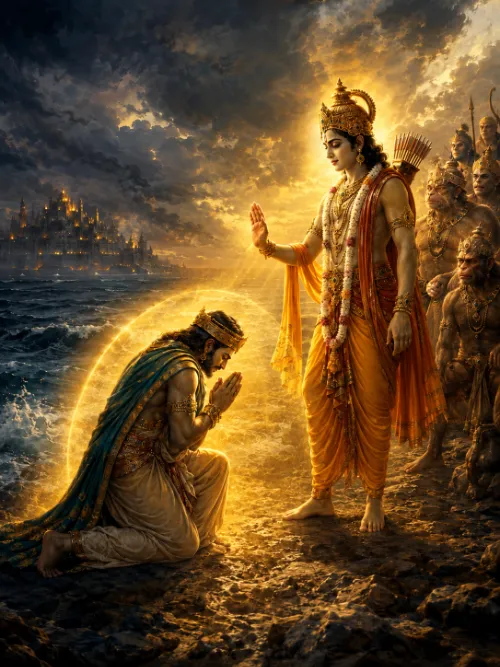
“I Am Yours”: Vibhīṣaṇa’s Surrender and the Theology of Śaraṇāgati
What does a person have to say to God when everything else has failed? The Rāmāyaṇa gives an astonishingly simple answer:
तवास्मि
tavāsmi
“I am Yours.” And Lord Rāmacandra’s response is equally direct:
अभयं ददामि
abhayaṁ dadāmi
“I give fearlessness.” Not merely advice. Not merely encouragement. A promise. And Rāma seals that promise with words that have echoed through Vaiṣṇava traditions for centuries:
एतद् व्रतं मम
etad vrataṁ mama
“This is My vow.” The statement occurs during one of the most dramatic moments in the Rāmāyaṇa: the surrender of Vibhīṣaṇa, the younger brother of Rāvaṇa. Vibhīṣaṇa abandons Laṅkā and approaches Rāma’s army seeking refuge.
To Sugrīva and the vānaras, he looks dangerously suspicious. He is not merely a foreigner. He is the brother of the enemy king. He may be a spy. He may be attempting infiltration.
Accepting him could be a catastrophic military mistake. Yet Rāma announces a principle greater than political calculation: one who genuinely comes for refuge must be protected.
It is in this context that He declares one of the greatest verses on surrender in Vaiṣṇava literature.
The Verse as Quoted in Caitanya-caritāmṛta
Śrī Caitanya-caritāmṛta, Madhya 22.34, gives:
सकृदेव प्रपन्नो यस्
तवास्मीति च याचते ।
अभयं सर्वदा तस्मै
ददाम्येतद् व्रतं मम ॥
sakṛd eva prapanno yas
tavāsmīti ca yācate
abhayaṁ sarvadā tasmai
dadāmy etad vrataṁ mama
“It is My vow that if one only once sincerely takes refuge in Me, saying, ‘I am Yours,’ I grant that person fearlessness always.”
Prabhupāda renders the verse: “It is My vow that if one only once seriously surrenders unto Me, saying, ‘My dear Lord, from this day I am Yours,’ and prays to Me for courage, I shall immediately award courage to that person, and he will always remain safe from that time on.”
Kṛṣṇadāsa Kavirāja presents this as Lord Rāmacandra’s statement from the Rāmāyaṇa, Yuddha-kāṇḍa 18.33.
A Textual Refinement: The Vālmīki Rāmāyaṇa Reads Slightly Differently
The commonly transmitted text of Vālmīki’s Rāmāyaṇa gives a slightly different form:
सकृदेव प्रपन्नाय
तवास्मीति च याचते ।
अभयं सर्वभूतेभ्यो
ददाम्येतद् व्रतं मम ॥
sakṛd eva prapannāya
tavāsmīti ca yācate
abhayaṁ sarva-bhūtebhyo
dadāmy etad vrataṁ mama
“To one who comes to Me for refuge even once and pleads, ‘I am Yours,’ I grant freedom from fear from all beings. This is My vow.”
Vālmīki Rāmāyaṇa, Yuddha-kāṇḍa 6.18.33 in the common vulgate numbering.
The difference is small but worth preserving. Caitanya-caritāmṛta has: prapanno yas “whoever has surrendered” and: abhayaṁ sarvadā tasmai “I give him fearlessness always.”
The commonly transmitted Vālmīki text has: prapannāya “to one who has taken refuge” and: abhayaṁ sarva-bhūtebhyaḥ “fearlessness from all beings.”
The theological force remains essentially the same.
But for textual precision, the two forms should not be silently treated as verbally identical.
The Context: Vibhīṣaṇa Leaves Rāvaṇa
The verse becomes far more powerful when its narrative setting is understood. Vibhīṣaṇa is the younger brother of Rāvaṇa. But unlike Rāvaṇa, he repeatedly counsels restraint.
He advises that Sītā should be returned to Rāma. Rāvaṇa refuses. Eventually Vibhīṣaṇa abandons Laṅkā and crosses the ocean to Rāma’s camp. From his own perspective he is seeking dharma and refuge.
From Sugrīva’s perspective he may be: a spy, a saboteur, or an enemy agent. That is exactly why the scene matters. Rāma is not making an easy promise to a harmless devotee already trusted by everyone.
He is deciding what to do with a man whose surrender appears politically dangerous.
Sugrīva’s Suspicion Is Reasonable
Sugrīva warns Rāma that Vibhīṣaṇa may have been deliberately sent by Rāvaṇa. This is not irrational paranoia. Kings at war must think about: espionage, betrayal, deception, security.
The episode therefore places two principles into tension: prudence and: refuge. Rāma hears the arguments. Then He establishes a principle that will override the fear: a genuine refugee is not to be betrayed.
Then Rāma Makes His Vow
The center of the verse is not an elaborate ritual. It is not: a sacrifice, a philosophical examination, a long austerity. It is the movement of surrender expressed in:
तवास्मि
tavāsmi
“I am Yours.” And Rāma responds:
अभयं … ददामि
abhayaṁ … dadāmi
“I give fearlessness.” Finally:
एतद् व्रतं मम
etad vrataṁ mama
“This is My vow.” The entire theology is contained in this exchange.
Tavāsmi : Two Words That Change Everything
The Sanskrit is beautifully simple. tava — Yours; asmi — I am. Together: tavāsmi “I am Yours.” This is not exactly the same as saying: “I believe You exist.” Nor: “I admire You.”
Nor even: “I worship You.” It is a statement of belonging. I am Yours. The center of identity shifts. The soul stops saying: “Everything is mine.” and begins saying: “I am Yours.”
That is why tavāsmi is one of the clearest verbal formulas of śaraṇāgati.
Surrender Is a Change of Ownership
Ordinary consciousness thinks in terms of: my body, my wealth, my plans, my success, my family, my security, my future. Śaraṇāgati introduces another principle: I myself belong to Bhagavān.
That changes the spiritual question. Instead of asking: “How can God improve what belongs to me?” one begins asking: “How should what belongs to Him be used?” This is why surrender is much deeper than asking for favors.
Caitanya-caritāmṛta Makes Exactly This Point One Verse Earlier
Immediately before quoting Rāma’s vow, Kṛṣṇadāsa Kavirāja writes:
‘কৃষ্ণ, তোমার হঞ’ যদি বলে একবার ।
মায়াবন্ধ হৈতে কৃষ্ণ তারে করে পার ॥
‘kṛṣṇa, tomāra haṅa’ yadi bale eka-bāra
māyā-bandha haite kṛṣṇa tāre kare pāra
“If one sincerely says even once, ‘Kṛṣṇa, I am Yours,’ Kṛṣṇa carries that person beyond the bondage of māyā.” — Caitanya-caritāmṛta, Madhya 22.33. Then comes Rāma’s verse.
The structure is deliberate: “Kṛṣṇa, I am Yours.” Rāma’s ancient vow: “I give fearlessness.” So Caitanya-caritāmṛta is not quoting the Rāmāyaṇa randomly. It is using Rāma’s promise as scriptural confirmation of the principle of surrender to Kṛṣṇa.
Sakṛd Eva : “Even Once”
The verse begins:
सकृद् एव
sakṛd eva
“even once,” “just once.” This is astonishing. Does it mean that somebody can casually say: “I am Yours” once without sincerity and thereby obtain a magical guarantee forever?
That would trivialize the verse. The force of sakṛd eva is different. Genuine surrender does not require Bhagavān to be persuaded repeatedly before He accepts it. Once the soul truly comes for refuge, the Lord does not say: “Come back after twenty years and perhaps I will consider you.”
The emphasis is on the readiness of divine acceptance. This is why Prabhupāda adds the interpretive language: “seriously surrenders.” There is no separate Sanskrit word meaning “seriously” here, but the addition protects the meaning of prapatti from becoming mechanical.
Prapanna : One Who Has Taken Refuge
The root involved is:
प्र-पद्
pra-pad
to resort to, approach, take refuge, surrender oneself. From this comes:
प्रपन्न
prapanna
one who has taken refuge. And:
प्रपत्ति
prapatti
the act or condition of surrender. This is not merely emotional helplessness. In Vaiṣṇava theology it is a conscious movement toward Bhagavān as: protector, maintainer, master, and ultimate shelter.
Abhaya : More Than Courage
The second central word is:
अभय
abhaya
formed from: a — absence; bhaya — fear. Thus: abhaya means: fearlessness, safety, security, freedom from fear. Prabhupāda renders it here as “courage,” which captures one consequence of divine protection.
But in the original Rāmāyaṇa setting, “assurance of safety” is especially strong. Vibhīṣaṇa is literally approaching an enemy army. The immediate question is: Will they kill him or accept him?
Rāma gives abhaya. In effect: “You are safe with Me.”
The Vālmīki Wording Makes the Protection Universal
The Vālmīki version says:
अभयं सर्वभूतेभ्यः
abhayaṁ sarva-bhūtebhyaḥ
“fearlessness from all beings.” That goes beyond: “I personally will not harm you.” Rāma takes responsibility for the refugee’s safety. The surrendered person is being placed under His protection.
This is why abhaya-pradāna—the giving of fearlessness—became an important concept in later Vaiṣṇava discussions of refuge.
The Next Verse Makes the Promise Radical
Immediately after making His vow, Rāma says:
आनयैनं हरिश्रेष्ठ
दत्तमस्याभयं मया ।
विभीषणो वा सुग्रीव
यदि वा रावणः स्वयम् ॥
ānayainaṁ hari-śreṣṭha
dattam asyābhayaṁ mayā
vibhīṣaṇo vā sugrīva
yadi vā rāvaṇaḥ svayam
“Bring him here, O best of the vānaras. I have granted him fearlessness. Whether he be Vibhīṣaṇa—or even Rāvaṇa himself.”
Vālmīki Rāmāyaṇa, Yuddha-kāṇḍa 6.18.34.
This makes Rāma’s principle almost shocking. He does not merely say: “I have investigated Vibhīṣaṇa carefully and decided he is probably trustworthy.” He says, in effect: “The law of refuge itself governs My response.”
Even if Rāvaṇa himself sincerely came seeking refuge, Rāma’s vow would apply.
Surrender Creates a New Relationship
This is the theological turning point. Before surrender: Vibhīṣaṇa is Rāvaṇa’s brother. He belongs to Laṅkā. He appears to stand in the enemy camp. After surrender: he becomes: śaraṇāgata one who has come for refuge.
The former identity does not disappear historically. But spiritually and relationally, another identity becomes decisive. He is now: one whom Rāma has promised to protect.
That is the transformative power of śaraṇāgati.
Grace Is Not Merely Reward for Prior Worthiness
The episode therefore challenges a purely merit-based understanding of divine protection. Rāma does not say: “I protect only those whose previous record already qualifies them.”
Vibhīṣaṇa comes from: Laṅkā, the rākṣasa dynasty, the family of Rāvaṇa. Yet refuge overrides inherited association. This does not mean moral history is meaningless. It means genuine surrender establishes a relationship stronger than former belonging.
Etad Vrataṁ Mama : “This Is My Vow”
Perhaps the most important words in the verse are actually the last:
एतद् व्रतं मम
etad vrataṁ mama
“This is My vow.” The word: vrata can mean: vow, solemn observance, binding commitment, firm resolution. Rāma does not say: “I may protect.” Nor: “I usually protect.” He says: “This is My vow.”
The assurance rests on Rāma’s own character.
The Security of the Devotee Rests on the Reliability of Bhagavān
This creates a profound shift. The surrendered soul may ask: “Is my surrender perfect enough?” The verse directs attention somewhere else: “What has Rāma promised?” Śaraṇāgati certainly requires sincerity.
But its ultimate security does not rest on the jīva becoming omnipotent in surrender. It rests upon: the faithfulness of Bhagavān to His own word. That is why: etad vrataṁ mama is so powerful.
Rāma Is the Perfect Speaker of Such a Promise
Rāma is celebrated throughout the epic for fidelity to: truth, dharma, promise, and duty. His word matters. Therefore a vow pronounced by Rāma is not casual reassurance. Vibhīṣaṇa’s safety is ultimately grounded in: Rāma’s truthfulness.
The theological implication is beautiful: śaraṇāgati transfers ultimate reliance from the instability of the conditioned self to the reliability of Bhagavān.
Bhagavad-gītā Gives the Same Structure
Kṛṣṇa’s final instruction to Arjuna says:
सर्वधर्मान् परित्यज्य
मामेकं शरणं व्रज ।
अहं त्वां सर्वपापेभ्यो
मोक्षयिष्यामि मा शुचः ॥
sarva-dharmān parityajya
mām ekaṁ śaraṇaṁ vraja
ahaṁ tvāṁ sarva-pāpebhyo
mokṣayiṣyāmi mā śucaḥ
“Abandon all other dharmas and take refuge in Me alone. I shall deliver you from all sinful reactions. Do not grieve.”
Bhagavad-gītā 18.66.
Compare the structure.
Rāmāyaṇa
tavāsmi “I am Yours.” abhayaṁ dadāmi “I give fearlessness.”
Bhagavad-gītā
The same spiritual logic appears: surrender → Bhagavān assumes responsibility for the surrendered soul.
Bhagavad-gītā 7.14 Adds the Problem of Māyā
Kṛṣṇa says:
दैवी ह्येषा गुणमयी
मम माया दुरत्यया ।
मामेव ये प्रपद्यन्ते
मायामेतां तरन्ति ते ॥
daivī hy eṣā guṇa-mayī
mama māyā duratyayā
mām eva ye prapadyante
māyām etāṁ taranti te
“This divine energy of Mine, composed of the guṇas, is difficult to cross; but those who take refuge in Me cross beyond it.”
Bhagavad-gītā 7.14
Again the crucial word is: prapadyante “they take refuge.” And the result: taranti “they cross beyond.” This closely parallels Caitanya-caritāmṛta Madhya 22.33: māyā-bandha haite kṛṣṇa tāre kare pāra “Kṛṣṇa carries that soul beyond the bondage of māyā.”
Śaraṇāgati Is More Than Asking for Help
There is a major difference between: “Protect me while I remain completely my own.” and: “I am Yours.” The first still makes personal control the center. The second shifts the center to Bhagavān.
The surrendered devotee does not merely ask: “How can God secure my plans?” He increasingly asks: “What does the Lord want from the life that now belongs to Him?” That is why true śaraṇāgati naturally produces: service.
Vibhīṣaṇa Does Not Become Passive
After taking shelter of Rāma, Vibhīṣaṇa does not simply sit down and wait for divine protection. He serves. He advises. He assists Rāma’s campaign. He becomes actively involved.
This is important because śaraṇāgati is sometimes misunderstood as: passivity, fatalism, or refusal to act. The Vibhīṣaṇa episode teaches the opposite. Surrender establishes the relationship in which service becomes possible.
The Six Limbs of Śaraṇāgati
Later in the same chapter, Caitanya-caritāmṛta gives the famous sixfold definition:
आनुकूल्यस्य सङ्कल्पः
प्रातिकूल्यस्य वर्जनम् ।
रक्षिष्यतीति विश्वासो
गोप्तृत्वे वरणं तथा ।
आत्मनिक्षेपकार्पण्ये
षड्विधा शरणागतिः ॥
ānukūlyasya saṅkalpaḥ
prātikūlyasya varjanam
rakṣiṣyatīti viśvāso
goptṛtve varaṇaṁ tathā
ātma-nikṣepa-kārpaṇye
ṣaḍ-vidhā śaraṇāgatiḥ
“The six divisions of surrender are: accepting what is favorable, rejecting what is unfavorable, faith that the Lord will protect, accepting Him as one’s guardian, complete self-offering, and humility.”
Caitanya-caritāmṛta, Madhya 22.100.
This gives us a fuller anatomy of what: tavāsmi actually contains.
First: Ānukūlyasya Saṅkalpaḥ
आनुकूल्यस्य सङ्कल्पः
ānukūlyasya saṅkalpaḥ
“Accepting what is favorable.” Surrender is not simply emotional. It changes decisions. The devotee deliberately accepts what supports: remembrance of Bhagavān, bhakti, service, purification.
Thus “I am Yours” becomes practical.
Second: Prātikūlyasya Varjanam
प्रातिकूल्यस्य वर्जनम्
prātikūlyasya varjanam
“Rejecting what is unfavorable.” One cannot meaningfully say: “I belong to You” while consciously clinging to everything that destroys the relationship. Śaraṇāgati therefore contains: renunciation.
Not renunciation for its own sake, but renunciation of what is incompatible with the relationship.
Third: Rakṣiṣyatīti Viśvāsaḥ
रक्षिष्यतीति विश्वासः
rakṣiṣyatīti viśvāsaḥ
“The firm conviction: ‘He will protect me.’” This connects directly with Rāma’s: abhayaṁ dadāmi. The devotee thinks: “My final protection lies with Bhagavān.” This does not forbid: medicine, planning, prudence, responsibility, defense.
It concerns the ultimate ground of confidence.
Fourth: Goptṛtve Varaṇam
गोप्तृत्वे वरणम्
goptṛtve varaṇam
“Accepting the Lord as one’s guardian and maintainer.” Protection asks: Who saves me from danger? Maintenance asks: Who ultimately sustains my existence? Śaraṇāgati places both into Bhagavān.
This is almost exactly what Vibhīṣaṇa does when he leaves Laṅkā and places himself under Rāma.
Fifth: Ātma-nikṣepa
आत्मनिक्षेप
ātma-nikṣepa
literally: “placing down the self,”
“complete self-offering.” This may correspond most deeply to: tavāsmi. “I am Yours.” Not merely: my possessions are Yours. Not merely: my worship is Yours.
But: I am Yours.
Sixth: Kārpaṇya
कार्पण्य
kārpaṇya
humility, meekness, awareness of dependence. This is not self-hatred. It is freedom from the illusion: “I am completely self-sufficient.” Vibhīṣaṇa cannot guarantee his own future.
He takes refuge. That recognition opens the door to grace.
Rāma’s Verse Contains the Sixfold Surrender in Seed Form
The relationship becomes striking when the texts are placed together.
Fearlessness Does Not Mean Nothing Painful Will Ever Happen
This distinction is essential. Devotees experience: illness, loss, persecution, danger, separation, death. Therefore: abhaya cannot simply mean: “After surrender, no frightening event will ever occur.”
The deeper promise is: the surrendered soul is no longer without refuge. External danger may remain. Ultimate abandonment does not.
There Is a Difference Between Danger and Being Without Shelter
A child in a storm may still hear: thunder, wind, rain. But if held securely by a trusted parent, the storm is experienced differently. Similarly, surrender does not necessarily remove every storm from embodied existence.
It changes: where the soul stands inside the storm. The surrendered devotee increasingly knows: “Whatever occurs, I belong to Bhagavān.” That is a deeper form of abhaya.
Fear Often Comes From the Illusion of Absolute Control
Much existential anxiety rests on the assumption: “Everything depends on my ability to keep life under control.” But the body cannot be permanently controlled. Other people cannot be permanently controlled.
Circumstances cannot be permanently controlled. Death certainly cannot be controlled through ordinary means. Śaraṇāgati loosens this impossible burden. The soul says: “I am Yours.”
That does not destroy responsibility. It destroys the fantasy that ultimate security comes from independent control.
Tavāsmi Is the Opposite of Mama
Material consciousness revolves around:
मम
mama
“mine.” My body. My wealth. My status. My future. My world. Surrender begins reversing the direction: from: “This is mine.” toward: “I am Yours.” That is why śaraṇāgati transforms identity before it transforms circumstances.
The Asymmetry of Grace
There is something beautiful about the disproportion between the two sides. The surrendered person says: tavāsmi two simple words: “I am Yours.” Rāma answers with the resources of Bhagavān: abhayaṁ sarva-bhūtebhyo dadāmi “I grant safety from all beings.”
The offering is finite. The protecting power is infinite. This asymmetry is one of the foundations of grace.
The Lord Is Not Purchased by the Magnitude of the Offering
Vibhīṣaṇa does not approach Rāma carrying a greater army. He approaches because he has abandoned the false shelter of Rāvaṇa. The decisive act is not: “Look what I can give You.”
It is: “I am taking shelter of You.” That is a radically different spiritual economy.
This Is Why Surrender and Bhakti Belong Together
Bhakti is not simply admiration of God. It is relationship. And relationship requires some degree of: trust, belonging, dependence, self-giving. Thus śaraṇāgati is not an optional psychological decoration added to bhakti.
It expresses bhakti’s fundamental direction: away from independent self-centeredness and toward belonging to Bhagavān.
Is Surrender Instantaneous or Gradual?
The answer is: in different senses, both. A person may genuinely turn toward Bhagavān in one decisive moment: “I am Yours.” That is the force of: sakṛd eva “even once.” But the full implications of that surrender may unfold throughout an entire life.
One gradually learns:
- what favorable service means;
- what must be rejected;
- how deeply one trusts protection;
- how completely one depends upon Bhagavān;
- how much ego still resists self-offering.
Thus there can be: a decisive act of surrender and: a lifelong deepening of surrender. There is no contradiction.
Surrender Is Not a Magical Formula
This also prevents superstition. The syllables: tavāsmi are not a password mechanically forcing God into an obligation. The words express a spiritual reality. If spoken sincerely, they mean: “I have come to You as my shelter.”
That is why the context of Vibhīṣaṇa matters. He actually leaves Laṅkā. He actually crosses over. He actually places himself before Rāma. His surrender has consequences.
True Surrender Reorders Life
If: “I am Yours” is genuine, then inevitably questions follow: How should I live? What should I abandon? What should I accept? Whom should I serve? How should I use my capacities?
How should I respond to fear? This is why the six limbs of śaraṇāgati are practical. They turn surrender from a sentence into a life.
The Ethical Dimension: Refuge Must Not Be Betrayed
The Rāmāyaṇa episode is also important ethically. Rāma is not merely discussing private mystical surrender. He is establishing the moral seriousness of protecting one who has sought refuge.
Thus the episode works on two levels:
Epic ethics
A righteous protector does not betray a genuine refugee.
Vaiṣṇava theology
Bhagavān Himself is the ultimate refuge of the soul. The second develops naturally from the first.
Why Vaiṣṇava Traditions Treasured This Verse
It is easy to see why the Vibhīṣaṇa episode became central in discussions of: prapatti and: śaraṇāgati. Few verses express the two sides of surrender so perfectly. The soul’s side: tavāsmi “I am Yours.”
Bhagavān’s side: abhayaṁ dadāmi “I give fearlessness.” Then divine assurance: etad vrataṁ mama “This is My vow.” Later Śrī Vaiṣṇava theologians in particular developed the Vibhīṣaṇa episode extensively as a paradigm of divine refuge, while Gauḍīya authors likewise cited Rāma’s vow as authoritative evidence for the power of surrender.
Why Caitanya-caritāmṛta Quotes Rāma
Kṛṣṇadāsa Kavirāja is explaining the qualities and practices of bhakti. He makes a remarkably bold statement:
‘কৃষ্ণ, তোমার হঞ’ যদি বলে একবার
kṛṣṇa, tomāra haṅa yadi bale eka-bāra
“If one says even once, ‘Kṛṣṇa, I am Yours…’” Then: māyā-bandha haite kṛṣṇa tāre kare pāra “Kṛṣṇa carries that soul beyond the bondage of māyā.” A reader might ask: Can surrender really possess such power?
Kṛṣṇadāsa answers with Rāma’s vow. This is the scriptural precedent: Bhagavān Himself has declared: “One who comes saying, ‘I am Yours,’ comes under My protection.”
Rāma’s Vow and Kṛṣṇa’s Final Gītā Promise Are One Spiritual Movement
The two great statements can be placed side by side.
Rāma
तवास्मि
tavāsmi
“I am Yours.”
अभयं ददामि
abhayaṁ dadāmi
“I give fearlessness.”
Kṛṣṇa
The theological structure is remarkably consistent. Bhagavān does not merely tell the soul: “Save yourself better.” He says: “Take refuge in Me.”
The Deepest Meaning of Fearlessness
At the ordinary level: abhaya means safety. At the psychological level: fear begins to loosen because the burden of ultimate self-protection is surrendered. At the theological level: the soul is no longer spiritually homeless.
Its shelter has been found. Thus the highest fearlessness may not be: “Nothing bad will ever happen.” It is: “Nothing can make me cease to belong to Bhagavān.” That is far deeper.
What This Teaching Does Not Mean
Rāma’s vow does not mean that:
- one casual verbal formula guarantees liberation regardless of sincerity;
- surrendered devotees will never suffer physically;
- śaraṇāgati means passivity;
- prudence becomes unnecessary;
- responsibility disappears;
- one may deliberately continue wrongdoing while demanding protection;
- surrender is merely emotional helplessness;
- or Bhagavān becomes obligated through magical words.
Those interpretations would trivialize the doctrine.
What It Does Mean
The passage teaches that:
- Bhagavān is genuinely accessible as refuge;
- sincere surrender establishes a new relationship;
- the essential movement is expressed in tavāsmi—“I am Yours”;
- Bhagavān answers surrender with protection;
- abhaya means more than psychological courage—it is the assurance of divine shelter;
- Rāma binds the promise to His own character with etad vrataṁ mama;
- genuine surrender does not need endless preliminary proof before Bhagavān accepts it;
- surrender naturally develops into service;
- and the surrendered soul increasingly places ultimate confidence not in personal control but in Bhagavān.
The Whole Theology in Three Phrases
The entire teaching can be remembered through three expressions.
तवास्मि
“I am Yours.”
1. Tavāsmi
The movement of the soul.
अभयं ददामि
“I give fearlessness.”
2. Abhayaṁ dadāmi
The response of Bhagavān.
एतद् व्रतं मम
“This is My vow.”
3. Etad vrataṁ mama
The guarantee. That is śaraṇāgati in miniature.
The Vibhīṣaṇa episode begins with uncertainty. An enemy prince appears over Rāma’s camp. Sugrīva sees danger. Military logic sees risk. Past association says: “He belongs to Rāvaṇa.”
But Vibhīṣaṇa comes seeking shelter. And Rāma establishes another logic: the logic of refuge. He says:
सकृदेव प्रपन्नाय
तवास्मीति च याचते ।
अभयं सर्वभूतेभ्यो
ददाम्येतद् व्रतं मम ॥
sakṛd eva prapannāya
tavāsmīti ca yācate
abhayaṁ sarva-bhūtebhyo
dadāmy etad vrataṁ mama
“To one who comes to Me for refuge even once and pleads, ‘I am Yours,’ I grant fearlessness from all beings. This is My vow.”
The most important thing Vibhīṣaṇa brings is not power. It is: surrender. The decisive sentence is not: “I can help You defeat Rāvaṇa.” It is: “I have come to Your shelter.”
And the spiritual heart of that surrender can be compressed to: tavāsmi “I am Yours.” Caitanya-caritāmṛta then takes that ancient promise and places it directly into Gauḍīya bhakti:
‘কৃষ্ণ, তোমার হঞ’ যদি বলে একবার ।
মায়াবন্ধ হৈতে কৃষ্ণ তারে করে পার ॥
‘kṛṣṇa, tomāra haṅa’ yadi bale eka-bāra
māyā-bandha haite kṛṣṇa tāre kare pāra
“If one sincerely says even once, ‘Kṛṣṇa, I am Yours,’ Kṛṣṇa carries that person beyond the bondage of māyā.” This is not a theology of cheap words. It is a theology of belonging.
The soul stops making itself the final shelter. It approaches Bhagavān. It says: “I am Yours.” And Bhagavān answers: “Then come under My protection.” The remarkable thing is that the final security does not rest on the strength of the refugee.
Vibhīṣaṇa is not safe because Vibhīṣaṇa suddenly becomes invincible. He is safe because: Rāma has given His word. That may be the deepest teaching of the verse. The surrendered soul is imperfect.
Its faith may still deepen. Its understanding may still grow. Its service may still mature. But the refuge is not imperfect. The soul says:
तवास्मि
tavāsmi
“I am Yours.” Rāma answers:
अभयं ददामि
abhayaṁ dadāmi
“I give fearlessness.” And then:
एतद् व्रतं मम
etad vrataṁ mama
“This is My vow.” The ultimate security of surrender rests not on the perfection of the surrendered soul— but on the faithfulness of the One to whom the soul has surrendered.
Primary Texts Cited
Vālmīki Rāmāyaṇa , Yuddha-kāṇḍa
- The verse numbering differs in critical-edition arrangements and other recensions.
Śrī Caitanya-caritāmṛta , Madhya-līlā
Bhagavad-gītā
Digital Texts and Reference Sites Consulted
- For a formal critical edition, the Rāmāyaṇa verse should be cited according to the specific recension or edition being used, since the numbering and minor wording of this famous passage vary across textual traditions.