

Tapana Miśra and Candraśekhara Vaidya
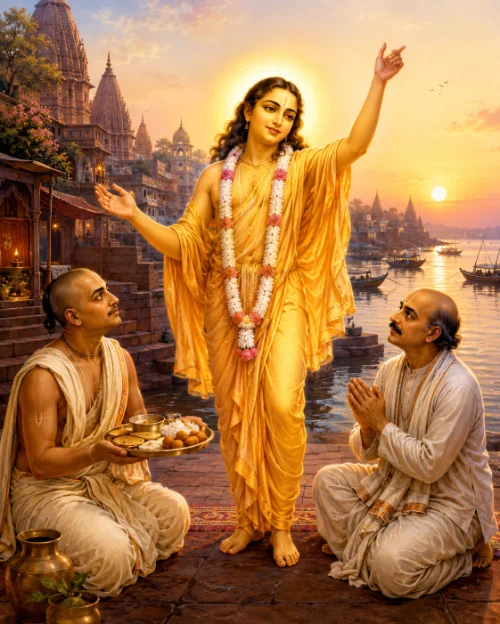
Tapana Miśra and Candraśekhara Vaidya: Śrī Caitanya Mahāprabhu’s Vārāṇasī Circle
Among Śrī Caitanya Mahāprabhu’s many associates, Tapana Miśra and Candraśekhara Vaidya occupy a distinctive position. Neither became famous as the founder of a large preaching branch, and neither belongs to the celebrated group of Vṛndāvana Gosvāmīs. Yet together they created the small devotional centre from which some of Caitanya’s most consequential activities in Vārāṇasī unfolded.
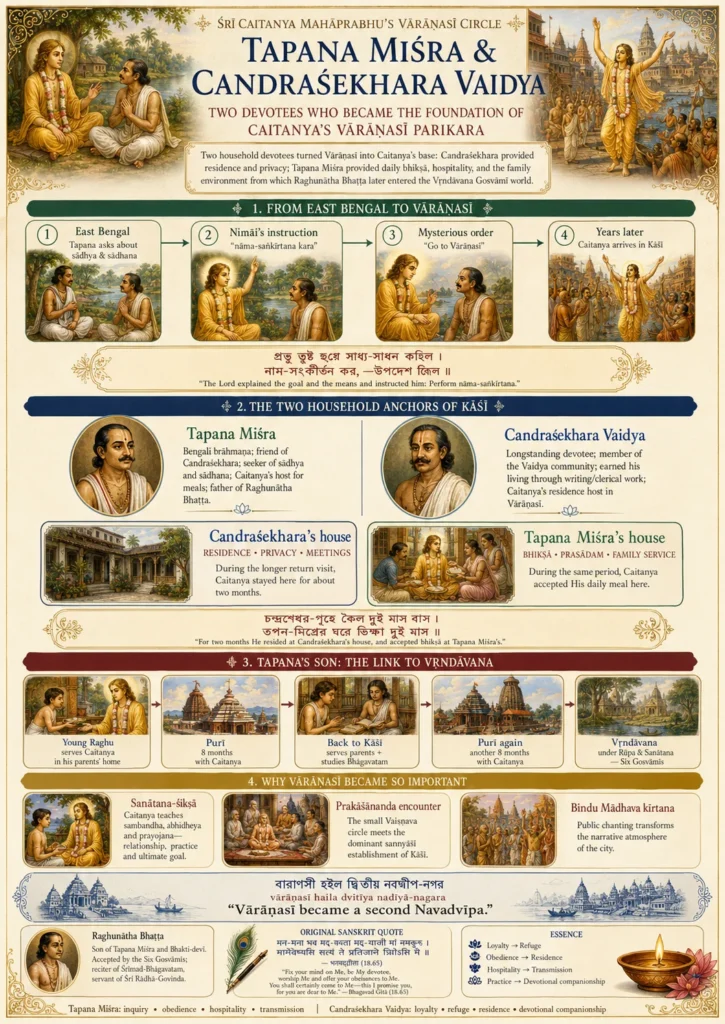
From East Bengal to Vārāṇasī, the two household anchors of Kāśī, Tapana’s son Raghunātha as the link to Vṛndāvana, and why Vārāṇasī mattered.
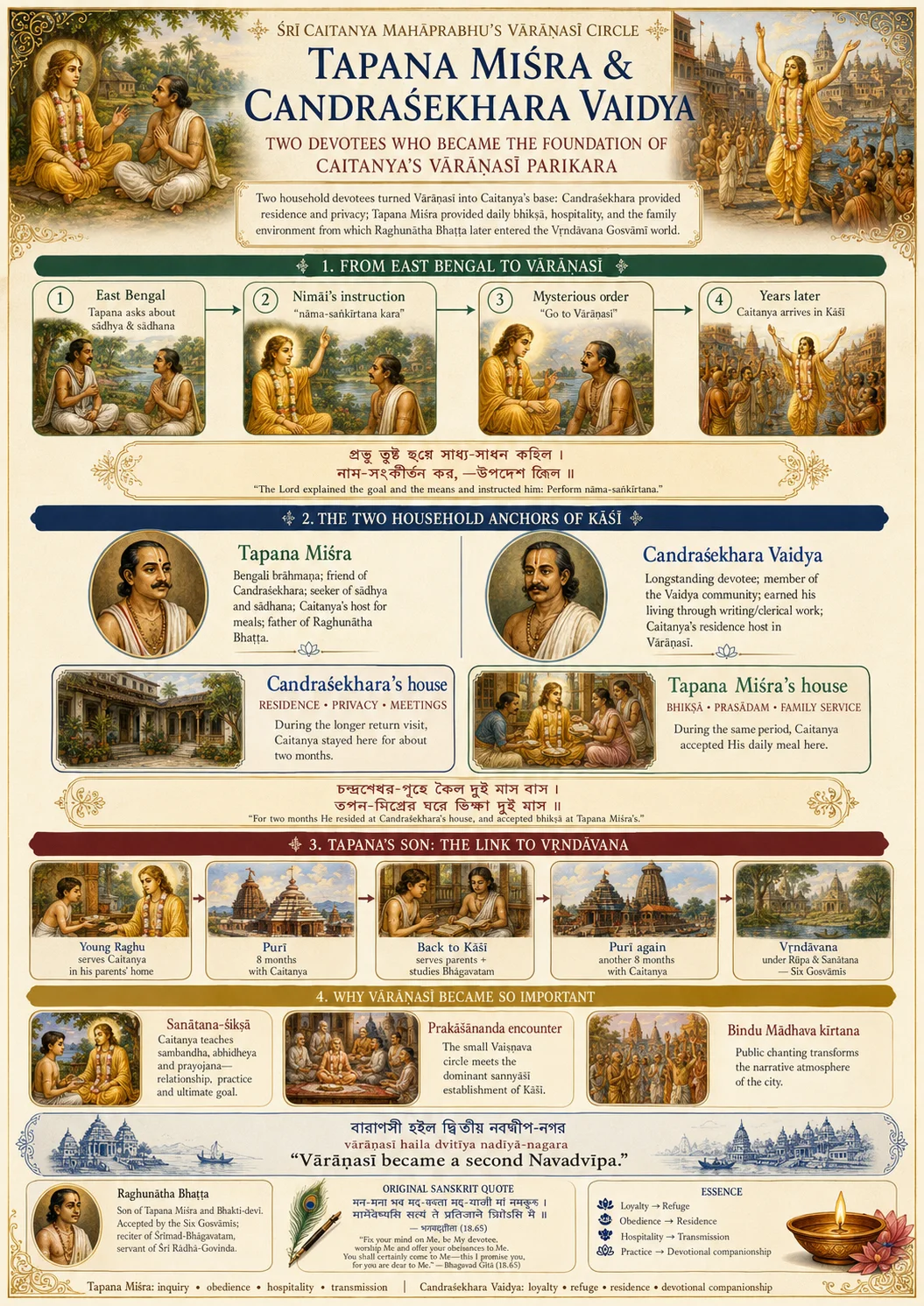
Their houses provided Caitanya with residence, food, companionship and a protected environment in one of the most intellectually formidable cities of early sixteenth-century India. During his longer stay there, Sanātana Gosvāmī received extensive theological instruction, Caitanya encountered the circle of Prakāśānanda Sarasvatī, and Vārāṇasī — initially described by Candraśekhara as a city filled with discussion of māyā, Brahman and philosophical systems — filled with kīrtana.
The connection extends still further. Tapana Miśra’s young son, who personally served Caitanya in the family home, eventually became Raghunātha Bhaṭṭa Gosvāmī, one of the Six Gosvāmīs of Vṛndāvana. These two households therefore form an important bridge:
East Bengal → Vārāṇasī → Caitanya → Sanātana and Raghunātha Bhaṭṭa → Vṛndāvana
The Three Principal Devotees of Vārāṇasī
When Kṛṣṇadāsa Kavirāja summarises Caitanya’s branches in the Caitanya-caritāmṛta, he explicitly groups three people together:
বারাণসী-মধ্যে প্রভুর ভক্ত তিন জন ।
চন্দ্রশেখর বৈদ্য, আর মিশ্র তপন ॥
vārāṇasī-madhye prabhura bhakta tina jana
candraśekhara vaidya, āra miśra tapana
“In Vārāṇasī there were three prominent devotees of the Lord: Candraśekhara Vaidya, Tapana Miśra…”
The next verse adds:
রঘুনাথ ভট্টাচার্য—মিশ্রের নন্দন ।
raghunātha bhaṭṭācārya — miśrera nandana
“Raghunātha Bhaṭṭācārya was the son of Miśra.” — Caitanya-caritāmṛta, Ādi 10.152–153
The Vārāṇasī circle can therefore be pictured simply as:
Tapana Miśra
    ├── friend: Candraśekhara Vaidya
    └── son: Raghunātha Bhaṭṭācārya → Raghunātha Bhaṭṭa Gosvāmī
The three represent three generations or functions within one small devotional environment:
Tapana Miśra Before Vārāṇasī
Tapana Miśra’s story begins many years before Caitanya’s famous Vārāṇasī period. At that time Caitanya was still the young Nimāi Paṇḍita, renowned principally as an extraordinary scholar. During His journey through East Bengal, He met Tapana Miśra, a learned brāhmaṇa wrestling with a fundamental spiritual problem.
সেই দেশে বিপ্র, নাম—মিশ্র তপন ।
নিশ্চয় করিতে নারে সাধ্য-সাধন ॥
sei deśe vipra, nāma — miśra tapana
niścaya karite nāre sādhya-sādhana
“In that country lived a brāhmaṇa named Tapana Miśra, who could not determine sādhya and sādhana.” — Ādi 16.10
These two terms contain the core of his question.
Tapana’s problem was therefore not a minor dispute about ritual technique. He was asking: what is the true goal of human life, and what is the effective means of attaining it?
The Caitanya-caritāmṛta presents Tapana as someone who had encountered numerous scriptures, teachings and interpretations but had not found certainty. Kṛṣṇadāsa’s narrative makes an important distinction: accumulating doctrines is not the same as attaining spiritual clarity. Tapana represents the sincere intellectual seeker whose knowledge has generated further questions rather than resolution.
Then something unusual happens. A brāhmaṇa appears to him in a dream and instructs him to approach Nimāi Paṇḍita, declaring that Nimāi can resolve his spiritual uncertainty. Tapana obeys and places his problem before Him.
Caitanya’s Answer: Nāma-saṅkīrtana
The response is remarkably concise:
প্রভু তুষ্ট হঞা সাধ্য-সাধন কহিল ।
নাম-সংকীর্তন কর,—উপদেশ কৈল ॥
prabhu tuṣṭa hañā sādhya-sādhana kahila
nāma-saṅkīrtana kara — upadeśa kaila
“The Lord, being pleased, explained the goal and the means and instructed him: ‘Perform nāma-saṅkīrtana.’” — Ādi 16.15
The answer places the chanting of the divine names at the centre of the spiritual path. For the later Caitanya movement this is enormously significant. Tapana’s encounter occurs before Caitanya’s mature public saṅkīrtana movement becomes fully manifest in Navadvīpa, yet the essential principle is already stated.
Tapana consequently wants to accompany Nimāi to Navadvīpa. Caitanya refuses. Instead, He gives him an apparently mysterious instruction: go to Vārāṇasī.
The Mysterious Order to Live in Kāśī
Kṛṣṇadāsa himself comments on how strange this appears:
প্রভুর অতর্ক্যলীলা বুঝিতে না পারি ।
স্বসঙ্গ ছাড়াঞা কেনে পাঠায় কাশীপুরী ॥
prabhura atarkya-līlā bujhite nā pāri
sva-saṅga chāḍāñā kene pāṭhāya kāśīpurī
“I cannot understand the Lord’s inconceivable pastime: why did He send Tapana to Kāśī rather than allow him His own association?” — Ādi 16.18
At the time, Tapana could hardly have foreseen the significance. Nimāi was still a householder. There was no obvious reason to expect that years later He would accept sannyāsa, travel throughout India, attempt to reach Vṛndāvana and eventually spend an extended period in Vārāṇasī. Yet by sending Tapana ahead, Caitanya effectively created a devotional base in Kāśī before He Himself arrived there. Years later that decision would become crucial.
Who Was Candraśekhara Vaidya?
Candraśekhara Vaidya belonged to Tapana Miśra’s Vārāṇasī circle but had his own previous relationship with Caitanya. The text gives an unusually precise description:
মিশ্রের সখা তেঁহ প্রভুর পূর্ব দাস ।
বৈদ্য-জাতি, লিখন-বৃত্তি, বারাণসী-বাস ॥
miśrera sakhā teṅho prabhura pūrva dāsa
vaidya-jāti, likhana-vṛtti, vārāṇasī-vāsa
“He was Tapana Miśra’s friend and a longstanding servant of the Lord. He belonged to the Vaidya community, earned his livelihood through writing, and lived in Vārāṇasī.” — Madhya 17.92
Several points are worth distinguishing.
A Small Vaiṣṇava Community in Vārāṇasī
Candraśekhara’s description of religious life in Vārāṇasī is one of the most revealing parts of the story. He tells Caitanya:
আপন-প্রারব্ধে বসি’ বারাণসী-স্থানে ।
‘মায়া’, ‘ব্রহ্ম’ শব্দ বিনা নাহি শুনি কাণে ॥
āpana-prārabdhe vasi’ vārāṇasī-sthāne
‘māyā’, ‘brahma’ śabda vinā nāhi śuni kāṇe
“Because of my destiny I live here in Vārāṇasī, but my ears hear nothing except the words ‘māyā’ and ‘Brahman.’” — Madhya 17.95
He continues by saying that people discuss the six philosophical systems, whereas Tapana Miśra is the person with whom he can speak about Kṛṣṇa. The picture is striking:
Before Caitanya’s arrival, Tapana and Candraśekhara effectively constitute a small Kṛṣṇa-centred devotional enclave inside one of India’s greatest centres of philosophical learning.
Caitanya’s First Vārāṇasī Visit: On the Way to Vṛndāvana
Years after Tapana had been sent to Kāśī, Caitanya Mahāprabhu finally arrived. He had accepted sannyāsa and was travelling through the Jhārikhaṇḍa forest toward Vṛndāvana, accompanied by Balabhadra Bhaṭṭācārya. At Vārāṇasī He bathed at the famous Maṇikarṇikā-ghāṭa, and there Tapana Miśra saw Him. The old instruction from East Bengal suddenly acquired meaning. Tapana fell at His feet, and Caitanya embraced him.
Tapana then took Caitanya to visit Viśveśvara, the great Śiva shrine of Kāśī, followed by Bindu Mādhava, an important Viṣṇu shrine:
প্রভু লঞা গেলা বিশ্বেশ্বর-দরশনে ।
তবে আসি’ দেখে বিন্দুমাধব-চরণে ॥
prabhu lañā gelā viśveśvara-daraśane
tabe āsi’ dekhe bindu-mādhava-caraṇe
“He took the Lord to see Viśveśvara, and afterward they came to behold Bindu Mādhava.” — Madhya 17.86
Tapana’s Hospitality
Tapana personally arranged Caitanya’s meal:
প্রভুরে নিমন্ত্রণ করি’ ঘরে ভিক্ষা দিল ।
বলভদ্র-ভট্টাচার্যে পাক করাইল ॥
prabhure nimantraṇa kari’ ghare bhikṣā dila
balabhadra-bhaṭṭācārye pāka karāila
“He invited the Lord to his home for bhikṣā and arranged for Balabhadra Bhaṭṭācārya to cook.” — Madhya 17.89
Here bhikṣā literally refers to alms accepted by a renunciant, but in this context it means the meal respectfully offered to Caitanya as a sannyāsī. Tapana’s household thereby becomes one of Caitanya’s first points of refuge in Kāśī.
Young Raghunātha Serves Caitanya
Tapana’s young son Raghu also participates. The Caitanya-caritāmṛta later summarises:
রঘুনাথ বাল্যে কৈল প্রভুর সেবন ।
উচ্ছিষ্ট-মার্জন আর পাদ-সম্বাহন ॥
raghunātha bālye kaila prabhura sevana
ucchiṣṭa-mārjana āra pāda-saṁvāhana
“As a boy Raghunātha served the Lord, cleaning after His meals and massaging His feet.” — Ādi 10.155
This child would eventually become Raghunātha Bhaṭṭa Gosvāmī, one of the Six Gosvāmīs. His first direct relationship with Caitanya was therefore neither academic nor institutional. It was household service.
Candraśekhara Arrives
Candraśekhara then comes to Tapana’s house, falls before Caitanya and is embraced by Him. Both Candraśekhara and Tapana plead with Caitanya to remain in Vārāṇasī. Candraśekhara wants relief from the spiritually arid atmosphere he experiences in the city; Tapana asks Caitanya to accept meals only from him during the stay. Although Caitanya had not intended to remain, He stayed ten days, constrained by the loving requests of these two servants.
The first visit already establishes the complementary pattern — Tapana provides household hospitality and food, Candraśekhara devotional companionship. On this first visit the narrative particularly associates Caitanya’s accommodation and hospitality with Tapana Miśra’s home.
The First Conflict with Prakāśānanda Sarasvatī’s Circle
This first visit also introduces the intellectual conflict that will later become important. A Maharashtrian brāhmaṇa who admired Caitanya approached Prakāśānanda Sarasvatī, a leading sannyāsī associated in the narrative with Māyāvāda and Advaita Vedānta. Prakāśānanda criticised Caitanya as a Bengali sannyāsī who merely sang and danced rather than properly studying Vedānta. The conflict is not resolved during this first brief visit — Caitanya continues toward Vṛndāvana — but the tension has been established.
Caitanya Returns from Vṛndāvana
After visiting Vṛndāvana, Caitanya returns to Vārāṇasī. This second stay is far longer and considerably more consequential. Here the division between the two households is completely explicit:
চন্দ্রশেখর-গৃহে কৈল দুই মাস বাস ।
তপন-মিশ্রের ঘরে ভিক্ষা দুই মাস ॥
candraśekhara-gṛhe kaila dui māsa vāsa
tapana-miśrera ghare bhikṣā dui māsa
“For two months He resided at Candraśekhara’s house, and for two months He accepted bhikṣā at Tapana Miśra’s house.” — Ādi 10.154
This gives the clearest description of their complementary service:
Together, the two homes functioned almost like an informal Gauḍīya devotional centre in Vārāṇasī.
Sanātana Gosvāmī Arrives in Kāśī
The most important theological event of this second stay is the arrival of Sanātana Gosvāmī. Sanātana had escaped political imprisonment and journeyed in great hardship to meet Caitanya. When he finally reached Vārāṇasī, Caitanya spent approximately two months instructing him. This body of teaching, spread across several chapters of the Madhya-līlā, later became foundational for Gauḍīya Vaiṣṇava theology. The topics include:
- the identity of the living being;
- bondage and liberation;
- the nature of Kṛṣṇa;
- divine manifestations and avatāras;
- bhakti;
- stages of devotional development;
- Vaiṣṇava conduct;
- sacred geography;
- deity worship;
- and the relationship between scripture, practice and the ultimate goal.
Candraśekhara and Tapana were therefore not merely providing food and lodging. Their hospitality made possible one of the great theological teaching periods of Caitanya’s life.
From Tapana’s Sādhya-Sādhana to Sanātana’s Sambandha-Abhidheya-Prayojana
There is a particularly elegant connection between Tapana’s first question in East Bengal and Caitanya’s later instruction to Sanātana in Vārāṇasī. Tapana originally asked about sādhya, the goal, and sādhana, the means. During the Sanātana instructions, the framework becomes more elaborate:
বেদশাস্ত্র কহে—‘সম্বন্ধ’, ‘অভিধেয়,’ ‘প্রয়োজন’ ।
‘কৃষ্ণ’—প্রাপ্য সম্বন্ধ, ‘ভক্তি’—প্রাপ্ত্যের সাধন ॥
veda-śāstra kahe — ‘sambandha’, ‘abhidheya’, ‘prayojana’
‘kṛṣṇa’ — prāpya sambandha, ‘bhakti’ — prāptyera sādhana
“The Vedic scriptures describe sambandha, abhidheya and prayojana: Kṛṣṇa is the reality to be known in relationship, and bhakti is the means of attaining Him.” — Madhya 20.124
A later verse summarises:
কৃষ্ণ, কৃষ্ণভক্তি, প্রেম,—তিন মহাধন
kṛṣṇa, kṛṣṇa-bhakti, prema — tina mahā-dhana
“Kṛṣṇa, devotion to Kṛṣṇa, and prema are the three great treasures.” — Madhya 20.143
The narrative symmetry is striking. Years earlier, Tapana had asked what the goal is and what the method is. Now, in the very city to which Caitanya mysteriously sent him, he could witness an extraordinarily detailed explanation of relationship, method and ultimate goal.
Candraśekhara and Tapana Suffer at the Criticism of Caitanya
The Prakāśānanda conflict now returns. Caitanya’s growing fame causes discussion among the sannyāsīs of Vārāṇasī, and criticism of Him deeply pains His devotees:
হেনকালে নিন্দা শুনি’ শেখর, তপন ।
দুঃখ পাঞা প্রভু-পদে কৈলা নিবেদন ॥
hena-kāle nindā śuni’ śekhara, tapana
duḥkha pāñā prabhu-pade kailā nivedana
“Hearing criticism, Candraśekhara and Tapana became distressed and submitted their feelings to the Lord.” — Madhya 25.12
Their reaction is important because it reveals their relationship with Caitanya. They are not detached observers of a philosophical dispute. They are personally wounded by criticism of Him.
The Meeting with the Vārāṇasī Sannyāsīs
A Maharashtrian brāhmaṇa, also devoted to Caitanya, devises a way to bring the parties together. He invites the sannyāsīs of Vārāṇasī and also humbly invites Caitanya. The resulting meeting becomes one of the best-known intellectual episodes in the Caitanya-caritāmṛta, in which Caitanya discusses Vedānta, the meaning of Vyāsa’s work, the relationship of the Vedānta-sūtra and Śrīmad-Bhāgavatam, the divine name, devotional service and the personal nature of the Absolute. The episode is significant precisely because it occurs in the environment Candraśekhara had previously described as dominated by “māyā” and “Brahman.”
Bindu Mādhava: The Transformation Becomes Visible
The narrative culminates at the temple of Bindu Mādhava. Caitanya arrives there accompanied by four close associates — Candraśekhara, Paramānanda Purī, Tapana Miśra and Sanātana Gosvāmī — and they begin chanting:
हरये नमः कृष्ण यादवाय नमः ।
गोपाल गोविन्द राम श्रीमधुसूदन ॥
haraye namaḥ kṛṣṇa yādavāya namaḥ
gopāla govinda rāma śrī-madhusūdana
“Obeisance to Hari, Kṛṣṇa, Yādava; to Gopāla, Govinda, Rāma and Śrī Madhusūdana.” — Madhya 25.64
Caitanya dances before Bindu Mādhava, crowds gather, and Prakāśānanda and his followers come to see Him. The intellectual disagreement of Kāśī has now become public saṅkīrtana.
“Vārāṇasī Became a Second Navadvīpa”
Kṛṣṇadāsa summarises the transformation with one striking line:
বারাণসী হৈল দ্বিতীয় নদীয়া-নগর
vārāṇasī haila dvitīya nadīyā-nagara
“Vārāṇasī became a second Nadia.” — Madhya 25.167
This is the literary answer to Candraśekhara’s earlier complaint. At the beginning: “I hear nothing here except māyā and Brahman.” At the end: Kāśī has become another Navadvīpa. The transformation from philosophical isolation to devotional abundance forms one of the narrative arcs of the Vārāṇasī episodes — and Tapana Miśra and Candraśekhara stand at both ends of it.
Raghunātha Bhaṭṭa: From Tapana’s House to the Six Gosvāmīs
The story does not end with Caitanya leaving Kāśī. Tapana’s son Raghunātha eventually becomes the family’s greatest link with the next generation of Gauḍīya Vaiṣṇavism. As a child he had cleaned after Caitanya’s meals, massaged His feet and lived in close proximity to Him. As a young man he later travelled from Vārāṇasī to Jagannātha Purī, where Caitanya embraced him and remembered his parents and Candraśekhara. Raghunātha remained with Caitanya for eight months:
এইমত প্রভু-সঙ্গে রহিলা অষ্টমাস
ei-mata prabhu-saṅge rahilā aṣṭa-māsa
“In this way he remained with the Lord for eight months.” — Antya 13.105
Raghunātha was also an accomplished cook and sometimes invited Caitanya to accept food he had prepared.
Caitanya Sends Him Back to His Parents
After eight months, Caitanya did something significant. He did not immediately send Raghunātha to Vṛndāvana. Instead He instructed him to do five things:
- do not marry;
- return to Vārāṇasī;
- serve your aged father and mother;
- study the Śrīmad-Bhāgavatam under a realised Vaiṣṇava;
- later return to Purī.
The first instruction is stated starkly:
‘বিবাহ না করিহ’
vivāha nā kariha
“Do not marry.” — Antya 13.112
Raghunātha obeyed. For approximately four years he remained in Kāśī serving his parents and studying the Bhāgavatam. This detail deepens our understanding of Tapana Miśra enormously: the same man who once approached Nimāi asking about sādhya and sādhana eventually raised a son whom Caitanya personally instructed to become deeply immersed in the Bhāgavata tradition.
Raghunātha Returns to Caitanya
After the deaths of his parents, Raghunātha became detached from household life and returned to Caitanya. Once again he remained for approximately eight months. Only then did Caitanya issue the decisive order:
আমার আজ্ঞায়, রঘুনাথ, যাহ বৃন্দাবনে ।
তাহাঁ যাঞা রহ রূপ-সনাতন-স্থানে ॥
āmāra ājñāya, raghunātha, yāha vṛndāvane
tāhāṅ yāñā raha rūpa-sanātana-sthāne
“My dear Raghunātha, on My order go to Vṛndāvana and remain under the care of Rūpa and Sanātana.” — Antya 13.120
Thus the full line becomes one of the cleanest generational transmission lines in the Caitanya world:
Tapana Miśra in East Bengal
        ↓
Tapana settles in Vārāṇasī
        ↓
young Raghunātha serves Caitanya
        ↓
Raghunātha spends eight months in Purī
        ↓
returns to Kāśī to serve his parents and study Bhāgavatam
        ↓
returns to Caitanya for another eight months
        ↓
sent to Rūpa and Sanātana in Vṛndāvana
        ↓
RAGHUNĀTHA BHAṬṬA GOSVĀMĪ
Raghunātha Bhaṭṭa and the Śrīmad-Bhāgavatam
In Vṛndāvana Raghunātha became particularly renowned for reciting the Śrīmad-Bhāgavatam:
রূপ-গোসাঞির সভায় করেন ভাগবত-পঠন ।
ভাগবত পড়িতে প্রেমে আউলায় তাঁর মন ॥
rūpa-gosāñira sabhāya karena bhāgavata-paṭhana
bhāgavata paḍite preme āulāya tāṅra mana
“In the assembly of Rūpa Gosvāmī he recited the Bhāgavatam, and while reciting it his mind became overwhelmed with divine love.” — Antya 13.126
His special contribution therefore differs from that of Rūpa, Sanātana or Jīva. He is not primarily remembered as an architect of massive systematic theological works. He embodies the heard and recited Bhāgavata — scripture rendered alive through devotional voice, emotion and contemplation. This makes Tapana Miśra’s household part of the intellectual history of Vṛndāvana in an indirect but very real way.
Why the Two Houses Matter
Tapana Miśra and Candraśekhara Vaidya should not be remembered merely as “the men whose houses Caitanya visited in Benares.” Their service was structurally important.
Together the two households functioned as an informal Vārāṇasī āśrama without being a formal monastery.
Two Complementary Personalities
Tapana Miśra — inquiry transformed into service
Tapana begins as the seeker: what is sādhya, what is sādhana? He receives the answer of nāma-saṅkīrtana. He then obeys a command he does not fully understand and moves to Kāśī. Years later his obedience allows him to host Caitanya, hear His teachings, witness the instruction of Sanātana, support the Vārāṇasī mission, and raise a son who becomes one of the Six Gosvāmīs. Tapana’s biography therefore moves from question to instruction to obedience to hospitality to transmission.
Candraśekhara Vaidya — steadfastness in an alien intellectual environment
Candraśekhara’s importance is different. He is neither the father of a famous Gosvāmī nor the author of a theological system. Instead, he represents the devotional companion who maintains Kṛṣṇa-centred life in an environment where he feels spiritually isolated. His service is friendship, loyalty, residence, companionship and protection of Caitanya’s space. His apparent lack of institutional fame should not obscure how essential such people are to the actual functioning of a religious movement.
A Bridge Between Three Worlds
Tapana Miśra and Candraśekhara become particularly significant when viewed geographically.
The two houses therefore constitute a bridge: Bengal → Kāśī → Vṛndāvana.
Perhaps the most useful way to understand the whole story is to compare its beginning and end. Tapana begins with a question: what is the goal and what is the means? Caitanya answers: nāma-saṅkīrtana. Caitanya then sends him to Kāśī, where Tapana finds Candraśekhara, another Kṛṣṇa devotee in a city Candraśekhara experiences as dominated by impersonal philosophical discourse. Years later Caitanya arrives. In their houses devotion is practised, Sanātana is instructed, Raghunātha is formed, Vaiṣṇava theology is explained, and Caitanya encounters Vārāṇasī’s scholarly establishment. Finally, before Bindu Mādhava, the city resounds with the names of Hari — and Kṛṣṇadāsa concludes that Vārāṇasī became a second Navadvīpa.
That is the full significance of Tapana Miśra and Candraśekhara Vaidya. They were not merely Caitanya’s hosts. They were the human infrastructure of His Vārāṇasī mission — the two household devotees whose friendship, hospitality and steadfastness helped connect Caitanya’s early Bengali world with the theological work of Sanātana and the later Gosvāmī tradition of Vṛndāvana.