

Śyāmānanda and Rādhārāṇī’s Anklet
The Golden Anklet of the Rāsa-līlā: How Duḥkhī Kṛṣṇadāsa Became Śyāmānanda
A Puruṣottama-month Kṛṣṇa-kathā on how Duḥkhī Kṛṣṇadāsa became Śyāmānanda. Sweeping Nidhivana one morning he finds a golden nūpura beneath a tree; an elderly woman comes looking for it, questions follow, and she proves to be Lalitā. The class is as much about the disciple’s discernment as about the mercy — he refuses the reward and asks only for the truth.
Dear devotees, dear Vaiṣṇavas, we continue our Kṛṣṇa-kathā during the sacred month of Puruṣottama. By narrating the pastimes of Kṛṣṇa, Śrīmatī Rādhārāṇī and the devotees, we engage in one of the most important processes of devotional service — hearing. And when you hear a story, it is important to retell it. In this way our smaraṇa, our remembrance, increases.
Today we will speak about the exalted Vaiṣṇava Śyāmānanda. Those who have visited Vṛndāvana may have been to the temple of Rādhā-Śyāmasundara, where this story is often told. Let us recite the auspicious prayers.
oṁ ajñāna-timirāndhasya
jñānāñjana-śalākayā
cakṣur unmīlitaṁ yena
tasmai śrī-gurave namaḥ
“I was born in the darkest ignorance, and my spiritual master opened my eyes with the torch of knowledge. I offer my respectful obeisances unto him.”
nama oṁ viṣṇu-pādāya
kṛṣṇa-preṣṭhāya bhū-tale
śrīmate bhaktivedānta-
svāmin iti nāmine
“I offer my respectful obeisances unto His Divine Grace A. C. Bhaktivedanta Swami, who is very dear to Lord Kṛṣṇa, having taken shelter at His lotus feet.”
namas te sārasvate deve
gaura-vāṇī-pracāriṇe
nirviśeṣa-śūnyavādi-
pāścātya-deśa-tāriṇe
“Our respectful obeisances unto you, O servant of Sarasvatī Gosvāmī. You are kindly preaching the message of Lord Caitanyadeva and delivering the Western countries, which are filled with impersonalism and voidism.”
Duḥkhī Kṛṣṇadāsa in Vṛndāvana
The story of Śyāmānanda begins when he was still known as Kṛṣṇadāsa, or Duḥkhī Kṛṣṇadāsa. Together with Śrīnivāsa and Narottama he stayed in Vṛndāvana and studied under Jīva Gosvāmī. They successfully studied the sacred scriptures, grammar, poetry, logic and aesthetics. But the most important subject they studied was that portion of the Vedic literature that describes pure devotional service — the sacred scriptures of the Vaiṣṇavas. They became very close friends and were like brothers.
Kṛṣṇadāsa knew the Gosvāmīs’ works very well. In addition to studying under Jīva Gosvāmī, he studied the works of Sanātana Gosvāmī and Gopāla Bhaṭṭa Gosvāmī. By that time Jīva Gosvāmī had already written his famous Gopāla-campū and the Sandarbhas.
Kṛṣṇadāsa had his own spiritual master, Hṛdaya Caitanya, who had sent his disciple to Jīva Gosvāmī for further training. Therefore Jīva Gosvāmī, feeling responsibility toward Kṛṣṇadāsa’s spiritual master, would send reports to Hṛdaya Caitanya in Kālnā. Hṛdaya Caitanya would reply to these reports, requesting that Jīva Gosvāmī reveal to Kṛṣṇadāsa all the mysteries and subtleties of devotional service.
And to his own disciple Kṛṣṇadāsa he gave a very strict instruction: “You must serve Jīva Gosvāmī and accept him as my representative — as you would accept me.” Very soon this mood of devotional service became permanently established within Kṛṣṇadāsa’s heart. While thinking about the Lord, studying the scriptures and associating with his friends, he would sometimes enter into trance.
Sweeping Nidhivana
When Kṛṣṇadāsa first came to Vṛndāvana, he asked Jīva Gosvāmī for some service. Jīva Gosvāmī replied: “Yes. Sweep Nidhivana.” He gave him this service for two reasons. First, while sweeping, one breathes the sacred dust of Vṛndāvana. Second, by cleaning the place one serves the pilgrims who come there to pray and meditate.
Externally, Kṛṣṇadāsa was very disciplined. He performed his sādhana, rose early, swept the grounds of Nidhivana, brought water for Śrī Jīva Gosvāmī, and performed many other services. Within Nidhivana there was a kuñja associated in this narration with Kalpa-kuñja-kuṭīra. And internally, within his heart, Kṛṣṇadāsa performed service to Śrī Śrī Rādhā-Kṛṣṇa under the guidance of the mañjarīs, particularly Rūpa Mañjarī.
Then something astonishing and extraordinary happened in Kṛṣṇadāsa’s life — something so unusual that even elevated Vaiṣṇavas found it difficult to understand how it should be regarded.
The Golden Anklet
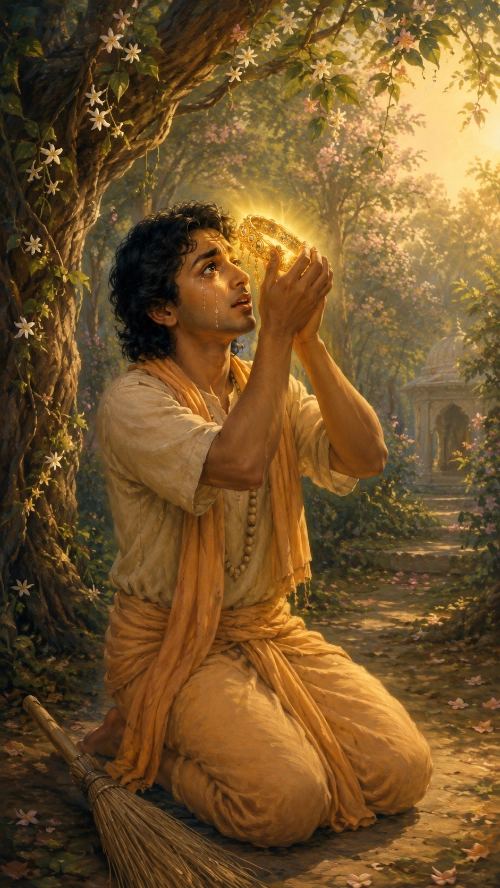
One early morning Kṛṣṇadāsa came to sweep the kuñja in Nidhivana. Suddenly, beneath a tree, he found a golden ornament. It was a beautiful anklet, a nūpura of extraordinary beauty. Kṛṣṇadāsa picked it up.
As he lifted it, the anklet began to make a sound — a very soft, delicate, melodious ringing, so beautiful that one could almost lose one’s mind hearing it. Waves of spiritual happiness seemed to emanate from the shining ornament. Kṛṣṇadāsa understood that this was no ordinary anklet, but he could not imagine to whom it might belong. Out of respect for the ornament and for the person who had worn it, he touched the anklet to his forehead.
At that very moment, all the symptoms of spiritual ecstasy manifested in his body. His hairs stood on end. He began perspiring profusely. Tears spontaneously streamed from his eyes. Kṛṣṇadāsa felt his entire being become filled with happiness. Divine love overwhelmed him. He pressed the anklet to his heart — and lost consciousness.
A considerable amount of time passed. When he regained consciousness, he began calling out for Rādhā and Kṛṣṇa, just as the gopīs, maddened by love, had once run here and there searching for Them. Kṛṣṇadāsa too began running and crying: “Where is Rādhā? Where is Kṛṣṇa? I must find Them!”
Eventually he regained his composure. He tied the anklet around his neck and continued cleaning the kuñja. Fearing that such a beautiful ornament might be stolen, he later buried it beneath a tree.
How Rādhārāṇī Lost Her Nūpura
In Vṛndāvana, within Nidhivana and its secluded kuñjas, the beautiful and exalted pastimes of Lord Kṛṣṇa and Śrīmatī Rādhārāṇī are eternally taking place. There is an eternal dance — the dance of the rāsa-līlā. Those who do not possess the necessary spiritual qualification cannot perceive this reality, even if they physically enter the place where these divine events unfold. But elevated devotees perceive that spiritual reality in all its beauty and glory.
Once Śrīmatī Rādhārāṇī, Kṛṣṇa and the gopīs were enjoying the rāsa-līlā together and entered a state of extraordinary ecstasy. The rhythm of the music, the dance and the entire atmosphere created an experience impossible to express through ordinary material senses. It inspired the dancers still further, and they moved according to the rhythm of Kṛṣṇa’s heart. They circled around Rādhā and Kṛṣṇa, playing various musical instruments, entering and leaving the circle of Their dance.
Soon the dance became so intense that Śrīmatī Rādhārāṇī lost one of Her nūpuras, Her anklets. No one even noticed when it happened.
But in truth, according to this narration, Śrīmatī Rādhārāṇī deliberately arranged this in order to bestow special mercy upon Kṛṣṇadāsa.
Later, when Śrīmatī Rādhārāṇī returned to Her room, She noticed that Her beloved anklet was missing. She turned to Lalitā and said: “Please return quickly to the kuñja and find My anklet. I lost it there.” Lalitā immediately hurried to carry out the order of her mistress.
Lalitā Appears as an Elderly Woman
When Lalitā entered the kuñja, she saw Kṛṣṇadāsa sweeping. Of course, she did not appear before him in her actual transcendental form; she disguised herself as an elderly woman. Approaching him, she said: “Oh, young man! How wonderful. You are serving so early in the morning and performing such useful service. What is your name?”
Kṛṣṇadāsa was extremely respectful. He replied: “My name is Duḥkhī Kṛṣṇadāsa. And what is your name? Where are you from? What brings you here at such an early hour?”
“Yes,” Lalitā replied, “I have indeed come here for a reason. I am looking for something that belongs to me. By chance, have you found a golden anklet here?”
Kṛṣṇadāsa thought for a moment. “Which village are you from? What is your name?” Lalitā smiled slightly and thought: “Oh, this young man is not quite so simple.” So she began inventing a story.
“My name is Rādhā-dāsī. I belong to a brāhmaṇa family of Vraja. And actually the anklet is not mine. It belongs to my daughter-in-law. She recently dropped it. You know how careless these young girls are. They are always losing one thing or another around here. So, what about the anklet, Kṛṣṇadāsa? Did you find it?”
Kṛṣṇadāsa replied: “Suppose I did find it. I must first make certain that it truly belongs to your daughter-in-law. Let us go to your village and show the anklet to your neighbours. If they confirm that it belongs to her, I will return it without asking any further questions.”
Lalitā Devī realised that this would not be so easy. For a moment she did not know what to say. Then she told him: “Kṛṣṇadāsa, let us not go anywhere. I will give you a reward for returning the anklet. You may ask for any blessing, and I will fulfil it.”
“The Best Reward You Can Give Me Is the Truth”
Now Kṛṣṇadāsa became even more curious about the identity of the person who had worn this anklet. He replied: “O most worthy lady, I desire nothing for myself. The best reward you can give me is the truth. Please tell me honestly: who are you, and who is the person to whom this extraordinary anklet belongs? As soon as I touched it, I felt as though I had entered an ocean of love for God. My heart became filled with pure devotion, and I lost consciousness. No ordinary anklet could possibly do this. Therefore I can only conclude that the owner of this anklet does not belong to this world.”
Lalitā nodded her head. “You are very perceptive for one so young. Very well. I shall tell you. This anklet belongs to Śrīmatī Rādhārāṇī, and I am Her maidservant, Lalitā Sundarī.”
Kṛṣṇadāsa exclaimed: “If that is so, then not only this anklet, but my very life belongs to you! If this is truly the case, I have only one desire: I wish to see your spiritual form. Please show me your true appearance.”
Lalitā replied: “My boy, you just lost consciousness merely by touching the anklet — and now you are asking to see my actual form? That is even more impossible!” But Kṛṣṇadāsa would not give up. “By your mercy, everything can become possible.”
At last Lalitā Devī relented. She told him to close his eyes. After a few moments, she allowed him to look upon her divine form. When Kṛṣṇadāsa saw the incomparable beauty of Lalitā Sundarī, he immediately lost consciousness. When he regained consciousness, Lalitā consoled him with affectionate words. With tears of love in his eyes, Kṛṣṇadāsa bowed at her feet.
Then Lalitā Sundarī placed her foot upon his head. The dust from her feet fell upon him and bestowed a great blessing. He came completely under the influence of the spiritual potency. He could no longer speak. He could only cry.
His Only Desire
Lalitā now invited him to ask for a blessing. Kṛṣṇadāsa replied without hesitation: “What else could I possibly ask for? My only desire is to serve Śrīmatī Rādhārāṇī and Kṛṣṇa under your guidance.”
Lalitā smiled. She was pleased to see how single-minded Kṛṣṇadāsa was. She told him: “I see your devotion. Do not doubt that you will attain the association of Rādhā and Kṛṣṇa. But you cannot serve Them intimately in this present body. You must prepare your mind — your manas — and your sevā, your service, for the intimate service of Śrī Rādhā. Then you will be able to enter the kuñja with Rūpa Mañjarī and personally behold the rāsa-līlā of Rādhā and Kṛṣṇa. And you will also come to know who you truly are. That realisation is true self-realisation.
“For now, continue serving. Continue living and serving the Gosvāmīs in this present body. Do not abandon your service in the kuñja. At the proper time, you will receive your perfected spiritual body, your siddha-deha.”
Lalitā then gave Kṛṣṇadāsa a secret mantra through which he could continually meditate upon and behold the form of Śrīmatī Rādhārāṇī.
The Golden Spade, and a New Name
Then they went to the place where the anklet had been buried. The iron spade Kṛṣṇadāsa had used to bury it had transformed into gold. Using that very spade, he dug up the ornament and retrieved the anklet. He respectfully touched it once more to his forehead and then carefully placed it into the hand of beautiful Lalitā.
She accepted the anklet. But unexpectedly, she touched it once again to Kṛṣṇadāsa’s forehead, marking him with it. She said: “May the touch of Śrīmatī Rādhikā’s feet remain forever imprinted upon your head.” Immediately, two vertical lines appeared upon his forehead. And where the central jewel of the anklet touched him, a dot appeared between them.
Lalitā said: “From this moment you shall have a new name. You shall be called Śyāmānanda.” Why? Because he had brought pleasure — ānanda — to Śyāmā, a name of Śrīmatī Rādhārāṇī. He had pleased Her by returning Her anklet.
Lalitā then told him: “Now return to your ordinary condition. Do not tell anyone what has taken place between us. You may tell only Jīva Gosvāmī.”
Śyāmānanda again bowed before Lalitā Devī. When he rose, Lalitā had disappeared. He began looking everywhere. “Where is beautiful Lalitā, the maidservant of Rādhārāṇī? Where has she gone?” But his search was useless. He remained there for a long time, almost unable to move, overwhelmed by spiritual love and an extraordinary state of joy.
Jīva Gosvāmī Finds Him
It was in this condition that Jīva Gosvāmī found him. Jīva immediately understood that something extraordinary had happened. How could he tell? He saw indescribable bliss in his disciple’s eyes. Kṛṣṇadāsa’s complexion seemed to have taken on a golden hue. And upon his forehead was a tilaka of an unusual form — a style of tilaka that the people of Vraja did not ordinarily wear.
Then Jīva Gosvāmī asked: “What has happened to you?” He also noticed the beautiful golden spade that Śyāmānanda was carrying wrapped in a piece of cloth. He began to suspect that something truly extraordinary had occurred. “And what is this unusual tilaka upon your forehead? I can see that you have received some special mercy from Kṛṣṇa — or perhaps from Śrīmatī Rādhārāṇī. Your body is displaying symptoms of ecstasy, and I can see tears of love flowing from your eyes. Please tell me what happened.”
Śyāmānanda replied: “My dear master and teacher, I was in Nidhivana, in the kuñja, and there I received the greatest mercy through my Gurudeva.” Because Lalitā Devī had specifically permitted him to tell Jīva Gosvāmī this sweet story, Śyāmānanda told him everything. But they agreed that the matter should not be revealed to others.
Śyāmānanda said: “I keep the lotus feet of my Guru Mahārāja, Hṛdaya Caitanya, upon my head. He is my master and lord. Although I am performing devotional service here in Vraja under the direction of Jīva Gosvāmī, I see everything as the mercy of my beloved Gurujī. It is through my spiritual master that I have received the blessings of Rādhārāṇī and Kṛṣṇa. I am completely certain that this name and this tilaka have been given to me through my Guru Mahārāja, Hṛdaya Caitanya, as the special mercy of the Divine Couple.”
It is remarkable how Śyāmānanda connected all of his spiritual advancement with the mercy of his spiritual master. For him, only through the guru had all of this become possible.
Because this had been Lalitā’s desire, Jīva Gosvāmī and Śyāmānanda did not tell others. Thus the residents of Vṛndāvana did not immediately learn the secret behind Kṛṣṇadāsa’s new name, Śyāmānanda. The new form of tilaka became known as Śyāmānandī tilaka, and also as Kṛpā-bindu, “the drop of mercy.” Only Jīva Gosvāmī and Śyāmānanda knew the secret of the name and the tilaka.
From this story we can understand that the spiritual world is very close — almost just beyond the next turn. Therefore, understanding the nearness of the Lord and of Śrīmatī Rādhārāṇī, it is extremely important that we sincerely and lovingly perform whatever service our Gurudeva has given us now.
We should place all our sincerity and all our love into that service. Then perhaps we may be noticed. Perhaps the curtain may be opened slightly for us. And then we may glimpse the true reality. And we may become truly ourselves. Hare Kṛṣṇa. Thank you, dear devotees.