

The Glory of Puruṣottama Month
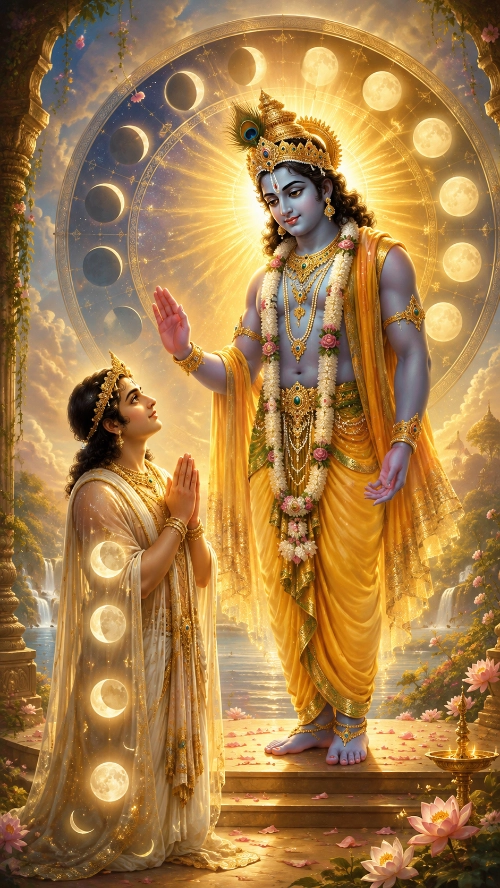
The Glory of Puruṣottama Month: The Extra Month That Kṛṣṇa Gave His Own Name
An address recorded on the eve of Puruṣottama-māsa, the thirteenth month the Vedic calendar inserts roughly once every three years. Bhakti Vijñāna Gosvāmī tells the Padma Purāṇa story of the month nobody wanted — mocked as Mala-māsa, the impure month, until it went weeping to Kṛṣṇa and came away bearing His own name — explains the astronomy that produces it, and sets out what a devotee should and should not do in the thirty days it lasts.
nama oṁ viṣṇu-pādāya kṛṣṇa-preṣṭhāya bhū-tale
śrīmate bhaktivedānta-svāmin iti nāmine
“I offer my respectful obeisances unto His Divine Grace A. C. Bhaktivedanta Swami, who is very dear to Lord Kṛṣṇa, having taken shelter at His lotus feet.”
namas te sārasvate deve gaura-vāṇī-pracāriṇe
nirviśeṣa-śūnyavādi-pāścātya-deśa-tāriṇe
“Our respectful obeisances unto you, O servant of Sarasvatī Gosvāmī. You are kindly preaching the message of Lord Caitanyadeva and delivering the Western countries, which are filled with impersonalism and voidism.”
vāñchā-kalpa-tarubhyaś ca kṛpā-sindhubhya eva ca
patitānāṁ pāvanebhyo vaiṣṇavebhyo namo namaḥ
“I offer my obeisances again and again unto the Vaiṣṇavas, who are like desire trees, who are oceans of mercy, and who deliver the fallen.”
jaya śrī-kṛṣṇa-caitanya prabhu nityānanda
śrī-advaita gadādhara śrīvāsādi-gaura-bhakta-vṛnda
“All glories to Śrī Kṛṣṇa Caitanya, Prabhu Nityānanda, Śrī Advaita, Gadādhara, Śrīvāsa and all the devotees of Lord Gaura.”
Hare Kṛṣṇa, Hare Kṛṣṇa, Kṛṣṇa Kṛṣṇa, Hare Hare
Hare Rāma, Hare Rāma, Rāma Rāma, Hare Hare
The mahā-mantra was chanted three times before the address began.
antaḥ praviśya mama vācam imāṁ prasuptāṁ
sañjīvayaty akhila-śakti-dharaḥ sva-dhāmnā
anyāṁś ca hasta-caraṇa-śravaṇa-tvag-ādīn
prāṇān namo bhagavate puruṣāya tubhyam
“Entering within, He who holds all potencies revives by His own effulgence this sleeping speech of mine, and my other faculties as well — hands, feet, hearing, skin and the life airs. Obeisances unto You, O Supreme Person.” The verse recited before one speaks from the Bhāgavatam.
Hare Kṛṣṇa, dear Vaiṣṇavas. I am recording this short address on the eve of the month of Puruṣottama. Tomorrow, May 17, the additional month — Adhika-māsa, or Puruṣottama-māsa — will begin, and will continue until June 15, if I am not mistaken.
Of course, in order to spend this time properly and receive the greatest possible benefit from this month, which occurs approximately once every three years, we need to understand clearly what kind of period this is, what should be done during it, and what should under no circumstances be done.
First I will tell a story connected with Puruṣottama-māsa and the Padma Purāṇa, a story that Kṛṣṇa Himself tells to the Pāṇḍavas while they are living in exile in Kāmyavana. Then I will explain astronomically how this additional month, or Adhika-māsa, arises. After that, I will explain what should be done and what should be avoided during this sacred month.
The Vedic Conception of Time
But first I would like us to recall the Vedic conception of time, in contrast to the modern materialistic conception. In the modern conception, time is understood as an impersonal medium in which events occur, while that medium itself has no influence on the events taking place within it.
But the Vedas say that time is a very concrete power, a manifestation of the Lord in this world, and that every moment of time carries a particular energy — auspicious or inauspicious. Just as a turbulent mountain river may rush violently and scatter spray, then divide into many streams, then suddenly begin flowing smoothly, and afterward accelerate again depending upon the shape of its riverbed, in the same way the current of time in which we exist exerts a definite and very powerful influence upon everything we do.
Every moment of time carries this energy. And if we learn to sense this energy — or at least to understand what sort of energy is contained within a particular moment, day, or month — then we can derive the greatest possible benefit from all these situations. We will not try to begin good activities at times dominated by tamo-guṇa, because the influence of tamo-guṇa upon our mind may contaminate those endeavors. Conversely, we will try to increase our good activities as much as possible during periods that favor them and make them most effective, because such periods help purify our consciousness.
This habit of observing time’s influence on our mind is extremely important. We should not go against it. For example, in the evening, when tamo-guṇa naturally begins to descend upon people and they become sleepy, they sometimes try to fight it. Of course, one can fight it — but at what cost? At the cost of losing sleep, at the cost of health problems, rather than submitting appropriately to the influence of time and the corresponding guṇa that is strengthened during that period, and thereby deriving maximum benefit from that moment.
Time is a great wheel. It is the Sudarśana-cakra in the hands of the Lord. It is constantly turning, sometimes pushing us toward the Lord and sometimes, conversely, obstructing our movement toward Him. If we understand this, even apparently unfavorable moments can be turned to our benefit.
Nārada Muni Asks About Kali-yuga
With that said, I will begin the story. It begins not very far from where I am now. I am in Ṛṣikeśa, at the foothills of the Himalayas, and high in the Himalayan mountains, in the abode of Lord Nārāyaṇa at Badarī-Nārāyaṇa, reside great sages and great yogīs. They are still present there even today.
Once Nārada Muni came there, to Badarikāśrama, in order to meet Lord Nārāyaṇa. There he asked Him: “How can one resist the mighty power of time in Kali-yuga? How can one neutralize the sins — or the dirt and contamination — that we naturally absorb simply by living in this very unfavorable age?”
Lord Nārāyaṇa smiled at Nārada’s question and praised him for being concerned about the welfare of the souls living in this world and undergoing the degrading influence of Kali-yuga. He said: “To answer your question, I will tell you a story — or rather, I will recount an event that took place when the Pāṇḍavas were living in exile.”
Kṛṣṇa Visits the Exiled Pāṇḍavas
Under the irresistible influence of time, the Pāṇḍavas had lost their kingdom, their wealth and their power, and they had almost lost their wife as well. They had endured the humiliating event in which Duḥśāsana attempted to strip Draupadī in front of everyone. They then went into exile.
The first place where they settled after entering the forest was Kāmyavana, a secluded forest on the border of Vraja. There, in Kāmyavana — or Kāmika-vana — Lord Kṛṣṇa came to them after learning everything that had happened.
When He saw the condition of the Pāṇḍavas, Kṛṣṇa became angry. He saw that they were dressed in tree bark, that their hair was matted, that instead of wearing royal silk garments they were dressed in rags, and that they were eating only very simple food. The anger rising in Lord Kṛṣṇa’s heart caused Him to say:
“I will destroy this entire creation right now — and Duryodhana as well. If wicked people can subject My devotees, innocent people, to such suffering, then this whole creation is not worth preserving. I created this world so that My bhaktas could develop love for Me and ultimately return to Me. But if wicked people triumph here, then what is the purpose of such a creation?”
He was already preparing to summon His Sudarśana disc when Arjuna folded his hands and began to plead with Him:
“Do not do this. Yes, You can easily destroy the entire creation — but because of whom? Because of Duryodhana, because of this one villain? Is that really necessary? There are still many good people in this world. Simply because one villain pollutes the world by walking upon the earth — or even hundreds or thousands of villains — there is no reason to destroy the entire creation.
“Instead, please explain why we have fallen into such a condition, why we have undergone such terrible humiliation, and how we can get out of it. How can we overcome the power of time that has condemned us to suffering?”
Then Kṛṣṇa sat down comfortably, looked at Arjuna, and said: “Now I shall reveal to you the glory of the month of Puruṣottama in relation to your question. For within this māhātmya, this glorification of Puruṣottama month, lies the answer to what you have asked. Even great sages do not know the full glory of this month. This is an extremely secret subject, concealed even from very wise people.”
Of course, nowadays, with the spread of the internet, perhaps there are no secrets left. Nevertheless, this subject remains guhyatamam, most confidential, because many people may hear about the glory of Puruṣottama month, but very few will take that glory seriously and make use of the powerful energy Kṛṣṇa has placed within it.
The Rejected Month
Kṛṣṇa began to explain that in this world, every phenomenon has a presiding deity, protector, or powerful force of nature that gives it potency. According to the astrological science, Jyotiṣa-śāstra, every moment of time has some demigod standing behind it who makes that moment unique. Every tithi, every muhūrta, every pakṣa, every month — every division of time has its presiding power.
But there was one exception. Adhika-māsa, which was also called Mala-māsa, the “impure” or “contaminated” month, had no protector. And so, in tears, this orphaned month, which had no presiding deity, no protector, and no special power standing behind it, went to Lord Nārāyaṇa to ask for His blessing.
In Vaikuṇṭha, Lord Nārāyaṇa learned of Adhika-māsa’s fate. People mocked this month. They laughed at it and said: “This is absolutely useless time. It is wasted time. During this period we cannot do anything good, nothing that will improve our karma or bring us closer to God.”
Showered with such ridicule, Adhika-māsa came to Viṣṇu. Viṣṇu said: “I will take you to the Lord of the highest planet of the spiritual world — to Kṛṣṇa Himself. Take shelter of Him. He will never refuse shelter to you.”
Together they went to Goloka. Adhika-māsa began to complain: “In every other month important events take place. The Sun moves from one zodiac sign to another. There is Sūrya-saṅkrānti, or Ravi-saṅkrānti. But I am completely empty. I have no protector. During my entire month the Sun does not change signs. What am I supposed to do?”
Overcome with grief, the personified month fainted. “It would be better if I did not exist. It would be better if I disappeared from this world, because my existence has no meaning and people only laugh at me.”
Kṛṣṇa, taking compassion upon him, naturally agreed to give him shelter. Kṛṣṇa always accepts those who sincerely surrender to Him. Seeing the sincerity of Adhika-māsa, the additional month, or Mala-māsa, He gave him a blessing:
“From this moment onward, you will become the most powerful of all months. All the other months will worship you. You will possess a potency that no other month could even dream of possessing. Just as rare souls worship Me, understanding that I am the Lord of all the demigods and all the other manifestations of Viṣṇu, in the same way knowledgeable people will worship you, bow before you, and reverently value every second of time that you give them. From now onward, this will be so. Do not doubt it.
“I shall become your presiding deity. Because you had no other adhiṣṭhātṛ-devatā, no protector, I Myself shall become your protector. And instead of being called Mala-māsa, the dirty month, or merely Adhika-māsa, the additional month, you shall bear the name Puruṣottama-māsa — the month bearing the name of the Supreme Personality of Godhead.
“Just as the Supreme Personality of Godhead, Puruṣottama, stands above all other manifestations and phenomena of both this world and even the spiritual world, in the same way you shall stand above all other periods of time. Your energy will have no equal.”
Why Did the Pāṇḍavas Suffer?
Having said this, Kṛṣṇa became silent. Arjuna again asked: “But what does this have to do with us? What did we do wrong? Why did we end up in such a condition?”
Then Kṛṣṇa began to tell a story about Draupadī. He said that in a previous life she had been a girl born into a brāhmaṇa family. Once Durvāsā Muni came to their house. Filled with enthusiasm, Durvāsā Muni began glorifying Puruṣottama month and explaining the significance and power of this sacred period. But Draupadī, being a girl from a very traditional family, did not take his words seriously.
Again, this month was traditionally regarded as impure. One could not perform certain auspicious rituals during it. One should not perform certain saṁskāras, marry, or give initiation. So people thought: “What use is there in this month?” Draupadī did not believe Durvāsā Muni. And because of this offense, Kṛṣṇa said, she underwent what she experienced in her present life.
In the Hari-bhakti-vilāsa, a verse quoted from the Bhaviṣyottara Purāṇa states that if a person neglects the Puruṣottama month and does not perform a vrata during it, he may lose his accumulated prosperity and piety, become unable to accomplish anything, and ultimately may even fall into hell. In one way or another, these scriptural statements — even if perhaps some of them use deliberate exaggeration as a rhetorical device — are meant to encourage us to take this month and the vows associated with it seriously. We will speak about those vows later.
Lord Kṛṣṇa then concluded His words to the Pāṇḍavas: “If you wish to escape the miserable condition in which you now find yourselves, you must make use of Puruṣottama month. Take strong vows and observe this month properly. This will eventually help you escape your present condition, defeat all your enemies, regain your kingdom, and once again rule in this world.”
And that, of course, is what the Pāṇḍavas eventually did. Their exile ultimately ended in a victorious war and their triumphant restoration.
Kamalā Ekādaśī
Among all the days of Puruṣottama month, two Ekādaśīs possess special power. These are the Kamalā Ekādaśīs, into which the goddess of prosperity herself is said to have invested her potency. The Pāṇḍavas carefully observed their vows throughout the entire month, paying special attention to these two Ekādaśīs occurring during Puruṣottama-māsa.
When Nārada Muni heard this story from Nārāyaṇa at Badarīnātha, he became greatly inspired. He said: “Now I understand how people in Kali-yuga can free themselves from the heavy burden of sin.”
And this is essentially the central meaning of Puruṣottama month. If a devotee carefully observes vows during this month, then ultimately he can become freed from the burden of offenses that he knowingly or unknowingly commits while practicing devotional service at other times. Because of its purifying power, and because of the glories described in the Purāṇas, this month assists us in our devotional service.
Greater Than Kārttika
The Purāṇas say that among all the months of the year, Kārttika is extremely powerful. Its potency is said to be one hundred times greater than that of an ordinary month. The sacred month of Māgha is also very powerful — Kṛṣṇa says in the Bhagavad-gītā that among months He is Māgha. Vaiśākha is likewise regarded as one of the most auspicious months of the year.
But Kārttika is said to surpass ordinary months one hundredfold. And Puruṣottama-māsa is said to surpass even Kārttika a thousandfold in potency. So, if we are intelligent, we should certainly receive the full benefit of these thirty days.
How Adhika-māsa Arises Astronomically
How does Puruṣottama-māsa, or Adhika-māsa, actually arise? It occurs because the lunar year is approximately eleven days shorter than the solar year. The solar year lasts approximately 365 days, while the lunar year lasts about 354 days. This difference of eleven days causes the lunar and solar calendars to drift apart by approximately one full month every few years — roughly every thirty-two months. At that point, an additional lunar month must be inserted so that the lunar and solar years become synchronized again. This is similar to how we insert a leap day into the calendar in a leap year to keep it aligned with the Sun’s actual movement.
So when is this additional month inserted? We know that in the calendar being discussed here, lunar months are counted in relation to the full moon — from one full moon to the next. Alongside these are solar months, which are counted from one saṅkrānti, the Sun’s transition from one zodiac sign to another, to the next. This usually occurs around the middle of each month.
Normally, one saṅkrānti occurs within every lunar month. But when a lunar month occurs in which there is no saṅkrānti at all, that month becomes an intercalary or additional month. In this particular calculation, the inserted month is reckoned from new moon to new moon. Thus, when a new moon occurs immediately after a saṅkrānti, there may be no further saṅkrānti before the next new moon. That lunar month then becomes Adhika-māsa, the inserted month, proudly bearing the name Puruṣottama.
In the year being discussed, 2026, this inserted month falls in connection with Jyeṣṭha, and therefore it is Jyeṣṭha Adhika-māsa. Sometimes the inserted month falls earlier, sometimes later.
What Should We Do During Puruṣottama Month?
Now, what should we actually do? Nothing extraordinary is required. We simply need to do well everything that we are already doing. If possible, one may increase the number of rounds of japa, or increase the quality and attention of one’s chanting.
Among the special practices traditionally performed during this month, one may offer a dīpa, a lamp, to the Lord every evening around sunset. Even more powerful is the akhaṇḍa-dīpa, an uninterrupted lamp. We take a larger lamp, fill it with oil, and carefully ensure the oil never runs out and the flame keeps burning. This akhaṇḍa-dīpa symbolizes the uninterrupted continuity of our bhakti toward the Lord. We are, in effect, saying: “I want my devotion to You never to end or dry up. May it always burn with a clear flame.” You may use any suitable oil; it does not necessarily have to be clarified butter. Vegetable oil may also be used.
Do Not Criticize Anyone
Far more important is this: during this month, do not criticize anyone. I emphasize again: absolutely no one. Kṛṣṇa does not like it when we place our consciousness in duality and begin judging other people according to our material conceptions of what is good and what is bad.
During this month one should not lie. One may take a vow of truthfulness: “I will speak the truth, only the truth, and nothing but the truth.” And “truth” for us ultimately means: “I will speak about the Absolute Truth and will try to avoid making statements that have no absolute spiritual value.”
During this month, one should avoid prajalpa, useless worldly talk. We should not spend our time discussing mundane subjects. We should reduce our visits to news websites, regardless of how strongly our consciousness and mind are agitated by all the storms constantly occurring in this world. One may also take a vow of silence — for example, remaining silent until noon, or until some chosen time of the day.
Read Scripture
During this month we should read sacred scriptures, above all:
- Bhagavad-gītā;
- Śrīmad-Bhāgavatam.
And if possible, one should read about the glories of Puruṣottama month from the Padma Purāṇa.
Bhaktivinoda Ṭhākura wrote a special article in Sajjana-toṣaṇī, where he exclaims: “O jīva-soul! Why are you lazy about performing harināma? Why do you neglect harināma during this extraordinary month, whose potency surpasses Kārttika, Māgha and Vaiśākha?” In this way he calls upon us to invest all our heart, all our consciousness, all our spiritual and physical strength in making use of this extraordinary month.
Following in the footsteps of his father, Bhaktisiddhānta Sarasvatī spent Puruṣottama month in Vraja during the last year of his life, in 1936. He left Calcutta, went to Vraja during the hot season, and spent the entire month in Vṛndāvana, speaking Śrīmad-Bhāgavatam every day. Therefore, this month is held in very high regard within the Gauḍīya Maṭha tradition.
Stay in a Holy Place If Possible
If you have the opportunity to spend this month in a holy place, that is especially beneficial. Many pilgrims come to Vṛndāvana during this month, especially Kṛṣṇa-bhaktas from Gujarat. Despite the heat, they undertake austerities in Vraja. Many perform Govardhana-parikramā with full daṇḍavats, and so on.
But this month, bathing in sacred places, sacred springs or sacred rivers is even more strongly recommended. If possible, one should bathe in such holy waters every day. The purification produced by such bathing is said to be multiplied many times during this month, so that sins and offenses may be washed away through observance of this vrata. One may also restrict oneself in particular foods — for example, abstaining from wheat for the entire month, or making some similar dietary vow.
Charity During Puruṣottama Month
In the sixteenth vilāsa of Hari-bhakti-vilāsa, one very important point is emphasized: during Puruṣottama-māsa, one should give charity, particularly to qualified brāhmaṇas. It is stated there that a person should give thirty-three sweets to thirty-three worthy brāhmaṇas. The text warns that neglecting such charity causes loss of piety.
But what I especially want to emphasize is this. We may perform austerities ourselves, or we may not have the physical strength to do so. But we can always help and support other people, particularly spiritual practitioners. This can bring very great benefit if a person gives with a sincere heart, thinking of Kṛṣṇa rather than of personal gain. Then such a person can genuinely attract Kṛṣṇa’s favor, which He is ready to bestow upon anyone who sincerely observes a vow during this month.
On Whom Should We Meditate?
One more very important point remains. All these austerities will be meaningless if we do not clearly understand for whom we perform them. To whom are they directed? For whose sake are we doing them?
Puruṣottama means “the Supreme Person,” the Supreme Personality of Godhead. The Fifteenth Chapter of the Bhagavad-gītā is called Puruṣottama-yoga. There Kṛṣṇa explains the distinction between kṣara and akṣara puruṣa.
Kṣara refers to those persons who, because of their tendency to enjoy material energy, continually undergo change. These are the painful changes that happen to us:
- birth;
- death;
- old age;
- disease;
- gradual deterioration of the body;
- the loss of energy day after day;
- and the body’s eventual collapse.
These changes also include our many emotional disturbances — especially negative emotions, stress, grief, longing, sadness and so forth.
Then there is akṣara-puruṣa. Kṛṣṇa explains that the akṣara beings are kūṭa-stha, unchanging. There are two kinds of puruṣas in this world, kṣara and akṣara. The akṣara-puruṣas are the liberated souls, nitya-muktas, who have become free from the necessity of taking birth and dying in this world, and free from the turbulent whirlwinds of emotional disturbance that trouble conditioned existence.
Above all of them, Kṛṣṇa says in the Bhagavad-gītā, stands Puruṣottama Himself, the Supreme Personality of Godhead, the Supreme Person who possesses all His energies. By definition, a person possesses energy. And Puruṣottama, the supreme person, is He who possesses and directs the supreme energy.
We know that the highest energy is hlādinī-śakti, the potency of divine love and bliss. Kṛṣṇa is that manifestation of God who possesses hlādinī-śakti in fullness. And the personification of that hlādinī-śakti is Śrīmatī Rādhārāṇī.
Therefore, the Deity of this month is not Kṛṣṇa alone. The Deity of this month is Rādhā-Kṛṣṇa, Rādhā-Mādhava, Rādhā-Govinda, Rādhā-Madana-mohana. They preside over this month. Deep within it lies the energy of divine love, and through sādhana this energy can become accessible to those who take the vrata of Puruṣottama-māsa seriously.
The Meditation Mantra
The śāstras give a mantra to be recited daily while meditating upon Rādhā-Kṛṣṇa:
dhyāyen nava-ghana-śyāmaṁ
dvi-bhujaṁ muralī-dharam
lasat-pīta-paṭaṁ ramyaṁ
sa-rādhāṁ puruṣottamam
“Let one meditate upon Puruṣottama, dark as a freshly gathered raincloud, two-armed, holding the flute, lovely in shining yellow cloth — and accompanied by Rādhā.”
Who is Puruṣottama? Puruṣottama is the Supreme Personality of Godhead together with Rādhā: sa-rādhāṁ puruṣottamam. One should meditate, contemplate and focus one’s attention upon this Puruṣottama. And who is He?
And if we worship Them and meditate upon Them, then, becoming pleased with us, They may reveal something of Themselves and share with us a portion of the bliss of which Their very existence is composed.
Thank you very much. I wish everyone an extremely fruitful Puruṣottama month, and success in choosing and taking their vows. It is still not too late today to consider what vows we can take, so that we may spend this month with the greatest possible benefit — for ourselves, for everyone around us, and for the whole world. Hare Kṛṣṇa. Śrīla Prabhupāda ki jaya!