

A River of Nectar Beside a Pit of Poison
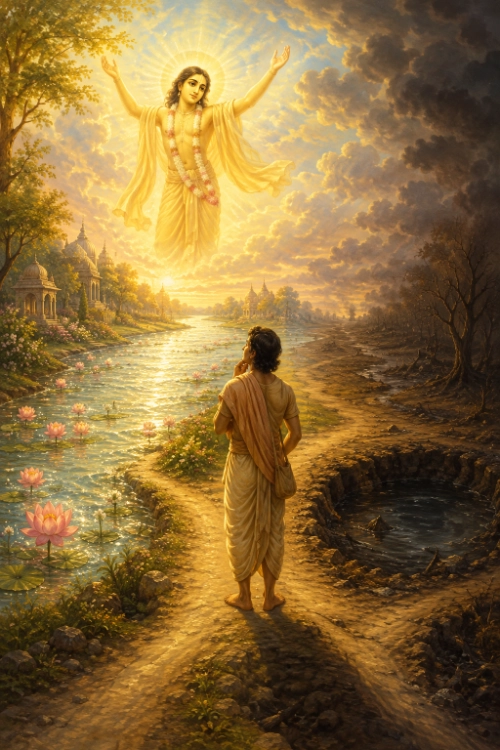
Why Human Life Is So Precious in the Teachings of Śrī Caitanya
A clear river of nectar is flowing nearby. A thirsty man walks past it, finds a muddy hollow in the ground, and drinks water mixed with poison. That is the image Kṛṣṇadāsa Kavirāja Gosvāmī leaves the reader with at the close of his account of Śrī Caitanya Mahāprabhu’s appearance — and it is one of the harshest things he ever wrote. It is also, read properly, not a condemnation at all. It is about opportunity.
Toward the end of the chapter describing the Lord’s appearance, Kṛṣṇadāsa turns abruptly away from narration and speaks directly to whoever is reading:
পাইয়া মানুষ জন্ম, যে না শুনে গৌরগুণ,
হেন জন্ম তার ব্যর্থ হৈল ।
পাইয়া অমৃতধুনী, পিয়ে বিষগর্ত-পানি,
জন্মিয়া সে কেনে নাহি মৈল ॥
pāiyā mānuṣa janma, ye nā śune gaura-guṇa
hena janma tāra vyartha haila
pāiyā amṛtadhunī, piye viṣa-garta-pāni
janmiyā se kene nāhi maila
“Having obtained human birth, one who does not hear the qualities and glories of Gaura has allowed such a birth to become fruitless. Having reached a river of nectar, he drinks the water of a poisoned pit. Having taken birth, why did he not die?”
“Anyone who attains a human body but does not take to the cult of Śrī Caitanya Mahāprabhu is baffled in his opportunity. Amṛtadhunī is a flowing river of the nectar of devotional service. If after getting a human body one drinks the water in a poison pit of material happiness instead of the water of such a river, it would be better for him not to have lived, but to have died long ago.”
Caitanya-caritāmṛta, Ādi-līlā 13.123
The severity is real and should not be softened. But the subject of the verse is not death. Human birth is presented as rare and spiritually consequential; Śrī Caitanya’s mercy is presented as a river in flood. The tragedy is receiving both and still directing a life toward what cannot finally satisfy. The image is meant to wake the reader up, not to sentence anyone.
Where the Verse Sits
Ādi-līlā’s thirteenth chapter narrates the appearance of Mahāprabhu at Navadvīpa. Immediately before the warning, Kṛṣṇadāsa writes:
ঐছে প্রভু শচী-ঘরে, কৃপায় কৈল অবতারে,
যেই ইহা করয়ে শ্রবণ ।
গৌরপ্রভু দয়াময়, তাঁরে হয়েন সদয়,
সেই পায় তাঁহার চরণ ॥
aiche prabhu śacī-ghare, kṛpāya kaila avatāre
yei ihā karaye śravaṇa
gaura-prabhu dayāmaya, tāṅre hayena sadaya
sei pāya tāṅhāra caraṇa
“In this way the Lord appeared in the house of Śacī out of His mercy. One who hears this account receives the favor of merciful Gaura and attains His feet.”
Caitanya-caritāmṛta, Ādi-līlā 13.122
and then the line everything turns on:
pāiyā mānuṣa janma, ye nā śune gaura-guṇa
“Having obtained human birth, one who does not hear Gaura’s glories…”
The connection matters, because it fixes what the verse is actually about. The activity in question is śravaṇa — hearing. The Bengali does not say that whoever fails to join a particular institution has wasted human life. It says: one who does not hear gaura-guṇa. That is both more traditional and considerably more searching.
What Gaura-guṇa Means
The compound is straightforward:
গৌরগুণ
gaura-guṇa
So gaura-guṇa means the qualities and glories of Śrī Caitanya — which in practice covers a great deal:
- His compassion and His humility,
- His teachings,
- His nāma-saṅkīrtana,
- His dealings with His devotees,
- His ecstatic love of Kṛṣṇa,
- His renunciation and His līlā,
- and the theological meaning of His appearance.
Prabhupāda’s phrase “the cult of Śrī Caitanya Mahāprabhu” uses cult in its older English sense — a system of worship or devotion — which is how the word functioned when he wrote. For a modern reader the Bengali says the thing more plainly: hear the glories of Gaura.
Hearing as a Practice
The emphasis on hearing is not a Bengali innovation. Prahlāda Mahārāja‘s famous list of the principal practices of bhakti opens with it:
श्रवणं कीर्तनं विष्णोः
स्मरणं पादसेवनम् ।
अर्चनं वन्दनं दास्यं
सख्यमात्मनिवेदनम् ॥
śravaṇaṁ kīrtanaṁ viṣṇoḥ
smaraṇaṁ pāda-sevanam
arcanaṁ vandanaṁ dāsyaṁ
sakhyam ātma-nivedanam
“Hearing about Viṣṇu, glorifying Him, remembering Him, serving His feet, worshiping Him, offering prayers, serving Him as a servant, relating to Him as a friend, and offering one’s very self.”
Śrīmad-Bhāgavatam 7.5.23
The first item is śravaṇam, hearing — and the reason is that consciousness is continuously shaped by whatever it takes in. A person hears about money, conflict, politics, pleasure, fear, success, failure, status, and a hundred temporary concerns, and is formed accordingly. Bhakti deliberately introduces a different center into that stream. Hearing becomes a way of redirecting attention, memory, desire, and eventually identity.
Hearing as Medicine
One of the closest Sanskrit parallels to gaura-guṇa-śravaṇa stands at the opening of the Tenth Canto:
निवृत्ततर्षैरुपगीयमानाद्
भवौषधाच्छ्रोत्रमनोऽभिरामात् ।
क उत्तमश्लोकगुणानुवादात्
पुमान् विरज्येत विना पशुघ्नात् ॥
nivṛtta-tarṣair upagīyamānād
bhavauṣadhāc chrotra-mano-‘bhirāmāt
ka uttamaśloka-guṇānuvādāt
pumān virajyeta vinā paśu-ghnāt
“Who could turn away from hearing the repeated glorification of the qualities of Uttamaśloka? Such glorification is sung by those free from material thirst, is medicine for material existence, and delights both the ear and the mind.”
Śrīmad-Bhāgavatam 10.1.4
Two of its expressions illuminate the Bengali verse directly. The first is uttamaśloka-guṇānuvāda, the repeated narration of Bhagavān’s qualities — which is precisely what gaura-guṇa names. The second is the more surprising one:
भवौषध
bhavauṣadha
— medicine for material existence. Hearing is not being described as the transfer of information. It is described as therapeutic, something that acts on consciousness. And the same verse calls the narration delightful to the ear and the mind: the medicine is also nectar. That is already most of the way to Kṛṣṇadāsa’s amṛtadhunī, a river of nectar.
Why Human Birth Is Precious
The verse opens with two words that invoke one of the great themes of the Bhāgavatam:
পাইয়া মানুষ জন্ম
pāiyā mānuṣa janma
“having obtained human birth.”
Human life is treated as unusually valuable — but not because the human body lasts. It does not. Its value lies in what can be deliberately done with it. Prahlāda states the paradox in a single verse:
कौमार आचरेत्प्राज्ञो
धर्मान्भागवतानिह ।
दुर्लभं मानुषं जन्म
तदप्यध्रुवमर्थदम् ॥
kaumāra ācaret prājño
dharmān bhāgavatān iha
durlabhaṁ mānuṣaṁ janma
tad apy adhruvam arthadam
“An intelligent person should practice bhāgavata-dharma from childhood. Human birth is rare; although impermanent, it is capable of bestowing the highest value.”
Śrīmad-Bhāgavatam 7.6.1
Three words in it carry the whole argument:
दुर्लभम्
— rare, difficult to obtain.
अध्रुवम्
— unstable, impermanent.
अर्थदम्
— capable of yielding real value. Rare, temporary, and immensely consequential: that combination is the emotional engine of Kṛṣṇadāsa’s warning. The opportunity is precious partly because it does not last.
What Is Not Uniquely Human
The Avadhūta brāhmaṇa makes the point to King Yadu with an observation that is easy to skim past:
लब्ध्वा सुदुर्लभमिदं बहुसम्भवान्ते
मानुष्यमर्थदमनित्यमपीह धीरः ।
तूर्णं यतेत न पतेदनुमृत्यु यावन्
निःश्रेयसाय विषयः खलु सर्वतः स्यात् ॥
labdhvā su-durlabham idaṁ bahu-sambhavānte
mānuṣyam artha-dam anityam apīha dhīraḥ
tūrṇaṁ yateta na pated anu-mṛtyu yāvan
niḥśreyasāya viṣayaḥ khalu sarvataḥ syāt
“Having obtained after many births this exceedingly rare human condition—which, though temporary, can bestow the highest value—a sober person should strive quickly for the supreme good before death arrives. Sense objects are available everywhere.”
Śrīmad-Bhāgavatam 11.9.29
Human life is valuable yet temporary — and then: viṣayaḥ khalu sarvataḥ syāt, sense enjoyment is available everywhere. The claim is not that eating and sleeping are shameful. It is that they are not distinctive:
- eating is not uniquely human,
- sleeping is not uniquely human,
- reproduction is not uniquely human,
- fear is not uniquely human,
- competition is not uniquely human,
- seeking shelter and comfort are not uniquely human.
What a human being can do that is genuinely distinctive is ask — and then act on the answer. Who am I? What is consciousness? Why is there suffering? What is death, and what survives it? What is the source of existence? Can consciousness become free of its conditioning? A human life can be consciously restructured around those questions. That is what arthadam means.
Ṛṣabhadeva puts the same argument more sharply:
नायं देहो देहभाजां नृलोके
कष्टान् कामानर्हते विड्भुजां ये ।
तपो दिव्यं पुत्रका येन सत्त्वं
शुद्ध्येद्यस्माद् ब्रह्मसौख्यं त्वनन्तम् ॥
nāyaṁ deho deha-bhājāṁ nṛ-loke
kaṣṭān kāmān arhate viḍ-bhujāṁ ye
tapo divyaṁ putrakā yena sattvaṁ
śuddhyed yasmād brahma-saukhyaṁ tv anantam
“This human body is not meant merely for laboring hard for sensory pleasures available even to lower creatures. One should undertake divine discipline by which one’s existence becomes purified and unlimited spiritual happiness is realized.”
Śrīmad-Bhāgavatam 5.5.1
The contrast there — temporary gratification against unlimited spiritual happiness — is exactly the contrast Kṛṣṇadāsa compresses into nectar and poison.
A River, Not a Drop
The central image of the Bengali verse is a single compound:
অমৃতধুনী
amṛtadhunī
Not a measured portion of nectar — a river of it. The metaphor is about abundance. Grace is not being depicted as a scarce substance handed out reluctantly; it is depicted as flowing past. That fits the Gauḍīya understanding of Śrī Caitanya’s appearance as an extraordinary outpouring of prema.
Prabhupāda’s purport to this verse cites Prabodhānanda Sarasvatī, whose imagery is almost identical:
प्रसारितमहाप्रेमपीयूषरससागरे
चैतन्यचन्द्रे प्रकटे यो दीनो दीन एव सः ॥
prasārita-mahā-prema-pīyūṣa-rasa-sāgare
caitanya-candre prakaṭe yo dīno dīna eva saḥ
“When Caitanya-candra has appeared and the nectarean ocean of great prema has been spread everywhere, one who nevertheless remains spiritually impoverished is truly poor.”
Caitanya-candrāmṛta
अवतीर्णे गौरचन्द्रे
विस्तीर्णे प्रेमसागरे ।
सुप्रकाशितरत्नौघे
यो दीनो दीन एव सः ॥
avatīrṇe gaura-candre
vistīrṇe prema-sāgare
suprakāśita-ratnaughe
yo dīno dīna eva saḥ
“When Gaura-candra has descended, the ocean of prema has expanded and its abundance of jewels has become clearly manifest; one who nevertheless remains destitute is truly destitute.”
Caitanya-candrāmṛta
The logic runs parallel to the Bengali. The complaint is never that there is no spiritual wealth available. It is that the treasure is overflowing and one remains poor anyway. The tragedy is indifference in the middle of abundance.
Why Gaura Specifically?
The Sanskrit sources speak broadly of hearing Bhagavān’s qualities. Why does Kṛṣṇadāsa narrow it to gaura-guṇa?
Because in Gauḍīya theology Śrī Caitanya is not a teacher standing at some distance from Kṛṣṇa. He is understood as Kṛṣṇa Himself, appeared in order to taste and distribute the prema associated with Śrī Rādhā and Vraja. Hearing Gaura therefore leads directly into Kṛṣṇa’s Name, Kṛṣṇa’s qualities, Kṛṣṇa’s līlā, and nāma-saṅkīrtana. Gaura-guṇa-śravaṇa is a doorway rather than a destination.
Water From a Poisoned Pit
Against the flowing river Kṛṣṇadāsa sets a deliberately ugly image:
বিষগর্ত-পানি
viṣa-garta-pāni
A clear river runs close by; the thirsty man turns instead toward a muddy hollow and drinks what is in it. The behavior is irrational, and its irrationality is the entire point. The image dramatizes what bhakti theology takes to be the internal contradiction of conditioned desire.
The Problem Is Not the Thirst
This distinction is the one most often lost, and losing it turns the verse into something it is not. Gauḍīya theology does not fault the living being for wanting happiness. Conscious beings seek fulfillment; that is not an error. The question the verse asks is not “why do you want nectar?” but “why are you looking for it in poison?”
Nor does it deny ordinary experience. Food does taste good. Friendship does bring joy. Beauty does delight, success does satisfy, rest is genuinely restful. The argument is about structure, not about sensation: conditioned pleasure is temporary, dependent, unstable, vulnerable to loss, and powerless against aging, separation, and death. Kṛṣṇa says as much:
ये हि संस्पर्शजा भोगा
दुःखयोनय एव ते ।
आद्यन्तवन्तः कौन्तेय
न तेषु रमते बुधः ॥
ye hi saṁsparśa-jā bhogā
duḥkha-yonaya eva te
ādy-antavantaḥ kaunteya
na teṣu ramate budhaḥ
“Pleasures born from contact with the senses become sources of suffering because they have a beginning and an end. Therefore the wise do not seek their ultimate satisfaction in them.”
Bhagavad-gītā 5.22
The operative phrase is ādy-antavantaḥ — “having a beginning and an end.” The poison is not that every pleasure hurts on contact. The poison is demanding from something temporary what only the eternal can supply.
The word amṛta itself carries the argument: a-mṛta, “not dead,” deathless. So the contrast is not pleasant experience against unpleasant experience. It is temporary enjoyment against what leads beyond death — and in Gauḍīya theology amṛta finally means something more particular than a superior sensation. It means relationship with Bhagavān, culminating in prema.
Two Gifts, Both Wasted
If there were no alternative, drinking bad water would be understandable. What makes the image bite is that Kṛṣṇadāsa says the alternative has already been received:
pāiyā amṛtadhunī
“having obtained a river of nectar.”
The verse names two gifts, not one. Mānuṣa janma: a human birth capable of spiritual inquiry. And amṛtadhunī: access to Gaura’s flowing mercy. The tragedy is wasting both at the same time, while consciousness stays occupied entirely with what is temporary. The verse speaks from a sense of astonishing availability.
The Harshest Line
And then the ending:
janmiyā se kene nāhi maila
“Having been born, why did he not die?”
Taken out of its literary world, that is brutal. Inside it, it is a recognizable convention: devotional Sanskrit regularly uses the rhetoric of living death to distinguish biological survival from spiritually awakened life. The line is rhetorical, and it is emphatically not an instruction to die. It asks what has actually been achieved by continuing to breathe, if the one capacity that makes human consciousness distinctive is never used.
Devahūti uses the same device:
नेह यत्कर्म धर्माय
न विरागाय कल्पते ।
न तीर्थपदसेवायै
जीवन्नपि मृतो हि सः ॥
neha yat karma dharmāya
na virāgāya kalpate
na tīrtha-pada-sevāyai
jīvann api mṛto hi saḥ
“Activity that does not lead toward dharma, detachment and service to the Lord’s lotus feet leaves a person, although living, as though dead.”
Śrīmad-Bhāgavatam 3.23.56
with its key phrase:
जीवन्नपि मृतः
jīvann api mṛtaḥ
— “although living, as though dead.” The Bhāgavatam pushes the figure further still:
जीवञ्छवो भागवताङ्घ्रिरेणुं
न जातु मर्त्योऽभिलभेत यस्तु ।
श्रीविष्णुपद्या मनुजस्तुलस्याः
श्वसञ्छवो यस्तु न वेद गन्धम् ॥
jīvañ chavo bhāgavatāṅghri-reṇuṁ
na jātu martyo ’bhilabheta yas tu
śrī-viṣṇu-padyā manujas tulasyāḥ
śvasañ chavo yas tu na veda gandham
“A mortal who never receives the dust of the feet of the Lord’s devotees is compared to a living corpse, and a person who, though breathing, never appreciates the fragrance of tulasī offered at Viṣṇu’s feet is likewise compared to a corpse that merely breathes.”
Śrīmad-Bhāgavatam 2.3.23
Here the expressions are jīvan śavaḥ, a corpse while living, and śvasan śavaḥ, a corpse though breathing. Again the contrast is not biological. One may breathe, eat, work, reproduce, accumulate and stay thoroughly busy, and never once investigate the deepest possibility of one’s own consciousness. That is what the Bhāgavata is willing to call living death.
Wasted Capacity, Not Worthless People
This is where the verse is most often misread. Kṛṣṇadāsa says:
hena janma tāra vyartha haila
“such a birth has become fruitless.”
He does not say the living being has no intrinsic worth. There is a difference between the value of the jīva and the use of an opportunity, and the verse is about the second. The jīva remains an eternal conscious being; what can be wasted is the particular opening that human life provides.
A scholarship can be extraordinarily valuable even if the person who received it never studies. The recipient has not become worthless. The opportunity has gone unused. That is much closer to the logic here.
The doctrine also should not collapse into a claim of human biological superiority. The human body is precious because of what can consciously be done with it — self-reflection, moral responsibility, language, scriptural inquiry, deliberate sādhana, philosophical reasoning, conscious change. The Bhāgavatam’s word is arthadam: capable of yielding the highest value. Human life matters because it can become a turning point.
The Verse Is Addressed to the Reader
Severe religious rhetoric turns outward very easily — those people have wasted their lives. But this kind of language exists in devotional literature for self-examination, and it works properly only when pointed inward. Have I obtained a human birth? Yes. Have I encountered these teachings? Yes. Then what am I actually doing with them — am I hearing, chanting, letting any of it reorder my priorities? Or has the literature gone onto a shelf while my actual attention stays almost entirely elsewhere?
Read that way, the verse produces humility rather than superiority. And it dissolves the comfortable sociological reading, because a person may formally identify as a devotee and still spend years drinking viṣa-garta-pāni through envy, prestige-seeking, possessiveness, anger, or simple complacency — while someone with no religious identity at all may hear sincerely and be changed. The real contrast is not between devotees and everyone else. It is between an opportunity taken up and an opportunity neglected.
Abundant Grace, and Still a Response
The three verbs of the verse show how it is built: pāiyā, having obtained; śune, hears; piye, drinks. A human birth has been obtained. A river of grace has been obtained. What remains open is what consciousness will turn toward.
So the verse presents grace as abundant without making the jīva merely passive. The river flows, the Name can be heard, śāstra speaks, sādhus teach — and hearing, receptivity and practice remain real responses. Divine generosity and human response are held together rather than played off against each other.
The Psychology of the Pit
There is a whole psychology of saṁsāra folded into the metaphor. The conditioned jīva wants security, love, permanence, satisfaction, identity, belonging, happiness — and none of those desires is absurd. The contradiction appears only when permanent fulfillment is demanded from temporary objects.
One orientation is centered on acquisition and enjoyment; the other on relationship with Bhagavān. The problem was never the thirst. The problem is the water.
A Verse About Abundance
At first hearing, Ādi 13.123 sounds relentlessly negative — fruitlessness, poison, death. The theological background is the opposite. Why is the failure counted so tragic? Because so much has already been given: human consciousness, the ability to hear, śāstra, the Holy Name, the example of saints, the possibility of bhakti, and the overflowing mercy of Gaura.
The darkness of the warning is only visible because the light behind it is so strong. For a modern reader the verse might be rendered interpretively:
“Having obtained the rare opportunity of human birth, one who never hears the qualities and glories of Śrī Gaura allows that birth to become spiritually fruitless. Such a person is like someone who, having come upon a flowing river of nectar, turns away and instead drinks stagnant water from a poisoned pit. If the uniquely human opportunity for spiritual awakening is never used, what has truly been gained merely by having lived?”
That is not a word-for-word translation. It makes explicit what the severe final line is doing rhetorically.
The Argument in One Sequence
Laid end to end, the reasoning running through the Sanskrit and Bengali sources is remarkably consistent — and every step of it has been quoted above:
And in Gauḍīya theology the appearance of Gaura means that the prema-sāgara, the ocean of divine love, has spread out in front of the world. Which is why the question can be put as bluntly as Kṛṣṇadāsa puts it: if human life has been obtained, and the river of nectar is flowing, why drink from the pit?
What the Verse Is Finally Asking
Ādi 13.123 is severe because Kṛṣṇadāsa Kavirāja believes human life contains an extraordinary possibility. He is not saying that material life is simply bad; he is saying that what is temporary should not be asked to fulfill an eternal conscious being. He is not saying that people who have not met Caitanya are condemned; he is saying that a river of mercy has become available, and it can be approached. And he is certainly not arguing that anyone should die — he is using an old devotional rhetoric to ask what biological life amounts to if its deepest capacity never wakes up.
He leaves the reader with one image, and it is the one that stays:
পাইয়া অমৃতধুনী, পিয়ে বিষগর্ত-পানি
pāiyā amṛtadhunī, piye viṣa-garta-pāni
“Having reached a river of nectar, he drinks the water of a poisoned pit.”
Caitanya-caritāmṛta, Ādi-līlā 13.123
You have been given consciousness, time, hearing, intelligence, and an opportunity to seek what is eternal. The force of the verse is not in its harshness but in the question it turns back on whoever reads it — and it is a question, not a verdict.