

Always Glorifying Kṛṣṇa
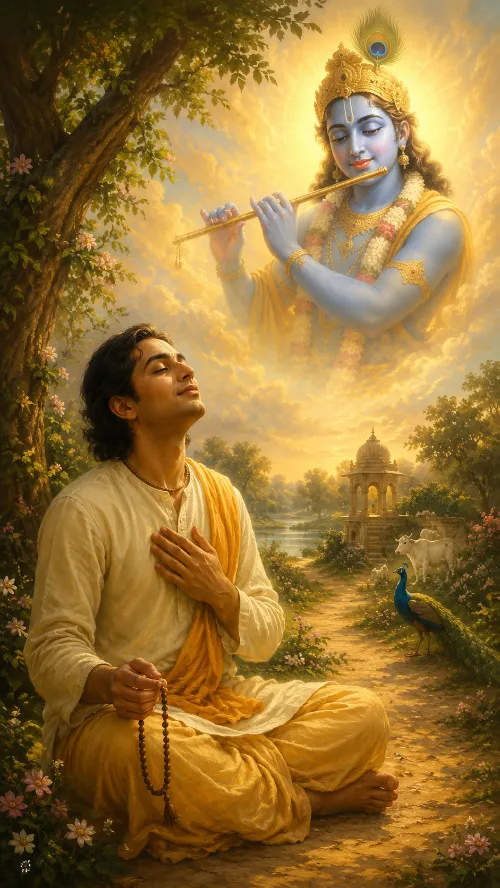
What a Life Continually Joined to Kṛṣṇa Looks Like
Asked what a devoted life actually looks like from the outside, Kṛṣṇa gives an answer in the Ninth Chapter that is easy to misread as a single instruction to chant more. It is considerably more than that. In one verse He names seven different things at once — speech, effort, resolve, the body, the heart, continuity, and worship — and together they describe not a practice but a whole life reorganized.
सततं कीर्तयन्तो मां
यतन्तश्च दृढव्रताः ।
नमस्यन्तश्च मां भक्त्या
नित्ययुक्ता उपासते ॥
satataṁ kīrtayanto māṁ
yatantaś ca dṛḍha-vratāḥ
namasyantaś ca māṁ bhaktyā
nitya-yuktā upāsate
“Always glorifying Me, striving with firm vows, bowing before Me with devotion, they worship Me while remaining continually united with Me.”
“Always chanting My glories, endeavoring with great determination, bowing down before Me, these great souls perpetually worship Me with devotion.”
Bhagavad-gītā 9.14
One contextual detail is worth noticing in the translation. The words “these great souls” do not occur in 9.14 itself. They refer back to mahātmānas in the immediately preceding verse, so 9.14 should be read as a continuation of 9.13. Together the two answer different questions: who a mahātmā is, and what such a person’s life actually looks like.
Who the Mahātmās Are
महात्मानस्तु मां पार्थ
दैवीं प्रकृतिमाश्रिताः ।
भजन्त्यनन्यमनसो
ज्ञात्वा भूतादिमव्ययम् ॥
mahātmānas tu māṁ pārtha
daivīṁ prakṛtim āśritāḥ
bhajanty ananya-manaso
jñātvā bhūtādim avyayam
“But the great souls, O Pārtha, having taken shelter of the divine nature, worship Me with undivided minds, knowing Me to be the imperishable origin of all beings.”
Bhagavad-gītā 9.13
That verse describes the mahātmā inwardly; 9.14 shows how the same consciousness expresses itself outwardly. And the definition is worth pausing on, because the word:
महात्मा
mahātmā
— mahā, great, and ātman, self — often functions in ordinary religious usage as an honorific. Kṛṣṇa does not use it that way. He does not define the mahātmā by robes, institutional position, fame, social influence, or number of followers. The mahātmā is defined by orientation.
“Always” Appears Twice
The verse opens with:
सततम्
satatam
— continually, constantly, always. And near its end Kṛṣṇa returns to the same idea in a different word:
नित्ययुक्ताः
nitya-yuktāḥ
— continually joined, perpetually connected. The repetition frames everything in between, and it points to the verse’s real subject: bhakti is not meant to stay an isolated religious activity walled off from the rest of life. It gradually becomes the thing life is organized around.
Does “Always” Mean Singing Around the Clock?
Not necessarily — and the Gītā explains itself on this point. Kṛṣṇa tells Arjuna:
तस्मात्सर्वेषु कालेषु
मामनुस्मर युध्य च ।
मय्यर्पितमनोबुद्धिर्
मामेवैष्यस्यसंशयम् ॥
tasmāt sarveṣu kāleṣu
mām anusmara yudhya ca
mayy arpita-mano-buddhir
mām evaiṣyasy asaṁśayam
“Therefore remember Me at all times and fight. With your mind and intelligence offered to Me, you will certainly come to Me.”
Bhagavad-gītā 8.7
with the instruction that settles the question:
मामनुस्मर युध्य च
mām anusmara yudhya ca
Remember Me and fight. Not “remember Me instead of acting” — remember Me while doing the thing in front of you. Which means continuous bhakti does not require one external activity performed without interruption. It means increasingly varied activities becoming integrated into a single devotional orientation.
The same vocabulary returns a few verses later:
अनन्यचेताः सततं
यो मां स्मरति नित्यशः ।
तस्याहं सुलभः पार्थ
नित्ययुक्तस्य योगिनः ॥
ananya-cetāḥ satataṁ
yo māṁ smarati nityaśaḥ
tasyāhaṁ sulabhaḥ pārtha
nitya-yuktasya yoginaḥ
“For the yogī who remembers Me constantly with undivided consciousness, I am easy to attain, O Pārtha, because that yogī is continually united with Me.”
Bhagavad-gītā 8.14
— satatam, constantly; nityaśaḥ, continually; nitya-yuktasya, of one continually connected. Kṛṣṇa keeps describing mature devotion as continuity of relationship rather than intensity of episode.
Glorifying: A Discipline of Attention
The first activity named in 9.14 is:
कीर्तयन्तो माम्
kīrtayanto mām
The verb is related to:
कीर्ति
kīrti
— fame, glory, renown. So kīrtana fundamentally means making Bhagavān’s glory heard, which covers a good deal more ground than one musical form: chanting divine names, singing hymns, describing His qualities, narrating His līlās, reciting śāstra, or simply speaking about Him with someone else.
Kṛṣṇa describes the same devotional culture in the Tenth Chapter:
मच्चित्ता मद्गतप्राणा
बोधयन्तः परस्परम् ।
कथयन्तश्च मां नित्यं
तुष्यन्ति च रमन्ति च ॥
mac-cittā mad-gata-prāṇā
bodhayantaḥ parasparam
kathayantaś ca māṁ nityaṁ
tuṣyanti ca ramanti ca
“Their minds are fixed upon Me, their lives are given to Me, and by enlightening one another and continually speaking about Me, they become satisfied and delighted.”
Bhagavad-gītā 10.9
where kathayantaś ca māṁ nityam, continually speaking about Me, sits alongside 9.14’s satataṁ kīrtayanto mām. Devotees do not merely hold a private belief. They keep bringing Bhagavān into speech, memory, community and consciousness.
Which is why kīrtana is a discipline of attention as much as an act of speech. Everyone speaks repeatedly about something — themselves, other people, work, money, fear, politics, conflict, achievement, failure. Speech is a fairly reliable indicator of what occupies consciousness. Kīrtana redirects that tendency: instead of continually magnifying me and mine, one repeatedly magnifies Bhagavān.
Prahlāda Mahārāja‘s list of devotional practices puts it in order:
श्रवणं कीर्तनं विष्णोः
स्मरणं पादसेवनम् ।
अर्चनं वन्दनं दास्यं
सख्यमात्मनिवेदनम् ॥
śravaṇaṁ kīrtanaṁ viṣṇoḥ
smaraṇaṁ pāda-sevanam
arcanaṁ vandanaṁ dāsyaṁ
sakhyam ātma-nivedanam
“Hearing about Viṣṇu, glorifying Him, remembering Him, serving His feet, worshiping Him, offering prayers, serving Him as a servant, befriending Him, and offering one’s very self.”
Śrīmad-Bhāgavatam 7.5.23
There is an ordinary psychology under that sequence. One hears about Bhagavān; what has been heard becomes the content of one’s own speech; and what is repeatedly heard and spoken becomes easier to remember. Kīrtana is one of the main ways consciousness stays inhabited.
Does the Verse Specifically Mean the Holy Name?
Strictly, kīrtayanto mām is broader than chanting Kṛṣṇa’s Name alone; its direct sense is “glorifying Me,” and that distinction is worth keeping. At the same time, the later Bhāgavata and Gauḍīya traditions give nāma-kīrtana an exceptionally central place as the most immediate form of that glorification.
Śukadeva Gosvāmī states the Bhāgavata position:
एतन्निर्विद्यमानानामिच्छतामकुतोभयम् ।
योगिनां नृप निर्णीतं हरेर्नामानुकीर्तनम् ॥
etan nirvidyamānānām icchatām akuto-bhayam
yogināṁ nṛpa nirṇītaṁ harer nāmānukīrtanam
“O King, repeated glorification of Hari’s Name has been established as the fearless path for those free from material desire, for those who still possess desires, and for yogīs.”
Śrīmad-Bhāgavatam 2.1.11
whose central expression is:
हरेर्नामानुकीर्तनम्
harer nāmānukīrtanam
— repeated kīrtana of Hari’s Name. And later the same text singles out the age we are in:
कलेर्दोषनिधे राजन्
अस्ति ह्येको महान् गुणः ।
कीर्तनादेव कृष्णस्य
मुक्तसङ्गः परं व्रजेत् ॥
kaler doṣa-nidhe rājan
asti hy eko mahān guṇaḥ
kīrtanād eva kṛṣṇasya
mukta-saṅgaḥ paraṁ vrajet
“O King, although Kali is an ocean of faults, it possesses one great quality: through Kṛṣṇa-kīrtana one becomes free from bondage and attains the supreme destination.”
Śrīmad-Bhāgavatam 12.3.51
Kṛṣṇadāsa Kavirāja then takes the further Gauḍīya step:
কলিকালে নামরূপে কৃষ্ণ–অবতার ।
নাম হৈতে হয় সর্বজগৎ–নিস্তার ॥
kali-kāle nāma-rūpe kṛṣṇa-avatāra
nāma haite haya sarva-jagat-nistāra
“In Kali-yuga Kṛṣṇa appears in the form of His Name; through the Name the whole world can be delivered.”
Caitanya-caritāmṛta, Ādi-līlā 17.22
The phrase nāma-rūpe kṛṣṇa-avatāra carries a distinctive theology of sacred sound. The Name is not treated as a symbolic reminder of an absent Kṛṣṇa but as a mode of His actual presence — which is why nāma-saṅkīrtana becomes central to Śrī Caitanya’s movement. The tradition is not replacing the Gītā’s teaching here. It is concentrating it: the Gītā says continually glorify Kṛṣṇa, and the Caitanya tradition gives that command its most accessible form.
But the Verse Contains Far More Than Kīrtana
This is the part most often lost. Kṛṣṇa does not stop at satataṁ kīrtayanto mām. Six more elements follow, and kīrtana only means what it means because it sits among them.
Striving
यतन्तः
yatantaḥ
— striving, endeavoring, making effort. This one word dismantles a common misunderstanding. Bhakti depends on grace, but grace does not imply passivity: the mahātmā endeavors. One has to keep turning the mind back toward Bhagavān, hearing, chanting, remembering, serving, disciplining habits, resisting harmful impulses, maintaining sādhana, meeting responsibilities, and returning after every distraction.
Firm in Commitment
दृढव्रताः
dṛḍha-vratāḥ
Dṛḍha, firm or resolute, joined to vrata, a vow or observance. This means considerably more than temporary inspiration. Emotion says today I feel like chanting; a vrata says whether the mind is enthusiastic today or not, I continue. Emotion fluctuates; commitment supplies continuity — which is precisely how a practice becomes satatam in the first place.
Spiritual life often begins with inspiration: a text moves the heart, a devotee’s example creates attraction, a moment of kīrtana awakens something. But inspiration by itself rarely transforms character, because transformation requires repetition. Firm commitment is what converts inspiration into practice, and repeated practice is what gradually reshapes attention, habit, memory and character.
Bowing
नमस्यन्तः
namasyantaḥ
Bowing, offering obeisance. It looks like the simplest item on the list and carries a surprising amount of theology. The head is physically lowered, and the body says what the ego resists saying: I am not the highest reality. The instinct of ego is I am the center; namaskāra answers Bhagavān is the center.
Bhakti does not treat spirituality as a purely mental affair — the body participates. The devotee stands before Bhagavān, bows, offers, serves, dances, circumambulates, folds the hands. Repeated bodily action reinforces what the heart is still learning.
But Kṛṣṇa does not say only namasyantaḥ. He adds:
नमस्यन्तश्च मां भक्त्या
namasyantaś ca māṁ bhaktyā
— they bow with devotion. The qualification is essential, because a person can bow from fear, social convention, obligation, politics, or calculation. The outer act is only worth what the inner relationship makes it worth.
Two Ways of Decentering the Self
There is a symmetry in the verse worth noticing:
And the pairing is protective in both directions. Kīrtana on its own can drift into performance, prestige, identity, or self-display — which is exactly why Kṛṣṇa sets bowing and bhaktyā beside it. Authentic kīrtana should be nourishing humility, remembrance and service; the sound and the consciousness it is cultivated in cannot be cleanly separated.
The reverse holds too. A person may have formidable discipline and remain inwardly dry, proud, severe or self-absorbed. So Kṛṣṇa says māṁ bhaktyā, to Me with devotion. The vow supports the love. It does not substitute for it.
Continually Connected
The theological heart of the verse is probably its penultimate phrase, nitya-yuktāḥ — nitya, constant, joined to yukta, connected or engaged. Yukta comes from the root √yuj, to yoke or join, which is the same root behind yoga. So what the verse describes as perfection is not constant religious activity. It is continuous relationship.
Arjuna later asks outright who the most perfect worshiper is, and the answer reuses the exact expression:
मय्यावेश्य मनो ये मां
नित्ययुक्ता उपासते ।
श्रद्धया परयोपेतास्
ते मे युक्ततमा मताः ॥
mayy āveśya mano ye māṁ
nitya-yuktā upāsate
śraddhayā parayopetās
te me yukta-tamā matāḥ
“Those who fix their minds upon Me and worship Me while constantly united with Me, endowed with supreme faith, are considered by Me the most perfectly joined in yoga.”
Bhagavad-gītā 12.2
— nitya-yuktā upāsate, and Kṛṣṇa calls them yukta-tamāḥ, the most perfectly united. The same principle closes the Sixth Chapter:
योगिनामपि सर्वेषां
मद्गतेनान्तरात्मना ।
श्रद्धावान्भजते यो मां
स मे युक्ततमो मतः ॥
yoginām api sarveṣāṁ
mad-gatenāntar-ātmanā
śraddhāvān bhajate yo māṁ
sa me yukta-tamo mataḥ
“Of all yogīs, the one whose inner self abides in Me and who worships Me with faith is considered by Me the most fully united.”
Bhagavad-gītā 6.47
Again bhajate mām and yukta-tamaḥ. The Gītā keeps presenting the highest yoga not as control of consciousness but as the loving connection of consciousness with Bhagavān.
Worshipful Attendance
उपासते
upāsate
Normally and correctly translated “they worship.” Etymologically the word carries a suggestive resonance — upa, near, and √ās, to sit or remain — giving a background image of drawing near and attending upon. That resonance should enrich the ordinary translation rather than replace it. Read together, nitya-yuktā upāsate evokes not occasional acknowledgment of a distant God but a life lived continually in worshipful relationship.
Which Does Not Mean Leaving Ordinary Life
The Ninth Chapter explains how this becomes practical:
यत्करोषि यदश्नासि
यज्जुहोषि ददासि यत् ।
यत्तपस्यसि कौन्तेय
तत्कुरुष्व मदर्पणम् ॥
yat karoṣi yad aśnāsi
yaj juhoṣi dadāsi yat
yat tapasyasi kaunteya
tat kuruṣva mad-arpaṇam
“Whatever you do, whatever you eat, whatever you offer, whatever you give, and whatever austerity you perform—do that as an offering to Me.”
Bhagavad-gītā 9.27
Kṛṣṇa does not require the devotee to abandon ordinary responsibility. Ordinary life itself becomes mad-arpaṇam, an offering. A devotee may still work, cook, study, raise children, manage resources, teach, travel and rest. The external activities stay diverse; what changes is what they are oriented toward:
Many activities, in other words, gradually becoming one sevā.
The Whole Person Is Engaged
Laid out structurally, the verse touches nearly every dimension of a human life at once:
So bhakti here is not emotion, or ritual, or philosophy, or song, or discipline, or meditation. It is integration — and the balance is deliberate. Mature devotion of this kind is joyful without being frivolous, disciplined without being dry, humble without being passive, active without being egoistic, and continuous without becoming mechanical. No single element supplies that on its own.
From Occasional Religion to Continuous Relationship
Most people naturally divide life into religious time and ordinary time — morning prayer, a temple visit, a weekly service, a festival, a period of chanting, and then “normal life.” This verse points somewhere more integrated. Formal sādhana remains important, but its function is to train a whole life toward continuous connection, which is why Kṛṣṇa keeps saying the same thing in different ways: remember Me while acting; offer whatever you do to Me; speak about Me continually; remain nitya-yukta.
Gradually the boundary between “my spiritual life” and “my life” thins out.
Kīrtana is unusually well suited to that, because sound can accompany ordinary life in ways most ritual activity cannot. One can chant while walking, hear while traveling, remember a verse while working, discuss Bhagavān with another person, sing communally or pray privately. The tongue that otherwise produces an endless stream of worldly conversation can keep returning to divine sound.
And it is not only private. Kṛṣṇa says devotees are:
बोधयन्तः परस्परम्
bodhayantaḥ parasparam
— enlightening one another. One devotee reminds another; one speaks what another has forgotten; one person’s faith strengthens someone else’s. Devotional community becomes a network of mutual remembrance, which is why sādhu-saṅga and kīrtana belong together so naturally.
From Effort Toward Spontaneity
At first satataṁ kīrtayantaḥ can sound impossible. The mind wanders, practice is deliberate, one forgets repeatedly and returns repeatedly. But repeated kīrtana, remembrance, service and association reshape habit, and what initially takes effort becomes progressively more natural. The aim of sādhana is not perpetual artificiality; it is a condition in which remembrance and service come more spontaneously. Which is exactly why the verse contains both yatantaḥ and nitya-yuktāḥ — the effort of practice pointing toward continuity of relationship.
Two Translations
A textually close rendering, preserving the grammatical elements without importing commentary:
“Always glorifying Me, continually striving and firm in their vows, bowing before Me with devotion, they worship Me while remaining perpetually joined to Me.”
And a deliberately interpretive one, for explanatory purposes:
“The great souls continually keep Me at the center of their speech and remembrance. They persevere in devotional practice with firm commitment, humbly bow before Me with love, and increasingly make their whole lives an act of worship by remaining continually connected with Me.”
The Architecture of the Verse
The verse also guards against reducing bhakti to vocal repetition. The Holy Name should increasingly nourish sincere effort, steadiness, humility, loving devotion, continuous connection and a worshipful life. Where chanting stays wholly disconnected from character, humility, service and remembrance, the portrait 9.14 gives has not yet been realized.
What the Verse Is Finally Measuring
The deepest teaching may lie in the relationship between the verse’s first word and its penultimate one — satatam, always, and nitya-yuktāḥ, continually connected. The movement runs from occasional remembrance toward continuous relationship; from religious activity toward a God-centered life; from kīrtana as one practice among many toward a life in which the many activities themselves become connected to Bhagavān.
Which changes the question a practitioner should be asking. Not how many hours did I chant? but: to what degree is Kṛṣṇa becoming what my speech, work, choices, humility, memory and love are organized around? That is the portrait of the mahātmā.
The verse begins in glorification and culminates in connection, and that order matters. Kīrtana is not merely something a devotee does; it is one of the means by which consciousness keeps returning to what it loves. The Name enters the tongue, the sound enters the ear, remembrance enters the mind, humility enters the body, the vow steadies the will, and devotion occupies the heart — until the scattered activities of a life are gathered into a single relationship.
सततं कीर्तयन्तो मां
यतन्तश्च दृढव्रताः ।
नमस्यन्तश्च मां भक्त्या
नित्ययुक्ता उपासते ॥
satataṁ kīrtayanto māṁ
yatantaś ca dṛḍha-vratāḥ
namasyantaś ca māṁ bhaktyā
nitya-yuktā upāsate
“Always glorifying Me, striving with firm vows, bowing before Me with devotion, they worship Me while remaining continually united with Me.”
Bhagavad-gītā 9.14
The instruction is not simply to chant without stopping. It is that the glorification of Bhagavān should become part of a whole life continually joined to Him — and within the Gauḍīya tradition that principle flowers especially through nāma-saṅkīrtana, the personal and communal glorification of Bhagavān through His Holy Name.