

The One Who Does Not Die
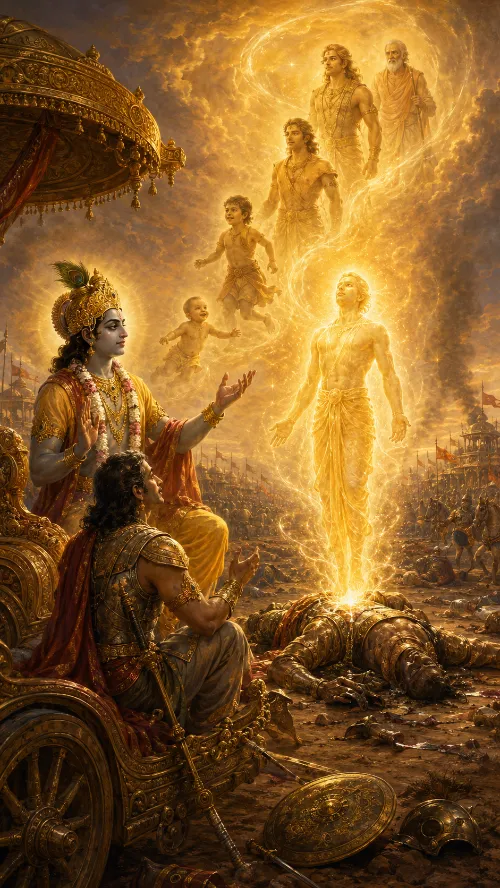
The Difference Between a Body’s Ending and the Soul’s Existence
Every photograph of you is already out of date.
The body in the picture has changed. Its cells, strength, appearance, sensations and abilities are no longer exactly what they were. Yet you do not normally look at an old photograph and say, “That was a completely different conscious being.” You say, “That was me.”
Bhagavad-gītā 2.20 takes that ordinary intuition and pushes it to its most radical conclusion. The conscious self does not merely survive the body’s changes during one lifetime. It does not begin when the body begins, grow when the body grows, become old when the body becomes old, or end when the body ends.
The body has a biography. The self has no birth date.
That is Kṛṣṇa’s answer to Arjuna’s paralysis on the battlefield. Arjuna sees teachers, relatives, and friends whose bodies may soon be destroyed. Kṛṣṇa does not tell him that loss is imaginary or that violence is harmless. He first corrects the deepest assumption beneath Arjuna’s grief: a person is not identical with the body that can be killed.
The verse
न जायते म्रियते वा कदाचिन्
नायं भूत्वा भविता वा न भूयः ।
अजो नित्यः शाश्वतोऽयं पुराणो
न हन्यते हन्यमाने शरीरे ॥
na jāyate mriyate vā kadācin
nāyaṁ bhūtvā bhavitā vā na bhūyaḥ
ajo nityaḥ śāśvato ’yaṁ purāṇo
na hanyate hanyamāne śarīre
“The self is never born, nor does it ever die. Having once existed, it never ceases to be. Unborn, eternal, everlasting and primeval, it is not slain when the body is slain.”
Bhagavad-gītā 2.20
A. C. Bhaktivedanta Swami Prabhupāda translates the verse:
“For the soul there is neither birth nor death at any time. He has not come into being, does not come into being, and will not come into being. He is unborn, eternal, ever-existing and primeval. He is not slain when the body is slain.”
Is that translation correct?
Yes. It accurately communicates the verse’s central claim: the conscious self has no temporal beginning, undergoes no material destruction, and is not killed when the body is killed.
One line deserves explanation. The compact Sanskrit nāyaṁ bhūtvā bhavitā vā na bhūyaḥ is rendered in different ways. A very direct idiomatic reading is, “Having once existed, it will never cease to be.” Prabhupāda’s “has not come into being, does not come into being, and will not come into being” stresses the complementary point: the self is not a product that enters existence at some moment. Both readings serve the sentence’s argument. Something manufactured at one time can be destroyed at another; the self is neither manufactured nor annihilated.
The English pronoun “he” also reflects Prabhupāda’s Vaiṣṇava theology of the soul as a conscious person. Sanskrit grammar by itself does not prove male sex here: ātmā, “self,” is grammatically masculine, while the embodied soul is not defined by a male or female material body.
The Śvetāśvatara Upaniṣad states the point directly:
नैव स्त्री न पुमानेष न चैवायं नपुंसकः ।
यद्यच्छरीरमादत्ते तेन तेन स युज्यते ॥
naiva strī na pumān eṣa na caivāyaṁ napuṁsakaḥ
yad yac charīram ādatte tena tena sa yujyate
“This self is neither female nor male nor neuter. Whatever body it takes, with that body it becomes associated.”
Śvetāśvatara Upaniṣad 5.10
This does not make embodied sex irrelevant to ordinary life. It means that no temporary bodily designation exhausts the identity of the one experiencing through the body.
The translation is therefore sound. But the verse says more than the slogan “the soul never dies.” It systematically removes the self from the entire life cycle of material things.
What each word rules out
Kṛṣṇa’s wording is deliberately cumulative. Each description closes another door through which material change might be smuggled back into our idea of the self.
Na jāyate means “it is not born.” The beginning of a body is not the beginning of the person within it.
Na mriyate means “it does not die.” The ending of the body is not the annihilation of the conscious self.
Kadācin means “at any time” or “ever.” The statement admits no exception in the past, present or future.
Ajaḥ means “unborn.” This is not merely a report that the self happened not to be born; it describes birthlessness as belonging to the self’s nature.
Nityaḥ means “eternal” or “constant.” The self persists through time without losing its identity.
Śāśvataḥ means “everlasting” or “abiding.” It does not decay toward nonexistence.
Purāṇaḥ means “ancient” or “primeval.” Traditional commentators draw out a beautiful paradox: the self is beginningless, yet it never becomes worn out. It is ancient without becoming old.
Na hanyate hanyamāne śarīre means “it is not slain when the body is slain.” The final line names the decisive distinction: what can be destroyed is the body; the conscious bearer of the body is not destroyed with it.
The repeated negatives are not empty rhetoric. They demolish the assumption that consciousness is a temporary side effect of matter.
The six changes that belong to the body—not the self
Classical commentators explain this verse through the six transformations of a material thing. This analysis predates the Gītā commentarial tradition. Yāska’s Nirukta, an early Sanskrit work on Vedic words and interpretation, attributes the scheme to Vārṣyāyaṇi:
षड् भावविकारा भवन्तीति वार्ष्यायणिः ।
जायतेऽस्ति विपरिणमते वर्धतेऽपक्षीयते विनश्यतीति ॥
ṣaḍ bhāva-vikārā bhavantīti vārṣyāyaṇiḥ
jāyate ’sti vipariṇamate vardhate ’pakṣīyate vinaśyatīti
“Vārṣyāyaṇi says that there are six transformations of an existent thing: it is born, it exists, it changes, it grows, it declines and it perishes.”
Some later lists reverse the order of “changes” and “grows,” but the sixfold analysis is the same:
Śrīdhara Svāmī reads the verse as a deliberate denial of all six changes. Madhusūdana Sarasvatī calls the self sarva-vikāra-śūnya—“free from every transformation.” Viśvanātha Cakravartī emphasizes that birth and death are denied in all three divisions of time: past, present, and future.
This does not mean the soul is a lifeless, frozen object. A conscious self can know, desire, choose, remember, forget, love, suffer, turn toward God or turn away. Its condition and awareness can change. What does not change is its fundamental status as a conscious existent. The soul may be conditioned or liberated, attentive or forgetful, embodied here or embodied elsewhere; it does not become a different kind of substance or pass into nonbeing.
A simple comparison helps. A driver may be lost, alert, frightened, reckless or disciplined. The car may be new, damaged, repaired or destroyed. Changes in the driver’s knowledge and circumstances do not turn the driver into the car. Similarly, changes in consciousness and embodiment do not make the self a material product.
The Gītā is echoing an Upaniṣad
Bhagavad-gītā 2.20 is not an isolated claim. It closely adapts a verse from the Kaṭha Upaniṣad, in which the young seeker Naciketas questions Yama, the lord of death, about what remains when a person dies. Some say the person continues; others say nothing remains. Naciketas refuses wealth, pleasure and long life in order to receive a definite answer.
Yama replies:
न जायते म्रियते वा विपश्चिन्
नायं कुतश्चिन्न बभूव कश्चित् ।
अजो नित्यः शाश्वतोऽयं पुराणो
न हन्यते हन्यमाने शरीरे ॥
na jāyate mriyate vā vipaścin
nāyaṁ kutaścin na babhūva kaścit
ajo nityaḥ śāśvato ’yaṁ purāṇo
na hanyate hanyamāne śarīre
“The discerning self is not born and does not die. It did not arise from anything, nor did anything arise from it. Unborn, eternal, everlasting and primeval, it is not slain when the body is slain.”
Kaṭha Upaniṣad 2.18 (also numbered 1.2.18)
Three of the four lines are virtually identical to the Gītā. Kṛṣṇa places Arjuna’s crisis within a recognized Upaniṣadic teaching about death. The battlefield question is therefore not merely, “Will these bodies fall?” It is, “What is a person, and what can death actually reach?”
Śaṅkara’s commentary on the Upaniṣadic verse makes the logic explicit: birth and destruction are the first and last of material change, so denying them brackets out the whole sequence. He compares the unaffected self to space. A jar can be broken, but the space apparently enclosed by the jar is not cut or killed.
Vaiṣṇava commentators accept the same immediate distinction between self and body while understanding the enduring self as a real individual who remains eternally dependent on the Supreme. The major Vedānta schools disagree about the self’s ultimate relation to Brahman, the Absolute, but they agree that the self discussed here is not born and destroyed like the body.
The argument begins before verse 2.20
Kṛṣṇa does not drop a metaphysical slogan into the conversation without preparation. The argument develops step by step.
The conscious person persists while the body changes
In Bhagavad-gītā 2.13, Kṛṣṇa points to a fact available within this life: the embodied self passes through childhood, youth and old age while remaining the subject of those changes. Death extends the principle rather than inventing it. The body changes; the possessor of the body continues.
Kṛṣṇa, Arjuna and the kings did not begin at the battlefield
न त्वेवाहं जातु नासं न त्वं नेमे जनाधिपाः ।
न चैव न भविष्यामः सर्वे वयमतः परम् ॥
na tv evāhaṁ jātu nāsaṁ na tvaṁ neme janādhipāḥ
na caiva na bhaviṣyāmaḥ sarve vayam ataḥ param
“Never was there a time when I did not exist, nor you, nor these kings; nor in the future shall any of us cease to be.”
Bhagavad-gītā 2.12
The verse speaks in the first, second, and third persons: I, you, and they. In Gauḍīya Vaiṣṇava interpretation, this grammar matters. Eternity does not erase personal identity. Kṛṣṇa does not say only that an undifferentiated existence remains; He says that all of us existed and will continue to exist.
Other Vedānta schools qualify this plurality differently. An Advaita reading treats ultimate selfhood as nondual, and regards separate individuality as belonging to empirical experience. Vaiṣṇava schools read the persons as eternally real, distinct yet dependent on the Supreme. A responsible article should acknowledge that disagreement. It should also acknowledge what the verse plainly supplies to the Vaiṣṇava argument: Kṛṣṇa speaks of enduring persons, not merely a surviving substance.
The self neither kills nor is killed
The verse immediately before 2.20 states:
य एनं वेत्ति हन्तारं यश्चैनं मन्यते हतम् ।
उभौ तौ न विजानीतो नायं हन्ति न हन्यते ॥
ya enaṁ vetti hantāraṁ yaś cainaṁ manyate hatam
ubhau tau na vijānīto nāyaṁ hanti na hanyate
“One who thinks this self the killer, and one who thinks it killed, both fail to understand. The self neither kills nor is killed.”
Bhagavad-gītā 2.19
This also echoes the Kaṭha Upaniṣad. Verse 2.20 then explains why the self cannot be killed: it is not something that begins and ends.
Death is a change of embodiment, not the end of the experiencer
After establishing the self’s eternity, Kṛṣṇa supplies a concrete image:
वासांसि जीर्णानि यथा विहाय
नवानि गृह्णाति नरोऽपराणि ।
तथा शरीराणि विहाय जीर्णा-
न्यन्यानि संयाति नवानि देही ॥
vāsāṁsi jīrṇāni yathā vihāya
navāni gṛhṇāti naro ’parāṇi
tathā śarīrāṇi vihāya jīrṇāny
anyāni saṁyāti navāni dehī
“As a person discards worn-out clothes and puts on others that are new, so the embodied self leaves worn-out bodies and enters others that are new.”
Bhagavad-gītā 2.22
The analogy should not be stretched too far. Changing bodies is not necessarily as voluntary or painless as changing a coat. According to the Gītā’s larger teaching, the next embodiment is shaped by consciousness, attachment and action. The point of the image is identity: the wearer is not the garment, and the embodied self is not the body.
Kṛṣṇa then denies that any material element or weapon can reach the self:
नैनं छिन्दन्ति शस्त्राणि नैनं दहति पावकः ।
न चैनं क्लेदयन्त्यापो न शोषयति मारुतः ॥
अच्छेद्योऽयमदाह्योऽयमक्लेद्योऽशोष्य एव च ।
नित्यः सर्वगतः स्थाणुरचलोऽयं सनातनः ॥
nainaṁ chindanti śastrāṇi nainaṁ dahati pāvakaḥ
na cainaṁ kledayanty āpo na śoṣayati mārutaḥ
acchedyo ’yam adāhyo ’yam akledyo ’śoṣya eva ca
nityaḥ sarva-gataḥ sthāṇur acalo ’yaṁ sanātanaḥ
“Weapons do not cut this self, fire does not burn it, waters do not wet it and wind does not dry it. It cannot be cut, burned, wetted or dried. It is eternal, all-pervading, stable, immovable and everlasting.”
Bhagavad-gītā 2.23–24
The four elements stand for the forces capable of breaking down a material body. None has jurisdiction over consciousness as spirit. Death ends one bodily instrument; it does not cancel the one who experienced through it.
This is also why ordinary memory cannot be the whole of personal identity. We forget most of early childhood, much of yesterday and, according to the Gītā, previous embodiments. Yet forgetting an experience is not proof that the experiencer did not exist. Memory belongs to the equipment through which the self presently functions; the self is the continuing subject to whom remembering and forgetting occur.
Eternal does not mean independent
It is possible to misunderstand “the soul is eternal” as “the soul is the supreme reality and needs nothing beyond itself.” That is not the Gauḍīya Vaiṣṇava conclusion.
The Śvetāśvatara Upaniṣad speaks of one supreme eternal conscious being in relation to many eternal conscious beings:
नित्यो नित्यानां चेतनश्चेतनानाम्
एको बहूनां यो विदधाति कामान् ।
तत्कारणं सांख्ययोगाधिगम्यं
ज्ञात्वा देवं मुच्यते सर्वपाशैः ॥
nityo nityānāṁ cetanaś cetanānām
eko bahūnāṁ yo vidadhāti kāmān
tat kāraṇaṁ sāṃkhya-yogādhigamyaṁ
jñātvā devaṁ mucyate sarva-pāśaiḥ
“He is the one Eternal among the many eternal beings, the one conscious Being among the many conscious beings, who fulfills the needs of the many. Knowing that divine cause, reached through discernment and spiritual discipline, one is freed from every bond.”
Śvetāśvatara Upaniṣad 6.13
The many are eternal, but the One sustains them. The individual self is not temporary, yet it is not self-sufficient.
The Gītā expresses this dependence directly:
ममैवांशो जीवलोके जीवभूतः सनातनः ।
मनःषष्ठानीन्द्रियाणि प्रकृतिस्थानि कर्षति ॥
mamaivāṁśo jīva-loke jīva-bhūtaḥ sanātanaḥ
manaḥ-ṣaṣṭhānīndriyāṇi prakṛti-sthāni karṣati
“The living being in this world is certainly My eternal part. Bound in material nature, it struggles with the six senses, including the mind.”
Bhagavad-gītā 15.7
Here aṁśa, “part,” should not be imagined as a material chip broken from God. Material wholes become smaller when divided; the Supreme does not. Gauḍīya teachers understand the living being as one with God in spiritual quality—conscious and enduring—yet different in magnitude and dependence.
Śrī Caitanya’s teaching is preserved in Bengali in Śrī Caitanya-caritāmṛta:
জীবের ‘স্বরূপ’ হয় — কৃষ্ণের ‘নিত্যদাস’ ।
কৃষ্ণের ‘তটস্থা-শক্তি’, ‘ভেদাভেদ-প্রকাশ’ ॥
সূর্যাংশ-কিরণ, যৈছে অগ্নিজ্বালাচয় ।
স্বাভাবিক কৃষ্ণের তিনপ্ৰকার ‘শক্তি’ হয় ॥
jīvera ‘svarūpa’ haya—kṛṣṇera ‘nitya-dāsa’
kṛṣṇera ‘taṭasthā-śakti’, ‘bhedābheda-prakāśa’
sūryāṁśa-kiraṇa, yaiche agni-jvālā-caya
svābhāvika kṛṣṇera tina-prakāra ‘śakti’ haya
“The living being’s intrinsic identity is to be Kṛṣṇa’s eternal servant. The living being is Kṛṣṇa’s marginal potency, a manifestation simultaneously one with and different from Him. As sunlight is related to the sun and sparks to a fire, so Kṛṣṇa naturally possesses three principal energies.”
Caitanya-caritāmṛta, Madhya 20.108–109
This gives Bhagavad-gītā 2.20 a relational depth. Eternal existence is not endless isolation. The self is eternally capable of relationship, knowledge, love and service. Its immortality matters because love of the eternal Supreme is not a temporary chemical event between two doomed organisms.
Liberation does not manufacture an immortal self
If the self is already unborn and indestructible, spiritual liberation cannot mean making it immortal. It means freeing its eternal nature from misidentification and bondage.
The Śrīmad-Bhāgavatam gives a compact definition:
मुक्तिर्हित्वान्यथारूपं स्वरूपेण व्यवस्थितिः ।
muktir hitvānyathā-rūpaṁ sva-rūpeṇa vyavasthitiḥ
“Liberation is giving up an identity foreign to one’s true nature and becoming established in one’s intrinsic identity.”
Śrīmad-Bhāgavatam 2.10.6
The deepest bondage is not that the soul has literally become matter. It is that the soul mistakes the body, mind, social role, and temporary history for the whole self. Liberation removes the false equation “I am this body and nothing more.” It does not erase the conscious person; in the Gauḍīya account, it restores the person to clear, loving relation with Kṛṣṇa.
This distinction is practical. Spiritual practice is not an attempt to create a soul, manufacture eternity or inflate the ego into God. It is a process of seeing accurately, living from one’s real identity and purifying one’s desires.
What the verse does not mean
A powerful teaching becomes dangerous when detached from its context. Bhagavad-gītā 2.20 does not support several careless conclusions.
What this means in real life
The verse is metaphysical, but its test is practical. If it changes nothing about how one lives, it has been admired rather than understood.
Aging changes what you have—not what you are
The body becomes slower. Roles disappear. Appearance alters. Abilities once taken for granted may fail. Bhagavad-gītā 2.20 separates dignity from performance. Your worth as a conscious being is not measured by youth, beauty, productivity or physical independence.
That does not romanticize aging. It prevents aging from becoming an identity verdict.
Death becomes serious without becoming absolute
The Gītā does not call death trivial. It calls death limited. Death can take a body, a familiar voice and a shared routine. It cannot turn the person into nothing.
This changes the question from “Will I exist?” to “In what state of consciousness will I continue?” The second question gives present choices enormous weight.
Character matters more than packaging
If the body is temporary and the self continues, then the most durable investments are not merely possessions, appearance or status. Habits of attention, truthfulness, compassion, discipline and devotion shape consciousness. What one repeatedly loves and remembers is more intimately one’s future than what one temporarily owns.
Other people cannot be reduced to their bodies
Race, sex, age, health, nationality and social position describe bodies and circumstances; they do not exhaust the person. Seeing others as conscious selves does not erase embodied differences or injustices. It places those differences inside a deeper equality.
Exploitation becomes harder to justify when we understand the vulnerable person before us as an eternal subject, not a disposable object.
Fear can be put in its proper place
Fear of pain, separation, and the unknown may remain. The verse targets the fear beneath them: “I will become nothing.” Kṛṣṇa says that this cannot happen.
Courage in the Gītā is not the belief that the body is invulnerable. It is the knowledge that the deepest self is not.
Spiritual practice becomes recovery of identity
Meditation, prayer, study, ethical restraint, and devotional service are not hobbies added to a material identity. They are methods for removing misidentification and reorienting consciousness toward its source.
A useful daily practice is to pause before acting and ask:
Am I responding only to what threatens or flatters my body and ego?
What choice strengthens clarity, compassion and responsibility in the conscious self?
Will this action deepen forgetfulness, or help me remember my relation with the Supreme?
Those questions turn a doctrine of immortality into a way of living.
The verse in one sentence
Bhagavad-gītā 2.20 does not merely promise that something vague survives death. It says that the conscious self was never produced by the body, never becomes old with the body, and is never destroyed with the body.
The body is born, grows, changes, declines and dies. The self witnesses those changes. It can misuse its freedom or purify its consciousness. It can forget its source or recover its relationship with the Supreme. But it cannot become nonexistent.
You do not need to become eternal.
You need to understand what in you already is—and learn how an eternal person ought to live.
Textual notes
Sanskrit quotations are given in Devanāgarī, followed by standard roman transliteration and an English translation. Translations not explicitly attributed are close translations prepared for this article.
Bhagavad-gītā 2.20 is closely paralleled by Kaṭha Upaniṣad 2.18, numbered 1.2.18 in editions that divide the text by chapter, section and verse.
The “six transformations” passage occurs in Yāska’s Nirukta 1.2. Later presentations sometimes reverse the order of “transformation” and “growth” without changing the substance of the teaching.
Here, “Soul” refers to the conscious self. The Sanskrit word ātman can carry a wider range of meanings—including self, person and, in some contexts, body or mind—so its meaning must be determined from context. In Bhagavad-gītā 2.20 the contrast with the slain body makes the conscious, deathless self the intended referent.
The article explains the verse principally from a Gauḍīya Vaiṣṇava perspective while noting where other Vedānta traditions interpret eternal individuality differently.