

Grinding What Is Already Ground
Jaḍa Bharata’s Answer to Power, and Why Punishment Cannot Manufacture Wisdom
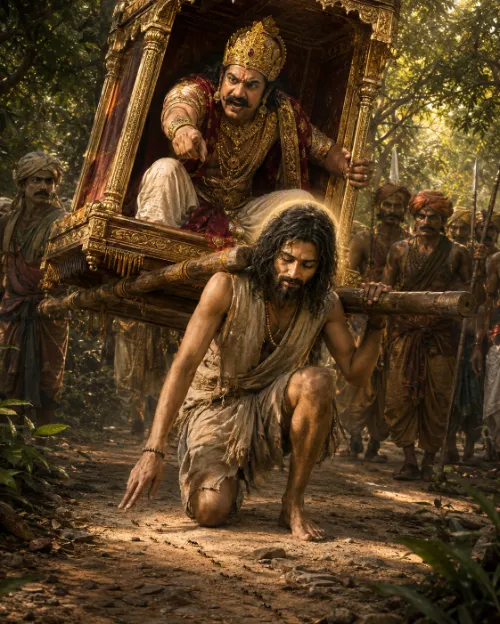
A king is being carried through the forest. The palanquin jolts. Furious, he threatens one of the carriers, calling his threat a “treatment” that will bring the man back to his senses.
The carrier is Jaḍa Bharata. He appears slow, mute, and half-mad. In reality, he is a spiritually realized person who has deliberately hidden his wisdom from the world. His reply dismantles the king’s assumptions in four lines: Force may control a body. It cannot make a soul understand.
The exchange in Śrīmad-Bhāgavatam 5.10 is not a vague rejection of authority. It is a precise attack on misdiagnosis, spiritual pride, and punishment masquerading as healing. It also warns parents, teachers, managers, religious leaders, judges, and anyone tempted to believe that fear automatically produces insight.
The king planned to cure the carrier. The carrier cured the king.
First: is the attribution correct?
Yes—with one important qualification. The source is correctly identified as Śrīmad-Bhāgavatam 5.10.13, and the speaker is Jaḍa Bharata addressing Mahārāja Rahūgaṇa, king of Sindhu and Sauvīra. The Sanskrit is also correct:
उन्मत्तमत्तजडवत्स्वसंस्थां
गतस्य मे वीर चिकित्सितेन ।
अर्थः कियान् भवता शिक्षितेन
स्तब्धप्रमत्तस्य च पिष्टपेषः ॥ १३ ॥
unmatta-matta-jaḍavat sva-saṁsthāṁ
gatasya me vīra cikitsitena
arthaḥ kiyān bhavatā śikṣitena
stabdha-pramattasya ca piṣṭapeṣaḥ
“O hero, what benefit is there in your ‘treatment’ of me—one who, while behaving like a madman, an intoxicated man, or a dullard, has attained his own settled state? And as for trying to discipline one who is truly obstinate and heedless, that is merely grinding what has already been ground.”
Śrīmad-Bhāgavatam 5.10.13
The familiar English wording is the published Bhaktivedanta translation. It is a valid explanatory translation, but it is not a strictly literal, line-by-line rendering of this verse alone. It deliberately brings in details from the surrounding narrative.
This distinction strengthens the passage rather than weakening it. The published translation gives the scene’s meaning; the Sanskrit conveys it through a compact image and a carefully constructed dilemma.
The literal force of the words
Several terms carry more weight than a smooth English translation can show.
The final image deserves to be retained. Flour has already been ground. Passing it through the mill again does not turn it into something new. “Beating a dead horse” communicates futility in natural English, but “grinding what is already ground” is closer to the Sanskrit and becomes important later in the conversation.
Who was Jaḍa Bharata?
The name Jaḍa Bharata means, roughly, “dull Bharata” or “Bharata who behaves as though inert.” It describes his outward appearance, not his inner condition. In an earlier life he had been King Bharata, the ruler after whom traditional accounts say Bhārata-varṣa—India—was named. He renounced his kingdom to pursue spiritual realization, but became excessively attached to a young deer. At death his mind remained fixed on that animal, and he was born as a deer. Because he retained memory of his previous life, he understood how a seemingly innocent attachment had diverted his spiritual practice.
After the deer’s death, he was born again in a brāhmaṇa family. This time Bharata guarded his consciousness with extraordinary severity. He feared social admiration, relationships, ritual status, and intellectual prestige because any of them might become another net of attachment. He therefore concealed himself beneath the appearance of incapacity.
The Bhāgavatam describes his strategy in 5.9.3:
आत्मानमुन्मत्तजडान्धबधिरस्वरूपेण दर्शयामास लोकस्य
ātmānam unmatta-jaḍāndha-badhira-svarūpeṇa darśayām āsa lokasya
“He displayed himself to the world as though mad, dull, blind, and deaf.”
This was spiritual camouflage. He was not confused about who he was; he wanted a society obsessed with status and utility to leave him alone. That does not make imitation of Jaḍa Bharata a general spiritual practice. His behavior rests on an exceptional level of realization and on the memory of two previous births. For an ordinary person, neglecting responsibilities and calling it detachment may be self-deception. The text asks us to understand his case, not theatrically copy his symptoms.
The road to Kapilāśrama
Rahūgaṇa was traveling in a palanquin to Kapilāśrama, intending to inquire about spiritual truth. That detail is deliciously ironic: the king is on his way to meet a teacher while failing to recognize the realized teacher under his own palanquin.
When the carriers needed an additional man, the king’s servants seized Jaḍa Bharata for forced labor. The narrative calls him a great soul and says he was not fit for such treatment. Yet he did not protest.
He carried the pole, but walked unevenly. He was looking ahead to avoid stepping on ants and other small creatures. His compassion for beings too small for the king to notice made the palanquin shake.
Rahūgaṇa first used sarcasm: the new carrier must be terribly exhausted, he joked, despite having carried the load only briefly. When the jolting continued, the king became angry. In 5.10.7 he called Jaḍa Bharata “dead while living,” asserted his position as master, and threatened punishment as a form of medicine:
प्रमत्तस्य च ते करोमि चिकित्सां … यथा प्रकृतिं स्वां भजिष्यसे
pramattasya ca te karomi cikitsāṁ … yathā prakṛtiṁ svāṁ bhajiṣyase
“I shall administer treatment to you, who are heedless … so that you return to your proper condition.”
Here lies the verbal key to 5.10.13. The king calls punishment cikitsā, treatment. Jaḍa Bharata accepts the metaphor and asks a devastating question: what exactly are you treating?
If the carrier is inwardly sane and merely looks mad, punishment cannot cure a disease that is not there. If he truly lacks the capacity to understand, beating him will not create that capacity. In either case, Rahūgaṇa’s threat fails as treatment.
The king has power, but no diagnosis.
The argument Jaḍa Bharata makes before verse 13
Jaḍa Bharata’s reply begins in 5.10.9 and unfolds step by step. First, he distinguishes the self from the body. The king has mocked him as weak and tired, but strength, weakness, fatigue, and weight belong to bodies. The body walks; the self is the conscious witness and experiencer. The burden rests on shoulders, the shoulders on a torso, the torso on legs, and the feet on the earth. What, precisely, is the king calling “you”?
Second, Jaḍa Bharata lists bodily conditions—fatness, thinness, disease, hunger, thirst, fear, disagreement, desire, old age, sleep, attachment, anger, ego, and grief. These are real experiences within embodied life, but they do not define the eternal self.
Third, he challenges Rahūgaṇa’s absolute language of master and servant. Today one person sits above and another carries him. Tomorrow political fortune, death, or karma may reverse their situations. A temporary social arrangement is not an eternal identity.
The point is not that bodily suffering is imaginary or that social duties do not matter. The point is that they are not the final truth about a person. A uniform, title, diagnosis, salary, disability, failure, or public reputation may describe a present condition. None exhausts the conscious being who experiences it.
The Bhagavad-gītā makes the same metaphysical distinction:
य एनं वेत्ति हन्तारं यश्चैनं मन्यते हतम् ।
उभौ तौ न विजानीतो नायं हन्ति न हन्यते ॥ १९ ॥
ya enaṁ vetti hantāraṁ yaś cainaṁ manyate hatam
ubhau tau na vijānīto nāyaṁ hanti na hanyate
“One who thinks the self is the killer, and one who thinks the self is killed, both fail to understand. The self neither kills nor is killed.”
Bhagavad-gītā 2.19
This verse does not say that bodily violence is harmless or morally irrelevant. Bodies feel pain; actions carry consequences; the aggressor becomes responsible for what he does. It says that physical destruction does not reach the self’s deepest identity. Metaphysical invulnerability is not permission for ethical carelessness.
Jaḍa Bharata’s two-part dilemma
Traditional commentator, Vīrarāghava, makes the logic of 5.10.13 explicit. He understands sva-saṁsthā as steadfastness in the true self, whose nature is spiritual: Sanskrit commentary
स्वस्मिन् ब्रह्मात्मके स्वात्मनि संस्थां निष्ठां … स्वसंस्थां प्राप्तस्य उन्मत्तादीननुकुर्वतः … चिकित्सितेन दण्डेन वा कियानर्थः ।
svasmin brahmātmake svātmani saṁsthāṁ niṣṭhām … sva-saṁsthāṁ prāptasya unmattādīn anukurvataḥ … cikitsitena daṇḍena vā kiyān arthaḥ
“‘Abiding’ means steadfastness in one’s own self, whose nature is Brahman. For one who has reached that self-abiding condition and merely imitates madmen and the like, what purpose can treatment or punishment serve?”
He then gives the other side: Sanskrit commentary
यदि पुनरहं न स्वसंस्थां गतः किन्तु प्रमत्तः संसार्येव तथापि … शिक्षादिकं पिष्टपेषणवद् व्यर्थमेव ।
yadi punar ahaṁ na sva-saṁsthāṁ gataḥ kintu pramattaḥ saṁsāry eva tathāpi … śikṣādikaṁ piṣṭa-peṣaṇavad vyartham eva
“But if I have not reached that self-abiding state and am instead truly a heedless conditioned person, then instruction and the like are still futile—like grinding what has already been ground.”
Jaḍa Bharata therefore places the king on the horns of a dilemma:
- If I only appear mad, you have misdiagnosed me. Your punishment treats an illusion produced by my behavior and your prejudice.
- If I really am incapable or heedless, force does not supply the missing understanding. Pain may make me afraid, but fear is not knowledge.
This is why “When a madman is punished, he is not cured of his madness” captures the verse’s practical thrust, even though those words are not a literal translation of one Sanskrit line.
What does “established in one’s own state” mean?
The phrase sva-saṁsthāṁ gatasya is the verse’s spiritual center. It does not merely mean that Jaḍa Bharata is comfortable with his personality. It means that he abides in knowledge deeper than his bodily role and public image.
Vīrarāghava connects this language with an Upaniṣadic expression:
ब्रह्मसंस्थोऽमृतत्वमेति
brahma-saṁstho ’mṛtatvam eti
“One who is firmly established in Brahman attains immortality.”
Chāndogya Upaniṣad 2.23.1
To be self-established is not to become numb. Jaḍa Bharata sees the ants beneath his feet. He notices bodily danger more carefully than the king does. His realization produces compassion, not indifference.
Spiritual identity does not mean the self is an isolated sovereign with no higher relationship. Gauḍīya Vaiṣṇava theology describes the living being’s deepest identity as relational:
জীবের ‘স্বরূপ’ হয় — কৃষ্ণের ‘নিত্যদাস’ ।
কৃষ্ণের ‘তটস্থা-শক্তি’, ‘ভেদাভেদ-প্রকাশ’ ॥ ১০৮ ॥
jīvera ‘svarūpa’ haya—kṛṣṇera ‘nitya-dāsa’
kṛṣṇera ‘taṭasthā-śakti’, ‘bhedābheda-prakāśa’
“The living being’s true identity is to be Kṛṣṇa’s eternal servant: Kṛṣṇa’s marginal energy, a manifestation simultaneously distinct from and nondifferent from Him.”
Caitanya-caritāmṛta, Madhya 20.108
Rahūgaṇa’s error, then, is not merely that he believes in service. It is that he treats his temporary control over another body as ultimate mastership. Jaḍa Bharata is not independent of God; he is independent of the king’s false definition of him.
“Madness” here is spiritual rhetoric, not a clinical diagnosis
This point must be made clearly for a modern reader. The passage uses words associated with madness, intoxication, dullness, and heedlessness. It does not offer a medical theory of psychosis, depression, dementia, addiction, neurological disability, or intellectual disability. It should not be used to stigmatize vulnerable people, to deny them professional care, or to claim that mental illness cannot be treated.
Three different conditions must not be collapsed:
1. Deliberately appearing incapable
This is Jaḍa Bharata’s situation. He performs social incompetence while remaining inwardly lucid. Rahūgaṇa judges reality from surface behavior and gets it exactly backward.
2. Spiritual and moral heedlessness
The Sanskrit word pramatta often describes a person intoxicated by bodily identity and sense gratification. It can mean careless, negligent, or dangerously inattentive—not necessarily mentally ill.
Ṛṣabhadeva, Bharata’s father in his former royal life, uses the same word:
नूनं प्रमत्तः कुरुते विकर्म
यदिन्द्रियप्रीतय आपृणोति ।
न साधु मन्ये यत आत्मनोऽयम्
असन्नपि क्लेशद आस देहः ॥ ४ ॥
nūnaṁ pramattaḥ kurute vikarma
yad indriya-prītaya āpṛṇoti
na sādhu manye yata ātmano ’yam
asann api kleśada āsa dehaḥ
“Surely a heedless person performs harmful or forbidden acts when absorbed in satisfying the senses. I do not consider that good, because through such action the self has obtained this temporary body, which brings suffering.”
Śrīmad-Bhāgavatam 5.5.4
Here pramatta means someone who knows too little—or cares too little—about the consequences of compulsive action. Repeated penalties may suppress one act without curing the desire, ignorance, habit, or social condition that keeps producing it.
3. Actual illness or reduced capacity
Real psychological and neurological conditions require compassion, competent assessment, protection from abuse, and—where appropriate—medical or therapeutic treatment. The verse’s practical insight supports that conclusion: beating, humiliation, and rage are not medicine.
The ancient text is not saying, “Do nothing.” It is saying, “Do not confuse inflicting pain with understanding the problem.”
Does the verse reject all punishment, discipline, or authority?
No. The dialogue itself blocks that interpretation. After Jaḍa Bharata speaks, Rahūgaṇa does not simply accept every claim without thought. He bows and apologizes, but he also raises intelligent objections. The body may not be the self, he argues, yet bodily heat can affect consciousness—just as a hot pot heats water, the water heats rice, and the rice is cooked. Temporary social roles may not be eternal, but a king still has a duty to protect citizens and restrain wrongdoing.
Most strikingly, Rahūgaṇa repeats Jaḍa Bharata’s own image:
शास्ताभिगोप्ता नृपतिः प्रजानां
यः किङ्करो वै न पिनष्टि पिष्टम् ।
स्वधर्ममाराधनमच्युतस्य
यदीहमानो विजहात्यघौघम् ॥ २३ ॥
śāstābhigoptā nṛpatiḥ prajānāṁ
yaḥ kiṅkaro vai na pinaṣṭi piṣṭam
sva-dharmam ārādhanam acyutasya
yad īhamāno vijahāty aghaugham
“A king is the governor and protector of the people. Acting as a servant, he does not merely grind what is already ground. By carrying out his own duty as worship of Acyuta, the infallible Lord, he casts off the flood of sinful reactions.”
Śrīmad-Bhāgavatam 5.10.23
This is Rahūgaṇa’s counterargument, not an erasure of Jaḍa Bharata’s teaching. It forces a necessary distinction. Legitimate discipline may:
- protect other people from immediate harm;
- establish fair boundaries and predictable consequences;
- interrupt destructive conduct;
- preserve public order;
- create conditions in which learning or rehabilitation becomes possible.
But punishment by itself cannot:
- produce self-knowledge;
- heal trauma or mental illness;
- dissolve addiction or compulsive desire;
- make a proud person humble;
- turn external compliance into inward understanding.
Accountability and transformation are related, but they are not identical. A court may restrain an offender. A school may enforce a rule. A parent may remove a privilege. A manager may address misconduct. Such actions can be necessary. The mistake is assuming the consequence itself has diagnosed and cured the cause.
Rahūgaṇa’s own behavior proves the point. Threats do not awaken him. Contact with truth does. He changes when he hears a realized person, recognizes his arrogance, descends from the palanquin, bows, apologizes, questions, and listens.
The king gets off the palanquin
The physical movement matters. Rahūgaṇa begins above Jaḍa Bharata, carried by bodies he treats as instruments. After hearing him, the king comes down. The Bhāgavatam says that Jaḍa Bharata’s words loosen the knot in his heart. Rahūgaṇa places his head at the feet of the man he had insulted and asks forgiveness.
This is not the humiliation of leadership; it is its recovery. A weak leader protects his image even after being proved wrong. A teachable leader can say:
- I misread the person.
- I used authority before understanding the situation.
- I spoke with contempt.
- I need to hear what I was too proud to hear.
The king had been traveling to ask the sage Kapila about the safest spiritual shelter. Providence placed an answer directly beneath him, disguised as an inconvenience. His first test was not whether he could recite philosophy. It was whether he could recognize dignity in a powerless worker.
That is one reason the scene remains so contemporary. Expertise and wisdom often arrive without the packaging status expects. A title can make a fool sound important; dirty clothes can make a saint look disposable.
Body and self: distinction without denial
“I am not the body” is easily abused. It can become an excuse to ignore exhaustion, disability, medical needs, economic exploitation, or another person’s pain. That is not what Jaḍa Bharata demonstrates.
He distinguishes the self from the body, but he does not cease to notice bodies:
- He carefully avoids crushing ants.
- He understands that the king can inflict physical punishment.
- He continues carrying the palanquin after speaking.
- The narrative acknowledges that embodied experience and past action continue until their effects are exhausted.
The Bhagavad-gītā holds both sides together:
पुरुषः प्रकृतिस्थो हि भुङ्क्ते प्रकृतिजान्गुणान् ।
कारणं गुणसङ्गोऽस्य सदसद्योनिजन्मसु ॥ २२ ॥
puruṣaḥ prakṛti-stho hi bhuṅkte prakṛti-jān guṇān
kāraṇaṁ guṇa-saṅgo ’sya sad-asad-yoni-janmasu
“The living self, situated in material nature, experiences the qualities born of nature. Association with those qualities becomes the cause of birth in higher and lower conditions.”
Bhagavad-gītā 13.22
The self is more than the body, yet the embodied self experiences material nature. Therefore, spiritual maturity has two responsibilities at once:
- Do not reduce a person to the body or its present condition.
- Do not neglect the body through which that person presently experiences the world.
Care for the body. Protect it. Feed it, rest it, treat it, and do not abuse it. But do not mistake it—or its beauty, age, strength, illness, race, sex, occupation, or social rank—for the whole person.
The deepest diagnosis: the mind turns the wheel
Jaḍa Bharata’s teaching continues beyond chapter 5.10. In chapter 5.11 he explains that the uncontrolled mind expands worldly designation, conflict, and bondage. The deeper problem is not merely who carries whom. It is the mind that says, “I am the master; this person exists for my comfort.”
A parallel appears in the song of the Avanti brāhmaṇa:
द्विज उवाच
नायं जनो मे सुखदुःखहेतुर्
न देवतात्मा ग्रहकर्मकालाः ।
मनः परं कारणमामनन्ति
संसारचक्रं परिवर्तयेद् यत् ॥ ४२ ॥
dvija uvāca
nāyaṁ jano me sukha-duḥkha-hetur
na devatātmā graha-karma-kālāḥ
manaḥ paraṁ kāraṇam āmananti
saṁsāra-cakraṁ parivartayed yat
“The brāhmaṇa said: These people are not the ultimate cause of my happiness and distress, nor are the gods, the body, the planets, past action, or time. The wise declare the mind to be the chief immediate cause, for it keeps the wheel of material existence turning.”
Śrīmad-Bhāgavatam 11.23.42
This is a discipline of inner freedom, not victim-blaming. Other people can injure, exploit, deceive, and oppress; the Bhāgavatam itself condemns Rahūgaṇa’s conduct. The verse addresses the additional question: must the offender also be allowed to govern one’s deepest identity and inner direction?
Jaḍa Bharata’s freedom lies here. The king can order his body onto a palanquin. He cannot climb into the center of Bharata’s consciousness and become its master.
The final destination of the teaching
Jaḍa Bharata does not leave Rahūgaṇa with a merely negative philosophy—“You are not the body, social roles are temporary, punishment is limited.” The conversation moves toward a positive account of ultimate reality.
ज्ञानं विशुद्धं परमार्थमेकम्
अनन्तरं त्वबहिर्ब्रह्म सत्यम् ।
प्रत्यक् प्रशान्तं भगवच्छब्दसंज्ञं
यद्वासुदेवं कवयो वदन्ति ॥ ११ ॥
jñānaṁ viśuddhaṁ paramārtham ekam
anantaraṁ tv abahir brahma satyam
pratyak praśāntaṁ bhagavac-chabda-saṁjñaṁ
yad vāsudevaṁ kavayo vadanti
“Pure knowledge, the one ultimate reality, without an inner or outer division, is the true Absolute—indwelling, peaceful, and designated by the word Bhagavān. The wise call that reality Vāsudeva.”
Śrīmad-Bhāgavatam 5.12.11
The same teaching that breaks Rahūgaṇa’s bodily pride ends in Vāsudeva, the Supreme Person. In this Vaiṣṇava reading, self-realization is neither ego inflation nor absorption in an isolated private self. It is awakened relation to the source of consciousness.
And how is that realization received? Jaḍa Bharata’s concluding emphasis is not institutional rank, intellectual performance, or spectacular austerity:
रहूगणैतत्तपसा न याति
न चेज्यया निर्वपणाद् गृहाद्वा ।
नच्छन्दसा नैव जलाग्निसूर्यैर्
विना महत्पादरजोऽभिषेकम् ॥ १२ ॥
rahūgaṇaitat tapasā na yāti
na cejyayā nirvapaṇād gṛhād vā
na cchandasā naiva jalāgni-sūryair
vinā mahat-pāda-rajo-’bhiṣekam
“Rahūgaṇa, this realization is not attained merely by austerity, worship, renunciation, household life, Vedic study, or severe practices involving water, fire, and sun, without being bathed in the dust of the feet of great souls.”
Śrīmad-Bhāgavatam 5.12.12
The image of “dust from the feet” expresses humility, service, and transformative association. The king began by placing a saint’s feet beneath his load. He ends by learning that the dust of such feet is more powerful than royal status, ritual achievement, or intellectual pride.
What this means in real life
The scene is ancient; the mistakes are current.
For parents and teachers
Before punishing, diagnose. Is the problem ignorance, inability, exhaustion, anxiety, defiance, lack of practice, an unsafe environment, or an unclear instruction? One consequence cannot solve seven different causes.
A child may comply because of fear and learn nothing except how to avoid being caught. Firm boundaries can be necessary, but boundaries become education only when joined to explanation, example, relationship, and a realistic path to improvement.
Ask: What capacity is missing, and how will my response help build it?
For managers and institutions
Do not call intimidation “coaching.” A warning may define a standard, but it does not automatically teach the skill needed to meet it. If a worker is failing, distinguish unwillingness from inadequate training, conflicting instructions, impossible workload, illness, and systemic dysfunction.
Rahūgaṇa’s first error was to reduce a person to a labor function. His second was to interpret every disruption as insolence. Leaders repeat both errors when they treat human beings as interchangeable carrying bodies.
Ask: Am I solving the problem, or merely displaying control?
For criminal justice and public policy
Society must sometimes restrain dangerous conduct. Jaḍa Bharata’s argument does not abolish protection, law, restitution, or proportionate consequences. It does challenge systems that repeatedly punish without addressing literacy, addiction, trauma, mental illness, social reintegration, or the habits that produce reoffending.
If the same person returns to the same behavior after the same intervention, grinding harder may just grind what is already ground. Ask: Does this response protect people and reduce future harm, or does it only satisfy anger?
For spiritual communities
Outward oddness is not proof of realization, but neither is polish proof of wisdom. Do not romanticize dysfunction; do not worship appearances. Character, compassion, clarity, humility, and freedom from exploitation matter more than costume or charisma.
Religious authority becomes dangerous when it treats questioning as madness and punishment as cure. Rahūgaṇa’s transformation begins when he stops using rank to shield himself from truth.
Ask: Does our discipline restore people to honest spiritual practice, or protect leaders’ prestige?
For personal conflict
When someone criticizes you, separate the tone from the possible truth. Rahūgaṇa could have defended himself forever. Instead, once he recognized Jaḍa Bharata’s depth, he climbed down and listened.
That does not require accepting abuse or surrendering sound judgment. Rahūgaṇa keeps asking questions and even raises objections. Humility is not intellectual passivity; it is freedom from the need to be right before the inquiry begins.
Ask: What becomes visible if I do not spend all my energy defending my position?
For one’s own identity
You have a body, a history, obligations, wounds, skills, relationships, and social roles. They matter. But none fully defines you. The practical result is neither neglect nor escapism. It is proportion:
- Care for the body without worshiping it.
- Perform a role without making it your eternal identity.
- Accept a diagnosis without becoming nothing but a diagnosis.
- Exercise authority without imagining yourself the ultimate controller.
- Receive consequences without concluding that your deepest self is worthless.
- Endure another person’s judgment without giving that judgment ownership of your consciousness.
Seven takeaways from the palanquin
Conclusion: Who was really unconscious?
Rahūgaṇa called Jaḍa Bharata “dead while living.” The irony is that the silent carrier was awake, while the powerful king was unconscious of the person beneath him, the creatures underfoot, the limits of punishment, and the instability of his own status.
Jaḍa Bharata did not defeat him by resisting the palanquin or competing for power. He exposed the king’s categories:
- body is not the whole person;
- role is not eternal identity;
- domination is not education;
- pain is not automatically medicine;
- authority without self-knowledge is blindness;
- humility can turn a collision into revelation.
“Grinding what has already been ground” is therefore more than a proverb about wasted effort. It tests every corrective action: What new understanding, capacity, protection, or transformation will this produce?
If the honest answer is “none,” greater force may only produce finer flour.