

The Guru Is Nondifferent from Kṛṣṇa
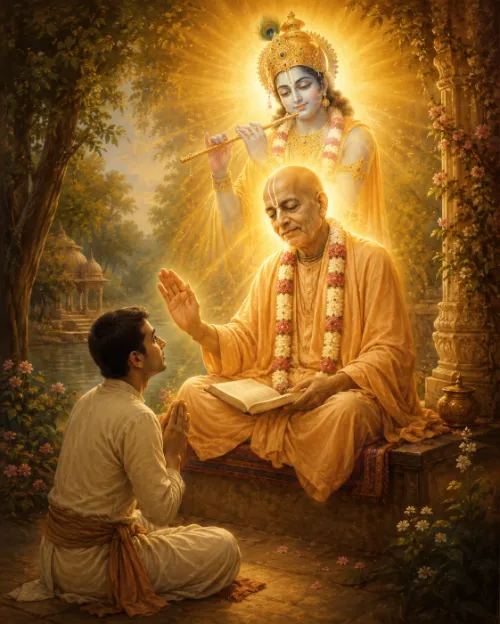
The Guru Is Nondifferent from Kṛṣṇa — But Not Kṛṣṇa in Every Respect
Śrīla Prabhupāda’s purport to Caitanya-caritāmṛta, Ādi-līlā 1.46, explains that pure devotees may regard the spiritual master and Lord Śiva as one with the Personality of Godhead because they are exceedingly dear to Him—not because they are identical with Him in every possible respect.
That explanation accurately conveys Jīva Gosvāmī’s Sanskrit in Bhakti-sandarbha 213. In fact, Jīva’s own wording is even more exact than the English summary. He says that certain pure devotees hold this vision of non-difference solely because Bhagavān is most dear to guru and Śiva.
The honor is immense. The distinction remains. If the first half is isolated—“the guru and Śiva are one with God”—the result can be a crude doctrine of absolute identity that Jīva did not teach. But if the qualification is used to reduce guru to an ordinary teacher or Śiva to an ordinary soul, the opposite error is committed. Gauḍīya theology insists on both truths at once: genuine divine representation and real personal distinction.
The exact chain of sources
Several texts are involved, and keeping them separate prevents confusion.
Thus the “real source” behind the note has three layers. The verse appearing as Caitanya-caritāmṛta Ādi 1.46 originally comes from the Bhāgavatam. The purport then cites Jīva Gosvāmī’s theological explanation. Jīva, in turn, supports his explanation with another Bhāgavatam verse concerning Śiva and the Pracetās.
“Know the ācārya as Myself”
The Sanskrit verse printed as Caitanya-caritāmṛta, Ādi 1.46, is Śrīmad-Bhāgavatam 11.17.27. Kṛṣṇa speaks it to Uddhava while describing the conduct of a student living under the spiritual master’s care:
आचार्यं मां विजानीयान्नावमन्येत कर्हिचित् ।
न मर्त्यबुद्ध्यासूयेत सर्वदेवमयो गुरुः ॥
ācāryaṁ māṁ vijānīyān nāvamanyeta karhicit
na martya-buddhyāsūyeta sarva-deva-mayo guruḥ
“One should know the ācārya as Myself and never dishonor him. One should not resent him by viewing him as an ordinary mortal, for the guru represents all the divine beings.”
The verse is deliberately uncompromising. The disciple is not invited to regard guru as merely a lecturer, counselor, or religious employee. The words māṁ vijānīyāt—“one should know him as Me”—locate the guru within Kṛṣṇa’s own work of revelation and mercy.
Yet the verse is about how the disciple must receive the authentic ācārya. It does not grant every self-appointed teacher the status of God, nor does it say that a guru becomes the independent source of all divine powers. The rest of the Gauḍīya discussion explains the kind of non-difference intended.
Kṛṣṇadāsa Kavirāja gives the distinction before giving the identity
The immediate Bengali context of the Caitanya-caritāmṛta already blocks a simplistic reading. Just before quoting the Sanskrit verse, Kṛṣṇadāsa Kavirāja places service and manifestation side by side:
যদ্যপি আমার গুরু—চৈতন্যের দাস ।
তথাপি জানিয়ে আমি তাঁহার প্রকাশ ॥
গুরু কৃষ্ণরূপ হন শাস্ত্রের প্রমাণে ।
গুরুরূপে কৃষ্ণ কৃপা করেন ভক্তগণে ॥
yadyapi āmāra guru—caitanyera dāsa
tathāpi jāniye āmi tāṅhāra prakāśa
guru kṛṣṇa-rūpa hana śāstrera pramāṇe
guru-rūpe kṛṣṇa kṛpā karena bhakta-gaṇe
“Although my guru is a servant of Śrī Caitanya, I nevertheless know him as His manifestation. According to the testimony of scripture, guru is Kṛṣṇa’s form; in the form of guru, Kṛṣṇa bestows mercy upon His devotees.”
Caitanya-caritāmṛta, Ādi 1.44–45
The two descriptions are not rivals:
- The guru is Caitanya’s servant.
- The guru is Caitanya’s manifestation.
- Kṛṣṇa acts through guru to give mercy.
The servant does not cease to be a servant when the Lord’s mercy becomes perfectly visible through him. Rather, his transparent servitorship is precisely what makes him a manifestation of divine mercy.
Kavirāja Gosvāmī makes the same structure even more explicit when speaking of the instructing guru:
শিক্ষাগুরুকে ত’ জানি কৃষ্ণের স্বরূপ ।
অন্তর্যামী, ভক্তশ্রেষ্ঠ,—এই দুই রূপ ॥
śikṣā-guruke ta’ jāni kṛṣṇera svarūpa
antaryāmī, bhakta-śreṣṭha,—ei dui rūpa
“Know the instructing guru as Kṛṣṇa’s own form. He appears in these two ways: as the indwelling Lord and as the foremost devotee.”
Caitanya-caritāmṛta, Ādi 1.47
Kṛṣṇa guides from within as the indwelling Lord and from without through His exalted devotee. The external guru is therefore not a competitor who replaces Kṛṣṇa. He is the devotee through whom Kṛṣṇa’s guidance becomes audible, personal, and practical.
What Jīva Gosvāmī actually says
The decisive sentence in Bhakti-sandarbha 213 reads:
शुद्धभक्तास्त्वेके श्रीगुरोः श्रीशिवस्य च भगवता सहाभेददृष्टिं तत्प्रियतमत्वेनैव मन्यन्ते ।
śuddha-bhaktās tv eke śrī-guroḥ śrī-śivasya ca bhagavatā sahābheda-dṛṣṭiṁ tat-priyatamatvenaiva manyante
“Yet certain pure devotees regard Śrī Guru and Śrī Śiva as nondifferent from Bhagavān solely because they are supremely dear to Him.”
Every important safeguard is already present in that single sentence.
Prabhupāda’s phrase “not identical with Him in all respects” is not a separate half-line literally found in Jīva’s Sanskrit. It is an accurate unpacking of Jīva’s restrictive eva and of the reason Jīva supplies: tat-priyatamatva, “being supremely dear to Him.”
In other words, Jīva is not saying:
Guru = Śiva = Bhagavān in person, powers, role, and every ontological respect.
He is saying:
Because guru and Śiva are extraordinarily dear to Bhagavān and perfectly joined to His purpose, pure devotees may honor them with a vision of non-difference from Him.
This is relational non-difference. It is not the erasure of persons.
Why Śiva is Jīva’s perfect example
Immediately after the defining sentence, Jīva quotes the Pracetās’ prayer to the eight-armed form of Bhagavān:
वयं तु साक्षाद्भगवन् भवस्य
प्रियस्य सख्युः क्षणसङ्गमेन ।
सुदुश्चिकित्स्यस्य भवस्य मृत्यो-
र्भिषक्तमं त्वाद्य गतिं गताः स्म ॥
vayaṁ tu sākṣād bhagavan bhavasya
priyasya sakhyuḥ kṣaṇa-saṅgamena
suduścikitsyasya bhavasya mṛtyor
bhiṣaktamaṁ tvādya gatiṁ gatāḥ sma
“O Bhagavān, through even a moment’s association with Bhava—Śiva, Your dear friend—we have now attained You as our destination, the best physician for the almost incurable disease of repeated birth and death.”
Śrīmad-Bhāgavatam 4.30.38
The verse does not say that the Pracetās met Śiva and therefore no longer needed Bhagavān. It says the opposite: through Śiva they attained Bhagavān. This follows the narrative of the Rudra-gītā. The Pracetās met Śiva on their journey. Śiva recognized their devotional disposition, instructed them in a prayer to Vāsudeva, and directed their consciousness toward the Supreme Lord. Much later, when Bhagavān appeared before them, they understood that their attainment had come through Śiva’s mercy.
Jīva then cites the commentary’s explanation of the crucial expression “Your dear friend” and adds his own decisive observation:
तव यः प्रियः सखा तस्य भवस्य ।
श्रीशिवो ह्येषां वक्तॄणां गुरुः ।
tava yaḥ priyaḥ sakhā tasya bhavasya
śrī-śivo hy eṣāṁ vaktṝṇāṁ guruḥ
“Of Bhava, who is Your dear friend. Śrī Śiva was indeed the guru of these speakers.”
The example therefore joins both halves of Jīva’s sentence in one person. Śiva is Bhagavān’s dear friend, and Śiva is the Pracetās’ guru. Their guru’s greatness consists in bringing them to Bhagavān.
The theological movement is simple and profound: Bhagavān’s mercy flows through His dear servant as instruction and grace, and the disciple is thereby brought to Bhagavān. Guru does not terminate the movement of devotion in himself. He carries it to its true object.
The preceding section makes guru’s divine status equally strong
It would be a mistake to use Bhakti-sandarbha 213 to weaken the disciple’s reverence. Immediately before it, in section 212, Jīva quotes Nārada’s warning about viewing guru as mortal:
यस्य साक्षाद्भगवति ज्ञानदीपप्रदे गुरौ ।
मर्त्यासद्धीः श्रुतं तस्य सर्वं कुञ्जरशौचवत् ॥
yasya sākṣād bhagavati jñāna-dīpa-prade gurau
martyāsad-dhīḥ śrutaṁ tasya sarvaṁ kuñjara-śaucavat
“For one who falsely regards as mortal the guru who is directly Bhagavān and who gives the lamp of knowledge, all that he has heard is useless, like an elephant’s bathing.”
Śrīmad-Bhāgavatam 7.15.26
The elephant bathes and then throws dust over itself. Likewise, scriptural learning cannot purify a person who receives transcendental knowledge from guru but then dismisses its giver as ordinary.
The sequence is important:
- Jīva first establishes that guru must not be viewed with ordinary mortal vision.
- He then explains the devotional basis on which certain pure devotees see guru and Śiva as nondifferent from Bhagavān.
- The qualification preserves distinction without diluting reverence.
The doctrine is not “guru is merely human.” Nor is it “guru is an independent God.” It is that Bhagavān becomes personally accessible through His dearmost servant.
Devotion offered to guru as it is offered to God
Jīva also cites the celebrated conclusion of the Śvetāśvatara Upaniṣad:
यस्य देवे परा भक्तिर्यथा देवे तथा गुरौ ।
तस्यैते कथिता ह्यर्थाः प्रकाशन्ते महात्मनः ॥
yasya deve parā bhaktir yathā deve tathā gurau
tasyaite kathitā hy arthāḥ prakāśante mahātmanaḥ
“To the great soul who has supreme devotion to the Lord and, as to the Lord, so also to guru, the meanings taught in scripture become manifest.”
Śvetāśvatara Upaniṣad 6.23
The verse teaches a corresponding depth of devotion: yathā deve tathā gurau—“as toward the Lord, so toward guru.” That equality of reverence does not require an equality of independent identity. One may honor an ambassador as the sovereign’s fully authorized representative without imagining that the ambassador and sovereign are one person. The analogy is limited, but it clarifies the difference between equal reception of authority and total identity of being.
Guru is more than a symbol, however. In Gauḍīya thought, Kṛṣṇa actually instructs and bestows grace through him. The guru’s representative status is therefore living and effective, not merely ceremonial.
Jīva is equally clear about Śiva
Elsewhere in Bhakti-sandarbha—in section 106—Jīva gives the complementary rule:
श्रीब्रह्मशिवावपि वैष्णवत्वेनैव भजेत ।
śrī-brahma-śivāv api vaiṣṇavatvenaiva bhajeta
“One should honor Brahmā and Śiva precisely in their character as Vaiṣṇavas.”
He then cites scriptural warnings against flattening all divine persons into a single undifferentiated level. One such verse, also quoted as Hari-bhakti-vilāsa 1.117, states:
यस्तु नारायणं देवं ब्रह्मरुद्रादिदैवतैः ।
समत्वेनैव वीक्षेत स पाषण्डी भवेद् ध्रुवम् ॥
yas tu nārāyaṇaṁ devaṁ brahma-rudrādi-daivataiḥ
samatvenaiva vīkṣeta sa pāṣaṇḍī bhaved dhruvam
“One who regards Lord Nārāyaṇa as simply equal to the deities headed by Brahmā and Rudra certainly rejects the Vaiṣṇava conclusion.”
Jīva then explains the scope of scriptural statements about non-difference:
अत एवाभेददृष्टिवचनं समभक्तज्ञान्यादिपरमेव ।
ata evābheda-dṛṣṭi-vacanaṁ sama-bhakta-jñāny-ādi-param eva
“Therefore, statements about a vision of non-difference refer to equality in devotion, wisdom, and similar qualities.”
This is powerful corroboration. The same Jīva who permits an abheda-dṛṣṭi—a vision of non-difference—also rejects an indiscriminate samatva-dṛṣṭi, the idea that Nārāyaṇa and every other divine being are simply equal in status. The shared language must be interpreted according to the quality or relationship being discussed.
Śiva is neither an ordinary soul nor Viṣṇu in every respect
The qualification must not be turned into disrespect for Śiva. The Bhāgavatam gives him a singular place:
निम्नगानां यथा गङ्गा देवानामच्युतो यथा ।
वैष्णवानां यथा शम्भुः पुराणानामिदं तथा ॥
nimna-gānāṁ yathā gaṅgā devānām acyuto yathā
vaiṣṇavānāṁ yathā śambhuḥ purāṇānām idaṁ tathā
“As the Gaṅgā is foremost among rivers, Acyuta among divine beings, and Śambhu among Vaiṣṇavas, so this is foremost among the Purāṇas.”
Śrīmad-Bhāgavatam 12.13.16
Śiva is called the greatest Vaiṣṇava, not a rival who contests Viṣṇu’s supremacy. His greatness shines in his devotion. At the same time, Gauḍīya theology does not place Śiva in the category of an ordinary finite soul. Brahma-saṁhitā 5.45 uses the famous milk-and-curd comparison:
क्षीरं यथा दधि विकारविशेषयोगात्
सञ्जायते न हि ततः पृथगस्ति हेतोः ।
यः शम्भुतामपि तथा समुपैति कार्याद्
गोविन्दमादिपुरुषं तमहं भजामि ॥
kṣīraṁ yathā dadhi vikāra-viśeṣa-yogāt
sañjāyate na hi tataḥ pṛthag asti hetoḥ
yaḥ śambhutām api tathā samupaiti kāryād
govindam ādi-puruṣaṁ tam ahaṁ bhajāmi
“Just as milk becomes curd through a particular transformation and the effect is not independent of its cause, so Govinda assumes the condition of Śambhu for a particular cosmic function. I worship Govinda, the original person.”
Curd comes from milk and is inseparable from it as its cause, yet curd is not functionally identical with milk. The analogy gives Śiva a unique derivative status: he is not independent of Govinda, not an ordinary jīva or finite soul, and not identical with Govinda in every respect.
This is a separate but complementary point. Bhakti-sandarbha 213 defines a devotional perception of Śiva based on dearness to Bhagavān. Brahma-saṁhitā 5.45 addresses the more specialized ontological relation of Śiva-tattva, the theological category of Śiva, to Govinda. The two should not be collapsed, and Jīva’s sentence should not be mistaken for a complete definition of Śiva’s metaphysical status.
Guru and Śiva are therefore paired in Bhakti-sandarbha 213 because the Pracetās’ guru was Śiva and because both are supremely dear to Bhagavān. This does not mean that every spiritual master belongs to the same ontological category as Śiva.
Raghunātha dāsa Gosvāmī: remember guru as Mukunda’s dearest
Prabhupāda’s purport also points to Raghunātha dāsa Gosvāmī. The reference is to Manaḥ-śikṣā 2, whose concluding lines say:
शचीसूनुं नन्दीश्वरपतिसुतत्वे गुरुवरं
मुकुन्दप्रेष्ठत्वे स्मर परमजस्रं ननु मनः ॥
śacī-sūnuṁ nandīśvara-pati-sutatve guru-varaṁ
mukunda-preṣṭhatve smara param ajasraṁ nanu manaḥ
“O mind, always remember Śacī’s son as the son of the lord of Nandīśvara—Kṛṣṇa—and remember the exalted guru as Mukunda’s dearmost.”
Raghunātha does not instruct the mind to remember guru as an independent Mukunda. He says mukunda-preṣṭhatve: remember guru in his identity as most dear to Mukunda. This is a poetic counterpart to Jīva’s tat-priyatamatvena.
The bond with Kṛṣṇa is not incidental to guru’s identity. It is the heart of it.
Viśvanātha Cakravartī makes both halves impossible to miss
The same principle appears with unmatched clarity in the seventh verse of Viśvanātha Cakravartī Ṭhākura’s Śrī Gurvaṣṭakam:
साक्षाद्धरित्वेन समस्तशास्त्रैर्
उक्तस्तथा भाव्यत एव सद्भिः ।
किन्तु प्रभोर्यः प्रिय एव तस्य
वन्दे गुरोः श्रीचरणारविन्दम् ॥
sākṣād-dharitvena samasta-śāstrair
uktas tathā bhāvyata eva sadbhiḥ
kintu prabhor yaḥ priya eva tasya
vande guroḥ śrī-caraṇāravindam
“All scriptures describe the guru as directly Hari, and saintly persons understand him in that way. Yet he is the Lord’s own dear one. I bow to the lotus feet of that guru.”
The first two lines demand the divine vision; the third begins with kintu—“yet” or “but”—and identifies guru as the Lord’s dear one. Viśvanātha is not correcting the scriptures after quoting them. He is explaining how both descriptions coexist.
Remove the first half, and guru becomes ordinary. Remove the second, and guru can be falsely turned into an independent God. Keep both, and the Gauḍīya principle becomes clear.
Four kinds of “oneness” that should not be confused
The following is an explanatory map rather than a set of technical categories formally listed by Jīva. It helps ordinary readers see why the same word “nondifferent” can perform different work in different passages.
The word “ontological” simply asks what someone is in the order of being. The note is therefore right to say that relational unity does not abolish ontological distinctions. It would be even more exact to add that Śiva has his own unique theological category, while the human spiritual master’s non-difference is discussed primarily in terms of representation, divine agency, and dearness to Bhagavān.
The doctrine avoids two opposite mistakes
Mistake one: reducing guru to an ordinary person
This violates Kṛṣṇa’s command not to apply martya-buddhi—ordinary mortal judgment—to the ācārya. It also makes spiritual knowledge self-defeating: one seeks divine truth through guru but refuses to recognize divine grace when it arrives through him.
To say that guru is not Kṛṣṇa in every respect does not mean that he is “just another person.” The bona fide guru is to be revered because he carries Kṛṣṇa’s message, embodies service to Kṛṣṇa, and functions as Kṛṣṇa’s merciful approach to the disciple.
Mistake two: making guru an independent God
This destroys the very feature by which guru is known: his servitorship. Prabhupāda’s purport explicitly warns that a false teacher may claim total identity with Kṛṣṇa in order to exploit disciples. Such a person imitates the Lord rather than representing Him.
A genuine guru does not draw the disciple away from Kṛṣṇa to become a rival center of enjoyment. He does not claim the right to imitate Kṛṣṇa’s unique pastimes. His authority is transparent, dependent, and devotional. He speaks for Kṛṣṇa because he serves Kṛṣṇa.
The same balance applies to Śiva:
- To treat Śiva as an ordinary conditioned soul is a serious theological reduction.
- To treat Śiva and Viṣṇu as interchangeable in every status, power, and function erases distinctions maintained by the very texts that glorify Śiva.
- To honor Śiva as Bhagavān’s supremely dear devotee, unique cosmic manifestation, and teacher of devotion preserves both his greatness and Viṣṇu’s supremacy.
Why the qualification matters in practice
This is not only a metaphysical debate. It has consequences for spiritual life and religious authority. First, the qualification protects the purpose of guru-disciple life. The goal of surrender to guru is surrender to Bhagavān through the guidance of His servant. The Pracetās’ story gives the model: association with guru culminates in reaching Bhagavān.
Second, it protects disciples from a personality cult. Extraordinary reverence is not permission for a teacher to reverse scripture, imitate God, or make personal gratification the goal of discipleship. Prabhupāda’s purport identifies service to the Lord—not self-deification—as the test of an ācārya.
Third, it protects reverence from becoming merely symbolic. Guru is not honored only because ancient etiquette says teachers deserve respect. He is honored because Kṛṣṇa actively gives knowledge and mercy through him.
Fourth, it protects the theology of Śiva from both sectarian contempt and careless equivalence. Śiva’s glory is not diminished by calling him the greatest Vaiṣṇava. In Gauḍīya eyes, being Bhagavān’s dearest devotee is itself an immeasurable glory.
The shortest accurate formulation
The principle can be compressed into four sentences:
- Kṛṣṇa reveals His instruction and mercy through the bona fide spiritual master.
- The disciple must therefore honor guru as Kṛṣṇa’s manifested representative, not as an ordinary mortal.
- Guru remains Kṛṣṇa’s dearmost servant and is not independently identical with Him in every respect.
- Śiva may likewise be viewed as nondifferent from Bhagavān in dearness, divine alignment, and causal relation, while retaining his distinct identity and unique status.
This is not a compromise between reverence and philosophy. It is the precise form of reverence taught by the Gauḍīya ācāryas.
This attribution is substantially correct. The citation to Bhakti-sandarbha 213 is real, the connection made in Prabhupāda’s purport is accurate, and the qualification that follows is indispensable.
The deepest point is contained in one Sanskrit word: eva—“only,” “precisely,” or “indeed.” Jīva says that certain pure devotees see guru and Śiva as nondifferent from Bhagavān because of their supreme dearness to Him. Prabhupāda rightly draws out the consequence: this is not identity “in all respects.”
But the qualification must not be made to cancel the original affirmation. The disciple is still commanded to know the ācārya as Kṛṣṇa’s own manifestation of mercy. Guru is simultaneously servant and manifestation, recipient of Kṛṣṇa’s love and bearer of Kṛṣṇa’s authority.
The formula is therefore neither “guru is merely human” nor “guru is independently God.” It is this:
Kṛṣṇa reaches the disciple through His dearmost servant, and the servant’s perfect transparency to Kṛṣṇa is the ground of his sacred non-difference from Him.
Honor the unity. Preserve the distinction. Omit neither.
Websites and digital texts consulted
- VedaBase: Caitanya-caritāmṛta, Ādi-līlā 1.44
- VedaBase: Caitanya-caritāmṛta, Ādi-līlā 1.45
- VedaBase: Caitanya-caritāmṛta, Ādi-līlā 1.46, with Prabhupāda’s purport
- VedaBase: Caitanya-caritāmṛta, Ādi-līlā 1.47
- GRETIL: Jīva Gosvāmī’s Bhakti-sandarbha, complete Sanskrit text
- Internet Archive: 1955 Calcutta edition of Bhakti-sandarbha, Sanskrit with Bengali translation
- VedaBase: Śrīmad-Bhāgavatam 11.17.27
- VedaBase: Śrīmad-Bhāgavatam 7.15.26
- VedaBase: Śrīmad-Bhāgavatam 4.30.38
- VedaBase: Śrīmad-Bhāgavatam 12.13.16
- VedaBase: Brahma-saṁhitā 5.45
- GRETIL: Hari-bhakti-vilāsa 1.117 in its Sanskrit context
- Bhaktivinoda Institute: Manaḥ-śikṣā 2 and Bhaktivinoda Ṭhākura’s commentary
- Text of Viśvanātha Cakravartī Ṭhākura’s Śrī Gurvaṣṭakam