

When God Himself Becomes the Gift
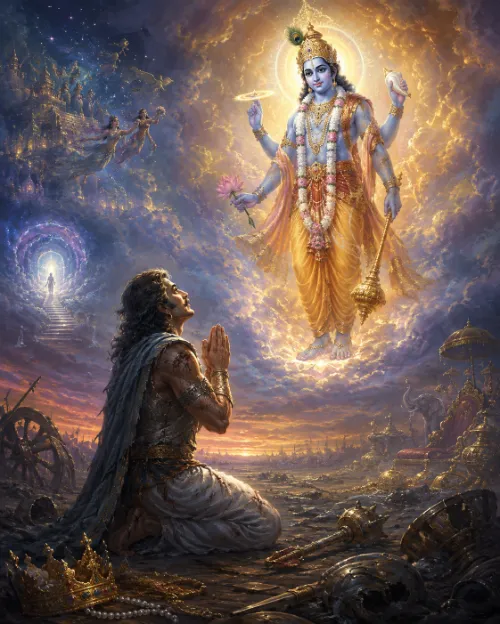
When God Himself Becomes the Gift: Why the Pure Devotee Asks for Nothing Else
A profound difference exists between asking God for something and wanting God Himself. Śrīmad-Bhāgavatam 6.9.48 captures that difference in a remarkably compact verse. The Supreme Lord has appeared before the demigods. He is pleased with their prayers. He possesses unlimited power. Nothing they could reasonably desire is beyond His ability to grant.
Yet He tells them something unexpected:
किं दुरापं मयि प्रीते
तथापि विबुधर्षभाः ।
मय्येकान्तमतिर्नान्यन्
मत्तो वाञ्छति तत्त्ववित् ॥
kiṁ durāpaṁ mayi prīte
tathāpi vibudharṣabhāḥ
mayy ekānta-matir nānyan
matto vāñchati tattva-vit
Śrīmad-Bhāgavatam 6.9.48
A close translation is: “What can possibly be difficult to obtain when I am pleased? Nevertheless, O best of the intelligent gods, one who knows the truth and whose mind is exclusively fixed upon Me desires nothing else from Me.”
A. C. Bhaktivedanta Swami Prabhupāda translates the final thought more explicitly: “A pure devotee, whose mind is exclusively fixed upon Me, does not ask Me for anything but the opportunity to engage in devotional service.”
That translation expresses the passage’s theology very well, but one textual refinement is worth making. The Sanskrit itself does not literally contain a phrase meaning: “except devotional service.”
It says: nānyan matto vāñchati “he desires nothing else from Me” or, with a closely related nuance, “he desires nothing other than Me.” The positive idea of desiring only devotional service is the Vaiṣṇava interpretation of what such exclusive desire actually looks like.
Remarkably, the Bhāgavatam itself soon supplies the evidence. Only two chapters later, Vṛtrāsura—the very enemy the demigods want God to destroy—prays: “May I become the servant of Your servants. May my mind remember You, my words glorify You, and my body serve You.”
The supposed demon becomes the living embodiment of the pure devotion the Lord had just described. That narrative reversal is the key to understanding the verse.
The Paradox: God Can Give Everything, Yet the Devotee Wants Nothing Else
The opening words are: kiṁ durāpam mayi prīte “What is difficult to obtain when I am pleased?” The implied answer is: Nothing. If the Supreme Lord chooses to give, no external power can obstruct Him.
He can give: wealth, health, victory, long life, heavenly enjoyment, political power, mystic perfection, cosmic status, liberation, or anything else within or beyond material existence.
Then comes the decisive word: tathāpi “nevertheless.” That word turns the entire verse. The logic becomes: Nothing is impossible for the devotee to obtain when Bhagavān is pleased.
Nevertheless, the person who truly understands reality does not ask Him for something else.
The verse is therefore not primarily about God’s generosity. It is about the transformation of desire.
Why Does the Devotee Stop Asking?
The final word of the verse supplies the answer: tattva-vit “one who knows reality.” Break the expression down: tattva — truth, reality, the actual nature of something; vit — one who knows.
The pure devotee does not merely suppress desire because a religious rule says: “Good devotees should not ask God for things.” He stops valuing those things independently because he understands what they really are.
This is a much deeper teaching. The devotee’s renunciation is not primarily moral restraint. It is transformed perception.
The Very Next Verse Explains the Contrast
Śrīmad-Bhāgavatam 6.9.49 says:
न वेद कृपणः श्रेय
आत्मनो गुणवस्तुदृक् ।
तस्य तानिच्छतो यच्छेद्
यदि सोऽपि तथाविधः ॥
na veda kṛpaṇaḥ śreya
ātmano guṇa-vastu-dṛk
tasya tān icchato yacched
yadi so ’pi tathā-vidhaḥ
“The miserly person who sees value in objects produced by the material guṇas does not know the true good of the self. If someone grants such a person the things he desires, the giver would himself be of the same mentality.”
Śrīmad-Bhāgavatam 6.9.49
Now the contrast becomes explicit. Verse 48 gives us: tattva-vit — one who knows reality. Verse 49 gives us: guṇa-vastu-dṛk — one whose vision is fixed on objects belonging to the material guṇas.
These are two completely different ways of seeing life.
Guṇa-vastu-dṛk: Seeing the Temporary as the Ultimate
The compound is revealing: guṇa-vastu-dṛk guṇa — the three material modes, sattva, rajas, and tamas; vastu — object or thing; dṛk — one who sees. The person sees the temporary products of material nature and thinks: “This is where my real happiness lies.”
He sees: wealth, status, sensuous enjoyment, beauty, reputation, power, victory, longevity, even residence in heavenly worlds, and assigns them ultimate value. The Bhāgavatam calls such a person: kṛpaṇa a miser.
Why? Because the human being has the capacity to seek the infinite but spends that capacity bargaining for the finite.
The Miser and the Treasure
A miser is not necessarily someone who possesses very little. He is someone whose sense of value is tragically small. One may stand before Bhagavān—the source of everything—and ask only for another temporary rearrangement of material circumstances.
The problem is not that food, shelter, health, family, wealth, or safety are intrinsically evil. The problem is mistaking a limited good for the highest good. That is why the next important word is: śreyaḥ the genuine good of the self.
Śreyaḥ and Preyaḥ: The Good and the Pleasant
The distinction recalls one of the great teachings of the Kaṭha Upaniṣad.
श्रेयश्च प्रेयश्च मनुष्यमेतस्
तौ सम्परीत्य विविनक्ति धीरः ।
श्रेयो हि धीरोऽभि प्रेयसो वृणीते
प्रेयो मन्दो योगक्षेमाद् वृणीते ॥
śreyaś ca preyaś ca manuṣyam etas
tau samparītya vivinakti dhīraḥ
śreyo hi dhīro ’bhi preyaso vṛṇīte
preyo mando yoga-kṣemād vṛṇīte
“The truly good and the merely pleasant approach the human being. The wise person examines and distinguishes them. The wise chooses the good over the pleasant, whereas the foolish chooses the pleasant for the sake of acquisition and preservation.”
Kaṭha Upaniṣad 1.2.2
The distinction is subtle but fundamental. Preyaḥ asks: “What do I want now?” Śreyaḥ asks: “What is actually good for me?” The two may coincide. But they often do not. Śrīmad-Bhāgavatam 6.9.48–50 applies this distinction directly to prayer.
God Is Not a Cosmic Order-Fulfillment System
Verse 50 gives one of the Bhāgavatam’s most memorable analogies.
स्वयं निःश्रेयसं विद्वान्
न वक्त्यज्ञाय कर्म हि ।
न राति रोगिणोऽपथ्यं
वाञ्छतोऽपि भिषक्तमः ॥
svayaṁ niḥśreyasaṁ vidvān
na vakty ajñāya karma hi
na rāti rogiṇo ’pathyaṁ
vāñchato ’pi bhiṣaktamaḥ
“One who knows the supreme good does not direct an ignorant person toward fruitive activity, just as an excellent physician does not give harmful food to a patient even when the patient desires it.”
Śrīmad-Bhāgavatam 6.9.50
The image changes the theology of prayer. A sick patient says: “Give me what I crave.” A competent physician asks: “Will it heal you?” Likewise, the immature religious mind thinks: “If God loves me, He should give me what I ask for.”
The Bhāgavata replies: That may not be love. A loving God seeks the soul’s actual good. Sometimes that may mean granting a desire. Sometimes it may mean refusing it. Sometimes it may mean transforming the person who desires it.
Divine Mercy Is Not the Same as Material Increase
This is a difficult theological principle. We often measure divine favor according to acquisition: more wealth, better health, more influence, more comfort, greater success.
But if Bhagavān is compared to the best physician, His favor cannot be reduced to satisfying every appetite. A physician who knowingly gives a harmful substance to a patient because the patient begged for it is not compassionate.
Likewise, divine grace may sometimes frustrate a desire because the desire itself is part of the disease. The deepest mercy is not: “May everything I want happen.” It is: “May I come to want what is truly good.”
Mayy Ekānta-matiḥ: When Consciousness Has One Center
The central devotional expression in verse 48 is: mayy ekānta-matiḥ mayi — in Me; ekānta — exclusive, undivided, directed toward one end; matiḥ — mind, intention, orientation, conviction.
The phrase describes consciousness that no longer treats Bhagavān as one instrument among many. Ordinary religious psychology can look like this: “I want prosperity, and God may give it.”
“I want victory, and God may help me obtain it.” “I want protection, and God may provide it.” “I want liberation, and God may grant it.” God remains the means. The desired object remains the goal.
In ekānta-bhakti, the structure reverses. God becomes the goal. Everything else becomes subordinate.
Bhagavad-gītā Gives the Same Ideal
अनन्याश्चिन्तयन्तो मां
ये जनाः पर्युपासते ।
तेषां नित्याभियुक्तानां
योगक्षेमं वहाम्यहम् ॥
ananyāś cintayanto māṁ
ye janāḥ paryupāsate
teṣāṁ nityābhiyuktānāṁ
yoga-kṣemaṁ vahāmy aham
“For those who worship Me while thinking exclusively of Me, remaining constantly united with Me, I carry what they lack and preserve what they possess.”
Bhagavad-gītā 9.22
The devotee is not told to make yoga-kṣema—acquisition and preservation—the center of consciousness. Kṛṣṇa becomes the center. Then Kṛṣṇa says: “I shall take responsibility for yoga-kṣema.”
That is a profound reversal.
Knowledge Naturally Produces Exclusive Devotion
Bhagavad-gītā 7.17 gives another close parallel:
तेषां ज्ञानी नित्ययुक्त
एकभक्तिर्विशिष्यते ।
प्रियो हि ज्ञानिनोऽत्यर्थम्
अहं स च मम प्रियः ॥
teṣāṁ jñānī nitya-yukta
eka-bhaktir viśiṣyate
priyo hi jñānino ’tyartham
ahaṁ sa ca mama priyaḥ
“Among them, the person of knowledge who is constantly united with Me in exclusive devotion is especially distinguished, for I am exceedingly dear to him, and he is dear to Me.”
Bhagavad-gītā 7.17
Again the pattern is: knowledge → exclusiveness → love. The knowledgeable devotee realizes that the greatest thing Bhagavān can give is not something external to Bhagavān.
It is Bhagavān Himself.
The Immediate Context: The Demigods Want Vṛtrāsura Killed
Śrīmad-Bhāgavatam 6.9.48 appears in a very specific story. The demigods are in serious trouble. Their enemy is Vṛtrāsura. They approach the Supreme Lord and offer sophisticated theological prayers.
The Lord is pleased with their words. But underneath the prayers lies a very practical desire: they want their enemy defeated. This makes verse 48 almost gently corrective.
The Lord effectively says: “Nothing is impossible when I am pleased. Yet one who truly knows Me and is exclusively devoted to Me does not desire another object from Me.” Their theology is advanced.
Their motive remains mixed. That contrast is important. A person can understand a great deal of religious philosophy while still approaching God primarily as a supplier of desired outcomes.
Vibudharṣabhāḥ: “O Best of the Intelligent Gods”
The Lord addresses them: vibudha-ṛṣabhāḥ vibudha — intelligent, enlightened; also a standard word for the gods; ṛṣabha — literally a bull, figuratively the foremost or best.
So the phrase means: “O foremost among the intelligent gods.” There is an almost deliberate tension here. They are called intelligent. Then the Lord explains what the true tattva-vit, the knower of reality, actually wants.
It is as if the text asks: If you are truly wise, what will you ultimately ask God for?
Then the Story Turns Upside Down
The greatest irony appears later. The demigods want God’s help to kill Vṛtrāsura. But when Vṛtrāsura finally stands on the battlefield, the supposedly demonic enemy speaks some of the purest prayers in the entire Bhāgavata Purāṇa.
The man whom the gods want destroyed becomes the theological exemplar of the consciousness the Lord described in 6.9.48. That is one of the most beautiful narrative reversals in the Sixth Canto.
Vṛtrāsura Does Ask for Something
And what does he ask for? Not nothing. He asks for service.
अहं हरे तव पादैकमूल-
दासानुदासो भवितास्मि भूयः ।
मनः स्मरेतासुपतेर्गुणांस्ते
गृणीत वाक् कर्म करोतु कायः ॥
ahaṁ hare tava pādaika-mūla-
dāsānudāso bhavitāsmi bhūyaḥ
manaḥ smaretāsu-pater guṇāṁs te
gṛṇīta vāk karma karotu kāyaḥ
“O Hari, may I again become the servant of Your servants whose only shelter is Your lotus feet. May my mind remember Your qualities, my speech glorify them, and my body perform service to You.”
Śrīmad-Bhāgavatam 6.11.24
This verse supplies the positive content behind Prabhupāda’s interpretation of 6.9.48. Pure devotion is not merely: “I want nothing.” It is: “I want to serve.”
The Servant of the Servant
Vṛtrāsura does not even say merely: “I want to be Your servant.” He says: dāsa-anudāsaḥ “the servant of Your servant.” This is an important Vaiṣṇava principle. The highest devotional aspiration is not domination, proximity for prestige, or possession of divine power.
It is service within the community of service. The mind serves by remembering. The voice serves by glorifying. The body serves by acting. The whole person becomes reorganized around Bhagavān.
Then Vṛtrāsura Rejects Almost Every Possible Reward
न नाकपृष्ठं न च पारमेष्ठ्यं
न सार्वभौमं न रसाधिपत्यम् ।
न योगसिद्धीरपुनर्भवं वा
समञ्जस त्वा विरहय्य काङ्क्षे ॥
na nāka-pṛṣṭhaṁ na ca pārameṣṭhyaṁ
na sārva-bhaumaṁ na rasādhipatyam
na yoga-siddhīr apunar-bhavaṁ vā
samañjasa tvā virahayya kāṅkṣe
“I do not desire heavenly existence, the position of Brahmā, universal sovereignty, rulership of the lower worlds, mystic powers, or even freedom from rebirth if these mean separation from You.”
Śrīmad-Bhāgavatam 6.11.25
Notice how far the list goes. Vṛtrāsura rejects: heavenly pleasure; cosmic rank; political sovereignty; rule over other realms; yogic siddhis; and even: apunar-bhava — liberation from rebirth.
This is not simply rejection of crude materialism. It is the rejection of anything that becomes an alternative to loving relationship with Bhagavān.
Even Liberation Is Secondary to Service
That is one of the most radical features of bhakti theology. The pure devotee does not simply say: “I reject material pleasures because I want a greater spiritual reward called liberation.”
Even liberation can become secondary. Why? Because bhakti does not ultimately seek freedom from existence. It seeks relationship within eternal existence. If liberation is separated from service, the devotee does not regard it as the highest prize.
Kapila States the Principle Explicitly
सालोक्यसार्ष्टिसामीप्य-
सारूप्यैकत्वमप्युत ।
दीयमानं न गृह्णन्ति
विना मत्सेवनं जनाः ॥
sālokya-sārṣṭi-sāmīpya-
sārūpyaikatvam apy uta
dīyamānaṁ na gṛhṇanti
vinā mat-sevanaṁ janāḥ
“Even when liberation in the forms of living in My realm, sharing My opulence, attaining My proximity, attaining a form like Mine, or oneness is offered, My devotees do not accept it without My service.”
Śrīmad-Bhāgavatam 3.29.13
The decisive expression is: vinā mat-sevanam “without My service.” Now the meaning implicit in 6.9.48 becomes explicit. The issue is not merely: “Is the reward spiritual?”
The decisive question is: “Does it contain loving service?”
Prahlāda: Devotion Is Not Commerce
Prahlāda Mahārāja expresses the same principle in extraordinarily sharp language. Lord Nṛsiṁhadeva invites him to ask for benedictions. Prahlāda replies:
नान्यथा तेऽखिलगुरो
घटेत करुणात्मनः ।
यस्त आशिष आशास्ते
न स भृत्यः स वै वणिक् ॥
nānyathā te ’khila-guro
ghaṭeta karuṇātmanaḥ
yas ta āśiṣa āśāste
na sa bhṛtyaḥ sa vai vaṇik
“One who desires benedictions from You in exchange for service is not truly a servant; he is a merchant.”
Śrīmad-Bhāgavatam 7.10.4
The distinction could hardly be clearer. The merchant says: “I give something so that I may receive something.” The servant asks: “How may I serve?” Bhakti becomes distorted when worship becomes a commercial exchange with God.
Prahlāda Defines the Relationship Positively
अहं त्वकामस्त्वद्भक्तस्
त्वं च स्वाम्यनपाश्रयः ।
नान्यथेहावयोरर्थो
राजसेवकयोरिव ॥
ahaṁ tv akāmas tvad-bhaktas
tvaṁ ca svāmy anapāśrayaḥ
nānyathehāvayor artho
rāja-sevakayor iva
“I am Your devotee without ulterior desire, and You are my independent master. There is no other transaction between us; our relationship is simply that of master and servant.”
Śrīmad-Bhāgavatam 7.10.6
The important word is: akāmaḥ “without material desire.” But Prahlāda is not psychologically empty. He has an intense desire: to serve Bhagavān. Thus desirelessness in bhakti does not mean absence of desire.
It means absence of an independent competing agenda.
Rūpa Gosvāmī Defines Pure Bhakti the Same Way
अन्याभिलाषिताशून्यं
ज्ञानकर्माद्यनावृतम् ।
आनुकूल्येन कृष्णानु-
शीलनं भक्तिरुत्तमा ॥
anyābhilāṣitā-śūnyaṁ
jñāna-karmādy-anāvṛtam
ānukūlyena kṛṣṇānu-
śīlanaṁ bhaktir uttamā
“The highest bhakti is favorable cultivation directed toward Kṛṣṇa, free from desirousness for other independent aims and unobstructed by jñāna, karma, and similar pursuits.”
Bhakti-rasāmṛta-sindhu 1.1.11
The famous phrase is: anyābhilāṣitā-śūnyam “empty of other desires.” But that cannot mean a total absence of longing. The second half is intensely active: ānukūlyena kṛṣṇānuśīlanam “continuous favorable cultivation directed toward Kṛṣṇa.”
Pure devotion therefore does not destroy desire. It concentrates desire.
Many Desires Become One Desire
Ordinary consciousness is fragmented: “I want God.” “I also want prestige.” “I want security.” “I want admiration.” “I want control.” “I want pleasure.” “I want liberation.”
“I want God partly because He might provide these things.” Pure bhakti gradually gathers all these competing centers into one: “May Kṛṣṇa be pleased.” That is the experiential meaning of: ekānta-mati a consciousness with one ultimate center.
Śrī Caitanya Gives the Same Prayer
न धनं न जनं न सुन्दरीं
कवितां वा जगदीश कामये ।
मम जन्मनि जन्मनीश्वरे
भवताद्भक्तिरहैतुकी त्वयि ॥
na dhanaṁ na janaṁ na sundarīṁ
kavitāṁ vā jagad-īśa kāmaye
mama janmani janmanīśvare
bhavatād bhaktir ahaitukī tvayi
“O Lord of the universe, I do not desire wealth, followers, beautiful enjoyment, or worldly achievement. Birth after birth, may I have causeless devotion unto You.”
Śikṣāṣṭaka 4; Caitanya-caritāmṛta, Antya 20.29
The most radical phrase may be: janmani janmani “birth after birth.” The prayer does not even make liberation a precondition. It does not say: “I shall serve You if You stop my rebirth.”
It says: “Whatever my external condition, let there be bhakti.” This is the same spiritual psychology as Vṛtrāsura’s prayer.
Dhruva Shows What Happens When Vision Changes
Dhruva Mahārāja began his worship with a material objective. He wanted a kingdom greater than that of his father. But after encountering the Lord, his valuation changes.
अहो बत ममानात्म्यं
मन्दभाग्यस्य पश्यत ।
भवच्छिदः पादमूलं
गत्वा याचे यदन्तवत् ॥
aho bata mamānātmyaṁ
manda-bhāgyasya paśyata
bhava-cchidaḥ pāda-mūlaṁ
gatvā yāce yad antavat
“Alas, see my misfortune! Having reached the feet of the Lord who destroys material existence, I asked for something that has an end.”
Śrīmad-Bhāgavatam 4.9.31
This is the psychology of tattva-vit emerging. Before realization: “May God give me the object.” After realization: “How could I stand before the eternal and ask primarily for something temporary?”
The object has not necessarily changed. Its perceived value has.
Pure Devotion Is Not Poverty for Its Own Sake
The teaching should not be misunderstood as saying: “A pure devotee must own nothing.” Possession and desire are not identical. A wealthy devotee may regard wealth entirely as a field of service.
A poor person may spend every waking moment longing for wealth. Thus the deeper question is not: “How many things do I possess?” It is: “What possesses my consciousness?”
The Bhāgavata’s concern is attachment, valuation, and ultimate orientation.
Nor Does the Verse Forbid Every Prayer for Help
The Bhāgavata itself contains many devotees who cry to God in distress. Gajendra prays for rescue. Draupadī calls for Kṛṣṇa. The Pāṇḍavas repeatedly depend upon Him. Kuntī prays amid calamity.
Therefore 6.9.48 should not be turned into a rigid rule: “A true devotee must never ask Bhagavān for practical help.” The issue is not whether a devotee may say: “Please protect me.”
The deeper question is: What happens to the relationship if the request is not granted? Mixed devotion says: “I worship because You give me what I want.” Pure devotion says: “I belong to You whether You grant the request or not.”
Honesty in Prayer Is Not Impurity
Bhakti does not require pretending that pain does not hurt. A devotee can say: “I am afraid.” “I am suffering.” “Please help me.” “Please protect my family.” “Please remove this obstacle.”
The danger arises when the prayer becomes a contract: “If You love me, You must obey my preferred outcome.” The physician analogy of 6.9.50 forbids that conclusion. Bhagavān may know a deeper good than the petitioner presently sees.
God May Help an Imperfect Devotee Without Declaring the Motive Perfect
This nuance is beautifully illustrated in the story itself. After correcting the demigods’ understanding, the Lord does in fact help them. He directs them toward the sage Dadhīci, whose bones will be used to create the thunderbolt with which Indra will eventually confront Vṛtrāsura.
So the narrative does not say: “Your devotion is mixed, therefore God refuses you.” Instead: God hears them. God teaches them. God exposes the higher standard. And God still assists them.
This is spiritually important. Bhakti can begin mixed. A person need not already possess pure devotion before approaching Bhagavān. But scripture still shows the direction in which devotion should mature.
Pure Bhakti Is the Ocean; Other Rewards Are Puddles
Near the end of the Vṛtrāsura episode the Bhāgavata gives one of its most beautiful images.
यस्य भक्तिर्भगवति
हरौ निःश्रेयसेश्वरे ।
विक्रीडतोऽमृताम्भोधौ
किं क्षुद्रैः खातकोदकैः ॥
yasya bhaktir bhagavati
harau niḥśreyaseśvare
vikrīḍato ’mṛtāmbhodhau
kiṁ kṣudraiḥ khātakodakaiḥ
“For one who has devotion to Bhagavān Hari, the Lord of the supreme good, and who sports in an ocean of nectar, what use is there for the water contained in tiny ditches?”
Śrīmad-Bhāgavatam 6.12.22
This image explains 6.9.48 better than a prohibition ever could. Material benefits are not necessarily evil. They are small. If someone is swimming in an ocean of nectar, one does not need to command him: “Do not become attached to puddles.”
The puddles have simply lost their fascination. That is what happens when bhakti becomes real.
The Pure Devotee Has Found the Greater Taste
Renunciation based only on suppression says: “I still desperately want this, but I am forbidden to take it.” Bhakti produces something deeper: “I have found something greater.”
That is why the pure devotee’s lack of material demand is not bleakness. It is abundance. He does not stop asking because life has become empty. He stops asking for lesser things because consciousness has become full.
Why “Nothing Else From Me” Can Mean “Nothing Other Than Me”
The Sanskrit: nānyan matto vāñchati allows a beautiful theological resonance. At minimum it means: “he desires nothing else from Me.” But because mattaḥ can also establish comparison or separation, the phrase naturally evokes: “he desires nothing other than Me.”
The distinction is subtle but spiritually powerful. The immature devotee says: “I want something from God.” The mature devotee says: “I want service to God.” The purest orientation becomes: “I want God.”
Service Is Not Separate From the Lord
One might ask: If the pure devotee wants only Bhagavān, why speak so much about service? Because in bhakti, Bhagavān is not enjoyed as an impersonal possession. He is approached through relationship.
To want Bhagavān means to want: to remember Him, to hear about Him, to glorify Him, to serve Him, to please Him, and to participate eternally in relationship with Him. Thus the desire for service is not a lesser alternative to wanting God.
It is the relational form of wanting God.
The Theology of Prayer Becomes Completely Different
The progression can now be stated very clearly. The beginning stage thinks: “God can give me what I want.” A deeper stage realizes: “Perhaps what I want is not my real good.”
A deeper stage says: “God knows my true good better than I do.” Then: “My highest good is my relationship with Him.” And finally: “I no longer want Him mainly for what He gives. I want Him and His service.”
That is the movement from transactional religion to ekānta-bhakti.
The Lord Being “Pleased” Also Changes Meaning
The first half of 6.9.48 says: mayi prīte “when I am pleased.” Religious thinking often imagines the sequence:
- I worship.
- God becomes pleased.
- God gives me the reward.
But the Bhāgavatam reveals a higher possibility. One of the greatest gifts of divine pleasure may be the purification of the devotee’s desire itself. Instead of asking: “What can I get because God is pleased?”
the heart begins asking: “What can I do that pleases God?” That is the real spiritual revolution.
The Difference Between a Merchant and a Lover
Prahlāda’s use of the word vaṇik, merchant, exposes the basic problem. A commercial relationship always contains calculation: “What do I give?” “What do I receive?” “What is my return?”
Pure devotion is not irrational. But its center is no longer exchange. Love asks: “What is good for the beloved?” Thus the transition to pure bhakti can be summarized as: transaction → relationship acquisition → service demand → surrender many competing goals → one center God as means → God as goal
Why Vṛtrāsura Is the Perfect Example
This is what makes the Sixth Canto story so extraordinary. The demigods appear externally divine. Vṛtrāsura appears externally demonic. The demigods pray to preserve their position.
Vṛtrāsura prays for service even if he dies. The demigods want the Lord to remove an enemy. Vṛtrāsura says he does not even want liberation if it separates him from the Lord.
The Bhāgavatam deliberately overturns superficial classification. Spiritual greatness is ultimately measured by consciousness, not costume. The enemy on the battlefield possesses the heart of a pure devotee.
Prabhupāda’s Translation in Light of the Whole Narrative
We can now understand why Prabhupāda translates: “does not ask Me for anything but the opportunity to engage in devotional service.” Strictly speaking, the Sanskrit says: “desires nothing else from Me.”
But the Bhāgavata itself tells us what that purified desire becomes. Vṛtrāsura says: dāsānudāso bhavitāsmi “May I become the servant of Your servant.” Kapila says: vinā mat-sevanam “without My service, My devotees do not accept even liberation.”
Prahlāda rejects a mercantile relationship with God. Rūpa Gosvāmī defines pure bhakti as: anyābhilāṣitā-śūnyam freedom from other competing desires, joined positively with: ānukūlyena kṛṣṇānuśīlanam favorable cultivation of service to Kṛṣṇa.
Śrī Caitanya prays: janmani janmani … bhaktir ahaitukī tvayi “birth after birth, let there be causeless bhakti unto You.” Prabhupāda’s translation is therefore not an arbitrary addition.
It unpacks the verse through the theology of the Bhāgavatam itself.
What the Verse Does Not Teach
“If someone suffers materially, this proves God is specially purifying him.”
That conclusion should never be imposed mechanically on another person’s suffering. The theology concerns divine wisdom and spiritual valuation, not a license to explain every tragedy with certainty.
“Liberation is bad.”
No. The point is that liberation without loving service is not the devotee’s highest aspiration.
“Mixed devotees are rejected.”
No. The demigods themselves receive divine help. The text distinguishes between being accepted by God and having reached the highest standard of devotion.
The Complete Meaning of 6.9.48
Śrīmad-Bhāgavatam 6.9.48 does not merely teach that devotees should refrain from asking God for material things. Its claim is much deeper. When a person actually knows reality, the hierarchy of desire changes.
Temporary objects remain temporary. Power remains temporary. Heaven remains temporary. Even liberation becomes secondary if conceived apart from loving relationship with Bhagavān.
The pure devotee therefore does not simply become desireless. He becomes single-hearted. The many competing aims of conditioned consciousness are gathered into one center: Bhagavān and His service.
That is: mayy ekānta-matiḥ a mind exclusively fixed upon the Lord.
At the beginning of religion, God can easily appear as the supreme means to other ends. We ask: “Can God protect me?” “Can God prosper me?” “Can God defeat my enemies?” “Can God free me from suffering?”
“Can God give me liberation?” The Bhāgavatam does not mock those questions. But it leads the devotee somewhere higher. Eventually the question becomes: “What if God is not merely the giver of the treasure?”
“What if God is the treasure?” Then prayer changes. The devotee no longer says primarily: “Give me this.” The prayer becomes: “Let me remember You.” “Let me glorify You.”
“Let me serve Your servants.” “Let my body serve You.” “Do not give me even liberation if liberation means losing Your service.” This is why Vṛtrāsura’s prayer is the perfect commentary on the Lord’s teaching.
The entire progression can be reduced to three stages: The immature devotee asks God for gifts. The mature devotee asks God for service. The pure devotee discovers that God Himself is the gift.
That is the deepest force of: mayy ekānta-matir nānyan
matto vāñchati tattva-vit “The knower of truth whose mind is exclusively fixed upon Me desires nothing else from Me.”
Primary texts and classical sources discussed
- Śrī Caitanya Mahāprabhu, Śikṣāṣṭaka 4, preserved in Caitanya-caritāmṛta Antya 20.29 — the prayer for causeless devotion birth after birth.
Websites and digital editions consulted
- Standard digital Sanskrit editions of the Kaṭha Upaniṣad were also compared for the śreyaḥ–preyaḥ passage.