

What Happens When Life Has One Center
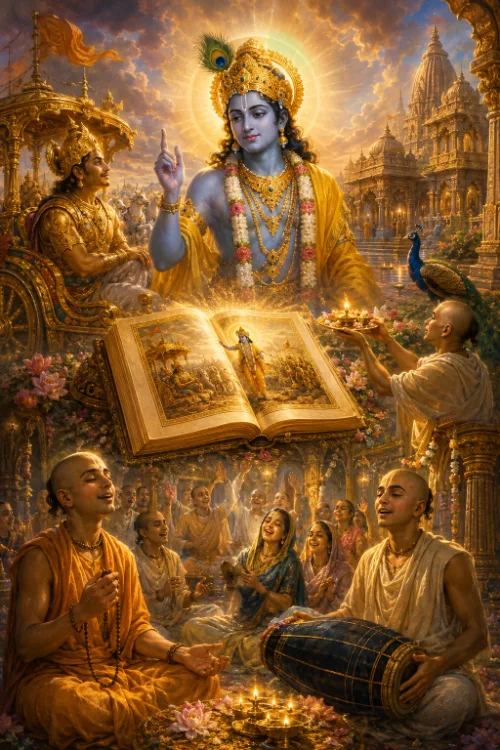
One Scripture, One Lord, One Name, One Service
Modern life is fragmented almost by design. There are countless books worth reading, countless philosophies worth weighing, countless sounds competing for attention, countless occupations pulling in different directions. A short verse from the Gītā-māhātmya — the traditional verses glorifying the Bhagavad-gītā — asks what would happen if all of those branches were traced back to a single root. It answers in four lines.
एकं शास्त्रं देवकीपुत्रगीतम्
एको देवो देवकीपुत्र एव ।
एको मन्त्रस्तस्य नामानि यानि
कर्माप्येकं तस्य देवस्य सेवा ॥
“One scripture—the Gītā sung by the son of Devakī.
One worshipable Lord—the son of Devakī alone.
One mantra—His names.
And one activity—service to that Lord.”
Gītā-māhātmya 7
Four words carry the whole statement, and each one names a different region of a human life:
Śrīla A. C. Bhaktivedanta Swami Prabhupāda gave this verse a deliberately universal reading in his introduction to Bhagavad-gītā As It Is: one common scripture for humanity, the Bhagavad-gītā; one God, Śrī Kṛṣṇa; one essential mantra, the chanting of His names; and one work, the service of the Supreme Lord.
That application is faithful to the direction of the Sanskrit, but a distinction is worth preserving, because keeping it makes the verse more interesting rather than less.
The Sanskrit does not literally say “for the whole world.” It does not contain the phrase “one religion.” It does not spell out the sixteen words of the Hare Kṛṣṇa mahā-mantra. Those belong to Prabhupāda’s interpretation and application of the verse for a modern international audience. What the Sanskrit itself says is more compressed: one śāstra — Kṛṣṇa’s Gītā; one Deva — Kṛṣṇa; one mantra — His names; one karma — His service.
A Necessary Textual Note
This verse is not one of the seven hundred verses of the dialogue between Kṛṣṇa and Arjuna. It belongs to the Gītā-māhātmya literature — verses glorifying the status, message, and potency of the Bhagavad-gītā. The safest citation is therefore Gītā-māhātmya 7, rather than an invented reference of the form “Bhagavad-gītā 18.xx.”
Different editions and traditional compilations assign different broader Purāṇic attributions to collections of Gītā-māhātmya verses. Because those recensions are not uniform, it is better not to attach a precise Purāṇic chapter-and-verse reference unless working from a specific Sanskrit edition.
What can be established is that the verse is genuinely old within Gauḍīya Vaiṣṇava theology. Śrī Jīva Gosvāmī cites a closely related form of it in the Kṛṣṇa-sandarbha.
Jīva Gosvāmī’s Sixteenth-Century Witness
While establishing Kṛṣṇa’s position as Svayaṁ Bhagavān, Jīva Gosvāmī introduces the verse with a simple formula of citation:
तदुक्तम्
tad uktam
“Thus it is said.”
And then quotes it:
एकं शास्त्रं देवकीपुत्रगीतम्
एको देवो देवकीपुत्र एव ।
कर्माप्येकं देवकीपुत्रसेवा
मन्त्रोऽप्येको देवकीपुत्रनाम ॥
“One scripture—the Gītā spoken by the son of Devakī.
One Lord—the son of Devakī alone.
One activity—service to the son of Devakī.
And one mantra—the name of the son of Devakī.”
Kṛṣṇa-sandarbha, Anuccheda 82 in commonly used modern numbering
The wording differs slightly from the familiar Gītā-māhātmya form. The order of karma and mantra is reversed, and Jīva’s reading is even more explicit — devakī-putra-sevā, service to Devakī’s son, and devakī-putra-nāma, the name of Devakī’s son. The theology is the same.
The citation matters because it shows the verse already circulating and doing theological work in the sixteenth century. It is not a twentieth-century slogan.
Why the Verse Repeats “One”
The dominant word is eka — one — and it appears four times, once in each line. The repetition is not stylistic. It creates a movement toward concentration, and it works by contrast with the actual condition of a human life, which is scattered across many books, many desires, many identities, many demands.
The verse is not making four unrelated claims. It is proposing an architecture.
One Scripture
The first line reads:
एकं शास्त्रं देवकीपुत्रगीतम्
ekaṁ śāstraṁ devakī-putra-gītam
“One scripture—the Gītā sung by the son of Devakī.”
The word śāstra comes from the root śās — to instruct, discipline, guide, govern — so it means authoritative instruction. And devakī-putra-gītam means “that which was sung by Devakī’s son”: the Bhagavad-gītā spoken by Kṛṣṇa to Arjuna.
Does That Mean Rejecting Every Other Scripture?
No — and the tradition that preserved the verse is itself the argument against that reading. Gauḍīya Vaiṣṇavism constantly studies and quotes the Vedas, the Upaniṣads, the Vedānta-sūtra, the Mahābhārata, the Purāṇas, the Śrīmad-Bhāgavatam, and the works of the Gosvāmīs. Jīva Gosvāmī, who cites this very verse, builds the Ṣaṭ-sandarbha out of an immense range of śāstric evidence.
So ekaṁ śāstram cannot reasonably mean that every other scripture is worthless. It is better read as a statement of essentialization: if the vast Vedic library has to be brought to one concentrated point of orientation, the Bhagavad-gītā can serve that role, because it addresses the whole range directly — the jīva, prakṛti, karma, yoga, bhakti, Īśvara, and the ultimate goal.
The Gītā as the Milk of the Upaniṣads
The verse immediately preceding this one makes the relationship explicit, and it is worth reading the two together:
सर्वोपनिषदो गावो
दोग्धा गोपालनन्दनः ।
पार्थो वत्सः सुधीर्भोक्ता
दुग्धं गीतामृतं महत् ॥
“All the Upaniṣads are cows. Kṛṣṇa, the son of the cowherd, is their milker. Arjuna is the calf, the wise are the drinkers, and the milk is the great nectar of the Gītā.”
Gītā-māhātmya 6
The analogy does not say the Upaniṣads are false. They are the cows. The Gītā is their milk — the concentrated, nourishing essence of what they contain. That is the proper background for “one scripture.”
Kṛṣṇa makes a parallel claim inside the Gītā itself:
वेदैश्च सर्वैरहमेव वेद्यो
वेदान्तकृद्वेदविदेव चाहम् ॥
“By all the Vedas I alone am to be known. I am the maker of Vedānta and the knower of the Veda.”
Bhagavad-gītā 15.15
The crucial expression is the middle of that line:
अहमेव वेद्यः
aham eva vedyaḥ
“I alone am to be known.”
There are many Vedic texts; according to Kṛṣṇa their ultimate object of knowledge is one. “One scripture” points toward one center of scriptural meaning rather than one permitted book.
Why “Devakī’s Son”?
The verse could have said kṛṣṇa-gītam, “Kṛṣṇa’s Gītā.” Instead it says devakī-putra-gītam, and then immediately devakī-putra eva — “Devakī’s son alone.”
That choice is theologically deliberate. The Supreme is not named here as the Absolute, the Infinite, the First Cause, or Brahman. He is named relationally: as somebody’s son. This is characteristic of Vaiṣṇava theology, where the Supreme is not diminished by relationship — His relationships are where His fullness becomes visible. He is Devakī’s son, Yaśodā’s son, Nanda’s son, Arjuna’s friend, the beloved of the gopīs, and the Lord of all existence at once. Transcendence and intimacy are not in competition.
One Supreme Lord
The second statement is the shortest of the four:
एको देवो देवकीपुत्र एव
eko devo devakī-putra eva
“The one Deva is Devakī’s son alone.”
The word eva carries the emphasis — “alone,” “indeed,” “certainly.” Within Gauḍīya Vaiṣṇavism this line sits naturally beside the celebrated Bhāgavata statement:
एते चांशकलाः पुंसः
कृष्णस्तु भगवान् स्वयम् ॥
“These are portions and portions of portions, but Kṛṣṇa is Bhagavān Himself.”
Śrīmad-Bhāgavatam 1.3.28
whose defining phrase became the foundation of Jīva Gosvāmī’s Kṛṣṇa-sandarbha:
कृष्णस्तु भगवान् स्वयम्
kṛṣṇas tu bhagavān svayam
“Kṛṣṇa is Bhagavān Himself.”
Kṛṣṇa says as much in the Gītā directly:
मत्तः परतरं नान्यत्
किञ्चिदस्ति धनञ्जय ।
“There is nothing whatsoever superior to Me, O Dhanañjaya.”
Bhagavad-gītā 7.7
अहं सर्वस्य प्रभवो
मत्तः सर्वं प्रवर्तते ।
“I am the source of everything; from Me everything proceeds.”
Bhagavad-gītā 10.8
So eko devo devakī-putra eva does not import a theology foreign to the Bhagavad-gītā. It condenses claims the text makes throughout.
Does “One Deva” Mean Other Devas Do Not Exist?
No. A careful Vaiṣṇava reading distinguishes existence from ultimate supremacy. The Vedic and Purāṇic universe contains Brahmā, Śiva, Indra, Sūrya, Candra, Agni, Varuṇa and many others, and Vaiṣṇava theology has no need to deny them — nor does it deny divine manifestations such as Nārāyaṇa, Rāma, Nṛsiṁha, Vāmana, or Varāha.
The claim of eko devaḥ is better understood as naming one ultimate worshipable source, which Gauḍīya theology identifies as Svayaṁ Bhagavān Śrī Kṛṣṇa. That is a statement of hierarchy, not a flat denial.
One Lord Does Not Mean One Sect
Two lines of the Gītā make this difficult to read sectarian. Kṛṣṇa describes Himself as the origin of every kind of being:
अहं बीजप्रदः पिता
ahaṁ bīja-pradaḥ pitā
“I am the seed-giving father.”
Bhagavad-gītā 14.4
and as the well-wisher of all:
सुहृदं सर्वभूतानाम्
suhṛdaṁ sarva-bhūtānām
“the well-wisher of all living beings.”
Bhagavad-gītā 5.29
If Kṛṣṇa is genuinely the source and well-wisher of every living being, He cannot be the private property of one nationality, ethnicity, or institution. This is what makes sense of Prabhupāda’s phrase “one God for the whole world.” Its intent is not to shrink Kṛṣṇa to a sectarian identity but the reverse: if He is the source of everyone, then everyone already stands in some relationship to Him.
One Mantra — His Names
The third declaration is where readers most often over-read the Sanskrit:
एको मन्त्रस्तस्य नामानि यानि
eko mantras tasya nāmāni yāni
“One mantra—those which are His names.”
The decisive grammatical detail is that the word for “names” is plural:
नामानि
nāmāni
The verse therefore does not claim that only one sequence of Sanskrit syllables is valid. Its assertion is that the essence of mantra is Bhagavān’s own Names.
The Mahā-mantra as Gauḍīya Application
Prabhupāda applies tasya nāmāni, “His names,” through the chanting of the Hare Kṛṣṇa mahā-mantra. It is worth keeping the two levels distinct: the Sanskrit gives a principle, His Names; the Gauḍīya tradition supplies a specific practice through which that principle is lived. The second is a theological specification, not a literal translation of the first.
A well-known Sanskrit witness for these sixteen names occurs in the Kali-santaraṇa Upaniṣad, where Brahmā tells Nārada:
हरे राम हरे राम
राम राम हरे हरे ।
हरे कृष्ण हरे कृष्ण
कृष्ण कृष्ण हरे हरे ॥
“Hare Rāma, Hare Rāma,
Rāma Rāma, Hare Hare;
Hare Kṛṣṇa, Hare Kṛṣṇa,
Kṛṣṇa Kṛṣṇa, Hare Hare.”
and then states their effect:
इति षोडशकं नाम्नां
कलिकल्मषनाशनम् ।
नातः परतरोपायः
सर्ववेदेषु दृश्यते ॥
“These sixteen names destroy the contamination of Kali. No higher means than this is seen throughout the Vedas.”
Kali-santaraṇa Upaniṣad 2
A textual detail worth noting rather than smoothing over: in commonly transmitted Sanskrit editions of the Upaniṣad, Hare Rāma comes first, while the Gauḍīya tradition ordinarily chants Hare Kṛṣṇa first. The same sixteen divine names are present in both; the order differs.
Kīrtana in Kali-yuga
The Śrīmad-Bhāgavatam independently gives Kṛṣṇa-kīrtana an extraordinary position, and it does so using the same language of “one”:
कलेर्दोषनिधे राजन्
अस्ति ह्येको महान् गुणः ।
कीर्तनादेव कृष्णस्य
मुक्तसङ्गः परं व्रजेत् ॥
“O King, although Kali is an ocean of faults, it possesses one great virtue: simply by the kīrtana of Kṛṣṇa one becomes free from bondage and attains the supreme destination.”
Śrīmad-Bhāgavatam 12.3.51
The age is called an ocean of faults, and against that it sets eko mahān guṇaḥ — “one great virtue” — reached kīrtanād eva, “by kīrtana itself.” The third “one” of the Gītā-māhātmya fits directly into this wider Bhāgavata theology of the age.
The Name Is Not Merely a Label
Vaiṣṇava theology makes a stronger claim than saying that names remind us of God. A celebrated verse cited by Rūpa Gosvāmī states it plainly:
नाम चिन्तामणिः कृष्णश्
चैतन्यरसविग्रहः ।
पूर्णः शुद्धो नित्यमुक्तोऽभिन्नत्वान्
नामनामिनोः ॥
“The Holy Name is Kṛṣṇa Himself, a wish-fulfilling spiritual reality and embodiment of conscious rasa. It is complete, pure, and eternally liberated because there is no separation between the Name and the Named.”
Bhakti-rasāmṛta-sindhu 1.2.233
The crucial expression is the compound at the end:
अभिन्नत्वान् नामनामिनोः
abhinnatvān nāma-nāminoḥ
“because of the nondifference of the Name and the Named.”
Chanting, on this understanding, is not merely speaking about Kṛṣṇa. The Name is treated as a mode of encountering Him through sacred sound.
A Bengali Parallel
The Caitanya-caritāmṛta gives a formulation strikingly close to the Gītā-māhātmya’s third line:
কৃষ্ণমন্ত্র হৈতে হবে সংসার-মোচন ।
কৃষ্ণনাম হৈতে পাবে কৃষ্ণের চরণ ॥
“Through Kṛṣṇa-mantra one becomes liberated from saṁsāra; through Kṛṣṇa-nāma one attains Kṛṣṇa’s feet.”
Caitanya-caritāmṛta, Ādi-līlā 7.73
And the verse that follows is closer still:
নাম বিনা কলিকালে নাহি আর ধর্ম ।
সর্বমন্ত্রসার নাম, এই শাস্ত্রমর্ম ॥
“In Kali-yuga there is no dharma apart from the Holy Name. The Name is the essence of all mantras—this is the essential conclusion of śāstra.”
Caitanya-caritāmṛta, Ādi-līlā 7.74
Its key phrase — sarva-mantra-sāra nāma, “the Name is the essence of all mantras” — reads almost as a direct Gauḍīya commentary on eko mantras tasya nāmāni yāni. Here too “one mantra” means one essential center, not the denial of every other authentic mantra used in Vaiṣṇava practice.
One Activity — His Service
The fourth statement keeps the verse from staying in the head:
कर्माप्येकं तस्य देवस्य सेवा
karmāpy ekaṁ tasya devasya sevā
“And the one activity is service to that Lord.”
The key word is the last one:
सेवा
sevā
One may understand śāstra, acknowledge who Bhagavān is, and chant — and the verse still asks for something further. Life itself has to become service.
Does That Mean One Occupation?
No. The verse does not ask farmers to stop farming, parents to stop raising children, teachers to stop teaching, or householders to abandon legitimate responsibilities. Its claim is that many different activities can receive a single ultimate orientation. Kṛṣṇa says so directly:
यत्करोषि यदश्नासि
यज्जुहोषि ददासि यत् ।
यत्तपस्यसि कौन्तेय
तत्कुरुष्व मदर्पणम् ॥
“Whatever you do, whatever you eat, whatever you offer, whatever you give, and whatever austerity you perform—do it as an offering to Me.”
Bhagavad-gītā 9.27
The movement in that verse is the whole point: yat karoṣi, “whatever you do,” becomes mad-arpaṇam, “an offering to Me.” Many activities, one center.
Near the end of the Gītā the same idea returns as a definition of perfection:
यतः प्रवृत्तिर्भूतानां
येन सर्वमिदं ततम् ।
स्वकर्मणा तमभ्यर्च्य
सिद्धिं विन्दति मानवः ॥
“By worshiping, through one’s own work, Him from whom all beings arise and by whom everything is pervaded, a human being attains perfection.”
Bhagavad-gītā 18.46
with its significant phrase:
स्वकर्मणा तमभ्यर्च्य
sva-karmaṇā tam abhyarcya
“worshiping Him through one’s own work.”
So sevā does not necessarily mean escaping ordinary life. It means transforming ordinary life through intention, offering, and relationship.
What the Four “Ones” Are Actually Answering
Read together, each line answers a different question that a person actually has:
Knowledge, relationship, remembrance, and action — the whole person is gradually gathered around one center.
“One” Does Not Mean One External Form
Because the language is absolute, it invites a crude reading: only one legitimate book, one permissible religious form, one valid mantra, one acceptable activity. But that reading does not survive contact with the tradition that preserved the verse.
The verse works by reduction to essence: many scriptures, one ultimate teaching; many divine manifestations, one ultimate source; many mantras, one essential reality in the divine Name; many activities, one ultimate purpose. It is unity through a center, not uniformity of expression.
Prabhupāda’s Universal Application
This distinction is what makes Prabhupāda’s use of the verse legible. The Sanskrit gives four categories — śāstra, deva, mantra, karma — and does not contain the word dharma or “religion.” Yet he speaks of one scripture, one God, one mantra, one work, and, in his broader explanation, one religion.
He is not adding a fifth Sanskrit term. He is drawing out what he takes to be the verse’s universal implication: that religion in its deepest sense is not a temporary institutional identity but the eternal function of the living being — service to Bhagavān. The final line, tasya devasya sevā, becomes on that reading the heart of universal spiritual dharma.
The same logic explains why he identifies tasya nāmāni with the Hare Kṛṣṇa mahā-mantra. The Sanskrit gives the principle — His Names. Prabhupāda gives a practice through which the principle can actually be lived. Literal translation is one level; theological application is another, and his exposition becomes easier to appreciate accurately when the two are kept distinct rather than collapsed.
One Center, Not One Culture
For a modern reader this may be the most useful way to hold the verse. Its deepest claim need not be that everyone must become culturally identical. It is that a human life becomes coherent when knowledge, worship, remembrance, and action share one transcendent center.
Without such a center, life fragments in predictable ways — knowledge pulls one direction, desire another, identity another, work another. The verse proposes reintegration rather than addition: read with Kṛṣṇa at the center, worship with Kṛṣṇa at the center, remember with Kṛṣṇa at the center, work with Kṛṣṇa at the center, and the many dimensions of a life become one movement.
The Four Converge
From a deeper Gauḍīya perspective the four categories are not finally separate at all. The Gītā is Kṛṣṇa speaking. The Deva is Kṛṣṇa Himself. Nāma is Kṛṣṇa present through His Name. Sevā is relationship with Kṛṣṇa enacted through a life. They are four approaches to one Person, and they fall into a natural progression:
- through śāstra, Kṛṣṇa instructs;
- through nāma, He becomes accessible in sacred sound;
- as Deva, He becomes the object of love;
- through sevā, the jīva enters active relationship with Him.
Hear Kṛṣṇa, know Kṛṣṇa, call Kṛṣṇa, serve Kṛṣṇa — or, in the older vocabulary, knowledge, relationship, remembrance, surrender.
From the Four “Ones” to “Me Alone”
The repeated eka of the Gītā-māhātmya also recalls the most famous use of ekam in the Bhagavad-gītā itself, where Kṛṣṇa concludes His entire teaching:
सर्वधर्मान्परित्यज्य
मामेकं शरणं व्रज ।
अहं त्वां सर्वपापेभ्यो
मोक्षयिष्यामि मा शुचः ॥
“Abandon all separate dharmas and take refuge in Me alone. I shall free you from all sinful reactions; do not fear.”
Bhagavad-gītā 18.66
with the two words the whole verse turns on:
मामेकम्
mām ekam
“Me alone.”
The four “ones” may therefore be heard as an echo of the Gītā’s own culminating movement toward single-pointed surrender — one scripture, one Lord, one mantra, one activity, all converging in mām ekam, “Me alone.”
What the Verse Finally Offers
Read once more with all of that in view, the verse is a good deal more than a slogan about one book, one God, one mantra and one work:
एकं शास्त्रं देवकीपुत्रगीतम्
एको देवो देवकीपुत्र एव ।
एको मन्त्रस्तस्य नामानि यानि
कर्माप्येकं तस्य देवस्य सेवा ॥
“One scripture—the Gītā sung by the son of Devakī.
One worshipable Lord—the son of Devakī alone.
One mantra—His names.
And one activity—service to that Lord.”
Gītā-māhātmya 7
It answers four different questioners at once. The intellect asks what is true, and receives devakī-putra-gītam, the teaching Kṛṣṇa spoke. The heart asks whom to love, and receives devakī-putra eva, Devakī’s son. The tongue asks what to call and remember, and receives tasya nāmāni, His Names. Life itself asks what to do, and receives tasya devasya sevā, service to that Lord.
And all four converge on Kṛṣṇa’s own final instruction:
मामेकं शरणं व्रज
mām ekaṁ śaraṇaṁ vraja
“Take refuge in Me alone.”
Bhagavad-gītā 18.66
The message of the four “ones” is not the impoverishment of spiritual life but its integration — not the rejection of diversity, but the discovery of the center around which diversity acquires meaning. One ultimate truth to understand. One Supreme Person to love. His Names to remember. His service as the purpose of a life.