

The Fruit Seller and Little Kṛṣṇa
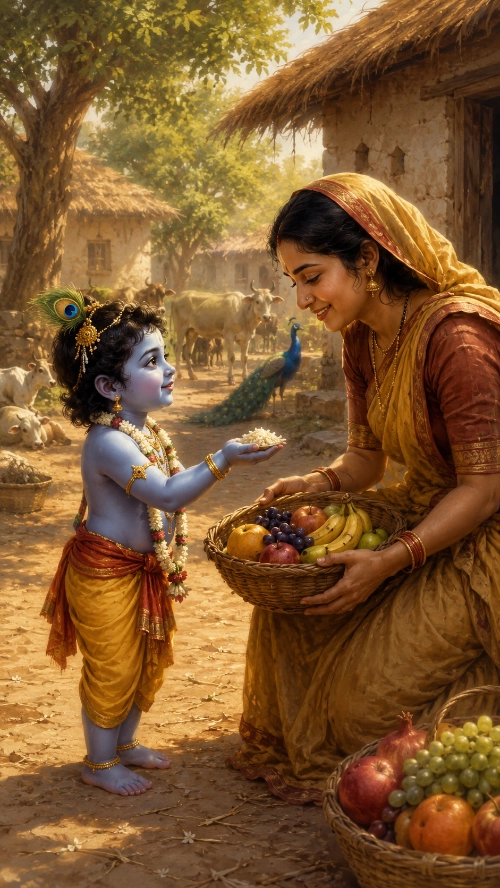
The Fruit Seller and Little Kṛṣṇa: A Story of How Love Is More Valuable Than Wealth
A short Kṛṣṇa-kathā on the fruit seller of Gokula, who took a few spilled grains of rice from a child and filled his arms with fruit. She found her basket turned to jewels — and cared less about that than about having pleased Him. The class closes by identifying Caitanya Mahāprabhu with her: a seller of fruits, giving away the sweetness of the holy name.
Good afternoon. Hare Kṛṣṇa. I would like to tell a story about Kṛṣṇa — about little Kṛṣṇa.
A Handful of Rice
One day, when Kṛṣṇa was walking through Gokula, the place where He lived, a fruit seller came out onto the street. She brought a whole basket with her, set it down, and began calling out: “Please come! Fruits, fruits! Delicious, fragrant fruits! Wonderful fruits!”
Little Kṛṣṇa loved fruit very much, and He wanted some. He grabbed a small handful of rice and ran toward her, carrying a few grains in His tiny palm. He knew that this was how people traded there: His parents would bring rice or some other grain and exchange it for other goods.
So He ran toward the fruit seller with this rice. But while He was running, some of the grains spilled from His hand, so by the time He reached her, almost nothing was left in His little palm.
When He ran up to the woman, she looked at Him and was completely captivated by the beauty of this little boy. His eyes were shining. He was so sweet, so charming and beautiful, that she simply wanted to give Him the fruit. Kṛṣṇa opened His little hand, and only a few grains of rice remained there.
The woman said: “All right, then. I will give You some fruit.” She took those few grains of rice and began placing as many fruits into Kṛṣṇa’s hands as His tiny arms could hold. Kṛṣṇa happily ran home to His mother.
The Basket of Jewels
The fruit seller thought: “How beautiful He is. I am so happy that I was able to make little Kṛṣṇa happy. I think I will go back and bring some more fruit, enough for Him, for His entire family, and for His friends.” So she went back for more fruit, to the same forest from which she had come.
But when she began putting more fruit into her basket, only then did she notice that the basket had become filled with diamonds, gold, and all kinds of precious jewels. In this way, Kṛṣṇa had repaid the woman for her generosity.
But when she gathered more fruit, that gold and those jewels were not nearly as important to her as the fact that she had brought happiness to Lord Kṛṣṇa.
So she filled her basket with fruit once again, went to Kṛṣṇa’s home, and began giving the fruit to Kṛṣṇa and to His mother, Mother Yaśodā.
Fruits That Could Not Be Forgotten
And what is interesting is that when Kṛṣṇa had gathered a whole armful of those fruits, He went and began distributing them to all His relatives and friends. Everyone began taking the fruits and tasting them, and they were simply delighted. They were amazed at how delicious the fruits were.
Jīva Gosvāmī, the great sage, said that those who tasted these fruits from the hands of Kṛṣṇa remarked that they had never in their lives eaten fruits so delicious. More than that, they were never able to forget that sweet taste for the rest of their lives.
Mahāprabhu, the Seller of Fruits
Lord Caitanya said: “I am like this fruit seller. I Myself am a seller of fruits, and I want to give these fruits, this sweetness, to all people.” And these sweet fruits are the holy names of the Lord.
Hare Kṛṣṇa, Hare Kṛṣṇa,
Kṛṣṇa Kṛṣṇa, Hare Hare,
Hare Rāma, Hare Rāma,
Rāma Rāma, Hare Hare.
The mahā-mantra — the fruit Mahāprabhu distributes.
He distributes these fruits and calls upon us: “Please help Me spread this sweet taste of love for the Lord.”
Thank you. Hare Kṛṣṇa.
The exchange is deliberately lopsided. A child brings almost nothing — a few grains, most of them lost on the way — and receives all the fruit his arms can carry. The seller is not paid for the rice; she is answering the boy in front of her.
The jewels arrive only afterwards, and the story is careful to record that she barely noticed them. Having pleased Him was already the reward, and she went back for more fruit rather than counting the gold. That is the measure the title points at: love valued above wealth, by someone who had just been handed both.