

When God Becomes the Seeker
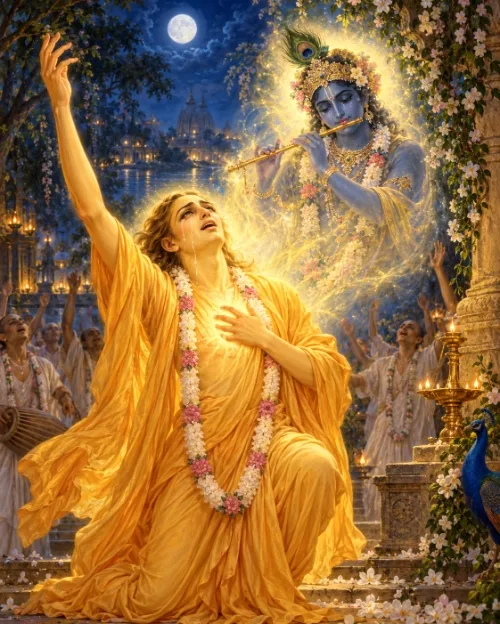
The Astonishing Mystery of Śrī Caitanya Mahāprabhu
Kṛṣṇa is normally the one whom devotees seek. They chant His name, remember Him, cry for Him, serve Him, and long to see Him. But Caitanya-caritāmṛta presents an extraordinary reversal: Kṛṣṇa Himself becomes the seeker.
He who is loved by Rādhā enters Rādhā’s emotional position. He who is worshiped becomes a worshiper. He who is the object of Kṛṣṇa-prema begins to taste what it means to love Kṛṣṇa.
He who causes the gopīs to cry in separation cries: “Where is Kṛṣṇa?” This is the mystery behind Kṛṣṇadāsa Kavirāja’s deceptively simple declaration:
অচিন্ত্য, অদ্ভুত কৃষ্ণচৈতন্য-বিহার ।
চিত্র ভাব, চিত্র গুণ, চিত্র ব্যবহার ॥
acintya, adbhuta kṛṣṇa-caitanya-vihāra
citra bhāva, citra guṇa, citra vyavahāra
“The pastimes of Śrī Kṛṣṇa Caitanya are inconceivable and astonishing. Extraordinary are His devotional moods, extraordinary His qualities, and extraordinary His behavior.”
Caitanya-caritāmṛta, Ādi 17.306
This is not simply poetic praise. It is a compact statement of one of the most distinctive claims of Gauḍīya Vaiṣṇava theology: Śrī Caitanya is Kṛṣṇa Himself experiencing devotion from the devotee’s side.
That is why His emotions are citra. His qualities are citra. His behavior is citra. And His entire manifestation is: acintya, adbhuta— inconceivable and astonishing.
The Verse Makes More Sense When We Read What Comes Before It
Kṛṣṇadāsa does not suddenly announce that Caitanya is “wonderful.” The preceding verses explain exactly what has astonished him. He first describes a remarkable feature of Caitanya’s relationship with His associates:
পণ্ডিত-গোসাঞি আদি যাঁর যেই রস ।
সেই সেই রসে প্রভু হন তাঁর বশ ॥
paṇḍita-gosāñi ādi yāṅra yei rasa
sei sei rase prabhu hana tāṅra vaśa
“Whatever transcendental rasa His associates possess, in that particular rasa the Lord becomes controlled by them.”
Caitanya-caritāmṛta, Ādi 17.301
The word: vaśa means: controlled, subordinate, brought under another’s influence. This is already a paradox. Bhagavān is the Supreme Controller. Yet in bhakti He willingly becomes: controlled by love.
This is not loss of divinity. For Gauḍīya theology, it is one of the sweetest expressions of divinity.
Śyāma There, Gaura Here
Kṛṣṇadāsa then contrasts Kṛṣṇa-līlā and Caitanya-līlā:
তিহঁ শ্যাম,—বংশীমুখ, গোপবিলাসী ।
ইহঁ গৌর—কভু দ্বিজ, কভু ত’ সন্ন্যাসী ॥
tihaṅ śyāma — vaṁśī-mukha, gopa-vilāsī
ihaṅ gaura — kabhu dvija, kabhu ta’ sannyāsī
“There He is Śyāma, with the flute at His mouth, enjoying as a cowherd boy. Here He is Gaura—at one time a brāhmaṇa householder and later a sannyāsī.”
Ādi 17.302
There: dark-complexioned Kṛṣṇa. Flute at His lips. Cowherd companions. Vṛndāvana. Here: golden Caitanya. Navadvīpa. Scholar. Kīrtana leader. Then: sannyāsī. Already the external form appears dramatically transformed.
But the deepest transformation is not His complexion. It is: His inner emotional position.
Kṛṣṇa Assumes Gopī-bhāva
The next verse gives the key:
অতএব আপনে প্রভু গোপীভাব ধরি’ ।
ব্রজেন্দ্রনন্দনে কহে ‘প্রাণনাথ’ করি’ ॥
ataeva āpane prabhu gopī-bhāva dhari’
vrajendra-nandane kahe ‘prāṇa-nātha’ kari’
“Therefore the Lord Himself assumes the mood of the gopīs and addresses Vrajendra-nandana Kṛṣṇa as ‘the Lord of My life.’”
Ādi 17.303
The crucial phrase is:
গোপীভাব
gopī-bhāva
“the emotional mood of the gopīs.”
And the astonishing address is:
প্রাণনাথ
prāṇa-nātha
literally: “Lord of My life.” Who is calling Kṛṣṇa “Lord of My life”? According to Kṛṣṇadāsa: Kṛṣṇa Himself. This is why the next verse speaks of an apparent contradiction.
“That Kṛṣṇa Is Also That Gopī”
Kṛṣṇadāsa writes:
সেই কৃষ্ণ, সেই গোপী,—পরম বিরোধ ।
অচিন্ত্য চরিত্র প্রভুর অতি সুদুর্বোধ ॥
sei kṛṣṇa, sei gopī — parama virodha
acintya caritra prabhura ati sudurbodha
“He is that Kṛṣṇa, and yet He assumes the position of that gopī—an extreme apparent contradiction. The Lord’s inconceivable character is exceedingly difficult to understand.”
Ādi 17.304
The phrase:
পরম বিরোধ
parama virodha
means: “extreme contradiction” or, more carefully in context: “extreme apparent contradiction.” Why apparent? Because Gauḍīya theology does not claim that Kṛṣṇa somehow ceases to be Kṛṣṇa.
Rather: Kṛṣṇa remains the divine identity, while assuming another experiential position. He remains the beloved— yet tastes the experience of the lover. He remains Kṛṣṇa— yet enters the mood through which Rādhā and the gopīs love Kṛṣṇa.
That distinction is essential.
Caitanya Is Not Simply Kṛṣṇa With a Golden Complexion
One of the most famous theological verses in the entire Caitanya-caritāmṛta explains this much more precisely.
राधा कृष्णप्रणयविकृतिर्ह्लादिनी शक्तिरस्माद्
एकात्मानावपि भुवि पुरा देहभेदं गतौ तौ ।
चैतन्याख्यं प्रकटमधुना तद्द्वयं चैक्यमाप्तं
राधाभावद्युतिसुवलितं नौमि कृष्णस्वरूपम् ॥
rādhā kṛṣṇa-praṇaya-vikṛtir hlādinī śaktir asmād
ekātmānāv api bhuvi purā deha-bhedaṁ gatau tau
caitanyākhyaṁ prakaṭam adhunā tad-dvayaṁ caikyam āptaṁ
rādhā-bhāva-dyuti-suvalitaṁ naumi kṛṣṇa-svarūpam
“Rādhā is the transformation of Kṛṣṇa’s hlādinī-śakti in the form of divine love. Although Rādhā and Kṛṣṇa are one reality, They eternally manifest in two forms. Now those two have become united in the manifestation known as Caitanya. I bow to that Kṛṣṇa-svarūpa who is adorned with the mood and radiance of Rādhā.”
Caitanya-caritāmṛta, Ādi 4.55
The decisive phrase is:
राधाभावद्युतिसुवलितम्
rādhā-bhāva-dyuti-suvalitam
“adorned with Rādhā’s bhāva and radiance.”
Thus Caitanya is not merely: Kṛṣṇa + golden skin. The theological claim is much deeper: Kṛṣṇa takes Rādhā’s inner mood and outward radiance.
Rādhā and Kṛṣṇa: One Reality, Two Forms
Kṛṣṇadāsa immediately explains:
রাধাকৃষ্ণ এক আত্মা, দুই দেহ ধরি’ ।
অন্যোন্যে বিলসে রস আস্বাদন করি’ ॥
rādhā-kṛṣṇa eka ātmā, dui deha dhari’
anyonye vilase rasa āsvādana kari’
“Rādhā and Kṛṣṇa are one reality who have assumed two forms in order to enjoy and taste rasa with one another.”
Ādi 4.56
This gives the theological architecture.
Why Would Kṛṣṇa Want to Experience Rādhā’s Love?
This is one of Gauḍīya Vaiṣṇavism’s most distinctive ideas. Kṛṣṇa knows what it is like: to be Kṛṣṇa; to be beautiful; to attract everyone; to receive Rādhā’s love. But there is another experience: What does Kṛṣṇa look like through Rādhā’s love?
What sweetness does She perceive in Him? What does Her prema feel like from within? Why does loving Kṛṣṇa give Her such extraordinary bliss? The beloved can experience: being loved.
But only the lover experiences: loving from the lover’s side. Caitanya’s manifestation is understood as Kṛṣṇa entering precisely that mystery.
The Three Desires Behind Caitanya’s Appearance
Earlier in Ādi-līlā, Kṛṣṇadāsa explains three internal desires that arise in Kṛṣṇa. He wishes to understand:
- the greatness of Rādhā’s love for Him;
- the extraordinary qualities in Himself that only Rādhā fully relishes;
- the happiness Rādhā experiences when tasting His sweetness.
These are not ordinary deficiencies in divine knowledge. They are presented as mysteries of: rasa. Knowing something propositionally is not necessarily identical to: experiencing it from another relational position.
Thus Caitanya-līlā is described as the divine experiment of love: Kṛṣṇa tasting Himself through Rādhā’s heart.
Acintya : What Cannot Be Exhausted by Ordinary Thought
Now Ādi 17.306 makes much more sense:
অচিন্ত্য
acintya
means: inconceivable, beyond complete conceptual grasp. From: a- — not; cintya — thinkable, fully conceivable. But acintya does not mean: “irrational nonsense.” That is an important distinction.
Kṛṣṇadāsa immediately gives a traditional Sanskrit principle:
अचिन्त्याः खलु ये भावा
न तांस्तर्केण योजयेत् ।
प्रकृतिभ्यः परं यच्च
तदचिन्त्यस्य लक्षणम् ॥
acintyāḥ khalu ye bhāvā
na tāṁs tarkeṇa yojayet
prakṛtibhyaḥ paraṁ yac ca
tad acintyasya lakṣaṇam
“Realities that are truly inconceivable should not be forced into the limits of ordinary reasoning. That which lies beyond material nature is characterized as inconceivable.”
quoted in Ādi 17.308
The key phrase is:
प्रकृतिभ्यः परम्
prakṛtibhyaḥ param
“beyond material nature.”
Thus acintya is not an excuse to accept every contradiction anyone invents. It refers specifically to a reality whose mode of existence is said to exceed ordinary material categories.
Reason Is Not Rejected
Kṛṣṇadāsa himself argues constantly. The Caitanya-caritāmṛta contains: scriptural argument, logical argument, grammar, philosophy, ontology, theological distinctions. So when he warns against reducing Caitanya’s identity to ordinary tarka, he is not saying: “Stop thinking.”
He is saying: “Do not assume that material categories exhaust the possibilities of transcendental reality.” That is very different. Reason remains useful. But reason is not declared omnipotent.
Adbhuta : The Experience of Wonder
The second word is:
অদ্ভুত
adbhuta
meaning: astonishing, wonderful, marvelous, extraordinary. Sanskrit aesthetics even recognizes: adbhuta-rasa the rasa of wonder. But here one need not conclude that Kṛṣṇadāsa is making a technical rasa classification.
The simpler point is powerful enough: Caitanya’s identity produces astonishment. And interestingly, the greatest astonishment is not primarily a miracle. It is: love.
The Greatest Miracle Is Not Supernatural Power
Religious literature often defines divine wonder through: visions, miracles, cosmic powers, supernatural displays. Caitanya literature certainly contains extraordinary events.
But the immediate context of 17.306 points elsewhere. The greatest marvel is: the Supreme Lord becomes fascinated by His devotee’s love. He does not merely receive prema.
He wants to taste it. The controller becomes controlled. The beloved enters the lover’s position. The worshiped becomes a worshiper. That is the real: adbhuta.
Citra : More Than “Wonderful”
Kṛṣṇadāsa then repeats the word:
চিত্র
citra
three times. Citra can mean: variegated, striking, astonishing, extraordinary, wondrous, even pictorially colorful. Thus: citra bhāva extraordinary emotional states; citra guṇa extraordinary qualities; citra vyavahāra extraordinary behavior.
The repetition creates a deliberate crescendo. The wonder penetrates every dimension of Caitanya’s manifestation.
Citra Bhāva : Astonishing Devotional Emotions
ভাব
bhāva
can mean: state, emotion, mood, devotional sentiment, ecstatic condition. Prabhupāda renders it here as: “ecstasy.” That is appropriate. But “devotional mood” helps expose the connection with the preceding verses.
Caitanya’s bhāva is extraordinary because Kṛṣṇa Himself manifests: bhakta-bhāva the position of a devotee, and especially: gopī-bhāva the mood of the gopīs, culminating in: Rādhā-bhāva.
The One Sought Becomes the Seeker
This produces one of the most beautiful reversals in Gauḍīya theology. Normally: Rādhā seeks Kṛṣṇa. The gopīs seek Kṛṣṇa. Devotees seek Kṛṣṇa. But as Caitanya: Kṛṣṇa seeks Kṛṣṇa.
He cries for Kṛṣṇa. He remembers Kṛṣṇa. He chants Kṛṣṇa’s name. He experiences separation from Kṛṣṇa. The metaphysical identity remains Kṛṣṇa. The emotional standpoint becomes the devotee’s.
That is: citra bhāva.
Love in Separation Becomes Central
The later life of Caitanya Mahāprabhu, especially as portrayed in the Antya-līlā, becomes increasingly dominated by:
विप्रलम्भ
vipralambha
love in separation. This is one of the deepest mysteries of His manifestation. How can Kṛṣṇa experience separation from Kṛṣṇa? Again, because the relational standpoint has changed.
As the beloved: He is Kṛṣṇa. As Caitanya tasting Rādhā’s emotional position: He experiences longing for Kṛṣṇa. The One who causes longing begins to taste: longing itself.
His Tears Are Therefore Theology
Caitanya’s: crying, fainting, trembling, singing, restlessness, ecstatic transformations are not merely emotional biography. Within Gauḍīya theology they reveal: what divine love feels like from the side of the supreme devotee.
Caitanya-līlā therefore opens something unusual: not merely the external acts of God, but what Gauḍīya authors understand as: the interior world of divine love.
Citra Guṇa : Extraordinary Qualities
The verse next says:
চিত্র গুণ
citra guṇa
“extraordinary are His qualities.”
Many qualities could be included. His: compassion, humility, affection for devotees, generosity, ecstatic love, power to awaken bhakti, and extraordinary attraction to Kṛṣṇa’s name.
But the immediate context emphasizes one particularly striking quality: He allows Himself to be controlled by His devotees.
Can the Supreme Controller Be Controlled?
At first this sounds contradictory. If God is supreme, how could anyone control Him? Gauḍīya theology answers: He is not compelled by superior force. He is: voluntarily conquered by love.
This distinction is essential. A prison guard can control someone physically. That is power over another. But someone whom you deeply love may cause you willingly to do what they desire.
That is a different kind of “control.” Prema does not defeat Bhagavān by force. Bhagavān delights in surrendering to prema.
Omnipotence Includes the Freedom to Be Conquered by Love
This produces a fascinating theological reversal. One might say: “If Bhagavān becomes subordinate to devotees, He must no longer be supreme.” Gauḍīya theology says: Quite the opposite.
If the Supreme were incapable of reciprocal intimacy, that would itself be a limitation.
His freedom is so complete that He can voluntarily:
- become Yaśodā’s child,
- lose wrestling matches to cowherd boys,
- obey Rādhā’s moods,
- become the charioteer of Arjuna,
and as Caitanya: become a devotee of Himself. Majesty does not disappear. It becomes hidden beneath: mādhurya sweetness.
The Supreme Lord Becomes the Model Devotee
This is perhaps Caitanya’s most practically important quality. Kṛṣṇa says in the Bhagavad-gītā: “Surrender to Me.” Caitanya demonstrates: what surrender to Kṛṣṇa looks like.
Kṛṣṇa is: the object of kīrtana. Caitanya performs: kīrtana. Kṛṣṇa receives: worship. Caitanya performs: worship. Kṛṣṇa is: the object of remembrance. Caitanya remembers: Kṛṣṇa.
The Lord does not merely command devotion. He demonstrates devotion.
Bhakta-rūpa : God in the Form of His Devotee
A famous Gauḍīya description identifies Caitanya as:
भक्तरूप
bhakta-rūpa
“the Lord in the form of a devotee.”
This does not mean Caitanya ceases to be Bhagavān. Rather: His divine identity is manifested through: devotional form, devotional emotion, devotional conduct.
This creates a theological teaching enacted as biography. The devotee does not merely receive a philosophy. He sees: bhakti embodied.
Citra Vyavahāra : Astonishing Behavior
The final phrase is:
চিত্র ব্যবহার
citra vyavahāra
“extraordinary behavior” or: “astonishing dealings.”
Vyavahāra refers to: conduct, behavior, practical interactions, dealings with others. And Caitanya’s behavior becomes extraordinary precisely when measured against the claim that He is Bhagavān.
The Omniscient Lord Becomes a Student
Caitanya appears as: Nimāi Paṇḍita. He studies. He teaches grammar. He debates. He interacts with scholars. Later He becomes a sannyāsī. He receives instruction. He hears from devotees.
If the theological claim is: He is Kṛṣṇa Himself, then this behavior is already citra. The source of knowledge takes the role of: learner.
The Worshiped Becomes the Worshiper
Bhagavān ordinarily receives: ārati, prayer, mantra, kīrtana. Caitanya participates in all of these from the devotee’s side. He bows. He chants. He serves. He glorifies Kṛṣṇa.
He celebrates Kṛṣṇa’s devotees. The divine subject assumes the position of: the devotional servant. This is one of Caitanya-līlā’s defining inversions.
The Possessor of Everything Becomes a Mendicant
Then Caitanya takes: sannyāsa. The Supreme Lord, who possesses everything, appears as someone who: owns almost nothing. The One worshiped by Lakṣmī accepts the life of a renunciant.
The Lord of unlimited worlds wanders as: a mendicant monk. Again: citra vyavahāra.
The Object of Everyone’s Longing Cries, “Where Is Kṛṣṇa?”
This may be the most powerful image of all. The person for whom countless devotees long begins longing: for Himself. Through Rādhā-bhāva He cries: Where is Kṛṣṇa? Where is the Lord of My life?
Where is Vrajendra-nandana? Theologically, the scene is almost impossible to express without paradox. Hence: acintya. Hence: adbhuta. Hence: citra.
This Is Not Crude Logical Contradiction
An important philosophical distinction is needed. Gauḍīya theology is not simply saying: “Kṛṣṇa is simultaneously Kṛṣṇa and not Kṛṣṇa.” Rather, it distinguishes:
So the theological claim concerns several dimensions of identity simultaneously. Kṛṣṇa remains Kṛṣṇa. But Kṛṣṇa experiences devotional love from Rādhā’s relational position.
That is the parama virodha Kṛṣṇadāsa calls: acintya.
This Belongs to the Same World as Acintya-bhedābheda
Ādi 17.306 is not formally defining the later doctrinal expression:
अचिन्त्यभेदाभेद
acintya-bhedābheda
“inconceivable simultaneous difference and non-difference.”
But it belongs naturally within the same theological universe. Rādhā and Kṛṣṇa are: one, yet two. The Lord and His potency are: inseparable, yet distinguishable.
Caitanya is: Kṛṣṇa, yet experiences Rādhā’s bhāva. The relationships cannot be reduced simply to: absolute identity or: absolute separation. The tradition therefore uses: acintya to preserve both dimensions.
The Verse Also Connects With Kṛṣṇa’s Desire for Intimacy
Elsewhere Kṛṣṇadāsa describes Kṛṣṇa as dissatisfied with love dominated by awareness of His majesty.
ঐশ্বর্য-জ্ঞানেতে সব জগৎ মিশ্রিত ।
ঐশ্বর্য-শিথিল-প্রেমে নাহি মোর প্রীত ॥
aiśvarya-jñānete saba jagat miśrita
aiśvarya-śithila-preme nāhi mora prīta
Caitanya-caritāmṛta, Ādi 4.17
More precisely in context, Kṛṣṇa contrasts devotion dominated by awareness of His majesty with the intimate love He especially desires. Then:
আমারে ঈশ্বর মানে, আপনাকে হীন ।
তার প্রেমে বশ আমি না হই অধীন ॥
āmāre īśvara māne, āpanāke hīna
tāra preme vaśa āmi nā ha-i adhīna
“If one regards Me only as the Supreme Lord and oneself as subordinate and insignificant, I do not become fully controlled by that love.”
Ādi 4.18
The idea is not that knowledge of Kṛṣṇa’s divinity is false. The point is: reverence creates distance. Vraja-prema creates: intimacy.
Caitanya Is the Culmination of That Mystery
In Vraja: devotees love Kṛṣṇa so intimately that they forget His majesty. Yaśodā binds Him. The cowherd boys climb on Him. The gopīs rebuke Him. Rādhā’s love controls Him.
Caitanya-līlā goes one step further. Kṛṣṇa asks: What is this love that controls Me? And then He enters: the devotee’s side. Thus Caitanya theology grows naturally out of Vraja theology.
God Becomes Fascinated by Bhakti
This may be the deepest theological insight in the passage. Bhakti is not merely something God demands from lesser beings. Bhakti becomes so beautiful that: God Himself becomes fascinated by it.
He sees Rādhā’s prema. He tastes its effects from His own side. Then He desires to understand: the prema itself. That gives bhakti an extraordinary status. The Supreme is not merely its recipient.
He becomes: its student.
Caitanya-Līlā Reveals the Interior of Divinity
Most theology asks questions such as: What can God do? How powerful is He? Did He create the universe? Is He omniscient? Caitanya theology asks a very different question: What does God experience in love?
That shifts attention from: divine power to: divine interiority. Caitanya-līlā is therefore not merely another series of miraculous acts. It becomes a revelation of: Bhagavān’s relationship with prema itself.
Why Caitanya’s Humanity Matters
Caitanya’s: relationships, tears, arguments, journeys, friendships, sannyāsa, kīrtana, separation are not accidental coverings over theology. They are the medium through which the theology is expressed.
His: vyavahāra is itself revelation. He teaches not only through words. He teaches through: how He lives.
The Threefold Citra
The whole verse can now be mapped clearly.
Thus the three expressions correspond to: inside, character, outside.
Bhāva. Guṇa. Vyavahāra. The wonder is complete.
A More Precise Translation of Ādi 17.306
The familiar translation is correct: “The pastimes of Śrī Kṛṣṇa Caitanya Mahāprabhu are inconceivable and wonderful. His ecstasy is wonderful, His qualities are wonderful, and His behavior is wonderful.”
But a slightly more interpretive rendering exposes the context better: “Inconceivable and astonishing are the pastimes of Śrī Kṛṣṇa Caitanya. Extraordinary are His devotional moods, extraordinary His qualities, and extraordinary His dealings.”
Or more literary: “Śrī Kṛṣṇa Caitanya’s play is inconceivable and wondrous—astonishing His emotions, astonishing His qualities, astonishing His every way of acting.” The important improvement is recognizing that: bhāva here means more than generic emotional excitement.
It concerns: divine devotional experience.
What the Verse Does Not Mean
Ādi 17.306 does not mean that:
- anything irrational may be defended by calling it acintya;
- Caitanya ceased to be Kṛṣṇa;
- Rādhā and Kṛṣṇa are simply interchangeable personalities;
- devotional ecstasy is ordinary psychological instability;
- logical thought is useless;
- miracles are the main proof of Caitanya’s divinity;
- or “wonderful behavior” simply means eccentric behavior.
These interpretations miss the tightly constructed theological context.
What It Does Mean
The verse teaches that:
- Caitanya is understood as Kṛṣṇa Himself;
- Kṛṣṇa assumes the emotional position of His devotees;
- this culminates especially in Rādhā-bhāva;
- Caitanya therefore experiences Kṛṣṇa from the lover’s side;
- divine love can voluntarily control Bhagavān;
- the Supreme Controller does not lose supremacy by yielding to love;
- Caitanya’s inner emotions, qualities, and behavior reveal different dimensions of this mystery;
- and transcendental identity cannot always be reduced to material categories of mutually exclusive experience.
The Central Paradox in Its Simplest Form
Everything in the passage can be reduced to four movements:
- Kṛṣṇa is the beloved.
- Rādhā loves Kṛṣṇa more deeply than anyone.
- Kṛṣṇa desires to taste Rādhā’s experience of loving Him.
- Kṛṣṇa appears as Caitanya, adorned with Rādhā’s mood and radiance.
That produces: acintya, adbhuta kṛṣṇa-caitanya-vihāra.
Kṛṣṇadāsa Kavirāja begins with a mystery: the Lord becomes controlled by His devotees’ rasa. Then he goes further. The dark flute-player of Vraja appears as: golden Gaura.
The object of the gopīs’ love assumes: gopī-bhāva. Kṛṣṇa calls Kṛṣṇa: “prāṇa-nātha”—“Lord of My life.” And Kṛṣṇadāsa says:
সেই কৃষ্ণ, সেই গোপী,—পরম বিরোধ
sei kṛṣṇa, sei gopī — parama virodha
“That very Kṛṣṇa assumes that very gopī’s position—an extreme apparent contradiction.”
The contradiction becomes intelligible only when we distinguish: identity from: relational experience. Caitanya remains: Kṛṣṇa-svarūpa. Yet He is: rādhā-bhāva-dyuti-suvalita adorned with Rādhā’s mood and radiance.
That is why Kṛṣṇadāsa finally exclaims:
অচিন্ত্য, অদ্ভুত কৃষ্ণচৈতন্য-বিহার ।
চিত্র ভাব, চিত্র গুণ, চিত্র ব্যবহার ॥
acintya, adbhuta kṛṣṇa-caitanya-vihāra
citra bhāva, citra guṇa, citra vyavahāra
“Inconceivable and astonishing are the pastimes of Śrī Kṛṣṇa Caitanya. Extraordinary are His devotional moods, extraordinary His qualities, and extraordinary His behavior.”
The verse ultimately points toward something even more astonishing than divine power. God becomes fascinated by love. Not merely by being loved— but by: what it feels like to love Him.
And so the supreme object of devotion becomes: a devotee. The One everyone seeks becomes: the seeker. The One everyone cries for begins to cry: for Kṛṣṇa. That is the wonder of Caitanya-līlā.
And perhaps the deepest essence of the entire passage is this: Kṛṣṇa does not merely receive Rādhā’s love. As Caitanya, He enters Rādhā’s heart to discover what loving Kṛṣṇa feels like from within.