

How Service to Hari Transforms Ordinary Life
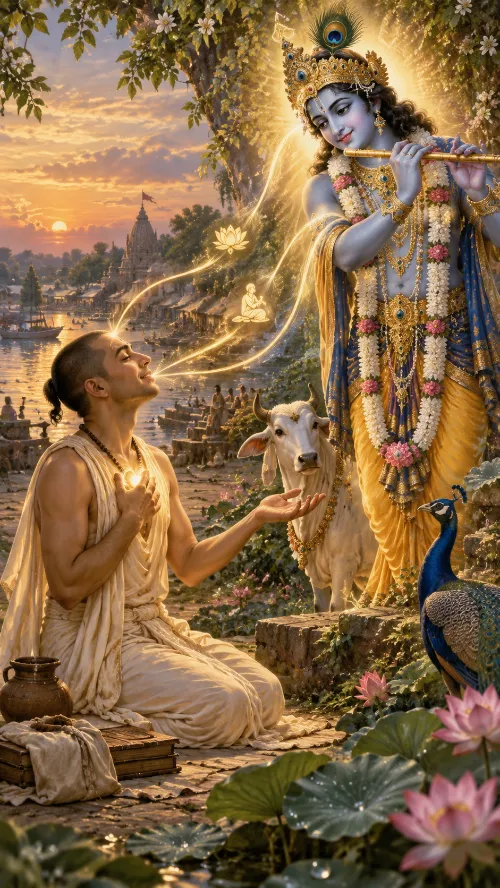
Rūpa Gosvāmī, Jīvan-mukti, and the Radical Meaning of “I Belong to Kṛṣṇa”
A person may still have a body, a job, responsibilities, possessions, relationships, difficulties, and an apparently ordinary life—and yet, according to a striking Vaiṣṇava teaching preserved by Rūpa Gosvāmī, already be liberated while living.
The famous verse declares:
ईहा यस्य हरेर्दास्ये
कर्मणा मनसा गिरा ।
निखिलास्वप्यवस्थासु
जीवन्मुक्तः स उच्यते ॥
īhā yasya harer dāsye
karmaṇā manasā girā
nikhilāsv apy avasthāsu
jīvan-muktaḥ sa ucyate
“One whose endeavor is directed toward servitude to Hari through action, mind, and speech is called liberated while living, in whatever circumstances he may be.”
Nāradīya Purāṇa, quoted in Bhakti-rasāmṛta-sindhu 1.2.187
The statement is remarkable because it relocates liberation. Liberation is not presented simply as something that happens after death, after the material body disappears, or after one physically withdraws from ordinary life.
It can begin here. The decisive issue is not merely where a person lives or what the person appears to be doing. It is whom the life belongs to.
First, an important correction: this is not simply “a verse by Rūpa Gosvāmī”
The verse is often quoted as though Rūpa Gosvāmī composed it himself. Strictly speaking, that is not how he presents it. Immediately before the verse, he writes:
द्वितीयं यथा नारदीये —
dvitīyaṁ yathā nāradīye —
“The second [form of dāsya], as stated in the Nāradiya…”
Rūpa is therefore explicitly quoting a Nāradiya scriptural source. The safest citation is consequently: Nāradīya Purāṇa, quoted by Rūpa Gosvāmī in Bhakti-rasāmṛta-sindhu 1.2.187.
There is a textual complication worth preserving. The exact verse is not readily identifiable in the presently searchable GRETIL electronic text of the extant Nārada/Nāradīya Purāṇa. This does not overturn Rūpa Gosvāmī’s attribution; it means only that the surviving searchable recension cannot presently be used to supply a secure chapter-and-verse number.
Purāṇic texts circulated through different recensions, manuscript traditions, quotations, and regional transmissions. A responsible citation should therefore preserve what can actually be demonstrated rather than manufacture a modern verse reference that has not been verified.
And what can be demonstrated is significant enough: Rūpa Gosvāmī himself introduces the verse as coming from the Nāradiya.
Why Rūpa Quotes This Verse: Two Levels of Dāsya
The surrounding context makes the verse much richer than an isolated statement about liberation. Rūpa is discussing dāsya—service to Bhagavān in the consciousness of being His servant.
He writes:
दास्यं कर्मार्पणं तस्य
कैङ्कर्यमपि सर्वथा ॥
dāsyaṁ karmārpaṇaṁ tasya
kaiṅkaryam api sarvathā
“Dāsya consists of offering one’s activities to Him and also complete service in the identity of His servant.”
Bhakti-rasāmṛta-sindhu 1.2.183
Two related spiritual orientations are being distinguished. The first is karmārpaṇa—offering one’s activities to the Lord. A person still begins, psychologically, from something like: “Here is my work, my duty, my life—and I shall offer it to God.”
That is already spiritually significant. But kaiṅkarya goes deeper. Its center is: “I belong to Him. Therefore my life itself is for His service.” The difference is subtle but profound.
In the first model, the activity is offered. In the second, the person has been offered. And it is precisely when Rūpa explains this deeper form of dāsya that he quotes the verse: īhā yasya harer dāsye… jīvan-muktaḥ sa ucyate.
That context changes everything. The verse is not merely teaching that certain religious activities are spiritually beneficial. It describes a person whose entire existential orientation has become service.
The Key Word Is Īhā : What Are You Actually Striving For?
The verse begins with an unusually important word:
ईहा
īhā
“endeavor, striving, purposeful effort, eager inclination.”
The verse therefore does not simply say: “Anyone who occasionally performs something devotional is liberated.” It describes someone whose driving endeavor has become:
हरेर्दास्ये
harer dāsye
“toward servitude to Hari.”
This point becomes especially powerful in the traditional commentaries. Jīva Gosvāmī explains the inner meaning of īhā as:
दासो भवामीति स्पृहा
dāso bhavāmīti spṛhā
“The longing: ‘May I become His servant.’”
The crucial word here is spṛhā—longing, aspiration, yearning. Liberation does not produce a dead or desireless consciousness in the sense of annihilating all will. The desire has been purified and reoriented.
Material desire asks: “How can this serve me?” Devotional desire asks: “How can I serve Him?” Mukunda Gosvāmī expresses the underlying consciousness still more compactly:
तदीयोऽहमिति बुद्ध्या
tadīyo ’ham iti buddhyā
“With the understanding: ‘I belong to Him.’”
That may be the psychological heart of the entire teaching. Before: “I am mine.” After: “I am His.” Everything else follows from that change.
What Does Jīvan-mukta Actually Mean?
The expression is straightforward:
जीवन्
jīvan
“living; while alive”
and
मुक्त
mukta “released, free, liberated.” Thus:
जीवन्मुक्त
jīvan-mukta
“liberated while living.”
The person has not necessarily ceased bodily existence. He may still eat, sleep, speak, work, organize, teach, govern, raise children, earn money, experience illness, grow old, and deal with complicated material circumstances.
Rūpa nevertheless says that such a person may be called liberated. Why? Because in Vaiṣṇava thought bondage cannot ultimately be reduced to the mere possession of a material body.
The deeper bondage is false identification and false proprietorship. “I am this body.” “This is mine.” “My intelligence exists for me.” “My abilities exist for me.” “My speech exists for my prestige.”
“My possessions exist for my enjoyment.” “My life belongs to me independently.” When that center changes, the spiritual status of the life changes with it.
The Bhāgavatam’s Definition of Liberation
The Śrīmad-Bhāgavatam gives an exceptionally concise definition:
मुक्तिर्हित्वान्यथारूपं
स्वरूपेण व्यवस्थितिः ॥
muktir hitvānyathā-rūpaṁ
sva-rūpeṇa vyavasthitiḥ
“Liberation is giving up the condition of existing otherwise than one’s true nature and becoming established in one’s own svarūpa.”
Śrīmad-Bhāgavatam 2.10.6
This is crucial. Mukti is not defined merely as: “The body disappeared.” It is: sva-rūpeṇa vyavasthitiḥ “becoming established in one’s true nature.” The obvious next question is therefore: What is that true nature?
Caitanya Mahāprabhu’s teaching to Sanātana Gosvāmī answers it directly.
“The Jīva’s Svarūpa Is to Be Kṛṣṇa’s Eternal Servant”
The Caitanya-caritāmṛta states in Bengali:
জীবের ‘স্বরূপ’ হয় — কৃষ্ণের ‘নিত্যদাস’ ।
কৃষ্ণের ‘তটস্থা-শক্তি’, ‘ভেদাভেদ-প্রকাশ’ ॥
jīvera ‘svarūpa’ haya — kṛṣṇera ‘nitya-dāsa’
kṛṣṇera ‘taṭasthā-śakti’, ‘bhedābheda-prakāśa’
“The constitutional identity of the living entity is to be Kṛṣṇa’s eternal servant. The jīva is Kṛṣṇa’s marginal potency, a manifestation simultaneously distinct from and connected with Him.”
Caitanya-caritāmṛta, Madhya 20.108
Now the logic becomes clear. The Bhāgavatam says: Liberation means becoming established in one’s svarūpa. Caitanya Mahāprabhu says: The jīva’s svarūpa is Kṛṣṇa’s eternal servant.
Rūpa describes someone whose whole endeavor has become: Hari’s service. Then Rūpa makes the conclusion: jīvan-muktaḥ sa ucyate “Such a person is called liberated while living.”
These are not disconnected doctrines. They fit together with extraordinary precision.
Liberation Is Therefore Relational
This is one of the distinctive beauties of Vaiṣṇava theology. Liberation is not fundamentally: “I escaped everything.” It is: “I recovered my proper relationship.” The conditioned being understands independence as freedom: “Nothing owns me. I belong only to myself.”
Bhakti turns that assumption upside down. Its liberation begins with: tadīyo ’ham “I belong to Him.” Paradoxically, voluntary divine servitude becomes freedom because the jīva is no longer fighting against its own nature.
The soul is liberated not by becoming relationless but by becoming rightly related. Not by having no identity, but by recovering the right identity. Not by ceasing to act, but by acting from the right center.
The Lotus Leaf: In the World Without Being Bound by It
The Bhagavad-gītā gives the perfect image:
ब्रह्मण्याधाय कर्माणि
सङ्गं त्यक्त्वा करोति यः ।
लिप्यते न स पापेन
पद्मपत्रमिवाम्भसा ॥
brahmaṇy ādhāya karmāṇi
saṅgaṁ tyaktvā karoti yaḥ
lipyate na sa pāpena
padma-patram ivāmbhasā
“One who performs action while dedicating those works to the Supreme and abandoning attachment is not stained by karmic reaction, just as a lotus leaf is untouched by water.”
Bhagavad-gītā 5.10
The lotus does not escape the pond. Its leaf is in the water. But the water does not cling to it. Likewise, the devotee may remain inside society, family life, work, administration, economics, bodily existence, and ordinary responsibilities.
The spiritual question is not simply: “Are these things present?” It is: “How is the person related to them?” Possession becomes stewardship. Ability becomes service. Speech becomes service.
Intelligence becomes service. Wealth becomes service. Time becomes service. The material environment may remain recognizable while its organizing principle has changed.
Bhakti Can Transcend the Guṇas Before Death
Kṛṣṇa states:
मां च योऽव्यभिचारेण
भक्तियोगेन सेवते ।
स गुणान्समतीत्यैतान्
ब्रह्मभूयाय कल्पते ॥
māṁ ca yo ’vyabhicāreṇa
bhakti-yogena sevate
sa guṇān samatītyaitān
brahma-bhūyāya kalpate
“One who serves Me through unwavering bhakti-yoga transcends these material guṇas and becomes qualified for the spiritual platform.”
Bhagavad-gītā 14.26
The significance is immediate. Kṛṣṇa does not say that such transcendence begins only after the devotee dies. The devotee is serving now, and through that service is said to transcend the binding jurisdiction of the guṇas.
That is remarkably close to Rūpa’s:
जीवन्मुक्तः स उच्यते
jīvan-muktaḥ sa ucyate
“He is called liberated while living.”
Liberation Does Not Mean Inactivity
Many people instinctively imagine a liberated person as someone who has withdrawn almost completely from ordinary action. Rūpa’s verse gives a different picture. It explicitly contains:
कर्मणा
karmaṇā
“through action.”
The liberated devotee may be extremely active. The crucial distinction is not activity versus inactivity. It is: for whom is the activity being performed? The conditioned mentality says: “I am the independent enjoyer, owner, controller, and beneficiary of what I do.”
The devotional mentality increasingly says: “Let this action satisfy Hari.” That is why the familiar English rendering “with body, mind and words” communicates the sense reasonably well, although the Sanskrit itself is more precisely:
कर्मणा मनसा गिरा
karmaṇā manasā girā
“through action, mind, and speech.”
The verse does not literally contain a word meaning “body.” Karmaṇā means “through action” or “through deeds.” The body is naturally implied as an instrument of action, but preserving the literal wording helps reveal just how comprehensive the verse is.
Ambarīṣa: A King Who Turned an Entire Life Into Service
Mahārāja Ambarīṣa is perhaps one of the clearest scriptural illustrations of this principle. The Bhāgavatam says:
स वै मनः कृष्णपदारविन्दयो-
र्वचांसि वैकुण्ठगुणानुवर्णने ।
करौ हरेर्मन्दिरमार्जनादिषु
श्रुतिं चकाराच्युतसत्कथोदये ॥
sa vai manaḥ kṛṣṇa-padāravindayor
vacāṁsi vaikuṇṭha-guṇānuvarṇane
karau harer mandira-mārjanādiṣu
śrutiṁ cakārācyuta-sat-kathodaye
“He fixed his mind upon Kṛṣṇa’s lotus feet, his speech upon describing the Lord’s qualities, his hands upon cleansing Hari’s temple, and his hearing upon sacred narrations concerning Acyuta.”
Śrīmad-Bhāgavatam 9.4.18
The following verses continue through his other senses and faculties. That matters because Ambarīṣa was not a hermit hiding from society. He was a king. Kingship involves government, wealth, administration, politics, protection, resources, decisions, and responsibility.
The lesson is therefore not that spiritual life becomes possible only when worldly responsibility disappears. The lesson is that an entire complex human life can be reorganized around service.
External busyness and material bondage are not necessarily identical.
But Can Anything Be Declared “Service”?
Here a serious safeguard is necessary. Otherwise this teaching could be abused: “Whatever I choose to do is spiritual because I say I am doing it for Kṛṣṇa.” Rūpa Gosvāmī does not allow that loophole.
He quotes:
लौकिकी वैदिकी वापि
या क्रिया क्रियते मुने ।
हरिसेवानुकूलैव
सा कार्या भक्तिमिच्छता ॥
laukikī vaidikī vāpi
yā kriyā kriyate mune
hari-sevānukūlaiva
sā kāryā bhaktim icchatā
“O sage, whether an activity is worldly or Vedic, one who desires bhakti should perform it only insofar as it is favorable to the service of Hari.”
Bhakti-rasāmṛta-sindhu 1.2.200
The controlling word is:
अनुकूल
anukūla
“favorable, conducive.”
An action does not automatically become devotional merely because someone privately labels it “for Kṛṣṇa.” It must actually be favorable to Hari’s service. That excludes the idea that selfishness, exploitation, cruelty, dishonesty, or forbidden conduct can simply be baptized with spiritual vocabulary.
Bhakti is not subjective self-certification.
Pure Bhakti Requires Favorability Toward Kṛṣṇa
Rūpa’s famous definition of uttama-bhakti makes exactly the same point:
अन्याभिलाषिताशून्यं
ज्ञानकर्माद्यनावृतम् ।
आनुकूल्येन कृष्णानुशीलनं
भक्तिरुत्तमा ॥
anyābhilāṣitā-śūnyaṁ
jñāna-karmādy-anāvṛtam
ānukūlyena kṛṣṇānuśīlanaṁ
bhaktir uttamā
“Highest bhakti is continuous cultivation directed toward Kṛṣṇa, performed favorably, free from extraneous desires and unobstructed by independent pursuits of karma, jñāna, and other aims.”
Bhakti-rasāmṛta-sindhu 1.1.11
Again:
आनुकूल्येन
ānukūlyena
“favorably.”
Three things must therefore converge: service identity, service intention, and conduct genuinely compatible with service. Without this, “I am serving Kṛṣṇa” can become merely a flattering story the ego tells about itself.
Bhakti Does Not Destroy the Senses—It Reassigns Them
Another famous Vaiṣṇava definition sharpens the point:
सर्वोपाधिविनिर्मुक्तं
तत्परत्वेन निर्मलम् ।
हृषीकेण हृषीकेश-
सेवनं भक्तिरुच्यते ॥
sarvopādhi-vinirmuktaṁ
tat-paratvena nirmalam
hṛṣīkeṇa hṛṣīkeśa-
sevanaṁ bhaktir ucyate
“Bhakti is service to Hṛṣīkeśa, the Lord of the senses, with the senses purified through freedom from material designations and complete dedication to Him.”
Nārada-pañcarātra, quoted in Bhakti-rasāmṛta-sindhu 1.1.12 and Caitanya-caritāmṛta, Madhya 19.170
Notice what is not said. The senses are not destroyed. The mind is not destroyed. Action is not destroyed. Individual existence is not destroyed. They are purified and redirected.
This is why bhakti does not require hatred of the body. The conditioned mentality thinks: “This body is mine. What can I obtain through it?” Devotional consciousness increasingly thinks: “This body can become an instrument of service.”
The same transformation applies to intelligence, speech, creativity, wealth, profession, social position, technical skill, influence, strength, and time. They cease to be merely possessions.
They become instruments entrusted for service.
Bhakti Purifies Desire Rather Than Making Consciousness Dead
The word īhā in the original verse deserves another look. The liberated devotee still has īhā—endeavor. And Jīva Gosvāmī describes it as:
स्पृहा
spṛhā
“longing, aspiration.”
What longing?
दासो भवामि
dāso bhavāmi
“May I become His servant.”
The Gauḍīya ideal is therefore not a consciousness incapable of wanting anything. It is a consciousness whose desire has found its proper object. Material desire asks: “How can everything become mine?”
Spiritual desire asks: “How can everything entrusted to me become useful to Him?” The faculty of desire remains. Its center changes. That is much more radical than simple repression.
Material or Spiritual? The Same Movement Can Have a Different Meaning
This teaching also explains why two externally similar activities can have radically different spiritual significance. Cooking merely for unrestricted personal consumption and cooking food to offer to Bhagavān before honoring it as prasāda can look almost identical from across a room.
The physical movements may be the same. But the relation is different. Speaking in order to magnify oneself and speaking about Kṛṣṇa for another person’s spiritual benefit both use the same tongue.
The sound production mechanism is the same. The orientation is different. Earning money solely to intensify private consumption and earning responsibly while maintaining dependents, supporting dharmic obligations, giving in charity, and serving Bhagavān may involve the same profession.
The external category “work” does not tell the whole spiritual story. Bhakti asks what the action is for, how it is related to Kṛṣṇa, and whether that relation is genuinely favorable to Him.
The Teaching Is About Identity More Than Geography
This has another consequence. A person does not become materially conditioned merely because the geographic coordinates happen to be on planet Earth. Nor does a person become spiritually perfect merely by moving physically into a sacred place.
A person can stand in a marketplace while asking: “How can this situation serve Hari?” Another can live in a holy place while remaining absorbed in greed, prestige, rivalry, and enjoyment.
Rūpa’s phrase is deliberately broad:
निखिलास्वप्यवस्थासु
nikhilāsv apy avasthāsu
“in all circumstances whatsoever.”
That cuts through superficial measurements of spirituality. Location matters. Association matters. Conduct matters. Sacred places matter. But none of them substitutes for transformed consciousness.
Does Jīvan-mukta Mean a Beginner Is Already a Perfected Saint?
No. This is one of the most important qualifications. Rūpa’s verse occurs within his treatment of sādhana-bhakti, devotional practice. His theological system carefully distinguishes spiritual stages such as:
साधन
sādhana
“practice”
भाव
bhāva
“the awakening of mature spiritual emotion”
and
प्रेम
prema “fully developed divine love.” Calling someone jīvan-mukta in the sense of BRS 1.2.187 does not erase those distinctions. It does not automatically mean that the practitioner possesses complete realization of every spiritual truth, never makes a practical mistake, has attained the highest rasa, or possesses fully matured prema.
The statement is making a more specific claim: when the governing orientation of embodied life genuinely becomes Hari’s service, that person is no longer living according to the fundamental logic of material bondage.
This can be true while spiritual development continues. Liberation from the basic principle of bondage and full maturation of divine love are not necessarily identical descriptions of the same stage.
Uddhava and the Possibility of Transcendental Life While Still Present in the World
A.C. Bhaktivedanta Swami Prabhupāda repeatedly used this verse to explain the status of devotees whose bodies remain visibly present within material nature while their consciousness is no longer governed by its ordinary motives.
In discussing Uddhava, for example, he invokes this principle to explain how a devotee can remain externally situated within the world and yet function transcendentally as the Lord’s representative.
This reinforces an essential distinction: material location is not automatically material consciousness. A body may remain within the field of prakṛti while the purpose governing the person’s life has become transcendental.
The Paradox of Bhakti: By Forgetting Liberation, the Devotee Becomes Liberated
The teaching becomes even more striking when placed within Rūpa Gosvāmī’s larger theology. For him, liberation is not even the highest prize of bhakti. He lists six extraordinary characteristics of devotion:
क्लेशघ्नी शुभदा मोक्षलघुताकृत् सुदुर्लभा ।
सान्द्रानन्दविशेषात्मा श्रीकृष्णाकर्षिणी च सा ॥
kleśa-ghnī śubhadā mokṣa-laghutā-kṛt sudurlabhā
sāndrānanda-viśeṣātmā śrī-kṛṣṇākarṣiṇī ca sā
“Bhakti destroys suffering, bestows auspiciousness, makes liberation seem insignificant, is exceedingly difficult to attain, possesses the nature of concentrated spiritual bliss, and attracts Śrī Kṛṣṇa Himself.”
Bhakti-rasāmṛta-sindhu 1.1.17
One phrase is especially startling:
मोक्षलघुताकृत्
mokṣa-laghutā-kṛt
“that which makes mokṣa seem small or insignificant.”
This completely changes how jīvan-muktaḥ sa ucyate should be read. Rūpa is not saying: “Serve Hari because liberation is the greatest possible reward.” He is saying something closer to: “The person genuinely devoted to Hari is already liberated; therefore liberation itself no longer needs to be the central objective.”
The goal is bhakti. Ultimately, the goal is prema.
A Very Different Spiritual Psychology
The ordinary spiritual seeker may ask: “How can I become liberated?” The devotee increasingly asks: “How can I serve?” And this produces a beautiful Vaiṣṇava paradox. By ceasing to make personal liberation the center of spiritual life, the devotee becomes liberated.
The devotee does not serve Hari in order eventually to reach a state in which service is no longer necessary. Service itself is the desired eternal relationship. Therefore the devotee’s prayer is not: “When will I finally stop serving?”
It is: “May my service become pure.” That is why bhakti can make even mokṣa appear secondary.
The Whole Teaching in Three Expressions
The logic of the verse can almost be compressed into three Sanskrit statements. First:
तदीयोऽहम्
tadīyo ’ham
“I belong to Him.”
That is identity. Then:
हरेर्दास्ये ईहा
harer dāsye īhā
“My endeavor is toward Hari’s service.”
That is orientation. And therefore:
जीवन्मुक्तः
jīvan-muktaḥ
“liberated while living.”
That is the consequence. The order matters. Liberation follows the recovery of relationship.
Liberation Begins Before the World Disappears
It is easy to imagine spiritual freedom chronologically: life now, death, then liberation. Rūpa Gosvāmī offers a more immediate possibility. The body may remain. Responsibilities may remain.
Work may remain. Problems may remain. The surrounding world may remain. Yet something decisive has changed. The hands remain, but they increasingly serve. The mind remains, but it plans service.
The voice remains, but it speaks in service. The intelligence remains, but it discriminates for service. Resources remain, but they are understood as entrusted rather than absolutely owned.
The external instruments have not necessarily changed. Their center of ownership has changed. And that is why jīvan-mukti in this teaching is not primarily about leaving the world.
It is about ceasing to live as though one existed independently for oneself. The conditioned consciousness says: “I am mine, and everything else should ultimately serve me.”
The liberated consciousness says: “I am His. Let everything I am—my action, mind, speech, abilities, and circumstances—become service.” Once that center genuinely changes, the Nāradiya verse quoted by Rūpa Gosvāmī makes its astonishing declaration:
ईहा यस्य हरेर्दास्ये
कर्मणा मनसा गिरा ।
निखिलास्वप्यवस्थासु
जीवन्मुक्तः स उच्यते ॥
īhā yasya harer dāsye
karmaṇā manasā girā
nikhilāsv apy avasthāsu
jīvan-muktaḥ sa ucyate
“One whose endeavor is directed toward servitude to Hari through action, mind, and speech is called liberated while living, in whatever circumstances he may be.”
Liberation, in this vision, is not merely the future disappearance of bondage. It is the present recovery of who one belongs to.
Sources and Online Text Repositories
- Anuśīlana: Sanskrit text and traditional interpretive material on Rūpa Gosvāmī’s definition of uttama-bhakti and the six characteristics of bhakti, useful for comparison with the primary-text readings.