

The Missing Center: Why Vyāsa Was Still Dissatisfied
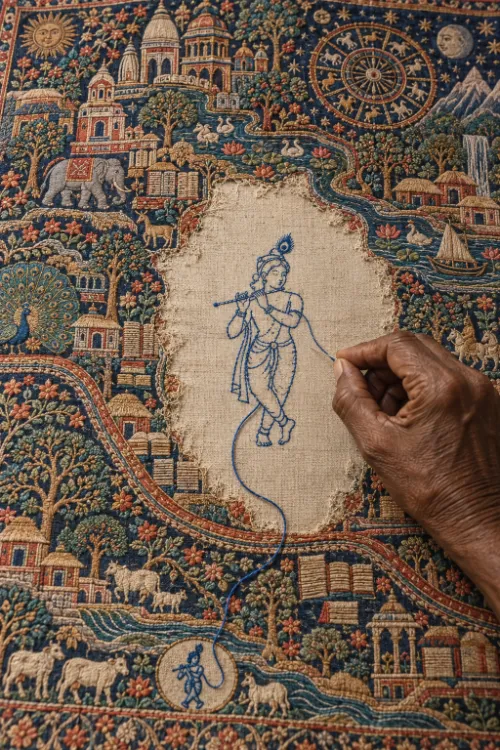
Nārada’s Diagnosis of Knowledge Without a Center
Vyāsa had accomplished what almost no human author could imagine accomplishing. Within the narrative of the Śrīmad-Bhāgavatam, he had organized Vedic revelation, divided the Veda for the benefit of later generations, transmitted enormous bodies of sacred knowledge, composed the Mahābhārata, and explained religion, duty, philosophy, human goals, liberation and the workings of the cosmos.
And yet Vyāsa was unhappy. Not confused about some minor technical question. Not dissatisfied because his literary work lacked sophistication. Something much deeper was wrong.
He had knowledge. He had discipline. He had scriptural authority. He had extraordinary literary accomplishment. But his heart was not satisfied. Then Nārada arrived and diagnosed the problem.
श्रीनारद उवाच
भवतानुदितप्रायं यशो भगवतोऽमलम् ।
येनैवासौ न तुष्येत मन्ये तद्दर्शनं खिलम् ॥
śrī-nārada uvāca
bhavatānudita-prāyaṁ yaśo bhagavato ’malam
yenaivāsau na tuṣyeta manye tad darśanaṁ khilam
“Śrī Nārada said: The spotless glories of Bhagavān have, for the most part, not been sufficiently proclaimed by you. I consider that philosophical vision by which He Himself is not pleased to be defective or incomplete.”
Śrīmad-Bhāgavatam 1.5.8
A. C. Bhaktivedanta Swami Prabhupāda renders the concluding thought more forcefully:
“That philosophy which does not satisfy the transcendental senses of the Lord is considered worthless.”
The force of the translation is faithful to Nārada’s judgment, but the Sanskrit contains subtleties that make the verse even more interesting. Nārada is not simply saying: “You forgot to mention God.”
Nor is he saying: “Everything you wrote before was false.” His criticism is far more precise. Bhagavān was present in Vyāsa’s writings—but Bhagavān had not been made sufficiently central.
That difference changes everything.
Vyāsa Had Everything—Except Satisfaction
The drama begins several verses earlier. Vyāsa admits to Nārada that despite everything he has accomplished, something inside him remains unresolved.
व्यास उवाच
अस्त्येव मे सर्वमिदं त्वयोक्तं
तथापि नात्मा परितुष्यते मे ।
तन्मूलमव्यक्तमगाधबोधं
पृच्छामहे त्वात्मभवात्मभूतम् ॥
vyāsa uvāca
asty eva me sarvam idaṁ tvayoktaṁ
tathāpi nātmā parituṣyate me
tan-mūlam avyaktam agādha-bodhaṁ
pṛcchāmahe tvātma-bhavātma-bhūtam
Vyāsa said: “Everything you have said about me is certainly true. Nevertheless, my self is not completely satisfied. I therefore ask you, whose understanding is profound, to explain the hidden root of this dissatisfaction.”
Śrīmad-Bhāgavatam 1.5.5
The crucial confession is: nātmā parituṣyate me “my self is not completely satisfied.” This is remarkable. Vyāsa’s problem is not lack of achievement. It is that achievement has failed to produce fulfillment.
That already makes the episode surprisingly modern. One may possess: knowledge, prestige, discipline, religious accomplishment, creative success, intellectual sophistication— and still feel that the most important thing has somehow been missed.
Vyāsa knows that something is lacking. But he cannot identify it. Nārada can.
The Spotless Glory of Bhagavān
Nārada says: bhavatānudita-prāyaṁ yaśo bhagavato ’malam The phrase deserves close examination.
- bhavatā — by you
- anudita — unspoken, unproclaimed
- prāyam — for the most part, almost
- yaśaḥ — glory, fame
- bhagavataḥ — of Bhagavān
- amalam — spotless, stainless.
So a very literal sense is: “The spotless glory of Bhagavān has been almost left unproclaimed by you.” But why almost? Because Vyāsa had obviously spoken of Bhagavān before.
Kṛṣṇa is central to enormous sections of the Mahābhārata. The Bhagavad-gītā is spoken by Kṛṣṇa Himself. Viṣṇu and His manifestations occur throughout Vedic and Purāṇic literature.
Nārada cannot mean that Vyāsa had literally said nothing about God. The next verse makes the criticism explicit.
यथा धर्मादयश्चार्था
मुनिवर्यानुकीर्तिताः ।
न तथा वासुदेवस्य
महिमा ह्यनुवर्णितः ॥
yathā dharmādayaś cārthā
muni-varyānukīrtitāḥ
na tathā vāsudevasya
mahimā hy anuvarṇitaḥ
“O best of sages, although you have extensively described the various goals beginning with dharma, you have not described the greatness of Vāsudeva to the same extent.”
Śrīmad-Bhāgavatam 1.5.9
There is the diagnosis. The problem is not absence. It is proportion. Vyāsa had elaborately described the traditional human goals: dharma — religious duty, order, righteousness artha — prosperity, security and material flourishing kāma — enjoyment and fulfillment of desire mokṣa — liberation.
But Nārada asks: Where is Vāsudeva in relation to all of this? Has Bhagavān become one subject among many? Or has He become the center around which everything else is understood?
That distinction is the heart of the chapter.
God Can Be Present Without Being Central
This may be the simplest way to understand Nārada’s criticism. A book can mention God hundreds of times while fundamentally remaining about: human prosperity, human morality, human fear, human liberation, human fulfillment, human success.
God may still function primarily as the means by which human beings obtain their desired ends. The structure remains: God → what I want. I worship because I want wealth. I worship because I want protection.
I worship because I want heaven. I worship because I want peace. I worship because I want liberation. Nārada introduces a radically different center: What does Bhagavān want?
And: Is Bhagavān pleased? That is exactly what the second half of 1.5.8 says: yenaivāsau na tuṣyeta “by which He Himself would not be pleased.” The criterion has shifted.
Spiritual life is no longer evaluated only by what it produces for me. It is evaluated by whether it is actually pleasing to Him.
What Does Amalam —“Spotless”—Mean?
Nārada specifically calls Bhagavān’s glory: yaśo bhagavato ’malam “the spotless glory of Bhagavān.” The word is important. mala means stain, impurity or dirt. a-mala means unstained, stainless, spotless.
Why would glorification of Bhagavān be called spotless? Because devotion can itself be mixed. One may approach God because one desires: material prosperity, freedom from suffering, mystical power, social prestige, heaven, or even liberation.
Bhāgavata-bhakti progressively strips away these ulterior motives. The Lord is loved not because He can provide something supposedly more desirable than Himself. He Himself becomes desirable.
This principle appears near the beginning of the Bhāgavatam.
स वै पुंसां परो धर्मो
यतो भक्तिरधोक्षजे ।
अहैतुक्यप्रतिहता
ययात्मा सुप्रसीदति ॥
sa vai puṁsāṁ paro dharmo
yato bhaktir adhokṣaje
ahaituky apratihatā
yayātmā suprasīdati
“The supreme dharma for humanity is that by which devotion to Adhokṣaja, the transcendent Lord, arises—devotion that is causeless and unobstructed. By such devotion the self becomes completely satisfied.”
Śrīmad-Bhāgavatam 1.2.6
Two words define pure devotion: ahaitukī — without ulterior motive apratihatā — uninterrupted, unobstructed. The devotee is no longer saying: “I will love You if You give me what I want.”
Bhagavān has ceased to be a transaction.
Gauḍīya Theology Makes This Even More Explicit
Centuries later, Kṛṣṇadāsa Kavirāja expresses the same distinction memorably in Bengali.
কৃষ্ণভক্ত — নিষ্কাম, অতএব ‘শান্ত’ ।
ভুক্তি-মুক্তি-সিদ্ধি — কামী সকলি ‘অশান্ত’ ॥
kṛṣṇa-bhakta — niṣkāma, ataeva ‘śānta’
bhukti-mukti-siddhi-kāmī — sakali ‘aśānta’
“The devotee of Kṛṣṇa is without selfish desire and therefore peaceful. Those who desire material enjoyment, liberation or mystical perfection remain disturbed.”
Caitanya-caritāmṛta, Madhya 19.149
The contrast is telling: bhukti — enjoyment mukti — liberation siddhi — mystical perfection versus bhakti — loving service. Even liberation can become another form of self-centered desire if the fundamental question remains: “What will I obtain?”
Bhakti gradually transforms that question into: “How may Kṛṣṇa be pleased?” That is precisely the orientation already present in Nārada’s: yenaivāsau na tuṣyeta “that by which He is not pleased.”
The Most Important Word May Be Khilam
The final word of Nārada’s diagnosis is unusually rich: manye tad darśanaṁ khilam “I consider that darśana to be khilam.” darśana literally means seeing, vision or viewpoint and can therefore mean a philosophical vision or system.
But khila has a fascinating history. Classical Sanskrit lexicons give senses such as: an uncultivated piece of ground among cultivated fields, a bare or waste place, an empty space, a gap, something added to fill an omission, a supplement.
The image is striking. Imagine an enormous field. Most of it has been carefully cultivated. The irrigation system is sophisticated. The soil has been worked. The boundaries are measured.
Everything appears impressive. But in the middle there remains an uncultivated patch. Something essential is missing. That is close to the force of khilam. Thus “worthless,” although powerful, is not the only way to understand Nārada’s statement.
Possible nuances include: defective incomplete insufficient leaving an essential gap failing to fulfill its intended purpose. This makes Nārada’s criticism more sophisticated.
He is not necessarily saying: “Everything you wrote is rubbish.” He is saying:
“An essential center remains unfilled.”
Vyāsa Needed Not More Information, but a Clearer Center
That distinction is fundamental. Vyāsa’s problem was clearly not ignorance. Who could reasonably tell Vyāsa: “You simply need more information”? He possessed an extraordinary breadth of knowledge already.
What was missing was not another layer of data. It was integration around the highest purpose. In other words: Vyāsa did not need more information. He needed a clearer center.
This is why the chapter has continuing relevance. We often assume that dissatisfaction must be solved by accumulation: more knowledge, more experiences, more wealth, more recognition, more achievement, more spiritual technique.
Nārada’s diagnosis suggests another possibility. The problem may not be that there is too little in our lives. The problem may be that what is present has not been arranged around the right center.
“That Philosophy by Which He Is Not Pleased”
Prabhupāda translates:
“That philosophy which does not satisfy the transcendental senses of the Lord is considered worthless.”
Strictly speaking, the Sanskrit does not contain a separate word meaning “senses.” It simply says: asau na tuṣyeta “He would not be pleased.” The verb comes from the Sanskrit root √tuṣ: to be satisfied, content, pleased.
Prabhupāda’s phrase “transcendental senses” makes explicit the personalist Vaiṣṇava theology underlying the verse: Bhagavān is not an impersonal principle incapable of relationship.
He can: receive service, respond, love, be pleased. The more literal form may actually make the philosophical revolution even clearer:
“A philosophical vision by which Bhagavān Himself is not pleased is incomplete.”
This transforms theology from mere speculation about God into relationship with God.
Religion Usually Begins With the Human Being at the Center
Consider how easily spirituality can remain fundamentally self-oriented. Someone may say: “God, protect me.” “God, give me prosperity.” “God, cure my suffering.” “God, grant me peace.”
“God, grant me liberation.” None of these aspirations are necessarily condemned at the beginning of spiritual life. The Bhagavad-gītā itself recognizes people approaching God for many motives.
But Nārada is speaking about something higher. Pure bhakti reverses the direction. Instead of: Bhagavān → my satisfaction it becomes: my life → Bhagavān’s satisfaction. This is not self-destruction.
Paradoxically, the Bhāgavata says that when the self ceases to make itself the center, the self becomes truly satisfied. Remember 1.2.6: yayātmā suprasīdati “by which the self becomes completely satisfied.”
Two Satisfactions Run Through the Chapter
One of the most beautiful literary features of this dialogue is easily missed. Vyāsa says: nātmā parituṣyate me “My self is not satisfied.” Then Nārada diagnoses a vision: yenaivāsau na tuṣyeta “by which He is not pleased.”
The verbal connection is striking.
- Vyāsa is not satisfied.
- Bhagavān has not been sufficiently pleased.
The Bhāgavata implicitly connects the two. The deepest satisfaction of the self arises not by making the self the supreme object of satisfaction, but through establishing its proper relationship with Bhagavān.
That is the paradox of bhakti: when personal satisfaction stops being the ultimate goal, a deeper satisfaction becomes possible.
Nārada’s Next Judgment Is Even More Radical
Having identified the missing center, Nārada turns to literature itself. And what he says is astonishing.
न यद्वचश्चित्रपदं हरेर्यशो
जगत्पवित्रं प्रगृणीत कर्हिचित् ।
तद्वायसं तीर्थमुशन्ति मानसा
न यत्र हंसा निरमन्त्युशिक्क्षयाः ॥
na yad vacaś citra-padaṁ harer yaśo
jagat-pavitraṁ pragṛṇīta karhicit
tad vāyasaṁ tīrtham uśanti mānasā
na yatra haṁsā niramanty uśik-kṣayāḥ
“Words that, although beautifully composed, do not proclaim the glory of Hari that purifies the world are regarded by saintly persons as a pilgrimage place for crows. Swanlike saints take no delight there.”
Śrīmad-Bhāgavatam 1.5.10
The remarkable expression is: citra-padam beautiful wording, ornate expression, ingenious composition. Nārada therefore acknowledges the possibility of literature that is: brilliant, cultured, eloquent, technically sophisticated, artistically dazzling— and spiritually barren.
Its craftsmanship may be excellent. Its center may still be wrong.
The Crows and the Swans
Nārada employs a deliberately provocative image. Certain environments attract crows. Others attract swans. The analogy does not mean that literary skill is bad. It asks: What kind of consciousness does the work nourish?
Does it continually stimulate: lust, greed, anger, envy, ego, fear, obsession with worldly status? Or does it turn consciousness toward what is purifying and transcendent?
Nārada’s literary criticism is therefore not primarily aesthetic. It is transformative. He judges speech by what it does to consciousness.
Then Comes the Reverse Case: Imperfect Literature Can Be Spiritually Powerful
Immediately afterward, Nārada makes the opposite argument.
तद्वाग्विसर्गो जनताघविप्लवो
यस्मिन् प्रतिश्लोकमबद्धवत्यपि ।
नामान्यनन्तस्य यशोऽङ्कितानि यत्
शृण्वन्ति गायन्ति गृणन्ति साधवः ॥
tad-vāg-visargo janatāgha-viplavo
yasmin prati-ślokam abaddhavaty api
nāmāny anantasya yaśo ’ṅkitāni yat
śṛṇvanti gāyanti gṛṇanti sādhavaḥ
“That creation of words which contains the names and glories of the Unlimited Lord brings about a revolution in the sinful condition of humanity. Even if such verses are imperfectly composed, saintly persons hear them, sing them and accept them.”
Śrīmad-Bhāgavatam 1.5.11
Now the contrast is extraordinary. Beautiful literature without Hari: citra-padam may remain barren. Literature containing Hari: abaddhavaty api “even if imperfectly composed” may produce: janatāgha-viplavaḥ a revolution against the sinful condition of humanity. The word viplava is powerful. It can indicate: upheaval, overturning, reversal, revolution.
Nārada does not merely say sacred literature is “nice.” He says it can overturn consciousness.
What Makes Words Spiritually Powerful?
According to the verse: nāmāny anantasya yaśo ’ṅkitāni “They bear the names and glories of Ananta, the Unlimited Lord.” The power lies not simply in literary elegance. Nor merely in emotional sincerity.
The sacred words function because they establish contact with Bhagavān through: His names, His glories, His qualities, His activities. The result is that genuine sādhus: śṛṇvanti — hear them gāyanti — sing them gṛṇanti — accept and proclaim them.
This gives us a central Bhāgavata principle: sacred hearing is transformative participation. The reader or hearer is not merely gathering information about God. Consciousness is being reoriented.
Nārada Does Not Stop With Ordinary Literature
Someone might think: “Fine. Nārada is criticizing mundane poetry and worldly entertainment.” But the next verse makes that interpretation impossible. He goes much further.
नैष्कर्म्यमप्यच्युतभाववर्जितं
न शोभते ज्ञानमलं निरञ्जनम् ।
कुतः पुनः शश्वदभद्रमीश्वरे
न चार्पितं कर्म यदप्यकारणम् ॥
naiṣkarmyam apy acyuta-bhāva-varjitaṁ
na śobhate jñānam alaṁ nirañjanam
kutaḥ punaḥ śaśvad abhadram īśvare
na cārpitaṁ karma yad apy akāraṇam
“Even knowledge of self-realization, although free from material contamination, does not shine beautifully when devoid of loving relation to Acyuta. What then can be said of action that is not offered to the Lord?”
Śrīmad-Bhāgavatam 1.5.12
Now Nārada is no longer speaking about worldly ignorance. He says: jñānam alaṁ nirañjanam pure, stainless, transcendental knowledge— can still be: na śobhate “not beautiful,”
“not shining,” “not splendid.” Why? Because it is: acyuta-bhāva-varjitam devoid of bhāva toward Acyuta. This is one of the most uncompromising statements in the chapter. Even liberation-oriented spiritual knowledge does not represent the fullest beauty of spiritual realization if relationship with Bhagavān is missing.
Knowledge Is Not Rejected—It Is Asked to Flower
This point must be made carefully. The Bhāgavata is not anti-intellectual. It is one of the most philosophically sophisticated works in Sanskrit religious literature. The later Gauḍīya tradition produced thinkers such as: Sanātana Gosvāmī, Rūpa Gosvāmī, Jīva Gosvāmī, Baladeva Vidyābhūṣaṇa— whose works display immense philosophical rigor.
The criticism is therefore not: knowledge is bad. It is:
Knowledge has not reached its fullest spiritual purpose while the knower remains unrelated to the ultimate object of knowledge.
The problem is not intelligence. The problem is disconnection.
Perfectly Performed Dharma Can Still Miss the Goal
The same principle appears slightly earlier in the Bhāgavatam.
धर्मः स्वनुष्ठितः पुंसां
विष्वक्सेनकथासु यः ।
नोत्पादयेद्यदि रतिं
श्रम एव हि केवलम् ॥
dharmaḥ svanuṣṭhitaḥ puṁsāṁ
viṣvaksena-kathāsu yaḥ
notpādayed yadi ratiṁ
śrama eva hi kevalam
“If the dharma perfectly performed by a person does not generate attraction for hearing about Viṣvaksena, the Supreme Lord, it is nothing but labor.”
Śrīmad-Bhāgavatam 1.2.8
The radical phrase is: śrama eva hi kevalam “merely labor.” Notice that the verse does not describe badly performed dharma. It says: svanuṣṭhitaḥ properly, correctly, faithfully performed.
The external execution may therefore be impeccable. But the Bhāgavata asks: What happened to the heart? Did duty produce: rati attraction, affection, taste for hearing about Bhagavān?
If not, something central has still been missed.
The Ultimate Test Is Transformation
This gives us a recurring Bhāgavata criterion. A religious practice cannot finally be evaluated only by asking: Was the ritual technically correct? Was the doctrine logically coherent?
Was the Sanskrit grammatically perfect? Was the institution successful? Was the speaker eloquent? Was the practitioner socially respectable? Those questions may matter. But the deeper question is:
What kind of consciousness did all of this produce?
Did it awaken remembrance of Bhagavān? Did it generate attraction to His names? Did it deepen humility? Did it awaken service? Did it purify desire? Did it produce love? That is a much more demanding standard.
Why Vyāsa’s Earlier Presentation Could Become Dangerous
There is also a pedagogical problem behind Nārada’s criticism. Human beings are already strongly attracted toward: enjoyment, possessions, status, sexual pleasure, power, security.
Vedic culture recognizes these tendencies and regulates them through dharma. But regulation can easily be mistaken for endorsement of the desire itself as the highest goal.
A concession can become confused with the conclusion. A staircase can be mistaken for the destination. A medicine can be mistaken for ordinary food. Thus if scripture devotes enormous attention to how one may obtain desirable material results through religious means, people may become religious without ever becoming transcendental.
Religion then sanctifies desire rather than transforming it. Nārada therefore wants something stronger. He wants Vyāsa to compose literature in which no intelligent reader can miss the ultimate center.
Nārada Gives the Positive Prescription
After explaining what is missing, Nārada tells Vyāsa what he should actually do.
अथो महाभाग भवानमोघदृक्
शुचिश्रवाः सत्यरतो धृतव्रतः ।
उरुक्रमस्याखिलबन्धमुक्तये
समाधिनानुस्मर तद्विचेष्टितम् ॥
atho mahā-bhāga bhavān amogha-dṛk
śuci-śravāḥ satya-rato dhṛta-vrataḥ
urukramasyākhila-bandha-muktaye
samādhinānusmara tad-viceṣṭitam
“O greatly fortunate Vyāsa, your vision is unfailing, your reputation is pure, and you are firmly situated in truth. Therefore, in samādhi, contemplate the activities of Urukrama for the liberation of all beings from bondage.”
Śrīmad-Bhāgavatam 1.5.13
The prescription is extremely revealing. Nārada does not say: “Construct one more abstract metaphysical system.” He says: anusmara tad-viceṣṭitam “deeply remember His activities.”
His deeds. His manifestations. His interactions. His līlā. The cure for the deficiency is therefore not less theology. It is theology becoming personal.
Why the Bhāgavatam Is Filled With Stories About God
This helps explain the very form of the Śrīmad-Bhāgavatam. Why so many stories? Why describe: Prahlāda and Nṛsiṁha? Dhruva seeing Viṣṇu? Gajendra calling for the Lord? Kṛṣṇa stealing butter?
Yaśodā binding Kṛṣṇa? Kṛṣṇa eating lunch with the cowherd boys? The gopīs hearing the flute? The Pāṇḍavas speaking personally with Kṛṣṇa? Because according to Nārada: tad-viceṣṭitam the Lord’s activities are themselves revelatory.
Narrative is not merely ornament attached to philosophy. Līlā is theology in motion.
A Definition Cannot Tell You Everything a Relationship Can
Suppose we define God as: eternal, omniscient, omnipotent, all-pervading, the cause of all causes. These statements are philosophically important. But they do not tell us what happens when Yaśodā runs after Kṛṣṇa with a rope because He has mischievously broken a butter pot.
That story reveals another dimension of divinity: the Infinite can allow Himself to become subordinate to love. No abstract proposition communicates that truth in exactly the same way.
Likewise, Kṛṣṇa wrestling with His cowherd friends reveals something about divine intimacy that the word “omnipotent” alone cannot express. Thus Nārada’s recommendation of tad-viceṣṭitam is extraordinarily significant.
The Absolute must not merely be defined. He must be encountered as a Person.
The Vedas Ultimately Point Toward Bhagavān
This interpretation is closely connected with Kṛṣṇa’s declaration in the Bhagavad-gītā.
सर्वस्य चाहं हृदि सन्निविष्टो
मत्तः स्मृतिर्ज्ञानमपोहनं च ।
वेदैश्च सर्वैरहमेव वेद्यो
वेदान्तकृद्वेदविदेव चाहम् ॥
sarvasya cāhaṁ hṛdi sanniviṣṭo
mattaḥ smṛtir jñānam apohanaṁ ca
vedaiś ca sarvair aham eva vedyo
vedānta-kṛd veda-vid eva cāham
“I am situated in everyone’s heart, and from Me come remembrance, knowledge and forgetfulness. By all the Vedas I am to be known. Indeed, I am the compiler of Vedānta and the knower of the Vedas.”
Bhagavad-gītā 15.15
The central statement is: vedaiś ca sarvair aham eva vedyaḥ “By all the Vedas, I am to be known.” This does not deny the enormous variety within Vedic literature. The Vedas discuss: ritual, cosmology, ethics, sacrifice, social order, meditation, knowledge, renunciation, liberation.
But in the Vaiṣṇava reading, these constitute pathways within a larger sacred architecture. The destination is Bhagavān. A reading that never arrives there has stopped somewhere along the road.
What Is the Unfailing Purpose of Knowledge?
Nārada eventually provides an extraordinary summary of human intellectual and spiritual culture.
इदं हि पुंसस्तपसः श्रुतस्य वा
स्विष्टस्य सूक्तस्य च बुद्धिदत्तयोः ।
अविच्युतोऽर्थः कविभिर्निरूपितो
यदुत्तमश्लोकगुणानुवर्णनम् ॥
idaṁ hi puṁsas tapasaḥ śrutasya vā
sviṣṭasya sūktasya ca buddhi-dattayoḥ
avicyuto ’rthaḥ kavibhir nirūpito
yad-uttamaśloka-guṇānuvarṇanam
“The wise have concluded that the unfailing purpose of austerity, Vedic learning, sacrifice, sacred recitation, cultivated intelligence and charity is the repeated description of the qualities of Uttamaśloka, the Supreme Lord.”
Śrīmad-Bhāgavatam 1.5.22
The expression is: avicyuto ’rthaḥ the unfailing purpose, the purpose that does not fall away, the enduring significance. Consider what Nārada includes: tapas — austerity śruta — sacred learning iṣṭa — sacrifice sūkta — sacred recitation buddhi — cultivated intelligence datta — charity.
All of these human capacities find their ultimate spiritual fulfillment in: uttamaśloka-guṇānuvarṇanam “repeatedly describing the qualities of the Lord praised by the highest poetry.”
The Message Is Not “Stop Learning”
The implication is therefore not: stop studying, stop writing, stop thinking, stop creating, stop working. The implication is: discover what all these abilities are ultimately for.
Intelligence can serve ego—or Bhagavān. Literature can excite craving—or illuminate the soul. Speech can gossip—or become kīrtana. Wealth can inflate identity—or become service.
Art can intensify material fascination—or awaken remembrance. Philosophy can become intellectual domination—or humble contemplation of reality. Knowledge does not have to be discarded.
It can be consecrated.
Even Ordinary Action Can Be Reoriented
By the end of Nārada’s teaching, the solution is not universal withdrawal from activity. It is transformation of the center from which activity proceeds.
कुर्वाणा यत्र कर्माणि
भगवच्छिक्षयासकृत् ।
गृणन्ति गुणनामानि
कृष्णस्यानुस्मरन्ति च ॥
kurvāṇā yatra karmāṇi
bhagavac-chikṣayāsakṛt
gṛṇanti guṇa-nāmāni
kṛṣṇasyānusmaranti ca
“While performing their activities according to the instruction of Bhagavān, they constantly glorify Kṛṣṇa’s qualities and names and remember Him.”
Śrīmad-Bhāgavatam 1.5.36
The activities continue: kurvāṇā karmāṇi “while performing actions.” But simultaneously: gṛṇanti guṇa-nāmāni they glorify His qualities and names, and: kṛṣṇasyānusmaranti they remember Kṛṣṇa.
The world has not disappeared. The axis has changed.
The Bhāgavatam Is the Answer to Vyāsa’s Crisis
The dialogue therefore functions almost as the Śrīmad-Bhāgavatam’s own explanation of why it needed to exist. Vyāsa’s crisis: nātmā parituṣyate me “My self is not satisfied.”
Nārada’s diagnosis: bhavatānudita-prāyaṁ yaśo bhagavato ’malam “You have not sufficiently proclaimed the spotless glory of Bhagavān.” The deficiency: tad darśanaṁ khilam “that vision remains incomplete.”
The prescription: samādhinānusmara tad-viceṣṭitam “enter deep contemplation and remember His activities.” And the ultimate purpose: uttamaśloka-guṇānuvarṇanam “repeatedly describe the qualities of the Supreme Lord.”
That progression explains the character of the Bhāgavatam itself. It is not primarily organized around the question: “What can human beings obtain from religion?” Its deeper questions are: Who is Bhagavān?
What is He like? What are His qualities? How does He relate to His devotees? What happens when one hears about Him? What does pure love of Him look like?
Nārada Is Not Condemning the Vedas or Mahābhārata as False
This qualification is essential. Nārada’s criticism should not be distorted into: “The Vedas were useless.” “The Mahābhārata was spiritually worthless.” “Dharma is meaningless.”
“Philosophy is irrelevant.” That would contradict the broader textual tradition. Nārada is speaking about a hierarchy of purposes. Dharma has value. Ethics have value. Sacrifice has value.
Knowledge has value. Renunciation has value. Liberation has value. But these are not necessarily the final center. The issue is whether the highest purpose has become unmistakably clear.
That is why khilam is such a useful word. The previous structures contain value. Yet something remains unfilled.
Presence Is Not the Same as Centrality
The theological distinction may therefore be summarized very simply:
- Kṛṣṇa was present in Vyāsa’s earlier work.
- Nārada wanted Kṛṣṇa to become central.
That distinction applies far beyond ancient scripture. A person may believe in God while structuring his entire life around money. A religious institution may speak constantly about God while structuring itself around prestige.
A philosopher may write about the Absolute while structuring his thinking around intellectual superiority. A spiritual practitioner may chant the names of God while secretly treating God as a supplier of personal desires.
Thus the relevant question is not merely: “Is Bhagavān somewhere in my life?” It is: “What actually occupies the center?”
Nārada’s Test for Literature
The same standard can be applied to writing and media. Nārada would not ask merely: Is it intelligent? Is it beautiful? Is it technically accomplished? Is it emotionally powerful?
Is it popular? He would also ask: What does it awaken? Does it leave the reader: more greedy? more lustful? more fearful? more envious? more obsessed with ego? Or does it produce: remembrance, clarity, humility, purification, devotion, love?
That is why 1.5.10 and 1.5.11 belong together. One work may be citra-padam—brilliantly written—and fail. Another may be abaddhavaty api—stylistically imperfect—and produce viplava, revolution.
For the Bhāgavata, beauty of language is valuable. But beauty of consciousness is higher.
Nārada’s Test for Knowledge
The same principle applies to education. One can accumulate enormous quantities of information without answering: What kind of person is this knowledge creating? Knowledge can make a person: more capable, more powerful, more influential— while simultaneously making him: more arrogant, more exploitative, more detached from meaning.
Nārada’s standard therefore goes beyond information. Even: jñānam alaṁ nirañjanam stainless transcendental knowledge fails to display its fullest beauty when it remains: acyuta-bhāva-varjitam devoid of loving orientation toward Acyuta.
Knowledge reaches its summit when truth becomes relationship.
Nārada’s Test for Religion
Likewise, religious correctness by itself is insufficient. One may perform dharma accurately. Yet the Bhāgavata asks: Did it produce: ratiṁ viṣvaksena-kathāsu attraction for hearing about Bhagavān?
If not: śrama eva hi kevalam it has become little more than labor. This does not mean moral behavior is unnecessary. It means moral behavior is not the final destination.
The purpose of purification is to make the heart capable of love.
Nārada’s Test for the Self
Finally comes the most personal question. Why was Vyāsa dissatisfied? Because something in the architecture of his work mirrored something in the orientation of consciousness.
The highest center had not yet been fully expressed. Thus: Vyāsa’s dissatisfaction was not cured by acquiring more. It was cured by re-centering. This may be one of the deepest psychological insights in the entire episode.
Human beings often seek fulfillment by adding objects around the self. Nārada proposes another route: move the self away from the center. And astonishingly, the Bhāgavata says that this is precisely how the self becomes: suprasīdati deeply, completely, peacefully satisfied.
The Great Reversal
Ordinary consciousness asks: “How can everything serve me?” Bhakti asks: “How can I serve Bhagavān?” Ordinary religion may ask: “How can God fulfill my desires?” Pure devotion asks: “What would please Him?”
Ordinary knowledge asks: “How much can I understand?” Bhāgavata knowledge ultimately asks: “Whom am I coming to know?” Ordinary literature asks: “How powerful are my words?”
Nārada asks: “What consciousness do those words create?” This is the revolution contained in 1.5.8.
Why “Worthless” Is Both Right and Not Quite Enough
We can now return to Prabhupāda’s forceful translation:
“That philosophy which does not satisfy the transcendental senses of the Lord is considered worthless.”
In theological force, this is entirely consistent with Nārada’s uncompromising judgment. But the Sanskrit khilam offers a complementary insight. The problem is not always total falsity.
It may be: incompleteness. A philosophy may contain profound truth and still stop short. A religious system may contain real virtue and still fail to produce love. A literary masterpiece may contain extraordinary beauty and still nourish the wrong consciousness.
A spiritual practitioner may possess immense knowledge and still have the center wrong. That is the devastating subtlety of Nārada’s critique. A great deal can be right while the most important thing is still missing.
This is why Śrīmad-Bhāgavatam 1.5.8 deserves far more attention than its brief wording initially suggests. Nārada is not merely correcting Vyāsa’s publishing strategy. He is articulating a theology of: knowledge, literature, religion, action, satisfaction, and ultimately love.
The central problem is not that Vyāsa lacked knowledge of God. It is that the spotless glory of Bhagavān had not been given the unmistakable centrality it deserved. That deficiency appears in one extraordinary word: khilam something remains unfilled.
And the cure appears in another expression: yaśo bhagavato ’malam the spotless glory of Bhagavān. The transformation that follows is therefore profound. Philosophy becomes more than abstraction.
It becomes darśana—vision. Speech becomes more than communication. It becomes kīrtana. Memory becomes more than recollection. It becomes smaraṇa. Action becomes more than karma.
It becomes seva. Literature becomes more than art. It becomes viplava—a revolution in consciousness. And the restless self finally begins to understand why all its achievements had failed to satisfy it.
Vyāsa did not need more knowledge. He needed the knowledge he already possessed to revolve around its true center. That is Nārada’s diagnosis. That is the theological program of the Śrīmad-Bhāgavatam.
And it is perhaps the deepest lesson of 1.5.8:
The problem is not always that something is false. Sometimes nearly everything is present—but the center is missing.
When Bhagavān returns to that center, everything else finds its proper place.
Primary texts and source sites consulted
- Bhaktivedanta VedaBase — vedabase.io
Original Sanskrit, transliteration, translations and traditional Gauḍīya Vaiṣṇava commentary for Śrīmad-Bhāgavatam, Bhagavad-gītā and Caitanya-caritāmṛta. - Cologne Digital Sanskrit Lexicon — sanskrit-lexicon.uni-koeln.de / sanskrit-lexicon.github.io
Monier-Williams Sanskrit-English Dictionary, particularly for the semantic history of khila. - Sanskrit Heritage / University of Hyderabad — sanskrit.uohyd.ac.in
Digital access to Sanskrit lexical material, including the Monier-Williams dictionary tradition.
Principal passages discussed
- Śrīmad-Bhāgavatam 1.2.6
- Śrīmad-Bhāgavatam 1.2.8
- Śrīmad-Bhāgavatam 1.5.5
- Śrīmad-Bhāgavatam 1.5.8–13
- Śrīmad-Bhāgavatam 1.5.22
- Śrīmad-Bhāgavatam 1.5.36
- Bhagavad-gītā 15.15
- Caitanya-caritāmṛta, Madhya-līlā 19.149