

Who Creates Brahmā and Śiva?
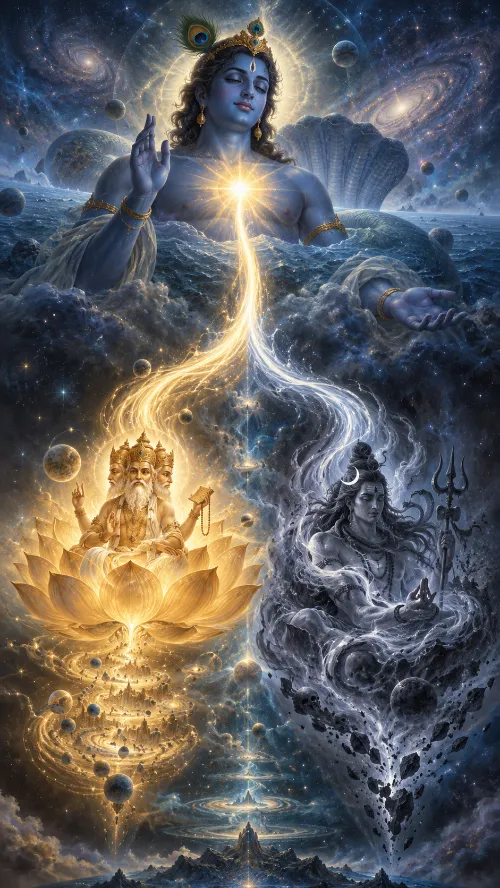
A verse quoted in a purport, what it says, and what it does not
In his purport to Bhagavad-gītā 10.8, A. C. Bhaktivedanta Swami Prabhupāda quotes a striking Sanskrit verse:
प्रजापतिं च रुद्रं चाप्य्
अहमेव सृजामि वै ।
तौ हि मां न विजानीतो
मम मायाविमोहितौ ॥
prajāpatiṁ ca rudraṁ cāpy
aham eva sṛjāmi vai
tau hi māṁ na vijānīto
mama māyā-vimohitau
Prabhupāda translates: “The patriarchs, Śiva and others are created by Me, though they do not know that they are created by Me because they are deluded by My illusory energy.”
The verse is powerful. But it is important to understand exactly what it is—and what it is not. This is not Bhagavad-gītā 10.8 itself. It is a supporting Sanskrit quotation that Prabhupāda introduces in his purport to BG 10.8, identifying it as coming from the Mokṣa-dharma section of the Mahābhārata.
Once we examine its textual history and surrounding Sanskrit sources, however, the passage becomes considerably more interesting. The basic theological idea is firmly embedded in the Mahābhārata: Nārāyaṇa is presented as the ultimate source, while Brahmā and Rudra perform cosmic functions dependent upon Him.
Yet the same Mahābhārata also speaks of an extraordinary unity between Rudra and Nārāyaṇa. The resulting theology is therefore subtler than the simplistic claim: “Viṣṇu is God and Śiva is merely an ordinary subordinate being.”
The original texts say something much more sophisticated.
What Bhagavad-gītā 10.8 Actually Says
The starting point must be the actual Gītā verse.
अहं सर्वस्य प्रभवो
मत्तः सर्वं प्रवर्तते ।
इति मत्वा भजन्ते मां
बुधा भावसमन्विताः ॥
ahaṁ sarvasya prabhavo
mattaḥ sarvaṁ pravartate
iti matvā bhajante māṁ
budhā bhāva-samanvitāḥ
“I am the source of everything. From Me everything proceeds. Knowing this, the wise worship Me, endowed with deep devotional feeling.”
Bhagavad-gītā 10.8
Prabhupāda renders the opening even more explicitly: “I am the source of all spiritual and material worlds. Everything emanates from Me.” The key declaration is:
अहं सर्वस्य प्रभवः
ahaṁ sarvasya prabhavaḥ
“I am the source of everything.”
And:
मत्तः सर्वं प्रवर्तते
mattaḥ sarvaṁ pravartate
“From Me everything proceeds.”
This is one of the strongest statements of divine causality in the entire Bhagavad-gītā. Kṛṣṇa does not say: “I am one important cause among others.” He says:
सर्वस्य — sarvasya
“of everything.” That universal statement is what Prabhupāda’s subsequent quotations are intended to substantiate.
The Context Begins Even Earlier: Bhagavad-gītā 10.2
Only six verses before 10.8, Kṛṣṇa has already declared that even the gods and great ṛṣis derive from Him.
न मे विदुः सुरगणाः
प्रभवं न महर्षयः ।
अहमादिर्हि देवानां
महर्षीणां च सर्वशः ॥
na me viduḥ sura-gaṇāḥ
prabhavaṁ na maharṣayaḥ
aham ādir hi devānāṁ
maharṣīṇāṁ ca sarvaśaḥ
“Neither the hosts of gods nor the great sages fully know My origin, for I am in every respect the source of the gods and the great sages.”
Bhagavad-gītā 10.2
The logic is straightforward: The gods cannot precede Kṛṣṇa as His cause, because Kṛṣṇa identifies Himself as their cause. Thus BG 10.8 is not an isolated declaration. Chapter 10 progressively establishes Kṛṣṇa as the origin behind the cosmic hierarchy.
Why Prabhupāda Quotes Other Scriptures
Prabhupāda does not leave BG 10.8 standing alone. His purport constructs what might be called a scriptural chain of corroboration. He cites Upaniṣadic material concerning Nārāyaṇa, Brahmā and Rudra, then the Mokṣa-dharma, then the Varāha Purāṇa.
His purpose is clear: to demonstrate that Kṛṣṇa’s statement “I am the source of everything” is consistent with a wider Vaiṣṇava reading of Vedic and Purāṇic revelation. One passage cited in the purport says:
नारायणाद् ब्रह्मा जायते ।
नारायणात् प्रजापतिः प्रजायते ।
नारायणाद् इन्द्रो जायते ।
नारायणाद् एकादश रुद्रा जायन्ते ॥
nārāyaṇād brahmā jāyate
nārāyaṇāt prajāpatiḥ prajāyate
nārāyaṇād indro jāyate
nārāyaṇād ekādaśa rudrā jāyante
“From Nārāyaṇa Brahmā is born. From Nārāyaṇa Prajāpati arises. From Nārāyaṇa Indra is born. From Nārāyaṇa the eleven Rudras are born.”
The repeated grammatical construction is significant:
नारायणात् — nārāyaṇāt
“from Nārāyaṇa.” Again and again the direction of causality points backward toward a single source.
The Mokṣa-dharma Quotation
Then comes the verse in question:
प्रजापतिं च रुद्रं चाप्य्
अहमेव सृजामि वै ।
तौ हि मां न विजानीतो
मम मायाविमोहितौ ॥
prajāpatiṁ ca rudraṁ cāpy
aham eva sṛjāmi vai
tau hi māṁ na vijānīto
mama māyā-vimohitau
A stricter translation than the one normally printed would be: “I alone indeed create Prajāpati and Rudra. Those two do not know Me, being bewildered by My māyā.” Several grammatical details matter enormously.
“Prajāpati” Is Singular, Not Plural
Prabhupāda’s English says: “The patriarchs, Śiva and others…” But the Sanskrit actually contains:
So the most literal first half is:
प्रजापतिं च रुद्रं चाप्य् अहमेव सृजामि वै
prajāpatiṁ ca rudraṁ cāpy aham eva sṛjāmi vai
“Prajāpati and Rudra also—I Myself indeed create.”
Prabhupāda’s “patriarchs, Śiva and others” communicates the wider theological implication, but it is not a strict word-for-word translation.
“Aham Eva”: I Alone
The expression
अहमेव सृजामि वै
aham eva sṛjāmi vai
is considerably stronger than simply: “I create them.” It says something approaching: “It is I Myself who indeed create them.” That is an almost perfect expansion of:
अहं सर्वस्य प्रभवः
ahaṁ sarvasya prabhavaḥ
“I am the source of everything.”
“Those Two Do Not Know Me”
The next expression is grammatically interesting:
तौ हि मां न विजानीतो
tau hi māṁ na vijānīto
The verb is dual because precisely two beings have been named. So the strict meaning is: “For those two do not know Me.”
Prabhupāda translates: “they do not know that they are created by Me.” That follows naturally from the preceding sentence, but the Sanskrit itself is actually broader. It says: they do not fully know Me.
The distinction matters. The verse is not merely about ignorance of one historical event—their own creation. It concerns the difficulty even exalted cosmic beings may have in comprehending the Supreme’s ultimate nature and causality.
“Bewildered by My Māyā”
The final line reads:
मम मायाविमोहितौ
mama māyā-vimohitau
- mama — My
- māyā — māyā, divine power
- vimohitau
— the two bewildered, confounded, or obscured Thus: “those two being bewildered by My māyā.” At first this may sound shocking.
How could Brahmā and Śiva—among the greatest beings in Hindu scripture—be described as bewildered? The answer depends upon what māyā means in context. It need not imply that Brahmā and Śiva are simply ignorant materialists.
The deeper issue is that no finite or functionally manifested cosmic being automatically possesses exhaustive knowledge of the Supreme’s total nature and potency. And an especially revealing parallel occurs in the Varāha Purāṇa.
A Textual Mystery: Where Exactly Is This Mokṣa-dharma Verse?
Here the investigation becomes important. Prabhupāda explicitly says: “In the Mokṣa-dharma section of the Mahābhārata, Kṛṣṇa also says…” and then quotes the verse. This attribution was not invented by Prabhupāda.
An earlier Gauḍīya authority, Baladeva Vidyābhūṣaṇa, cites essentially the same verse in his commentary on BG 10.8 and explicitly introduces it with:
मोक्षधर्मे च
mokṣa-dharme ca
“And in the Mokṣa-dharma…”
Thus the attribution was already part of the Gauḍīya exegetical tradition centuries before Bhagavad-gītā As It Is. Yet a textual problem remains. The exact four pādas quoted by Baladeva and Prabhupāda do not appear in this exact form in the standard searchable critical Nārāyaṇīya text presently available.
This does not automatically make the citation false. Sanskrit texts survive through multiple manuscripts, recensions, quotations, anthologies and commentarial traditions, and Purāṇic and epic verses frequently circulate in more than one textual environment.
More importantly, the standard Mahābhārata Mokṣa-dharma text does preserve very close statements expressing precisely the same theology.
The Nārāyaṇīya: A Vaiṣṇava Core Inside the Mokṣa-dharma
Within the vast Śānti-parvan of the Mahābhārata lies the Mokṣa-dharma, a major collection of teachings on liberation, metaphysics and spiritual practice. Within that lies a specifically Nārāyaṇa-centered theological corpus generally known as the:
नारायणीय — Nārāyaṇīya
In the critical Mahābhārata, it occupies approximately Śānti-parvan 12.321–339. This is not peripheral evidence. The Nārāyaṇīya contains remarkably explicit statements about Nārāyaṇa, Brahmā and Rudra.
Brahmā from Grace, Rudra from Wrath
नमोऽतियशसे तस्मै देहिनां परमात्मने ।
नारायणाय विश्वाय निर्गुणाय गुणात्मने ॥
यस्य प्रसादजो ब्रह्मा रुद्रश्च क्रोधसम्भवः ।
योऽसौ योनिर्हि सर्वस्य स्थावरस्य चरस्य च ॥
namo ‘ti-yaśase tasmai dehināṁ paramātmane
nārāyaṇāya viśvāya nirguṇāya guṇātmane
yasya prasāda-jo brahmā rudraś ca krodha-sambhavaḥ
yo ‘sau yonir hi sarvasya sthāvarasya carasya ca
“Obeisance to that exceedingly glorious Nārāyaṇa, the Paramātmā of embodied beings, the universal Lord, beyond the guṇas yet the ground of the guṇas.
At Mahābhārata 12.328.11–12 we find:
From His grace Brahmā arises, and Rudra arises from His wrath. He is the source of everything moving and unmoving.” The final expression is especially important:
योनिः सर्वस्य
yoniḥ sarvasya
“the source of everything.”
Compare BG 10.8:
अहं सर्वस्य प्रभवः
ahaṁ sarvasya prabhavaḥ
“I am the source of everything.”
The conceptual correspondence is unmistakable.
The Birth of Brahmā
The Nārāyaṇīya continues:
ब्राह्मे रात्रिक्षये प्राप्ते तस्य ह्यमिततेजसः ।
प्रसादात्प्रादुरभवत्पद्मं पद्मनिभेक्षण ।
तत्र ब्रह्मा समभवत्स तस्यैव प्रसादजः ॥
brāhme rātri-kṣaye prāpte tasya hy amita-tejasaḥ
prasādāt prādur abhavat padmaṁ padma-nibhekṣaṇa
tatra brahmā samabhavat sa tasyaiva prasādajaḥ
“When the cosmic night had ended, from the grace of that Being of immeasurable splendor a lotus appeared, O lotus-eyed one. There Brahmā manifested; he was born from His grace.”
The imagery is familiar from later Vaiṣṇava cosmology: the lotus, Brahmā, and the transcendent source from whom Brahmā appears.
The Appearance of Rudra
The next verse states:
अह्नः क्षये ललाटाच्च सुतो देवस्य वै तथा ।
क्रोधाविष्टस्य संजज्ञे रुद्रः संहारकारकः ॥
ahnaḥ kṣaye lalāṭāc ca suto devasya vai tathā
krodhāviṣṭasya saṁjajñe rudraḥ saṁhāra-kārakaḥ
“At the end of the day, from the forehead of the Lord, when filled with wrath, a son arose—Rudra, the agent of dissolution.”
Notice the title:
संहारकारकः — saṁhāra-kārakaḥ
“the agent of dissolution.” Rudra possesses a genuine cosmic function. But the next verse explains something crucial about both Brahmā and Rudra.
Brahmā and Rudra Are “Nimitta-mātra”—Instruments
एतौ द्वौ विबुधश्रेष्ठौ प्रसादक्रोधजौ स्मृतौ ।
तदादेशितपन्थानौ सृष्टिसंहारकारकौ ।
निमित्तमात्रं तावत्र सर्वप्राणिवरप्रदौ ॥
etau dvau vibudha-śreṣṭhau prasāda-krodha-jau smṛtau
tad-ādeśita-panthānau sṛṣṭi-saṁhāra-kārakau
nimitta-mātraṁ tāv atra sarva-prāṇi-vara-pradau
“These two foremost divine beings are remembered as arising from grace and wrath. Following the path ordained by Him, they carry out creation and dissolution. They are instruments in these functions, although they grant boons to living beings.”
Mahābhārata 12.328.17
The phrase:
निमित्तमात्रम् — nimitta-mātram
means: “merely the instrument,” “the instrumental cause.” This is striking because the Bhagavad-gītā uses exactly the same expression for Arjuna.
निमित्तमात्रं भव सव्यसाचिन् ॥
nimitta-mātraṁ bhava savyasācin
“Become merely the instrument, O Savyasācī.”
Bhagavad-gītā 11.33
The point is not that Arjuna does nothing. Arjuna performs tremendous action. But the ultimate orchestration belongs to Kṛṣṇa. Likewise, according to the Nārāyaṇīya, Brahmā and Rudra perform genuinely immense cosmic functions while the ultimate source and authorization remain with Nārāyaṇa.
This greatly clarifies the theology behind Prabhupāda’s quotation.
The Varāha Purāṇa Preserves an Astonishingly Close Parallel
The strongest textual clue comes from the Varāha Purāṇa. Chapter 125 is explicitly called:
मायाचक्रम् — Māyā-cakram
“The Wheel of Māyā.” The Earth asks Viṣṇu: What exactly is Your māyā? Viṣṇu responds by describing ways in which His power operates throughout cosmic existence while remaining difficult even for great beings to comprehend.
Early in the chapter He says:
अद्यापि मां न जानन्ति
रुद्रेन्द्राः सपितामहाः ।
मम मायां विशालाक्षि
किं पुनस्त्वं वसुन्धरे ॥
adyāpi māṁ na jānanti
rudrendrāḥ sa-pitāmahāḥ
mama māyāṁ viśālākṣi
kiṁ punas tvaṁ vasundhare
“Even Rudra, Indra and Pitāmaha do not fully know Me and My māyā, O wide-eyed Earth. What then of you, O Vasundharā?”
Then comes the remarkable parallel at approximately Varāha Purāṇa 125.50:
प्रजापतिं च रुद्रं च
सृजामि च वहामि च ।
तेऽपि मायां न जानन्ति
मम मायाविमोहिताः ॥
prajāpatiṁ ca rudraṁ ca
sṛjāmi ca vahāmi ca
te ‘pi māyāṁ na jānanti
mama māyā-vimohitāḥ
“I create Prajāpati and Rudra, and I sustain them. Even they do not know My māyā, being bewildered by My māyā.”
Now compare that with the traditional Mokṣa-dharma quotation:
Traditional quotation
- prajāpatiṁ ca rudraṁ cāpy
- aham eva sṛjāmi vai
- tau hi māṁ na vijānīto
- mama māyā-vimohitau
Varāha Purāṇa
- prajāpatiṁ ca rudraṁ ca
- sṛjāmi ca vahāmi ca
- te ‘pi māyāṁ na jānanti
- mama māyā-vimohitāḥ
The resemblance is extraordinary. Both contain: prajāpatiṁ ca rudraṁ ca “I create…”
“they do not know…” and mama māyā-vimohita— “bewildered by My māyā.” This strongly suggests that the verse belongs to an old, interconnected Vaiṣṇava textual tradition, even if its precise path into the quotation labeled “Mokṣa-dharma” cannot presently be reconstructed with certainty.
What We Should—and Should Not—Conclude About the Source
It would therefore be too strong to say: “Prabhupāda misquoted the Mahābhārata.” That ignores the older commentarial evidence. Baladeva Vidyābhūṣaṇa already attributes essentially the same verse to the Mokṣa-dharma.
It would also be too strong to say: “The exact verse certainly occurs in every Mahābhārata manuscript.” The currently accessible critical Nārāyaṇīya does not contain those exact four pādas.
The academically safer conclusion is: The citation is traditional, its doctrinal content is unquestionably represented in the Mokṣa-dharma/Nārāyaṇīya, and a remarkably close verbal parallel survives in the Varāha Purāṇa. Its precise recension-history remains uncertain.
That is not a weakness. It is exactly what we should expect from a vast Sanskrit textual culture transmitted for centuries through manuscripts, quotations and overlapping Purāṇic traditions.
But Does This Mean Śiva Is Merely an Ordinary Created Being?
No. And this is where reading the surrounding Mahābhārata verses becomes indispensable. Immediately after describing Rudra as arising through Nārāyaṇa’s wrath and acting as an instrument of dissolution, the Nārāyaṇīya says:
नारायणात्मको ज्ञेयः
पाण्डवेय युगे युगे ॥
nārāyaṇātmako jñeyaḥ
pāṇḍaveya yuge yuge
“Rudra should be understood, O son of Pāṇḍu, as having Nārāyaṇa as his very self or essential ground, age after age.”
Mahābhārata 12.328.19
The compound:
नारायणात्मकः — nārāyaṇātmakaḥ
can convey:
- “whose self is Nārāyaṇa,”
- “whose nature is rooted in Nārāyaṇa,”
- “constituted through Nārāyaṇa.”
That is already far more nuanced than treating Śiva as simply one ordinary deva among many.
Worship of Maheśvara Reaches Nārāyaṇa
The next verse states:
तस्मिन् हि पूज्यमाने वै
देवदेवे महेश्वरे ।
सम्पूजितो भवेत्पार्थ
देवो नारायणः प्रभुः ॥
tasmin hi pūjyamāne vai
deva-deve maheśvare
saṁpūjito bhavet pārtha
devo nārāyaṇaḥ prabhuḥ
“When that Maheśvara, the God of gods, is worshiped, O Pārtha, Lord Nārāyaṇa is thereby worshiped.”
This is remarkably generous theology. The text that strongly establishes Nārāyaṇa’s causal supremacy simultaneously honors Maheśvara.
Kṛṣṇa Says He Worships Rudra
The passage becomes even more surprising. Kṛṣṇa explains:
अहमात्मा हि लोकानां
विश्वानां पाण्डुनन्दन ।
तस्मादात्मानमेवाग्रे
रुद्रं सम्पूजयाम्यहम् ॥
aham ātmā hi lokānāṁ
viśvānāṁ pāṇḍu-nandana
tasmād ātmānam evāgre
rudraṁ saṁpūjayāmy aham
“I am indeed the Self of the worlds, O son of Pāṇḍu. Therefore, when I worship Rudra, I worship My own Self.”
And then:
यस्तं वेत्ति स मां वेत्ति
योऽनु तं स हि मामनु ॥
yas taṁ vetti sa māṁ vetti
yo ‘nu taṁ sa hi mām anu
“One who knows him knows Me; one who follows him follows Me.”
Then comes perhaps the most startling statement in the entire section.
“Rudra and Nārāyaṇa Are One Reality in Two Forms”
रुद्रो नारायणश्चैव
सत्त्वमेकं द्विधाकृतम् ।
लोके चरति कौन्तेय
व्यक्तिस्थं सर्वकर्मसु ॥
rudro nārāyaṇaś caiva
sattvam ekaṁ dvidhā-kṛtam
loke carati kaunteya
vyakti-sthaṁ sarva-karmasu
“Rudra and Nārāyaṇa are one reality divided into two; O son of Kuntī, it moves within the world manifested through different functions.”
Mahābhārata 12.328.24
This verse must be read alongside the earlier verses. The Nārāyaṇīya can say both: Nārāyaṇa is the ultimate causal source from whom Brahmā and Rudra manifest and: Rudra and Nārāyaṇa represent one profound reality expressed in two modes or forms.
The text therefore simultaneously preserves difference and non-difference. That is exactly what crude sectarian summaries tend to miss.
Yet the Same Passage Still Places Nārāyaṇa First
Immediately afterward the Nārāyaṇīya states:
सब्रह्मकाः सरुद्राश्च
सेन्द्रा देवाः सहर्षिभिः ।
अर्चयन्ति सुरश्रेष्ठं
देवं नारायणं हरिम् ॥
sa-brahmakāḥ sa-rudrāś ca
sendrā devāḥ saharṣibhiḥ
arcayanti sura-śreṣṭhaṁ
devaṁ nārāyaṇaṁ harim
“The gods, together with Brahmā, Rudra and Indra and accompanied by the sages, worship Nārāyaṇa Hari, the supreme among the gods.”
And:
भविष्यतां वर्ततां च
भूतानां चैव भारत ।
सर्वेषामग्रणीर्विष्णुः
सेव्यः पूज्यश्च नित्यशः ॥
bhaviṣyatāṁ vartatāṁ ca
bhūtānāṁ caiva bhārata
sarveṣām agraṇīr viṣṇuḥ
sevyaḥ pūjyaś ca nityaśaḥ
“Among all beings of the future, present and past, O Bhārata, Viṣṇu is foremost and is eternally to be served and worshiped.”
This is why the Nārāyaṇīya cannot simply be reduced to: “Viṣṇu and Śiva are interchangeable in every possible respect.” Nor can it be reduced to: “Śiva is merely a powerless subordinate.”
The theology is hierarchical and relational. Nārāyaṇa is presented as the ultimate source. Rudra manifests in intimate relationship with Him and exercises an extraordinary divine function.
The Gauḍīya Solution: Milk and Yogurt
Later Gauḍīya theology develops almost exactly this problem: How can Śiva be one with Viṣṇu and yet not identical with Viṣṇu-tattva? The classic answer uses milk and yogurt.
দুগ্ধ যেন অম্লযোগে দধিরূপ ধরে ।
দুগ্ধান্তর বস্তু নহে, দুগ্ধ হৈতে নারে ॥
dugdha yena amla-yoge dadhi-rūpa dhare
dugdhāntara vastu nahe, dugdha haite nāre
“Just as milk assumes the form of yogurt through contact with a souring agent, yogurt is not a substance completely different from milk—yet it can no longer function simply as milk.”
The Caitanya-caritāmṛta, Madhya 20.309, says in Bengali:
This is a wonderfully precise analogy. Yogurt comes from milk. It is constitutionally inseparable from its source. Yet yogurt is also genuinely distinct in function and condition.
The next verse quotes the Brahma-saṁhitā.
Brahma-saṁhitā 5.45: Govinda Becomes Śambhu for a Particular Function
क्षीरं यथा दधि विकारविशेषयोगात्
सञ्जायते न तु ततः पृथगस्ति हेतोः ।
यः शम्भुतामपि तथा समुपैति कार्याद्
गोविन्दमादिपुरुषं तमहं भजामि ॥
kṣīraṁ yathā dadhi vikāra-viśeṣa-yogāt
sañjāyate na tu tataḥ pṛthag asti hetoḥ
yaḥ śambhutām api tathā samupaiti kāryād
govindam ādi-puruṣaṁ tam ahaṁ bhajāmi
“Just as milk becomes yogurt through a particular transformation and yet is not independent of milk, its cause, so Govinda assumes the condition of Śambhu for a particular cosmic function. I worship that Govinda, the original person.”
The crucial phrase is:
कार्यात् — kāryāt
“for the sake of a particular function.” Compare the Nārāyaṇīya’s description of Rudra:
संहारकारकः
saṁhāra-kārakaḥ
“the agent of dissolution.”
The conceptual similarity is striking. Gauḍīya theology regards Śiva not as an ordinary jīva but as a unique ontological category associated with the Supreme’s contact with material nature for particular cosmic functions.
Caitanya-caritāmṛta: Śiva and Māyā
The next Bengali verse states the distinction more explicitly.
‘শিব’ — মায়াশক্তিসঙ্গী, তমোগুণাবেশ ।
মায়াতীত, গুণাতীত ‘বিষ্ণু’ — পরমেশ ॥
‘śiva’ — māyā-śakti-saṅgī, tamo-guṇāveśa
māyātīta, guṇātīta ‘viṣṇu’ — parameśa
“Śiva is associated with the māyā-śakti and is connected with the mode of darkness. Viṣṇu is beyond māyā and beyond the material qualities; He is the Supreme Lord.”
Caitanya-caritāmṛta, Madhya 20.311
This illuminates the phrase:
मम मायाविमोहितौ
mama māyā-vimohitau
in the traditional Mokṣa-dharma quotation. Śiva’s relationship with māyā is not the same as Viṣṇu’s. Viṣṇu remains:
Śiva Is Also the Greatest Vaiṣṇava
Any presentation of Gauḍīya theology that uses these passages merely to diminish Śiva would be seriously incomplete. The Śrīmad-Bhāgavatam famously declares:
निम्नगानां यथा गङ्गा
देवानामच्युतो यथा ।
वैष्णवानां यथा शम्भुः
पुराणानामिदं तथा ॥
nimna-gānāṁ yathā gaṅgā
devānām acyuto yathā
vaiṣṇavānāṁ yathā śambhuḥ
purāṇānām idaṁ tathā
“As the Gaṅgā is foremost among rivers, as Acyuta is foremost among divine beings, and as Śambhu is foremost among Vaiṣṇavas, so this Bhāgavata is foremost among Purāṇas.”
Śrīmad-Bhāgavatam 12.13.16
The phrase:
वैष्णवानां यथा शम्भुः
vaiṣṇavānāṁ yathā śambhuḥ
means: “as Śambhu is among the Vaiṣṇavas.” Śiva’s greatness is therefore not denied. It is celebrated.
So What Does “Deluded by My Māyā” Really Mean?
We can now answer more carefully. The statement should not be interpreted as: “Brahmā and Śiva are foolish ordinary conditioned souls.” The surrounding literature instead suggests several levels of meaning.
First, the Supreme’s total nature and māyā are incomprehensible even to extremely exalted beings. Second, Brahmā and Rudra perform specific cosmic functions within the manifested order, whereas Nārāyaṇa is represented as the transcendent source of that order.
Third, Śiva’s unique relationship with māyā is itself part of his cosmic role. Fourth, the Mahābhārata simultaneously insists upon a deep intimacy—or even non-difference—between Nārāyaṇa and Rudra.
Thus “bewilderment” must be understood relative to the immeasurable knowledge and independence of the Supreme, not as an insult to Śiva.
Source, Function and Manifestation
The easiest way to understand all these passages together is through three categories. Source: Nārāyaṇa/Kṛṣṇa is presented as the ultimate origin:
अहं सर्वस्य प्रभवः
ahaṁ sarvasya prabhavaḥ
“I am the source of everything.”
Function: Brahmā creates and Rudra dissolves as cosmic agents:
सृष्टिसंहारकारकौ
sṛṣṭi-saṁhāra-kārakau
“agents of creation and dissolution.”
Instrumentality: Their cosmic power operates within the supreme order:
निमित्तमात्रम्
nimitta-mātram
“instruments.”
This avoids two opposite mistakes. The first mistake is imagining Brahmā, Viṣṇu and Śiva as three completely independent competing gods. The second is flattening all distinctions and pretending the texts make no differentiation between their functions or ontological positions.
The Sanskrit sources do neither.
Why This Matters for Bhagavad-gītā 10.8
We can now return to the verse from which the entire discussion began.
अहं सर्वस्य प्रभवो
मत्तः सर्वं प्रवर्तते
ahaṁ sarvasya prabhavo
mattaḥ sarvaṁ pravartate
“I am the source of everything. Everything proceeds from Me.”
Prabhupāda’s Mokṣa-dharma quotation is meant to answer an obvious question: Does “everything” include the great cosmic rulers themselves? His answer is: Yes. Brahmā is not an independent first cause.
Rudra is not an independent first cause. Indra is not an independent first cause. Prakṛti is not an independent first cause. All causal chains ultimately rest upon the Supreme.
This is precisely what the Nārāyaṇīya itself says:
योऽसौ योनिर्हि सर्वस्य
स्थावरस्य चरस्य च
yo ‘sau yonir hi sarvasya
sthāvarasya carasya ca
“He is the source of everything moving and unmoving.”
That is almost a Mahābhārata commentary on:
अहं सर्वस्य प्रभवः
“I am the source of everything.”
And Knowing the Source Produces Bhakti
There is one further point easily lost in debates about divine hierarchy. BG 10.8 does not end with cosmology. Kṛṣṇa says:
इति मत्वा भजन्ते मां
बुधा भावसमन्विताः
iti matvā bhajante māṁ
budhā bhāva-samanvitāḥ
“Knowing this, the wise worship Me with deep devotional feeling.”
The purpose of establishing the Supreme source is not merely to win a metaphysical argument. Knowledge culminates in:
The Most Careful Form of the Mokṣa-dharma Note
A precise scholarly note could therefore read: Bhagavad-gītā 10.8 — Purport The following Sanskrit is not BG 10.8 itself, but a supporting verse quoted by A. C. Bhaktivedanta Swami Prabhupāda in his purport and identified as coming from the Mokṣa-dharma section of the Mahābhārata. The same attribution is already found in the earlier Gauḍīya commentary of Baladeva Vidyābhūṣaṇa.
प्रजापतिं च रुद्रं चाप्य्
अहमेव सृजामि वै ।
तौ हि मां न विजानीतो
मम मायाविमोहितौ ॥
prajāpatiṁ ca rudraṁ cāpy
aham eva sṛjāmi vai
tau hi māṁ na vijānīto
mama māyā-vimohitau
“I alone indeed create Prajāpati and Rudra. Those two do not fully know Me, being bewildered by My māyā.”
The precise four-line form has not been located in the standard searchable critical Nārāyaṇīya text, although Mahābhārata 12.328 contains closely parallel teachings stating explicitly that Brahmā arises through Nārāyaṇa’s grace, Rudra arises through His wrath, and both function as instruments in creation and dissolution. Varāha Purāṇa 125.50 preserves an exceptionally close verbal parallel.
That formulation is both faithful to the traditional citation and honest about the surviving textual evidence.
The Deeper Theological Picture
The full body of evidence produces a remarkably sophisticated picture. Kṛṣṇa/Nārāyaṇa is the ultimate source. Brahmā manifests for creation. Rudra manifests for dissolution.
Their cosmic functions are real and enormous. Yet their causality is derivative rather than absolutely independent. Rudra in particular occupies a unique position: he is not reducible to an ordinary jīva, nor is his relation to Viṣṇu described as simple absolute identity.
The Nārāyaṇīya can simultaneously say:
यस्य प्रसादजो ब्रह्मा
रुद्रश्च क्रोधसम्भवः
yasya prasāda-jo brahmā
rudraś ca krodha-sambhavaḥ
“Brahmā arises from His grace and Rudra from His wrath.”
And:
रुद्रो नारायणश्चैव
सत्त्वमेकं द्विधाकृतम्
rudro nārāyaṇaś caiva
sattvam ekaṁ dvidhā-kṛtam
“Rudra and Nārāyaṇa are one reality expressed in two.”
Later Gauḍīya theology captures the same tension through milk and yogurt: one source, intimate continuity, real distinction, different function. That is far more interesting than a crude hierarchy.
The Mokṣa-dharma quotation in Prabhupāda’s purport to BG 10.8 is therefore important for more than one reason. It teaches that even the greatest cosmic beings do not constitute independent ultimate causes.
It demonstrates how Gauḍīya commentators read the Gītā through a wider network of Upaniṣadic, epic and Purāṇic texts. Its textual history also reminds us that Sanskrit scripture was transmitted through multiple recensions and interlocking traditions, not through one modern standardized edition.
And when the surrounding Mahābhārata material is restored, the passage teaches something even richer: Nārāyaṇa is the ultimate source, Brahmā and Rudra operate through His cosmic order, and Rudra nevertheless possesses an extraordinary intimacy with Nārāyaṇa that resists simplistic categorization.
The purpose of BG 10.8 is ultimately not to reduce the divine world to a ranking chart. It is to reveal the root behind the entire tree of existence. Kṛṣṇa says:
अहं सर्वस्य प्रभवः
ahaṁ sarvasya prabhavaḥ
“I am the source of everything.”
And then immediately explains what genuine understanding of that truth produces:
इति मत्वा भजन्ते मां
iti matvā bhajante mām
“Understanding this, they worship Me.”
That is the heart of the verse. Metaphysics becomes devotion. Knowledge of the source becomes love of the source. And that is why Prabhupāda surrounds BG 10.8 with citations concerning Brahmā, Rudra, Nārāyaṇa and creation: not simply to establish cosmic hierarchy, but to drive home the uncompromising claim contained in two Sanskrit words—
अहं सर्वस्य
ahaṁ sarvasya
“I am the source of all.”