

This Very Kṛṣṇa Is He
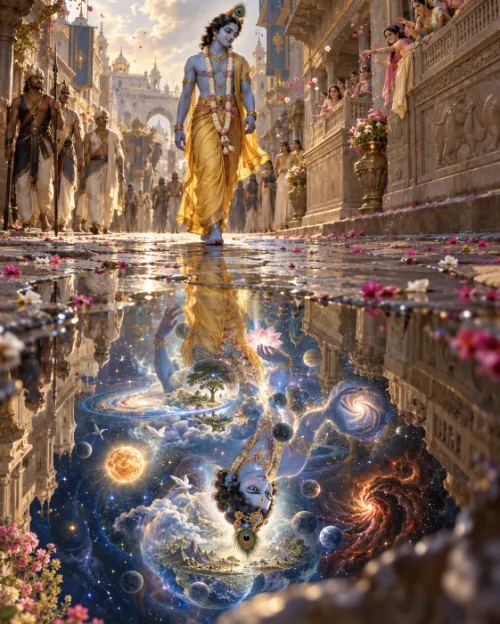
The hidden Lord of the Vedas walking through Hastināpura
Kṛṣṇa is leaving Hastināpura. The great Kurukṣetra war is over. Yudhiṣṭhira has been established on the throne, and Kṛṣṇa is preparing to return to Dvārakā. The citizens come out to see Him. Women climb onto the rooftops and look down as He passes through the streets.
Arjuna attends Him. Uddhava and Sātyaki accompany Him. Flowers fall upon Him. Kṛṣṇa smiles at the citizens as He departs. Then the women begin talking among themselves. What they say is extraordinary.
They do not merely praise Kṛṣṇa as a heroic prince, the friend of the Pāṇḍavas, or an extraordinary holy man. Looking directly at the apparently human Kṛṣṇa walking beneath them, they identify Him with the primordial Person who existed before creation, the hidden object of Vedic revelation, the one Supreme Lord, the Soul of the universe, and the source of creation, preservation, and dissolution.
Their statement in Śrīmad-Bhāgavatam 1.10.24 is one of the First Canto’s most compact declarations of Kṛṣṇa’s transcendental identity.
The Verse
स वा अयं सख्यनुगीतसत्कथो
वेदेषु गुह्येषु च गुह्यवादिभिः ।
य एक ईशो जगदात्मलीलया
सृजत्यवत्यत्ति न तत्र सज्जते ॥ २४ ॥
sa vā ayaṁ sakhy anugīta-sat-katho
vedeṣu guhyeṣu ca guhya-vādibhiḥ
ya eka īśo jagad-ātma-līlayā
sṛjaty avaty atti na tatra sajjate
“O friend, this indeed is He whose true and excellent accounts are sung in the Vedas and in confidential revelation by those who disclose the confidential truth. He is the one Lord who, as the Soul of the universe and through His līlā, creates, preserves, and consumes it, yet never becomes attached to it.”
Śrīmad-Bhāgavatam 1.10.24
The familiar Bhaktivedanta translation expresses the sense more devotionally: “O dear friends, here is that very Personality of Godhead whose attractive and confidential pastimes are described in the confidential parts of Vedic literature by His great devotees. It is He only who creates, maintains and annihilates the material world and yet remains unaffected.”
That is accurate, but the Sanskrit contains several nuances worth drawing out.
“Friend—This Is Him!”
The verse begins: sa vā ayaṁ sakhi The underlying sense is: “O friend, this indeed is He.” The word ayam means “this,” “this one here,” “this very person.” That demonstrative is crucial.
The women are not discussing a remote theological abstraction. Kṛṣṇa is physically present before their eyes. One can almost hear one woman pointing Him out to another: “Friend—look! This is actually Him.”
The philosophical force of the verse comes precisely from the juxtaposition: the apparently human Kṛṣṇa visible in the street is identified with the invisible cosmic Lord described by revelation.
This theme had already appeared three verses earlier.
स वै किलायं पुरुषः पुरातनो
य एक आसीदविशेष आत्मनि ।
अग्रे गुणेभ्यो जगदात्मनीश्वरे
निमीलितात्मन्निशि सुप्तशक्तिषु ॥
sa vai kilāyaṁ puruṣaḥ purātano
ya eka āsīd aviśeṣa ātmani
agre guṇebhyo jagad-ātmanīśvare
nimīlitātman niśi supta-śaktiṣu
“This indeed is that primordial Person who alone existed before the manifestation of the material qualities, when the beings and their powers lay dormant within the Supreme Self of the universe.”
Śrīmad-Bhāgavatam 1.10.21
Again: ayam — “this one.” The man passing through Hastināpura is identified with the puruṣaḥ purātanaḥ—the primordial Person preceding the manifested cosmos. This is one of the central theological moves of the Bhāgavatam: the Absolute is not discovered by moving away from Kṛṣṇa’s personhood. The Absolute is discovered within the apparently human person of Kṛṣṇa.
The Women of Hastināpura Are Doing Theology From the Rooftops
The setting itself deserves attention. Immediately before their conversation, the text says:
अन्योन्यमासीत् संजल्प उत्तमश्लोकचेतसाम् ।
कौरवेन्द्रपुरस्त्रीणां सर्वश्रुतिमनोहरः ॥
anyonyam āsīt sañjalpa
uttama-śloka-cetasām
kauravendra-pura-strīṇāṁ
sarva-śruti-mano-haraḥ
“The women of the Kuru capital, whose minds were absorbed in Uttamaśloka, began conversing among themselves; their conversation was captivating like the highest sacred hearing.”
Śrīmad-Bhāgavatam 1.10.20
The traditional Bhaktivedanta rendering takes the final expression even more strongly: their discussion was more attractive than the hymns of the Vedas. The important point is clear either way.
These women are not conducting a formal Vedānta debate. They are talking about Kṛṣṇa because their minds are absorbed in Him: uttama-śloka-cetasām Their consciousness has become Kṛṣṇa-centered, and therefore their apparently spontaneous conversation becomes profound theology.
The scene embodies an important Bhāgavata principle: spiritual realization is not identical with intellectual specialization. Learning has immense value, but revelation becomes alive when knowledge is joined with devotion.
The women look at Kṛṣṇa with affection—and recognize what philosophers seek through metaphysical inquiry.
Anugīta-sat-kathaḥ — He Whose True and Sacred Narratives Are Sung
The expression anugīta-sat-kathaḥ is richer than simply “whose pastimes are described.” anugīta means “sung after,” “repeatedly celebrated,” “recounted,” or “sung in accordance with tradition.”
sat carries the senses of true, real, good, excellent, saintly, or spiritually genuine. kathā means speech, narrative, account, discourse, or sacred story. Thus sat-kathā is not merely entertainment about a religious figure. It is true, auspicious, spiritually transformative discourse concerning reality.
Kṛṣṇa is therefore the person: “whose authentic and sacred accounts are continually celebrated.” This points toward one of the Bhāgavatam’s distinctive convictions: narration about the Supreme is itself a mode of revelation.
The Absolute is not disclosed only through metaphysical formulas. He is disclosed through kathā—through hearing about His names, actions, relationships, qualities, and līlā.
The Double Mystery: guhyeṣu … guhya-vādibhiḥ
Perhaps the most suggestive phrase in the verse is:
वेदेषु गुह्येषु च गुह्यवादिभिः
vedeṣu guhyeṣu ca guhya-vādibhiḥ
The root idea guhya appears twice. guhya means hidden, secret, confidential, esoteric, or inward. guhya-vādin means one who speaks or expounds confidential truth. The line therefore has an intentional atmosphere of hidden revelation: the hidden truth is spoken in hidden revelation by those who know how to speak the hidden truth.
Kṛṣṇa can be seen by everyone walking through Hastināpura. But who He actually is remains concealed. A person may see: the cousin of the Pāṇḍavas, Arjuna’s friend, a diplomat, a prince of the Yadus, a warrior, a charismatic human being.
The women see something deeper: ya eka īśaḥ — He is the one Lord.
Śrīdhara Svāmī on the “Secret” Revelation
The great medieval commentator Śrīdhara Svāmī gives a remarkably concise gloss on this expression in his Bhāvārtha-dīpikā:
वेदेषु रहस्यागमेषु च रहस्यनिरूपकैरनुगीतसत्कथः
vedeṣu rahasyāgameṣu ca rahasya-nirūpakair anugīta-sat-kathaḥ
“His true narratives are sung in the Vedas and in confidential āgamas by those who expound the mysteries.”
This is useful because it slightly broadens the way guhyeṣu can be heard. It need not refer simply to a particular book called “the secret Veda.” Rather, it evokes the inner revelatory dimension of Vedic and esoteric sacred teaching.
In the Bhaktivedanta-Gauḍīya reading, the expression naturally includes the Upaniṣadic and Vedāntic revelation in which the ultimate Lord is indicated more indirectly, while the Bhāgavatam makes His personal identity increasingly explicit.
The Hidden God of the Upaniṣads
The language of Bhāgavatam 1.10.24 has striking Upaniṣadic parallels. Consider the Śvetāśvatara Upaniṣad.
एको देवः सर्वभूतेषु गूढः
सर्वव्यापी सर्वभूतान्तरात्मा ।
कर्माध्यक्षः सर्वभूताधिवासः
साक्षी चेता केवलो निर्गुणश्च ॥
eko devaḥ sarva-bhūteṣu gūḍhaḥ
sarva-vyāpī sarva-bhūtāntarātmā
karmādhyakṣaḥ sarva-bhūtādhivāsaḥ
sākṣī cetā kevalo nirguṇaś ca
“The one Divine Being is hidden within all beings, all-pervading, the inner Self of all beings, the overseer of action, the dwelling place of all beings, the witness, the conscious one, the one alone, beyond the material qualities.”
Śvetāśvatara Upaniṣad 6.11
Compare this with the women’s words: ya eka īśaḥ “He who is the one Lord” and jagad-ātmā “the Soul of the universe.” The resemblance is unmistakable: eka — one īśa/deva — Lord/divine being ātman — inner Self gūḍha/guhya — hidden, secret nirguṇa / na sajjate — untouched by material involvement The Bhāgavatam is effectively saying: the hidden Lord sought in the language of the Upaniṣads is this Kṛṣṇa.
Ya eka īśaḥ — Not One God Among Many
The phrase
य एक ईशः
ya eka īśaḥ
“who is the one Lord.”
The word īśa denotes a ruler, master, controller, or lord. But the addition of eka is decisive. The women are not merely calling Kṛṣṇa an impressive divine personality among numerous independent gods.
They identify Him with the singular governing Lord behind the cosmic order. A later Gauḍīya text states the same theology with complete directness.
ईश्वरः परमः कृष्णः
सच्चिदानन्दविग्रहः ।
अनादिरादिर्गोविन्दः
सर्वकारणकारणम् ॥
īśvaraḥ paramaḥ kṛṣṇaḥ
sac-cid-ānanda-vigrahaḥ
anādir ādir govindaḥ
sarva-kāraṇa-kāraṇam
“Kṛṣṇa, Govinda, is the Supreme Lord. His form consists of eternal being, consciousness, and bliss. He has no beginning, yet He is the beginning of all, the cause of all causes.”
Brahma-saṁhitā 5.1
The essential movement is exactly the same: Kṛṣṇa → supreme īśvara → ultimate cause.
Jagad-ātma — The Soul of the Universe
Then comes one of the densest expressions in the verse: jagad-ātma jagat means the moving world, creation, cosmos, or universe. ātman means self, soul, inner reality, sustaining principle.
Thus jagad-ātma can mean: “the Self of the universe,” “the Soul of the cosmos,” or, theologically, “the indwelling Supreme Self sustaining the universe.” This is important because God is not imagined merely as an external craftsman standing outside His creation.
The Lord transcends the cosmos, yet is simultaneously its inner ground and sustaining presence. A particularly powerful parallel occurs later in the Tenth Canto.
कृष्णमेनमवेहि त्वमात्मानमखिलात्मनाम् ।
जगद्धिताय सोऽप्यत्र देहीवाभाति मायया ॥
kṛṣṇam enam avehi tvam
ātmānam akhilātmanām
jagad-dhitāya so ’py atra
dehīvābhāti māyayā
“Know this Kṛṣṇa to be the Self of all selves. For the welfare of the world He appears here as though He were an embodied person, through His divine potency.”
Śrīmad-Bhāgavatam 10.14.55
Again the demonstrative is striking: kṛṣṇam enam — “this Kṛṣṇa.” And again the paradox appears: the ordinary-looking person before one’s eyes is the Self of all selves. The word iva — “as though” is especially important: dehī iva ābhāti “He appears as though He were an ordinary embodied being.”
The Bhāgavata claim is therefore not: a human being eventually became God. It is nearly the reverse: the cosmic Self appears within completely humanlike relationships without ceasing to be the cosmic Self.
The Son of Nanda Is the Nondual Absolute
Kṛṣṇadāsa Kavirāja later expresses this distinctly Gauḍīya understanding in Bengali.
কৃষ্ণের স্বরূপ-বিচার শুন, সনাতন ।
অদ্বয়জ্ঞান-তত্ত্ব, ব্রজে ব্রজেন্দ্রনন্দন ॥
kṛṣṇera svarūpa-vicāra śuna, sanātana
advaya-jñāna-tattva, vraje vrajendra-nandana
“O Sanātana, hear the truth concerning Kṛṣṇa’s essential nature: the nondual Absolute Reality is, in Vraja, the son of the king of Vraja.”
Caitanya-caritāmṛta , Madhya 20.152
This could almost serve as a Gauḍīya commentary on the women’s words. The mystery is not that the Absolute eventually transcends Kṛṣṇa’s apparently personal identity. It is that: Vrajendra-nandana—the son of Nanda—is Himself advaya-jñāna-tattva, nondual Absolute Reality.
Another Bengali verse makes the connection with the classic threefold realization of the Absolute explicit.
অদ্বয়জ্ঞান তত্ত্ববস্তু কৃষ্ণের স্বরূপ ।
ব্রহ্ম, আত্মা, ভগবান্—তিন তাঁর রূপ ॥
advaya-jñāna tattva-vastu kṛṣṇera svarūpa
brahma, ātmā, bhagavān — tina tāṅra rūpa
“Kṛṣṇa’s own nature is the nondual Absolute Reality. Brahman, Paramātmā, and Bhagavān are three manifestations in which that one reality is known.”
Caitanya-caritāmṛta , Ādi 2.65
This is built upon the famous Bhāgavata statement:
वदन्ति तत्तत्त्वविदस्तत्त्वं यज्ज्ञानमद्वयम् ।
ब्रह्मेति परमात्मेति भगवानिति शब्द्यते ॥
vadanti tat tattva-vidas
tattvaṁ yaj jñānam advayam
brahmeti paramātmeti
bhagavān iti śabdyate
“Knowers of reality describe that nondual Absolute Truth as Brahman, Paramātmā, and Bhagavān.”
Śrīmad-Bhāgavatam 1.2.11
Seen from this perspective, Bhāgavatam 1.10.24 is remarkable because the women are visibly looking at Bhagavān Kṛṣṇa, while simultaneously describing Him in the language of Paramātmā, Īśvara, and the cosmic cause.
Līlayā — God Does Not Create Because He Needs the Universe
The instrumental word līlayā means: “by līlā,” “playfully,” “as divine play.” The compound jagad-ātma-līlayā is highly compressed and can carry several shades of meaning: the Lord acts as the cosmic Self through His līlā; or, being the Self of the cosmos, performs these cosmic functions playfully.
Either way, the word līlā matters enormously. Creation is not imposed upon God. He does not create because He is deficient. The universe does not complete an incomplete Absolute.
The Supreme is not trapped in a compulsory cosmic job. His activity proceeds from fullness and potency. The Śvetāśvatara Upaniṣad describes precisely this freedom.
न तस्य कार्यं करणं च विद्यते
न तत्समश्चाभ्यधिकश्च दृश्यते ।
परास्य शक्तिर्विविधैव श्रूयते
स्वाभाविकी ज्ञानबलक्रिया च ॥
na tasya kāryaṁ karaṇaṁ ca vidyate
na tat-samaś cābhyadhikaś ca dṛśyate
parāsya śaktir vividhaiva śrūyate
svābhāvikī jñāna-bala-kriyā ca
“He has no compulsory work and requires no material instrument for action. No one equal to or greater than Him is seen. His supreme potency is heard of as manifold, and knowledge, strength, and action belong to Him intrinsically.”
Śvetāśvatara Upaniṣad 6.8
The crucial expression is: parāsya śaktir vividhaiva śrūyate “His supreme potency is manifold.” That provides an important metaphysical background for līlā. The Supreme does not struggle against matter in order to make the universe.
His energies operate under His sovereignty.
Three Verbs Contain the History of the Cosmos
The most compact phrase in the verse is: sṛjaty avaty atti Three verbs contain the entire cosmic cycle.
The imagery suggests not mere violent destruction but reabsorption. The universe comes forth from its source, remains supported by its source, and is ultimately taken back into its source.
Thus: creation → preservation → reabsorption.
An Ancient Upaniṣadic Definition of Brahman Says Almost the Same Thing
The Taittirīya Upaniṣad famously describes Brahman through exactly this threefold cosmic relationship.
यतो वा इमानि भूतानि जायन्ते ।
येन जातानि जीवन्ति ।
यत्प्रयन्त्यभिसंविशन्ति ।
तद्विजिज्ञासस्व । तद्ब्रह्मेति ॥
yato vā imāni bhūtāni jāyante
yena jātāni jīvanti
yat prayanty abhisaṁviśanti
tad vijijñāsasva
tad brahmeti
“That from which these beings are born, by which, once born, they live, and into which they enter when they depart—seek to know That. That is Brahman.”
Taittirīya Upaniṣad 3.1.1
Compare: jāyante — they arise jīvanti — they live abhisaṁviśanti — they enter back with: sṛjati — He creates avati — He preserves atti — He consumes/reabsorbs. The Upaniṣad gives the metaphysical definition.
The women of Hastināpura point toward Kṛṣṇa and effectively say: “That Brahman is Him.”
The Opening of the Bhāgavatam Already Prepared Us for This
The first verse of the entire Śrīmad-Bhāgavatam begins:
जन्माद्यस्य यतोऽन्वयादितरतश्चार्थेष्वभिज्ञः स्वराट् …
janmādy asya yato ’nvayād itarataś cārtheṣv abhijñaḥ svarāṭ …
“From whom arise the birth, sustenance, and dissolution of this universe; who is directly and indirectly conscious of everything, and who is fully independent…”
Śrīmad-Bhāgavatam 1.1.1
The phrase janmādy asya yataḥ echoes the opening aphorism of the Vedānta-sūtra concerning Brahman as the source from whom the universe originates and upon whom its existence depends.
The architecture of the First Canto is therefore significant. At the opening of the Bhāgavatam: The Absolute Truth is identified as the source of everything. In 1.10.24: The women point to Kṛṣṇa and identify Him with that source.
But Does Kṛṣṇa Personally Manufacture the Material Universe?
This requires an important theological distinction. When the verse says Kṛṣṇa creates, maintains, and dissolves, it identifies Him as the ultimate source and supreme controller of the entire causal system.
It does not require us to imagine the two-armed Kṛṣṇa of intimate humanlike līlā physically assembling galaxies. The Bhagavad-gītā explains the mechanism more carefully.
मयाध्यक्षेण प्रकृतिः सूयते सचराचरम् ।
हेतुनानेन कौन्तेय जगद्विपरिवर्तते ॥
mayādhyakṣeṇa prakṛtiḥ
sūyate sa-carācaram
hetunānena kaunteya
jagad viparivartate
“Under My supervision, material nature brings forth the moving and nonmoving beings. Because of this, O Kaunteya, the world proceeds through its transformations.”
Bhagavad-gītā 9.10
The key word is: mayādhyakṣeṇa “under My supervision,” “under My governance.” Prakṛti acts as potency. Kṛṣṇa remains the sovereign source. In Gauḍīya Vaiṣṇava theology, this becomes further articulated through the puruṣa expansions associated with cosmic manifestation: Mahā-Viṣṇu, Garbhodakaśāyī Viṣṇu, and Kṣīrodakaśāyī Viṣṇu.
Thus one can maintain both propositions simultaneously: Kṛṣṇa is the ultimate cause of the material universes. And: His intimate humanlike Kṛṣṇa-līlā is not reducible to cosmic administration.
This distinction becomes particularly important in Gauḍīya theology, where Kṛṣṇa’s sweetness—mādhurya—is regarded as revealing something beyond the awe inspired by cosmic majesty—aiśvarya.
Na tatra sajjate — Nothing Sticks to Him
After assigning the whole cosmic cycle to Kṛṣṇa, the verse suddenly adds:
न तत्र सज्जते
na tatra sajjate “He does not become attached to it.” The verb sajjate, from √sañj, means to cling to, adhere to, become attached to, or become entangled in something.
The implication is vivid: the universe does not stick to Him. He creates without becoming conditioned by creation. He maintains without depending upon what He maintains. He dissolves without undergoing destruction.
He acts without becoming a karmic product of His own action.
The Bhagavad-gītā Gives an Almost Exact Parallel
न च मां तानि कर्माणि निबध्नन्ति धनञ्जय ।
उदासीनवदासीनमसक्तं तेषु कर्मसु ॥
na ca māṁ tāni karmāṇi
nibadhnanti dhanañjaya
udāsīna-vad āsīnam
asaktaṁ teṣu karmasu
“Those actions do not bind Me, O Dhanañjaya. I remain as though neutral, unattached to those activities.”
Bhagavad-gītā 9.9
Compare: Bhāgavatam: na tatra sajjate “He does not become attached there.” Gītā: asaktaṁ teṣu karmasu “unattached to those actions.” The philosophical point is the same. The conditioned being acts under material necessity, desire, identification, and karma.
The Supreme acts without becoming subordinate to the mechanism through which He acts.
Detachment Does Not Mean That God Is Emotionally Cold
This distinction is crucial. na tatra sajjate does not mean: God has no emotions. God has no relationships. God does not love. God is an indifferent metaphysical force. The verse refers to material attachment and cosmic involvement.
Kṛṣṇa is not bound by prakṛti. That does not prevent Him from entering relationships through His own free spiritual potency. Indeed, the Bhāgavatam will eventually present an extraordinary paradox: the Lord whom the universe cannot bind freely allows Himself to be bound by the love of His devotees.
Material causality cannot bind Him. Yet Yaśodā’s rope can bind Him. Not because maternal rope is stronger than God— but because prema is part of His own spiritual līlā. This difference between bondage by matter and self-surrender to love lies at the heart of Bhāgavata theology.
The Vedas Point Toward Him
The expression vedeṣu … anugīta “He is sung in the Vedas” is illuminated directly by Kṛṣṇa’s statement in the Bhagavad-gītā.
सर्वस्य चाहं हृदि सन्निविष्टो
मत्तः स्मृतिर्ज्ञानमपोहनं च ।
वेदैश्च सर्वैरहमेव वेद्यो
वेदान्तकृद्वेदविदेव चाहम् ॥
sarvasya cāhaṁ hṛdi sanniviṣṭo
mattaḥ smṛtir jñānam apohanaṁ ca
vedaiś ca sarvair aham eva vedyo
vedānta-kṛd veda-vid eva cāham
“I am situated in everyone’s heart. From Me come memory, knowledge, and forgetfulness. By all the Vedas I alone am ultimately to be known. I am the author of Vedānta and the knower of the Vedas.”
Bhagavad-gītā 15.15
Notice how closely this combines the ideas of Bhāgavatam 1.10.24: Vedic revelation: vedaiś ca sarvair aham eva vedyaḥ the indwelling Self: sarvasya cāhaṁ hṛdi sanniviṣṭaḥ The same connection appears in the women’s words: vedeṣu…
and jagad-ātmā. The Kṛṣṇa spoken of by the Vedas is also the Self dwelling within creation.
Verses 21–24 Form a Miniature Theology of Kṛṣṇa
Śrīmad-Bhāgavatam 1.10.24 becomes much more powerful when read together with the preceding verses. The women’s conversation unfolds almost systematically.
The verse says:
पश्यन्ति भक्त्युत्कलितामलात्मना
paśyanti bhakty-utkalitāmalātmanā
“They behold Him with a purified self awakened and intensified by devotion.”
Verse 24: Revelation and Cosmic Sovereignty
He is the hidden object of sacred revelation, the one Lord and Soul of the universe, creating, sustaining, and reabsorbing the cosmos without becoming entangled in it. The progression is elegant: before creation → manifestation → realization → revelation.
And the subject throughout is: ayam — “this Kṛṣṇa here.”
Then the Theology Suddenly Becomes Intimate
Something extraordinary happens after these metaphysical declarations. The women do not remain absorbed in abstract cosmology. They begin speaking about: Mathurā, Dvārakā, Kṛṣṇa’s beauty, His smiles, His queens, and the women whose lives revolve completely around Him.
This is not accidental. The Bhāgavatam repeatedly moves from majesty toward intimacy. The Lord who creates universes becomes a friend. The indwelling Self smiles. The primordial Person walks through city streets.
The object of Upaniṣadic inquiry becomes emotionally accessible. This is one of the distinctive movements of Bhāgavata theology: cosmic greatness does not cancel personality.
And personality does not diminish divinity. Instead: the greater the divinity, the more astonishing the intimacy becomes.
The Infinite Hidden by Intimacy
Why can people fail to recognize Kṛṣṇa? Not necessarily because He is invisible. Sometimes the opposite is true. He is too visible. He eats. He speaks. He walks. He jokes.
He becomes someone’s friend. He becomes someone’s son. He drives Arjuna’s chariot. He receives guests. He participates in political affairs. One sees the humanlike activity and assumes that the being performing it must therefore be merely human.
The Bhāgavatam reverses that inference. It says: the infinite can conceal itself inside perfect intimacy. The divine mystery is not simply that God is beyond perception. The deeper mystery is that: one can look directly at Him and still not understand what one is seeing.
The women of Hastināpura understand. Their “ayam” — “this one” becomes a declaration of recognition.
The Cosmic Lord and the Cowherd Boy Are Not Two Different Absolutes
Gauḍīya theology develops this point explicitly. Kṛṣṇa as the son of Nanda is not one local manifestation standing alongside some higher, impersonal Absolute. The Bengali formulation is wonderfully concise: advaya-jñāna-tattva, vraje vrajendra-nandana “The nondual Absolute Truth is the son of Nanda in Vraja.”
Thus Brahman, Paramātmā, cosmic Īśvara, Nārāyaṇa, Viṣṇu, and Kṛṣṇa are not understood as competing independent ultimates. They belong to a single divine reality understood through different manifestations, functions, and degrees of personal revelation.
For the Gauḍīya tradition, Kṛṣṇa’s apparently simple cowherd identity does not represent less God. It represents the Supreme in a mode where intimacy overwhelms majesty.
That is why His humanlike activities can be considered more confidential than His cosmic power. Creating a universe displays greatness. Letting a friend climb onto His shoulders displays intimacy.
Supporting all beings displays sovereignty. Allowing Yaśodā to scold Him displays love. Theologically, the latter does not deny the former. It presupposes it.
The Real Meaning of guhya
We can now return to the repeated word guhya. What exactly is hidden? Not merely the proposition: “God exists.” Nor even: “There is one supreme cosmic ruler.” The Upaniṣads already move deeply into those questions.
The more confidential Bhāgavata mystery is the identity of that Absolute: the one Lord is personally Kṛṣṇa. And beyond even that: the one Lord possesses relationships so intimate that His supremacy can disappear from the emotional experience of those who love Him.
This is why the Bhāgavata progression eventually moves beyond cosmic theology into Vraja. The highest secret is not simply God’s power. It is what God is like when power no longer stands between Him and love.
Kṛṣṇa Creates Everything—Yet Creation Does Not Exhaust Who He Is
This may be the deepest correction the verse offers to ordinary ideas about God. Human beings often define God primarily through function: God creates. God judges. God rules.
God controls. God maintains. Those functions are certainly present in the verse: sṛjati — He creates avati — He maintains atti — He absorbs But all three are introduced under one extraordinary word: līlayā They are His līlā.
This means cosmic activity does not exhaust His identity. God is more than His job as Creator. Creation may be inconceivably vast to us, but from the standpoint of the infinite Supreme, producing universes does not consume His existence.
That leaves room for the Bhāgavata’s astonishing claim that intimate loving relationships reveal dimensions of divinity that sheer cosmic power cannot.
The Ending of the Scene Is Perfect
After all this extraordinary theology, the chapter gives us one final image.
एवंविधा गदन्तीनां स गिरः पुरयोषिताम् ।
निरीक्षणेनाभिनन्दन् सस्मितेन ययौ हरिः ॥
evaṁvidhā gadantīnāṁ
sa giraḥ pura-yoṣitām
nirīkṣaṇenābhinandan
sasmitena yayau hariḥ
“As the women of the city spoke in this way, Hari acknowledged their words with His glance and, smiling, departed.”
Śrīmad-Bhāgavatam 1.10.31
The scene could hardly end better.
The women have just discussed:
- the primordial Person,
- the hidden Lord of revelation,
- the Soul of the universe,
- the source of creation,
- the sustainer of existence,
- the absorber of worlds.
And what does the Absolute Truth do? He looks up at them and smiles. That single smile contains the entire theological paradox of the passage. The inaccessible Supreme is accessible.
The hidden Lord is standing in plain sight. The cosmic Self possesses a face. The subject of Vedānta hears the women’s conversation. And the One from whom universes emerge simply smiles at His devotees and continues down the road.
The Central Message
Śrīmad-Bhāgavatam 1.10.24 is much more than a declaration that “Kṛṣṇa is God.” Its structure is more subtle. The women point toward the departing Kṛṣṇa and say, in effect: This very person is He.
He is the One hidden within sacred revelation. He is eka īśaḥ, the one Supreme Lord. He is jagad-ātmā, the Soul of the universe. Through His līlā, He creates, preserves, and reabsorbs the cosmos.
Yet na tatra sajjate—nothing in that cosmic process binds or conditions Him. And still this same Lord walks among human beings as friend, relative, companion, and beloved.
That is the theological shock of the passage. The Bhāgavatam does not ask us to choose between the infinite God of metaphysics and the intimate Kṛṣṇa of līlā. It insists that they are the same person.
The Lord hidden in the guhya Vedas is walking openly through Hastināpura. The jagad-ātma, Soul of the universe, can be seen from a rooftop. The source into whom worlds disappear can become Arjuna’s friend.
And the Supreme Reality sought by sages can hear a group of women speaking about Him— and smile.
The deepest claim of Śrīmad-Bhāgavatam 1.10.24 is contained in the simple word ayam: “this one.” The primordial Lord, the hidden object of Vedic revelation, the Soul of the universe, and the unbound source of creation is not somewhere else. He is this very Kṛṣṇa—the personal, beautiful, humanlike Lord walking among His devotees. Infinite majesty is concealed within perfect intimacy.