

The Vedic Tree of Knowledge
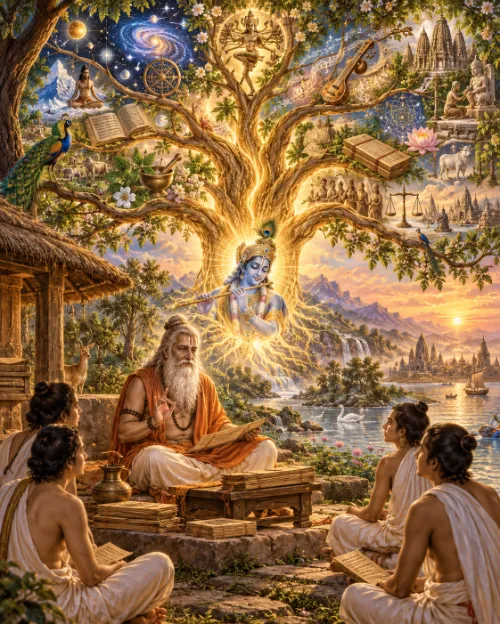
The Many Śākhās of the Vedas, and What It Really Means to Say That All Knowledge Comes From the Vedas
A striking statement appears in A. C. Bhaktivedanta Swami Prabhupāda’s purport to Śrīmad-Bhāgavatam 1.4.23: “The original source of knowledge is the Vedas. There are no branches of knowledge, either mundane or transcendental, which do not belong to the original text of the Vedas. They have simply been developed into different branches.”
Taken superficially, this can sound like an extraordinary historical claim: that everything from medicine to mathematics, politics, astronomy and metaphysics was once literally written out in a single ancient book and later separated into different subjects.
That is not the most precise way to understand either the Sanskrit verse or the wider Vedic tradition. The actual verse is about something much more concrete: the transmission and subdivision of the Vedas into numerous textual and teaching traditions called śākhās. Prabhupāda then expands that image into a larger philosophy of knowledge: behind the many sciences and disciplines stands one ultimately unified reality and, therefore, one ultimate source of genuine knowledge.
Ancient Sanskrit literature strongly supports such a broad intellectual vision. The Upaniṣads mention grammar, mathematics, astronomy, logic, political science, military knowledge, natural sciences and arts alongside sacred learning. Later texts formally classify fourteen or eighteen major branches of knowledge. At the same time, those very scriptures insist that mastering every branch is not yet the same as knowing the Self or knowing Bhagavān.
That tension is essential. The Vedic tradition values knowledge enormously. But it does not worship information. Many branches matter—but the branches must eventually lead back to the root.
The Actual Verse: The Vedas Become Many-Branched
Śrīmad-Bhāgavatam 1.4.23
त एत ऋषयो वेदं
स्वं स्वं व्यस्यन्ननेकधा ।
शिष्यैः प्रशिष्यैस्तच्छिष्यैर्
वेदास्ते शाखिनोऽभवन् ॥
ta eta ṛṣayo vedaṁ
svaṁ svaṁ vyasyann anekadhā
śiṣyaiḥ praśiṣyais tac-chiṣyair
vedās te śākhino ’bhavan
“These sages each divided their respective Veda in many ways through their disciples, granddisciples and the disciples of those disciples; thus the Vedas came to possess many branches.”
The imagery is unmistakable:
- one body of revelation
- teachers
- disciples
- granddisciples
- further generations
- many branches.
The verse is fundamentally about: transmission.
The Crucial Words
Several terms reveal exactly what is happening.
स्वं स्वम्
svaṁ svam
“Each his own.”
Each sage had been entrusted with a particular portion of Vedic revelation. They were not all independently inventing their own scriptures. Each transmitted: his assigned Veda.
व्यस्यन्
vyasyan
The verb means: dividing, distributing, arranging into separate forms. Śrīdhara Svāmī glosses it simply:
व्यस्यन् विभक्तवन्तः
vyasyan vibhaktavantaḥ
“They divided them.”
This is important. The sages are not primarily portrayed as: authors inventing Vedic truth. They are: organizers and transmitters of revelation.
अनेकधा
anekadhā
“In many ways,” “into many divisions.”
The Vedic material did not remain one monolithic stream. Different schools developed distinct: arrangements, recensions, teaching systems, ritual applications, pronunciations.
शिष्यैः
śiṣyaiḥ
“Through disciples.”
Then:
प्रशिष्यैः
praśiṣyaiḥ
“through disciples of disciples.”
And:
तच्छिष्यैः
tac-chiṣyaiḥ
“through their disciples.”
The verse devotes extraordinary attention to the human chain of transmission. Sacred knowledge survives because: someone hears it, learns it precisely, embodies it, and teaches it onward.
What Is a Śākhā?
The final word is:
शाखिन्
śākhin
“possessing branches,”
from:
शाखा
śākhā
“branch.”
A Vedic śākhā was not merely a different academic subject. That distinction is crucial. A śākhā was a recensional and teaching branch of a Veda—often simultaneously: a textual tradition and: the community that preserved it.
Different śākhās could preserve distinctive: mantra arrangements, pronunciation, Vedic accent, ritual instructions, textual ordering, associated Brāhmaṇas, Āraṇyakas, and Upaniṣads.
So when ŚB 1.4.23 says: vedās te śākhino ’bhavan “the Vedas became branched,” it is first describing Vedic textual lineages, not saying that astronomy, medicine and political science are literally the śākhās referred to in this specific verse.
That larger interpretation comes later.
Before the Branches, There Was “One Veda”
The story begins several verses earlier. ŚB 1.4.19 says:
चातुर्होत्रं कर्म शुद्धं
प्रजानां वीक्ष्य वैदिकम् ।
व्यदधाद् यज्ञसन्तत्यै
वेदमेकं चतुर्विधम् ॥
cātur-hotraṁ karma śuddhaṁ
prajānāṁ vīkṣya vaidikam
vyadadhād yajña-santatyai
vedam ekaṁ catur-vidham
“Seeing the Vedic sacrificial system intended for human purification, Vyāsa divided the one Veda into four divisions so that the sacrificial tradition might continue.”
The key expression is:
वेदम् एकम्
vedam ekam
“the one Veda.”
Then:
चतुर्विधम्
catur-vidham
“made fourfold.”
Within the Bhāgavata’s sacred account, the familiar four Vedas are therefore not four unrelated revelations. They are four great divisions of: one Vedic body of knowledge.
The Four Vedas—and the “Fifth Veda”
The following verse says:
ऋग्यजुःसामाथर्वाख्या
वेदाश्चत्वार उद्धृताः ।
इतिहासपुराणं च
पञ्चमो वेद उच्यते ॥
ṛg-yajuḥ-sāmātharvākhyā
vedāś catvāra uddhṛtāḥ
itihāsa-purāṇaṁ ca
pañcamo veda ucyate
“The Vedas were separated into four, called Ṛg, Yajur, Sāma and Atharva; and Itihāsa and Purāṇa are called the fifth Veda.”
Śrīmad-Bhāgavatam 1.4.20
This already reveals something important. The wider Vedic tradition does not always use “Veda” in the extremely narrow sense: only the four mantra-saṁhitās. The revelatory world also includes: Itihāsa, Purāṇa, and extensive explanatory traditions.
Vyāsa Entrusts the Traditions to Specific Teachers
The next verses identify the principal transmitters:
Then ŚB 1.4.23 explains what happens next: their students teach students; those students teach further students; and the Vedas develop numerous: śākhās. Thus the full movement is:
- one Veda
- fourfold Veda
- principal teachers
- disciplic lineages
- many recensions.
The Twelfth Canto Shows the Tree Growing
Śrīmad-Bhāgavatam 12.6 returns to this history in much greater detail. Paila receives the Ṛgvedic corpus. He divides it and teaches portions to: Indrapramiti, Bāṣkala. Bāṣkala then divides his portion again among several disciples.
Indrapramiti teaches: Māṇḍūkeya. Māṇḍūkeya’s line divides further. Śākalya again produces subdivisions. The process repeats with the Yajur, Sāma, and Atharva traditions. Thus 1.4.23 is really the compressed description of an enormous genealogical tree of teachers and texts.
Ancient India Remembered Far More Vedic Schools Than Survive Today
Traditional sources speak of a surprisingly large number of Vedic branches. Patañjali’s Mahābhāṣya famously recalls traditions of approximately: 21 Ṛgvedic branches, 100 Yajurvedic branches, 1,000 Sāmavedic branches, 9 Atharvavedic branches although exact enumerations vary in different sources.
Only a small fraction survive intact today. This makes the image of the tree particularly poignant. The ancient Vedic world once contained an enormous forest of oral schools.
Many branches disappeared. A few remain.
Oral Transmission Was Not Primitive Technology
It is easy to imagine manuscript culture as automatically superior. But Vedic oral preservation developed astonishingly sophisticated methods. The knowledge transmitted was not merely: “the approximate wording.”
It included: exact sounds, pitch accents, vowel lengths, word boundaries, meters, and sophisticated recitation patterns designed partly to detect errors. In such a system, the teacher is not merely explaining ideas.
He is carrying: a living acoustic text. That helps explain why ŚB 1.4.23 emphasizes: śiṣya → praśiṣya → tac-chiṣya. Without trained people, the Veda does not survive simply because a manuscript exists somewhere.
The lineage itself is part of the preservation mechanism.
Now We Can Understand Prabhupāda’s Larger Claim
Prabhupāda takes the literal Vedic branching process and expands the image: “The original source of knowledge is the Vedas. There are no branches of knowledge, either mundane or transcendental, which do not belong to the original text of the Vedas. They have simply been developed into different branches.”
The Sanskrit verse itself says: Vedic traditions branched. Prabhupāda goes further: knowledge itself has branched. This is no longer simply textual history. It is: a philosophy of knowledge.
Does Traditional Sanskrit Literature Support Such a Broad Vision?
Very much so. One of the most remarkable examples occurs in the Chāndogya Upaniṣad. Nārada approaches Sanatkumāra and lists what he has already studied. His curriculum is astonishing.
Nārada’s Encyclopedia of Knowledge
Chāndogya Upaniṣad 7.1.2 begins:
ऋग्वेदं भगवोऽध्येमि
यजुर्वेदं सामवेदमाथर्वणं चतुर्थम्
इतिहासपुराणं पञ्चमम्…
ṛgvedaṁ bhagavo ’dhyemi
yajurvedaṁ sāmavedam ātharvaṇaṁ caturtham
itihāsa-purāṇaṁ pañcamam…
“Revered sir, I have studied the Ṛg Veda, Yajur Veda, Sāma Veda and Atharva Veda as the fourth, and Itihāsa and Purāṇa as the fifth…”
Then Nārada continues through numerous fields of knowledge, including disciplines traditionally interpreted as: grammar, mathematics, ritual calculation, logic, ethics, divine knowledge, Brahma-vidyā, knowledge of living beings, military science, astronomy, knowledge of serpents, and arts associated with celestial beings.
This is not a picture of ancient sacred learning isolated from practical and intellectual disciplines. It is a picture of: a whole civilization of knowledge.
But Then Nārada Says Something Astonishing
Despite all that learning:
सोऽहं भगवो मन्त्रविदेवास्मि नात्मवित् ।
so ’haṁ bhagavo mantravid evāsmi nātmavit
“Revered sir, I am merely a knower of texts and mantras; I am not a knower of the Self.”
Then:
श्रुतं ह्येव मे भगवद्दृशेभ्यस्
तरति शोकमात्मविदिति
śrutaṁ hy eva me bhagavad-dṛśebhyas
tarati śokam ātmavid iti
“I have heard from realized persons like you that one who knows the Self crosses beyond sorrow.”
Chāndogya Upaniṣad 7.1.3
This is crucial. Nārada possesses vast learning. But he admits: information is not realization. That qualification protects the Vedic philosophy of knowledge from becoming mere encyclopedism.
The Vedas Themselves Can Belong to “Lower Knowledge”
The Muṇḍaka Upaniṣad makes the distinction even sharper:
द्वे विद्ये वेदितव्ये इति ह स्म
यद्ब्रह्मविदो वदन्ति
परा चैवापरा च ॥
dve vidye veditavye iti ha sma
yad brahma-vido vadanti
parā caivāparā ca
“Two kinds of knowledge are to be known, say the knowers of Brahman: the higher and the lower.”
Muṇḍaka Upaniṣad 1.1.4
Then it identifies:
तत्रापरा ऋग्वेदो यजुर्वेदः सामवेदोऽथर्ववेदः
शिक्षा कल्पो व्याकरणं निरुक्तं छन्दो ज्योतिषमिति ।
अथ परा यया तदक्षरमधिगम्यते ॥
tatrāparā ṛgvedo yajurvedaḥ sāmavedo ’tharvavedaḥ
śikṣā kalpo vyākaraṇaṁ niruktaṁ chando jyotiṣam iti
atha parā yayā tad akṣaram adhigamyate
“The lower knowledge consists of the Ṛg Veda, Yajur Veda, Sāma Veda, Atharva Veda, phonetics, ritual, grammar, etymology, meter and astronomy. The higher knowledge is that by which the Imperishable is realized.”
Muṇḍaka Upaniṣad 1.1.5
This is one of the most radical passages in the Upaniṣads. Even mastery of: the four Vedas can be called: aparā vidyā “lower knowledge” when compared with direct realization of: Akṣara the Imperishable.
So the Vedic tradition does not confuse: knowing texts with: knowing Reality.
This Clarifies “Mundane and Transcendental Knowledge”
Prabhupāda’s distinction between: mundane and: transcendental knowledge has a clear traditional parallel. There are fields concerning: the body, society, language, ritual, calculation, politics, nature, astronomy.
And there is knowledge concerning: Ātman, Brahman, Bhagavān, liberation. The tradition embraces both. But it does not place them on the same level. A doctor can know the body without knowing the Self.
An astronomer can understand celestial motions without knowing Bhagavān. A grammarian can analyze sacred speech without realizing the speaker’s ultimate source. Thus: breadth is not the same as depth.
The Bṛhadāraṇyaka Upaniṣad: All Knowledge as the “Breath” of the Supreme
One of the strongest śruti passages supporting Prabhupāda’s larger theological vision appears in Bṛhadāraṇyaka Upaniṣad 2.4.10. Yājñavalkya says:
एवं वा अरेऽस्य महतो भूतस्य निःश्वसितमेतद्
यदृग्वेदो यजुर्वेदः सामवेदोऽथर्वाङ्गिरस
इतिहासः पुराणं विद्या उपनिषदः
श्लोकाः सूत्राण्यनुव्याख्यानानि व्याख्यानानि ।
अस्यैवैतानि निःश्वसितानि ॥
evaṁ vā are ’sya mahato bhūtasya niḥśvasitam etad
yad ṛgvedo yajurvedaḥ sāmavedo ’tharvāṅgirasa
itihāsaḥ purāṇaṁ vidyā upaniṣadaḥ
ślokāḥ sūtrāṇy anuvyākhyānāni vyākhyānāni
asyaivaitāni niḥśvasitāni
“The Ṛg Veda, Yajur Veda, Sāma Veda, Atharvāṅgirasa, Itihāsa, Purāṇa, the sciences, the Upaniṣads, verses, aphorisms, explanations and commentaries are the breath of this Great Being. From Him all these are breathed forth.”
The metaphor is extraordinary: knowledge is the breath of ultimate Reality. The various disciplines are not presented as independent universes. They arise within: one greater Being.
Vidyā : The Sciences Are Explicitly Included
Especially important is:
विद्या
vidyā
knowledge, science, discipline, field of learning. The Upaniṣad does not list only: ritual texts. It places vidyā beside: Vedas, Itihāsa, Purāṇa, Upaniṣads, sūtras, commentaries.
This is perhaps the strongest early scriptural parallel to the statement that diverse knowledge ultimately has a single sacred source.
Fourteen Traditional “Seats of Knowledge”
Later Sanskrit literature formalized knowledge into major categories. Yājñavalkya-smṛti says:
पुराणन्यायमीमांसाधर्मशास्त्राङ्गमिश्रिताः ।
वेदाः स्थानानि विद्यानां धर्मस्य च चतुर्दश ॥
purāṇa-nyāya-mīmāṁsā-dharmaśāstrāṅga-miśritāḥ
vedāḥ sthānāni vidyānāṁ dharmasya ca caturdaśa
“The Vedas, together with the Vedāṅgas, Purāṇa, Nyāya, Mīmāṁsā and Dharmaśāstra, constitute the fourteen seats of knowledge and dharma.”
The traditional fourteen are: 4 Vedas 6 Vedāṅgas Purāṇa Nyāya Mīmāṁsā Dharmaśāstra.
The Six Vedāṅgas
The six traditional auxiliaries are themselves major intellectual disciplines:
Jyotiṣa
astronomical/calendrical science required for timing rituals. Already we can see how a sacred textual culture generates: linguistics, phonology, metrics, interpretation, mathematical astronomy, ritual theory.
The branches grow because preserving the root requires specialized knowledge.
From Fourteen to Eighteen Sciences
The Viṣṇu Purāṇa expands the traditional curriculum:
आयुर्वेदो धनुर्वेदो
गान्धर्वश्चैव ते त्रयः ।
अर्थशास्त्रं चतुर्थं तु
विद्या ह्यष्टादशैव ताः ॥
āyurvedo dhanurvedo
gāndharvaś caiva te trayaḥ
arthaśāstraṁ caturthaṁ tu
vidyā hy aṣṭādaśaiva tāḥ
“Āyurveda, Dhanurveda and Gāndharva knowledge are three more; Arthaśāstra is the fourth. Thus the sciences are eighteen.”
The additional disciplines include:
Arthaśāstra
government, economics, administration and political strategy. This is enormously important for understanding what a traditional statement such as: “all branches of knowledge belong to the Vedic tree”
was intended to evoke. The intellectual tree contained far more than: religious ritual.
So Are Medicine and Politics “Veda”?
The answer depends upon what is meant. If “Veda” means narrowly: the surviving mantra-saṁhitās, then no—the Ṛg Veda is not a complete medical textbook and the Sāma Veda is not a manual of economics.
But if “Veda” is understood more broadly as: the divinely ordered body of knowledge transmitted within Vedic civilization, then disciplines such as: Āyurveda, Dhanurveda, Gāndharvaveda, Arthaśāstra can be understood as branches within that larger intellectual cosmos.
That is much closer to what Prabhupāda is expressing.
What the Claim Should Not Mean
For intellectual honesty, this should be stated clearly. Prabhupāda’s sentence does not require us to claim: “Every proposition of modern chemistry, quantum mechanics, microbiology, calculus and computer science can be found explicitly written somewhere in the surviving Vedic Saṁhitās.”
The textual evidence does not establish that. The extant Vedas are not modern encyclopedias. Scientific knowledge has demonstrably developed through many civilizations, experiments and historical processes.
Reducing the Vedic claim to: “Every modern discovery was already written down word-for-word” actually makes the traditional philosophy weaker, because it replaces a profound epistemological claim with an easily falsifiable bibliographical one.
The Stronger Vedic Claim
The deeper claim is: Reality is one. Therefore genuine knowledge of reality cannot ultimately possess a source completely independent of: the source of reality itself. Medicine studies one part of reality: the living body.
Astronomy studies: the heavens. Grammar studies: language. Logic studies: valid reasoning. Arthaśāstra studies: organized society and power. Philosophy studies: being and knowledge.
Vedānta asks: What is the ultimate source in which all these realities rest? Different disciplines examine different branches. But they all stand within: one tree of existence.
Knowledge Does Not Create Reality
This is another important philosophical point. Scientific knowledge works because reality already possesses: structure, regularity, causality, order. The human mind discovers and describes that order.
Within a theistic Vedic worldview, that intelligibility is not accidental. Reality can be known because: it comes from intelligence. Thus all true knowledge ultimately reflects something about: the order established by Bhagavān.
This is a much more defensible understanding of “all knowledge comes from Veda.”
Kṛṣṇa Gives the Vaiṣṇava Conclusion
In the Bhagavad-gītā, Kṛṣṇa says:
सर्वस्य चाहं हृदि सन्निविष्टो
मत्तः स्मृतिर्ज्ञानमपोहनं च ।
वेदैश्च सर्वैरहमेव वेद्यो
वेदान्तकृद्वेदविदेव चाहम् ॥
sarvasya cāhaṁ hṛdi sanniviṣṭo
mattaḥ smṛtir jñānam apohanaṁ ca
vedaiś ca sarvair aham eva vedyo
vedānta-kṛd veda-vid eva cāham
“I am situated in everyone’s heart. From Me come remembrance, knowledge and forgetfulness. By all the Vedas I alone am ultimately to be known. I am the compiler of Vedānta and the knower of the Vedas.”
Bhagavad-gītā 15.15
Two statements here are especially powerful. First:
मत्तः स्मृतिर्ज्ञानम्
mattaḥ smṛtir jñānam
“From Me come remembrance and knowledge.”
Second:
वेदैश्च सर्वैरहमेव वेद्यः
vedaiś ca sarvair aham eva vedyaḥ
“By all the Vedas, I alone am ultimately to be known.”
Thus the many branches have: a common epistemological source and: a common ultimate object.
Gauḍīya Theology Says the Same in Bengali
Śrī Caitanya Mahāprabhu’s teaching is summarized in Caitanya-caritāmṛta:
বেদ-শাস্ত্র কহে — ‘সম্বন্ধ’, ‘অভিধেয়’, ‘প্রয়োজন’ ।
‘কৃষ্ণ’ — প্রাপ্য সম্বন্ধ, ‘ভক্তি’ — প্রাপ্ত্যের সাধন ॥
veda-śāstra kahe — ‘sambandha’, ‘abhidheya’, ‘prayojana’
‘kṛṣṇa’ — prāpya sambandha, ‘bhakti’ — prāptyera sādhana
“The Vedic scriptures explain sambandha, abhidheya and prayojana—the fundamental relationship, the means, and the ultimate goal. Kṛṣṇa is the reality to be attained, and bhakti is the means of attaining Him.”
Caitanya-caritāmṛta, Madhya
This is the specifically Gauḍīya interpretation of the Vedic tree. The Vedas do not merely deliver: facts.
They establish:
- sambandha — what reality is and how everything is related;
- abhidheya — what one should do;
- prayojana — what the ultimate goal is.
And the center is: Kṛṣṇa.
The Vedic Tree Therefore Has a Direction
A tree does not simply spread outward. It also depends inwardly upon: the root. The image can therefore be read in two directions.
Outward
- One source
- many Vedas
- many śākhās
- many sciences
- many specialized disciplines.
Inward
- Many disciplines
- one ordered universe
- one ground of reality
- one ultimate source.
The centrifugal movement produces: specialization. The centripetal movement produces: wisdom.
The Bhāgavatam Also Warns Against Mistaking the Branches for the Goal
Kṛṣṇa says:
वेदा ब्रह्मात्मविषयास्त्रिकाण्डविषया इमे ।
परोक्षवादा ऋषयः परोक्षं मम च प्रियम् ॥
vedā brahmātma-viṣayās
tri-kāṇḍa-viṣayā ime
parokṣa-vādā ṛṣayaḥ
parokṣaṁ mama ca priyam
“Although these Vedas speak in three major divisions, their ultimate subject is spiritual reality. The ṛṣis often speak indirectly, and such indirect expression is pleasing to Me.”
Śrīmad-Bhāgavatam 11.21.35
The Vedas may speak about: ritual, prosperity, heaven, family, social order, cosmology. But according to this Vaiṣṇava reading, those subjects are not necessarily the final destination.
The Vedic educational structure can lead gradually: from action to: knowledge to: realization to: devotion.
This Is Why Nārada’s Confession Is So Important
Nārada has studied an enormous curriculum. Yet he still says:
मन्त्रविदेवास्मि नात्मवित्
mantravid evāsmi nātmavit
“I am merely a knower of texts; I am not a knower of the Self.”
This single sentence prevents the whole philosophy from degenerating into intellectual pride. You can know: grammar without knowing yourself.
You can know: astronomy without knowing yourself. You can know: the Vedas without knowing yourself. You can even speak expertly about: Brahman without realizing Brahman. Thus knowledge has levels.
Information, Knowledge, Wisdom, Realization
A useful modern distinction is:
Even Sacred Text Can Become Merely Information
The Muṇḍaka Upaniṣad is uncompromising here. It includes: the Ṛg Veda, Yajur Veda, Sāma Veda, Atharva Veda within: aparā vidyā when they are merely studied as bodies of knowledge.
Why? Because the highest question is not: “How much scripture have you memorized?” It is: “Have you realized the Imperishable?” This distinction is profoundly relevant today.
One can accumulate enormous amounts of religious content and remain: angry, fearful, selfish, confused. The quantity of information is not the measure of transformation.
Why the Many Branches Still Matter
This does not make ordinary sciences useless. The Vedic worldview is not: “Only meditate; medicine, grammar and politics are worthless.” Quite the opposite. The traditional curriculum develops: medicine, language, logic, statecraft, music, astronomy, law.
But these disciplines receive their healthiest place when they serve: life, dharma, and ultimately spiritual awakening. Medicine serves the embodied person. Government protects society.
Grammar preserves meaning. Astronomy orders calendars and understanding of the heavens. Music can become worship. Economics can serve social stability. Knowledge becomes destructive mainly when severed from: wisdom and dharma.
The Problem Is Not Specialization
A modern scientist can know an extraordinary amount about one small part of reality. That is not a defect. Specialization is one of the natural consequences of the branching process.
The danger appears when the branch forgets: the tree. A discipline can become so self-contained that it begins to assume: only what it studies is real. The Vedic vision resists that reduction.
The doctor studies the body. But the body is not the entirety of the person. The economist studies exchange. But economic value is not the whole of human value. The political scientist studies power.
But power does not determine what is morally right. The neuroscientist studies brain processes. But the metaphysical question of consciousness remains larger than any one measurement.
Specialization produces precision. Wisdom reconnects: the whole.
Vyāsa’s Role Is Therefore Enormous
Vyāsa is called: Veda-vyāsa because of this great act of: division, organization, transmission. Yet division does not mean fragmentation in the negative sense. He divides in order to: preserve.
A body of knowledge too vast for later human capacity is distributed among different teaching lineages. Thus specialization can actually serve unity. Each lineage protects: one portion.
Together they preserve: the larger inheritance.
The Sages Transmit—They Do Not Own Knowledge
The Vedic model also challenges the modern idea of knowledge as private intellectual property. A sage receives. A sage preserves. A sage teaches. The knowledge is not ultimately: his possession.
The teacher’s greatness lies in: faithfulness. That is why the Bṛhadāraṇyaka can describe revelation as: the breath of the Great Being. The ṛṣi does not own the breath. He hears it.
Paramparā Is Therefore Part of Epistemology
This brings us back to ŚB 1.4.23. Why mention: śiṣya, praśiṣya, tac-chiṣya so explicitly? Because the Vedic concept of knowledge asks not only: “What do you know?” but also: “How did you come to know it?”
Who transmitted it? Was it preserved accurately? Was its context preserved? Was the student qualified to understand it? Knowledge is connected to: lineage and method. That is essentially an epistemological question.
The Verse Is About Continuity
ŚB 1.4.23 therefore has a beautifully simple historical meaning: knowledge survives because it is transmitted. Without transmission: a revelation disappears. Without students: a teacher’s knowledge dies with him.
Without careful preservation: a text mutates beyond recognition. Every living tradition depends upon: memory, discipline, correction, and succession. That truth extends far beyond religion.
Science itself operates through: teachers, students, institutions, journals, laboratories, methods, replication. Knowledge is always socially transmitted. The Vedic model recognized this thousands of years ago in its own distinctive form.
What Prabhupāda Means by “No Independent Knowledge Beyond the Vedas”
The strongest version of this statement is not: “No non-Indian person ever discovered anything.” Nor: “Every discovery was copied from a Sanskrit manuscript.” The deeper theological meaning is: there cannot be a second reality existing outside the reality established by the Supreme.
Therefore no true knowledge can ultimately concern something totally independent of: the Supreme source. One may discover a law of nature without ever mentioning God. But if that law is real, it belongs to: the reality God sustains.
Thus the knowledge is epistemologically derivative even if historically discovered independently. That is a much more sophisticated claim.
The Root Does Not Abolish the Branches
There is another important balance. Saying: all knowledge has one ultimate source does not mean: all disciplines are identical. Medicine is not grammar. Grammar is not astronomy.
Astronomy is not Vedānta. Their methods differ. Their questions differ. Their objects differ. Unity does not destroy: difference. The tree has one root precisely while producing: many branches.
This is a useful Vaiṣṇava principle more broadly: unity with real distinction.
The Vedic Tree in One Picture
The entire concept can be summarized:
Yajur
Sāma
Atharva
Itihāsa–Purāṇa
Vaiśampāyana
Jaimini
Sumantu
Romaharṣaṇa
Nyāya
Mīmāṁsā
Dharmaśāstra
Āyurveda
Dhanurveda
Gāndharvaveda
Arthaśāstra
and many other disciplines.
Yet the tradition finally asks: Where is the root?
The Gauḍīya Conclusion: Knowledge Culminates in Relationship
For Gauḍīya Vaiṣṇavism, the final answer is not merely: Brahman as abstract existence. It is: Kṛṣṇa. Hence:
বেদ-শাস্ত্র কহে — ‘সম্বন্ধ’, ‘অভিধেয়’, ‘প্রয়োজন’ ।
‘কৃষ্ণ’ — প্রাপ্য সম্বন্ধ, ‘ভক্তি’ — প্রাপ্ত্যের সাধন ॥
veda-śāstra kahe — ‘sambandha’, ‘abhidheya’, ‘prayojana’
‘kṛṣṇa’ — prāpya sambandha, ‘bhakti’ — prāptyera sādhana
“The Vedic scriptures teach relationship, the means and the ultimate goal. Kṛṣṇa is the reality to be attained, and bhakti is the means of attaining Him.”
The highest function of knowledge is therefore not:
- winning arguments,
- accumulating information,
- or merely classifying existence.
It is: recovering one’s relationship with Reality.
The Deep Paradox of the Vedic Knowledge Tradition
The tradition simultaneously makes two enormous claims. First: knowledge is vast. There are Vedas, branches, sciences, philosophies, arts, ritual systems, commentaries. Second: all that knowledge can still leave a person ignorant of the Self.
Nārada embodies the paradox. He knows an enormous amount. Yet: nātmavit “I do not know the Self.” That is perhaps the most important warning for any civilization drowning in information.
More Information Does Not Automatically Mean More Wisdom
Modern humanity has access to more data than any previous civilization. A person holding a phone can access: medicine, history, astronomy, languages, politics, philosophy, religion, music, maps, statistics.
Yet the ancient question remains: Does this knowledge remove sorrow? Does it produce: clarity? Character? Wisdom? Self-knowledge? Purpose? If not, Nārada’s confession remains startlingly contemporary: “I know many subjects—but I do not yet know myself.”
Śrīmad-Bhāgavatam 1.4.23 is first of all a verse about: Vedic transmission.
त एत ऋषयो वेदं
स्वं स्वं व्यस्यन्ननेकधा ।
ta eta ṛṣayo vedaṁ
svaṁ svaṁ vyasyann anekadhā
“Those sages divided their respective Vedas in many ways.”
How?
शिष्यैः प्रशिष्यैस्तच्छिष्यैः
śiṣyaiḥ praśiṣyais tac-chiṣyaiḥ
“through disciples, granddisciples and subsequent disciples.”
And therefore:
वेदास्ते शाखिनोऽभवन्
vedās te śākhino ’bhavan
“the Vedas became possessed of many branches.”
That is the literal meaning. Prabhupāda then sees a larger pattern. Knowledge itself behaves like a tree. One reality. Many perspectives.
One source. Many disciplines. One revelation. Many branches. Ancient Sanskrit literature supports this wider intellectual world remarkably well. The Chāndogya Upaniṣad places grammar, mathematics, astronomy, logic, military science and other disciplines beside Vedic learning. The Bṛhadāraṇyaka Upaniṣad describes Veda, Itihāsa, Purāṇa, vidyā, Upaniṣads, sūtras and commentaries as the breath of the Great Being. Later traditions organize knowledge into fourteen and eighteen major sciences, including medicine, warfare, music and statecraft.
But the tradition then makes an equally important correction. Knowledge has hierarchy. The Muṇḍaka Upaniṣad calls even mastery of the four Vedas: aparā vidyā lower knowledge when compared with direct realization of: the Imperishable.
Nārada knows an entire encyclopedia of ancient learning and still confesses:
मन्त्रविदेवास्मि नात्मवित्
mantravid evāsmi nātmavit
“I know the texts—but I do not know the Self.”
And Kṛṣṇa gives the ultimate Vaiṣṇava conclusion:
वेदैश्च सर्वैरहमेव वेद्यः
vedaiś ca sarvair aham eva vedyaḥ
“By all the Vedas, I alone am ultimately to be known.”
Thus the deepest meaning of the Vedic tree is not: one ancient book secretly containing every later textbook. It is something much more profound: all genuine knowledge concerns one reality, arises within one intelligible order, and ultimately finds its meaning only when the many branches reconnect us with the root.
The branches are real. The sciences are real. The distinctions are real. But the Vedic question remains: What is their source—and where do they finally lead?