

The Three Great Deity Forms of Vṛndāvana
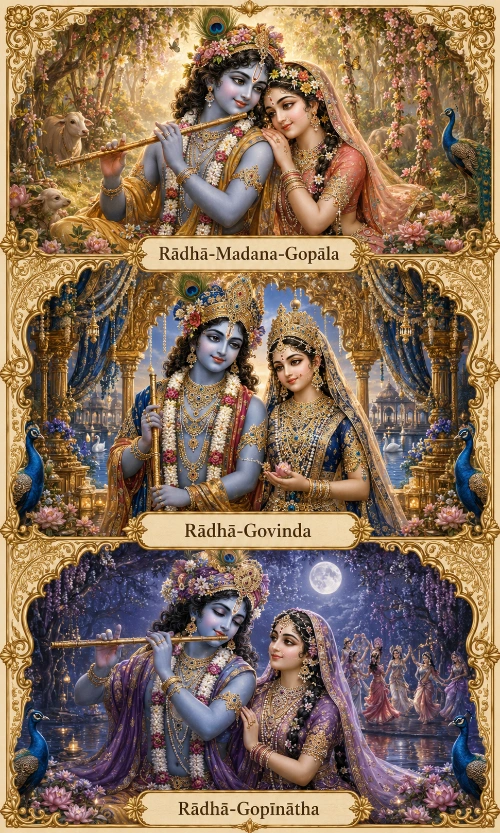
Rādhā-Madana-Gopāla, Rādhā-Govinda and Rādhā-Gopīnātha: The Three Great Deity Forms of Vṛndāvana
Among the sacred Deities of Gauḍīya Vṛndāvana, three forms of Kṛṣṇa hold a particular position — Madana-Gopāla or Madana-mohana, Govindadeva, and Gopīnātha. They are not merely three temple images. Gauḍīya literature places them together as a theological triad expressing the progressive unfolding of the devotee’s relationship with Kṛṣṇa, and pairs each with a differently named form of Śrī Rādhā.
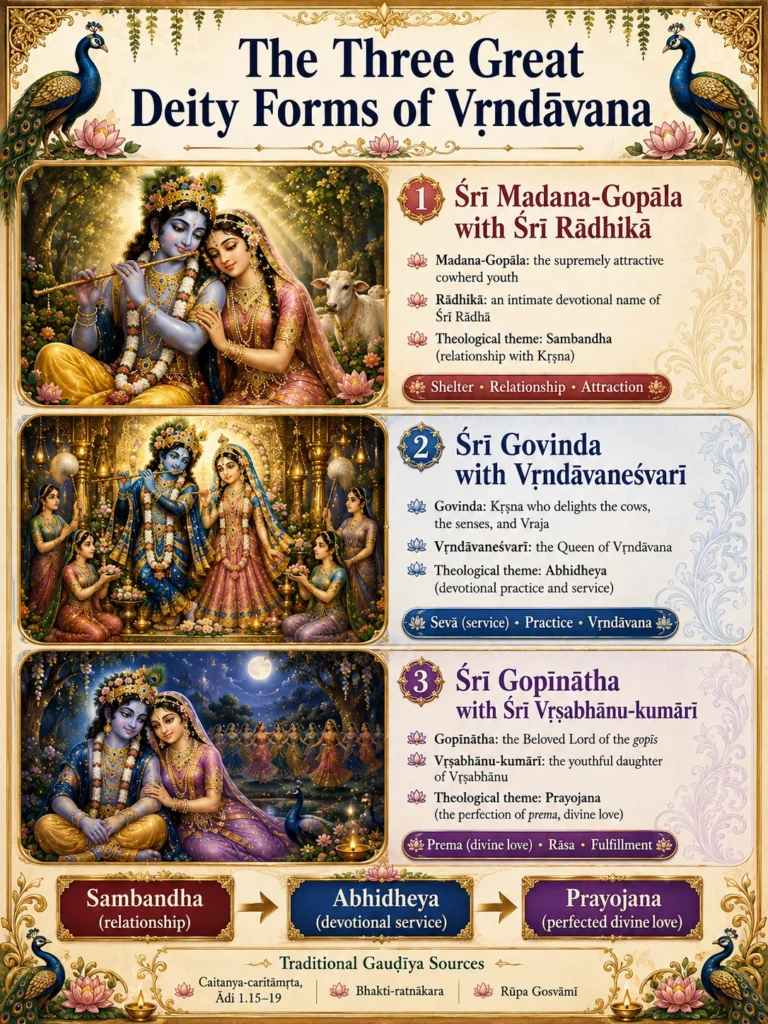
Each pair with its Rādhā name and theological theme, and the sambandha–abhidheya–prayojana progression beneath.
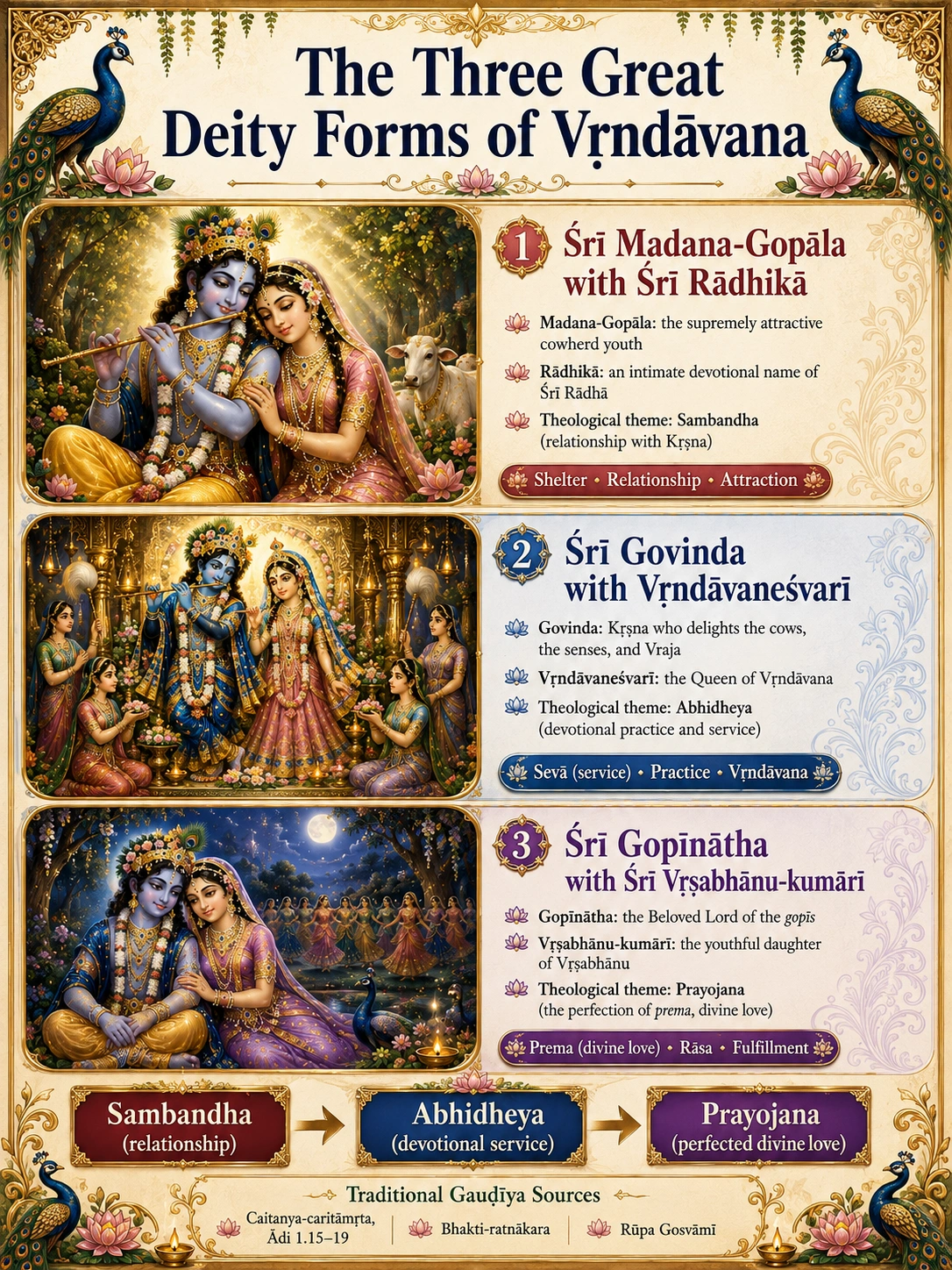
The essential point is that Rādhikā, Vṛndāvaneśvarī and Vṛṣabhānu-kumārī are all Śrī Rādhā. Each name simply reveals a different dimension of her identity.
The Bhakti-ratnākara Passage
The pairing is not a modern devotional list. Narahari Cakravartī gives it directly:
শ্রী রাধিকা-সহিত শ্রী মদন-গোপাল ।
বৃন্দাবনেশ্বরী-সহ শ্রী গোবিন্দ-লাল ॥
বৃষভানু-কুমারী সহ শ্রী গোপীনাথ ।
দর্শন-শোভায় জন্ম মানিল কৃতার্থ ॥
śrī rādhikā-sahita śrī madana-gopāla
vṛndāvaneśvarī-saha śrī govinda-lāla
vṛṣabhānu-kumārī saha śrī gopīnātha
darśana-śobhāya janma mānila kṛtārtha
“If one beholds Śrī Madana-Gopāla together with Śrī Rādhikā, Śrī Govinda together with Vṛndāvaneśvarī, and Śrī Gopīnātha together with Vṛṣabhānu-kumārī, one considers one’s birth successful.” — Bhakti-ratnākara 4.330–331
The three feminine names emphasise three aspects of the same Śrī Rādhā, and the variation is poetically significant:
She is simultaneously the intimate beloved of Kṛṣṇa, the Queen of Vṛndāvana, and the cherished daughter of Vṛṣabhānu Mahārāja.
1. Śrī Madana-Gopāla with Śrī Rādhikā
The name combines madana — Cupid, Kāma, the power that awakens desire — with gopāla, protector of cows, and so Kṛṣṇa as the youthful cowherd. Madana-Gopāla evokes Kṛṣṇa as the supremely attractive cowherd youth. The related and more famous title is Madana-mohana, “he who enchants Madana”: ordinary beings are bewildered by Cupid, but Kṛṣṇa’s beauty is so extraordinary that Cupid himself is bewildered by him. In the Vṛndāvana Gauḍīya tradition the two names are closely identified, and devotional sources sometimes use them for the same celebrated Deity — the form associated with Śrī Sanātana Gosvāmī and the historic Madana-mohana temple.
Kṛṣṇadāsa Kavirāja opens the Caitanya-caritāmṛta with him:
जयतां सुरतौ पङ्गोर्मम मन्दमतेर्गती ।
मत्सर्वस्वपदाम्भोजौ राधामदनमोहनौ ॥
jayatāṁ suratau paṅgor
mama manda-mater gatī |
mat-sarvasva-padāmbhojau
rādhā-madana-mohanau ||
“Glory to Rādhā and Madana-mohana. For me, lame and dull-minded, they are my refuge. Their lotus feet are my everything.” — Caitanya-caritāmṛta, Ādi 1.15
Notice the mood. Kṛṣṇadāsa does not begin with mastery but with helplessness: he is paṅgu, lame and unable to proceed, and manda-mati, of weak understanding. What saves him is Rādhā-Madana-mohana, whose lotus feet become mat-sarvasva — “my entire wealth,” my everything.
It is sometimes said that Rādhikā merely means “little Rādhā,” a diminutive. That is too weak. Although the suffix -ikā can carry intimate or diminutive nuances in Sanskrit, Rādhikā became a fully established sacred name in Gauḍīya literature — Rūpa Gosvāmī uses it as one of the paired names in his own Nāma-yugāṣṭakam:
राधामाधवयोरेतद् वक्ष्ये नामयुगाष्टकम् ।
राधादामोदरौ पूर्वं राधिका-माधवौ ततः ॥
rādhā-mādhavayor etad vakṣye nāma-yugāṣṭakam |
rādhā-dāmodarau pūrvaṁ rādhikā-mādhavau tataḥ ||
“I shall proclaim these paired names of Rādhā and Mādhava: first Rādhā-Dāmodara, and then Rādhikā-Mādhava.” — Rūpa Gosvāmī, Śrī Rādhā-Mādhavayor Nāma-yugāṣṭakam 1
2. Śrī Govinda with Vṛndāvaneśvarī
Govinda is one of Kṛṣṇa’s oldest and most multivalent names. The Sanskrit go can mean cow, earth, sense faculty, ray, speech and in some contexts sacred word; the root vid or vind can carry the senses of knowing, finding or obtaining. Indian textual traditions therefore offer several complementary readings: he is the protector and giver of pleasure to the cows, the one who gives delight to the senses, the one associated with the earth, and in an ancient explanation the one who recovered the Earth. For Vraja devotion the pastoral meaning is the natural one — Govinda is Kṛṣṇa as the beloved nourisher and delight of the cows, the cowherds and the whole living world of Vraja.
Rādhā’s corresponding name divides as Vṛndāvana plus īśvarī, lady or sovereign: the Lady, more naturally the Queen, of Vṛndāvana. This is one of her most significant theological titles, and Rūpa Gosvāmī addresses the Divine Couple with it directly:
त्वं च वृन्दावनाधीश त्वं च वृन्दावनेश्वरी ।
tvaṁ ca vṛndāvanādhīśa
tvaṁ ca vṛndāvaneśvarī |
“You are the Lord of Vṛndāvana, and you are the Lady of Vṛndāvana.” — Rūpa Gosvāmī, Kārpaṇya-pañjikā-stotra 10
He gives another striking expression in the Nāma-yugāṣṭakam, where the Divine Couple are praised as the Hero and Heroine of the secluded bowers, the crest-jewels of the youthful inhabitants of Vraja, and — decisively — the two sovereigns of Vṛndāvana:
निकुञ्जनागरौ गोष्ठकिशोरजनशेखरौ ।
वृन्दावनाधिपौ कृष्णवल्लभाराधिकाप्रियौ ॥
nikuñja-nāgarau goṣṭha-kiśora-jana-śekharau |
vṛndāvanādhipau kṛṣṇa-vallabhā-rādhikā-priyau ||
“The Hero and Heroine of the secluded bowers, crest-jewels of the youthful people of Vraja, the two sovereigns of Vṛndāvana — she the beloved of Kṛṣṇa, he the beloved of Rādhikā.” — Rūpa Gosvāmī, Nāma-yugāṣṭakam
The dual vṛndāvanādhipau, “the two sovereigns,” makes Rādhā’s title far more than poetic flattery. Within the intimate līlā-world of Vraja she shares sovereignty with Kṛṣṇa.
Kṛṣṇadāsa Kavirāja’s prayer to Govindadeva is among the most important descriptions in Gauḍīya literature:
दीव्यद्वृन्दारण्यकल्पद्रुमाधः
श्रीमद्रत्नागारसिंहासनस्थौ ।
श्रीमद्राधाश्रीलगोविन्ददेवौ
प्रेष्ठालीभिः सेव्यमानौ स्मरामि ॥
dīvyad-vṛndāraṇya-kalpa-drumādhaḥ
śrīmad-ratnāgāra-siṁhāsana-sthau |
śrīmad-rādhā-śrīla-govinda-devau
preṣṭhālībhiḥ sevyamānau smarāmi ||
“I remember Śrī Rādhā and Śrī Govindadeva, seated upon a glorious throne within a jewelled pavilion beneath a desire tree in radiant Vṛndāvana, being served by their most intimate companions.” — Caitanya-caritāmṛta, Ādi 1.16
Every detail matters. The Divine Couple sit in Vṛndāvana, beneath a kalpa-druma or desire tree, within a jewelled pavilion, surrounded by their preṣṭha-ālīs, their most beloved sakhīs. And they are sevyamānau — “being served.” That single word becomes decisive for the association of Govinda with abhidheya, devotional practice and sevā. The historical association is suggestive too: Govindadeva belongs especially to Śrī Rūpa Gosvāmī, the great systematiser of bhakti-rasa and of the theology of Rādhā-Kṛṣṇa sevā.
3. Śrī Gopīnātha with Śrī Vṛṣabhānu-kumārī
This name is beautifully transparent: gopī, cowherd maiden, and nātha — lord, protector, beloved, refuge. Literally “Lord of the gopīs”; but in the intimate devotional context of Vraja, “beloved Lord of the gopīs” carries the sense better than the colder English “master.” Kṛṣṇadāsa introduces him with one of the most evocative verses in the whole work:
श्रीमान् रासरसारम्भी
वंशीवटतटस्थितः ।
कर्षन् वेणुस्वनैर्गोपीर्
गोपीनाथः श्रियेऽस्तु नः ॥
śrīmān rāsa-rasārambhī
vaṁśīvaṭa-taṭa-sthitaḥ |
karṣan veṇu-svanair gopīr
gopīnāthaḥ śriye ‘stu naḥ ||
“May glorious Gopīnātha, who inaugurates the rasa of the rāsa dance, who stands at Vaṁśī-vaṭa and attracts the gopīs with the sound of his flute, bestow auspiciousness upon us.” — Caitanya-caritāmṛta, Ādi 1.17
The verse gives Gopīnātha an extremely specific identity. He stands at Vaṁśī-vaṭa; he plays the flute; the flute draws the gopīs toward him; and he is rāsa-rasa-ārambhī, the inaugurator of the rasa of the rāsa-līlā. Gopīnātha therefore represents the fully blossomed world of mādhurya-rasa.
Rādhā’s name here combines Vṛṣabhānu, her father, with kumārī, youthful daughter. This is not merely a later Bengali devotional title — Rūpa Gosvāmī uses precisely this name, balancing the two familial identities:
वृषभानुकुमारी च तथा गोपेन्द्रनन्दनः ।
गोविन्दस्य प्रियसखी गान्धर्वाबान्धवस्तथा ॥
vṛṣabhānu-kumārī ca tathā gopendra-nandanaḥ |
govindasya priya-sakhī gāndharvā-bāndhavas tathā ||
“She is Vṛṣabhānu-kumārī, the youthful daughter of Vṛṣabhānu, while he is Gopendra-nandana, the son of the king of the cowherds. She is Govinda’s beloved companion, and he is the beloved companion of Gāndharvā.” — Rūpa Gosvāmī, Nāma-yugāṣṭakam 2
The same idea appears in several closely related names — Vṛṣabhānu-nandinī, “the daughter who gives joy to Vṛṣabhānu”; Vṛṣabhānu-sutā, “the daughter of Vṛṣabhānu”; and Vṛṣabhānu-kumārikā. Rūpa Gosvāmī closes his Gāndharvā-samprārthanāṣṭakam with vṛṣabhānu-kumārikāyāḥ, so the name belongs firmly to his own vocabulary for Śrī Rādhā.
The Three at the Opening of the Caitanya-caritāmṛta
One of the strongest reasons to consider the three together is that Kṛṣṇadāsa Kavirāja deliberately invokes them consecutively at the beginning of his masterpiece — Rādhā-Madana-mohana at Ādi 1.15, where the helpless devotee seeks their feet as refuge; Rādhā-Govinda at 1.16, seated in the Vṛndāvana yoga-pīṭha and served by their sakhīs; and Gopīnātha at 1.17, standing at Vaṁśī-vaṭa drawing the gopīs with his flute. Then he says plainly:
এই তিন ঠাকুর গৌড়ীয়াকে করিয়াছেন আত্মসাৎ ।
এ তিনের চরণ বন্দোঁ, তিনে মোর নাথ ॥
ei tina ṭhākura gauḍīyāke kariyāchena ātmasāt |
e tinera caraṇa vandoṅ, tine mora nātha ||
“These three Ṭhākuras have accepted the Gauḍīyas as their own. I worship the feet of these three; these three are my Lords.” — Caitanya-caritāmṛta, Ādi 1.19
Sambandha, Abhidheya and Prayojana
A famous Gauḍīya interpretation associates the three Deities with the three foundational categories of the tradition’s theology.
The association is authentic and deeply established in Gauḍīya teaching — but the Sanskrit of Ādi 1.15–17 does not itself contain the words sambandha, abhidheya or prayojana. It is a theological interpretation of the three Deities, and is best presented as such rather than as though Kṛṣṇadāsa had written the technical labels into those verses. That said, the imagery fits remarkably well: refuge, then service, then rāsa and fulfilled prema.
The Sādhana-dīpikā on the Three Forms
A Sanskrit text also treats the three as a meaningful triad, and distinguishes them aesthetically rather than treating the names as interchangeable:
श्रीमन्मदनगोपालोऽप्यत्रैव सुप्रतिष्ठितः ।
कैशोररूपी गोपालो गोविन्दः प्रौढविग्रहः ।
उभयोस्तारतम्येन गोपीनाथोऽतिसुन्दरः ॥
śrīman-madana-gopālo ‘py atraiva supratiṣṭhitaḥ |
kaiśora-rūpī gopālo govindaḥ prauḍha-vigrahaḥ |
ubhayos tāratamyena gopīnātho ’tisundaraḥ ||
“Glorious Madana-Gopāla is firmly established here. Gopāla manifests the form of youthful kaiśora; Govinda manifests a more mature youthful form; and in comparison with the two, Gopīnātha is exceedingly beautiful.” — Sādhana-dīpikā
धीरौद्धतस्तु गोपालो धीरौदात्ततयोच्यते ।
गोविन्दो गोपिकानाथो यो धीरललिताकृतिः ॥
dhīroddhatas tu gopālo dhīrodāttatayocyate |
govindo gopikā-nātho yo dhīra-lalitākṛtiḥ ||
The verse applies the classical Sanskrit categories of the romantic hero — dhīroddhata, dhīrodātta, dhīra-lalita — to the three forms. — Sādhana-dīpikā
The terminology reflects the sophisticated Sanskrit aesthetics through which Gauḍīya authors contemplated the youthful Kṛṣṇa, and the point is important: Madana-Gopāla, Govinda and Gopīnātha are not interchangeable labels but reveal different aesthetic dimensions of his eternal youthful form.
Feet, Chest and Face: The Iconographic Tradition
The Sādhana-dīpikā distinguishes the three aesthetically. Vraja tradition also distinguishes them bodily, and this is the distinction a pilgrim is most often taught. It rests on the Vajranābha account: Kṛṣṇa’s great-grandson is said to have had images made from the memory of an elder who had actually seen Kṛṣṇa, and each image was recognised as resembling him perfectly in one part of his form. The historical layers behind that tradition are separated out in The Sapta-devalaya of Vṛndāvana; what concerns us here is what it says about how the three Deities look.
Darśana of all three therefore amounts to a complete vision of Kṛṣṇa. This is why they are named as a set rather than ranked against one another, and it gives the theological triad a second, entirely physical logic alongside sambandha, abhidheya and prayojana.
Modern retellings frequently interchange Govinda and Gopīnātha in this scheme. The order given above is the one preserved in the Vraja and Rajasthan temple traditions, including that of the surviving original Madana-mohana now at Karauli, and it is the safer of the two to follow.
Madana-Gopāla — the deepest curve
The Bhakti-ratnākara presents Madana-Gopāla as kaiśora, an adolescent, with a waist described as lion-like and the body held in a pronounced tribhaṅga, the threefold bend at neck, waist and knee. He is the most slender and the most visibly curved of the three: hips and knees gracefully turned, the lower body and feet unusually elegant, the flute raised toward the lips. The impression is youthful and almost delicate rather than imposing — and the eye is drawn downward, toward the posture and the feet.
The Karauli temple preserves a further detail of its own concerning the original Deity: the right hand on the flute sits slightly lower than the left, so that the arms are deliberately asymmetrical.
Govinda — the face
Govinda is prauḍha-vigraha in the verse quoted above, a more developed adolescent: a somewhat broader chest than Madana-Gopāla, the body poised in a dancing stance with the feet crossed, dark as a rain cloud, dressed in yellow cloth and flowers, flute in hand. But his distinguishing feature is the face. In the Vajranābha account it was the face that the elder recognised as resembling Kṛṣṇa most exactly — the long eyes, the sidelong glance, the shape of the lips, the smile. Where Madana-Gopāla draws the eye downward, Govinda draws it upward.
Gopīnātha — the torso
Gopīnātha stands between the two, and the Bhakti-ratnākara’s association of both Govinda and Gopīnātha with broad chests fits the tradition exactly. He is fuller through the chest and shoulders while remaining slender at the waist, in tribhaṅga, playing the flute — the instrument framed by the torso, which is the visual centre of the form. His presence is more commanding than Madana-Gopāla’s without any loss of grace.
Gopīnātha also carries an outward distinction that has nothing to do with the body of Kṛṣṇa. His historic altar holds three figures rather than two: Rādhā on one side, and on the other Anaṅga Mañjarī, identified in Gauḍīya tradition with Jāhnavā Devī, the consort of Nityānanda.
One caution for anyone depicting these forms. The differentiation belongs in Kṛṣṇa’s body, not in three different Rādhās. The companion Rādhā mūrtis have their own separate histories and proportions and in several cases were installed later than the Kṛṣṇa Deity, so there is no traditional warrant for three sharply distinguished Rādhās — and, as the Bhakti-ratnākara passage itself insists, she is one Rādhā under three names.
The Three Historic Vṛndāvana Deities
The theological triad is therefore embedded in the physical sacred geography of Vṛndāvana as well; the full seven-temple picture is set out in The Sapta-devalaya of Vṛndāvana.
Why the Three Appear in the Rādhā-Ramaṇa Story
The Bhakti-ratnākara passage occurs in a particularly interesting context: the account of Śrī Gopāla Bhaṭṭa Gosvāmī and the manifestation of Śrī Rādhā-Ramaṇa. Tradition describes Rādhā-Ramaṇa as mysteriously containing the beauty of the three famous Vṛndāvana Deities — his form is said to recall Govinda in the face, Gopīnātha in the chest and Madana-mohana in the feet. That is precisely the scheme set out above, read in reverse: what the Vajranābha tradition distributes across three Deities, Rādhā-Ramaṇa is said to gather into one. It explains why the text invokes all three together at that moment.
This yields an elegant theological pattern. Madana-mohana, Govinda and Gopīnātha reveal distinct dimensions of Kṛṣṇa, yet they are not three separate Gods but manifestations of one Kṛṣṇa. Likewise Rādhikā, Vṛndāvaneśvarī and Vṛṣabhānu-kumārī are not three goddesses but one Śrī Rādhā. Divine form can be differentiated for the sake of rasa and sevā without implying separation in divine identity.
A historical nuance is worth keeping distinct from the theology. Rādhā and Kṛṣṇa are eternally inseparable — but the physical companion Rādhā mūrtis standing beside the famous Kṛṣṇa Deities were not necessarily installed at the same time as the original Kṛṣṇa vigrahas, and the Bhakti-ratnākara preserves traditions of Rādhā Deities being brought from other regions and installed beside them. Since that work was composed substantially later than the lives of the Six Gosvāmīs, such accounts are best presented as Gauḍīya temple and devotional tradition rather than as independently verified sixteenth-century history. This does not weaken the theology; it simply separates eternal divine identity from the installation history of particular temple images.
Rādhā Is Never Secondary in This Triad
One point emerges clearly from these texts. It would be misleading to speak of Madana-mohana, Govinda and Gopīnātha as though Rādhā were an optional addition. Kṛṣṇadāsa’s first two Sanskrit invocations explicitly say Rādhā-Madana-mohana and Rādhā-Govinda. Rūpa Gosvāmī repeatedly presents the Divine Couple as the joint sovereigns of Vṛndāvana. And the Bhakti-ratnākara sees the three forms together with Rādhikā, Vṛndāvaneśvarī and Vṛṣabhānu-kumārī. The mature Gauḍīya vision is fundamentally Rādhā-Kṛṣṇa theology: Kṛṣṇa is never fully understood in Vṛndāvana without Rādhā.
From Madana-mohana to Gopīnātha
The whole teaching can be read as a single spiritual movement. The devotee first stands before Rādhā-Madana-mohana and admits, “I cannot reach Kṛṣṇa by my own strength”; their lotus feet become everything. Then he beholds Rādhā-Govinda beneath the desire tree, surrounded by companions engaged in service, and asks, “how may I serve?” Finally Gopīnātha stands at Vaṁśī-vaṭa, his flute calls, and rāsa begins: relationship and service culminate in prema.
Rādhā-Madana-mohana ── sambandha ── relationship
 └─ Rādhā-Govinda ── abhidheya ── devotional service
     └─ Rādhā-Gopīnātha ── prayojana ── perfected prema
Or, more simply: shelter, then sevā, then prema. This is why the three became far more than historic temple forms. Together they provide a map of the entire Gauḍīya spiritual path — which is precisely why they stand at the entrance to the Caitanya-caritāmṛta itself.
The Bhakti-ratnākara gives three visions: Śrī Madana-Gopāla with Śrī Rādhikā, Śrī Govinda with Vṛndāvaneśvarī, Śrī Gopīnātha with Śrī Vṛṣabhānu-kumārī. The Rādhā names differ, but the Goddess is one; the Kṛṣṇa forms differ, but Kṛṣṇa is one. Each pair reveals another dimension of the same eternal Divine Couple. Madana-mohana establishes attraction and relationship; Govinda becomes the centre of sevā; Gopīnātha reveals the culmination in rāsa and prema. And Rādhā appears throughout — as Rādhikā the intimately beloved, as Vṛndāvaneśvarī the Queen of Vṛndāvana, and as Vṛṣabhānu-kumārī the eternally youthful daughter of Vṛṣabhānu. The whole progression can be stated in three words: relationship, service, love — or, in the classical vocabulary, sambandha, abhidheya, prayojana. These are not merely three Deities one visits in Vṛndāvana. Together with Śrī Rādhā they express the path, the practice and the ultimate perfection of Vraja-bhakti.
Primary Sources
Two cautions. The pairing of Rādhikā with Madana-Gopāla, Vṛndāvaneśvarī with Govinda and Vṛṣabhānu-kumārī with Gopīnātha is explicitly preserved in the Bhakti-ratnākara; but the equation of the three Deities with sambandha, abhidheya and prayojana, while a well-established Gauḍīya theological interpretation, is not stated in those words in Caitanya-caritāmṛta Ādi 1.15–17. And accounts of the historical installation of particular Rādhā companion mūrtis should be distinguished from the theological teaching that Rādhā and Kṛṣṇa are eternally inseparable. The bodily descriptions in the iconographic section are given in prose rather than as quotations: they follow the sense of the Bhakti-ratnākara’s portraits and of Vraja temple tradition, and no verse wording is reproduced there. The asymmetrical flute-hand is the Karauli temple’s own tradition concerning its Deity. Resources consulted in digital form: the Bhaktivedanta Vedabase and VaniSource for the Caitanya-caritāmṛta invocations; the IGNCA Sanskrit repository for Rūpa Gosvāmī’s Stava-mālā and Kārpaṇya-pañjikā-stotra; GRETIL for the Sādhana-dīpikā; Śrī Krishna Kathāmṛta Bindu for Bhakti-ratnākara 4.330–331 and its Rādhā-Ramaṇa context; and Gauḍīya temple and pilgrimage archives for the traditions concerning the principal Vṛndāvana Deities.