

The Ten Subjects of Śrīmad-Bhāgavatam
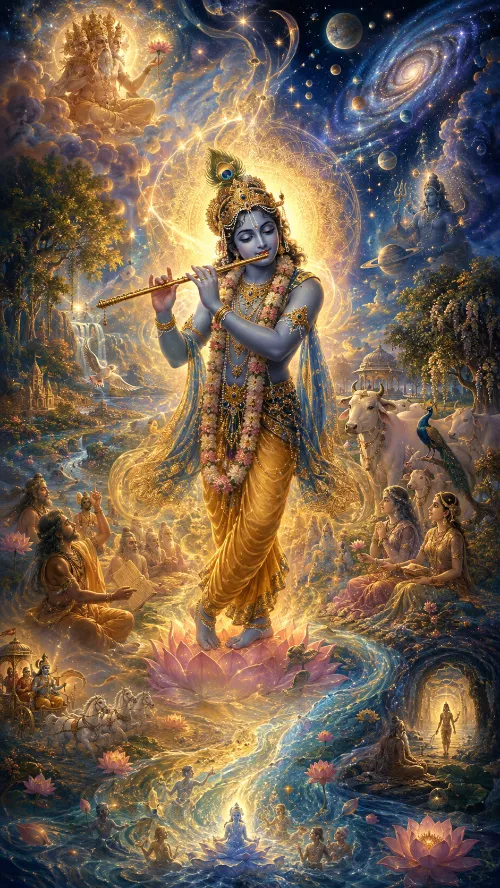
The Ten Subjects of Śrīmad-Bhāgavatam: From Cosmic Creation to Kṛṣṇa, the Ultimate Shelter of Everything
Why does the Śrīmad-Bhāgavatam speak about the creation of the universe? Why describe Brahmā, the Manus, cosmic cycles, avatāras, karmic impulses, dissolution, liberation, dynasties, sages, demons, devotees, and entire planetary systems?
Are these simply many different religious subjects collected into one enormous Purāṇa? The Bhāgavatam itself gives a remarkable answer. It identifies ten fundamental subjects, but immediately says the first nine are described to help understand the tenth.
That tenth subject is:
आश्रय
āśraya
the ultimate shelter, foundation, source, and resting place of everything. For Gauḍīya Vaiṣṇavas, that āśraya reaches its fullest personal revelation in Śrī Kṛṣṇa. Thus the ten subjects are not merely a table of contents.
They form a theological map. Creation is described so that we may discover its source. Cosmic order is described so that we may discover its maintainer. Divine protection reveals the protector.
The activities of avatāras reveal the Lord who descends. Liberation reveals the true position of the soul in relation to Him. And even cosmic dissolution points back toward the Reality into whom everything is withdrawn.
The first nine explain what depends. The tenth reveals the One on whom everything depends.
The Original Tenfold List
Śukadeva Gosvāmī tells Mahārāja Parīkṣit:
श्रीशुक उवाच
अत्र सर्गो विसर्गश्च
स्थानं पोषणमूतयः ।
मन्वन्तरेशानुकथा
निरोधो मुक्तिराश्रयः ॥
śrī-śuka uvāca
atra sargo visargaś ca
sthānaṁ poṣaṇam ūtayaḥ
manvantareśānukathā
nirodho muktir āśrayaḥ
“Śrī Śukadeva said: In this Bhāgavatam are described creation, secondary creation, proper establishment, protection, the impulses toward activity, the periods of the Manus, narrations concerning the Lord, cosmic withdrawal, liberation, and the supreme shelter.”
Śrīmad-Bhāgavatam 2.10.1
The ten are therefore:
- Sarga — primary creation
- Visarga — secondary creation
- Sthāna — proper establishment and maintenance
- Poṣaṇa — divine protection and grace
- Ūti — karmic impulses and motivations
- Manvantara — the reigns of the Manus and their dharma
- Īśānukathā — narrations of Bhagavān and His devotees
- Nirodha — cosmic withdrawal
- Mukti — liberation
- Āśraya — the supreme shelter
But the next verse changes how we should read the entire list.
The First Nine Exist to Reveal the Tenth
Śukadeva continues:
दशमस्य विशुद्ध्यर्थं
नवानामिह लक्षणम् ।
वर्णयन्ति महात्मानः
श्रुतेनार्थेन चाञ्जसा ॥
daśamasya viśuddhy-arthaṁ
navānām iha lakṣaṇam
varṇayanti mahātmānaḥ
śrutenārthena cāñjasā
“For the clear ascertainment of the tenth, the great souls describe here the characteristics of the other nine through revealed testimony and direct explanation.”
Śrīmad-Bhāgavatam 2.10.2
The crucial phrase is:
दशमस्य विशुद्ध्यर्थम्
daśamasya viśuddhy-artham
“for the clear ascertainment of the tenth.” This is the interpretive key. The Bhāgavatam is not saying: “Here are ten equally independent subjects.” It is saying: “The other nine help us understand āśraya.”
That is why āśraya receives such extraordinary emphasis in Gauḍīya theology.
Sarga — Primary Creation
The Bhāgavatam defines sarga:
भूतमात्रेन्द्रियधियां
जन्म सर्ग उदाहृतः ।
bhūta-mātrendriya-dhiyāṁ
janma sarga udāhṛtaḥ
“The arising of the material elements, sense objects, senses, and cognitive principle is called sarga.”
Śrīmad-Bhāgavatam 2.10.3
Sarga is creation at the level of fundamental cosmic ingredients. Before there can be: mountains, human bodies, cows, trees, oceans, planets, and entire species, there must first exist the elementary principles from which such forms can arise.
These include the gross elements and subtler components involved in perception and cognition. Prabhupāda expands the explanation to include such categories as: the gross elements, objects of sense perception, the senses, mind, intelligence, false ego, and the total material energy.
The essential idea is simple: sarga is the manifestation of the basic cosmic toolkit.
Creation Does Not Begin With Brahmā
This distinction is important. Brahmā is often called the creator. But he does not create existence from absolute nothingness. The fundamental powers and ingredients already arise through the Supreme.
Brahmā works with what has been supplied. This is why the opening verse of the entire Bhāgavatam defines the Absolute as:
जन्माद्यस्य यतः
janmādy asya yataḥ
“that from whom the origin and subsequent development of this universe arise.” — Śrīmad-Bhāgavatam 1.1.1 The ultimate question behind sarga is therefore not merely: “How did the universe begin?”
It is: “What is the source of the powers by which a universe can begin at all?” That question already points toward āśraya.
Visarga — Secondary Creation
The second half of ŚB 2.10.3 says:
ब्रह्मणो गुणवैषम्याद्
विसर्गः पौरुषः स्मृतः ॥
brahmaṇo guṇa-vaiṣamyād
visargaḥ pauruṣaḥ smṛtaḥ
“The subsequent creation arising through the differentiated interaction of the material qualities under Brahmā is known as visarga.”
Here the cosmic ingredients become organized into the immense variety of manifested life. A useful distinction is:
Sarga
Creation of the ingredients.
Visarga
Organization of those ingredients into differentiated worlds, bodies, species, and living arrangements. Thus Brahmā is a secondary creator. He shapes the material field. He does not constitute its ultimate source.
A Simple Analogy
Imagine a builder. Before the builder begins, there must already be: wood, stone, metal, tools, physical laws, space, and intelligence. The builder arranges those ingredients.
Likewise: sarga supplies the cosmic principles;
visarga organizes them into the manifested universe of embodied life. This distinction prevents us from confusing Brahmā with the ultimate āśraya.
Sthāna — Proper Establishment and Maintenance
The third category is:
स्थान
sthāna
placement, stability, proper establishment, maintenance. The explanatory verse says:
स्थितिर्वैकुण्ठविजयः
sthitir vaikuṇṭha-vijayaḥ
“Proper establishment is the prevailing order—the victory—of the Lord of Vaikuṇṭha.”
Śrīmad-Bhāgavatam 2.10.4
Prabhupāda explains sthāna in practical terms as: the maintenance of the universe by Viṣṇu. But the Sanskrit phrase: vaikuṇṭha-vijayaḥ suggests something deeper than simply keeping matter functioning.
The universe possesses order because it remains subject to the Supreme. Thus sthāna includes: preservation, cosmic stability, proper arrangement, law, order, and the sustaining supremacy of Viṣṇu.
Creation Without Maintenance Would Immediately Collapse
It is one thing to produce something. It is another to preserve its ordered existence. A universe requires continuity. Planetary systems must remain positioned. Living beings must be sustained.
Material processes must operate according to stable laws. Thus the theological question behind sthāna is: What makes an ordered cosmos remain ordered? Again the answer points beyond the cosmos itself.
Poṣaṇa — Divine Nourishment and Protection
Śukadeva defines the fourth category beautifully:
पोषणं तदनुग्रहः
poṣaṇaṁ tad-anugrahaḥ
“Poṣaṇa is His grace.”
Śrīmad-Bhāgavatam 2.10.4
The word: anugraha means: mercy, favor, benevolence, grace. Poṣaṇa therefore means more than biological maintenance. It is Bhagavān’s active care, especially as revealed toward His devotees.
Prabhupāda gives the analogy of a king. A good king maintains the entire kingdom. But his relationship with members of his household is especially intimate. Likewise, Bhagavān sustains all living beings, yet His surrendered devotees experience a particular form of divine protection.
Poṣaṇa Is One of the Great Themes of the Bhāgavatam
Much of the Bhāgavatam can be read as a series of demonstrations of poṣaṇa. Prahlāda is protected before Hiraṇyakaśipu. Gajendra is rescued when he helplessly calls to the Lord.
Ambarīṣa is protected when Durvāsā attacks him. The Pāṇḍavas repeatedly survive overwhelming danger through Kṛṣṇa’s protection. The theological principle is not: “Devotees never encounter difficulty.”
They clearly do. The principle is: they are never outside Bhagavān’s care. Poṣaṇa asks: How does the ultimate shelter behave toward those who take shelter of Him?
Ūti — The Hidden Impulse Behind Action
The fifth category is one of the most psychologically interesting:
ऊति
ūti
Prabhupāda describes it as the: initiative or creative impetus toward action. But Śukadeva gives an even more precise definition:
ऊतयः कर्मवासनाः
ūtayaḥ karma-vāsanāḥ
“The ūtis are the karmic vāsanās—the latent desires and impulses toward action.”
Śrīmad-Bhāgavatam 2.10.4
This is extremely important. A vāsanā is not simply one conscious thought. It is a deeper tendency: conditioning, habit, latent inclination, desire, impression. Thus ūti explains why conditioned beings repeatedly act in particular ways.
Desire Produces Action, and Action Produces Further Desire
The structure can be expressed as:
This cycle helps explain saṁsāra psychologically. The universe is not merely a physical environment. It is a field in which conditioned desires repeatedly seek expression.
Thus cosmology and psychology meet. The jīva carries the impulse toward action into the created world.
Ūti Explains Why Creation Matters to the Conditioned Soul
Why should there be a material field full of bodies, senses, and opportunities for action? Because conditioned beings possess desires. The world becomes the arena in which those desires unfold.
Thus ūti links: karma with: cosmology. Sarga gives the ingredients. Visarga gives bodies. Ūti explains why living beings become dynamically entangled with those bodies.
Manvantara — Cosmic Governance and Dharma
The word:
मन्वन्तर
manvantara
is formed around Manu. A manvantara is the great period associated with Manu’s rule. But the category is not simply a chronological measurement. Śukadeva says:
मन्वन्तराणि सद्धर्मः
manvantarāṇi sad-dharmaḥ
“The manvantaras concern true dharma.”
Śrīmad-Bhāgavatam 2.10.4
This gives the category two dimensions.
Cosmological
Different Manus govern successive epochs.
Spiritual and social
The Manus establish systems of dharma by which human civilization may be properly ordered. Thus manvantara asks: How is dharma preserved through cosmic history?
Dharma Is Not Outside the Cosmic Story
The Bhāgavatam does not separate metaphysics from practical life. If the cosmos has an āśraya, then human conduct also has a proper relation to that āśraya. The Manus therefore provide divinely ordered principles for civilization.
Their significance is not merely: “Who ruled when?” It is: How should human beings live if life is to move toward its proper perfection?
Īśānukathā — Narrations of the Lord and His Devotees
The seventh category is perhaps the most recognizably Bhāgavata-like:
ईशानुकथा
īśānukathā
The word combines: īśa — the Lord; anukathā — narration concerning, following narration, detailed account. Śukadeva defines it:
अवतारानुचरितं
हरेश्चास्यानुवर्तिनाम् ।
पुंसामीशकथाः प्रोक्ता
नानाख्यानोपबृंहिताः ॥
avatārānucaritaṁ
hareś cāsyānuvartinām
puṁsām īśa-kathāḥ proktā
nānākhyānopabṛṁhitāḥ
“Īśa-kathā consists of the narratives of Hari’s avatāras and activities, together with the activities of those who follow Him, expanded through many different accounts.”
Śrīmad-Bhāgavatam 2.10.5
This is beautiful because the category includes both: Bhagavān and: bhakta.
The Devotee’s Story Becomes Part of the Story of God
Why tell the story of Prahlāda? Because through Prahlāda we encounter Nṛsiṁha. Why tell the story of Dhruva? Because through Dhruva we see the Lord’s response to determined devotion.
Why tell the story of Ambarīṣa? Because his life reveals bhakta-parādhīnatā—the Lord’s loving dependence upon His devotee. Why describe the gopīs? Because their prema reveals dimensions of Kṛṣṇa impossible to understand through cosmology alone.
Thus the devotee’s biography becomes theological revelation. Bhagavān is known through relationship. This is why Śrīmad-Bhāgavatam is not merely a book about God. It is a book about God and those who love Him.
Īśānukathā Is More Than Sacred Biography
An avatāra story is not simply: “God came down and did something miraculous.” It reveals: His character, His compassion, His justice, His humor, His protection, His beauty, His relationships, His rasa.
Similarly, a devotee’s life reveals what happens when consciousness becomes oriented toward Bhagavān. Thus īśānukathā moves us from abstract metaphysics into living theology.
Nirodha — Cosmic Withdrawal
The eighth category is:
निरोध
nirodha
withdrawal, cessation, winding up. Śukadeva says:
निरोधोऽस्यानुशयनम्
आत्मनः सह शक्तिभिः ।
nirodho ’syānuśayanam
ātmanaḥ saha śaktibhiḥ
“Nirodha is the withdrawal of the living beings together with the energies when the cosmic manifestation rests within the Lord.”
Śrīmad-Bhāgavatam 2.10.6
Creation is therefore not a one-way event. The manifested universe emerges. It remains. It is withdrawn. Another cycle may later begin. This gives us the great cosmic rhythm: manifestation → maintenance → withdrawal.
Nirodha Is Not Mukti
This distinction is essential. A conditioned jīva may enter an unmanifest state when the cosmos is dissolved. But when creation begins again, that jīva may return to conditioned embodiment.
Therefore: cosmic disappearance is not automatically spiritual liberation. Nirodha concerns: the universe. Mukti concerns: the conditioned identity of the jīva. The world may disappear without the soul becoming liberated.
That is why the Bhāgavatam lists these as separate categories.
Mukti — Liberation as Restoration of True Identity
The Bhāgavatam now gives one of its most celebrated definitions:
मुक्तिर्हित्वान्यथारूपं
स्वरूपेण व्यवस्थितिः ॥
muktir hitvānyathā-rūpaṁ
sva-rūpeṇa vyavasthitiḥ
“Liberation is abandoning the condition of being otherwise and becoming properly established in one’s own svarūpa.”
Śrīmad-Bhāgavatam 2.10.6
This is an extraordinarily positive definition. Mukti is not merely: cessation, escape, nothingness, or disappearance of individuality. It is: restoration.
Anyathā-rūpa : Becoming What One Is Not
The phrase:
अन्यथारूप
anyathā-rūpa
literally suggests: “a condition or identity other than one’s proper one.” The conditioned soul identifies with: body, mind, social role, karma, possessions, temporary desires.
These are real conditions of experience. But they are not the eternal svarūpa of the jīva. Mukti means abandoning the false superimposition.
Svarūpeṇa Vyavasthitiḥ : Being Properly Established in One’s Own Nature
The positive half of the definition is:
स्वरूपेण व्यवस्थिति
sva-rūpeṇa vyavasthiti
“firm establishment in one’s own true nature.” This is why Gauḍīya theology interprets liberation relationally. The jīva is not liberated merely because suffering stops. Liberation reaches fulfillment when the soul is restored to its proper spiritual relationship with Bhagavān.
That is closely connected with Caitanya Mahāprabhu’s famous statement:
জীবের ‘স্বরূপ’ হয়—কৃষ্ণের ‘নিত্যদাস’ ।
jīvera ‘svarūpa’ haya — kṛṣṇera ‘nitya-dāsa’
“The constitutional nature of the living being is to be Kṛṣṇa’s eternal servant.”
Śrī Caitanya-caritāmṛta, Madhya 20.108
Thus mukti is not merely freedom from material bondage. It is freedom for spiritual relationship and service.
Liberation Can Begin While the Body Remains
This leads naturally to:
जीवन्मुक्त
jīvan-mukta
“liberated while living.” A person may still appear physically present in the material world. He may: eat, walk, sleep, work, age. Yet consciousness may no longer be governed by material identification.
Thus liberation is not ultimately defined by physical disappearance. It is defined by spiritual situatedness.
Āśraya — The Ultimate Shelter
Now the list reaches its center. Śukadeva defines āśraya:
आभासश्च निरोधश्च
यतोऽस्त्यध्यवसीयते ।
स आश्रयः परं ब्रह्म
परमात्मेति शब्द्यते ॥
ābhāsaś ca nirodhaś ca
yato ’sty adhyavasīyate
sa āśrayaḥ paraṁ brahma
paramātmeti śabdyate
“That from whom the manifestation arises and in whom its withdrawal is established is the āśraya. He is called the Supreme Brahman and the Paramātmā.”
Śrīmad-Bhāgavatam 2.10.7
This verse explains why āśraya is not simply: “another theological category.” The āśraya is: the source, foundation, support, reservoir, and final resting place of everything else.
The Beginning and End of the Universe Point to the Same Reality
The universe manifests from āśraya. It exists by dependence upon āśraya. At dissolution it returns into the powers of āśraya. This recalls the very first statement of the Bhāgavatam:
जन्माद्यस्य यतः
janmādy asya yataḥ
“That from whom creation, sustenance, and dissolution arise.” The book therefore begins and later organizes itself around the same question: What is the ultimate source?
Brahman, Paramātmā, Bhagavān
The Bhāgavatam also famously says:
वदन्ति तत्तत्त्वविदस्
तत्त्वं यज्ज्ञानमद्वयम् ।
ब्रह्मेति परमात्मेति
भगवानिति शब्द्यते ॥
vadanti tat tattva-vidas
tattvaṁ yaj jñānam advayam
brahmeti paramātmeti
bhagavān iti śabdyate
“Those who know Reality describe the one nondual Absolute Truth as Brahman, Paramātmā, and Bhagavān.”
Śrīmad-Bhāgavatam 1.2.11
Thus: Brahman, Paramātmā, and Bhagavān are not three unrelated ultimate realities. They are realizations of the one Absolute Truth. The Gauḍīya tradition identifies the fullest personal revelation of that Absolute in: Bhagavān.
And the Bhāgavatam then makes its famous declaration:
एते चांशकलाः पुंसः
कृष्णस्तु भगवान् स्वयम् ॥
ete cāṁśa-kalāḥ puṁsaḥ
kṛṣṇas tu bhagavān svayam
“These are portions or portions of portions of the Supreme Person, but Kṛṣṇa is Bhagavān Himself.”
Śrīmad-Bhāgavatam 1.3.28
For Gauḍīyas, the conclusion follows: Kṛṣṇa is the fullest personal revelation of āśraya-tattva.
आश्रय
आश्रित
Āśraya
Āśrita
The Manus are āśrita. Karmic processes operate within āśrita reality. Liberation restores the jīva to proper consciousness of his relation with āśraya. The first nine categories therefore concern realities whose meaning ultimately depends on the tenth.
The Ten Subjects Are Therefore Not Merely Cosmology
One could superficially divide them into: creation, history, religion, theology, liberation. But their internal logic is deeper. They trace: the relationship between dependent reality and its ultimate source.
That is why cosmology matters. The Bhāgavatam is not ultimately fascinated with matter for matter’s sake. It asks: Whose energy is this? History matters because Bhagavān acts within history.
Dharma matters because it directs the jīva toward its true good. Liberation matters because the jīva belongs ultimately to the spiritual order. Everything converges on āśraya.
A Second Traditional List of Ten Purāṇic Subjects
The Bhāgavatam later gives another tenfold Purāṇic classification:
सर्गोऽस्याथ विसर्गश्च
वृत्तिरक्षान्तराणि च ।
वंशो वंशानुचरितं
संस्था हेतुरपाश्रयः ॥
sargo ’syātha visargaś ca
vṛtti-rakṣāntarāṇi ca
vaṁśo vaṁśānucaritaṁ
saṁsthā hetur apāśrayaḥ
“The subjects are creation, secondary creation, maintenance, protection, the periods of the Manus, dynasties, accounts of those dynasties, dissolution, motivation, and the supreme shelter.”
Śrīmad-Bhāgavatam 12.7.9
The next verse says that a great Purāṇa is understood through ten characteristics, while some authorities describe a fivefold scheme for shorter Purāṇic works. This does not contradict the Second Canto list.
Rather, it shows that traditional Purāṇic subject matter could be organized through overlapping classifications. Both schemes culminate in: the supreme shelter.
Do Not Assign One Topic Mechanically to Each Canto
A useful scholarly caution is necessary. It is sometimes tempting to imagine: Canto One = one subject, Canto Two = another, and so on. But the tradition itself warns against such a rigid reading.
The purport to ŚB 12.7.9–10 cites Jīva Gosvāmī’s explanation that the ten subjects appear throughout the twelve cantos, with differing degrees of emphasis.
Thus:
- sarga appears in more than one place;
- īśānukathā permeates the entire Bhāgavatam;
- poṣaṇa appears wherever the Lord protects His devotees;
- āśraya is ultimately the meaning of the whole work.
So the ten topics are better understood as: recurring theological lenses rather than ten isolated compartments.
Why the Tenth Canto Is So Important
Gauḍīya tradition nevertheless sees a powerful progression toward the Tenth Canto. Why? Because the first nine subjects gradually prepare the reader to encounter the āśraya not simply as: cosmic principle, impersonal Absolute, or universal ruler, but as: Śrī Kṛṣṇa.
The extraordinary movement of the Bhāgavatam is therefore from: cosmology to: personality. The source of innumerable universes eventually appears: stealing butter, playing with cowherd boys, being bound by Yaśodā, dancing with the gopīs.
The āśraya is not merely metaphysical. The āśraya has a face.
This Is Why Kṛṣṇa-līlā Is Not a Digression From Cosmology
Someone might imagine: “The early Bhāgavatam discusses serious metaphysics and cosmology, and then the Tenth Canto switches to charming stories about Kṛṣṇa.” From the ten-topic structure, the opposite is true.
The cosmology is preparing the question: Who is the ultimate shelter? Kṛṣṇa-līlā gives the fullest personal answer. The One from whom universes arise is: the same Kṛṣṇa who plays His flute in Vṛndāvana.
The One who maintains the cosmos becomes dependent on Yaśodā’s love. The source of Brahman becomes the friend of the cowherd boys. Thus the intimacy of Kṛṣṇa-līlā does not abandon the theology of āśraya.
It completes it.
The Greatest Question Behind Mukti
Mukti asks: Where does the liberated jīva truly belong? In its proper spiritual relation to āśraya. Thus the ten categories are not merely subjects. They are questions converging on one answer.
The Bhāgavatam Is Therefore a Science of Dependence
Modern consciousness often seeks independence: independent identity, independent pleasure, independent control. The āśraya-āśrita distinction challenges that assumption. The jīva is not independent.
Matter is not independent. Cosmic rulers are not independent. Even Brahmā’s creation is not independent. Everything has a source. The spiritual problem is therefore not dependence itself.
The problem is: taking shelter in what is itself dependent. We seek permanent shelter in: the body, wealth, status, relationships, political structures, technology, cosmic powers.
But every one of these belongs to the realm of āśrita. The Bhāgavatam directs the seeker toward: āśraya.
Mukti Then Becomes a Return to Proper Dependence
This gives a deeper meaning to: muktir hitvānyathā-rūpaṁ
sva-rūpeṇa vyavasthitiḥ Liberation is not becoming absolutely independent. That would be impossible for the jīva.
It is abandoning false dependence and false identity and becoming properly situated in relation to the real shelter. Thus Vaiṣṇava liberation is not: independence from Bhagavān.
It is: freedom from everything that obscures one’s natural dependence upon and relationship with Bhagavān. This is why mukti and āśraya belong together.
Īśānukathā Then Becomes Central to Knowing Āśraya
If āśraya were merely an impersonal principle, cosmological analysis might be sufficient. But if āśraya is Bhagavān, then: relationship becomes revelation. One learns something about Nṛsiṁha through Prahlāda that a philosophical definition alone cannot show.
One learns something about Kṛṣṇa through Yaśodā that even cosmic descriptions cannot reveal. One learns something about Bhagavān through the gopīs that even knowledge of His omnipotence does not disclose.
Thus īśānukathā is the bridge between: āśraya as philosophical source and: āśraya as beloved Person.
What the Ten Subjects Do Not Mean
The tenfold system does not mean that:
- each subject belongs exclusively to one canto;
- sarga and visarga are identical;
- Brahmā is the ultimate creator;
- sthāna means only mechanical preservation;
- poṣaṇa means devotees never experience suffering;
- ūti means merely a momentary intention;
- manvantara is only a cosmic calendar;
- īśānukathā refers only to avatāra biographies and excludes devotees;
- nirodha is the same as liberation;
- mukti means annihilation of the individual soul;
- or āśraya is simply the tenth topic because someone had to come last.
These would all miss the internal architecture of the teaching.
What the Ten Subjects Do Mean
The system teaches that:
- sarga reveals the primary manifestation of cosmic principles;
- visarga explains their secondary organization into living worlds;
- sthāna reveals the sustaining order of Viṣṇu;
- poṣaṇa reveals Bhagavān’s protecting grace;
- ūti reveals the karmic desires driving conditioned action;
- manvantara reveals dharma functioning through cosmic history;
- īśānukathā reveals Bhagavān through His avatāras and devotees;
- nirodha reveals the withdrawal of manifestation;
- mukti reveals restoration of the jīva to its proper spiritual condition;
- āśraya reveals the ultimate Reality from whom all of these arise, upon whom they depend, and in whom they find their final explanation.
And according to ŚB 2.10.2: the first nine are described precisely so that the tenth may be understood clearly.
The ten subjects of Śrīmad-Bhāgavatam form an extraordinary theological architecture. They begin with: creation. They move through: cosmic organization, maintenance, grace, karma, dharma, avatāra, devotees, dissolution, and liberation.
And they culminate in: āśraya. The supreme shelter. The source. The foundation. The Reality from whom manifestation arises and into whom it is withdrawn. The Bhāgavatam itself says:
दशमस्य विशुद्ध्यर्थं
नवानामिह लक्षणम्
daśamasya viśuddhy-arthaṁ
navānām iha lakṣaṇam
“The characteristics of the nine are described for the clear ascertainment of the tenth.”
That sentence changes everything. The point of cosmology is ultimately not cosmology. The point of history is not merely history. The point of avatāra narratives is not merely sacred storytelling.
The point of liberation is not merely escape from suffering. Each subject leads toward the question: What is the ultimate shelter of all reality? Śukadeva answers:
स आश्रयः परं ब्रह्म
परमात्मेति शब्द्यते
sa āśrayaḥ paraṁ brahma
paramātmeti śabdyate
“That is the āśraya, the Supreme Brahman, the Paramātmā.”
And the broader Bhāgavatam then brings the reader toward its specifically personal conclusion:
कृष्णस्तु भगवान् स्वयम्
kṛṣṇas tu bhagavān svayam
“Kṛṣṇa is Bhagavān Himself.” The philosophical source becomes the personal Lord. The cosmic foundation becomes the cowherd of Vṛndāvana. The Absolute becomes the object of bhakti.
Thus Prabhupāda’s conclusion that: “the greatest necessity of life is to study the science of Kṛṣṇa” is not an arbitrary devotional addition to the ten subjects. It follows the text’s architecture.
The entire Bhāgavatam is moving toward āśraya. And in Gauḍīya theology, the final revelation of that āśraya is: Śrī Kṛṣṇa—the source of everything, the shelter of everything, and the ultimate object of loving devotion.
Perhaps the entire tenfold system can therefore be remembered in one sentence: The first nine subjects explain what depends; the tenth reveals the One on whom everything depends.
The Ten Subjects at a Glance
सर्ग
1. Sarga
Primary creation: manifestation of the fundamental principles and ingredients of material existence.
विसर्ग
2. Visarga
Secondary creation: organization of those ingredients into differentiated worlds, bodies, and species.
स्थान
3. Sthāna
Proper establishment and maintenance of the cosmic order under Viṣṇu.
पोषण
4. Poṣaṇa
Bhagavān’s nourishment, protection, grace, and special care for His devotees.
ऊति
5. Ūti
The karma-vāsanās: latent desires and impulses driving conditioned activity.
मन्वन्तर
6. Manvantara
The reigns of the Manus and the establishment of sad-dharma through cosmic history.
ईशानुकथा
7. Īśānukathā
Narrations of Bhagavān’s avatāras, activities, and the activities of His devotees.
निरोध
8. Nirodha
The withdrawal of the manifested cosmic energies and conditioned beings at dissolution.
मुक्ति
9. Mukti
Giving up false conditioned identity and becoming established in one’s proper spiritual nature.
आश्रय
10. Āśraya
The ultimate shelter, source, foundation, and resting place of all dependent reality.
Primary Texts Cited
Śrīmad-Bhāgavatam
Śrī Caitanya-caritāmṛta
Digital Texts and Reference Sites Consulted
Vedabase.io — Śrīmad-Bhāgavatam 12.7.9–10, including the alternative tenfold Purāṇic classification and the traditional caution that the ten topics occur throughout the twelve cantos rather than mapping mechanically one-to-one onto them.
Shlokam.org — Śrīmad-Bhāgavatam 2.10 — Sanskrit text, transliteration, and traditional explanatory material for ŚB 2.10.1–7, including the direct Sanskrit definitions of sarga, visarga, sthāna/sthiti, poṣaṇa, ūti, manvantara, īśānukathā, nirodha, mukti, and āśraya.
Vedabase.io / BBT textual tradition — consulted for the Gauḍīya interpretation of āśraya as the ultimate Absolute and its culmination in Kṛṣṇa-tattva.