

The Twelve Rasas: How Love of God Becomes Something to Be Tasted
The Vaiṣṇava Science of Spiritual Relationship
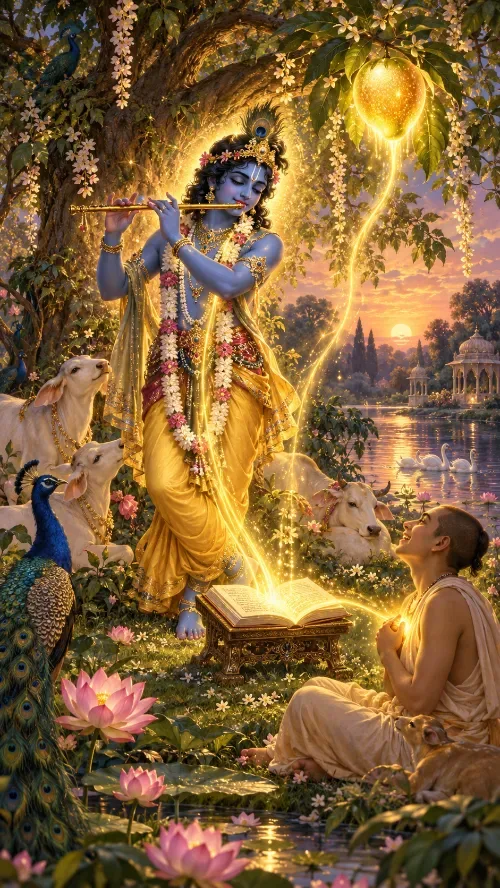
The Śrīmad-Bhāgavatam does not begin by asking its reader merely to understand God. It asks the reader to taste. One of its opening verses describes the Bhāgavatam as the perfectly ripened fruit of the entire Vedic tree and then gives an unusual command: Drink it.
Not once. Again and again. Why? Because its ultimate subject is rasa—the relishable experience of relationship with Bhagavān. This single word eventually becomes the foundation of one of the most sophisticated areas of Gauḍīya Vaiṣṇava theology. Rūpa Gosvāmī would later systematize devotional rasa into five primary relationships and seven secondary emotional flavors, giving the famous twelvefold classification that A. C. Bhaktivedanta Swami Prabhupāda summarizes in his purport to Śrīmad-Bhāgavatam 1.1.3.
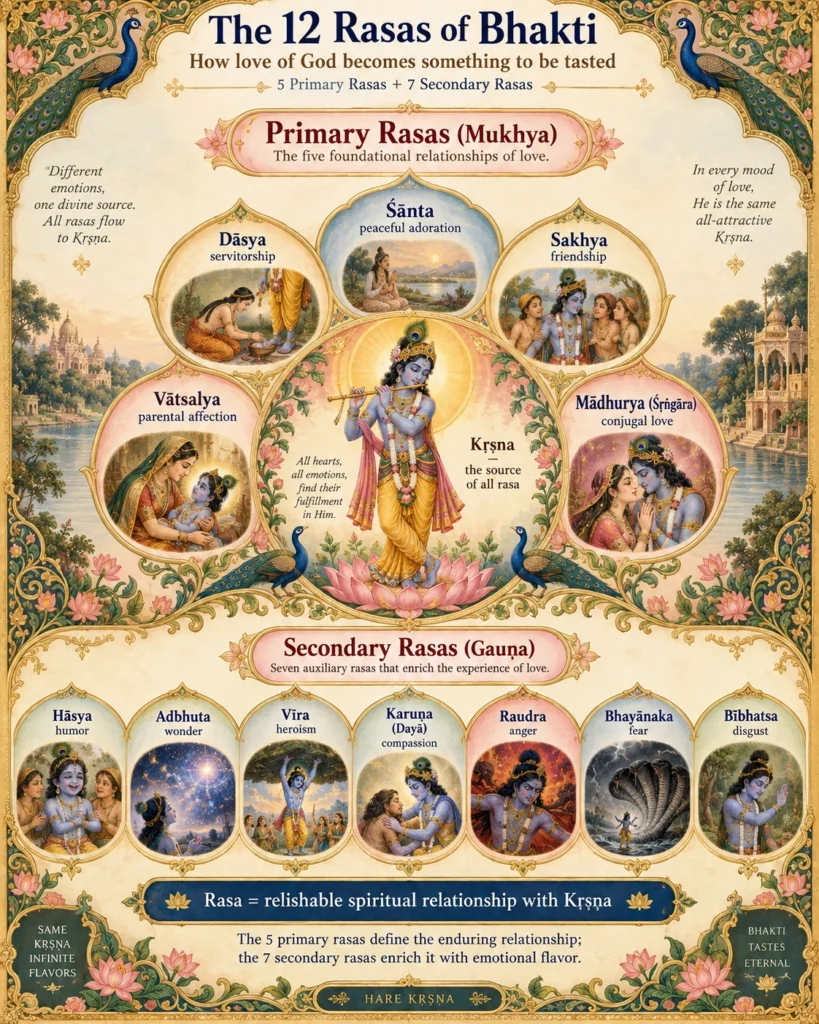
The five primary rasas ring Kṛṣṇa at the centre; the seven secondary rasas run beneath them, each with its own scene.
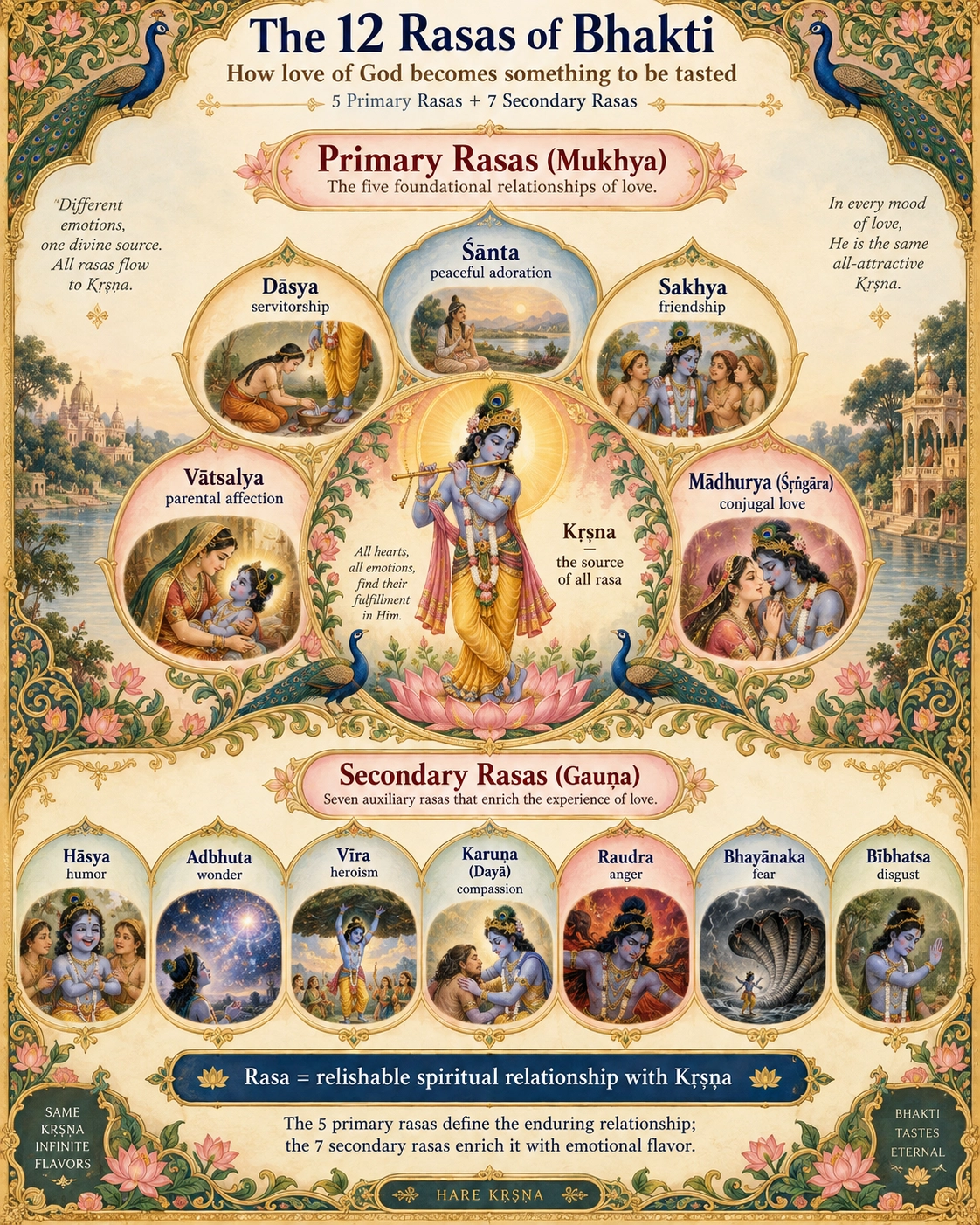
The idea is much deeper than simply saying that religion contains twelve emotions. The five primary rasas answer: Who is Kṛṣṇa to me? The seven secondary rasas answer: What can love feel like while that relationship is being lived?
And behind all twelve stands an Upaniṣadic declaration of extraordinary importance:
रसो वै सः
raso vai saḥ
“He indeed is rasa.”
The Absolute is not merely the object of knowledge. He is the ultimate reality of spiritual relish.
The Ripened Fruit of the Vedic Tree
निगमकल्पतरोर्गलितं फलं
शुकमुखादमृतद्रवसंयुतम् ।
पिबत भागवतं रसमालयं
मुहुरहो रसिका भुवि भावुकाः ॥
nigama-kalpa-taror galitaṁ phalaṁ
śuka-mukhād amṛta-drava-saṁyutam
pibata bhāgavataṁ rasam ālayam
muhur aho rasikā bhuvi bhāvukāḥ
“O rasikas and thoughtful souls upon the earth, drink again and again the Śrīmad-Bhāgavatam—the fully ripened fruit of the wish-fulfilling tree of Vedic revelation, made still more nectarean after passing through the mouth of Śuka.”
Śrīmad-Bhāgavatam 1.1.3
Every important image in the verse concerns: ripeness, sweetness, juice, drinking, relish. The text does not present the Bhāgavatam as a dry philosophical manual. It is: galitaṁ phalam a fully ripened fruit.
And what does a ripe fruit contain? Rasa.
What Does Rasa Mean?
The Sanskrit word:
रस
rasa
has a wide semantic range. It can mean: juice, sap, flavor, taste, essence, relish. From this concrete meaning developed the classical Sanskrit theory of aesthetic experience.
A powerful drama does not merely communicate facts. It makes the audience: taste an emotion. Love becomes relishable. Heroism becomes relishable. Wonder becomes relishable.
Even sorrow, fear, or anger can become aesthetically savored within an artistic experience. Vaiṣṇava theologians take this concept further. They ask: What happens when the object of rasa is Kṛṣṇa Himself?
Then rasa becomes not merely aesthetic emotion but: the spiritually relishable relationship between Bhagavān and His devotee.
The Upaniṣadic Foundation: “He Is Rasa”
The Taittirīya Upaniṣad gives a famous statement:
रसो वै सः ।
रसं ह्येवायं लब्ध्वानन्दी भवति ॥
raso vai saḥ
rasaṁ hy evāyaṁ labdhvānandī bhavati
“He indeed is rasa. Having attained that rasa, one becomes blissful.”
Taittirīya Upaniṣad 2.7.1
This is extremely important for later Vaiṣṇava theology. The Absolute is not merely: existence, infinity, consciousness, or impersonal transcendence. The Absolute is: rasa.
The ultimate reality is capable of: relationship, exchange, relish, bliss. Thus the theology of rasa is not an optional decorative addition to philosophy. It answers a profound question: If Brahman is ānanda, what is the positive content of that bliss?
Vaiṣṇava theology replies: relationship with Bhagavān.
Why the Vedas Are Compared to a Wish-Fulfilling Tree
The phrase:
निगमकल्पतरु
nigama-kalpa-taru
means approximately: “the wish-fulfilling tree of Vedic revelation.” The Vedic corpus contains many branches: ritual, dharma, cosmology, sacrifice, yoga, philosophy, social order, knowledge of Brahman, liberation.
But a tree eventually produces: fruit. The Bhāgavatam presents itself as that fruit. Not an immature fruit. Not merely one more branch. But:
गलितं फलम्
galitaṁ phalam
the fully ripened fruit. The imagery therefore makes a theological claim: the Bhāgavatam represents the mature culmination of Vedic revelation. And what makes it mature? Its concentration upon: Bhagavān, bhakti, and rasa.
Śukadeva Makes the Fruit Sweeter
Then comes:
शुकमुखात्
śuka-mukhāt
“from the mouth of Śuka.”
Śuka means: Śukadeva Gosvāmī. But śuka also means: parrot. Traditional commentators delight in the wordplay. A ripe fruit pecked by a parrot is poetically imagined to become even sweeter.
Similarly, the ripened fruit of Vedic revelation becomes: amṛta-drava-saṁyutam filled with flowing nectar after passing through Śukadeva’s mouth. This is a beautiful image of realized transmission.
The speaker does not make revelation true. But a realized speaker can make its rasa: accessible and relishable.
“Drink the Bhāgavatam”
The command is:
पिबत
pibata
“Drink!”
This is very different from: memorize, catalog, analyze. Those things may be useful. But the intended culmination is: relish. And then:
मुहुः
muhuḥ
“again and again.”
The Bhāgavatam is not something one finishes once and puts away. Rasa deepens through repeated tasting.
The same līlā can reveal something new because:
- the hearer changes,
- the relationship deepens,
- the heart becomes more receptive.
Rasam Ālayam : A Reservoir of Rasa
The phrase:
रसमालयम्
rasam ālayam
is traditionally understood as: “the abode or reservoir of rasa.” There is also a traditional play on ā-layam suggesting: “even up to and beyond liberation.” That is significant.
For some spiritual systems, liberation is the terminal point: material existence ends; the problem is solved. Bhakti theology asks: What happens after bondage is gone? The answer is not: nothing.
It is: rasa. Liberation removes the obstruction. Relationship remains. Thus the command is: keep drinking.
Prabhupāda’s Twelve Rasas
In the purport to ŚB 1.1.3, Prabhupāda gives twelve:
- raudra — anger
- adbhuta — wonder
- śṛṅgāra — conjugal love
- hāsya — comedy
- vīra — chivalry
- dayā — mercy
- dāsya — servitorship
- sakhya — fraternity
- bhayānaka — horror
- bībhatsa — shock
- śānta — neutrality
- vātsalya — parenthood.
The list is genuine. But technically, Gauḍīya rasa theory organizes these twelve into two very different groups: five primary rasas and: seven secondary rasas. That distinction is essential.
The Five Primary Rasas
Rūpa Gosvāmī states in Bhakti-rasāmṛta-sindhu:
मुख्यस्तु पञ्चधा शान्तः
प्रीतः प्रेयांश्च वत्सलः ।
मधुरश्चेत्यमी ज्ञेया
यथापूर्वमनुत्तमाः ॥
mukhyas tu pañcadhā śāntaḥ
prītaḥ preyāṁś ca vatsalaḥ
madhuraś cety amī jñeyā
yathā-pūrvam anuttamāḥ
“The primary rasas are known to be five: śānta, prīta, preyān, vatsala, and madhura.”
Bhakti-rasāmṛta-sindhu 2.5.115
Rūpa’s terminology corresponds approximately to:
- śānta — peaceful adoration
- prīta — dāsya, service
- preyān — sakhya, friendship
- vatsala — vātsalya, parental affection
- madhura — intimate lover-beloved love
These are: enduring relationships.
They answer: Who is Kṛṣṇa to the devotee?
Śānta: Peaceful Spiritual Appreciation
शान्त
śānta
literally means: peaceful, tranquil. “Neutrality,” though traditional in English translations, can sound too cold. Śānta-rasa contains: spiritual peace, freedom from material craving, awareness of Bhagavān, reverence, attraction.
But it lacks the more active intimacy that appears in the succeeding rasas. The relationship has begun. But the devotee does not yet approach Kṛṣṇa primarily as: master, friend, child, or beloved.
Dāsya: “I Am Yours”
दास्य
dāsya
means: servitorship, the mood of service. The fundamental consciousness is: “You are my Lord, and I belong to You.” Service itself becomes pleasurable. The devotee does not serve merely because duty commands it.
He relishes: being useful to Bhagavān. This is the first primary rasa in which active service becomes dominant.
Sakhya: God as Friend
सख्य
sakhya
means: friendship. Here reverential distance decreases dramatically. The cowherd boys of Vraja can: run with Kṛṣṇa, eat with Him, joke with Him, wrestle with Him, climb upon His shoulders, defeat Him in games.
They do not constantly interrupt the relationship by thinking: “This is the omnipotent Supreme Lord.” Their intimacy is so complete that divinity becomes hidden by: sweetness.
This is one of the distinguishing marks of Vraja-bhakti.
Vātsalya: “I Must Protect Kṛṣṇa”
वात्सल्य
vātsalya
means: parental, nurturing affection. Here the ordinary theological hierarchy is turned almost upside down. Religion normally teaches: “God protects me.” Yaśodā thinks: “I must protect Kṛṣṇa.”
She feeds Him. Bathes Him. Dresses Him. Worries about Him. Scolds Him. Even binds Him when He is naughty. Ontologically: He remains Bhagavān. Emotionally: He becomes: her child.
Love has become so intimate that the devotee forgets dependence upon God and instead feels: God depends upon me.
Mādhurya: Kṛṣṇa as Beloved
The fifth primary rasa is:
मधुर
madhura
or: mādhurya-rasa. Prabhupāda uses the classical aesthetic term: śṛṅgāra in his SB 1.1.3 list. The two overlap, but Rūpa Gosvāmī generally prefers madhura for devotional theology.
This is the lover-beloved relationship. Its supreme expression in Gauḍīya theology is: Rādhā’s love for Kṛṣṇa. Mādhurya contains extraordinary intimacy because the beloved may: serve, befriend, care for, joke with, rebuke, long for, embrace Kṛṣṇa.
For this reason Gauḍīya theologians describe mādhurya as containing the greatest fullness of intimate exchange.
The Seven Secondary Rasas
Rūpa then states:
हास्योऽद्भुतस्तथा वीरः
करुणो रौद्र इत्यपि ।
भयानकः स बीभत्स
इति गौणश्च सप्तधा ॥
hāsyo ’dbhutas tathā vīraḥ
karuṇo raudra ity api
bhayānakaḥ sa-bībhatsa
iti gauṇaś ca saptadhā
“The secondary rasas are seven: humor, wonder, heroism, compassion or pathos, anger, fear, and disgust.”
Bhakti-rasāmṛta-sindhu 2.5.116
And then:
एवं भक्तिरसो भेदाद्
द्वयोर्द्वादशधोच्यते ॥
evaṁ bhakti-raso bhedād
dvayor dvādaśadhocyate
“Thus, through these two divisions, bhakti-rasa is said to be twelvefold.”
Bhakti-rasāmṛta-sindhu 2.5.117
So the arithmetic is simple: 5 primary + 7 secondary = 12.
The Secondary Rasas Are Not Seven More Permanent Relationships
This is one of the most important clarifications. A devotee does not normally have an eternal relationship with Kṛṣṇa called: “anger-rasa” in the same sense that Yaśodā has: vātsalya.
The seven secondary rasas arise temporarily within a permanent relationship. A useful analogy is: primary rasa = home secondary rasa = weather The weather changes. The home remains.
Yaśodā as the Perfect Example
Yaśodā’s permanent relationship is: vātsalya.
Yet within that motherhood she experiences:
- hāsya — laughter at Kṛṣṇa;
- adbhuta — astonishment;
- bhayānaka — fear that something may hurt Him;
- raudra — anger when He misbehaves;
- karuṇa — sorrow and tenderness.
These do not replace: motherhood. They enrich it. Thus the secondary rasas create movement inside the primary rasa.
The Cowherd Boys Show the Same Pattern
Their permanent relationship is: sakhya. Yet they can experience: laughter, competitive heroism, wonder, temporary irritation, fear during danger. The relationship remains: friendship.
But friendship becomes dramatically alive through shifting emotional colors. This is why citra—variegatedness—is so important in rasa theology. Perfect love is not emotionally flat.
It is infinitely dynamic.
Hāsya: Divine Laughter
हास्य
hāsya
means: laughter, humor, comic delight. This matters because spiritual life is sometimes imagined as permanently solemn. Vraja is not like that. Kṛṣṇa jokes. His friends tease Him.
The gopīs exchange witty remarks with Him. Divine relationship contains: play. The Absolute is not deprived of humor.
Adbhuta: Wonder
अद्भुत
adbhuta
means: astonishment, wonder, marvel. A devotee may suddenly witness some extraordinary feature of Kṛṣṇa. For example: Yaśodā sees the universe in His mouth. Her ordinary parental consciousness encounters: cosmic astonishment.
Yet eventually motherhood again overwhelms metaphysical wonder. That is a beautiful example of a secondary rasa briefly illuminating the primary one.
Vīra: Heroic Emotion
वीर
vīra
means: heroic, valiant. It can arise through: combat, competition, generosity, determination. Kṛṣṇa’s cowherd friends may compete with Him. Devotees may act heroically in His service.
The emotion becomes spiritual because its center is: Kṛṣṇa.
Karuṇa: Compassion, Pathos, Lamentation
Prabhupāda’s list says: dayā — mercy. The underlying idea is understandable, but the standard technical rasa is:
करुण
karuṇa.
Karuṇa includes: compassion, sorrow, pathos, lamentation. In classical aesthetic theory its underlying emotion is especially: śoka sorrow. Thus for technical accuracy it is better to say: karuṇa — compassion/pathos/lamentation while noting that Prabhupāda paraphrases the category as: dayā, mercy.
Raudra: Anger Can Be Spiritual
रौद्र
raudra
means: anger, fury. How can anger belong to spiritual life? Because an emotion is not spiritually defined merely by its outer appearance. Material anger commonly arises from: frustrated ego, possessiveness, self-interest.
Spiritual anger can arise from: love. Yaśodā becomes angry with Kṛṣṇa because she cares for Him. A gopī may become angry because of deep intimate love. A devotee may become furious when Kṛṣṇa is threatened.
Thus the external emotion resembles material anger. The center has changed completely.
Bhayānaka: Fear
भयानक
bhayānaka
means: fearful, terrifying, fear. Again, devotional fear does not necessarily mean: fear of God as a threatening tyrant. A mother may fear: “Kṛṣṇa could be hurt!” A friend may fear: “A demon is attacking Him!”
A beloved may fear: “He will leave.” Fear intensifies the underlying love.
Bībhatsa: Disgust or Revulsion
बीभत्स
bībhatsa
is better translated technically as: disgust, revulsion, abhorrence. Prabhupāda’s “shock” points toward emotional disturbance but is less precise. Its aesthetic basis is aversion.
Within a devotional context such revulsion may arise toward: something offensive to Kṛṣṇa, impurity, violent enemies, or circumstances contrary to love. Again, it does not normally constitute the permanent relationship.
Classical Rasa Theory Originally Looked Different
The twelvefold Vaiṣṇava system should not simply be projected backward unchanged into the ancient Nāṭyaśāstra. Classical Sanskrit drama famously recognizes eight rasas:
शृङ्गार-हास्य-करुणा
रौद्र-वीर-भयानकाः ।
बीभत्साद्भुत-संज्ञौ
चेत्यष्टौ नाट्ये रसाः स्मृताः ॥
śṛṅgāra-hāsya-karuṇā
raudra-vīra-bhayānakāḥ
bībhatsādbhuta-saṁjñau
cety aṣṭau nāṭye rasāḥ smṛtāḥ
“Eight rasas are recognized in drama: śṛṅgāra, hāsya, karuṇa, raudra, vīra, bhayānaka, bībhatsa, and adbhuta.”
Nāṭyaśāstra 6.15
Later Indian aesthetics famously develops: śānta as the ninth. Rūpa Gosvāmī inherits this rich aesthetic tradition but transforms it.
What Rūpa Gosvāmī Changes
Classical aesthetics asks: How does dramatic representation produce a relishable emotional experience in the spectator? Rūpa asks: How does love for Kṛṣṇa become spiritually relishable?
That is a major shift. He takes concepts such as: rasa, bhāva, vibhāva, anubhāva, sthāyi-bhāva, sāttvika-bhāva and places them inside: bhakti. The result is not simply theatre theory applied to religion.
It is an elaborate theology of: divine relationship.
Rasa and Bhāva Are Not Identical
This distinction helps enormously.
भाव
bhāva
is an emotional state, disposition, or devotional mood. Rasa is the fully relishable experience that arises when the stable devotional emotion is nourished through all the elements of relationship.
So rasa is not merely: “I feel something.” It is closer to: the complete flavor of a lived spiritual relationship. This is why Rūpa calls his work:
भक्तिरसामृतसिन्धु
Bhakti-rasāmṛta-sindhu
“The Ocean of the Nectar of Devotional Rasa.”
Kṛṣṇa in the Wrestling Arena: One Person, Many Tastes
One of the clearest scriptural illustrations appears when Kṛṣṇa enters Kaṁsa’s wrestling arena.
मल्लानामशनिर्नृणां नरवरः स्त्रीणां स्मरो मूर्तिमान्
गोपानां स्वजनोऽसतां क्षितिभुजां शास्ता स्वपित्रोः शिशुः ।
मृत्युर्भोजपतेर्विराडविदुषां तत्त्वं परं योगिनां
वृष्णीनां परदेवतेति विदितो रङ्गं गतः साग्रजः ॥
mallānām aśanir nṛṇāṁ nara-varaḥ strīṇāṁ smaro mūrtimān
gopānāṁ sva-jano ’satāṁ kṣiti-bhujāṁ śāstā sva-pitroḥ śiśuḥ
mṛtyur bhoja-pater virāḍ aviduṣāṁ tattvaṁ paraṁ yogināṁ
vṛṣṇīnāṁ para-devateti vidito raṅgaṁ gataḥ sāgrajaḥ
“When Kṛṣṇa entered the arena with His elder brother, the wrestlers saw Him as a thunderbolt, ordinary men as the finest of men, the women as Cupid embodied, the cowherds as their own kinsman, wicked rulers as their chastiser, His parents as their child, Kaṁsa as death, the ignorant as the cosmic form, the yogīs as the Supreme Truth, and the Vṛṣṇis as their supreme worshipable Lord.”
Śrīmad-Bhāgavatam 10.43.17
The same Kṛṣṇa enters one arena. Yet everyone experiences Him differently. Why? Because rasa is: relational. The object is one. The relationship transforms the experience.
This Does Not Mean Every Emotion Toward Kṛṣṇa Is Bhakti-rasa
An important technical qualification is necessary. Kaṁsa thinks about Kṛṣṇa constantly. But he thinks about Him in: fear, hatred, hostility. Does that make Kaṁsa a perfected bhakta in bhayānaka-rasa?
No. In Rūpa Gosvāmī’s technical system, secondary bhakti-rasa develops upon an underlying devotional attachment to Kṛṣṇa. Kaṁsa’s fear is hostile. The emotion may concern Kṛṣṇa, but it is not automatically: devotional rasa.
This distinction prevents the twelvefold scheme from becoming too loose.
Rasa Requires Relationship
Rasa does not exist merely inside: Kṛṣṇa. Nor merely inside: the devotee. It arises in: exchange. For friendship, there must be: Kṛṣṇa as friend and: the devotee loving Him as friend.
For vātsalya: Kṛṣṇa as child and: the devotee loving Him parentally. For mādhurya: Kṛṣṇa as beloved and: the lover’s devotion. Thus rasa is fundamentally: relational theology.
Material Rasa as Reflection
Prabhupāda’s purport then makes another major claim: the rasas experienced in material existence are reflections of: original spiritual rasa. Human beings constantly seek: friendship, romance, family affection, humor, heroism, wonder, emotional intensity.
Why? Because consciousness naturally seeks: relish. The desire for relationship is not accidental. Vaiṣṇava theology says it ultimately originates in: the soul’s capacity for relationship with Bhagavān.
“Reflection” Does Not Mean Material Love Is Nothing
This point deserves care.
Calling material relationships “reflections” does not mean:
- a mother’s love is meaningless;
- friendship is unreal;
- romantic affection contains no genuine beauty.
The distinction concerns: permanence, purity, center. Material relationship is conditioned by: bodily identity, self-interest, time, change, death. Spiritual rasa is understood as relationship no longer obstructed by those limitations.
So the reflection contains something recognizable. But not yet: the fullness.
Why Material Rasa Eventually Hurts
Every material relationship is vulnerable to: separation, aging, misunderstanding, change, death. The deeper the love, the greater the possibility of pain. This does not prove love meaningless.
It reveals its vulnerability within: impermanence. Vaiṣṇava theology therefore proposes something striking: our seemingly excessive hunger for enduring relationship is not a mistake.
It points toward: an eternal object. Hence: raso vai saḥ.
Bhakti Does Not End in Emotional Emptiness
This is one reason the Bhāgavata conception of liberation is so distinctive. The goal is not merely: “I no longer suffer.” It is: positive relationship with Bhagavān. Liberation removes: ignorance, false identity, material obstruction.
But it does not eliminate: love. Quite the opposite. It makes pure love possible. So when the Bhāgavatam says: pibata “drink,” and: muhuḥ “again and again,” it presents spiritual perfection as: ever-deepening relish.
The Five Rasas Describe Increasing Intimacy
Gauḍīya theology often sees a progression:
- śānta
- dāsya
- sakhya
- vātsalya
- mādhurya
The general logic is increasing intimacy. In śānta there is peaceful appreciation. Dāsya adds active service. Sakhya adds equality and confidence. Vātsalya adds protective possessiveness.
Mādhurya adds the unique intimacy of beloved and lover. This helps explain why Gauḍīya theology gives special prominence to: Rādhā-Kṛṣṇa.
But “Higher” Does Not Mean Everyone Should Change Rasa
A genuine devotee does not approach spiritual life like a career ladder: “I am in dāsya; I should upgrade to mādhurya.” That would misunderstand rasa. The devotee’s perfected relationship is: intrinsically fulfilling.
Yaśodā does not envy the gopīs. Kṛṣṇa’s cowherd friends do not wish to stop being His friends. The perfection of rasa lies in: complete fulfillment within one’s genuine relationship.
The theological hierarchy describes types of intimacy. It does not imply dissatisfaction in liberated love.
Rasa Helps Explain Why Vraja Is So Important
In majestic worship, God’s divinity remains strongly foregrounded. The devotee thinks: “You are infinite. I am tiny. You are Lord. I am servant.” That relationship is authentic.
But Vraja reveals something else: love can become so intimate that awareness of majesty recedes. Yaśodā does not stop to calculate God’s omnipotence before chasing Kṛṣṇa with a rope.
The cowherd boys do not meditate upon cosmic ontology before wrestling with Him. Rādhā does not relate to Kṛṣṇa primarily as: Creator of the universe. This is: mādhurya sweetness, intimacy.
And rasa theory is the language Gauḍīya theology uses to explain it.
Even God Wants Rasa
This opens a deeper theological insight. Rasa is not only something the devotee desires. Kṛṣṇa desires relationship too. He wants: friends, parents, lovers, servants. He allows Himself to be: fed, defeated, bound, teased, embraced, reproached.
Why? Because omnipotence alone does not exhaust divine life. Bhagavān possesses: relationship. That is why Gauḍīya theology can say that Kṛṣṇa is conquered by: prema.
The Absolute as Person Means the Absolute Can Relate
This is where rasa theology becomes philosophically important. If ultimate reality were only: undifferentiated existence, then ultimate perfection would tend toward: the disappearance of relational difference.
But if ultimate reality is: Bhagavān then difference can remain without alienation. The soul remains: the lover. Kṛṣṇa remains: the beloved. Yet unity occurs through: love.
Rasa therefore offers a distinct answer to the philosophical problem of unity and difference: relationship itself becomes perfection.
Why the Bhāgavatam Must Be “Drunk”
A purely intellectual reading can identify: characters, doctrines, verses, chronology. But the verse invites something beyond that. pibata. Drink. To drink the Bhāgavatam means gradually to allow: its names, līlās, relationships, devotees, emotional world to become spiritually relishable.
This does not eliminate analysis. It gives analysis a destination. Knowledge becomes: taste.
Rasikā and Bhāvukāḥ
The verse addresses:
रसिकाः
rasikāḥ
those capable of appreciating rasa, and:
भावुकाः
bhāvukāḥ
those possessing deep feeling, sensitivity, or spiritual insight. This is significant. The ideal reader is neither: emotion without understanding nor: understanding without emotional capacity.
The Bhāgavatam calls for both. The mature reader is: sensitive and discerning.
A Corrected Twelvefold Scheme
For technical clarity, the twelve should be presented as follows:
Five primary rasas
śānta — peaceful adoration dāsya / prīta — service sakhya / preyān — friendship vātsalya / vatsala — parental affection mādhurya / madhura — lover-beloved intimacy
Seven secondary rasas
hāsya — laughter/humor adbhuta — wonder vīra — heroism karuṇa — compassion/pathos/lamentation raudra — anger bhayānaka — fear bībhatsa — disgust/revulsion Prabhupāda’s twelve correspond to this structure, though he uses: śṛṅgāra for the fifth primary rasa and: dayā for the category technically called karuṇa.
Why “Śṛṅgāra” and “Madhura” Both Appear
Śṛṅgāra is the established classical Sanskrit aesthetic term for: amorous or erotic rasa. Rūpa Gosvāmī’s Vaiṣṇava theology prefers: madhura “sweet” for the corresponding devotional relationship.
That terminological shift matters. The subject is not ordinary eroticism projected onto God. It is understood as: transcendental intimacy whose material erotic experience is only a distorted reflection.
Thus mādhurya becomes the safer theological term.
Why Rūpa’s System Is More Than Literary Theory
Rūpa Gosvāmī’s achievement lies in taking an already sophisticated theory of aesthetics and making a profound theological claim: the capacity to taste emotion exists because ultimate reality itself is relational and relishable.
Drama gives us: aesthetic rasa. Material life gives us: temporary relational rasa. Bhakti gives us: spiritual rasa with Bhagavān. This is why Bhakti-rasāmṛta-sindhu is not merely a manual of devotional emotions.
It is effectively a: phenomenology of divine love.
The Twelve Rasas Are Not Twelve Compartments
Another mistake would be to imagine twelve sealed boxes. Actual rasa is dynamic. A single scene can contain: friendship, laughter, heroism, wonder, fear, affection. But one relationship normally provides the dominant center.
This is why Kṛṣṇa-līlā feels emotionally rich rather than schematic. Rasa theory analyzes life after the fact. The līlā itself is: living relationship.
The Real Question Is Not “Which Emotion?”
The deeper question is: Whose emotion, toward whom, and arising from what relationship? Anger centered on ego is material. Anger centered on protecting Kṛṣṇa can nourish bhakti.
Fear of losing material control binds. Fear that Kṛṣṇa may be hurt can deepen vātsalya. Romantic desire directed through bodily exploitation is material. Mādhurya is defined as completely Kṛṣṇa-centered love.
Thus the same outward emotional category can possess radically different spiritual meaning depending upon: its center.
Rasa Is Therefore a Science of the Center
The distinction between material and spiritual rasa ultimately comes down to: Who is at the center? Material consciousness says: “How does this relationship satisfy me?” Bhakti gradually asks: “How can this relationship satisfy Kṛṣṇa?”
The emotional vocabulary may initially look similar. The orientation has been transformed. That is why Vaiṣṇava authors call material rasa: reflection rather than: complete invention.
The Bhāgavatam Begins by Telling Us How to Read It
That may be the deepest significance of 1.1.3. Before the great narratives unfold— before Dhruva, Prahlāda, Kapila, Ṛṣabhadeva, Kṛṣṇa’s birth, Vṛndāvana, rāsa-līlā, Uddhava— the text tells us: Do not read this merely as information.
Drink it. The word: rasa functions almost like an instruction manual for the remaining twelve cantos. The Bhāgavatam is not ultimately asking: “Did you understand what happened?”
It is asking: “Did you begin to taste what relationship with Bhagavān means?”
What the Twelve-Rasa Teaching Does Not Mean
The doctrine does not mean that every emotion toward Kṛṣṇa is automatically pure bhakti. It does not mean that material anger, fear, or eroticism should simply be declared spiritual.
It does not mean that the five primary rasas are interchangeable personalities that a practitioner chooses casually. It does not mean classical Indian aesthetics and Gauḍīya bhakti-rasa are historically identical systems.
And it does not mean devotional life should become sentimentalism without: śāstra, discernment, sādhana, or philosophical clarity. Rasa is the flowering of genuine bhakti.
Not a substitute for it.
What the Teaching Does Mean
The twelvefold scheme reveals that spiritual perfection is not emotional emptiness. It is: purified relationship. The five primary rasas describe enduring ways of loving Kṛṣṇa.
The seven secondary rasas show how astonishingly varied that love can become. Humor does not disappear. Wonder does not disappear. Heroism does not disappear. Even anger, fear, sorrow, and disgust can find transformed expression when completely related to: Bhagavān.
The spiritual world is therefore not less emotionally rich than material existence. It is: infinitely more so.
Śrīmad-Bhāgavatam 1.1.3 begins with a fruit. The Vedas are the tree. The Bhāgavatam is the fruit. Śukadeva makes it sweeter. And then the reader is told:
पिबत
pibata
“Drink.”
Why? Because:
रसम्
rasam
is inside. The later Vaiṣṇava tradition explains that rasa through twelve principal forms: five enduring relationships— śānta, dāsya, sakhya, vātsalya, mādhurya— and seven secondary emotional flavors— hāsya, adbhuta, vīra, karuṇa, raudra, bhayānaka, bībhatsa.
But the deepest point is not the number twelve. It is the reality behind them. The Upaniṣad says:
रसो वै सः
raso vai saḥ
“He indeed is rasa.”
The Absolute is not merely an idea to understand. Bhagavān can be: served, befriended, cared for, loved, laughed with, marveled at, longed for. Thus bhakti does not culminate merely in: knowing that Kṛṣṇa exists.
It culminates in: relationship with Kṛṣṇa becoming relishable. And that is why the opening of the Bhāgavatam does not merely say: “Study this book.” It says: “Drink.” Again and again.
Because the deepest promise of the Bhāgavatam is not merely information about the Absolute. It is: taste of the Absolute. And the entire doctrine can be remembered through one simple distinction: The five primary rasas tell us who Kṛṣṇa is to the devotee. The seven secondary rasas tell us what love can feel like while that relationship is alive.