

The Sapta-devalaya of Vṛndāvana
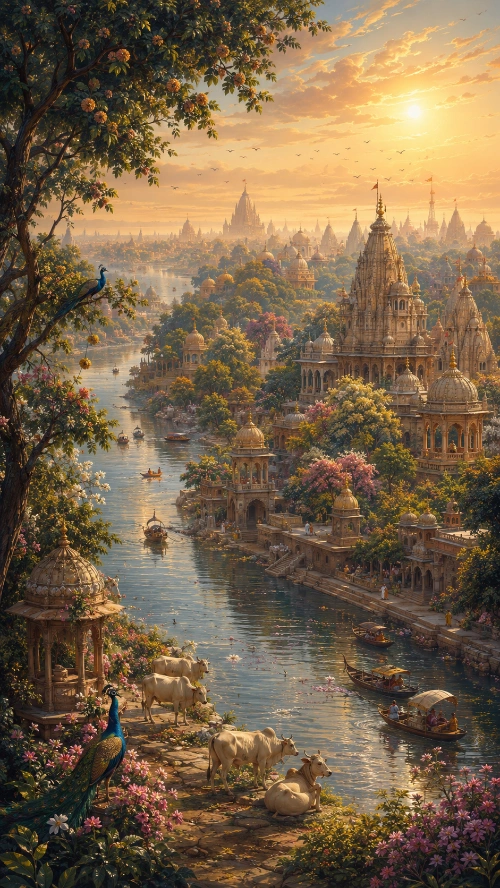
The Seven Great Gauḍīya Temples of Vṛndāvana: The Sapta-devalaya
Vṛndāvana contains hundreds of temples, but within the Gauḍīya Vaiṣṇava tradition seven historic shrines came to be remembered collectively as the Sapta-devalaya — the Seven Temples of Vṛndāvana. They are not merely a sightseeing list. Behind each stands a layered history of ancient sacred memory, Gauḍīya rediscovery, guru and Deity worship, monumental construction, royal patronage, seventeenth-century displacement, and later restoration.
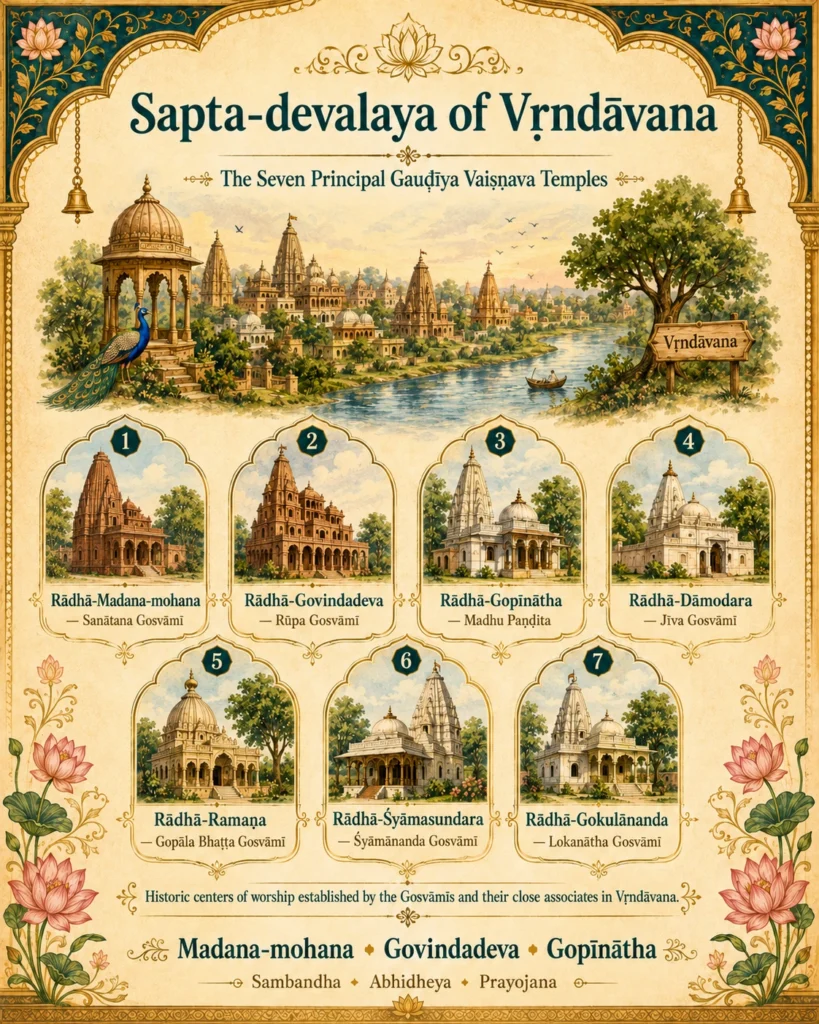
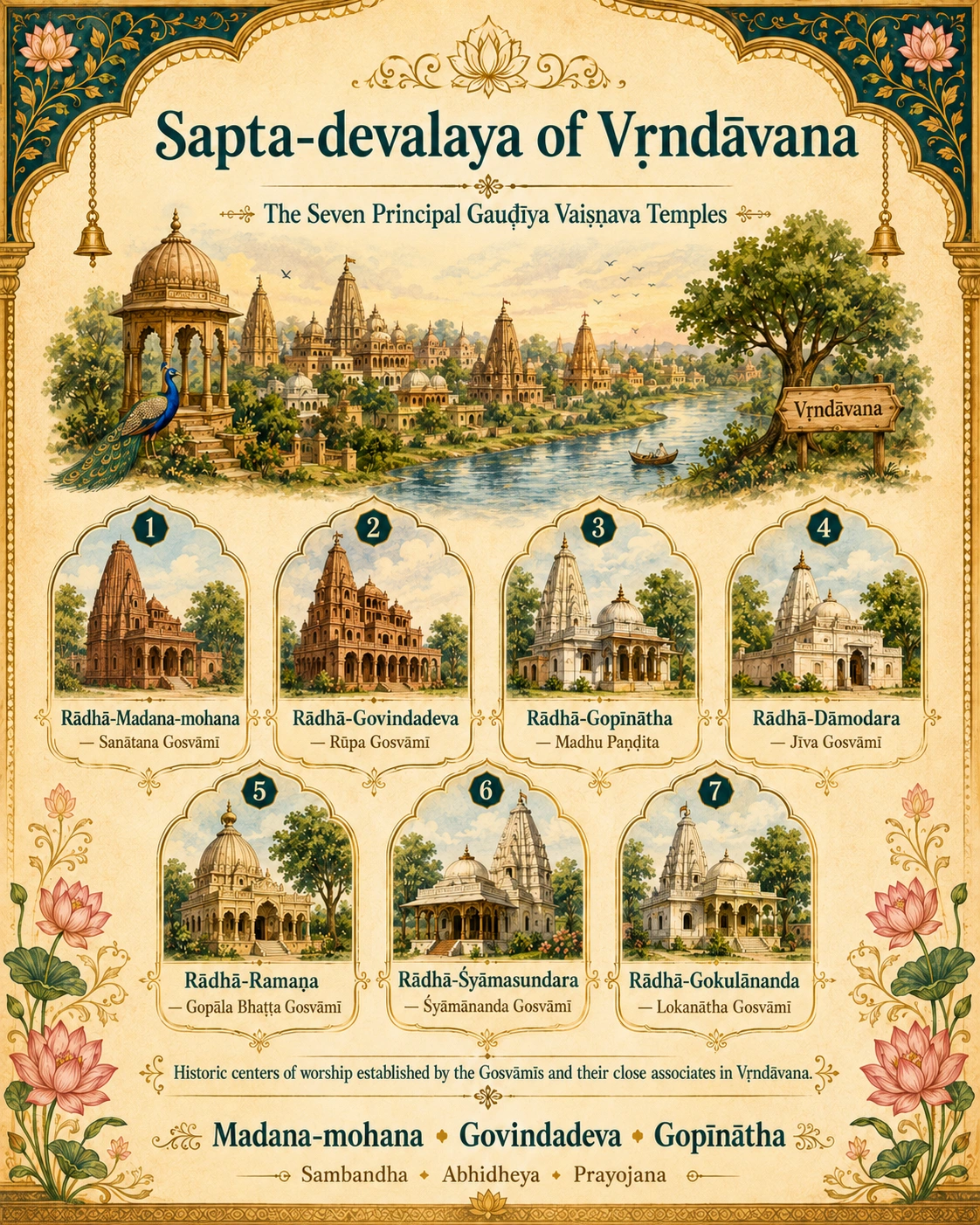
The seven temples with their principal Gauḍīya ācāryas, and the foundational triad beneath.
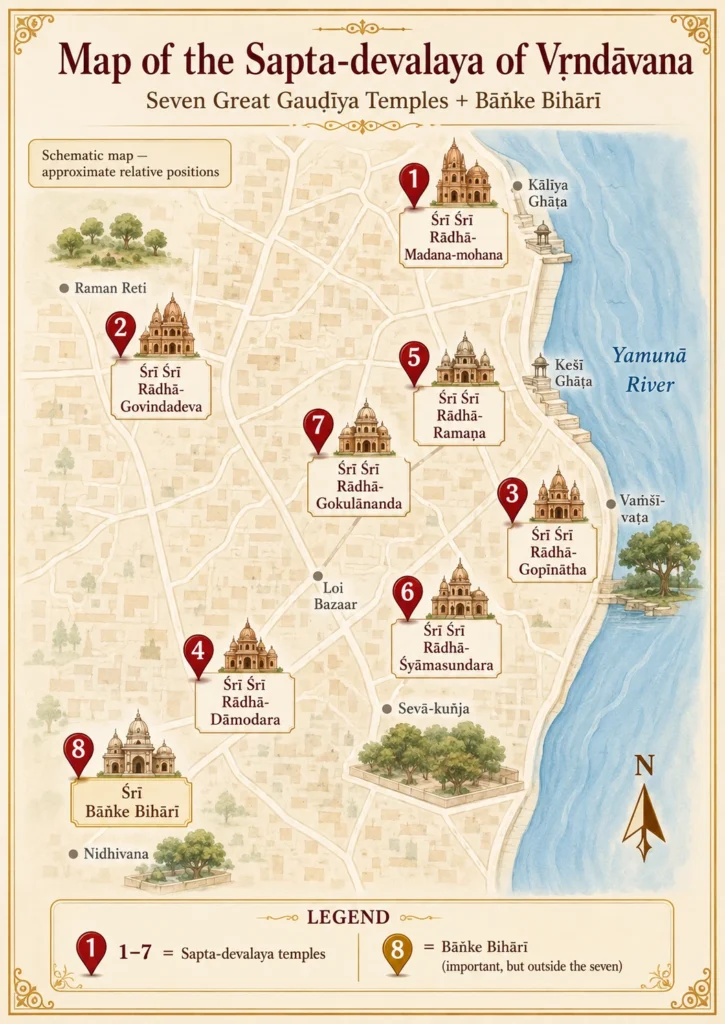
Schematic positions of the seven temples along the Yamunā, with Bāṅke Bihārī marked separately as the eighth.
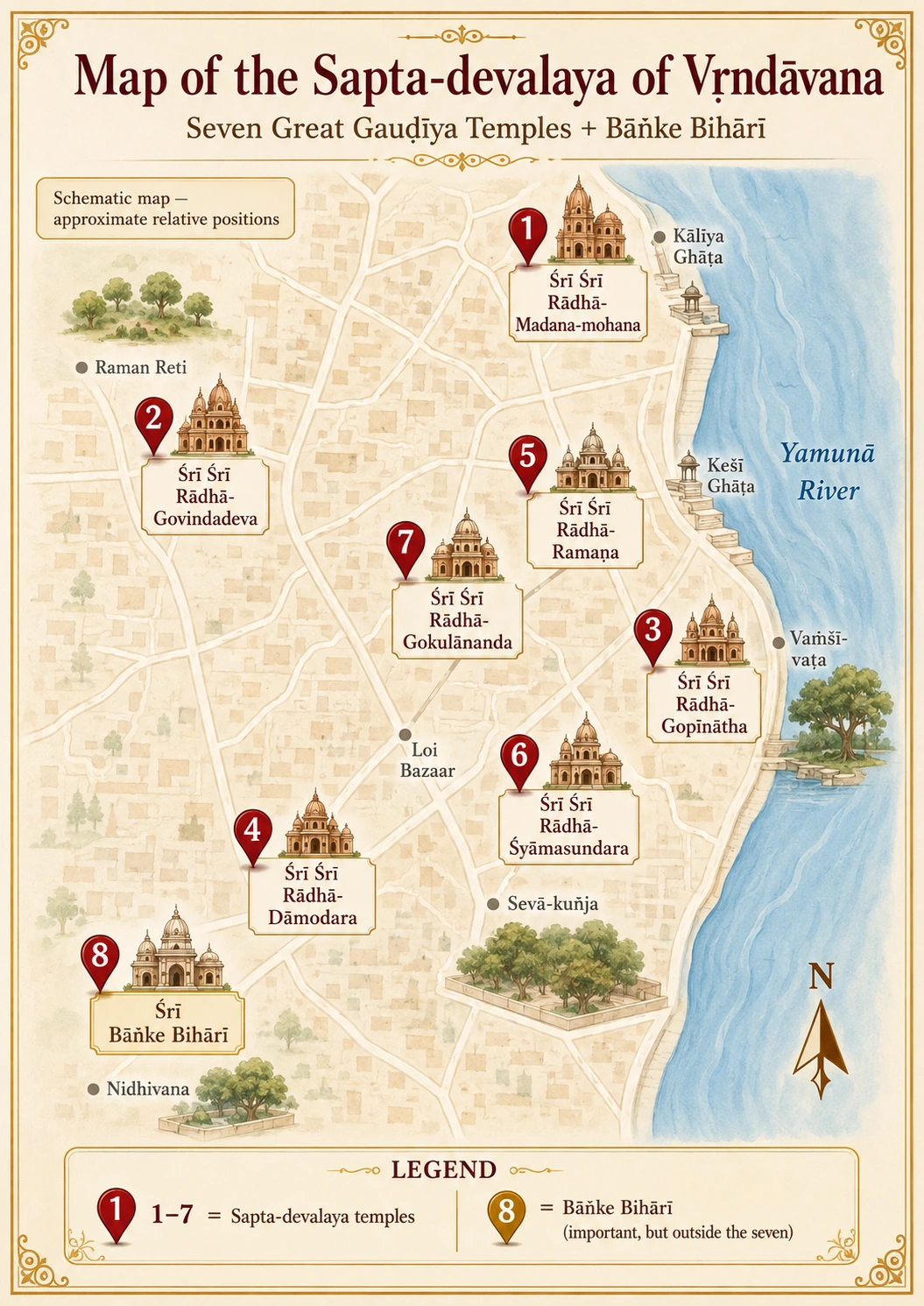
To these seven one often adds Vṛndāvana’s enormously famous Śrī Bāṅke Bihārījī. Bāṅke Bihārī, however, belongs to the Svāmī Haridāsa and Nidhivana tradition and is not normally part of the specifically Gauḍīya Sapta-devalaya. The distinction matters, because modern pilgrimage literature uses “seven temples of Vṛndāvana” in several different ways.
Before There Were Seven, There Were Three
Historically and textually, the earliest and most authoritative Gauḍīya grouping is not seven but three: Madana-mohana, Govinda and Gopīnātha. Near the conclusion of the Caitanya-caritāmṛta, Kṛṣṇadāsa Kavirāja writes:
শ্রী-রাধা-সহ ‘শ্রী-মদনমোহন’ ।
শ্রী-রাধা-সহ ‘শ্রী-গোবিন্দ’-চরণ ॥
শ্রী-রাধা-সহ শ্রীল ‘শ্রী-গোপীনাথ’ ।
এই তিন ঠাকুর হয় ‘গৌড়ীয়ার নাথ’ ॥
śrī-rādhā-saha ‘śrī-madana-mohana’
śrī-rādhā-saha ‘śrī-govinda’-caraṇa
śrī-rādhā-saha śrīla ‘śrī-gopīnātha’
ei tina ṭhākura haya ‘gauḍiyāra nātha’
“Śrī Madana-mohana with Śrī Rādhā, Śrī Govinda with Śrī Rādhā, and Śrī Gopīnātha with Śrī Rādhā — these three Ṭhākuras are the Lords of the Gauḍīyas.” — Caitanya-caritāmṛta, Antya 20.142–143
The passage matters because it shows that these three form a classical Gauḍīya triad, older and more textually explicit than the later institutional grouping of seven. Kṛṣṇadāsa also invokes each of them individually at the very beginning of his work.
जयतां सुरतौ पङ्गोर्मम मन्दमतेर्गती ।
मत्सर्वस्वपदाम्भोजौ राधामदनमोहनौ ॥
jayatāṁ suratau paṅgor
mama manda-mater gatī |
mat-sarvasva-padāmbhojau
rādhā-madana-mohanau ||
“Glory to Rādhā-Madana-mohana. For me, lame and dull-minded, they are my refuge; their lotus feet are my everything.” — Caitanya-caritāmṛta, Ādi 1.15
दीव्यद्वृन्दारण्यकल्पद्रुमाधः
श्रीमद्रत्नागारसिंहासनस्थौ ।
श्रीमद्राधाश्रीलगोविन्ददेवौ
प्रेष्ठालीभिः सेव्यमानौ स्मरामि ॥
dīvyad-vṛndāraṇya-kalpa-drumādhaḥ
śrīmad-ratnāgāra-siṁhāsana-sthau |
śrīmad-rādhā-śrīla-govinda-devau
preṣṭhālībhiḥ sevyamānau smarāmi ||
“I remember Śrī Rādhā and Śrī Govindadeva, seated upon a splendid throne in a jewelled pavilion beneath a desire tree in radiant Vṛndāvana, being served by their most intimate sakhīs.” — Caitanya-caritāmṛta, Ādi 1.16
श्रीमान् रासरसारम्भी
वंशीवटतटस्थितः ।
कर्षन् वेणुस्वनैर्गोपीर्
गोपीनाथः श्रियेऽस्तु नः ॥
śrīmān rāsa-rasārambhī
vaṁśīvaṭa-taṭa-sthitaḥ |
karṣan veṇu-svanair gopīr
gopīnāthaḥ śriye ‘stu naḥ ||
“May glorious Gopīnātha, who stands at Vaṁśī-vaṭa, attracts the gopīs with the sound of his flute and inaugurates the rasa of the rāsa dance, bestow auspiciousness upon us.” — Caitanya-caritāmṛta, Ādi 1.17
Later Gauḍīya interpretation famously associates the three with the three great categories of the tradition’s theology:
The later seven-temple network therefore grew around a Vṛndāvana landscape whose theological centre had already been articulated through these three. The triad, and the three names of Śrī Rādhā paired with them, are treated in full in The Three Great Deity Forms of Vṛndāvana.
Four Different Histories Must Be Kept Separate
Much of the confusion surrounding these temples comes from treating four distinct historical layers as though they were one.
These persons and events are often not identical. Govindadeva is the clearest case:
Vajranābha ── ancient installation, according to tradition
 └─ Rūpa Gosvāmī ── rediscovery and establishment of worship
     └─ Rāja Mān Singh ── monumental temple patronage
         └─ late 17th century ── original Deity removed from Vṛndāvana
             └─ Jaipur ── present seat of the original Govindadeva
Once these layers are distinguished, many apparent contradictions disappear. “Who founded the Deity worship?” and “who built the temple?” are simply not the same question.
Vajranābha and the Ancient Vraja Deities
Vraja tradition connects the ancient images of Madana-mohana, Govinda and Gopīnātha with Vajranābha, properly described as Kṛṣṇa’s great-grandson:
Kṛṣṇa
 └─ Pradyumna
     └─ Aniruddha
         └─ Vajranābha
The tradition holds that Vajranābha established sacred images of Kṛṣṇa in Vraja after Kṛṣṇa’s earthly pastimes ceased to be manifest; these were later lost or concealed, and rediscovered when Caitanya’s followers came to Vṛndāvana in the sixteenth century.
This is a deeply important Vraja temple tradition and should be identified as such rather than presented as archaeologically demonstrable history. A careful formulation is: “according to longstanding Vraja and Gauḍīya tradition, the ancient Deity was originally installed by Vajranābha.” The same applies to the popular tradition linking the three great Deities with different parts of Kṛṣṇa’s form — Madana-mohana with his lotus feet, Gopīnātha with his chest, Govinda with his face — so that darśana of all three gives a complete vision of Kṛṣṇa. It is a beautiful and widespread oral tradition, but modern sources do not assign the parts uniformly.
1. Śrī Śrī Rādhā-Madana-mohana
The great Gauḍīya association is Sanātana Gosvāmī, who worshipped Madana-mohana in the area of Dvādaśāditya-ṭīlā above the Yamunā. His relationship with this Deity became so fundamental that Madana-mohana came to represent the devotee’s initial relationship with Kṛṣṇa. The name means “he who enchants Madana” — Madana being Kāma, the god of erotic attraction. Ordinary beings are conquered by Cupid; Kṛṣṇa is so beautiful that Cupid himself is conquered by him.
The surviving red-sandstone temple is one of the oldest great monumental Gauḍīya structures in Vṛndāvana, and a date of roughly 1580–1585 CE is safest. Traditional accounts associate its construction with a wealthy merchant from Multan, commonly called Kapur Ram Das, acting under Sanātana’s spiritual influence. Sanātana is the spiritual centre of the Deity tradition; the merchant patron made the architecture possible.
During the late seventeenth-century crisis surrounding the temples of Mathurā and Vṛndāvana, the original Madana-mohana was removed for safety. He passed through Rajasthan and was eventually established at Karauli, where the original Deity is worshipped today. The ancient Vṛndāvana site remains sacred, and representative forms are worshipped there.
2. Śrī Śrī Rādhā-Govindadeva
The principal Gauḍīya association is Rūpa Gosvāmī, who according to tradition rediscovered Govindadeva in the area associated with Gomā-ṭīlā, Govinda’s Yogapīṭha, and established his worship. Rūpa — not Rāja Mān Singh — is the key spiritual figure here.
The monumental red-sandstone temple was built through Rajput royal patronage, most famously associated with Rāja Mān Singh I of Amber, around 1590 CE. The patronage network is also preserved in tradition in connection with Raghunātha Bhaṭṭa Gosvāmī. But Mān Singh should not replace Rūpa as the principal Gauḍīya association of Govindadeva.
During the late seventeenth century the original Govindadeva was removed from Vṛndāvana and eventually established at Jaipur, where he became extraordinarily important to the Kachhwaha royal state — so much so that Govindadeva could be understood symbolically as the true sovereign of Jaipur, the human ruler functioning as his servant and representative. Gauḍīya literature also repeatedly presents Govinda together with Śrī Rādhā as Vṛndāvaneśvarī, the Sovereign Lady of Vṛndāvana: the tradition represents not Kṛṣṇa alone but the Divine Couple at the Yogapīṭha, served by their intimate sakhīs.
3. Śrī Śrī Rādhā-Gopīnātha
The principal Gauḍīya saint associated with Gopīnātha is Madhu Paṇḍita, though the rediscovery tradition is more complicated. A strong Gauḍīya temple tradition holds that Gopīnātha was rediscovered near Vaṁśī-vaṭa by Paramānanda Bhaṭṭācārya, after which Madhu Paṇḍita became prominently associated with the Deity’s service. Some modern summaries give the discoverer’s name in another form, such as Padmanābha Bhaṭṭācārya, so the safest formulation keeps both elements: rediscovery near Vaṁśī-vaṭa by Paramānanda Bhaṭṭācārya, with the worship subsequently associated especially with Madhu Paṇḍita.
The name combines gopī, cowherd maiden, with nātha — lord, protector, beloved, refuge. Kṛṣṇadāsa Kavirāja directly associates him with Vaṁśī-vaṭa and the rāsa-līlā in the verse quoted above: vaṁśīvaṭa-taṭa-sthitaḥ, “standing at Vaṁśī-vaṭa,” and karṣan veṇu-svanair gopīḥ, “drawing the gopīs by the sounds of his flute.” The place-name itself is vaṁśī, flute, plus vaṭa, banyan tree — the Banyan Tree of the Flute, the famous Yamunā-side līlā-sthalī of Kṛṣṇa’s call to the gopīs. The name of the place and the identity of the Deity reinforce one another.
The original Gopīnātha was removed during the same broad period of danger, and the original Deity tradition became established in Jaipur. The three members of the classical triad are therefore now geographically divided — Madana-mohana at Karauli, Govindadeva and Gopīnātha at Jaipur — while their original Vṛndāvana sites remain major pilgrimage places.
4. Śrī Śrī Rādhā-Dāmodara
The principal association is Jīva Gosvāmī, and the temple tradition dates its establishment to 1542 CE. A longstanding Gauḍīya account says that Rūpa Gosvāmī prepared or manifested the Dāmodara Deity and gave him to Jīva, his nephew and disciple. The name is famously connected with the child Kṛṣṇa bound by Mother Yaśodā: dāma, rope, and udara, belly — “he whose belly was bound with a rope.”
An important correction. Older pilgrimage notes sometimes state that the original Rādhā-Dāmodara Deities were taken to Jaipur and that only representative images are worshipped in Vṛndāvana today. According to the present Rādhā-Dāmodara temple history the sequence was different: moved to Jaipur for safety in 1670, and the original Deities returned to Vṛndāvana in 1739, where they have continued to be worshipped. This makes Rādhā-Dāmodara materially different from Madana-mohana, Govinda and Gopīnātha.
The temple is extraordinary because its sacred identity extends well beyond the principal altar. Temple tradition associates it with several other historic Gauḍīya Deities:
The temple is also famous for a Govardhana-śilā associated with Sanātana Gosvāmī, on which temple tradition identifies marks as traces of Kṛṣṇa’s foot, flute, staff and a calf’s hoof. This stone must not be confused with the other famous Govardhana-śilā preserved at Rādhā-Gokulānanda; they are two different sacred objects with two different lineages.
5. Śrī Śrī Rādhā-Ramaṇa
The principal saint is Gopāla Bhaṭṭa Gosvāmī, and this tradition is unique among the seven. According to temple history Gopāla Bhaṭṭa worshipped twelve Śālagrāma-śilās, and in 1542 CE one of them spontaneously manifested the three-dimensional form worshipped as Śrī Rādhā-Ramaṇa. The Deity is therefore not described as a humanly carved image but as svayam-prakaṭa, self-manifested.
The name means “he who delights Rādhā,” establishing the Deity within the intimate Rādhā-Kṛṣṇa world of Vraja. Rādhā-Ramaṇa is also unusual in that the principal historic altar does not display a conventional Rādhā mūrti beside Kṛṣṇa in the way most Rādhā-Kṛṣṇa temples do; her presence is represented symbolically and liturgically within the temple tradition. The name itself carries the point: even where Rādhā is not represented by a matching sculpted figure, the Deity is understood as inseparable from her.
Unlike the original Madana-mohana, Govinda and Gopīnātha, the original Rādhā-Ramaṇa never left Vṛndāvana. This makes it one of the particularly important surviving original sixteenth-century Gauḍīya Deity traditions still centred in Vṛndāvana itself.
6. Śrī Śrī Rādhā-Śyāmasundara
The principal association is Śyāmānanda Prabhu, a disciple of Hṛdaya Caitanya who received advanced theological education in Vṛndāvana under Jīva Gosvāmī and later became one of the great transmitters of Vṛndāvana Gauḍīya theology into Odisha. According to the Śyāmānandī devotional tradition, Śrī Rādhā personally bestowed upon him a small Deity of Śyāmasundara, affectionately known as Lālā, with the companion Rādhā as Lālī. These details belong to Śyāmānandī hagiography and are best identified as such.
The name combines śyāma — dark, blackish-blue, of beautiful dark complexion — with sundara, beautiful: “the Beautiful Dark One.” It captures one of the central paradoxes of Kṛṣṇa’s appearance, that his complexion is dark like a monsoon cloud and yet he is supremely beautiful.
The temple’s altar has a more complex history than the simplified statement that Śyāmānanda installed what is seen today. The small original Śyāmasundara belongs to his sacred tradition, while larger Deity arrangements and later worship developed through the subsequent lineage; Baladeva Vidyābhūṣaṇa also became strongly associated with it. The temple is best understood as Śyāmānanda’s Deity lineage rather than as a set of images each installed by him personally.
7. Śrī Śrī Rādhā-Gokulānanda
Of the seven, Rādhā-Gokulānanda is the most misleading if reduced to one saint and one Deity. It is better understood as a multi-ācārya sacred complex, functioning almost as a compressed history of several generations of Gauḍīya Vaiṣṇavism:
Writing simply “Rādhā-Gokulānanda — Viśvanātha Cakravartī” is not wrong, but it is incomplete. The temple also preserves one of the most important sacred objects in Gauḍīya memory: a Govardhana-śilā associated with Raghunātha dāsa Gosvāmī, which according to tradition had previously been worshipped personally by Śrī Caitanya Mahāprabhu and was then given to him. The Caitanya-caritāmṛta records Caitanya giving Raghunātha a Govardhana stone and a guñjā-mālā:
শিলার স্বরূপ শুনি’ রঘুনাথের হর্ষ হৈল ।
প্রভুর কর-স্পর্শ জানি’ সেবা আরম্ভিল ॥
śilāra svarūpa śuni’ raghunāthera harṣa haila
prabhura kara-sparśa jāni’ sevā ārambhila
“Hearing the nature of the stone, Raghunātha became delighted. Knowing that it had been touched by the Lord’s hand, he began its worship.”
The theological meaning is profound. For Raghunātha dāsa the Govardhana-śilā was not a souvenir brought back from Govardhana; it was worshipped as Kṛṣṇa himself.
Temple tradition further identifies a mark on this stone as an impression of Śrī Caitanya Mahāprabhu’s thumb. That is best phrased as what it is — “according to the Rādhā-Gokulānanda temple tradition” — which preserves the tradition without confusing devotional identification with archaeological demonstration.
What Is a Pratibhū-mūrti?
The term appears frequently in modern explanations of Vṛndāvana temple history. Pratibhū can mean representative, proxy, substitute or counterpart, so a pratibhū-mūrti is a representative Deity installed or worshipped in a shrine after the original vigraha has been relocated. It is especially useful for understanding Madana-mohana, Govindadeva and Gopīnātha — though it should not be inflated into a larger theological category than the sources warrant. Here it is principally temple-historical vocabulary.
The Mughal-Period Relocation
The late seventeenth century transformed Vṛndāvana’s sacred geography. During the reign of Aurangzeb the major temples of the Mathurā-Vṛndāvana region came under severe threat, and around 1669–1670 several important vigrahas were removed westward for safety. The process was rarely a single event in which soldiers arrived and the Deity was immediately taken to its present home; it typically involved warning, temporary refuge, multiple relocations, Rajput protection, and only eventual permanent installation.
This produces a situation worth stating plainly: a temple can remain one of Vṛndāvana’s holiest places even when the original Deity once worshipped there now resides hundreds of kilometres away. Place, lineage, architecture and vigraha have connected but sometimes separate histories.
Bāṅke Bihārī — the Great Temple That Is Not One of the Seven
No account of Vṛndāvana’s Deities would feel complete without Śrī Bāṅke Bihārījī — but he belongs in a separate category. Bāṅke Bihārī belongs to the lineage of Svāmī Haridāsa and the sacred grove of Nidhivana. Svāmī Haridāsa is traditionally identified within his own devotional lineage as a manifestation of Lalitā-sakhī, and according to that tradition the Divine Couple manifested before him in Nidhivana and assumed the single beloved form worshipped as Bāṅke Bihārī.
The Braj expression bāṅkā or bāṅke suggests bent, curved, gracefully crooked, and bihārī means one who sports or enjoys pastimes — so the name is approximately “the graceful, threefold-bending enjoyer of pastimes,” evoking Kṛṣṇa’s famous tribhaṅga posture. The Deity is also associated with the name Kuñja-Bihārī, “he who enjoys pastimes in the forest bowers,” which suits the devotional atmosphere of Nidhivana perfectly.
The reason for the exclusion is not importance — Bāṅke Bihārī is arguably among the most famous and most visited Deities in all of Vṛndāvana. The distinction is one of lineage and historical grouping. The Gauḍīya Sapta-devalaya developed around Deity traditions associated with Caitanya’s Vṛndāvana followers and their successors, while Bāṅke Bihārī belongs to the Haridāsī devotional environment. He is one of the great central Deities of Vṛndāvana, but not an eighth member of the specifically Gauḍīya seven.
“Seven Temples” Is Not Always Used the Same Way
Modern Vṛndāvana literature produces apparently contradictory lists. One may find Gokulānanda as the seventh; another may include Rādhā-Vallabha; another may mention Bāṅke Bihārī or Jugal-Kiśora. This does not make the Gauḍīya list meaningless. It means that “seven temples of Vṛndāvana” is often used loosely outside the technical Gauḍīya context — which is why the heading the Gauḍīya Sapta-devalaya removes most of the ambiguity.
The related expression “the Seven Gosvāmī Temples” is conventional and useful but can mislead, because not all seven correspond neatly to one of the famous Six Gosvāmīs. Four do — Sanātana with Madana-mohana, Rūpa with Govinda, Jīva with Dāmodara, Gopāla Bhaṭṭa with Ramaṇa. The other three belong to major Gauḍīya figures outside that six: Madhu Paṇḍita with Gopīnātha, Śyāmānanda with Śyāmasundara, and Lokanātha Gosvāmī with Viśvanātha Cakravartī at the Gokulānanda complex. “Gosvāmī temples” therefore means the great temples of early and classical Gauḍīya Vṛndāvana, not seven temples each founded by one of the Six.
The Sapta-devalaya as a History of Gauḍīya Vṛndāvana
Read in sequence, the seven amount to a compressed history of the tradition itself.
The wider chain of that transmission — through gurus, households, books and Deities — is traced in Networks of Transmission in Early Gauḍīya Vaiṣṇavism.
The Names of the Seven
मदनमोहन ।
गोविन्द ।
गोपीनाथ ।
दामोदर ।
राधारमण ।
श्यामसुन्दर ।
गोकुलानन्द ॥
madana-mohana |
govinda |
gopī-nātha |
dāmodara |
rādhā-ramaṇa |
śyāma-sundara |
gokulānanda ||
The seven Deity names, in the order of the temples.
Even the names of the seven therefore form a miniature theology of Kṛṣṇa, expanding outward from the foundational triad: Dāmodara recalls him bound by a mother’s love, Ramaṇa defines him through his intimacy with Rādhā, Śyāmasundara celebrates his paradoxical dark beauty, and Gokulānanda names him simply as the joy of Gokula.
The Seven at a Glance
The Sapta-devalaya should not be understood merely as a sightseeing list. Behind each temple lie several overlapping histories — ancient sacred memory, Gauḍīya rediscovery, guru and Deity worship, temple construction, royal patronage, seventeenth-century displacement, and later restoration and lineage continuity. Together the seven preserve the transformation of Vṛndāvana from a remembered sacred landscape into one of the great organised centres of Rādhā-Kṛṣṇa devotion. And at the heart of that history stand the three Deities whom Kṛṣṇadāsa Kavirāja explicitly calls gauḍiyāra nātha, the Lords of the Gauḍīyas: Rādhā-Madana-mohana, Rādhā-Govinda and Rādhā-Gopīnātha. Around that foundational triad grew the wider constellation of Dāmodara, Ramaṇa, Śyāmasundara and Gokulānanda — not simply seven historic buildings, but seven living witnesses to the recovery, theology, worship, displacement and survival of Gauḍīya Vṛndāvana.
Primary Sources
Several distinctions are worth preserving. The Gauḍīya Sapta-devalaya should be kept separate from looser modern lists of seven famous Vṛndāvana temples. The traditions concerning Vajranābha are sacred historical traditions of Vraja rather than archaeologically verified chronology. The popular feet–chest–face tradition concerning Madana-mohana, Gopīnātha and Govinda is devotional and not uniform across later sources. The identification of a mark on the Raghunātha dāsa Govardhana-śilā as Caitanya Mahāprabhu’s thumbprint belongs to temple tradition, as do the claims that Rādhā personally gave Śyāmasundara to Śyāmānanda and that Svāmī Haridāsa is Lalitā-sakhī. None of this diminishes the traditions; it allows sacred history, early textual evidence and later temple memory to be presented together without confusing their different kinds of authority. Resources consulted in digital form: the Bhaktivedanta Vedabase and VaniSource for the Caitanya-caritāmṛta; the District Mathura (Government of Uttar Pradesh) Sapt Devalaya listing; the Śrī Rādhā-Dāmodara Mandir temple history; comparative temple resources for Gopīnātha, Rādhā-Ramaṇa, Govindadeva and Madana-mohana; and modern Vraja pilgrimage compilations, treated as secondary evidence rather than as substitutes for the early Gauḍīya texts.