

Gaurāṅga’s Lotus Feet: The Thirty-Two Auspicious Marks
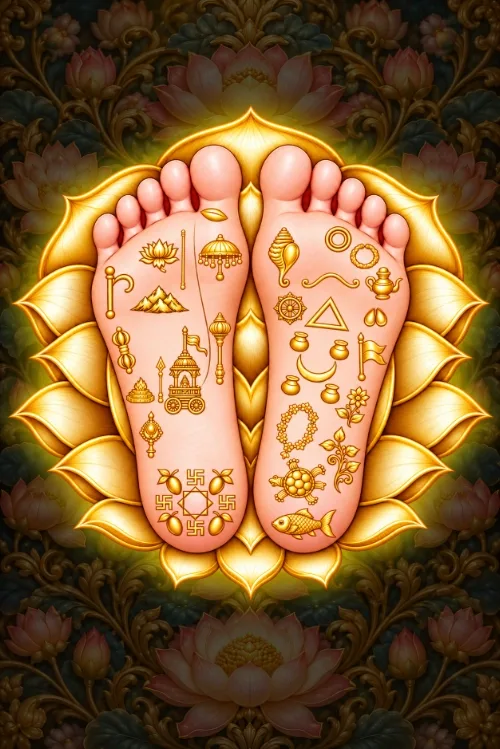
The sacred footprints of Śrī Caitanya Mahāprabhu, their scriptural origins, their connection with Rādhā and Kṛṣṇa, and the extraordinary mercy they reveal.
When the infant Nimāi began moving about His parents’ home in Navadvīpa, something astonishing appeared on the floor: tiny footprints bearing unmistakable divine symbols. Among them were a conchshell, a disc, a thunderbolt, a flag, and a fish. His parents were bewildered. Whose footprints were these, and how had they appeared inside their house?
The mystery was soon revealed. The same extraordinary markings adorned the tender soles of their own child.
For Gauḍīya Vaiṣṇavas, this episode is far more than a charming childhood miracle. It reveals the hidden identity of Śrī Caitanya Mahāprabhu, whom the tradition understands to be Kṛṣṇa Himself, appearing with the loving mood and golden radiance of Śrīmatī Rādhārāṇī.
An elaborate devotional tradition describes thirty-two auspicious markings on Gaurāṅga’s lotus feet—sixteen on each sole. They include symbols of divine sovereignty, protection, purity, spiritual abundance, transcendental beauty, and loving service.
An even more intriguing pattern emerges when these markings are compared with those of Rādhā and Kṛṣṇa. Traditional descriptions identify nineteen auspicious marks on Kṛṣṇa’s feet and nineteen on Rādhā’s. Every symbol in those two catalogs also appears in the expanded thirty-two-mark list associated with Gaurāṅga, though not necessarily on the same foot.
The correspondence is theologically suggestive. Yet understanding it requires distinguishing what the scriptures explicitly state, what classical commentators explain, and what later devotional compilations preserve.
The deeper purpose of these markings, however, lies beyond their number or arrangement. They reveal why the lotus feet of the Lord are celebrated as the soul’s highest refuge—and why Gaurāṅga’s feet, in particular, are regarded as an extraordinary gateway to the love of Rādhā and Kṛṣṇa.
1. The Greatest Treasure: Gaurāṅga’s Two Lotus Feet
Śrīla Narottama Dāsa Ṭhākura, one of the great poet-saints of the Gauḍīya Vaiṣṇava tradition, places Gaurāṅga’s feet at the very center of spiritual life.
In his celebrated Bengali song Gaurāṅgera Duṭi Pada, preserved in Prārthanā, he sings:
gaurāṅgera duṭi pada, jāra dhana sampada
se jāne bhakati-rasa-sāra
gaurāṅgera madhura-līlā, jāra karṇe praveśilā
hṛdaya nirmala bhela tāra
Whoever regards the two lotus feet of Lord Gaurāṅga as their greatest wealth and treasure understands the very essence of devotional love. Whoever hears His sweet divine pastimes finds the heart purified.
The expression dhana-sampada means wealth, property, or treasured possessions. Narottama deliberately transforms the ordinary understanding of prosperity. Material wealth must be accumulated, maintained, defended, and eventually relinquished. The wealth of devotion is different. It consists of a relationship with the Supreme Lord that is not destroyed by time.
The phrase bhakati-rasa-sāra is even more significant. Bhakti means devotion, rasa refers to the experienced essence or relational flavor of spiritual love, and sāra means its essential substance.
Narottama is therefore making a profound theological statement: shelter at Gaurāṅga’s lotus feet leads toward an understanding of the deepest spiritual relationships revealed in Gauḍīya Vaiṣṇava literature.
The second half of the stanza introduces another principle. Hearing the Lord’s sweet pastimes purifies the heart. Devotional realization is not merely intellectual. It develops through hearing, remembrance, affection, service, and the gradual transformation of consciousness.
The lotus feet consequently represent more than an object of sacred contemplation. They signify shelter, surrender, spiritual identity, and entrance into a living relationship with the Supreme Lord.
2. The Mysterious Footprints in Jagannātha Miśra’s House
One of the clearest scriptural descriptions of Gaurāṅga’s divine footmarks appears in Śrī Caitanya-caritāmṛta, Ādi-līlā, Chapter 14.
Śrī Caitanya Mahāprabhu had appeared in Navadvīpa as the beloved son of Śacī-devī and Jagannātha Miśra. Affectionately called Nimāi, He delighted His parents through His apparently ordinary childhood activities. Yet extraordinary manifestations of His identity occasionally appeared within the intimacy of family life.
One day, His parents discovered tiny footprints inside their home.
gṛhe dui jana dekhi laghu-pada-cihna
tāhe śobhe dhvaja, vajra, śaṅkha, cakra, mīna
The two parents noticed small footprints inside their home, beautifully adorned with the marks of a flag, thunderbolt, conchshell, disc, and fish.
Śrī Caitanya-caritāmṛta, Ādi-līlā 14.7
These five symbols are explicitly identified in the original narrative. They are not later decorative additions or speculative interpretations.
Astonished, the parents wondered whose footprints they could be. Jagannātha Miśra suggested that the household’s worshipable Lord, present with their śālagrāma-śilā, might have manifested in the form of child Kṛṣṇa and begun playing in the room.
Then, while Śacī-devī was nursing Nimāi, she noticed the same extraordinary symbols upon His own soles.
stana piyāite putrera caraṇa dekhila
sei cihna pāye dekhi’ miśre bolāila
While nursing her son, Śacī noticed those same markings on His feet and immediately called Jagannātha Miśra.
Śrī Caitanya-caritāmṛta, Ādi-līlā 14.11
Seeing the signs, Jagannātha Miśra became joyful and privately summoned Nīlāmbara Cakravartī, the learned astrologer and Nimāi’s maternal grandfather.
Nīlāmbara had previously calculated the child’s birth horoscope. Examining the markings, he recognized the bodily characteristics associated with an extraordinary personality.
His conclusion is recorded in Ādi-līlā 14.16.
nārāyaṇera cihna-yukta śrī-hasta caraṇa
ei śiśu sarva loke karibe tāraṇa
This child’s palms and soles bear the auspicious signs of Lord Nārāyaṇa. This child will deliver all three worlds.
This prediction contains two remarkable ideas.
First, the child’s hands and feet both display divine characteristics. This scriptural statement provides an important foundation for studying Gaurāṅga’s lotus hands alongside His lotus feet.
Second, the outward signs of divinity are directly connected to His future mission. The child whose body bears the emblems of Nārāyaṇa will become the great teacher of devotion, spreading the chanting of the holy names and awakening spiritual love.
Yet the setting is strikingly intimate. The Supreme Lord is not revealing His power from a celestial throne or upon a battlefield. He is resting in His mother’s lap.
The markings disclose His divine majesty, but His parents continue to relate to Him through profound parental affection. The combination of divine greatness and intimate sweetness is one of the defining characteristics of Gauḍīya Vaiṣṇava theology.
3. Three Different Enumerations: Thirty-Two, Thirty-Two, and Forty-Four
The childhood narrative introduces an important distinction that must not be overlooked.
Three different groups of auspicious characteristics are associated with Gaurāṅga in the scriptures and devotional literature.
These are separate enumerations, not contradictory accounts of the same marks. Their evidentiary foundations also differ.
The thirty-two bodily characteristics
In Caitanya-caritāmṛta, Ādi-līlā 14.14–15, Nīlāmbara identifies the thirty-two characteristics of a mahāpuruṣa, a great or extraordinary personality.
The classification is quoted from the traditional literature known as Sāmudrika, which concerns the interpretation of bodily characteristics.
pañca-dīrghaḥ pañca-sūkṣmaḥ
sapta-raktaḥ ṣaḍ-unnataḥ
tri-hrasva-pṛthu-gambhīro
dvātriṁśal-lakṣaṇo mahān
A great personality possesses thirty-two distinguishing bodily characteristics: five elongated, five delicate, seven reddish, six elevated, three short, three broad, and three deep.
The five elongated characteristics include the nose, arms, chin, eyes, and knees. The five delicate features concern the skin, fingertips, teeth, body hair, and hair of the head.
The seven reddish features include the eyes, soles, palms, palate, nails, and lips. The other categories concern elevated, short, broad, and deep features, including such qualities as the depth of the navel and voice.
These characteristics are distributed across the body. They are not thirty-two individual emblems upon the soles.
Within the traditional system of physiognomy, they signify an extraordinary personality. Their presence does not, by itself, constitute a philosophical proof of divinity; the theological identification of Caitanya Mahāprabhu rests upon a wider body of scriptural testimony.
The thirty-two footmarks
A separate devotional catalog associates sixteen emblematic markings with Gaurāṅga’s right sole and sixteen with His left.
The Caitanya-caritāmṛta explicitly confirms the presence of divine marks upon His feet, but the childhood narrative does not enumerate all thirty-two.
The complete arrangement is preserved in later and currently circulating devotional compilations. Its exact original Sanskrit or Bengali textual source has not yet been conclusively established.
The forty-four handmarks
Another extended devotional catalog describes twenty-one auspicious marks on Gaurāṅga’s left palm and twenty-three on His right, for a total of forty-four.
This enumeration is associated with sacred images of His hands and includes finger-tip emblems, objects of sovereignty, divine weapons, auspicious animals, and distinctive palm lines.
Here again, the distinction between scriptural testimony and an extended iconographic catalog is necessary. Ādi-līlā 14.16 explicitly states that His hands bear the signs of Nārāyaṇa, but it does not enumerate all forty-four.
The three traditional numbers therefore describe different categories:
Thirty-two bodily characteristics, thirty-two footmarks, and forty-four handmarks
Their numerical similarity or difference should not be mistaken for a contradiction.
4. The Thirty-Two Auspicious Marks on Gaurāṅga’s Lotus Feet
The traditional devotional depiction distributes thirty-two named emblems equally between Gaurāṅga’s two feet.
The following catalog preserves that arrangement.
The Sanskrit designations are names of the corresponding objects, not a recovered Sanskrit verse listing all thirty-two marks. Some English labels are interpretive, and some compound arrangements are counted as a single category.
The right lotus foot: Sixteen auspicious marks
Lotus — Padma or kamala
Stick or staff — Daṇḍa
Upcurving or rising line — Ūrdhva-rekhā
Barleycorn — Yava
Umbrella — Chatra
Mountain — Parvata
Elephant goad — Aṅkuśa
Thunderbolt — Vajra
Chariot — Ratha
Spear — Śakti or śūla, depending on form
Sacrificial altar — Yajña-vedī
Club — Gadā
Earrings — Kuṇḍala
Svastika symbols — Svastika
Jambū fruits — Jambū-phala
Octagon — Aṣṭakoṇa
The left lotus foot: Sixteen auspicious marks
Conchshell — Śaṅkha
Sky or space — Ākāśa
Jeweled bangle — Ratna-valaya
Pitchers — Kalaśa
Unstrung bow — Dhanus
Disc — Cakra
Cow’s hoofprint — Goṣpada
Triangle — Trikoṇa
Half-moon — Ardha-candra
Waterpots — Jala-kumbha
Victory flag — Dhvaja
Flower — Puṣpa
Flowering twig — Puṣpa-pallava
Flower garland — Puṣpa-mālā
Tortoise — Kūrma
Fish — Matsya or mīna
Important details about the catalog
The number thirty-two refers to thirty-two named categories or arrangements. It does not necessarily mean thirty-two individual impressions. Four svastikas, several fruits, or a group of vessels may be treated as one named category within the enumeration.
Some editions call the earrings Kunda Earrings. The securely identifiable Sanskrit designation is kuṇḍala, meaning an earring. The more specific label should be understood as a traditional descriptive variant unless its exact textual form is established.
Similarly, the catalog lists pitchers and waterpots separately. Both terms can describe related kinds of vessels, and their precise distinction in this particular image has not been independently established. Preserving both entries maintains the transmitted thirty-two-item arrangement without inventing a difference that may not be present in the original source.
The fruits sometimes called blackberries are more accurately understood as jambū fruits, commonly identified with Indian jamun, the dark-purple fruit of Syzygium cumini.
The svastika is an ancient Indian emblem of auspiciousness and well-being. Its sacred significance long predates its appropriation by the Nazi movement.
Finally, the list identifies which foot traditionally bears each symbol. It should not be used to impose a precise placement upon every form of the Lord. Different sacred descriptions and devotional diagrams preserve different arrangements.
5. The Remarkable Connection Between Gaurāṅga, Rādhā, and Kṛṣṇa
The thirty-two markings become especially interesting when compared with the traditional descriptions of the feet of Śrī Kṛṣṇa and Śrīmatī Rādhārāṇī.
The three enumerations are:
Śrī Kṛṣṇa
Śrī Rādhā
Śrī Gaurāṅga
Kṛṣṇa’s nineteen marks are described in the Gauḍīya commentarial tradition, particularly in explanations of Śrīmad-Bhāgavatam 10.30.25 and in Viśvanātha Cakravartī Ṭhākura’s Śrī Rūpa-cintāmaṇi.
The tradition associated with Rūpa Gosvāmī’s Ujjvala-nīlamaṇi describes Rādhā’s nineteen marks, as quoted in the commentary on Śrīmad-Bhāgavatam 10.30.28. They are also celebrated in Śrī Rūpa-cintāmaṇi.
The comparison reveals something striking. All the emblems found in the nineteen-mark catalogs of Rādhā and Kṛṣṇa appear somewhere within the thirty-two-mark catalog of Gaurāṅga.
But their placement is not identical.
How the marks change sides
Lotus
Disc
Conchshell
Flag
Elephant goad
Fish
Barleycorn
Half-moon
Sacrificial altar
Jeweled bangle
These differences are important. The disc on Kṛṣṇa’s right foot should not be moved to His left merely because a Gaurāṅga diagram places it there. Likewise, the fish belongs to Rādhā’s right foot in the traditional nineteen-mark arrangement, but to Kṛṣṇa’s and Gaurāṅga’s left feet.
The same symbol may appear in different locations without implying that one depiction must be incorrect.
The expanded Gaurāṅga catalog also includes four entries not separately named in the combined Rādhā-Kṛṣṇa lists: a staff, pitchers distinguished from waterpots, a flower garland, and a tortoise.
This observation depends upon treating pitchers and waterpots as separate catalog entries, as the transmitted thirty-two-item list does. If the two labels ultimately refer to one emblem, the numerical comparison would require refinement.
Does Gaurāṅga literally possess the combined footmarks of Rādhā and Kṛṣṇa?
The correspondence invites a beautiful theological reflection, but it requires precision.
Gauḍīya Vaiṣṇava theology identifies Gaurāṅga as Kṛṣṇa appearing in Rādhā’s loving mood and golden complexion. The expanded footmark catalog can therefore be contemplated as a devotional expression of the unity of Rādhā and Kṛṣṇa in Caitanya Mahāprabhu.
However, the numerical pattern does not establish that His feet are literally an anatomical addition of Their individual footmarks.
The thirty-two-mark arrangement is an extended devotional catalog whose exact primary source remains uncertain. Explicit theological texts independently support the theological unity of Rādhā and Kṛṣṇa in Caitanya Mahāprabhu.
Thus the relationship between the lists is best understood as a meaningful iconographic correspondence, not a mathematical proof of divine identity.
6. Kṛṣṇa’s Nineteen Footmarks: Recognized by the Gopīs
The sacred symbols on Gaurāṅga’s feet belong to a much older Vaiṣṇava tradition describing Kṛṣṇa’s divine footprints.
One of the most beautiful examples appears in the Tenth Canto of the Śrīmad-Bhāgavatam.
During the rāsa-līlā in Vṛndāvana, Kṛṣṇa disappears from the gopīs’ company. Overwhelmed by separation, they wander through the forests, asking the trees, creepers, and other inhabitants of Vraja whether they have seen their beloved.
Eventually, they discover footprints in the forest dust.
padāni vyaktam etāni
nanda-sūnor mahātmanaḥ
lakṣyante hi dhvajāmbhoja-
vajrāṅkuśa-yavādibhiḥ
These footprints clearly belong to Nanda’s glorious son. They are recognizable by the marks of a flag, lotus, thunderbolt, elephant goad, barleycorn, and other auspicious symbols.
Śrīmad-Bhāgavatam 10.30.25
The gopīs recognize Kṛṣṇa without seeing Him. His feet have left signs upon the earth that cannot be mistaken for those of an ordinary person.
The five specifically named emblems—flag, lotus, thunderbolt, elephant goad, and barleycorn—form part of the wider nineteen-mark description preserved in the commentarial tradition.
Eleven marks on Kṛṣṇa’s right foot
The traditional enumeration includes the lotus, rising line, barleycorn, disc, umbrella, elephant goad, thunderbolt, flag, svastikas, jambū fruits, and octagon.
The commentary explains that the disc lies near the base of the great toe, the lotus near the middle toe, and the thunderbolt near the small toe. Kṛṣṇa’s elephant goad is described as situated below the thunderbolt.
A rising line extends toward the space between the great and second toes. An umbrella appears below the disc, while a central arrangement of svastikas, fruits, and an octagonal figure forms a more elaborate pattern.
Eight marks on Kṛṣṇa’s left foot
The traditional enumeration consists of the conchshell, sky, unstrung bow, cow’s hoofprint, triangle, half-moon, waterpots, and fish.
The conchshell is positioned near the great toe. Two concentric circles represent the inner and outer sky. Beneath them appears Cupid’s unstrung bow, followed by the cow’s hoofprint and the triangular design associated with a group of waterpots.
The half-moon and fish complete the arrangement.
The cow’s hoofprint deserves particular attention. It appears in the traditional eight-item enumeration and explicitly in Śrī Rūpa-cintāmaṇi. It also appears in the expanded discussion of Viśvanātha Cakravartī’s commentary, though it is absent from the shortened left-foot enumeration in some published summaries.
Therefore, the complete traditional enumeration of Kṛṣṇa’s marks remains eleven on the right and eight on the left, nineteen altogether.
Yet the emotional force of the Bhāgavatam passage goes far beyond the number of symbols.
The gopīs are not examining sacred geometry. They are searching for someone they love. Each mark in the dust reminds them of Kṛṣṇa and deepens their longing for Him.
The footprints become evidence of His presence even during His apparent absence.
That is the true devotional significance of recognizing the marks.
7. Rādhā’s Nineteen Footmarks: The Beloved Who Accompanied Kṛṣṇa
As the gopīs continue searching the forests, they find another set of footprints beside Kṛṣṇa’s.
They realize that one especially fortunate companion has been singled out for His intimate attention.
anayārādhito nūnaṁ
bhagavān harir īśvaraḥ
yan no vihāya govindaḥ
prīto yām anayad rahaḥ
Certainly this fortunate gopī has perfectly worshiped Lord Hari, for Govinda was so pleased with Her that He left the others and took Her to a secluded place.
Śrīmad-Bhāgavatam 10.30.28
The verse does not explicitly name Rādhā. Nevertheless, Gauḍīya commentators understand the expression anayārādhitaḥ—“by Her He has been perfectly worshiped”—as a concealed indication of Śrīmatī Rādhārāṇī.
Viśvanātha Cakravartī Ṭhākura explains that Śukadeva Gosvāmī carefully concealed Her identity, yet Her name shines through the verse’s wording.
In the commentary to this passage, a detailed account of Rādhā’s footprints is preserved, attributed to Rūpa Gosvāmī’s Ujjvala-nīlamaṇi.
Eleven marks on Rādhā’s left foot
The marks are the barleycorn, disc, rising line, lotus, umbrella, elephant goad, flag, jeweled bangle, flower, flowering creeper, and half-moon.
The barleycorn is situated near the great toe, followed by the disc and umbrella. A bracelet or bangle appears below the umbrella. A rising line extends toward the space between the great and second toes.
The lotus, flag, flowering creeper, elephant goad, and half-moon complete the arrangement.
Eight marks on Rādhā’s right foot
These are the sacrificial altar, mountain, conchshell, earring, club, chariot, spear, and fish.
The conchshell appears near the great toe. A spear is positioned beneath it, while the sacrificial altar, earring, and club are associated with the region beneath the smaller toes.
The mountain and chariot occupy another part of the sole, and the fish is situated upon the heel.
These nineteen marks preserve Rādhā’s distinct iconographic identity. They should not be rearranged simply to match the corresponding marks on Kṛṣṇa or Gaurāṅga.
The theological significance is equally important. The gopīs’ recognition of Rādhā’s footprints does not introduce a competing divine presence. Instead, it reveals the extraordinary intimacy of Rādhā’s relationship with Kṛṣṇa.
The footprints of the divine couple are associated with the deepest dimension of the Vraja pastimes: loving attraction, separation, remembrance, and reunion.
Within Gauḍīya devotion, this prepares the way for understanding Caitanya Mahāprabhu as the one in whom Rādhā and Kṛṣṇa are united.
8. Akrūra’s Encounter with Kṛṣṇa’s Footprints
Another powerful description of divine footmarks appears in Śrīmad-Bhāgavatam 10.38.25–27.
Akrūra was traveling from Mathurā to Vraja to bring Kṛṣṇa and Balarāma to Kaṁsa’s court. Although his journey began at the wicked king’s command, Akrūra was a devoted servant of the Lord.
Throughout the journey, he meditated upon the extraordinary blessing of seeing Kṛṣṇa.
When he arrived at the cow pastures of Vraja, he discovered something that overwhelmed his heart.
padāni tasyākhila-loka-pāla-
kirīṭa-juṣṭāmala-pāda-reṇoḥ
dadarśa goṣṭhe kṣiti-kautukāni
vilakṣitāny abja-yavāṅkuśādyaiḥ
In the cow pastures, Akrūra saw the footprints of the Lord, whose pure foot-dust adorns the crowns of the rulers of the universe. Distinguished by the lotus, barleycorn, elephant goad, and other auspicious signs, those footprints wonderfully beautified the earth.
Śrīmad-Bhāgavatam 10.38.25
The imagery is extraordinary.
The rulers of the universe, powerful beings who govern cosmic affairs, honor the dust of Kṛṣṇa’s feet upon their crowns. Yet that very dust is found upon the simple ground of Vraja, where the Lord walks among cows and cowherd companions.
Supreme majesty and pastoral intimacy meet within the same scene.
The following verse describes Akrūra’s response.
tad-darśanāhlāda-vivṛddha-sambhramaḥ
premṇordhva-romāśru-kalākulekṣaṇaḥ
rathād avaskandya sa teṣv aceṣṭata
prabhor amūny aṅghri-rajāṁsy aho iti
Overwhelmed with joy upon seeing the Lord’s footprints, his bodily hairs standing on end through love and his eyes filled with tears, Akrūra descended from his chariot and rolled upon the ground, exclaiming, “Ah! This is the dust from my Lord’s feet!”
Śrīmad-Bhāgavatam 10.38.26
Akrūra did not treat the footprints as merely extraordinary physical evidence. He perceived them through devotion.
The dust was precious because it had touched Kṛṣṇa. The marks awakened remembrance, and remembrance awakened an uncontrollable expression of love.
The following verse, 10.38.27, explains that such absorption in the Lord is the true fulfillment of embodied existence. Through his devotion, Akrūra abandoned pride, fear, and sorrow.
This episode establishes a central principle of Vaiṣṇava spirituality: the Lord can be remembered through things directly associated with Him.
Sacred places, the dust of Vraja, worshipable images, remnants of offerings, and the Lord’s footprints acquire spiritual significance through their relationship with the Supreme.
Their greatness is relational rather than merely material.
9. The Classical Symbolism of the Sacred Footmarks
The symbolic interpretation of divine footmarks is not solely a modern devotional exercise.
Classical Vaiṣṇava commentaries preserve specific explanations of several markings, particularly those associated with Kṛṣṇa’s feet.
In his commentary on Śrīmad-Bhāgavatam 10.30.25, Viśvanātha Cakravartī Ṭhākura draws upon passages attributed to the Skanda Purāṇa and descriptions preserved in the Vaiṣṇava-toṣaṇī tradition.
These sources offer a theological foundation for understanding similar marks associated with Gaurāṅga.
However, a distinction is necessary: a meaning or anatomical position established for Kṛṣṇa’s footmark should not automatically be transferred to Gaurāṅga’s foot as a literal description.
The disc: Destroying the six internal enemies
dakṣiṇasya padāṅguṣṭha-
mūle cakraṁ bibharty ajaḥ
tatra bhakta-janasyāri-
ṣaḍ-varga-cchedanāya saḥ
At the base of His right great toe, the unborn Lord bears a disc that destroys the six enemies of His devotees.
The six enemies, commonly called ṣaḍ-ripu, are lust (kāma), anger (krodha), greed (lobha), delusion (moha), pride (mada), and envy (mātsarya).
These enemies are not external adversaries. They are destructive tendencies within the conditioned mind.
The disc therefore represents divine power at work in the devotee’s life. Just as the Lord’s weapon overcomes hostile forces, His grace destroys the internal obstacles that prevent the development of pure devotion.
In the classical passage, the disc is specifically associated with Kṛṣṇa’s right sole. The expanded Gaurāṅga catalog places the disc on His left sole. The shared spiritual meaning does not require identical placement.
The lotus: Attracting the bee-like mind
madhyamāṅguli-mūle ca
dhatte kamalam acyutaḥ
dhyātṛ-citta-dvirephāṇāṁ
lobhanāyāti-śobhanām
At the base of His middle toe, Lord Acyuta bears a beautiful lotus that attracts the bee-like minds of devotees who meditate upon His feet.
The image is delicate and psychologically profound.
The mind is compared to a bee wandering among flowers in search of nectar. Ordinarily, it moves from object to object, seeking pleasure, satisfaction, and security.
When attracted to the Lord’s lotus feet, that same tendency toward attachment becomes redirected toward the Supreme.
Devotion is therefore not simply suppressing desire. It is the transformation of desire.
The lotus represents the beauty of divine attraction, through which the wandering mind gradually discovers its highest object of love.
The thunderbolt: Shattering the mountain of sin
kaniṣṭha-mūlato vajraṁ
bhakta-pāpādri-bhedanam
At the base of His little toe is the thunderbolt, which shatters the mountain of His devotees’ sinful reactions.
The Sanskrit compound pāpādri combines pāpa, sin or sinful reactions, with adri, mountain.
The image suggests a burden so enormous and deeply established that individual effort seems incapable of removing it.
The vajra, or thunderbolt, symbolizes irresistible divine power. Here, it is not destruction for its own sake, but the removal of forces that obstruct the devotee’s spiritual life.
The teaching is that divine mercy can overcome obstacles beyond the conditioned soul’s strength.
The elephant goad: Guiding the restless mind
Another passage associates the elephant goad with the mind.
pārṣṇi-madhye ’ṅkuśaṁ bhakta-
cittebha-vaśa-kāriṇam
In the middle of the heel is an elephant goad that brings the elephant-like minds of devotees under control.
The comparison is unmistakable. The uncontrolled mind resembles a powerful elephant—restless, difficult to restrain, and capable of great destruction.
The aṅkuśa, an instrument used to guide elephants, symbolizes the Lord’s ability to bring the mind under spiritual direction.
But an important distinction follows in the same commentarial discussion.
vajraṁ vai dakṣiṇe pārśve
aṅkuśo vai tad-agrataḥ
The thunderbolt is situated on the right side of His right foot, with the elephant goad placed before it.
The Vaiṣṇava ācāryas clarify that Kṛṣṇa’s elephant goad is situated below the thunderbolt on His right foot. The goad situated upon the heel belongs rather to Nārāyaṇa and other viṣṇu-tattva manifestations in the arrangement under discussion.
This is a subtle but important iconographic distinction.
It does not alter the elephant goad’s spiritual symbolism. The emblem still represents the Lord’s control over the elephant-like mind.
In devotional life, that control is cultivated through hearing, chanting, remembering, and serving the Supreme Lord. The mind gradually becomes steady not merely because it is restrained, but because it develops a higher attachment.
The barleycorn: The abundance of divine shelter
A further verse describes the barleycorn.
bhoga-sampan-mayaṁ dhatte
yavam aṅguṣṭha-parvaṇi
Upon the joint of His great toe, the Lord bears a barleycorn, representing abundance and enjoyable prosperity.
Barley has long been associated with nourishment, agricultural abundance, and sacred offerings.
The mark therefore suggests prosperity under divine shelter.
In devotional interpretation, such prosperity need not be limited to worldly enjoyment. Its highest expression is the nourishment of spiritual life: faith, remembrance, service, association with devotees, and the gradual awakening of love.
The classical descriptions demonstrate that sacred markings are more than decorative designs. They express the Lord’s qualities and His active relationship with those who seek His shelter.
10. The Sixteen Marks on Gaurāṅga’s Right Foot: Protection, Guidance, and Divine Power
The following interpretations combine meanings established in classical Vaiṣṇava discussions with broader devotional reflection.
Where no independently verified textual explanation is available for a particular Gaurāṅga footmark, its interpretation is presented as contemplative rather than as a direct scriptural definition.
1. Lotus — Padma
The lotus grows in water and mud yet blossoms without being stained by them. It represents purity, transcendental beauty, and the possibility of remaining spiritually untouched by material contamination.
In Vaiṣṇava literature, lotus imagery also conveys exceptional softness, fragrance, and attractiveness. The Lord’s feet are compared to lotuses because they are supremely beautiful and because devotion to them draws the heart toward transcendence.
2. Staff — Daṇḍa
A staff suggests discipline, guidance, protection, and authority. It can symbolize the need to bring one’s life under spiritual direction rather than remain subject to uncontrolled desires.
In the context of Caitanya Mahāprabhu, the emblem can also invite reflection upon His later acceptance of renunciation, although a direct textual interpretation connecting this particular footmark with His sannyāsa has not been established.
3. Rising Line — Ūrdhva-rekhā
The word ūrdhva means upward, while rekhā means a line or marking.
The rising line can be contemplated as an emblem of spiritual elevation—the movement of consciousness from material identification toward its relationship with the Supreme.
In the classical descriptions of Kṛṣṇa’s feet, the line possesses a specific anatomical position. Its symbolic interpretation should be distinguished from that physical description.
4. Barleycorn — Yava
Barley symbolizes nourishment, abundance, prosperity, and sacrificial offerings.
Classical commentary connects it with enjoyable opulence. In devotional reflection, it also suggests that the Lord sustains not merely the body but the spiritual life of those who seek His shelter.
The smallest grain can therefore become an emblem of divine generosity.
5. Umbrella — Chatra
The royal parasol is an ancient symbol of sovereignty and protection.
Placed upon the Lord’s feet, it recalls His willingness to shelter those who surrender to Him. Just as an umbrella protects a traveler from the burning sun, divine mercy offers refuge from the distress of material existence.
The symbol combines majesty with compassion: the Supreme Lord possesses unlimited authority, yet His authority becomes a source of protection for His devotees.
6. Mountain — Parvata
A mountain suggests stability, strength, endurance, and immovable support.
For devotees of Kṛṣṇa, it can also recall the lifting of Govardhana Hill, when the Lord protected the inhabitants of Vraja from Indra’s devastating storm.
As an interpretive association, the mountain illustrates divine strength expressed through loving protection rather than merely overwhelming power.
7. Elephant Goad — Aṅkuśa
The elephant goad represents the Lord’s ability to guide and steady the restless mind.
Its classical symbolism is directly established in the descriptions of divine footmarks associated with Kṛṣṇa and Nārāyaṇa.
Upon Gaurāṅga’s foot, it naturally recalls the transformation brought about through nāma-saṅkīrtana. The wandering mind gradually becomes concentrated through attraction to Kṛṣṇa’s holy names.
8. Thunderbolt — Vajra
The thunderbolt symbolizes irresistible spiritual power.
Classical explanation associates it with destroying mountains of sinful reactions. Applied devotionally to Gaurāṅga, it recalls His ability to overcome obstacles that seem insurmountable through human effort alone.
His power, however, is expressed most characteristically through mercy, purification, and the awakening of devotion.
9. Chariot — Ratha
A chariot suggests movement, purposeful action, and divine guidance.
It may recall Kṛṣṇa’s role as Arjuna’s charioteer in the Bhagavad-gītā, when the Supreme Lord guided His devotee through a profound moral and spiritual crisis.
The emblem can also suggest that the spiritual path requires direction. Movement alone is not progress; the destination and the guiding intelligence determine its value.
10. Spear — Śakti or Śūla
The spear symbolizes penetrating power and the removal of opposition.
As devotional imagery, it can represent the Lord’s ability to pierce ignorance, confusion, and deeply rooted misconception.
The exact Sanskrit name should be determined from the emblem’s original form when that becomes available. A spear, lance, and trident are not necessarily interchangeable in classical iconography.
11. Sacrificial Altar — Yajña-vedī
The sacrificial altar is the place where offerings are consecrated.
Its spiritual significance points toward the transformation of action through dedication to the Supreme.
In Gauḍīya Vaiṣṇava practice, the principle of sacrifice culminates in activities performed for Kṛṣṇa’s pleasure. Caitanya Mahāprabhu especially emphasized chanting the holy names as the appropriate spiritual sacrifice for the age of Kali.
12. Club — Gadā
The club is one of Lord Viṣṇu’s traditional attributes.
It represents divine strength, authority, and the power to uphold spiritual order.
On Gaurāṅga’s foot, the emblem evokes the majesty of Nārāyaṇa, whose divine characteristics are explicitly recognized in the childhood account of Caitanya Mahāprabhu.
It also reminds us that the gentle golden Lord possesses the complete power of the Supreme.
13. Earrings — Kuṇḍala
Earrings represent beauty, ornamentation, and the personal splendor of the divine form.
They invite contemplation not merely of divine authority but of divine attractiveness.
The mark also appears in the traditional description of Rādhā’s right foot, providing another point of correspondence between Her catalog and that associated with Gaurāṅga.
14. Svastikas — Svastika
The svastika is an ancient emblem of auspiciousness and well-being.
Its fourfold geometric structure can evoke harmony, favorable fortune, and protection extending in every direction.
Classical descriptions of Kṛṣṇa’s right foot mention four svastikas arranged around a central pattern. Their appearance in Gaurāṅga’s catalog belongs to that same broad language of sacred auspicious signs.
15. Jambū Fruits — Jambū-phala
The jambū fruit is associated with sweetness, nourishment, and the traditional cosmographical name Jambūdvīpa.
In devotional contemplation, the fruit may evoke the sweetness that matures through loving service.
Its association with Jambūdvīpa also reminds us that divine mercy extends to the world inhabited by conditioned living beings.
16. Octagon — Aṣṭakoṇa
The octagon is an eight-sided geometric emblem.
In classical descriptions of Kṛṣṇa’s footmarks, it appears in the center of a larger arrangement of svastikas and fruits.
Its eightfold structure can suggest completeness and the eight directions, inviting contemplation of divine protection and sovereignty extending everywhere.
Such directional symbolism is a devotional interpretation rather than a separately verified explanation of this specific Gaurāṅga emblem.
11. The Sixteen Marks on Gaurāṅga’s Left Foot: Mercy, Beauty, and Spiritual Fulfillment
The left-foot catalog contains symbols associated with divine sovereignty, the intimate world of Vraja, transcendental beauty, and the soul’s spiritual destination.
1. Conchshell — Śaṅkha
The conchshell is a traditional attribute of Lord Viṣṇu and an emblem of divine proclamation.
Its sound announces auspicious beginnings and sacred ceremonies. It is also associated with protection and victory.
In the context of Caitanya Mahāprabhu, the conch can recall the call of nāma-saṅkīrtana, through which the holy names of Hari are proclaimed for the world’s spiritual benefit.
2. Sky or Space — Ākāśa
The sky represents vastness, openness, and immeasurable extension.
In the classical description of Kṛṣṇa’s left foot, the mark consists of two concentric circles representing inner and outer space.
As a contemplative emblem, it may suggest that divine reality exceeds the limitations of material perception while remaining accessible through loving devotion.
3. Jeweled Bangle — Ratna-valaya
A jeweled bangle represents beauty, preciousness, and ornamentation.
Its presence in both Rādhā’s and Gaurāṅga’s traditional catalogs offers a particularly attractive point of comparison.
Within devotional reflection, the bangle may signify the incomparable value of spiritual love, which Gauḍīya theology considers greater than material wealth, heavenly enjoyment, or impersonal liberation.
4. Pitchers — Kalaśa
Sacred pitchers are associated with auspicious ceremonies, abundance, purification, and hospitality.
They may symbolize the overflowing generosity of divine grace.
This catalog lists pitchers separately from waterpots. Until their precise iconographic distinction is established, both entries should be preserved without assigning them artificially different theological meanings.
5. Unstrung Bow — Dhanus
The unstrung bow represents power held in reserve.
In the classical description of Kṛṣṇa’s footmarks, it is identified with Cupid’s bow, introducing the theme of attraction.
For Gauḍīya Vaiṣṇavas, this imagery can invite reflection upon the transcendental attraction of divine love, which is fundamentally different from ordinary material desire.
The Lord attracts the soul not merely through majesty or command, but through beauty, sweetness, and loving reciprocation.
6. Disc — Cakra
The disc represents divine power, protection, and the destruction of forces hostile to devotion.
Classical commentary identifies it with the removal of six internal enemies: lust, anger, greed, delusion, pride, and envy.
The placement differs among the traditional catalogs. Kṛṣṇa bears it on His right foot, while Rādhā and Gaurāṅga are depicted with it on Their left feet.
Its meaning is connected with divine purification; its location must be understood within the particular depiction being discussed.
7. Cow’s Hoofprint — Goṣpada
The cow’s hoofprint is especially meaningful in Vraja’s pastoral world.
Kṛṣṇa lives among cows, calves, cowherd boys, and gopīs. The hoofprint therefore recalls the intimate environment of His childhood pastimes.
It also introduces a profound scriptural metaphor: through shelter at the Lord’s lotus feet, the ocean of material existence becomes no greater than water collected in a calf’s hoofprint.
The image connects the ordinary landscape of Vraja with the highest promise of spiritual liberation.
8. Triangle — Trikoṇa
The triangle represents ordered form and geometric completeness.
It appears in the classical descriptions of Kṛṣṇa’s left foot, associated with a group of waterpots and the half-moon.
Without a separately verified textual explanation for its metaphysical significance on Gaurāṅga’s foot, elaborate interpretations involving particular cosmic energies or esoteric doctrines should remain tentative.
9. Half-Moon — Ardha-candra
The half-moon evokes coolness, gentleness, beauty, and soothing illumination.
Indian devotional literature frequently employs moonlight as an image of relief from heat and distress.
The emblem may therefore suggest the Lord’s mercy, which cools the burning anxieties of material existence.
It also appears among the symbols on both Rādhā’s and Gaurāṅga’s left feet.
10. Waterpots — Jala-kumbha
Waterpots are associated with sacred purification, hospitality, nourishment, and abundance.
In the classical description of Kṛṣṇa’s left foot, several waterpots surround the triangular mark.
Within Gaurāṅga’s catalog, the emblem can be contemplated as a reminder of spiritual nourishment and the overflowing gifts of divine grace.
The distinction between this entry and the separately listed pitchers remains a question of textual and iconographic identification.
11. Victory Flag — Dhvaja
A flag announces victory, sovereignty, and a ruler’s presence.
On the Lord’s feet, it represents divine triumph and the assurance of protection.
For devotees of Caitanya Mahāprabhu, the emblem can also evoke the victory of saṅkīrtana: the spiritual conquest of ignorance through the chanting of the holy names.
This victory is not principally military or political. Its highest expression is the transformation of consciousness through devotion.
12. Flower — Puṣpa
A flower embodies freshness, tenderness, fragrance, and beauty.
Flowers are among the simplest and most intimate offerings made in devotional worship.
The emblem recalls the principle that love gives an offering spiritual value. Its greatness does not depend upon material expense, but upon the devotion with which it is presented.
13. Flowering Twig — Puṣpa-pallava
A flowering twig suggests growth, renewal, and the gradual unfolding of beauty.
It can be contemplated as an image of devotion developing from a small beginning into mature spiritual love.
Within the broader Gauḍīya tradition, the flowering creeper also naturally recalls the bhakti-latā, the creeper of devotion, cultivated through hearing, chanting, and service.
This is a thematic association rather than a verified direct explanation of the particular footmark.
14. Flower Garland — Puṣpa-mālā
A flower garland is an offering of affection, respect, and intimate service.
Garlands appear repeatedly in the divine pastimes of Rādhā and Kṛṣṇa, where they participate in exchanges of beauty, friendship, and love.
On Gaurāṅga’s foot, the emblem can evoke the tenderness of devotional relationships and the transformation of ordinary objects into offerings of love.
15. Tortoise — Kūrma
The tortoise evokes steadiness, protection, patience, and endurance.
It also recalls Kūrma, the tortoise incarnation of Lord Viṣṇu, who supported Mount Mandara during the churning of the cosmic ocean.
As a devotional symbol, it may represent the firm support of divine shelter, even when surrounding circumstances appear unstable.
Its inclusion in the expanded Gaurāṅga catalog is notable because it is not separately named in the usual nineteen-mark lists of Rādhā and Kṛṣṇa.
16. Fish — Matsya or Mīna
The fish recalls Matsya, the divine incarnation associated with protection and preservation during a cosmic deluge.
More broadly, fish imagery suggests life sustained within water and the ability to move through dangerous currents.
Within devotional contemplation, it can represent the Lord’s capacity to carry the soul through the ocean of material existence.
The fish is also one of the five marks explicitly named in the childhood narrative of Gaurāṅga’s footprints in Caitanya-caritāmṛta 14.7.
Thus, unlike many more elaborate emblems, the primary narrative directly supports its presence on Gaurāṅga’s feet.
12. The Lotus Feet as a Boat Across the Ocean of Material Existence
The spiritual importance of divine footmarks becomes especially clear in one of the most celebrated verses of the Śrīmad-Bhāgavatam.
samāśritā ye pada-pallava-plavaṁ
mahat-padaṁ puṇya-yaśo murāreḥ
bhavāmbudhir vatsa-padaṁ paraṁ padaṁ
padaṁ padaṁ yad vipadāṁ na teṣām
For those who take shelter of the boat of the Lord’s tender lotus feet, the vast ocean of material existence becomes no greater than the water contained in a calf’s hoofprint. Their destination is the supreme abode, beyond the dangers and miseries encountered at every step in the material world.
Śrīmad-Bhāgavatam 10.14.58
The verse combines three powerful images.
First, the Lord’s feet are compared to tender lotus petals. The expression pada-pallava conveys their softness, beauty, and freshness.
Second, those same feet become a boat that carries the soul across the ocean of material existence.
Third, the seemingly endless ocean is reduced to a tiny amount of water collected in a calf’s hoofprint.
The contrast is deliberate.
Material existence appears vast and impossible to cross through independent effort. But when the soul obtains the Lord’s shelter, the scale of the difficulty changes entirely.
The word samāśritāḥ emphasizes taking refuge. The transformation is not simply intellectual; it rests upon a new relationship of dependence upon the Supreme.
The word vatsa-padam, meaning a calf’s hoofprint, is especially evocative when considered alongside the cow’s hoofprint included among the sacred markings of Kṛṣṇa and Gaurāṅga.
The imagery links spiritual liberation with the humble pastoral world of Vraja.
Yet the highest purpose of shelter is not merely freedom from suffering. The destination is paraṁ padam, the supreme spiritual abode, where the soul’s relationship of loving service to the Lord reaches fulfillment.
For Gauḍīya Vaiṣṇavas, that fulfillment ultimately finds its most intimate expression in the divine pastimes of Rādhā and Kṛṣṇa.
13. Why Gaurāṅga’s Lotus Feet Are the Lotus Feet of Kṛṣṇa
The reverence shown to Gaurāṅga’s lotus feet rests upon a central principle of Gauḍīya Vaiṣṇava theology: Caitanya Mahāprabhu is Kṛṣṇa Himself, appearing with the mood and golden complexion of Rādhā.
This understanding is expressed in one of the foundational theological verses of Śrī Caitanya-caritāmṛta.
rādhā kṛṣṇa-praṇaya-vikṛtir hlādinī śaktir asmād
ekātmānāv api bhuvi purā deha-bhedaṁ gatau tau
caitanyākhyaṁ prakaṭam adhunā tad-dvayaṁ caikyam āptaṁ
rādhā-bhāva-dyuti-suvalitaṁ naumi kṛṣṇa-svarūpam
Rādhā is the manifestation of Kṛṣṇa’s internal pleasure-giving potency. Although Rādhā and Kṛṣṇa are one in spiritual identity, They previously appeared in separate forms. Now They have manifested together as Śrī Caitanya, who is Kṛṣṇa Himself adorned with Rādhā’s loving mood and golden radiance. Unto Him I offer my obeisances.
Śrī Caitanya-caritāmṛta, Ādi-līlā 1.5
The verse introduces one of the deepest ideas in Gauḍīya theology.
Kṛṣṇa is the supreme object of love, while Rādhā embodies the highest perfection of love for Him.
Their relationship is understood not as an ordinary material romance but as the fullest expression of the Supreme Lord’s internal pleasure potency, known as hlādinī-śakti.
Although They are eternally one in spiritual reality, They appear as two divine personalities to exchange love.
In Caitanya Mahāprabhu, Their unity is revealed in a special form: Kṛṣṇa appears endowed with Rādhā’s loving mood and radiance.
This theological identity provides the deepest context for contemplating Gaurāṅga’s footmarks.
The thirty-two-mark catalog contains emblems associated with both Rādhā and Kṛṣṇa. Its numerical relationship with Their nineteen-mark descriptions is suggestive, but the doctrine of Their unity does not depend upon that numerical correspondence.
Rather, the scriptural teaching illuminates the devotional meaning of the imagery.
The child whose feet bear signs of divine sovereignty will later appear as an ecstatic devotee, chanting, dancing, weeping, and longing for Kṛṣṇa.
The supreme object of worship assumes the mood of the supreme worshiper.
Divine greatness and divine humility are thus manifested within the same personality.
14. The Golden Lord Who Distributes the Highest Love
The purpose of Caitanya Mahāprabhu’s appearance is beautifully expressed in a celebrated prayer of Śrīla Rūpa Gosvāmī, quoted in Śrī Caitanya-caritāmṛta, Ādi-līlā 1.4.
anarpita-carīṁ cirāt karuṇayāvatīrṇaḥ kalau
samarpayitum unnatojjvala-rasāṁ sva-bhakti-śriyam
hariḥ puraṭa-sundara-dyuti-kadamba-sandīpitaḥ
sadā hṛdaya-kandare sphuratu vaḥ śacī-nandanaḥ
May Śacīnandana, radiant with the beauty of molten gold, forever manifest within the heart. Out of compassion, He descended in the age of Kali to bestow the most elevated and radiant treasure of devotional love, which had not been distributed in this manner for a very long time.
The phrase unnatojjvala-rasa has a specific theological significance.
It refers especially to the highest and most radiant dimension of loving devotion associated with the intimate relationships of Rādhā and Kṛṣṇa in Vraja.
Caitanya Mahāprabhu’s mission is therefore understood as something far greater than restoring religious morality or establishing external discipline.
He descends to reveal and distribute access to the highest treasure of divine love.
Rūpa Gosvāmī expresses this more directly in another prayer.
namo mahā-vadānyāya
kṛṣṇa-prema-pradāya te
kṛṣṇāya kṛṣṇa-caitanya-
nāmne gaura-tviṣe namaḥ
I offer my obeisances to the supremely generous Lord, who bestows pure love of Kṛṣṇa. He is Kṛṣṇa Himself, appearing under the name Kṛṣṇa Caitanya with a golden complexion.
Śrī Caitanya-caritāmṛta, Madhya-līlā 19.53
The expression mahā-vadānya means supremely generous or magnanimous.
Generosity becomes a defining characteristic of Gaurāṅga’s descent.
His greatest gift is not material wealth, worldly influence, celestial enjoyment, or even liberation understood merely as freedom from suffering.
He bestows kṛṣṇa-prema, pure love for Kṛṣṇa, which the Gauḍīya tradition regards as the supreme attainment of the living being.
This offers a deeper perspective on the symbols of His feet.
Their emblems of sovereignty reveal His greatness. Their associations with protection reveal His sheltering power. Their beauty attracts remembrance and affection.
But His extraordinary generosity reveals the ultimate purpose of His appearance.
The Supreme Lord descends not merely to demonstrate divine authority, but to awaken the love through which He can be intimately known.
15. Surrender to Gaurāṅga: Humility, Chanting, and Service
Taking shelter of Gaurāṅga’s lotus feet is not merely a ritual action or an exercise in visualizing sacred symbols.
It must transform the practitioner’s consciousness and behavior.
One of Caitanya Mahāprabhu’s most celebrated instructions appears in the third verse of the Śikṣāṣṭaka, quoted in Śrī Caitanya-caritāmṛta, Ādi-līlā 17.31.
tṛṇād api su-nīcena
taror iva sahiṣṇunā
amāninā māna-dena
kīrtanīyaḥ sadā hariḥ
One should be humbler than a blade of grass, more tolerant than a tree, free from the demand for personal honor, and ready to offer respect to others. In such a state of mind, one can constantly chant Hari’s holy name.
The instruction reveals the practical meaning of approaching the Lord’s feet.
Humility does not mean self-hatred or denying spiritual dignity. It means freedom from the insistence that personal importance must dominate every relationship.
Tolerance does not require passive acceptance of injustice. It means developing the capacity to remain spiritually steady without allowing resentment to govern the heart.
Offering respect to others reflects recognition of the spiritual significance of living beings. Relinquishing the demand for personal honor weakens the ego’s constant struggle for prestige.
These qualities create favorable conditions for nāma-saṅkīrtana, the congregational chanting of the holy names.
The same principle illuminates the auspicious footmarks.
The umbrella suggests divine shelter, but shelter must be accepted through surrender. The elephant goad represents the mind’s guidance, but the practitioner must willingly engage the mind in spiritual practice.
The thunderbolt symbolizes the destruction of inner obstacles, yet spiritual progress requires an honest willingness to relinquish those obstacles.
The lotus represents divine beauty, but its transforming influence is experienced through remembrance and loving attachment.
Thus the markings are not substitutes for devotional practice. They aid understanding and remembrance of the personal Lord, whose teachings give that practice its direction.
16. From Gaurāṅga’s Feet to the Intimate World of Rādhā-Kṛṣṇa
Narottama Dāsa Ṭhākura’s Gaurāṅgera Duṭi Pada reveals the ultimate direction of devotion to Caitanya Mahāprabhu.
The first stanza declares that His two lotus feet are the highest treasure. The later stanzas describe the spiritual destination opened through that shelter.
In the third stanza, Narottama sings:
gaurāṅgera saṅgi-gaṇe, nitya-siddha kari māne
se yāya vrajendra-suta-pāśa
śrī-gauḍa-maṇḍala-bhūmi, yebā jāne cintāmaṇi
tāra haya vraja-bhūme vāsa
Whoever recognizes Gaurāṅga’s associates as eternally perfected devotees approaches Kṛṣṇa, the son of the king of Vraja. Whoever understands the sacred land of Gauḍa as transcendental and wish-fulfilling attains residence in Vraja.
The verse connects three important realities: Gaurāṅga’s associates, His sacred land, and the spiritual world of Kṛṣṇa.
Within Gauḍīya theology, Navadvīpa and Vṛndāvana are not unrelated centers of worship. They are intimately connected through Caitanya Mahāprabhu’s divine identity and the devotional purpose of His appearance.
The fourth stanza makes the culmination even more explicit.
gaura-prema-rasārṇave, se taraṅge yebā ḍube
se rādhā-mādhava-antaraṅga
gṛhe vā vanete thāke, ‘hā gaurāṅga’ bale ḍāke
narottama māge tāra saṅga
Whoever becomes immersed in the waves of the ocean of love for Gaurāṅga enters the intimate devotional association of Rādhā and Mādhava. Whether such a person lives at home or in the forest, if they sincerely call out, “O Gaurāṅga!” Narottama longs for their association.
Two principles emerge.
First, devotion to Gaurāṅga is intimately connected with the highest devotional relationships of Rādhā and Kṛṣṇa.
Gaurāṅga-prema is not presented as an isolated spiritual conclusion. It opens the heart toward the divine love Caitanya Mahāprabhu descended to distribute.
Second, spiritual realization is not determined solely by external social circumstances.
Narottama recognizes devotion expressed in household life as well as renunciation. The essential qualification is sincere attachment to the Lord, cultivated through remembrance, service, and association with devotees.
This understanding brings the discussion of sacred footmarks back to its central purpose.
The feet of Gaurāṅga are worshiped because they belong to the Lord who opens the path toward intimate love for Rādhā and Kṛṣṇa.
The symbols invite remembrance; remembrance awakens attachment; attachment matures through devotion into loving service.
17. Meditating Upon the Thirty-Two Sacred Marks
A traditional depiction of Gaurāṅga’s thirty-two auspicious markings can become a meaningful focus for devotional meditation.
Its purpose is not to assign independent supernatural power to geometric figures. Nor is it necessary to believe that each emblem possesses an isolated, mechanically effective spiritual energy.
The purpose is smaraṇa—remembrance of the personal Supreme Lord.
The first stage is contemplation of the divine form
The devotee meditates upon the golden Lord, His delicate reddish soles, and the auspicious symbols traditionally associated with them.
The marks are contemplated as belonging to a living divine personality, not as abstract shapes separated from Him.
The second stage is remembrance of divine qualities
The lotus recalls beauty and purity. The umbrella evokes shelter. The disc represents the removal of internal enemies, while the thunderbolt suggests the power to overcome deeply rooted obstacles.
The elephant goad recalls the guidance of the restless mind, the flag divine victory, and the flower and garland the tenderness of loving service.
These associations help transform visual attention into remembrance of the Lord’s qualities and pastimes.
The third stage is personal spiritual application
The symbols become reminders of qualities that must develop within the practitioner: humility, faith, steadiness, self-discipline, compassion, sincerity, and the willingness to serve.
Meditation is most meaningful when it helps awaken those qualities in everyday life.
The fourth stage is absorption in the devotional practices taught by Caitanya Mahāprabhu
Hearing the Lord’s pastimes, chanting the holy names, associating with devotees, worshiping, and serving gradually transform remembrance into a living relationship.
The traditional marks thus function as aids to devotion rather than independent objects of religious achievement.
A person may begin by contemplating a lotus, a conchshell, or a flag. Gradually, those symbols become associated with the Lord’s beauty, protection, generosity, and love.
Through remembrance, affection deepens. Through affection, service becomes natural.
This inner movement of devotion gives the sacred markings their highest significance.
18. The Treasure Beyond All Thirty-Two Marks
The story begins with tiny footprints upon the floor of a family home in Navadvīpa.
A mother discovers that the mysterious markings belong to her child. A learned astrologer recognizes the signs of an extraordinary personality and predicts that the child will deliver the worlds.
The same child will later become Caitanya Mahāprabhu, spreading the chanting of Kṛṣṇa’s holy names and revealing the highest ideals of loving devotion.
His traditional thirty-two footmarks contain an extraordinary range of imagery: the authority of the disc and club, the protection of the umbrella, the strength of the thunderbolt, the sweetness of the lotus and flowers, and the intimacy of symbols associated with the pastoral world of Vraja.
Their correspondence with the nineteen-mark descriptions of Rādhā and Kṛṣṇa deepens their devotional significance. Their precise enumeration remains a subject for continued textual study, but the spiritual message is already clear.
The Lord’s feet are a shelter because they belong to the one who protects. They are beautiful because they belong to the one who attracts all hearts. They are spiritually powerful because they belong to the one who can free the soul from ignorance and awaken pure love.
When the gopīs discovered Kṛṣṇa’s footprints, their hearts were overcome with longing. When Akrūra encountered those marks in the dust of Vraja, he descended from his chariot and wept with devotion.
Neither episode presents the footprints as mere objects of artistic or numerical curiosity.
Their importance lies in the relationship they awaken with the Lord.
For the Gauḍīya Vaiṣṇava tradition, Gaurāṅga’s lotus feet possess a special sweetness because the Supreme Lord Himself has appeared in the mood of a devotee, offering the very love through which He may be intimately known.
The thirty-two marks may be contemplated as thirty-two expressions of divine greatness, protection, beauty, and mercy.
Yet they ultimately point toward one treasure: loving service to the Supreme Lord.
As Narottama Dāsa Ṭhākura declares:
gaurāṅgera duṭi pada, jāra dhana sampada
se jāne bhakati-rasa-sāra
Whoever treasures the two lotus feet of Lord Gaurāṅga understands the very essence of devotional love.
Sources and Textual References
Primary scriptures and classical works
1. Śrī Caitanya-caritāmṛta — Ādi-līlā, Chapter 14
Caitanya Mahāprabhu’s childhood footprints, the five explicitly named emblems, the thirty-two mahāpuruṣa characteristics, and the signs on His hands and feet.
Especially verses 14.7–16.
2. Śrīmad-Bhāgavatam 10.30.25
The gopīs recognize Kṛṣṇa’s footprints. The published commentary and purport preserve explanations of the symbols attributed to the Skanda Purāṇa and the Vaiṣṇava-toṣaṇī tradition, including their meaning and placement.
3. Śrīmad-Bhāgavatam 10.30.28
The gopīs recognize that a specially favored companion has accompanied Kṛṣṇa. Gauḍīya commentary identifies Her as Śrī Rādhā and preserves a detailed description of Her nineteen footmarks attributed to Rūpa Gosvāmī’s Ujjvala-nīlamaṇi.
4. Śrī Rūpa-cintāmaṇi — Viśvanātha Cakravartī Ṭhākura
Contains Sanskrit descriptions of nineteen auspicious emblems on Kṛṣṇa’s feet and nineteen on Rādhā’s feet, together with extended meditation upon Their transcendental forms.
5. Śrīmad-Bhāgavatam 10.38.25–27
Akrūra’s discovery of Kṛṣṇa’s footprints and his ecstatic response to their presence in the dust of Vraja.
6. Śrīmad-Bhāgavatam 10.14.58
The Lord’s lotus feet as a boat across the ocean of material existence, which becomes no greater than water in a calf’s hoofprint.
7. Śrī Caitanya-caritāmṛta, Ādi-līlā 1.4–5
The purpose of Caitanya Mahāprabhu’s appearance and the theological identity of Rādhā and Kṛṣṇa united in His form.
8. Śrī Caitanya-caritāmṛta, Madhya-līlā 19.53
Rūpa Gosvāmī’s glorification of Caitanya Mahāprabhu as the supremely generous distributor of kṛṣṇa-prema.
9. Śrī Caitanya-caritāmṛta, Ādi-līlā 17.31
The third verse of the Śikṣāṣṭaka, describing humility, tolerance, respect, and the continual chanting of Hari’s holy names.
10. Prārthanā — Narottama Dāsa Ṭhākura, Gaurāṅgera Duṭi Pada
The devotional song identifying Gaurāṅga’s lotus feet as the highest treasure and connecting love for Gaurāṅga with intimate service to Rādhā and Kṛṣṇa.
Devotional compilations and comparative reference material
11. ISKCON Desire Tree — The Lotus Feet and Hands of Lords Nityānanda Gaurāṅga, Lord Kṛṣṇa, and Śrī Rādhā
A compilation containing the extended thirty-two-mark catalogue for Gaurāṅga’s feet, the forty-four-mark catalogue for His palms, and comparative lists for Rādhā and Kṛṣṇa.
This source is useful for identifying a circulating iconographic tradition. It should not be mistaken for a verified primary Sanskrit source for every arrangement.
Note on textual certainty
The presence of divine markings on Gaurāṅga’s hands and feet is explicitly attested in Śrī Caitanya-caritāmṛta. Five individual footmarks are named in its childhood narrative.
The nineteen-mark descriptions of Kṛṣṇa and Rādhā have stronger identifiable foundations in classical Gauḍīya commentarial and devotional literature, although condensed summaries do not always preserve every detail.
The exact textual provenance of Gaurāṅga’s extended thirty-two-mark foot diagram and forty-four-mark hand diagram remains insufficiently established. Likewise, not every symbolic interpretation attached to the extended catalogues can be traced to an individually verified primary passage.
Accordingly, this article distinguishes scriptural testimony, classical commentary, transmitted devotional iconography, and contemplative interpretation rather than treating them as interchangeable kinds of evidence.