

Pūrṇamadaḥ Pūrṇamidam
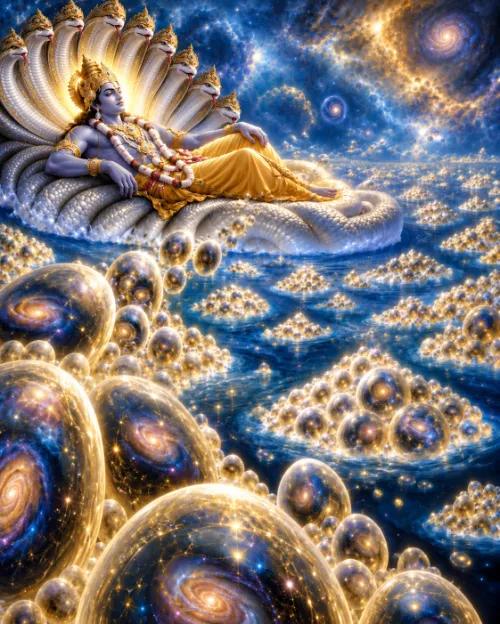
Pūrṇamadaḥ Pūrṇamidam: The Infinite Taken from the Infinite
Synopsis
What happens when the infinite is taken from the infinite? The Upaniṣad answers: the infinite remains.
Pūrṇamadaḥ pūrṇamidam is a verse of the Bṛhadāraṇyaka Upaniṣad (5.1.1), in the Śukla Yajurveda, and it is recited as the peace invocation, the śānti-pāṭha, that opens the Īśopaniṣad. It is chanted before the study of scripture, before sacred discussion and before meditation. In four short lines it says that Brahman, the source of everything, is whole; that the world which comes from it is whole too; and that nothing which comes forth ever lessens the source.
The mantra is given below in Devanāgarī and IAST with an English meaning, and then line by line.
The Mantra
ॐ पूर्णमदः पूर्णमिदं पूर्णात्पूर्णमुदच्यते ।
पूर्णस्य पूर्णमादाय पूर्णमेवावशिष्यते ॥
Oṁ pūrṇamadaḥ pūrṇamidaṁ pūrṇātpūrṇamudacyate |
Pūrṇasya pūrṇamādāya pūrṇamevāvaśiṣyate ||
That is full; this is full. From the full, the full comes forth. When the full is taken from the full, the full alone remains.
Pūrṇa means full, whole, complete: nothing is lacking and nothing can be added. “That” (adaḥ) is Brahman beyond all that is seen; “this” (idam) is Brahman as the world in front of us. The Advaita tradition, following Śaṅkara, reads the two as one reality, seen without and with name and form: the world adds nothing to Brahman and subtracts nothing from it, and when the limiting view is set aside, only the undivided whole is left. Vaiṣṇava teachers read the fullness as the Lord’s own. For Madhva, “that” is the Lord in his original form and “this” is each of his descents, every one equally full; in the Gauḍīya reading the Complete Person sends forth this world as a complete whole and remains himself undiminished. The traditions differ on what “this” finally is, and agree that the source is not used up by what comes from it.
ॐ शान्तिः शान्तिः शान्तिः ॥
Oṁ śāntiḥ śāntiḥ śāntiḥ ||
Oṁ. Peace, peace, peace.
Peace is asked for three times, for freedom from the three kinds of trouble: ādhyātmika, arising within oneself, in body and mind; ādhibhautika, arising from other beings; and ādhidaivika, arising from the powers of nature and the gods.
Line by Line
पूर्णमदः पूर्णमिदं
Pūrṇam adaḥ pūrṇam idaṁ
That is full; this is full. “That” is what lies beyond sight: Brahman, the supreme reality, limitless and complete in itself. “This” is the world that is seen, which comes from that source and is never cut off from it.
पूर्णात्पूर्णमुदच्यते
Pūrṇāt pūrṇam udacyate
From the full, the full comes forth. All that exists arises from the infinite, and however many beings and worlds come forth, the source is not lessened.
पूर्णस्य पूर्णमादाय
Pūrṇasya pūrṇam ādāya
Taking the full from the full. With ordinary quantities, what is taken away leaves less behind. The infinite cannot be divided, subtracted from or used up in creating.
पूर्णमेवावशिष्यते
Pūrṇam evāvaśiṣyate
The full alone remains. Whatever appears, changes or dissolves, the supreme reality remains whole, as it always was.
More in Mantras
Pūrṇamadaḥ PūrṇamidamMantras
You are here
Radha Kripa Kataksha StotraMantras
Radha mantrasMantras
Rahu mantrasMantras