

Bhīṣma’s Nine Universal Qualities of Civilized Life
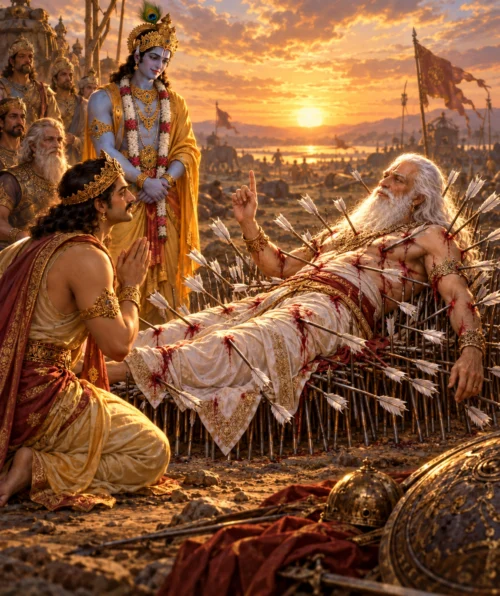
Before Religion Becomes Advanced, Character Must Become Human
On his bed of arrows after the Kurukṣetra war, Bhīṣmadeva was dying. Yet this was not merely the death of an old warrior. The greatest political, ethical, and spiritual questions of the age were being brought to him before he left the world. Shattered by the war’s destruction and unsure how to govern responsibly, Yudhiṣṭhira approached Bhīṣma and asked about dharma.
What makes a ruler righteous? What duties belong to different people? How should wealth be used? How should family life be regulated? What leads toward liberation? What constitutes true religion?
And before Bhīṣma explains the specialized duties of kings, priests, householders, renunciants, and other social roles, he lays down something even more basic: nine qualities that form the moral foundation of civilized human life.
A. C. Bhaktivedanta Swami Prabhupāda highlights these in his purport to Śrīmad-Bhāgavatam 1.9.26 and makes the striking observation: “One cannot be called a civilized person without acquiring the above-mentioned preliminary qualities.”
This is not an arbitrary modern list. It comes directly from Bhīṣma’s discourse in the Mahābhārata, Śānti-parva. And its central message is remarkably simple: Social position comes after character.
A person may be wealthy, powerful, educated, religious, technologically sophisticated or socially prestigious. But if he cannot control anger, speak truth, share, forgive, regulate sexuality, remain clean, abandon malice, live straightforwardly, and care for dependents, Bhīṣma does not yet consider the foundation complete.
The Sanskrit Source
Bhīṣma says:
अक्रोधः सत्यवचनं संविभागः क्षमा तथा ।
प्रजनः स्वेषु दारेषु शौचमद्रोह एव च ॥
आर्जवं भृत्यभरणं नवैते सार्ववर्णिकाः ॥
akrodhaḥ satya-vacanaṁ saṁvibhāgaḥ kṣamā tathā
prajanaḥ sveṣu dāreṣu śaucam adroha eva ca
ārjavaṁ bhṛtya-bharaṇaṁ navaite sārvavarṇikāḥ
“Freedom from anger, truthful speech, sharing of wealth, forgiveness, procreation with one’s own lawful spouse, purity, absence of malice, straightforwardness and maintenance of dependents—these nine are common to all the varṇas.”
Mahābhārata, Śānti-parva 12.60.7–8, numbering varying somewhat by edition
The decisive words are:
नवैते सार्ववर्णिकाः
navaite sārvavarṇikāḥ
“These nine belong to all the varṇas.”
This is important. Bhīṣma is speaking within the social framework of varṇāśrama. Literally, therefore, he says these duties are common to all four varṇas.
Prabhupāda takes the principle one step further and presents them as minimum qualifications of civilized human life generally. That distinction should be preserved. The Sanskrit says: sārvavarṇikāḥ — common to all varṇas.
Prabhupāda draws the broader conclusion: These are basic human qualities, prior to any claim of higher spiritual or social status. Bhīṣma Begins With Universal Character Before Specialized Duty The context makes this especially significant.
Before giving the nine, Bhīṣma says:
नमो धर्माय महते
नमः कृष्णाय वेधसे ।
ब्राह्मणेभ्यो नमस्कृत्वा
धर्मान् वक्ष्यामि शाश्वतान् ॥
namo dharmāya mahate
namaḥ kṛṣṇāya vedhase
brāhmaṇebhyo namaskṛtvā
dharmān vakṣyāmi śāśvatān
“I bow to the great Dharma and to Kṛṣṇa, the Creator. Having offered respect to the brāhmaṇas, I shall speak of the eternal principles of dharma.”
Then immediately comes the list of nine. Only afterward does Bhīṣma begin discussing the specific duties of: brāhmaṇas, kṣatriyas, vaiśyas, śūdras. The order is deliberate.
First: What kind of human being are you? Only then: What specialized responsibility do you hold? Thus a title cannot substitute for character. A brāhmaṇa who lies is defective.
A king ruled by rage is defective. A wealthy person who refuses to share is defective. An employer who exploits dependents is defective. A religious person whose life is crooked remains defective.
Status cannot cancel the common moral foundation. Śrīmad-Bhāgavatam Summarizes Bhīṣma’s Enormous Teaching The Bhāgavata does not reproduce the whole Śānti-parva. It compresses Bhīṣma’s massive instruction into a few verses.
पुरुषस्वभावविहितान्
यथावर्णं यथाश्रमम् ।
वैराग्यरागोपाधिभ्याम्
आम्नातोभयलक्षणान् ॥
puruṣa-sva-bhāva-vihitān
yathā-varṇaṁ yathāśramam
vairāgya-rāgopādhibhyām
āmnātobhaya-lakṣaṇān
“Bhīṣmadeva described the duties prescribed according to human nature, according to varṇa and āśrama, and explained the principles connected with both attachment and detachment.”
Śrīmad-Bhāgavatam 1.9.26
The next verse adds:
दानधर्मान् राजधर्मान् मोक्षधर्मान् विभागशः ।
स्त्रीधर्मान् भगवद्धर्मान् समासव्यासयोगतः ॥
dāna-dharmān rāja-dharmān
mokṣa-dharmān vibhāgaśaḥ
strī-dharmān bhagavad-dharmān
samāsa-vyāsa-yogataḥ
“He explained the principles of charity, royal duty, liberation, family and social duties, and devotion to Bhagavān, both in summary and in detail.”
Śrīmad-Bhāgavatam 1.9.27
This is the broader context for the nine virtues. Bhīṣma is asking: What must exist before a social order can function morally at all?
Akrodhaḥ — Do Not Be Ruled by Anger
The first virtue is:
अक्रोधः
akrodhaḥ
literally: absence of anger, freedom from wrath. Prabhupāda renders it: “not to become angry.” The meaning is not that a civilized person must never show firmness. Bhīṣma himself was a warrior. He discusses law, government, discipline, and punishment. Dharma sometimes requires strong action.
The point is: do not let uncontrolled anger govern your action. There is a major difference between: acting firmly because something must be corrected and: acting because rage has possessed the mind.
The Bhagavad-gītā lists the same quality among the divine virtues:
अहिंसा सत्यमक्रोधस्
त्यागः शान्तिरपैशुनम् ।
ahiṁsā satyam akrodhas
tyāgaḥ śāntir apaiśunam
“Nonviolence, truthfulness, freedom from anger, renunciation, tranquillity and aversion to faultfinding…”
Bhagavad-gītā 16.2
Thus: akrodha is not weakness. It is mastery of emotional force.
Satya-vacanam — Speak Truth
The second qualification is:
सत्यवचनम्
satya-vacanam
“truthful speech.”
Prabhupāda summarizes it: “not to lie.” That is correct, but the Sanskrit ethical tradition goes deeper. The Bhagavad-gītā describes disciplined speech:
अनुद्वेगकरं वाक्यं
सत्यं प्रियहितं च यत् ।
anudvega-karaṁ vākyaṁ
satyaṁ priya-hitaṁ ca yat
“Speech that does not unnecessarily agitate, that is truthful, pleasing and beneficial…”
Bhagavad-gītā 17.15
Truthfulness therefore does not justify cruelty. One can use technically correct information as a weapon. The dharmic ideal is: truth governed by responsibility. It should be: true, beneficial, appropriate, and free from deliberate deception.
Saṁvibhāgaḥ — Wealth Must Be Shared
The third term is particularly important:
संविभागः
saṁvibhāgaḥ
It means: division, distribution, sharing, allotment. Prabhupāda renders it: “to equally distribute wealth.” The expression should not necessarily be understood as modern mathematical economic equality.
The core principle is: do not consume everything selfishly. Bhīṣma later clarifies:
संविभज्य हि भोक्तव्यं
धनं सद्भिरितीष्यते ।
saṁvibhajya hi bhoktavyaṁ
dhanaṁ sadbhir itīṣyate
“The good hold that wealth should be enjoyed only after it has first been properly shared.”
The ethical sequence matters: not: consume first, give away whatever remains. But: recognize obligations first, then enjoy what remains. Those obligations traditionally include: family, dependents, guests, the needy, religious duties, and society.
Bhīṣma therefore rejects a radically isolated notion of ownership: “It belongs legally to me, therefore nobody else has any claim upon it.” Dharma says possession creates: responsibility.
Kṣamā — Forgiveness and Forbearance
The fourth quality is:
क्षमा
kṣamā
meaning: forgiveness, forbearance, patience, capacity to endure. Prabhupāda says: “to forgive.” This is more than saying: “I accept your apology.” It means developing the capacity not to let another person’s offense control one’s inner life indefinitely.
The Gītā again lists:
तेजः क्षमा धृतिः शौचम्
अद्रोहो नातिमानिता ।
tejaḥ kṣamā dhṛtiḥ śaucam
adroho nāti-mānitā
“Vigor, forgiveness, fortitude, purity, absence of malice and freedom from excessive pride.”
Bhagavad-gītā 16.3
Notice something important: tejas — strength and: kṣamā — forgiveness appear together. The ideal is neither: weakness nor: revenge. One can be powerful without being vindictive.
Prajanaḥ Sveṣu Dāreṣu — Sexuality Must Carry Responsibility
Bhīṣma says:
प्रजनः स्वेषु दारेषु
prajanaḥ sveṣu dāreṣu
Literally: “procreation with one’s own lawful spouse or spouses.” Prabhupāda explains: “to beget children only by one’s legitimate wife.” The ethical principle is: sexual fidelity and responsible family life.
A textual detail should be acknowledged. dāreṣu is grammatically plural. The social world of the Mahābhārata, particularly among kṣatriyas, permitted polygyny in certain circumstances. So the Sanskrit does not literally legislate modern monogamy.
Its underlying principle is: sexual activity belongs within lawful, responsible relationship—not illicit exploitation. Why does Bhīṣma include sexuality in a list of basic civilization?
Because sexuality produces consequences beyond private pleasure: children, inheritance, families, jealousy, abandonment, social obligation. Sex therefore cannot be treated merely as: private appetite.
Its exercise creates duties. Marriage Does Not Mean Unlimited Indulgence Prabhupāda goes further. He emphasizes that even within marriage, sexual life must remain regulated.
The principle is not: “marriage makes every desire automatically spiritual.” It is: sexuality should be subordinated to dharma. This places responsibility above appetite.
The larger Sanskrit tradition repeatedly treats control of the senses as foundational to human maturity.
Śaucam — Purity Inside and Outside
The sixth qualification is:
शौचम्
śaucam
meaning: purity, cleanliness, purification. Prabhupāda expands it as: “to be pure in mind and hygienic in body.” That is not a word-for-word translation but an excellent expression of the traditional twofold understanding.
External purity Clean body. Clean clothing. Clean surroundings. Clean food. Clean habits. Internal purity Honest intention. Freedom from corruption. Clean motives. Mental discipline.
A person can bathe repeatedly while nurturing: envy, deceit, hatred. That is not complete śauca. Likewise, spiritual talk cannot excuse gross physical neglect. Purity concerns: the whole person.
Manu Gives a Similar Universal Moral Foundation
Manu-smṛti gives a remarkably similar summary:
अहिंसा सत्यमस्तेयं
शौचमिन्द्रियनिग्रहः ।
एतं सामासिकं धर्मं
चातुर्वर्ण्येऽब्रवीन्मनुः ॥
ahiṁsā satyam asteyaṁ
śaucam indriya-nigrahaḥ
etaṁ sāmāsikaṁ dharmaṁ
cāturvarṇye ’bravīn manuḥ
“Nonviolence, truthfulness, nonstealing, purity and restraint of the senses—Manu declared these to be the summary of dharma common to the four varṇas.”
Manu-smṛti 10.63
Again: common morality first; specialized social function afterward.
Adrohaḥ — Do Not Cultivate Malice
The seventh quality is:
अद्रोहः
adrohaḥ
from: droha malice, hostility, treachery, intent to injure. Thus: a-droha means: absence of malicious hostility. Prabhupāda says: “not to be inimical toward anyone.” This should not be confused with: never opposing wrongdoing.
Bhīṣma can teach both: adroha and: the kṣatriya’s obligation to protect society. The distinction is subtle but crucial: You may have to stop someone without hating him. Dharma may require opposition.
It does not require: malice. Anger, Forgiveness and Non-Malice Form a Three-Part Psychology It is striking that Bhīṣma includes three related but distinct virtues: Akrodha Do not let anger explode uncontrolled.
Kṣamā Develop the capacity to forgive injury. Adroha Do not preserve an ongoing desire to harm. These describe three different stages of hostility. First: the emotional reaction.
Then: the response to the injury. Finally: the long-term disposition. The teaching therefore reaches much deeper than: “Do not hit people.” It asks: What are you building inside yourself after being hurt?
Ārjavam — Be Straight
The eighth virtue is:
आर्जवम्
ārjavam
meaning: straightness, sincerity, honesty, absence of crookedness. Prabhupāda translates it: “to be simple.” But “simple” should not be misunderstood as: ignorant, naïve, unsophisticated.
The image is literally: straight versus crooked. A person practicing ārjava does not maintain: one face publicly, another privately, a third when convenient. He does not construct elaborate manipulative personas.
The Bhagavad-gītā includes the same word:
स्वाध्यायस्तप आर्जवम्
svādhyāyas tapa ārjavam
“Sacred study, austerity and straightforwardness.”
— Bhagavad-gītā 16.1 Thus: ārjava = integrity. Truthfulness and Straightforwardness Are Not Identical This is why Bhīṣma lists both: satya-vacana and: ārjava.
A clever person can avoid technically false statements and still be: manipulative, misleading, calculating, crooked. Truthful speech asks: “Is what I said true?” Straightforwardness asks: “Is the way I live honest?”
Together they form: integrity in speech and character.
Bhṛtya-bharaṇam — Care for Those Who Depend Upon You
The ninth quality may be the most socially powerful.
भृत्यभरणम्
bhṛtya-bharaṇam
consists of: bhṛtya — servant, dependent, employee, subordinate; bharaṇa — maintenance, sustenance, support. Thus: “maintenance of dependents.” Prabhupāda renders it: “to support servants or subordinates.”
The implication is stronger than: “Do not abuse your employees.” Bhīṣma says the person who holds economic or social power carries a positive duty of care toward those dependent upon him.
Authority is not merely: the right to command. It creates: obligation. Religious Grandeur Cannot Excuse Neglected Dependents Prabhupāda develops this point strongly. Dependents should be: fed, clothed, maintained, protected.
One should not create an impressive religious spectacle while the people economically dependent upon the household or institution are neglected. This is a powerful ethical principle: ritual grandeur cannot compensate for social irresponsibility.
A leader who spends lavishly on prestige while subordinates cannot meet basic needs has reversed the moral order. This principle easily extends beyond the ancient household: employers, institutional leaders, teachers, managers, community heads, any person upon whom others materially depend.
The Nine Form a Complete Miniature Social Ethic
Seen together, Bhīṣma’s qualities form four great clusters.
It is difficult to imagine a functioning society without these.
Without truth: trust collapses. Without restraint: power becomes dangerous. Without sharing: wealth becomes predatory. Without forgiveness: conflict perpetuates itself. Without sexual responsibility: families become unstable.
Without purity: body and mind deteriorate. Without adroha: society becomes tribal hostility. Without ārjava: relationships become manipulation. Without responsibility toward dependents: authority becomes exploitation.
That is why Prabhupāda calls these: preliminary. They are not obscure mystical attainments. They are the minimum platform from which higher civilization can begin. This Is Not Yet Pure Bhakti Another point should be made clear.
A person can possess these nine virtues and still not have reached: prema, pure bhakti, samādhi, brahma-jñāna. Bhīṣma is not saying: “Master these nine and the entire spiritual path is finished.”
He is saying: without them, something foundational remains unfinished. They are: human preparation, ethical fitness, social sanity. Higher spiritual life should deepen them, not bypass them.
Religion Cannot Become an Excuse for Bad Character
This principle is extremely relevant. A person may know: many Sanskrit verses, philosophical categories, ritual procedures, theology, mantras.
But if that person: lies, explodes in rage, exploits subordinates, lives duplicitously, acts maliciously, then Bhīṣma’s list exposes a problem at the foundation. Spiritual sophistication does not abolish elementary morality.
It should: perfect it. Bhīṣma’s Ethics Closely Match Kṛṣṇa’s Daivī Sampad Kṛṣṇa gives a larger list of divine qualities in the Bhagavad-gītā:
अभयं सत्त्वसंशुद्धिर्
ज्ञानयोगव्यवस्थितिः ।
दानं दमश्च यज्ञश्च
स्वाध्यायस्तप आर्जवम् ॥
abhayaṁ sattva-saṁśuddhir
jñāna-yoga-vyavasthitiḥ
dānaṁ damaś ca yajñaś ca
svādhyāyas tapa ārjavam
“Fearlessness, purification of consciousness, steadiness in spiritual knowledge, charity, self-control, sacrifice, sacred study, austerity and straightforwardness…”
Then:
अहिंसा सत्यमक्रोधस्
त्यागः शान्तिरपैशुनम् ।
दया भूतेष्वलोलुप्त्वं
मार्दवं ह्रीरचापलम् ॥
ahiṁsā satyam akrodhas
tyāgaḥ śāntir apaiśunam
dayā bhūteṣv aloluptvaṁ
mārdavaṁ hrīr acāpalam
“Nonviolence, truthfulness, freedom from anger, renunciation, tranquillity, aversion to faultfinding, compassion toward living beings, freedom from greed, gentleness, modesty and steadiness…”
And:
तेजः क्षमा धृतिः शौचम्
अद्रोहो नातिमानिता ।
tejaḥ kṣamā dhṛtiḥ śaucam
adroho nāti-mānitā
“Vigor, forgiveness, fortitude, purity, absence of malice and freedom from excessive pride.”
Bhagavad-gītā 16.1–3
The overlap with Bhīṣma is striking: akrodha satya kṣamā śauca adroha ārjava appear in both. This is not accidental. These words belong to a coherent Sanskrit ethical vocabulary describing: daivī sampad divine character.
Mahābhārata Repeats the Same Moral Vocabulary
Elsewhere the Mahābhārata says:
अक्रोधः सत्यवचनमहिंसा दम आर्जवम् ।
अद्रोहो नातिमानश्च ह्रीस्तितिक्षा तपः शमः ॥
akrodhaḥ satya-vacanam ahiṁsā dama ārjavam
adroho nātimānaś ca hrīs titikṣā tapaḥ śamaḥ
“Freedom from anger, truthful speech, nonviolence, self-restraint, straightforwardness, absence of malice, freedom from excessive pride, modesty, forbearance, austerity and tranquillity.”
The ethical ideal is consistent. Again and again: truth, self-control, non-hostility, purity, straightforwardness, forbearance. These are not optional embellishments. They are the recurring grammar of dharmic character.
Why Prabhupāda Uses the Word “Civilized”
Prabhupāda’s provocative sentence deserves careful attention: “One cannot be called a civilized person without acquiring the above-mentioned preliminary qualities.”
The Sanskrit passage itself does not use the modern English concept: “civilized person.” That is Prabhupāda’s application. But what does he mean? Clearly not: someone who owns advanced technology.
Not: someone with a university degree. Not: someone living in a wealthy country. Not: someone who knows etiquette. For him, civilization begins with: self-restraint. A society may possess: computers, airplanes, weapons, universities, banks, huge cities— yet if its citizens routinely: lie, rage, hoard, exploit, betray, abandon responsibility, then technical advancement has not automatically produced: civilized character.
That is the force of his statement. Civilization Is the Voluntary Restraint of Power Look closely at the nine. Almost every one addresses something a human being could do but voluntarily chooses not to misuse.
You can become enraged. But you restrain anger. You can lie. But you speak truth. You can hoard. But you share. You can retaliate. But you forgive. You can pursue illicit gratification.
But you regulate sexuality. You can exploit people beneath you. But you support them. Civilization therefore has much to do with: the voluntary limitation of one’s power for the welfare of others.
That is an exceptionally strong ethical definition. Wealth Has Dharma Saṁvibhāga teaches that possession does not eliminate responsibility. The question is not merely: “What do I own?”
but: “What claims do others legitimately have upon what has come into my hands?” This is why classical dharma places such emphasis upon: charity, hospitality, feeding others, supporting dependents.
Wealth carries: obligation. Authority Has Dharma Bhṛtya-bharaṇa teaches the same principle concerning power. If others depend upon you: you owe them something. An employer cannot think only: “What labor can I extract?”
A ruler cannot think only: “What obedience can I demand?” A teacher cannot think only: “What loyalty am I owed?” Authority generates: responsibility toward the weaker party.
The greater the dependence, the greater the moral burden upon the person in power. Sexuality Has Dharma Likewise: prajanaḥ sveṣu dāreṣu teaches that sexual behavior does not exist in a social vacuum.
It creates: relationships, children, obligations, emotional consequences. Therefore appetite cannot be the only criterion. Civilization requires: desire governed by responsibility.
Speech Has Dharma satya-vacana means that speech cannot be reduced to: whatever benefits me. Human society depends upon trust. Once language becomes systematically deceptive: contracts fail, friendships fail, families fail, government fails, religion fails.
Truthfulness is therefore not merely: personal virtue. It is: social infrastructure. Anger Has Dharma Likewise: akrodha does not demand emotional numbness. Anger can indicate: injustice, danger, violation.
But unmanaged anger easily turns justice into: revenge. Bhīṣma asks for something harder: clarity without rage. Forgiveness Does Not Mean Permitting Abuse Kṣamā must also be understood intelligently.
Forgiveness does not necessarily mean:
- returning immediately to unsafe conditions,
- abandoning justice,
- pretending wrongdoing did not occur.
It means: not making vengeance and resentment the governing principle of the heart. One can: forgive internally while still: establishing boundaries, requiring accountability, protecting others.
That combination of: strength and: forgiveness is exactly why the Gītā can list: tejas and: kṣamā side by side. Straightforwardness Does Not Mean Gullibility Ārjava likewise does not require one to become politically naïve.
A straightforward person can be: intelligent, strategic, careful. What he does not become is: duplicitous. He does not build advantage upon: calculated deception. The opposite of ārjava is not intelligence.
It is: crookedness. Bhīṣma’s Nine Make Relationships Trustworthy Another way to see the list is this: each quality protects other people from some dangerous aspect of us.
Akrodha protects them from our rage. Satya protects them from our deception. Saṁvibhāga protects them from our greed. Kṣamā protects them from our vengeance. Sexual fidelity protects them from our irresponsibility.
Śauca protects the integrity of body and consciousness. Adroha protects them from our malice. Ārjava protects them from manipulation. Bhṛtya-bharaṇa protects dependents from our neglect.
The nine therefore create: trust. Without trust, civilization becomes impossible. Why These Qualities Come Before Higher Theology People are naturally attracted to advanced religious subjects: Who is Bhagavān?
What is Vaikuṇṭha? What is liberation? What is rasa? What is the structure of the cosmos? Bhīṣma begins with something less glamorous: Can you control anger? Can you speak truth?
Will you share? Can you forgive? Can the people dependent upon you trust you? This is not “lower spirituality.” It is: the foundation upon which higher spirituality becomes credible.
The Real Test of Spirituality Is Character
A person may know thousands of verses. Yet the question remains: Does that knowledge produce: truthfulness? Humility? Responsibility?
Purity? Compassion? If not, knowledge has not yet fully entered: character. Bhīṣma is not impressed by social or religious labels detached from conduct. That may be one of the most enduring lessons of his final discourse.
No Bengali Source Is Needed to Establish the Nine
Unlike many Gauḍīya theological discussions, this particular teaching originates in Sanskrit epic literature. The primary formulation is Sanskrit: the Mahābhārata.
The Bhāgavata summarizes Bhīṣma’s discourse in Sanskrit. Prabhupāda then interprets it in modern English. No original Bengali verse is required to establish the nine qualities themselves.
The teaching is therefore best presented through its actual primary textual chain: Mahābhārata → Śrīmad-Bhāgavatam → Prabhupāda’s purport. That preserves the source history instead of artificially inserting unrelated Bengali material.
The Nine Qualities, Refined
The notebook version is correct, but a slightly more precise rendering would be:
And Bhīṣma concludes:
नवैते सार्ववर्णिकाः
navaite sārvavarṇikāḥ
“These nine are common to all the varṇas.”
Conclusion: Before Asking What Your Position Is, Ask What Your Character Is
Bhīṣma’s teaching is powerful precisely because it is so elementary.
After one of the most catastrophic wars in sacred history, Yudhiṣṭhira approaches the dying patriarch and asks how society should be rebuilt. Bhīṣma does not begin with: political slogans, economic systems, ritual status, privilege.
He begins with: character. Can people control their anger? Can they tell the truth? Will they share what they possess? Can they forgive? Can they regulate sexuality responsibly?
Are they clean in body and intention? Will they abandon malice? Will they live without duplicity? Will those who depend upon them be properly cared for? Only then does specialized social duty make sense.
Prabhupāda therefore calls these: “preliminary qualities.” And his sharp conclusion follows naturally: “One cannot be called a civilized person without acquiring the above-mentioned preliminary qualities.”
This does not mean technological or intellectual accomplishment is worthless. It means such accomplishments cannot substitute for: human character. A society may become extremely powerful without becoming morally mature.
Bhīṣma’s nine qualities define another kind of advancement. Not: how much power we possess, but: how responsibly we restrain it. Not: how much wealth we accumulate, but: whether we share.
Not: how sophisticated our speech becomes, but: whether it is true. Not: how many people serve us, but: whether we care for those who depend upon us. Not: how advanced our religious identity appears, but: whether dharma has entered our character.
That is the central message. Special status begins after basic character. Or even more simply: Before asking whether someone is a king, priest, scholar, businessman, guru or leader, Bhīṣma first asks whether the person has learned how to be human.