

Śukadeva Gosvāmī and the 1.4 Million Verses of the Mahābhārata
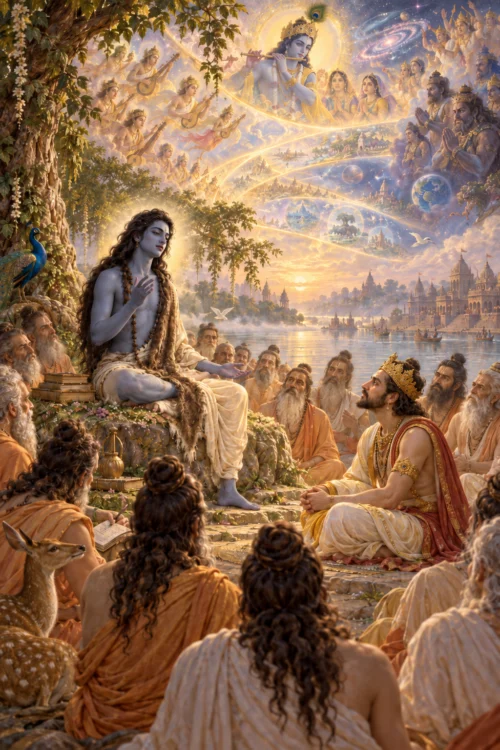
From the Vast Cosmic Bhārata to the Seven-Day Śrīmad-Bhāgavatam
Śukadeva Gosvāmī is remembered above all as the young renunciant who sat before the dying King Parīkṣit and spoke the Śrīmad-Bhāgavatam. That familiar image can make it easy to underestimate him.
According to the traditional Sanskrit accounts, Śukadeva was not simply an ecstatic mystic who knew Kṛṣṇa-kathā. His father, Vyāsadeva, personally instructed him in the vast Bhārata tradition. The Mahābhārata itself assigns him an astonishing role in its cosmic transmission: Śuka recited a recension associated with 1,400,000 verses to the Gandharvas, Yakṣas, and Rākṣasas.
A. C. Bhaktivedanta Swami Prabhupāda summarizes this tradition in his purport to Śrīmad-Bhāgavatam 1.9.8: Śukadeva Gosvāmī recited 1,400,000 verses of the Mahābhārata in the assemblies of the Gandharvas, Yakṣas, and Rākṣasas, and later recited Śrīmad-Bhāgavatam before Mahārāja Parīkṣit.
The first statement is firmly rooted in the traditional prologue of the Mahābhārata. The second is also substantially correct—but needs one refinement: Parīkṣit was not literally the first being ever to hear Bhāgavata knowledge. Vyāsa had already taught the compiled Bhāgavatam to Śuka, and the Bhāgavatam itself traces its wisdom through an earlier succession.
What happened before Parīkṣit was something more specific and enormously important: Śukadeva gave the paradigmatic public recitation of the completed Bhāgavata-saṁhitā to a king who had only seven days to live.
That recitation became one of the defining events of Vaiṣṇava sacred literature.
Śukadeva Appears Among the Great Sages at Bhīṣma’s Passing
The immediate verse, Śrīmad-Bhāgavatam 1.9.8, occurs as sages assemble around Bhīṣma on his bed of arrows:
अन्ये च मुनयो ब्रह्मन्
ब्रह्मरातादयोऽमलाः ।
शिष्यैरुपेता आजग्मुः
कश्यपाङ्गिरसादयः ॥
anye ca munayo brahman
brahmarātādayo ’malāḥ
śiṣyair upetā ājagmuḥ
kaśyapāṅgirasādayaḥ
“Many other spotless sages also arrived, headed by Brahmarāta [Śukadeva Gosvāmī], together with Kaśyapa, Āṅgirasa, and others, accompanied by their disciples.”
Śrīmad-Bhāgavatam 1.9.8
The verse itself gives no biography. Prabhupāda therefore uses the purport to identify Brahmarāta as Śukadeva and summarize his remarkable literary and spiritual history.
The claim concerning 1.4 million Mahābhārata verses comes from a much older tradition within the Mahābhārata itself.
Vyāsa First Taught the Bhārata to His Son Śuka
The traditional Mahābhārata prologue says explicitly:
इदं द्वैपायनः पूर्वं
पुत्रमध्यापयच्छुकम् ।
ततोऽन्येभ्योऽनुरूपेभ्यः
शिष्येभ्यः प्रददौ प्रभुः ॥
idaṁ dvaipāyanaḥ pūrvaṁ
putram adhyāpayac chukam
tato ’nyebhyo ’nurūpebhyaḥ
śiṣyebhyaḥ pradadau prabhuḥ
“Dvaipāyana [Vyāsa] first taught this to his son Śuka; afterward the great sage transmitted it to other qualified disciples.”
This is significant. Śukadeva was not only Vyāsa’s son biologically. He belonged directly to Vyāsa’s scriptural transmission. Before Śuka became eternally associated with the Bhāgavatam, the Mahābhārata tradition already remembered him as one of the great recipients and transmitters of Vyāsa’s Bhārata.
The Extraordinary Six-Million-Verse Mahābhārata
The traditional prologue then describes a form of the Mahābhārata vastly larger than the earthly text known today. It says:
षष्टिं शतसहस्राणि
चकारान्यां स संहिताम् ।
त्रिंशच्छतसहस्रं च
देवलोके प्रतिष्ठितम् ॥
ṣaṣṭiṁ śata-sahasrāṇi
cakārānyāṁ sa saṁhitām
triṁśac-chata-sahasraṁ ca
deva-loke pratiṣṭhitam
“He composed another recension consisting of sixty hundred-thousands [six million] verses; thirty hundred-thousands [three million] were established in the realm of the gods.”
The following verse distributes the remaining portions:
पित्र्ये पञ्चदश प्रोक्तं
गन्धर्वेषु चतुर्दश ।
एकं शतसहस्रं तु
मानुषेषु प्रतिष्ठितम् ॥
pitrye pañcadaśa proktaṁ
gandharveṣu caturdaśa
ekaṁ śata-sahasraṁ tu
mānuṣeṣu pratiṣṭhitam
“Fifteen hundred-thousands [1.5 million] were proclaimed in the realm of the Pitṛs, fourteen hundred-thousands [1.4 million] among the Gandharvas, and one hundred thousand were established among human beings.”
The traditional arithmetic is therefore:
- 3,000,000 verses — among the devas
- 1,500,000 verses — among the Pitṛs
- 1,400,000 verses — in the Gandharva-associated realm
- 100,000 verses — among human beings
Total: 6,000,000 verses. That is the direct background to Prabhupāda’s figure of: 1,400,000.
“Fourteen Lakhs” Means 1,400,000
Older English editions sometimes phrase the number in the Indian system as: fourteen lakhs. One lakh is: 100,000. Therefore: 14 × 100,000 = 1,400,000. So there is no discrepancy between: “fourteen lakhs”
and: “1,400,000 verses.” They are the same number expressed in different numerical conventions.
Then the Mahābhārata Explicitly Names Śuka
The next passage identifies who transmitted these versions:
नारदोऽश्रावयद्देवान्
असितो देवलः पितॄन् ।
गन्धर्वयक्षरक्षांसि
श्रावयामास वै शुकः ॥
nārado ’śrāvayad devān
asito devalaḥ pitṝn
gandharva-yakṣa-rakṣāṁsi
śrāvayām āsa vai śukaḥ
“Nārada caused the devas to hear it; Asita Devala caused the Pitṛs to hear it; and Śuka caused the Gandharvas, Yakṣas, and Rākṣasas to hear it.”
Then:
अस्मिंस्तु मानुषे लोके
वैशम्पायन उक्तवान्
asmiṁs tu mānuṣe loke
vaiśampāyana uktavān
“But in this human world, Vaiśampāyana recited it.”
This is the decisive textual basis. Śuka is explicitly assigned to:
- Gandharvas
- Yakṣas
- Rākṣasas.
Thus Prabhupāda’s statement is not a later invention or an isolated hagiographical embellishment.
It summarizes a genuine traditional passage from the Mahābhārata itself.
Why Does One Verse Mention Gandharvas While the Next Includes Yakṣas and Rākṣasas?
There are textual variations in the transmitted prologue. Some recensions associate the fourteen-lakh portion specifically with the Gandharvas, while others mention Yakṣas and Rākṣasas in the numerical distribution.
The following transmission verse, however, explicitly combines:
गन्धर्वयक्षरक्षांसि
gandharva-yakṣa-rakṣāṁsi
“Gandharvas, Yakṣas, and Rākṣasas.” Prabhupāda’s wording therefore represents a natural synthesis of the traditional account. This is also a reminder that the Mahābhārata survives in multiple recensional traditions whose prologues sometimes differ in detail.
These Were Not 1.4 Million Ordinary Earthly Verses
This distinction is essential. The traditional text itself says:
एकं शतसहस्रं तु
मानुषेषु प्रतिष्ठितम्
ekaṁ śata-sahasraṁ tu
mānuṣeṣu pratiṣṭhitam
“One hundred thousand were established among human beings.”
The 1.4 million therefore belong to the epic’s cosmic transmission narrative, not to the standard human recension. So one should not say: “Our present Mahābhārata originally had 1.4 million verses and virtually all of them were lost.”
That is not what the traditional passage says. Rather, it describes different forms of the Bhārata existing for different classes of beings. The human version is itself distinguished as approximately: 100,000 verses.
The Mahābhārata Also Speaks of a 24,000-Verse Core
The same prologue contains another important statement:
चतुर्विंशतिसाहस्रीं
चक्रे भारतसंहिताम् ।
उपाख्यानैर्विना तावद्
भारतं प्रोच्यते बुधैः ॥
caturviṁśati-sāhasrīṁ
cakre bhārata-saṁhitām
upākhyānair vinā tāvad
bhārataṁ procyate budhaiḥ
“He composed the Bhārata-saṁhitā consisting of twenty-four thousand verses; without the subsidiary narratives, this is called the Bhārata by the learned.”
Thus traditional literature itself remembers the work at several scales:
These are not necessarily three competing manuscript counts. They represent different conceptions or layers of the Bhārata tradition.
Traditional Sacred History and Modern Textual Criticism
A careful article should distinguish two different questions.
Within the traditional sacred account
Vyāsa produced a vast six-million-verse recension. Different portions circulated among: devas, Pitṛs, Gandharvas, Yakṣas, Rākṣasas, and humans. Śuka recited the celestial recension associated with 1.4 million verses to Gandharvas, Yakṣas, and Rākṣasas.
That is the traditional picture reflected in Prabhupāda’s purport.
From the perspective of manuscript criticism
No surviving human manuscript tradition contains anything approaching 1.4 million verses. Modern critical scholarship studies the much smaller earthly textual tradition and its development across different recensions.
Furthermore, some of the giant numerical statements belong to variant portions of the epic prologue rather than to a completely uniform archetype shared identically by every manuscript family.
These two perspectives answer different questions. The first concerns the Mahābhārata’s own sacred account of itself. The second concerns: surviving manuscripts and recoverable textual history.
They should not be confused.
Śukadeva Was Also Present in Yudhiṣṭhira’s World
Traditional Mahābhārata passages also place Śuka in the royal and sage assemblies associated with the Pāṇḍavas. The Sabhā-parva lists great sages associated with Yudhiṣṭhira’s magnificent assembly and includes:
कृष्णद्वैपायनः शुकः
kṛṣṇa-dvaipāyanaḥ śukaḥ
“Kṛṣṇa Dvaipāyana [Vyāsa] and Śuka.” So Śukadeva should not be imagined only as a completely inaccessible ascetic who appears suddenly beside Parīkṣit. Traditional literature places him within the wider sacred world of: Vyāsa, the Pāṇḍavas, the sages, and the transmission of the Bhārata tradition.
Then Vyāsa Compiled the Śrīmad-Bhāgavatam
The Bhāgavatam tells how Vyāsa, despite having compiled the Vedas and the Mahābhārata, remained dissatisfied. After Nārada instructed him to glorify Bhagavān directly, Vyāsa entered meditation, realized Bhagavān and His energies, and composed the Bhāgavata-saṁhitā.
Then comes an extremely important verse:
स संहितां भागवतीं
कृत्वानुक्रम्य चात्मजम् ।
शुकमध्यापयामास
निवृत्तिनिरतं मुनिः ॥
sa saṁhitāṁ bhāgavatīṁ
kṛtvānukramya cātma-jam
śukam adhyāpayām āsa
nivṛtti-nirataṁ muniḥ
“The sage, having compiled and arranged the Bhāgavata-saṁhitā, taught it to his own son Śuka, who was already fully absorbed in the path of renunciation.”
Śrīmad-Bhāgavatam 1.7.8
This establishes unequivocally: Vyāsa → Śukadeva as the immediate transmission of the compiled Śrīmad-Bhāgavatam.
Why Would an Already Liberated Śukadeva Study the Bhāgavatam?
This is exactly the question raised in the text. Śuka was already:
निवृत्तिनिरतम्
nivṛtti-niratam
“completely absorbed in renunciation.” He was not an ordinary student hoping eventually to become detached. So why would he become deeply absorbed in a Purāṇa filled with stories of Bhagavān?
The answer is extraordinary.
The Qualities of Hari Captured His Mind
The Bhāgavatam says:
हरेर्गुणाक्षिप्तमतिर्भगवान् बादरायणिः ।
अध्यगान्महदाख्यानं नित्यं विष्णुजनप्रियः ॥
harer guṇākṣipta-matir
bhagavān bādarāyaṇiḥ
adhyagān mahad ākhyānaṁ
nityaṁ viṣṇu-jana-priyaḥ
“The powerful son of Bādarāyaṇa, whose mind was captivated by the qualities of Hari and who was always dear to the devotees of Viṣṇu, studied this great narration.”
Śrīmad-Bhāgavatam 1.7.11
The central phrase is:
हरेर्गुणाक्षिप्तमतिः
harer guṇākṣipta-matiḥ
“whose mind was seized or captivated by the qualities of Hari.” This is perhaps more important than the claim about 1.4 million verses. Śukadeva could master immense sacred literature.
But what finally seized his mind? Not merely: genealogy, philosophy, politics, cosmology, ritual. It was: Hari.
Śukadeva Shows That Bhakti Is Beyond Mere Liberation
This becomes a major theological point in Vaiṣṇava traditions. Śuka was already liberated and detached. Yet he became attracted to: Kṛṣṇa’s qualities, Kṛṣṇa’s activities, Kṛṣṇa’s devotees.
Thus bhakti is not presented merely as: a means for conditioned people to become liberated. It can attract one who is already beyond ordinary material attachment. Śukadeva embodies the movement:
- detachment
- self-realization
- attraction to Bhagavān
- bhakti-rasa.
Liberation does not exhaust spiritual life. Love goes further.
This Is Closely Related to the Ātmārāma Principle
The Bhāgavatam famously declares that even: ātmārāmas those satisfied within the self, become attracted to the qualities of Hari. Śukadeva becomes the classic example. He does not approach the Bhāgavatam because he needs: wealth, heaven, mystical powers, even ordinary liberation.
He is attracted because: Bhagavān is inherently attractive. That is why Gauḍīya Vaiṣṇava theology places enormous emphasis on Śukadeva. He demonstrates that: Kṛṣṇa-bhakti is not beneath liberation.
It is capable of captivating the liberated.
Did Śukadeva Really Recite the Bhāgavatam “for the First Time” Before Parīkṣit?
Here Prabhupāda’s wording requires careful interpretation. It cannot mean: “Parīkṣit was literally the first person ever to hear the Bhāgavatam.” Why? Because ŚB 1.7.8 explicitly says: Vyāsa taught it to Śuka.
Śuka therefore heard it before Parīkṣit. And the final canto describes an even earlier spiritual transmission.
The Bhāgavata Transmission Goes Back Before Vyāsa
The concluding chapter says:
कस्मै येन विभासितोऽयमतुलो ज्ञानप्रदीपः पुरा
तद्रूपेण च नारदाय मुनये कृष्णाय तद्रूपिणा ।
योगीन्द्राय तदात्मनाथ भगवद्राताय कारुण्यतस्
तच्छुद्धं विमलं विशोकममृतं सत्यं परं धीमहि ॥
kasmai yena vibhāsito ’yam atulo jñāna-pradīpaḥ purā
tad-rūpeṇa ca nāradāya munaye kṛṣṇāya tad-rūpiṇā
yogīndrāya tad-ātmanātha bhagavad-rātāya kāruṇyatas
tac chuddhaṁ vimalaṁ viśokam amṛtaṁ satyaṁ paraṁ dhīmahi
“We meditate upon that pure, spotless, sorrowless, immortal Supreme Truth who originally revealed this incomparable lamp of knowledge to Brahmā; through Brahmā it was given to Nārada, through Nārada to Kṛṣṇa Dvaipāyana Vyāsa, through Vyāsa to the great yogī Śuka, and through Śuka, out of compassion, to Bhagavadrāta [Parīkṣit].”
Śrīmad-Bhāgavatam 12.13.19
The succession is therefore:
- Bhagavān
- Brahmā
- Nārada
- Vyāsa
- Śukadeva
- Parīkṣit
The Bhāgavata wisdom clearly predates Parīkṣit.
So What Was “First” About the Parīkṣit Recitation?
The best way to understand Prabhupāda’s statement is: Śukadeva’s recitation to Parīkṣit became the foundational public narration of the compiled Śrīmad-Bhāgavatam in the form that structures the scripture we now possess.
The distinction matters.
There was earlier:
- Bhāgavata wisdom,
- Bhāgavata revelation,
- and direct instruction from Vyāsa to Śuka.
But the famous seven-day assembly around Parīkṣit became the great public narrative event. It is the recitation through which Śukadeva became permanently identified with the Bhāgavatam.
Why Parīkṣit’s Seven Days Changed Everything
King Parīkṣit had been cursed: he would die from Takṣaka’s bite in seven days. Instead of attempting to escape death indefinitely, he renounced his kingdom, went to the Gaṅgā, and asked the assembled sages the supreme question: What should a person do when death is approaching?
This is why his question is not merely personal. Parīkṣit has seven days. Every human being has some unknown number of days. His situation is simply: our situation made explicit.
Śukadeva Calls His Question Beneficial to Everyone
Śuka begins:
श्रीशुक उवाच
वरीयानेष ते प्रश्नः
कृतो लोकहितं नृप ।
आत्मवित्सम्मतः पुंसां
श्रोतव्यादिषु यः परः ॥
śrī-śuka uvāca
varīyān eṣa te praśnaḥ
kṛto loka-hitaṁ nṛpa
ātmavit-sammataḥ puṁsāṁ
śrotavyādiṣu yaḥ paraḥ
“Śrī Śuka said: O King, your question is glorious, for it is beneficial to all people. Among all subjects worthy of hearing, it is supreme and is approved by those who know the self.”
Śrīmad-Bhāgavatam 2.1.1
The crucial phrase is:
लोकहितम्
loka-hitam
“for the welfare of the world.” Parīkṣit asks: “What should a dying man hear?” Śuka realizes that he has really asked: “What should every human being hear?” Because every human being is dying.
From 1.4 Million Verses to One Ultimate Question
This creates an extraordinary contrast. According to the traditional Mahābhārata account, Śuka could speak: 1,400,000 verses before celestial and semi-celestial beings. But his eternal fame comes from a very different scene.
No cosmic court. No enormous audience of Yakṣas and Gandharvas. A dying king. Seven days. One essential question: What must a person hear before death? This may be the deepest significance of the biography.
Śukadeva possesses enormous knowledge. Yet at the decisive moment he does not overwhelm Parīkṣit with every possible branch of knowledge. He gives him: Kṛṣṇa-kathā.
The Bhāgavatam Calls This Knowledge a Lamp
ŚB 12.13.19 describes the teaching as:
अतुलो ज्ञानप्रदीपः
atulo jñāna-pradīpaḥ
“the incomparable lamp of knowledge.” A lamp passes from: Bhagavān to Brahmā, Brahmā to Nārada, Nārada to Vyāsa, Vyāsa to Śuka, Śuka to Parīkṣit. The image is perfect for: paramparā.
The later speaker does not manufacture a new light. He receives it. He preserves it. He hands it forward. Śukadeva’s greatness is therefore not merely: how much he knew. It is: how transparently he transmitted what he had received.
The Bhāgavatam Becomes Identified With Śuka’s Voice
The opening invocation to the work famously says:
निगमकल्पतरोर्गलितं फलं
शुकमुखादमृतद्रवसंयुतम् ।
पिबत भागवतं रसमालयं
मुहुरहो रसिका भुवि भावुकाः ॥
nigama-kalpa-taror galitaṁ phalaṁ
śuka-mukhād amṛta-drava-saṁyutam
pibata bhāgavataṁ rasam ālayam
muhur aho rasikā bhuvi bhāvukāḥ
“Śrīmad-Bhāgavatam is the ripened fruit of the desire tree of Vedic revelation. Having passed through the mouth of Śuka, it has become filled with nectarean juice. O thoughtful relishers, drink this Bhāgavata rasa again and again.”
Śrīmad-Bhāgavatam 1.1.3
The phrase:
शुकमुखात्
śuka-mukhāt
“from the mouth of Śuka” became practically emblematic of the Bhāgavata tradition. Vyāsa compiled the text. But Śuka became: its voice.
“Śuka” Also Means Parrot
Traditional commentators delight in a poetic resonance.
शुक
śuka
also means: parrot. A fruit touched by a parrot is traditionally imagined as becoming especially sweet.
Thus the image becomes:
- the Vedas are a wish-fulfilling tree;
- the Bhāgavatam is their ripened fruit;
- Śuka tastes that fruit;
and through his mouth it becomes: amṛta-drava-saṁyutam “overflowing with nectar.” Whether read as deliberate wordplay or devotional symbolism, the image is beautiful. Śukadeva does not change the fruit into something else.
He reveals its sweetness.
That contrast is revealing.
Mahābhārata and Bhāgavata: A Theological Progression
This should not be reduced to: “Mahābhārata inferior, Bhāgavatam superior in every possible sense.” But Vaiṣṇava theology sees a meaningful progression. The Mahābhārata encompasses: dharma, politics, social duty, morality, war, renunciation, liberation, yoga, and the Bhagavad-gītā.
It is almost encyclopedic. The Śrīmad-Bhāgavatam concentrates the conclusion: What happens when Bhagavān Himself becomes the center of all those inquiries? Its explicit goal is: bhakti.
Thus Śukadeva’s movement from the immense Bhārata tradition toward the Bhāgavata can symbolize a spiritual condensation: from innumerable subjects toward: the supreme subject.
Vast Knowledge Does Not Equal the Highest Knowledge
This may be the practical lesson. A person may know: history, philosophy, ritual, cosmology, politics, ethics, grammar, logic. Śuka, according to tradition, possessed learning on a scale almost impossible to imagine.
Yet the Bhāgavatam describes the decisive event in his intellectual life not as: “He mastered more information.” It says: harer guṇākṣipta-matiḥ “His mind became captivated by Hari’s qualities.”
Knowledge finds its spiritual culmination when the knower becomes: attracted to Bhagavān.
Śukadeva Was Not Merely a Scholar
This distinction is crucial. His authority combines: śāstra scriptural mastery; vairāgya complete renunciation; ātma-jñāna self-realization; and: bhakti personal attraction to Hari.
That combination makes him the ideal Bhāgavata speaker. His speech is not: information about Kṛṣṇa from a distance. It proceeds from: absorption in Kṛṣṇa.
Why Śukadeva Is Called Bādarāyaṇi
The verse 1.7.11 calls him:
बादरायणिः
bādarāyaṇiḥ
“the son of Bādarāyaṇa.” Bādarāyaṇa is a name of Vyāsa.
Other traditional names include:
- Vaiyāsaki — the son or descendant of Vyāsa;
- Vyāsātmaja — Vyāsa’s son;
- Śuka — his familiar name;
- Brahmarāta — the epithet appearing in ŚB 1.9.8.
These names repeatedly anchor Śuka to: Vyāsa. His personal realization is immense, yet his scriptural role remains one of: received transmission.
The Most Important Correction to the Notebook
The original note is fundamentally right but should be phrased carefully. It should not say without qualification: “Śukadeva was the first person ever to recite the Śrīmad-Bhāgavatam.”
Because:
- Vyāsa taught it to Śuka;
- Nārada taught Vyāsa its essence;
- Brahmā received the primordial Bhāgavata wisdom from Bhagavān.
Better: Śukadeva delivered the foundational public recitation of the completed Śrīmad-Bhāgavatam to Mahārāja Parīkṣit. That preserves the importance of the Parīkṣit event without contradicting the Bhāgavatam’s own transmission history.
And the 1.4 Million Also Needs One Qualification
One should likewise avoid saying: “The original earthly Mahābhārata had 1.4 million verses.” Instead: Traditional Mahābhārata recensions describe a vast six-million-verse cosmic recension and associate 1.4 million verses with Śukadeva’s transmission among Gandharvas, Yakṣas, and Rākṣasas. The same traditional account assigns approximately 100,000 verses to the human realm.
That is both faithful and precise.
The Whole Transmission in Two Parallel Lines
The traditional picture can be summarized beautifully.
Mahābhārata
- Vyāsa
- Śukadeva
- Gandharvas, Yakṣas, Rākṣasas
Meanwhile, in the human realm:
- Vyāsa
- Vaiśampāyana
- Janamejaya and the human tradition
Śrīmad-Bhāgavatam
- Bhagavān
- Brahmā
- Nārada
- Vyāsa
- Śukadeva
- Parīkṣit
- Sūta
- Śaunaka and the sages of Naimiṣāraṇya
The common principle is: knowledge descends through hearing.
Why This Matters for the Idea of Paramparā
These transmission chains reveal something fundamental about the traditional understanding of sacred knowledge. Scripture is not merely: a book. It is also: a heard revelation passing through realized persons.
Vyāsa teaches Śuka. Śuka teaches Parīkṣit. Sūta later repeats what he heard. Thus sacred knowledge moves through: śravaṇa hearing and: kīrtana speaking. The Bhāgavatam itself becomes the record of this living exchange.
Śukadeva’s Greatness Is Ultimately Not Numerical
The figure: 1,400,000 verses is spectacular. It catches attention because it is almost unimaginably large. But ironically, that may not be the most extraordinary thing about Śuka.
The deepest line is:
हरेर्गुणाक्षिप्तमतिः
harer guṇākṣipta-matiḥ
“His mind was captivated by the qualities of Hari.” A person capable of mastering colossal bodies of sacred knowledge found something even more compelling: Kṛṣṇa. That is the spiritual center of the story.
From Six Million Verses to the Question of Death
There is something almost poetic about the progression. The Mahābhārata tradition expands outward: six million verses, many worlds, gods, ancestors, Gandharvas, Yakṣas, Rākṣasas, human kings, wars, dynasties, dharma.
Then the Bhāgavata scene contracts everything. One king. One sage. Seven days. Death approaching. And one question: What is really worth hearing now? Śukadeva’s answer is: Bhagavān.
That is why his recitation to Parīkṣit ultimately overshadows even the astonishing tradition of his 1.4-million-verse Mahābhārata recital.
Prabhupāda’s remarkable statement in the purport to ŚB 1.9.8 has a genuine foundation in traditional Sanskrit sources. The Mahābhārata says that Vyāsa taught his son Śuka.
It describes a vast six-million-verse cosmic recension. It associates: 1.4 million verses with the realm of Gandharvas and related beings. And it explicitly says:
गन्धर्वयक्षरक्षांसि
श्रावयामास वै शुकः
gandharva-yakṣa-rakṣāṁsi
śrāvayām āsa vai śukaḥ
“Śuka caused the Gandharvas, Yakṣas, and Rākṣasas to hear it.”
So the tradition of Śukadeva reciting 1,400,000 Mahābhārata verses is real. But the Bhāgavatam then shows us something greater. Vyāsa compiles the Bhāgavata-saṁhitā and teaches it to Śuka:
शुकमध्यापयामास
śukam adhyāpayām āsa
“He taught Śuka.” Why does the already liberated Śuka become absorbed in it? Because:
हरेर्गुणाक्षिप्तमतिः
harer guṇākṣipta-matiḥ
“His mind was captivated by the qualities of Hari.” Then comes Parīkṣit. Seven days remain. And the man who, according to tradition, could recite 1.4 million verses is confronted with the ultimate editorial problem: What matters enough to tell a dying human being?
Śukadeva does not begin with the immensity of everything he knows. He begins with what leads beyond death. The king asks. The sage speaks. And the subject eventually becomes: Kṛṣṇa.
That may be the real significance of Śukadeva’s biography. His greatness is not merely that he knew an inconceivable quantity of sacred literature. It is that after knowing so much, he knew what mattered most.
Primary Texts Discussed
Śrīmad-Bhāgavatam
Mahābhārata , Ādi-parva, Traditional Prologue
- Vyāsa teaching the Bhārata first to Śuka;
- a six-million-verse cosmic recension;
- three million verses among the devas;
- 1.5 million among the Pitṛs;
- 1.4 million among the Gandharva-associated beings;
- approximately 100,000 among humans;
- Nārada as transmitter among the devas;
- Asita Devala among the Pitṛs;
- Śukadeva among Gandharvas, Yakṣas, and Rākṣasas;
- Vaiśampāyana as the principal transmitter in the human world;
- and a 24,000-verse Bhārata core excluding subsidiary narratives.
- The traditional prologue describes:
- Exact verse numbering and some wording vary among editions and recensions.