

Śukadeva: The Sage the Sources Cannot Agree On
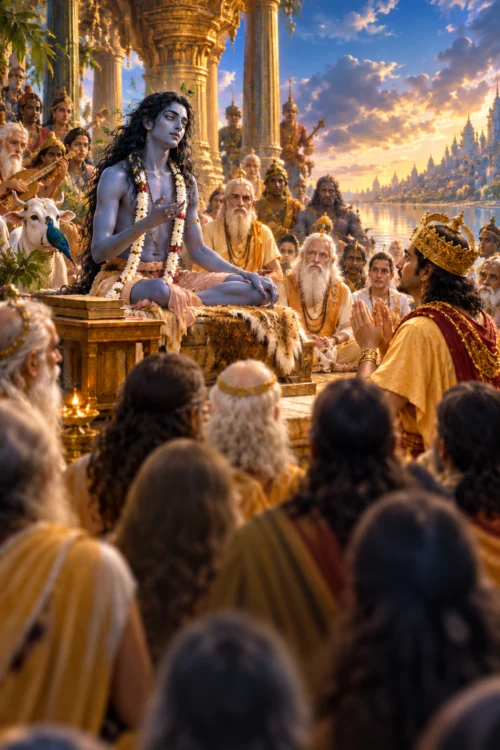
Ancestry, Birth Traditions, Teachers, Renunciation, and the Places Where the Scriptures Genuinely Disagree
I went much deeper into Śukadeva than the usual Bhāgavata biographies, including the Mahābhārata’s Mokṣadharma narrative, the Bhāgavata Purāṇa, Nāradiya Purāṇa, Skanda Purāṇa, Devī-Bhāgavata, the traditional Mahābhārata prologue, and later Vaiṣṇava interpretations.
The first major discovery is important: No single, completely uniform ancient biography of Śukadeva exists.
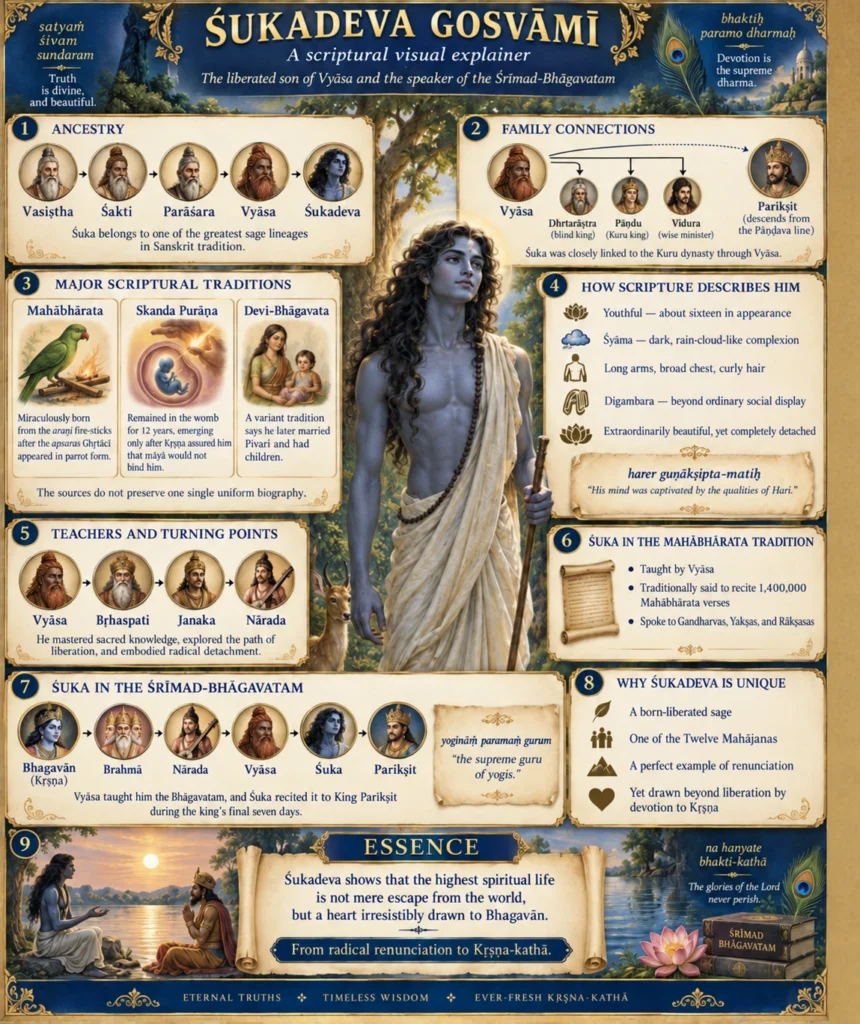
Nine panels trace Śuka’s ṛṣi ancestry and Kuru family, the three differing birth accounts, his teachers, and his two roles — reciter of the Mahābhārata and speaker of the Bhāgavatam.
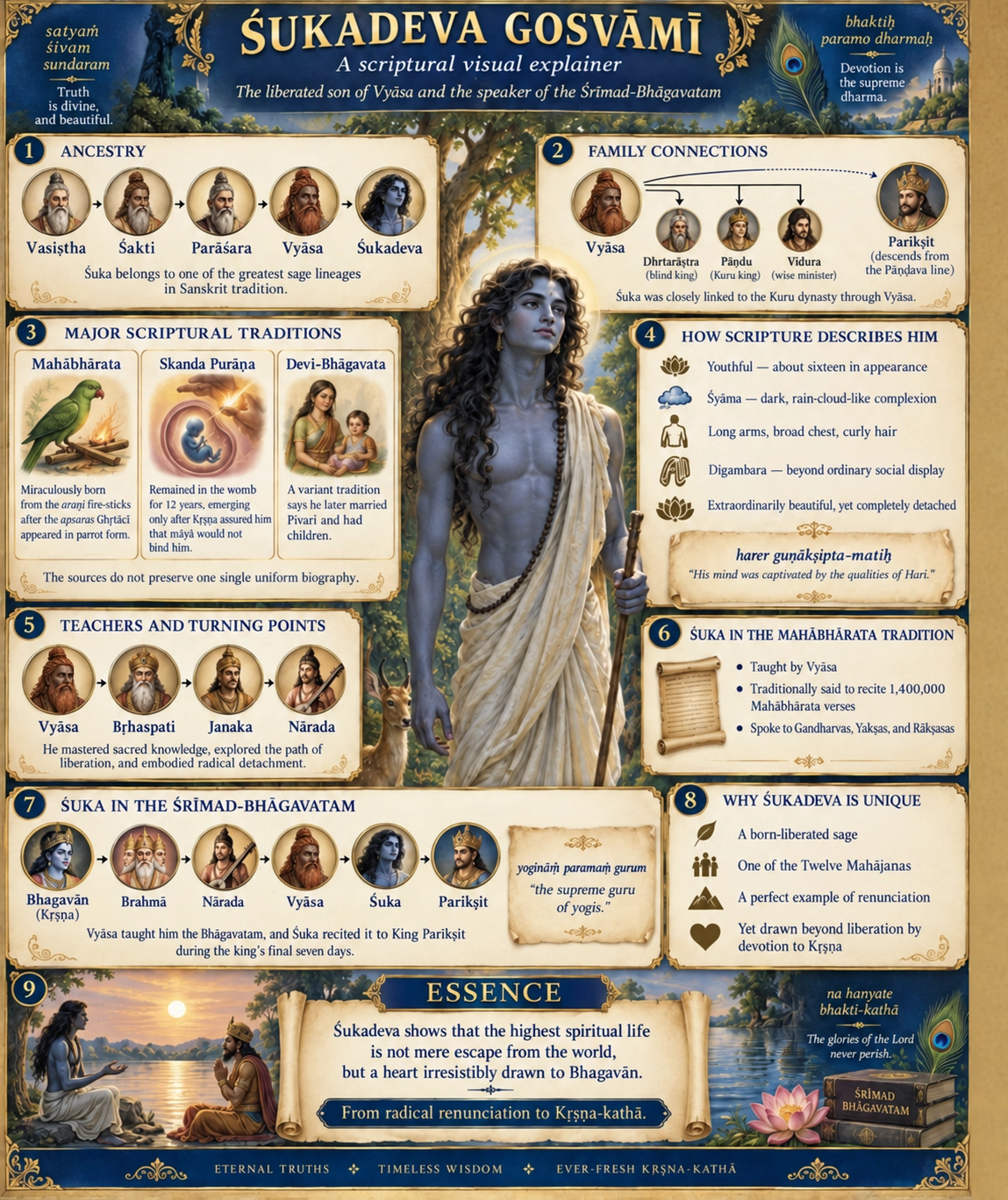
There is a very stable core—he is Vyāsa’s extraordinary son, a prodigious knower of sacred tradition, radically detached from bodily consciousness, a master of yoga and mokṣa, and one of India’s paradigmatic liberated sages. But the texts disagree on important details such as:
- his mother,
- the circumstances of his birth,
- whether he received formal initiation,
- whether he married,
- whether he had children,
- the chronology of his life,
and even how his final liberation relates chronologically to his later role in the Bhāgavatam. The most responsible reconstruction is therefore not to mash every story into one artificial biography. We should distinguish the different textual portraits and then see what they share.
A major scholarly comparison by V. M. Bedekar identifies the core Śuka biography in the Critical Edition of the Mahābhārata at Śānti-parva/Mokṣadharma XII.310–320, comprising roughly 481 verses, and shows that the Nāradiya Purāṇa preserves an extremely close version while the Devī-Bhāgavata substantially reshapes it.
Śukadeva’s ancestry: one of the greatest ṛṣi lineages in Sanskrit tradition
Śuka’s paternal genealogy is extraordinary. The Mahābhārata states directly:
वसिष्ठस्य सुतः शक्तिः शक्तेः पुत्रः पराशरः
vasiṣṭhasya sutaḥ śaktiḥ śakteḥ putraḥ parāśaraḥ
“Śakti was the son of Vasiṣṭha; Parāśara was the son of Śakti.”
It then continues with Kṛṣṇa Dvaipāyana Vyāsa as Parāśara’s son. The direct paternal line is therefore:
- Vasiṣṭha
- Śakti
- Parāśara
- Kṛṣṇa Dvaipāyana Vyāsa
- Śukadeva
This places Śuka in a lineage that includes some of the most consequential figures of Vedic and epic tradition.
Vasiṣṭha is an archetypal Vedic ṛṣi. His son Śakti fathers Parāśara. Parāśara fathers Vyāsa through Satyavatī. Vyāsa then fathers Śuka. And because Vyāsa is also the biological father of Dhṛtarāṣṭra, Pāṇḍu, and Vidura, Śuka is genealogically much closer to the Kuru dynasty than people usually realize.
Śuka was the son of Vyāsa—and the Kuru princes were his half-brothers
The Bhāgavatam gives an unusually direct autobiographical statement from Śuka himself. Speaking of Satyavatī and Parāśara, Śuka says of Kṛṣṇa Dvaipāyana Vyāsa:
यतोऽहमिदमध्यगाम्
yato ’ham idam adhyagām
“From him I studied this [Bhāgavatam].”
Then:
मह्यं पुत्राय शान्ताय
mahyaṁ putrāya śāntāya
“unto me, his peaceful son…”
The passage explicitly identifies Śuka as Vyāsa’s son and says that Vyāsa gave this supremely confidential teaching to him. Immediately afterward, the genealogy says that Vyāsa, at Satyavatī’s instruction, begot:
धृतराष्ट्रं च पाण्डुं च विदुरं च
dhṛtarāṣṭraṁ ca pāṇḍuṁ ca viduraṁ ca
Dhṛtarāṣṭra, Pāṇḍu and Vidura. So, in biological terms, through their common father Vyāsa: Śukadeva was a paternal half-brother of Dhṛtarāṣṭra, Pāṇḍu, and Vidura. That leads to a fascinating implication.
In the Kuru dynastic framework, Śuka was effectively an uncle of the Pāṇḍavas through Pāṇḍu. Arjuna’s grandson was: Parīkṣit. Thus the young king who eventually sat before Śukadeva and asked him how to die was not a stranger to Śuka’s extended family.
Śuka belonged to the same extraordinary Vyāsa–Kuru family network. This relationship is rarely emphasized.
Śuka’s paternal grandmother was Satyavatī
Vyāsa’s mother was: Satyavatī. Before marrying King Śantanu, she conceived Vyāsa with the sage Parāśara. The Bhāgavatam explicitly says that Satyavatī gave birth to Kṛṣṇa Dvaipāyana through Parāśara before her marriage to Śantanu.
Thus: Satyavatī was Śukadeva’s paternal grandmother. That creates another extraordinary network of relationships. Satyavatī later married Śantanu. Śantanu’s son from Gaṅgā was: Bhīṣma.
So Vyāsa and Bhīṣma became stepbrothers through Satyavatī’s marriage to Śantanu, though not blood brothers. Śuka therefore stood inside the broader family structure containing: Bhīṣma, Dhṛtarāṣṭra, Pāṇḍu, Vidura, the Pāṇḍavas, and eventually Parīkṣit.
When these figures meet in the texts, they are not merely famous sages and kings from unrelated narratives. They belong to a densely interconnected family.
But who was Śukadeva’s mother?
Here the sources diverge sharply. At least two major ancient birth traditions exist, along with later attempts to harmonize them.
The Mahābhārata: Śuka is born from the fire sticks
In the Mahābhārata’s Mokṣadharma narrative, Vyāsa desires a son and performs extremely severe austerities. For one hundred years he practices tapas on Mount Meru. Śiva eventually grants him a son, pure as the five great elements. The text describes the promised son as comparable in purity to: fire, air, earth, water, and space.
Then comes Śuka’s miraculous conception. Vyāsa is rubbing the araṇis, the wooden fire sticks used to generate sacrificial fire. He sees the apsaras: Ghṛtācī. She assumes the form of a female parrot.
Vyāsa becomes sexually agitated, and his semen falls upon the araṇi. As the fire sticks are churned, Śuka emerges from them, blazing like sacrificial fire. The Mahābhārata version therefore makes him essentially: ayonija— not born through an ordinary human womb.
Ghṛtācī catalyzes conception, but she is not an ordinary gestational mother in this version. That is an important distinction.
Why the name “Śuka”?
Śuka means: “parrot.” But even the explanation of the name varies. In the Mahābhārata/Devī-Bhāgavata birth complex, Ghṛtācī assumes the form of a: śukī female parrot. Śuka’s name is naturally connected with that event.
But the Skanda Purāṇa gives another explanation. After Śuka is born, Kṛṣṇa says that the boy speaks or “prattles” like a: śuka and instructs that he be called Śuka. So even the famous parrot association has more than one ancient explanation.
The Skanda Purāṇa gives Śuka an actual human mother: Vaṭikā or Piñjalā
The Skanda Purāṇa, Nāgara-khaṇḍa 147, preserves a radically different birth story. Here Vyāsa marries: Vaṭikā, also called Piñjalā, the daughter of the sage: Jābāli. She becomes pregnant by Vyāsa.
And then something extraordinary happens. Śuka remains inside her womb for: twelve years. While still unborn, he hears and remembers: the Vedas, Vedāṅgas, Smṛtis, Purāṇas, and teachings concerning liberation.
He refuses to come out. Why? Because he knows that once a jīva emerges into the world, it becomes touched by: Viṣṇumāyā. He fears losing the knowledge and detachment he possesses in the womb.
This is an extraordinarily sophisticated theological birth legend. Śuka is not reluctant because birth hurts. He is reluctant because: embodiment threatens spiritual forgetfulness.
Śuka demands Kṛṣṇa Himself as guarantor
Vyāsa assures him that māyā will not overcome him. Śuka does not accept even his father’s word. He demands: Vāsudeva Himself as guarantor. The Skanda Purāṇa has Vyāsa go to Dvārakā and bring Kṛṣṇa.
Kṛṣṇa assures the unborn Śuka that māyā will not overcome him. Only then does Śuka emerge. And he emerges not as an infant but as: a twelve-year-old boy approaching youth.
Immediately he bows to: Kṛṣṇa, Vyāsa, his mother, and begins leaving for the forest. The point is unmistakable: Śuka is born already finished with worldly life.
This tradition lies behind Prabhupāda’s account of the twelve-year pregnancy
Prabhupāda gives this story essentially in his purport to ŚB 9.21.25, attributing it to the Brahma-vaivarta Purāṇa.
There, too:
- Vyāsa has Jābāli’s daughter as wife;
- Śuka remains twelve years in the womb;
- he refuses to emerge because of māyā;
- Vyāsa seeks Bhagavān’s guarantee;
- Śuka comes out and immediately becomes a wandering renunciant.
I was able to verify a very close version directly in the Skanda Purāṇa. The precise Brahma-vaivarta recension behind Prabhupāda’s attribution is more difficult to establish from presently accessible Sanskrit editions, so academically I would distinguish: Prabhupāda’s Brahma-vaivarta attribution from: the independently verifiable Skanda Purāṇa parallel.
The Mahābhārata gives Śuka a spectacular divine childhood
After his miraculous araṇi birth, the Mahābhārata’s Śuka does not have an ordinary childhood. His arrival is celebrated by: Gandharvas, Apsarases, and heavenly beings. Flowers rain from the sky.
A staff and black deer skin appropriate to a brahmacārī descend for him. Indra provides a water vessel. Gaṅgā herself bathes him. And remarkably, Śiva and Pārvatī perform his upanayana in the epic narrative.
The Vedas are depicted as almost immediately available to him. This is one place where the Mahābhārata portrait differs sharply from the Bhāgavatam.
Because the Bhāgavatam says he left without upanayana
The Bhāgavatam opens with Sūta’s famous obeisance to Śuka:
यं प्रव्रजन्तमनुपेतमपेतकृत्यम्
yaṁ pravrajantam anupetam apeta-kṛtyam
It describes him as leaving home for renunciation without undergoing the usual rites, including the sacred-thread initiation. Vyāsa runs after him, crying:
पुत्रेति
putreti
“O son!”
and the trees answer instead. Thus: Mahābhārata Śuka: receives a spectacular divine upanayana. Bhāgavata Śuka: transcends the need for ordinary saṁskāras and leaves without them.
That is a genuine textual difference. It should not be hidden.
His formal teacher in the Mahābhārata was Bṛhaspati
After his initiation, the Mahābhārata says Śuka chooses: Bṛhaspati —the guru of the devas—as his teacher. He learns: the Vedas, history, and other branches of knowledge, including royal/statecraft knowledge.
The remarkable point is that he masters knowledge appropriate not only to ascetics but also to rulers and society. Yet after mastering it, he remains uninterested in ordinary worldly progression.
This gives us a much richer picture than “Śukadeva knew only the Bhāgavatam.” Traditional Śuka is a polymathic Vedic sage.
Vyāsa then teaches him Yoga and Sāṅkhya
Śuka’s real obsession is: mokṣa. He approaches Vyāsa and asks what he must do to attain absolute peace. The Mahābhārata preserves the substance of his request:
मोक्षधर्मेषु कुशलो भगवान् प्रब्रवीतु मे
mokṣa-dharmeṣu kuśalo bhagavān prabravītu me
In essence: “Please instruct me in the dharma leading to liberation.” Vyāsa first directs him into: Yoga and: Sāṅkhya. Then, remarkably, Vyāsa sends his own prodigious son to someone else.
To: King Janaka of Mithilā.
Why would Vyāsa send Śuka to a king?
This is one of the most philosophically interesting episodes in Śuka’s life. Śuka is: a renunciant, a sage, the son of Vyāsa. Janaka is: a king, living in a palace, governing a kingdom.
And yet Vyāsa says: Go learn liberation from Janaka. Why? Because Janaka represents: jīvan-mukti while acting in the world. Śuka initially finds this hard to accept. How can a man possess: kingdom, wealth, family, authority, yet be: Videha— “bodiless,” unattached?
The Śuka-Janaka encounter therefore sets up a profound tension: Is liberation dependent upon external renunciation—or internal freedom?
Śuka is tested in Mithilā
The Mahābhārata describes Śuka’s arrival at Janaka’s palace almost as a test of his realization. Gatekeepers obstruct him. He remains calm. He is led into magnificent palace surroundings.
Beautiful courtesans surround him. They: sing, dance, attend him, offer luxury. Śuka remains utterly unaffected. He meditates. Sleeps peacefully. Wakes and resumes contemplation.
Nothing disturbs him. The Devī-Bhāgavata expands this and says he regarded the women like mothers. The point is the same: his renunciation is not fear of temptation. It is absence of possessive desire.
Śuka asks one of the deepest questions about the āśrama system
Janaka explains the traditional sequence: brahmacarya, gṛhastha, vānaprastha, sannyāsa. But Śuka presses the issue. If direct realization has already arisen— must a person mechanically pass through every social stage?
That question is extraordinarily important. The Mahābhārata’s answer, as summarized in the Janaka episode, is essentially: not necessarily. For an exceptionally purified person in whom direct realization has arisen, liberation can be attained even from the first āśrama; the remaining stages are not mechanically required. Modern scholarship on the episode likewise notes that Janaka ultimately recognizes Śuka as already liberated.
This makes Śuka almost a scriptural paradigm of: adhikāra— spiritual qualification overriding mechanical imitation. He is exceptional precisely because normal rules were designed to lead ordinary practitioners toward a state he already possessed.
Śukadeva returns to Vyāsa—and joins Vyāsa’s great Vedic school
After Janaka’s instruction, the Mahābhārata has Śuka return to his father. Vyāsa is then teaching his famous disciples: Paila, Vaiśampāyana, Jaimini, Sumantu. Śuka joins them.
The four disciples say, in effect: “We are four disciples, and your son is the fifth.” This places Śuka directly within the circle responsible, in traditional accounts, for transmitting Vedic learning.
So Śuka is not merely: a solitary mystic. He is also: a transmitter within Vyāsa’s scholastic world.
Then comes Nārada’s great renunciation discourse
Later in the Mahābhārata, Śuka receives another major instruction from: Nārada. Nārada’s teaching is uncompromising.
Among its central principles are:
- knowledge is the highest eye;
- attachment is the deepest sorrow;
- renunciation is the greatest happiness;
- possession entangles the possessor;
- contentment is true wealth;
- life disappears day by day like water flowing downstream;
- the body is impermanent;
- the self is unborn and deathless.
One striking Sanskrit aphorism is:
नास्ति रागसमं दुःखं नास्ति त्यागसमं सुखम्
nāsti rāga-samaṁ duḥkhaṁ nāsti tyāga-samaṁ sukham
“There is no sorrow equal to attachment, and no happiness equal to renunciation.”
The Mahābhārata’s Śuka is therefore a culmination of its Mokṣadharma ideal of radical nonattachment.
But the Bhāgavata transforms Śuka’s spiritual center
This is one of the most important theological developments. The Bhāgavatam agrees that Śuka is already: liberated, self-satisfied, detached. Then it asks: Why would such a person study the Bhāgavatam at all?
Immediately before answering, it gives the famous Ātmārāma principle: even sages satisfied in the self become attracted to Bhagavān. Then it says of Śuka:
हरेर्गुणाक्षिप्तमतिः
harer guṇākṣipta-matiḥ
“his mind was captivated by the qualities of Hari.”
That changes everything. The Mahābhārata’s Śuka is the paradigmatic seeker of: mokṣa. The Bhāgavata’s Śuka is a liberated sage who discovers that: Hari is more compelling than liberation itself.
This is why Śuka becomes so important to Gauḍīya Vaiṣṇavism.
Vyāsa himself taught Śuka the Śrīmad-Bhāgavatam
The Bhāgavatam is unequivocal about this. After compiling and arranging the Bhāgavata-saṁhitā, Vyāsa:
शुकमध्यापयामास
śukam adhyāpayām āsa
“taught Śuka.”
Śuka was already described as: nivṛtti-nirata fully devoted to renunciation. So he did not study the Bhāgavatam because he needed basic religion. He studied it because Hari’s qualities drew even his liberated consciousness toward personal devotion.
This is the theological hinge of Śukadeva’s Bhāgavata identity.
Śukadeva is one of the Twelve Mahājanas
ŚB 6.3.20 makes his authority explicit. Yamarāja lists the great authorities on bhāgavata-dharma:
स्वयम्भूर्नारदः शम्भुः … बलिर्वैयासकिर्वयम्
svayambhūr nāradaḥ śambhuḥ … balir vaiyāsakir vayam
The list includes: Brahmā, Nārada, Śiva, the Kumāras, Kapila, Manu, Prahlāda, Janaka, Bhīṣma, Bali, Vaiyāsaki—Śukadeva, and Yamarāja. Thus Śuka is not merely a narrator.
He is counted among the twelve paradigmatic authorities on dharma.
His titles tell us who he is
The literature calls him by several names. Śuka — “parrot”; his personal name. Śukadeva — reverential expansion of Śuka. Vaiyāsaki — “son of Vyāsa.” ŚB 2.3.13 uses this directly.
Bādarāyaṇi — “son of Bādarāyaṇa,” another name of Vyāsa. ŚB 1.7.11 uses it. Vyāsātmaja / Vyāsa-sūnu — “son of Vyāsa.” Araṇeya / Araṇīsuta — names associated with his araṇi/fire-stick birth in the epic tradition. Prabhupāda also lists forms of these names in the purport to ŚB 1.9.8.
Brahmarāta — an important Bhāgavata epithet identifying him in ŚB 1.9.8 and 2.8.27. Its precise historical etymological interpretation is less certain than the simple identification “Śukadeva,” so I would avoid over-translating it without specifying a commentator.
And Gosvāmī is principally a later Vaiṣṇava honorific. The early Sanskrit texts generally call him simply Śuka or one of the patronymics above.
What did Śukadeva actually look like?
Here the Bhāgavatam is astonishingly detailed. When he arrives before Parīkṣit, he is described as:
द्व्यष्टवर्षम्
dvyaṣṭa-varṣam
literally: “two times eight years”—sixteen years old. He has: delicate but fully developed limbs, wide beautiful eyes, well-shaped nose and ears, fine eyebrows, a beautiful face, a conch-like neck.
The next verse gives: a broad elevated chest, deep navel, beautiful abdomen, long arms, loose curly hair falling around his face, and:
दिगम्बरम्
dig-ambaram
literally: “clothed by the directions”— naked. His hue is described in the surrounding passage as śyāma, and his bodily appearance is compared to Kṛṣṇa. This makes the dark, rain-cloud-like coloring we discussed for the illustration a legitimate devotional visualization, though the Sanskrit itself says śyāma/blackish/dusky, not “bright blue.”
He was extraordinarily beautiful
Śuka is not described as an emaciated, frightening ascetic. Quite the opposite. The text emphasizes: youth, bodily symmetry, health, beauty, a charming smile. He was attractive even to women.
Yet the extraordinary feature was that he himself possessed no sexual awareness of them as objects of desire. That is why the famous bathing-women story matters.
The naked women covered themselves before Vyāsa—but not before Śuka
ŚB 1.4.5 describes Vyāsa following his son. Young women are bathing naked. Śuka passes them. They remain completely unconcerned. Vyāsa approaches. They cover themselves. Vyāsa asks why.
Their explanation is that Śuka sees no fundamental bodily distinction: male / female whereas Vyāsa, despite his immense realization, still operates sufficiently within ordinary social distinction that they react differently to him.
The story is not praising nudity as spectacle. It is illustrating Śuka’s complete innocence toward bodily sexuality.
The same motif appears in the Mahābhārata’s final Śuka story
This is a fascinating intertextual connection. Near the end of the Mahābhārata Śuka narrative, Śuka flies past celestial women bathing in the Mandākinī. They do not cover themselves before him.
Later Vyāsa arrives while pursuing his son. Then the women become embarrassed and cover or hide themselves. Vyāsa recognizes: his son’s freedom and: his own remaining attachment.
The Bhāgavata’s bathing-women story therefore belongs to a much older Śuka narrative complex.
Śuka was not socially identifiable
When he arrives at Parīkṣit’s gathering, people initially do not know what to make of him. He does not arrive dressed as: a priest, king, court scholar, formal sannyāsī. He is essentially an avadhūta-like figure, outside ordinary social signaling.
Women and children follow him out of curiosity. But the great sages recognize his extraordinary bodily and spiritual marks and: stand up. That is one of the most dramatic scenes in the Bhāgavatam.
The youngest-looking person enters. The oldest and greatest sages rise. The text’s message is clear: spiritual authority is not measured by chronological age.
Parīkṣit calls this sixteen-year-old “the supreme guru of yogīs”
Parīkṣit addresses him:
योगिनां परमं गुरुम्
yogināṁ paramaṁ gurum
“the supreme guru of the yogīs.”
And asks him: What should a person do who is about to die? This is an extraordinary reversal of ordinary social hierarchy. A world emperor bows before an apparently naked sixteen-year-old wanderer.
And the assembled sages accept him as the person qualified to answer: the ultimate human question.
Śuka is also explicitly called a ṛṣi and a kavi
ŚB 2.3.13 calls him:
वैयासकिमृषिं कविम्
vaiyāsakim ṛṣiṁ kavim
“Vaiyāsaki, the sage and poet.”
Kavi here means more than someone who writes pleasant poetry. In Sanskrit religious discourse, it can imply: seer, inspired poet, one whose vision penetrates deeply.
Śukadeva is therefore simultaneously: a yogī, ṛṣi, kavi, mahājana, paramahaṁsa, guru, and transmitter of revelation.
Śukadeva and the 1.4 million Mahābhārata verses
The traditional Mahābhārata prologue assigns Śuka another astonishing role. Vyāsa’s Bhārata is described cosmologically in a vast six-million-verse form distributed among different classes of beings.
The traditional scheme assigns roughly:
- 3 million verses to the devas,
- 1.5 million to the Pitṛs,
- 1.4 million to Gandharva-associated beings,
- 100,000 to humans.
Then it states that Śuka recited to:
गन्धर्वयक्षरक्षांसि
gandharva-yakṣa-rakṣāṁsi
“Gandharvas, Yakṣas and Rākṣasas.”
This is the source behind Prabhupāda’s statement that Śukadeva recited 1,400,000 Mahābhārata verses in their assemblies. The important qualification remains: this does not mean our earthly Mahābhārata originally contained 1.4 million verses.
The traditional narrative itself distinguishes the roughly 100,000-verse human recension from the cosmic recensions.
Śuka was present in Yudhiṣṭhira’s royal assembly
The Mahābhārata tradition also places Śuka in the assembly of: Mahārāja Yudhiṣṭhira. Prabhupāda specifically cites Sabhā-parva 4.11 for this fact. Thus Śuka’s traditional biography intersects the Pāṇḍavas long before the famous Parīkṣit dialogue.
And that leads to a major chronological problem.
The sixteen-year-old Śukadeva creates a genuine chronology problem
The Bhāgavatam says he is sixteen when he comes to Parīkṣit. Yet the same Bhāgavatam identifies him as present when Bhīṣma lies dying after Kurukṣetra: brahmarātādayo ’malāḥ with Brahmarāta understood as Śukadeva.
Parīkṣit’s final days occur much later. If Śuka had already been present at Bhīṣma’s death, ordinary chronological aging would make it impossible for him to still be sixteen decades later.
This is not the only problem.
The Mahābhārata gives Śuka an entire life—and final liberation—in a story told by Bhīṣma
In the Mokṣadharma, Bhīṣma himself tells Yudhiṣṭhira Śuka’s life story, ending in Śuka’s final liberation. Śuka: practices yoga, rises into the sky, passes through the guṇas, crosses the heavenly regions, and enters the supreme state.
Yet the Bhāgavatam simultaneously places Śuka among the sages at Bhīṣma’s death—and later as Parīkṣit’s teacher. If we treat all these narratives as one straightforward modern chronological biography, they cannot easily be reconciled.
This is one of the clearest indications that different textual layers and traditions about Śuka have been combined in the Sanskrit corpus.
What happened in Śukadeva’s Mahābhārata liberation?
It is one of the most spectacular mokṣa narratives in Sanskrit epic literature. After Nārada’s instruction, Śuka resolves to achieve the supreme state through yoga. He turns toward the sun.
He rises into the sky. The gods and celestial beings watch in amazement. He moves through the cosmic regions. Mountain peaks split before him. He passes the Mandākinī. Finally the text says:
सर्वभूतोऽभवत् तदा
sarva-bhūto ’bhavat tadā
“he then became all beings.”
It then calls him:
- sarvagata — present everywhere;
- sarvātmā — the self of all;
- sarvatomukha — facing everywhere.
This is Śuka portrayed according to the Mahābhārata’s powerful nondual mokṣa language.
Vyāsa cries “Śuka!”—and the entire world answers
Vyāsa cannot bear to be separated from his son. He follows him and cries: “Śuka!” But Śuka has become: sarvagata— everywhere. The reply:
भोः
bhoḥ
echoes through creation. This is almost certainly the background of one of the most beautiful opening verses of the Bhāgavatam. Sūta says that when Śuka left home, Vyāsa cried: “O son!”
and: the trees answered. The Bhāgavata therefore appears to know and artistically reuse a famous older Śuka motif. But it gives the sage a new theological destination: not merely cosmic liberation— Bhāgavata-bhakti.
Śukadeva and Parīkṣit: the encounter for which he became immortal
Parīkṣit has seven days to live. He renounces the throne and sits beside the Gaṅgā. The great question is: What should a dying person do? Or more specifically: what should one hear?
what should one chant? what should one remember? what should one worship? what should one avoid? Śuka’s answer becomes the central teaching structure of the Śrīmad-Bhāgavatam.
This is why the scene is universal. Parīkṣit knows the date of his death. We do not. Otherwise the question is identical.
Śuka’s Bhāgavata teaching is not merely information about death
The answer gradually encompasses: the nature of the self, cosmology, creation, avatāras, karma, yoga, dharma, liberation, devotional practice, the lives of devotees, and ultimately the intimate līlās of Kṛṣṇa.
Thus the narrative movement is extraordinary. Parīkṣit asks: “How should I die?” Śuka ultimately answers by teaching: “Learn how to hear about Bhagavān.” Death becomes the pressure that strips away secondary questions.
Was Parīkṣit the first to hear the Śrīmad-Bhāgavatam?
Not literally. Śuka himself had already heard it from Vyāsa. And the Bhāgavatam traces its revelatory succession back still further. So Prabhupāda’s statement that Śuka first recited the Bhāgavatam before Parīkṣit is best understood as: the foundational public recitation of the compiled Bhāgavata-saṁhitā, not the first appearance of Bhāgavata wisdom in cosmic history.
The famous line is: Vyāsa → Śuka → Parīkṣit within a larger revelatory succession.
Śukadeva’s relation to Parīkṣit is especially beautiful
Recall the genealogy. Vyāsa fathers: Śuka and, through the Kuru niyoga, Pāṇḍu. Pāṇḍu’s dynastic line produces: Arjuna → Abhimanyu → Parīkṣit. Thus the great scene beside the Gaṅgā is not simply: an unrelated sage meets a dying king.
It is also, in the extended Vyāsa-Kuru family structure: an elder member of the same extraordinary lineage instructing a much younger descendant. That gives the scene another layer of intimacy.
Was Śukadeva married?
There is no single scriptural answer. This is one area where confident popular biographies are often misleading.
Mahābhārata / Nāradiya Purāṇa
Their Śuka is fundamentally a renouncer. The narrative trajectory points toward celibacy, detachment and final mokṣa. There is no household biography comparable to the Devī-Bhāgavata account. Bedekar finds the Nāradiya Purāṇa’s version remarkably close to the epic.
Devī-Bhāgavata
It explicitly says:
शुकश्चकार पत्नीं तां
śukaś cakāra patnīṁ tām
Śuka took Pīvarī as his wife. He fathers four sons: Kṛṣṇa, Gauraprabha, Bhūri, Devaśruta, and a daughter: Kīrti. Kīrti marries Anūha, son of Vibhrāja, and their line produces Brahmadatta.
Later Śuka again renounces and attains the supreme state.
Prabhupāda preserves yet another reconciliation: the “duplicate Śuka”
Prabhupāda’s ŚB 9.21.25 purport addresses a tradition in which Śuka’s daughter appears. He states, citing the Brahma-vaivarta Purāṇa, that the original Śukadeva remained a lifelong brahmacārī, but produced a duplicate or likeness of himself who later entered household life.
Thus the genealogical daughter belongs to the duplicate rather than the original Bhāgavata speaker. This is a theological harmonization of traditions that otherwise conflict.
Historically, it is safest to say: Different Purāṇas preserve competing Śuka biographies rather than one universally agreed marital history.
The Devī-Bhāgavata deliberately makes the renouncer experience household life
This is not a tiny alteration. It fundamentally changes Śuka’s biography. The Mahābhārata’s Śuka is a radical embodiment of spontaneous renunciation. The Devī-Bhāgavata has him learn from Janaka, return, marry Pīvarī, produce a family, and only later leave for final realization.
Bedekar’s comparative study calls this one of the most radical changes the Devī-Bhāgavata makes to the older Śuka narrative. Therefore: “Śukadeva had a wife named Pīvarī” is correct within one Purāṇic tradition, not a universal fact across Sanskrit scripture.
Was Śukadeva Rādhārāṇī’s pet parrot?
This deserves special treatment because it is now extremely popular in some Gauḍīya circles. The devotional story says that Śuka was originally a parrot belonging to Śrī Rādhā, heard Kṛṣṇa-kathā, and eventually became Śukadeva.
I searched specifically for this identification. The important result is: I did not find it in the Mahābhārata, Śrīmad-Bhāgavatam, Nāradiya Purāṇa, Devī-Bhāgavata, Skanda Purāṇa, or Caitanya-caritāmṛta passages examined.
Caitanya-caritāmṛta Madhya 17.208–217 does indeed describe a: śuka-śārī male and female parrot in Vṛndāvana. The male praises Kṛṣṇa and the female praises Rādhā. But the text does not identify that male parrot as Śukadeva Gosvāmī.
Later Gauḍīya teachers explicitly teach the Rādhā-parrot identity. So I would classify it as: a later devotional identification, not presently demonstrable from the early primary Śuka sources I checked.
That does not tell us how a practitioner must evaluate the tradition devotionally. It tells us its source status.
Nor should the Rādhā-parrot story be confused with the ancient “parrot” birth motif
This distinction is crucial. The ancient Mahābhārata story already associates Śuka with a parrot: Ghṛtācī assumes the form of a female parrot before Śuka’s conception. The Skanda Purāṇa also independently explains his name through parrot-like speech.
Thus: Śuka ↔ parrot is genuinely ancient. But: Śuka = Rādhārāṇī’s personal parrot is a more specific claim for which the early sources examined do not provide the same evidence.
Those are two different propositions.
Was Śukadeva really only sixteen?
The plain Bhāgavata Sanskrit says: dvyaṣṭa-varṣam sixteen years. There is no need to weaken that statement linguistically. But the broader chronology makes ordinary literal aging extremely difficult.
He is placed:
- at Yudhiṣṭhira’s assembly,
- at Bhīṣma’s final gathering,
- and much later at Parīkṣit’s death.
Moreover, the Mahābhārata has already narrated his final liberation in a story spoken by Bhīṣma. Thus two responsible readings are possible. The plain Bhāgavata literary reading is: Śuka is sixteen.
A harmonizing theological reading can say: Śuka appears eternally youthful, manifesting the form of a sixteen-year-old perfected sage. We should not pretend there is no chronological difficulty.
There is.
The Mahābhārata Śuka and Bhāgavata Śuka are related—but not seamlessly identical literary portraits
This is perhaps the most important result of the research. The Bhāgavatam clearly knows older Śuka material.
It knows:
- Vyāsa crying after him,
- the trees answering,
- his absolute transcendence of sexuality,
- his extraordinary renunciation.
But the Bhāgavatam makes Śuka serve a new theological purpose. The older epic Śuka culminates in: mokṣa into Brahman / cosmic universality. The Bhāgavata Śuka is already liberated—but then becomes: captivated by Hari.
That transformation is theologically brilliant. The question becomes no longer: Can Śuka become liberated? He already is. The question becomes: What can attract someone who no longer needs liberation?
The Bhāgavata’s answer: Kṛṣṇa.
This is why Śukadeva is such a powerful witness for bhakti
If Śuka were: fearful, worldly, desperate, seeking heaven, seeking liberation, then his devotion could be explained as a means to obtain something. But he is an: ātmārāma— self-satisfied sage.
He has nothing material to gain. And still: harer guṇākṣipta-matiḥ Hari’s qualities capture his mind. Therefore the Bhāgavata uses him almost as an experiment: Remove worldly desire.
Remove fear. Remove social ambition. Remove sexual attraction. Remove even the need for mokṣa. What remains capable of attracting such a person? Bhagavān Himself. That is Śukadeva’s distinctive theological power.
Śuka therefore represents something beyond ordinary vairāgya
He is often remembered simply as: the ultimate renunciant. That is true, especially in the Mahābhārata. But the Bhāgavata goes further. Renunciation is not the destination.
It clears the field. Śuka’s life becomes: vairāgya → brahma-jñāna → ātmārāmatā → attraction to Hari → bhakti → Kṛṣṇa-kathā. That is the full Bhāgavata arc.
Why Śukadeva was the perfect speaker for the rāsa-līlā
The Bhāgavatam also places its most intimate Kṛṣṇa narratives in Śuka’s mouth for an implicit theological reason. Who could narrate the gopīs’ love without reducing it to ordinary sexuality?
A person whom the text has already established as: completely beyond male/female bodily attraction. Śuka is therefore almost the ideal narrative safeguard. When he speaks of the rāsa-līlā, the text has already made it difficult to interpret his interest as erotic curiosity.
He is interested because: Kṛṣṇa is spiritually attractive even to the completely liberated. This is one of the Bhāgavata’s subtler literary achievements.
The final Mahābhārata image of Śuka is almost cosmic
In the epic’s final account, Śuka no longer remains simply an individual yogī. After transcending the guṇas, he reaches: paramaṁ padam the supreme state.
He becomes:
- sarva-bhūta — all beings;
- sarvagata — all-pervading;
- sarvātmā — the self of all;
- sarvatomukha — facing everywhere.
Vyāsa cries for his son. Śuka answers from everywhere. Even Śiva eventually consoles Vyāsa, telling him that his son has attained a state difficult even for the gods and that Śuka’s fame will endure.
This is one of the grandest yogic apotheoses in the Mahābhārata.
The Bhāgavata gives him another kind of immortality
The Mahābhārata makes Śuka: cosmically omnipresent. The Bhāgavatam makes him: eternally audible. Every time the Bhāgavatam is recited, the reader returns to: Śuka speaking; Parīkṣit hearing.
This is why ŚB 1.1.3 says the fruit of Vedic revelation becomes especially nectarean:
शुकमुखात्
śuka-mukhāt
“from the mouth of Śuka.”
He becomes not merely: a liberated sage, but: the voice through which the Bhāgavata tastes like itself.
My reconstruction: what can we say with the greatest confidence?
If I had to write a historically and scripturally responsible biography without pretending the sources agree on everything, I would state it like this: Śukadeva, or Śuka, is the son and disciple of Kṛṣṇa Dvaipāyana Vyāsa and belongs to the Vasiṣṭha–Śakti–Parāśara–Vyāsa sage lineage. Through Vyāsa, he is also closely connected biologically to the Kuru dynasty. The Mahābhārata preserves an extensive early biography in which Vyāsa obtains him through divine blessing; Śuka is miraculously born from the araṇi after the appearance of the apsaras Ghṛtācī in parrot form, receives extraordinary Vedic education, studies with Bṛhaspati, receives instruction in Yoga and Sāṅkhya from Vyāsa, seeks liberation from King Janaka, later receives a profound renunciation teaching from Nārada, and finally attains a cosmic form of mokṣa. The Nāradiya Purāṇa closely follows this version.
The Śrīmad-Bhāgavatam adopts the already famous liberated Śuka but gives his biography a specifically bhakti-centered culmination. It portrays him as an extraordinarily beautiful, naked, śyāma youth of sixteen, utterly beyond bodily distinctions and conventional social rites. Although already an ātmārāma, his mind is captured by Hari’s qualities. Vyāsa therefore teaches him the Bhāgavata-saṁhitā, and Śuka becomes its paradigmatic speaker to the dying King Parīkṣit. He is counted among the twelve mahājanas and is explicitly called a ṛṣi, kavi, and supreme guru of yogīs.
Other Purāṇas preserve competing biographies. The Skanda Purāṇa makes Vaṭikā/Piñjalā, Jābāli’s daughter, his mother and narrates his twelve-year stay in the womb until Kṛṣṇa guarantees that Viṣṇumāyā will not overcome him. The Devī-Bhāgavata makes him marry Pīvarī and father children before his final renunciation, whereas other traditions insist that the true Śukadeva remained a lifelong brahmacārī. These traditions should be distinguished rather than silently blended.
And his deepest theological identity, especially from the Bhāgavata-Gauḍīya perspective, is this: Śukadeva is not important merely because he renounced everything. He is important because after transcending everything the world could offer—even the need for liberation—he still found something capable of capturing his heart: the qualities of Kṛṣṇa.
That is why perhaps the single most revealing Sanskrit description of him is not: “sixteen years old,” not: “naked,” not: “son of Vyāsa,” not even: “knower of millions of verses.”
It is:
हरेर्गुणाक्षिप्तमतिः
harer guṇākṣipta-matiḥ
“His mind was captivated by the qualities of Hari.”
That is the key to understanding who Śukadeva Gosvāmī really is in the Śrīmad-Bhāgavatam.
Main sources used
For the early epic biography of Śuka, the most important source is the Mahābhārata, Śānti-parva/Mokṣadharma, especially Critical Edition XII.310–320; numbering differs substantially in the vulgate and Gita Press traditions. The Sanskrit conclusion is directly accessible in Mahābhārata XII.320, while V. M. Bedekar’s comparative study is especially valuable for mapping the Mahābhārata, Nāradiya and Devī-Bhāgavata versions.
For the Vaiṣṇava Śukadeva, the essential primary passages are Śrīmad-Bhāgavatam 1.2.2; 1.4.5; 1.7.8–11; 1.9.8; 1.19.25–40; 2.3.13–16; 6.3.20–21; 9.22.21–25, together with the later transmission passages.
For the twelve-year womb tradition, Skanda Purāṇa, Nāgara-khaṇḍa 147 is unusually explicit and also helps evaluate Prabhupāda’s parallel Brahma-vaivarta Purāṇa account.
For the householder Śuka tradition, Devī-Bhāgavata 1.19 explicitly names Pīvarī and the children, making it impossible to present Śuka’s marital status as uniform across the Purāṇas.
And for the popular “Rādhā’s parrot” identification, the Caitanya-caritāmṛta does contain the famous male and female parrots of Vraja, but the passage itself does not identify the male parrot with Vyāsa’s son Śukadeva; that more specific identification belongs to later devotional teaching rather than to the early Śuka sources located in this research.