

God Is More Than the Universe
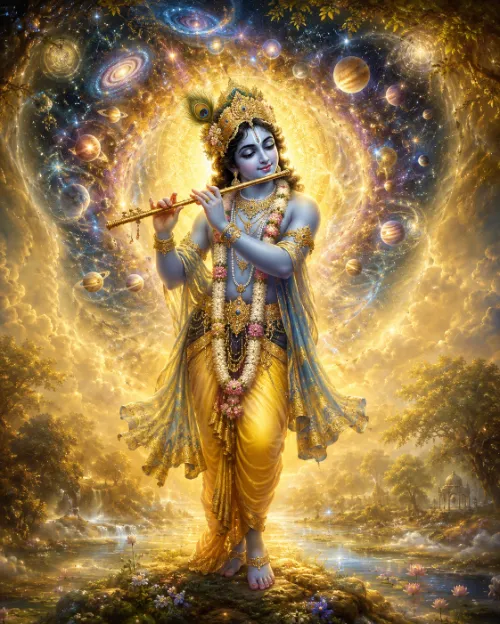
God Is More Than the Universe — and More Than Formlessness
The verse
अमुनी भगवद्रूपे मया ते ह्यनुवर्णिते ।
उभे अपि न गृह्णन्ति मायासृष्टे विपश्चितः ॥
amunī bhagavad-rūpe
mayā te hy anuvarṇite
ubhe api na gṛhṇanti
māyā-sṛṣṭe vipaścitaḥ
“The discerning do not accept either of these two forms attributed to Bhagavān, which I have described to you, because both are produced by māyā.”
“Neither of the above forms of the Lord, as just described unto you from the material angle of vision, is accepted by the pure devotees of the Lord who know Him well.”
This is accurate as a theological translation. The Sanskrit is exceptionally compact; the English makes its implied contrasts explicit.
What every word contributes
The grammar itself blocks a common misreading. The repeated duals—amunī, bhagavad-rūpe, anuvarṇite, ubhe, and māyā-sṛṣṭe—keep pointing to a definite pair.
The first conception: the gross cosmic person
The first member of the pair is named in the preceding verse:
एतद्भगवतो रूपं स्थूलं ते व्याहृतं मया ।
मह्यादिभिश्चावरणैरष्टभिर्बहिरावृतम् ॥
etad bhagavato rūpaṁ
sthūlaṁ te vyāhṛtaṁ mayā
mahy-ādibhiś cāvaraṇair
aṣṭabhir bahir āvṛtam
“I have described to you this gross form attributed to Bhagavān, externally enclosed by the eight coverings beginning with earth.”
Śrīmad-Bhāgavatam 2.10.33
This is the Virāṭ, the universe contemplated as a single gigantic person. The planetary systems become limbs; cosmic powers become senses; mountains, oceans, directions, elemental regions, and their presiding deities are coordinated as parts of one macrocosmic organism.
Such contemplation has a real spiritual purpose. A consciousness imprisoned in matter may initially be unable to conceive of anything beyond matter. The Virāṭ meditation teaches that the world is not ownerless, random, or independent. It trains the worshiper to see order, dependence, and divine governance throughout the cosmos.
But a map is not the territory, and a theological model is not automatically God’s own body. Calling the planets His limbs does not mean that Bhagavān is literally made of planets. The cosmos depends upon Him; He does not depend upon the cosmos in order to possess a form.
The First Canto makes the same distinction:
एतद्रूपं भगवतो ह्यरूपस्य चिदात्मनः ।
मायागुणैर्विरचितं महदादिभिरात्मनि ॥
etad rūpaṁ bhagavato
hy arūpasya cid-ātmanaḥ
māyā-guṇair viracitaṁ
mahad-ādibhir ātmani
“This form attributed to Bhagavān—whose nature is consciousness and who has no material form—is constructed in contemplation from the qualities of māyā, beginning with the cosmic principle called mahat.”
Śrīmad-Bhāgavatam 1.3.30
Here arūpa, “formless,” cannot coherently mean that Bhagavān has no spiritual identity or form whatsoever. The verse itself qualifies the negation: the Virāṭ is māyā-guṇair viracitam, fashioned from the constituents of material nature. Bhagavān is “formless” in the relevant sense that He has no material, conditioned form.
The second conception: the subtle cosmic totality
The next verse moves from the gross manifestation to something subtler:
अतः परं सूक्ष्मतममव्यक्तं निर्विशेषणम् ।
अनादिमध्यनिधनं नित्यं वाङ्मनसः परम् ॥
ataḥ paraṁ sūkṣmatamam
avyaktaṁ nirviśeṣaṇam
anādi-madhya-nidhanaṁ
nityaṁ vāṅ-manasaḥ param
“Beyond that is the most subtle, unmanifest and undifferentiated conception: without beginning, middle, or end, abiding, and beyond the reach of ordinary speech and mind.”
Śrīmad-Bhāgavatam 2.10.34
The adjectives are exalted, and this is precisely why the verse can be misread when isolated. In context, however, 2.10.35 immediately includes both preceding conceptions under māyā-sṛṣṭe. Jīva Gosvāmī identifies the pair as the gross and subtle collective bodies of the universe, known respectively as Virāṭ and Hiraṇyagarbha.
Hiraṇyagarbha—literally “the golden embryo” or “golden womb”—is the universe in its subtle, collective condition: the total field of cosmic life, mind, intelligence, and causal potential prior to, or underlying, gross differentiation. Virāṭ is the manifest cosmic organism; Hiraṇyagarbha is its subtle totality.
Thus the pair is not:
- Kṛṣṇa and Nārāyaṇa;
- two-armed and four-armed spiritual forms;
- personal God and an equally ultimate impersonal God;
- or one genuine form and one false form.
It is gross cosmos and subtle cosmos, both construed as divine forms for contemplative purposes. The language of 2.10.34 still carries theological value. Bhagavān truly transcends gross sense perception, material predicates, and ordinary conceptual capture. But 2.10.35 prevents us from turning a subtle cosmic principle—or the mere negation of visible features—into the whole truth of Bhagavān.
Subtle matter is still not spirit. Formlessness relative to gross matter is not yet the fullness of transcendental personality. Jīva Gosvāmī’s decisive explanation The clearest technical interpretation appears in Jīva Gosvāmī’s Paramātma-sandarbha, Anuccheda 57. He asks why the cosmic totality, having been called Bhagavān’s “form,” should not also be taken as nonmaterial. He then cites 2.10.35 to deny that inference.
Jīva’s identification of the two forms
अमुनी अमू उपासनार्थं भगवत्यारोपिते जगदात्मके स्थूलसूक्ष्माख्ये विराट्-हिरण्यगर्भापरपर्याये समष्टिशरीरे ये मया तुभ्यमनुवर्णिते ते उभे अपि विपश्चितो न गृह्णन्ति वस्तुतया नोपासते। किं तर्हि? तदीयबहिरङ्गाधिष्ठानतयैवेत्यर्थः।
amunī amū upāsanārthaṁ bhagavaty āropite jagad-ātmake sthūla-sūkṣmākhye virāṭ-hiraṇyagarbhāpara-paryāye samaṣṭi-śarīre ye mayā tubhyam anuvarṇite te ubhe api vipaścito na gṛhṇanti vastutayā nopāsate. kiṁ tarhi? tadīya-bahiraṅgādhiṣṭhānatayaivety arthaḥ.
“ ‘These two’ means the gross and subtle collective bodies of the universe, otherwise called Virāṭ and Hiraṇyagarbha, which are superimposed upon Bhagavān for the purpose of worship and which I have described to you. The discerning do not accept or worship either as His actual essential form. Rather, they understand them in terms of His relation to, and presiding over, His external potency.”
Several technical expressions deserve attention: Upāsanārtham—“for the purpose of worship or contemplation.” The cosmic model is pedagogical, not pointless. Āropite—“superimposed” or “attributed.” Features of the cosmos are mapped onto Bhagavān.
Samaṣṭi-śarīre—“the collective bodies.” These are the aggregate gross and subtle structures of cosmic manifestation. Vastutayā nopāsate—the wise do not worship them as the ultimate, essential reality of Bhagavān Himself.
Bahiraṅga—the external potency, the potency through which the material cosmos is manifested. Jīva then states the decisive positive conclusion:
अत एव “न गृह्णन्ति” इत्यत्र हेतुर्मायासृष्टे, न तु स्वरूपशक्तिप्रादुर्भाविते। अनेन चतुर्भुजादिलक्षणस्य साक्षाद्रूपस्य मायातीतत्वमपि व्यक्तम्।
ata eva “na gṛhṇanti” ity atra hetur māyā-sṛṣṭe, na tu svarūpa-śakti-prādurbhāvite. anena catur-bhujādi-lakṣaṇasya sākṣād-rūpasya māyātītatvam api vyaktam.
“Therefore the reason for the words ‘they do not accept’ is that these two are produced by māyā, not manifested by the Lord’s intrinsic potency. By this, the transcendence of māyā belonging to His direct form—marked by four arms and similar characteristics—is also made clear.”
This sentence rules out the most damaging misreading. The verse does not say that a personal divine form is a concession to ignorance. It says the opposite: because the cosmic forms are products of māyā while Bhagavān’s direct form is beyond māyā, the two must not be confused.
“Superimposed” does not mean “the universe is unreal” The word māyā is easily flattened into “illusion,” after which one may assume that the text dismisses the cosmos as sheer nonexistence. Jīva explicitly resists that conclusion in the following discussion:
तद्-आरोप एव मिथ्या, न तु विश्वं मिथ्या ।
tad-āropa eva mithyā, na tu viśvaṁ mithyā.
“That superimposition alone is false; it is not that the universe is false.”
Paramātma-sandarbha 58
The universe is real as a dependent manifestation of divine energy. What is mistaken is the equation: the material totality = Bhagavān’s own essential body The distinction can be put simply: The world is from God, sustained by God, pervaded by God, and governed by God.
The world is not the exhaustive measure of God. Its temporary material structure is not His eternal spiritual body. God can disclose a universal manifestation through His inconceivable power without becoming reducible to that manifestation.
This is neither crude pantheism nor a doctrine of total separation. It is a theology of simultaneous dependence, presence, and transcendence.
Pervading the universe is not being exhausted by it
The Bhagavad-gītā expresses this double truth with deliberate paradox:
मया ततमिदं सर्वं जगदव्यक्तमूर्तिना ।
मत्स्थानि सर्वभूतानि न चाहं तेष्ववस्थितः ॥ ९.४ ॥
न च मत्स्थानि भूतानि पश्य मे योगमैश्वरम् ।
भूतभृन्न च भूतस्थो ममात्मा भूतभावनः ॥ ९.५ ॥
mayā tatam idaṁ sarvaṁ jagad avyakta-mūrtinā
mat-sthāni sarva-bhūtāni na cāhaṁ teṣv avasthitaḥ
na ca mat-sthāni bhūtāni paśya me yogam aiśvaram
bhūta-bhṛn na ca bhūta-stho mamātmā bhūta-bhāvanaḥ
“By Me, in an unmanifest manner, this whole universe is pervaded. All beings rest in Me, yet I am not confined within them. And still, the beings do not rest in Me—behold My divine mystery! I sustain all beings and bring them forth, yet My own Self is not contained in them.”
Bhagavad-gītā 9.4–5
The Gītā first affirms radical divine immanence: everything rests upon Kṛṣṇa’s power. It then denies spatial or material confinement: Kṛṣṇa is not one component inside the cosmic system, nor is He merely the system’s collective total.
The sun and sunlight offer an imperfect but useful analogy. Sunlight depends upon the sun and reveals the sun’s energy, but the sun is not exhausted by the patch of light entering a room. Likewise, the cosmos reveals divine power without fully defining the divine person.
Why Arjuna wanted the universal form to end
Prabhupāda’s purport to 2.10.35 points to Arjuna’s experience in the Eleventh Chapter of the Bhagavad-gītā. Arjuna does not deny that Kṛṣṇa has revealed the universal form. He is overwhelmed by it. The vision establishes Kṛṣṇa’s sovereignty, but it does not suit the intimacy of friendship.
अदृष्टपूर्वं हृषितोऽस्मि दृष्ट्वा
भयेन च प्रव्यथितं मनो मे ।
तदेव मे दर्शय देव रूपं
प्रसीद देवेश जगन्निवास ॥ ११.४५ ॥
किरीटिनं गदिनं चक्रहस्तम्
इच्छामि त्वां द्रष्टुमहं तथैव ।
तेनैव रूपेण चतुर्भुजेन
सहस्रबाहो भव विश्वमूर्ते ॥ ११.४६ ॥
adṛṣṭa-pūrvaṁ hṛṣito ’smi dṛṣṭvā
bhayena ca pravyathitaṁ mano me
tad eva me darśaya deva rūpaṁ
prasīda deveśa jagan-nivāsa
kirīṭinaṁ gadinaṁ cakra-hastam
icchāmi tvāṁ draṣṭum ahaṁ tathaiva
tenaiva rūpeṇa catur-bhujena
sahasra-bāho bhava viśva-mūrte
“Seeing what no one had shown me before, I rejoice, yet my mind trembles with fear. O Lord of gods, shelter of the universe, be gracious and show me that familiar form again. O thousand-armed universal form, I wish to see You crowned, bearing the mace and discus; please appear in that four-armed form.”
Bhagavad-gītā 11.45–46
Arjuna’s response reveals the difference between power displayed and person encountered. The universal vision inspires astonishment and fear. The personal form permits reciprocal love.
Bhakti does not reject majesty. It refuses to let majesty erase relationship. A devotee wants not only to know that all worlds are within God, but to serve Him, speak to Him, remember His face, hear His flute, behold His smile, and enter an eternal relationship with Him.
The verse does not reject Bhagavān’s spiritual form The verse immediately following 2.10.35 is important because it stops negation from running too far:
स वाच्यवाचकतया भगवान् ब्रह्मरूपधृक् ।
नामरूपक्रिया धत्ते सकर्माकर्मकः परः ॥
sa vācya-vācakatayā
bhagavān brahma-rūpa-dhṛk
nāma-rūpa-kriyā dhatte
sakarmākarmakaḥ paraḥ
“The transcendent Bhagavān, bearing an absolute form, manifests names, forms, and activities as realities expressible in sacred language; though appearing to act, He remains untouched by material action.”
Śrīmad-Bhāgavatam 2.10.36
The sequence is theologically exact: Do not mistake the gross cosmos for Bhagavān’s intrinsic form. Do not mistake a subtle, featureless cosmic conception for the fullness of Bhagavān.
Do not conclude that Bhagavān therefore lacks transcendental name, form, qualities, and action. Gauḍīya theology calls the Lord’s own form svarūpa or sākṣād-rūpa: a direct manifestation of His intrinsic potency, not a body assembled from material elements. His body is not a container occupied by a separate self, as an embodied soul occupies a temporary organism. His form is the very expression of His conscious being.
Kṛṣṇadāsa Kavirāja states this plainly in Bengali:
কৃষ্ণের স্বরূপ-বিচার শুন, সনাতন ।
অদ্বয়জ্ঞান-তত্ত্ব, ব্রজে ব্রজেন্দ্রনন্দন ॥
সর্ব-আদি, সর্ব-অংশী, কিশোর-শেখর ।
চিদানন্দ-দেহ, সর্বাশ্রয়, সর্বেশ্বর ॥
kṛṣṇera svarūpa-vicāra śuna, sanātana
advaya-jñāna-tattva, vraje vrajendra-nandana
sarva-ādi, sarva-aṁśī, kiśora-śekhara
cid-ānanda-deha, sarvāśraya, sarveśvara
“O Sanātana, hear the truth concerning Kṛṣṇa’s own form. He is the nondual Absolute Truth, yet in Vraja He is the son of the king of Vraja. He is the origin of all, the source of every expansion, the crown of youthfulness; His body is conscious bliss, He is the shelter of all, and He is the Lord of all.”
Caitanya-caritāmṛta, Madhya 20.152–153
The Bengali juxtaposition is deliberate: nondual Absolute Truth and the son of Nanda in Vraja are not rivals. The personal form is not a material limitation imposed upon the Absolute. It is the fullest disclosure of the Absolute.
Three positions that should not be confused
Prabhupāda labels the first two tendencies “pantheism” and “monism.” The labels should be read as critiques of reduction, not as denials of every insight those positions contain. The world truly has an intimate relation to God, and the Absolute truly surpasses material differentiation. The error arises when either truth is isolated and treated as complete.
What “the wise do not accept” actually means
The phrase na gṛhṇanti must be handled carefully. It does not mean that the wise:
- reject the scriptural description as false revelation;
- deny that Kṛṣṇa can reveal a universal form;
- deny the universe’s reality as divine energy;
- deny God’s immanence within every being;
- or reject the Virāṭ as a preliminary form of meditation for a qualified practitioner.
It means that they do not take either cosmic construction as Bhagavān’s own eternal, essential form. They refuse a category error.
One may therefore distinguish three levels:
All three can be true at once.
Why the distinction matters spiritually
If God is only the universe, then God changes whenever the universe changes, suffers every material defect, and disappears when the cosmos is withdrawn. Transcendence is lost.
If God is only an indeterminate, featureless absolute, then eternal names, forms, qualities, actions, and relationships become provisional appearances destined to vanish. Personal devotion loses its permanent object.
Śrīmad-Bhāgavatam 2.10.35 refuses both outcomes. Its theology can be compressed into four statements: God is present in everything, but everything is not the whole of God.
God has form, but His own form is not made of matter. The universe is real as His dependent energy, but it is not His eternal body. Liberation does not terminate devotion, because the devotee’s Lord and the relationship with Him are eternal.
This explains Prabhupāda’s emphasis that the pure devotee worships both before and after liberation. Devotion is not merely a method for reaching a state in which the worshiper, worship, and worshiped object disappear. It awakens an everlasting relationship.
Śrīmad-Bhāgavatam 2.10.35 is not anti-form. It is anti-confusion. It tells the reader not to mistake a material cosmic symbol for Bhagavān’s own spiritual body, and not to mistake subtle indefiniteness for the highest realization of the Absolute. The Virāṭ and Hiraṇyagarbha can orient the mind toward divine sovereignty, but they remain related to the world fashioned through māyā. Bhagavān’s direct form—Kṛṣṇa, Nārāyaṇa, Rāma, Nṛsiṁha and His other eternal manifestations—is not produced by that external potency.
The deepest point is not that God is smaller than the universe because He possesses a personal form. It is that His person is greater than the universe. He can pervade it without being confined by it, display it without being composed of it, withdraw it without ceasing to exist, and meet the devotee face to face without surrendering His infinity.
The cosmos can evoke awe. The unmanifest can evoke silence. But Bhagavān evokes love.
Primary sources cited
Śrīmad-Bhāgavatam 1.3.30; 2.10.33–36 Bhagavad-gītā 9.4–5; 11.45–46 Jīva Gosvāmī, Paramātma-sandarbha 57–58 Kṛṣṇadāsa Kavirāja, Śrī Caitanya-caritāmṛta, Madhya 20.152–153