

The Self Beneath Body and Mind
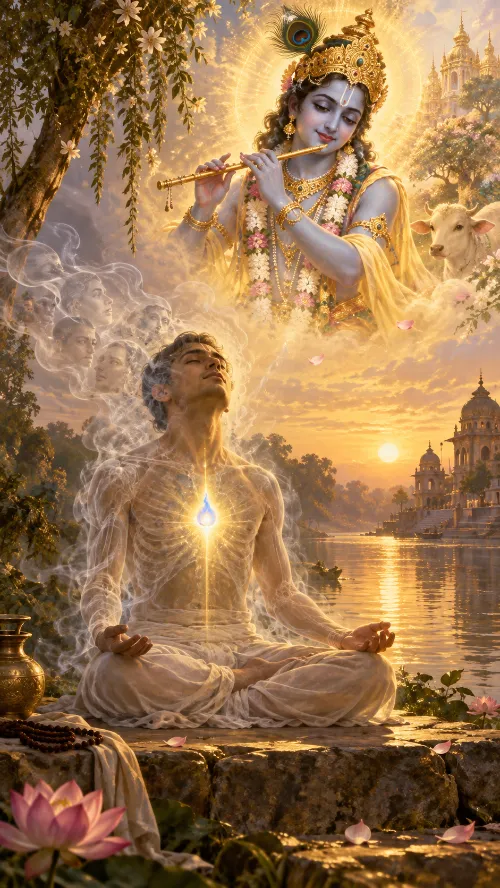
The Meaning of Brahma-darśana
Who are you when neither the body nor the mind is allowed to answer? That is the question hidden inside Śrīmad-Bhāgavatam 1.3.33. Ordinarily we identify ourselves through layers: my body, my age, my appearance, my memories, my emotions, my opinions, my intelligence, my social position.
The Bhāgavatam makes a much more radical claim: all of these belong to coverings experienced by the conscious self; they are not the self itself. The verse describes spiritual realization as the moment when the two material identities—the gross and subtle forms imposed upon the ātmā through ignorance—lose their claim to being “I.”
That is called:
ब्रह्मदर्शनम्
brahma-darśanam
“vision or realization of Brahman.”
A. C. Bhaktivedanta Swami Prabhupāda translates the verse interpretively: “Whenever a person experiences, by self-realization, that both the gross and subtle bodies have nothing to do with the pure self, at that time he sees himself as well as the Lord.”
The Sanskrit itself is even more compressed. Its central idea is not that the self becomes something new. It is that ignorance stops convincing the self that it is something it never was.
The Verse
यत्रेमे सदसद्रूपे
प्रतिषिद्धे स्वसंविदा ।
अविद्ययात्मनि कृते
इति तद्ब्रह्मदर्शनम् ॥
yatreme sad-asad-rūpe
pratiṣiddhe sva-saṁvidā
avidyayātmani kṛte
iti tad brahma-darśanam
“When these two forms—the gross and subtle forms imposed upon the self by ignorance—are negated through true self-awareness, that is the vision of Brahman.”
Śrīmad-Bhāgavatam 1.3.33
Prabhupāda’s rendering expands the Vaiṣṇava implication: when the coverings are known to be distinct from the self, one begins to see both the true self and the Supreme spiritual reality.
The Most Important Phrase: Avidyayātmani Kṛte
The verse says:
अविद्ययात्मनि कृते
avidyayātmani kṛte
literally: “made upon the self by ignorance.” The word:
अविद्या
avidyā
means: ignorance, nescience, misunderstanding of reality. But here avidyā is more than simply: “I do not know enough philosophy.” It is lived misidentification. The soul does not literally become: flesh, mind, memory, ego.
Rather, through ignorance it concludes: “This is me.” That is the problem.
“I Have a Body” Is Different From “I Am the Body”
This distinction seems simple until it is applied consistently. We naturally say: “I am old.” “I am young.” “I am beautiful.” “I am ugly.” “I am sick.” But each of those descriptions refers primarily to: the body.
A more philosophically precise formulation would be: “My body is aging.” “My body is ill.” That sounds almost artificial because bodily identification is so deeply embedded in ordinary consciousness.
Yet the Bhāgavatam asks us to distinguish: the experienced object from: the experiencer.
The Subtle Body Makes the Teaching Much Harder
It is relatively easy to hear: “You are not your body.” It is much more difficult to hear: “You are not ultimately your mind either.” The subtle body includes, in classical Vaiṣṇava analysis: mind, intelligence, false ego.
So the teaching does not stop at: “I am not my skin.” It continues: “I am not reducible to my thoughts.” “I am not identical with my memories.” “I am not identical with my changing emotions.”
“I am not even identical with the intellectual apparatus through which I analyze myself.” That is much more radical.
Bhagavad-gītā Describes the Gross and Subtle Elements
Kṛṣṇa says:
भूमिरापोऽनलो वायुः
खं मनो बुद्धिरेव च ।
अहङ्कार इतीयं मे
भिन्ना प्रकृतिरष्टधा ॥
bhūmir āpo ’nalo vāyuḥ
khaṁ mano buddhir eva ca
ahaṅkāra itīyaṁ me
bhinnā prakṛtir aṣṭadhā
“Earth, water, fire, air, ether, mind, intelligence, and false ego—these eight constitute My divided material energy.”
Bhagavad-gītā 7.4
The first five are associated with the gross material structure. The final three: manas — mind, buddhi — intelligence, ahaṅkāra — false ego, belong to the subtle apparatus.
All eight are: prakṛti material energy. The conscious self is something else.
The Self Is Beyond Even Intelligence
Bhagavad-gītā 3.42 makes the hierarchy explicit:
इन्द्रियाणि पराण्याहुर्
इन्द्रियेभ्यः परं मनः ।
मनसस्तु परा बुद्धिर्
यो बुद्धेः परतस्तु सः ॥
indriyāṇi parāṇy āhur
indriyebhyaḥ paraṁ manaḥ
manasas tu parā buddhir
yo buddheḥ paratas tu saḥ
“The senses are higher than dull matter, the mind is higher than the senses, intelligence is higher than the mind, and the self is higher even than intelligence.”
The crucial conclusion is:
बुद्धेः परतस्तु सः
buddheḥ paratas tu saḥ
“The self is beyond the intelligence.”
So even the faculty that says: “I am thinking” is not itself the deepest subject. It is an instrument being used by consciousness.
The Previous Verse Gives the Metaphor
ŚB 1.3.31 prepares the teaching with a striking image:
यथा नभसि मेघौघो
रेणुर्वा पार्थिवोऽनिले ।
एवं द्रष्टरि दृश्यत्वम्
आरोपितमबुद्धिभिः ॥
yathā nabhasi meghaugho
reṇur vā pārthivo ’nile
evaṁ draṣṭari dṛśyatvam
āropitam abuddhibhiḥ
“Just as clouds are attributed to the sky, or dust to the air, so the status of the seen is superimposed upon the seer by those lacking true understanding.”
The key word is:
आरोपितम्
āropitam
“superimposed.”
A cloud is not: the sky. Dust is not: the air. Yet we casually say: “the sky is cloudy” or: “the air is dirty.” Likewise the self becomes associated with conditions that properly belong to its coverings.
The Seer Is Mistaken for the Seen
The verse uses the philosophical contrast:
द्रष्टृ
draṣṭṛ
the seer, and:
दृश्य
dṛśya
the seen. This distinction is fundamental. The body can be observed. Thoughts can be observed. Emotions can be observed. Even changes in one’s intellectual convictions can be observed.
That raises a simple but powerful question: What is it that is aware of all those changes? That is where the Bhāgavata analysis directs attention.
Sad-asad-rūpe : The Two Material Forms
ŚB 1.3.33 calls the coverings:
सदसद्रूपे
sad-asad-rūpe
Traditionally in Gauḍīya explanation, this pair is understood as the: subtle and: gross forms. The subtle body is relatively more persistent. The gross body is visibly temporary and disintegrates at death.
The subtle apparatus is described as continuing with the conditioned jīva and participating in the movement toward another embodiment. But neither is the eternal self. So the contrast between sat and asat here should not be misunderstood as: one body eternal, the other temporary.
Both belong to material conditioning.
Why the Subtle Body Matters at Death
The doctrine of reincarnation becomes more intelligible within this framework. If only the gross physical body existed, then at death there would be no continuity of: mental tendencies, desires, karmic impressions, conditioned orientation.
Vaiṣṇava psychology therefore posits a subtle carrier. The gross body ends. The subtle body continues. The jīva remains the conscious subject underlying both. Thus: gross body ≠ jīva and: subtle body ≠ jīva.
Bhagavad-gītā 2.13 Gives an Accessible Entry Point
Kṛṣṇa says:
देहिनोऽस्मिन्यथा देहे
कौमारं यौवनं जरा ।
तथा देहान्तरप्राप्तिर्
धीरस्तत्र न मुह्यति ॥
dehino ’smin yathā dehe
kaumāraṁ yauvanaṁ jarā
tathā dehāntara-prāptir
dhīras tatra na muhyati
“Just as the embodied self passes in this body from childhood to youth to old age, so it passes into another body at death; the sober person is not bewildered by this.”
The body changes continuously. Yet a sense of: “I” persists through those transformations. The child’s body is gone. The adult nevertheless says: “That was me.” The Gītā asks: what accounts for that continuity?
Its answer is: dehī the embodied conscious self.
Pratiṣiddhe : What Is Actually Negated?
ŚB 1.3.33 says the gross and subtle forms become:
प्रतिषिद्धे
pratiṣiddhe
negated, rejected, disallowed as the true self. This does not mean that self-realization causes the body to disappear. A realized person still: eats, walks, speaks, thinks, remembers.
The mind does not necessarily stop functioning. What is removed is: false identification. The equation: body = self and: mind = self is rejected.
Liberation Can Therefore Begin While One Is Still Embodied
This is why Vaiṣṇava traditions can speak of:
जीवन्मुक्त
jīvan-mukta
one who is liberated while still living in the body. Liberation does not require immediate physical disappearance. The crucial transformation occurs in: identity. The body continues to function.
But it no longer defines the ultimate self.
The Bhāgavatam Gives a Famous Definition of Liberation
मुक्तिर्हित्वान्यथारूपं
स्वरूपेण व्यवस्थितिः ॥
muktir hitvānyathā rūpaṁ
sva-rūpeṇa vyavasthitiḥ
“Liberation is giving up the false or other form of identity and becoming established in one’s own true nature.”
Śrīmad-Bhāgavatam 2.10.6
This is remarkably close to ŚB 1.3.33. There: ignorance creates identities imposed upon the self. Here: liberation means abandoning: anyathā-rūpa the form of identity that is “other than” one’s true nature.
And then: sva-rūpeṇa vyavasthitiḥ “becoming situated in one’s own real condition.”
Liberation Is Therefore Not Primarily Going Somewhere
This is worth emphasizing. Popular religion often imagines liberation mainly geographically: leave this world, go somewhere spiritual. The Bhāgavatam gives a deeper definition.
The essence of liberation is: identity restored. One may later discuss spiritual destinations. But the foundational transformation is: knowing what one actually is.
The Next Verse Gives the Positive Side
After negating false identity, ŚB 1.3.34 says:
यद्येषोपरता देवी
माया वैशारदी मतिः ।
सम्पन्न एवेति विदुर्
महिम्नि स्वे महीयते ॥
yady eṣoparatā devī
māyā vaiśāradī matiḥ
sampanna eveti vidur
mahimni sve mahīyate
“When the divine illusory potency subsides and consciousness becomes clear, the living being becomes situated in its own glory.”
The beautiful phrase is:
महिम्नि स्वे
mahimni sve
“in its own glory.”
This prevents self-realization from becoming endless negation. It is not merely: not body, not mind, not ego. Eventually comes: what am I?
Gauḍīya Vaiṣṇavism Gives a Positive Answer
Caitanya-caritāmṛta gives one of the best-known Bengali formulations:
জীবের ‘স্বরূপ’ হয়—কৃষ্ণের ‘নিত্যদাস’ ।
কৃষ্ণের ‘তটস্থা-শক্তি’ ‘ভেদাভেদ-প্রকাশ’ ॥
jīvera ‘svarūpa’ haya — kṛṣṇera ‘nitya-dāsa’
kṛṣṇera ‘taṭasthā-śakti’ ‘bhedābheda-prakāśa’
“The constitutional nature of the jīva is to be an eternal servant of Kṛṣṇa. The jīva is Kṛṣṇa’s marginal potency, manifesting both distinction and connection with Him.”
Caitanya-caritāmṛta, Madhya 20.108
This supplies the positive identity that mere negation cannot give. The jīva is not: matter. But it is also not: an isolated spiritual monad with no relationship. Its svarūpa is relational.
False Ego Is More Than Arrogance
The subtle body includes:
अहङ्कार
ahaṅkāra
often translated: false ego. Modern English makes “ego” sound like: pride. But the Sanskrit concept is deeper. Ahaṅkāra literally involves: “I-making.” It is the principle through which consciousness says: “I am this.”
Therefore both: “I am superior to everyone” and: “I am worthless because my body is unattractive” can arise from the same underlying mechanism. The common problem is: mistaking a temporary condition for the self.
Self-Inflation and Self-Hatred Can Have the Same Root
This is psychologically important. Someone may think: “I am powerful because I am wealthy.” Another: “I am insignificant because I am poor.” One looks like pride. The other looks like low self-esteem.
But from the perspective of 1.3.33 both may be based on: body-and-mind identification. The external judgment differs. The false equation remains: temporary condition = ultimate self.
Avidyā Changes Self-Interest
Prabhupāda draws a practical conclusion from the verse. As long as we identify ourselves with the gross and subtle coverings, our idea of: self-interest is also misdirected.
If I think: “I am primarily my body,” then ultimate success becomes: comfort, beauty, security, survival, status. If I identify primarily with mind and ego, success becomes: being admired, winning arguments, protecting my opinions, gratifying emotional patterns.
But if the self transcends both: the definition of “what is good for me” changes.
This Does Not Make Bodily Life Unimportant
The doctrine should not be abused. “The body is not the self” does not mean: ignore disease, neglect food, abandon responsibilities, dismiss emotional suffering. The Bhagavad-gītā recommends regulated eating, sleep, work, and recreation.
The body is: not the self, but it is still: an instrument. A musician is not his instrument. Yet a good musician takes care of it. Likewise spiritual non-identification should produce: responsible care, not neglect.
Nor Should the Mind Be Neglected
Similarly: “You are not your mind”
does not mean:
- mental illness is imaginary,
- emotions should be suppressed,
- psychological care is unnecessary.
The claim concerns: ultimate identity. A person may need to treat the mind precisely because: the mind is an instrument affecting embodied life. One can care for: the instrument without believing: the instrument is the player.
Why Does Prabhupāda Say “He Sees Himself as Well as the Lord”?
The Sanskrit ends simply:
इति तद्ब्रह्मदर्शनम्
iti tad brahma-darśanam
“that is brahma-darśana.”
It does not literally say: “he sees the self and the Lord” as separate words. Prabhupāda is therefore giving: a theological unpacking of the phrase.
Within Vaiṣṇava interpretation, realization reveals: the jīva is spiritual, and: the Supreme is spiritual. But they are not thereby the same individual being.
Bhagavad-gītā Distinguishes Jīva and Paramātmā
उपद्रष्टानुमन्ता च
भर्ता भोक्ता महेश्वरः ।
परमात्मेति चाप्युक्तो
देहेऽस्मिन्पुरुषः परः ॥
upadraṣṭānumantā ca
bhartā bhoktā maheśvaraḥ
paramātmeti cāpy ukto
dehe ’smin puruṣaḥ paraḥ
“Within this body there is also another transcendental person, the Supreme Lord, who is the overseer, permitter, maintainer, and supreme proprietor, and who is known as Paramātmā.”
Bhagavad-gītā 13.23
The phrase:
पुरुषः परः
puruṣaḥ paraḥ
points to: the higher or Supreme Person. So self-realization does not stop at: “I am not matter.” It opens another realization: “There is also the Supreme conscious reality.”
The Jīva and Bhagavān Are Both Spiritual—but Not Identical Persons
This distinction is essential in Gauḍīya theology. The jīva is: spiritual. Bhagavān is: spiritual. But: qualitative spiritual kinship does not mean numerical identity. A sunray is luminous because it shares the nature of the sun.
Yet one ray is not: the entire sun. Likewise the jīva possesses conscious spiritual nature but remains: dependent, finite, relational. Bhagavān is: the Supreme source.
Brahman, Paramātmā, and Bhagavān
ŚB 1.2.11 gives the famous threefold description:
वदन्ति तत्तत्त्वविदस्
तत्त्वं यज्ज्ञानमद्वयम् ।
ब्रह्मेति परमात्मेति
भगवानिति शब्द्यते ॥
vadanti tat tattva-vidas
tattvaṁ yaj jñānam advayam
brahmeti paramātmeti
bhagavān iti śabdyate
“Those who know the Absolute Truth describe that nondual reality as Brahman, Paramātmā, and Bhagavān.”
This helps us understand: brahma-darśanam in 1.3.33. The verse describes the foundational spiritual realization: I am not material. Vaiṣṇava theology then develops that realization further toward: Paramātmā and ultimately: Bhagavān.
Jīva Gosvāmī Uses the Verse in This Way
In Gauḍīya theology, Jīva Gosvāmī cites ŚB 1.3.33 in discussions of: Brahman realization. That makes good sense. The verse concerns the collapse of: material self-identification.
This produces direct awareness of spiritual reality. But Gauḍīya theology does not treat this as the last word. The positive culmination is: relationship with Bhagavān.
Bhagavad-gītā 18.54 Shows the Progression
Kṛṣṇa says:
ब्रह्मभूतः प्रसन्नात्मा
न शोचति न काङ्क्षति ।
समः सर्वेषु भूतेषु
मद्भक्तिं लभते पराम् ॥
brahma-bhūtaḥ prasannātmā
na śocati na kāṅkṣati
samaḥ sarveṣu bhūteṣu
mad-bhaktiṁ labhate parām
“One situated on the Brahman platform becomes joyful, neither lamenting nor hankering, and sees all beings equally; in that state one attains supreme devotion to Me.”
This is particularly important. The sequence is: brahma-bhūta
- spiritual self-realization
- freedom from compulsive hankering and lamentation
- equal vision
- mad-bhaktiṁ labhate parām
“one attains supreme devotion to Me.” Thus self-realization is not the end of relationship. It makes pure relationship possible.
Why Realization Reduces Hankering and Lamentation
If I identify entirely with: temporary possessions, temporary body, temporary psychological conditions, then change constantly threatens: my identity. Loss becomes: “I am diminished.”
Aging becomes: “I am disappearing.” Failure becomes: “I am worthless.” But when the self is understood as deeper than those changing conditions, they remain important without carrying the impossible burden of defining: what I ultimately am.
This helps explain: na śocati na kāṅkṣati neither lamenting nor hankering.
Avidyā Is a Reversal of Identity
ŚB 11.2.37 describes the psychology of conditioning:
भयं द्वितीयाभिनिवेशतः स्याद्
ईशादपेतस्य विपर्ययोऽस्मृतिः ।
bhayaṁ dvitīyābhiniveśataḥ syād
īśād apetasya viparyayo ’smṛtiḥ
The full verse describes how turning away from the Lord produces: bhaya fear, viparyaya reversal or mistaken understanding, and: asmṛti forgetfulness. The important word here is:
विपर्यय
viparyaya
reversal. Avidyā does not merely hide one fact. It reverses the structure of identity. The non-self becomes: “I.” The temporary becomes: “permanent.” The dependent becomes: “independent.”
That is bondage.
Self-Realization Is Therefore Recognition, Not Construction
Modern identity language often assumes that the self must be: constructed, invented, performed. The Bhāgavata model is almost the opposite. The deepest self is: already there.
The task is not to manufacture it. It is to: stop confusing it with acquired coverings. That is why the verb of realization is associated with: seeing, knowing, recognizing.
The truth is uncovered rather than created.
This Is Why Liberation Is Not Annihilation
If the conditioned identities disappear, does anything remain? The Bhāgavatam answers emphatically: yes. ŚB 1.3.34 says:
महिम्नि स्वे महीयते
mahimni sve mahīyate
the jīva becomes established: “in its own glory.” And ŚB 2.10.6 says:
स्वरूपेण व्यवस्थितिः
sva-rūpeṇa vyavasthitiḥ
“situated in its own true nature.”
Nothing could be farther from: personal annihilation. Liberation is: recovered identity.
The Lord Is Not Covered in the Same Way
The surrounding Bhāgavata discussion makes another crucial distinction. The jīva’s gross and subtle bodies are: imposed through avidyā. Bhagavān is not subject to this kind of covering.
This prevents a common mistake: “Kṛṣṇa has form. I have form. My form is material. Therefore Kṛṣṇa’s form must also be material.” The Bhāgavata rejects that equation. The jīva’s conditioned form is: materially imposed.
Bhagavān’s form is understood as: transcendental. So the section simultaneously teaches: do not materialize the soul and: do not materialize Bhagavān.
Brahma-darśana Does Not Mean “I Am God”
This is perhaps the most important doctrinal safeguard. To realize: “I am spiritual” does not mean: “I am the Supreme Lord.” The distinction is:
Spiritual nature
shared qualitatively.
Identity, power, dependence
not identical. The jīva is conscious. Bhagavān is conscious. But Bhagavān is: the source and Lord of consciousness. The jīva remains: relational.
The Positive Gauḍīya Conclusion: Nitya-dāsa
This is why the Bengali verse from Caitanya-caritāmṛta matters so much:
জীবের ‘স্বরূপ’ হয়—কৃষ্ণের ‘নিত্যদাস’ ।
jīvera ‘svarūpa’ haya — kṛṣṇera ‘nitya-dāsa’
“The jīva’s true nature is to be Kṛṣṇa’s eternal servant.”
Self-realization therefore moves through two stages: First: “I am not this material covering.” Then: “What am I positively?” Gauḍīya Vaiṣṇavism answers: a conscious being eternally related to Kṛṣṇa.
A Useful Four-Stage Map
The whole teaching can be condensed into four stages.
That last stage transforms philosophical self-awareness into: bhakti.
What This Teaching Does Not Mean
ŚB 1.3.33 does not mean that:
- the body is evil;
- the mind is useless;
- emotions are meaningless;
- bodily or psychological suffering should be ignored;
- self-realization causes physical disappearance;
- individuality vanishes in liberation;
- the jīva becomes numerically identical with Bhagavān;
- all forms are ultimately unreal;
- or transcendental divine form is simply another product of avidyā.
Those interpretations go beyond what the surrounding text supports.
What It Does Mean
The verse teaches that:
- the gross body is not the ultimate self;
- the subtle body is not the ultimate self;
- mind, intelligence, and ego belong to the conditioned apparatus;
- avidyā creates false identification;
- realization negates identification, not necessarily bodily function;
- liberation is restoration of true identity;
- the jīva remains an individual spiritual conscious being;
- Bhagavān is transcendental and not covered by ignorance;
- spiritual realization can deepen from Brahman awareness into knowledge of Paramātmā and Bhagavān;
- and the positive Gauḍīya conclusion is not merely “I am not matter,” but “I am eternally related to Kṛṣṇa.”
The Deeper Structure of ŚB 1.3.31–34
The sequence is remarkably elegant.
3.31
mahimni sve in its own glory. That is a complete philosophy of bondage and liberation in four verses.
The Central Mistake Is Simple
The verse does not say avidyā creates the soul. Nor that avidyā damages the soul’s essence beyond recognition. Avidyā creates: misidentification. The soul remains what it is.
But it interprets itself through: the wrong categories. That gives us perhaps the sharpest formulation of the whole teaching: Avidyā does not change what the soul is. It changes what the soul thinks it is.
The body changes. The mind changes. Opinions change. Memory changes. Emotions change. Social identities change. Yet consciousness continues to say: “I experienced that.” Śrīmad-Bhāgavatam 1.3.33 asks us to turn attention from everything being experienced toward: the experiencer.
Its answer is: the experiencer is not reducible to: body, mind, intelligence, ego. Those are the: sad-asad-rūpe the gross and subtle forms imposed upon the self through: avidyā.
When their false claim to be the self is denied through: sva-saṁvid true self-awareness, the Bhāgavatam calls the result:
ब्रह्मदर्शनम्
brahma-darśanam
“vision of spiritual reality.”
But the Gauḍīya conclusion does not end with: “I am not matter.” It continues:
জীবের ‘স্বরূপ’ হয়—কৃষ্ণের ‘নিত্যদাস’
jīvera ‘svarūpa’ haya — kṛṣṇera ‘nitya-dāsa’
“The true nature of the jīva is to be Kṛṣṇa’s eternal servant.”
Thus realization has two movements: first: remove the false identity; then: discover the real relationship. That is why liberation is not erasure. It is: coming home to the self that was hidden beneath identification all along.
And the essence of the verse can be expressed in one question:
- The body is something you experience.
- The mind is something you experience.
- Who, then, is the one experiencing both?