

Many Gods, One Final Siddhānta
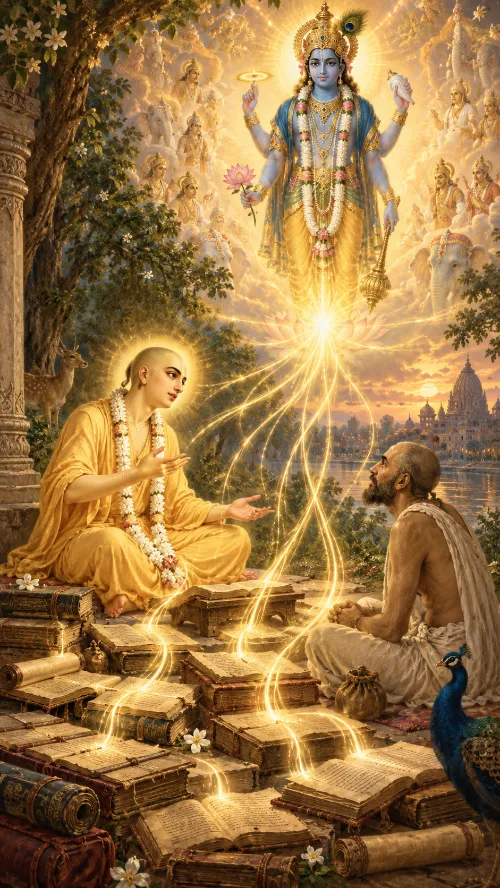
The Gauḍīya Method for Finding the Final Siddhānta
Open the Purāṇas and an obvious problem soon appears. One text glorifies Viṣṇu as supreme. Another speaks with extraordinary exaltation of Śiva. Elsewhere Devī appears as the source of everything. Particular tīrthas, mantras, vows, months, and forms of worship are repeatedly declared “highest,” “supreme,” or “unsurpassed.”
Can all such declarations be absolute in exactly the same sense? The Gauḍīya Vaiṣṇava tradition says no. Its answer is not simply, “Ignore the scriptures that disagree with us.” It proposes almost the opposite method: read broadly, compare passages, distinguish contextual glorification from final doctrine, and establish siddhānta from the scriptural corpus as a whole.
Kṛṣṇadāsa Kavirāja presents this principle during Caitanya Mahāprabhu’s instructions to Sanātana Gosvāmī and supports it with a striking verse from the Padma Purāṇa: various Purāṇas and Āgamas may proclaim different devatās supreme, but when the whole body of revelation is brought into discriminating analysis, the final conclusion is Viṣṇu.
Within Gauḍīya theology, the argument then takes one further step: Viṣṇu-tattva is supreme, and Kṛṣṇa is Svayaṁ Bhagavān—the original personal source within that divine category.
The passage is therefore much more than sectarian praise of Viṣṇu. It is a theory of how scripture should be interpreted when scripture appears to contradict itself.
The Padma Purāṇa Verse
व्यामोहाय चराचरस्य जगतस्ते ते पुराणागमास्
तां तामेव हि देवतां परमिकां जल्पन्तु कल्पावधि ।
सिद्धान्ते पुनरेक एव भगवान् विष्णुः समस्तागम-
व्यापारेषु विवेचनव्यतिकरं नीतेषु निश्चीयते ॥
vyāmohāya carācarasya jagatas te te purāṇāgamās
tāṁ tām eva hi devatāṁ paramikāṁ jalpantu kalpāvadhi
siddhānte punar eka eva bhagavān viṣṇuḥ samastāgama-
vyāpāreṣu vivecana-vyatikaraṁ nīteṣu niścīyate
“For the bewilderment of the moving and unmoving world, let the various Purāṇas and Āgamas go on proclaiming this or that deity to be supreme even until the end of the kalpa. Yet when the entire body of revelation is brought into discriminating examination, the final conclusion is established: Bhagavān is Viṣṇu alone.”
Caitanya-caritāmṛta, Madhya 20.145
A. C. Bhaktivedanta Swami Prabhupāda gives a more expansive translation: “There are many types of Vedic literature and supplementary Purāṇas. In each of them there are particular demigods who are spoken of as the chief demigods. This is just to create an illusion for moving and nonmoving living entities. Let them perpetually engage in such imaginations. However, when one analytically studies all the Vedic literature collectively, he comes to the conclusion that Lord Viṣṇu is the one and only Supreme Personality of Godhead.”
The heart of the verse is extraordinarily emphatic:
सिद्धान्ते पुनरेक एव भगवान् विष्णुः
siddhānte punar eka eva bhagavān viṣṇuḥ
“But in the final conclusion, Viṣṇu alone is Bhagavān.”
To understand what this means—and what it does not mean—we need to examine several key words.
Siddhānta : Not Just Another Opinion
The turning point is:
सिद्धान्त
siddhānta
literally:
- an established conclusion,
- a settled doctrinal conclusion,
- the result reached after inquiry.
The verse is contrasting two levels of scriptural language. At one level, an individual text may say: “This deity is supreme.” But siddhānta asks a different question: What conclusion emerges when all relevant revelation is interpreted together?
This is why Prabhupāda speaks of studying the Vedic literature: “collectively.” The verse is not recommending proof-texting. It is warning against it.
Samastāgama : Bring the Whole Scriptural Tradition Into View
Another crucial expression is:
समस्तागम
samastāgama
“the totality of the āgamas/scriptural traditions.”
That idea is extremely important. If one searches a vast Purāṇa for an isolated verse declaring a particular deity supreme, one will often find what one wants.
But if another Purāṇa contains an equally absolute declaration about someone else, simply accumulating quotations produces: contradiction, not siddhānta. The Gauḍīya method therefore demands comparison.
Ask: What does the text say elsewhere? What kind of passage is this? Is it a philosophical conclusion? A devotional glorification? A māhātmya intended to inspire participation?
A contextual instruction? A statement intended for a particular type of practitioner? Only after such questions does one attempt: niścaya a settled conclusion.
Vivecana : Spiritual Discernment
The Gauḍīya reading contains the important term:
विवेचन
vivecana
analysis, discernment, discrimination, careful examination. This explains Prabhupāda’s expression: “analytically studies.” The tradition is therefore not saying: “Do not think. Just accept our favorite verse.”
Its claim is: think comparatively. Distinguish different types of statement. Recognize hierarchy. Then determine the underlying doctrinal structure.
Eka Eva : “One Alone”
The statement:
एक एव
eka eva
is emphatic. eka — one. eva — indeed, alone, only. Thus: eka eva bhagavān viṣṇuḥ is stronger than: “Viṣṇu is a very important deity.” It asserts: Viṣṇu alone occupies the ultimate category of Bhagavān.
That is the explicitly Vaiṣṇava theological claim of the verse.
Devatā : Deity, Not “Imaginary God”
The Sanskrit word:
देवता
devatā
means: deity, divine being, object of worship. Prabhupāda commonly translates deva and devatā as: “demigod.” That terminology expresses his theological distinction between: Bhagavān and: subordinate divine administrators.
But the Sanskrit itself does not imply that these beings are imaginary. This is an essential point. The verse is not saying: “Viṣṇu exists and all the other gods are fake.”
Its argument is: the devatās are real, but they do not all possess ultimate independent supremacy. The issue is hierarchy, not existence.
The Difficult Word: Vyāmohāya
The most provocative term is:
व्यामोहाय
vyāmohāya
- “for bewilderment,”
- “for delusion,”
- “for confusion.”
Taken crudely, the verse might sound as though the scriptures deliberately lie to people. That requires refinement. Within the broader Vaiṣṇava framework, a better way to understand the principle is: graded revelation.
Human beings approach religion with very different motivations. Some seek: wealth, health, children, political success, victory, heavenly enjoyment, protection. Others seek: purification, knowledge, liberation.
Still others seek: bhakti itself. A vast scriptural tradition can address all of these people without treating every instruction as the highest final conclusion.
Bhagavad-gītā Explains How This Can Work
Kṛṣṇa says:
यो यो यां यां तनुं भक्तः
श्रद्धयार्चितुमिच्छति ।
तस्य तस्याचलां श्रद्धां
तामेव विदधाम्यहम् ॥
yo yo yāṁ yāṁ tanuṁ bhaktaḥ
śraddhayārcitum icchati
tasya tasyācalāṁ śraddhāṁ
tām eva vidadhāmy aham
“Whichever divine form a worshiper desires to worship with faith, I make that person’s faith in that form steady.”
Bhagavad-gītā 7.21
This is remarkably generous. Kṛṣṇa does not immediately destroy the worshiper’s chosen form of devotion. He supports the person’s faith. The next verse explains further.
स तया श्रद्धया युक्तस्तस्याराधनमीहते ।
लभते च ततः कामान्मयैव विहितान्हि तान् ॥
sa tayā śraddhayā yuktas
tasyārādhanam īhate
labhate ca tataḥ kāmān
mayaiva vihitān hi tān
“Endowed with that faith, the person worships that deity and obtains the desired benefits; yet those benefits are in fact granted through My arrangement.”
Bhagavad-gītā 7.22
So the worship is real. The deity is real. The benefit can also be real. But Kṛṣṇa says: the power ultimately operates within a larger divine order. Then comes the limitation.
अन्तवत्तु फलं तेषां
तद्भवत्यल्पमेधसाम् ।
देवान्देवयजो यान्ति
मद्भक्ता यान्ति मामपि ॥
antavat tu phalaṁ teṣāṁ
tad bhavaty alpa-medhasām
devān deva-yajo yānti
mad-bhaktā yānti mām api
“The fruits obtained by such worship are temporary. Worshipers of the devas go to the devas, whereas My devotees come to Me.”
Bhagavad-gītā 7.23
This gives a much better framework for understanding vyāmohāya. The problem is not necessarily: false worship. It is: incomplete understanding of the ultimate source.
Different Scriptures for Different Adhikāras
A useful traditional concept is:
अधिकार
adhikāra
qualification, eligibility, the spiritual level appropriate for receiving a particular teaching. The word does not occur in Madhya 20.145 itself, but the principle helps explain the passage.
A beginner may need one teaching. A person deeply attached to material rewards may need another. A renunciant requires another. A pure bhakta requires another. Thus a statement may be: genuinely useful for its intended audience without constituting: the final metaphysical siddhānta.
This distinction between: provisional guidance and: ultimate conclusion is essential to the Gauḍīya reading of apparently contradictory scripture.
The Immediate Context in Caitanya-caritāmṛta Is Crucial
Madhya 20.145 does not appear randomly. Caitanya Mahāprabhu is instructing Sanātana Gosvāmī in the basic architecture of revelation. The preceding verse gives one of Gauḍīya theology’s most important frameworks.
বেদশাস্ত্রে কহে সম্বন্ধ, অভিধেয়, প্রয়োজন ।
কৃষ্ণ, কৃষ্ণভক্তি, প্রেম,—তিন মহাধন ॥
veda-śāstre kahe sambandha, abhidheya, prayojana
kṛṣṇa, kṛṣṇa-bhakti, prema — tina mahā-dhana
“The Vedic scriptures teach sambandha, abhidheya, and prayojana: Kṛṣṇa, devotion to Kṛṣṇa, and prema are these three great treasures.”
Caitanya-caritāmṛta, Madhya 20.143
This gives the threefold Gauḍīya system.
Kṛṣṇa as the Central Scriptural Sambandha
The next verse says:
বেদাদি সকল শাস্ত্রে কৃষ্ণ—মুখ্য সম্বন্ধ ।
তাঁর জ্ঞানে আনুষঙ্গে যায় মায়াবন্ধ ॥
vedādi sakala śāstre kṛṣṇa — mukhya sambandha
tāṅra jñāne ānuṣaṅge yāya māyā-bandha
“In all scriptures beginning with the Vedas, Kṛṣṇa is the principal sambandha. By knowledge of Him, the bondage of māyā is simultaneously destroyed.”
Caitanya-caritāmṛta, Madhya 20.144
Now an obvious objection arises: If Kṛṣṇa really is the central conclusion of all scripture, why do some Purāṇas proclaim other deities supreme? Madhya 20.145 answers precisely that question.
That is why the verse matters.
And the Next Verse Explains the Method
Immediately afterward Caitanya says:
মুখ্য-গৌণ-বৃত্তি, কিংবা অন্বয়-ব্যতিরেকে ।
বেদের প্রতিজ্ঞা কেবল কহয়ে কৃষ্ণকে ॥
mukhya-gauṇa-vṛtti, kiṁvā anvaya-vyatireke
vedera pratijñā kevala kahaye kṛṣṇake
“Whether through primary and secondary meanings, or through direct and indirect analysis, the ultimate declaration of the Vedas points to Kṛṣṇa alone.”
Caitanya-caritāmṛta, Madhya 20.146
This verse shows that Madhya 20.145 is really about: hermeneutics. How do you read scripture? How do you decide which statement is primary? How do you reconcile passages that appear to conflict?
Mukhya-vṛtti and Gauṇa-vṛtti
The first pair is:
मुख्य-वृत्ति
mukhya-vṛtti
primary or direct meaning, and:
गौण-वृत्ति
gauṇa-vṛtti
secondary or indirect meaning. Sometimes scripture speaks directly. Sometimes language functions through: metaphor, extension, contextual implication, rhetorical glorification.
A competent interpreter must distinguish these. Not every sentence containing the word: “supreme” necessarily constitutes an absolute metaphysical proposition. Context matters.
Anvaya and Vyatireka
The second pair is:
अन्वय
anvaya
positive connection, direct affirmation, and:
व्यतिरेक
vyatireka
distinction, exclusion, indirect reasoning. In simple terms, interpretation asks both: What does scripture positively establish? and: What remains when incompatible alternatives are excluded?
Caitanya’s conclusion is: Kṛṣṇa. Whether other Vedāntic schools accept that conclusion is a separate question. But this is unmistakably the internal logic of the Gauḍīya system.
The Source Is Better Attested Than a Simple “Padma Purāṇa” Citation Suggests
The Caitanya-caritāmṛta identifies the stanza simply as coming from the: Padma Purāṇa. But earlier Gauḍīya works preserve a more specific citation. Hari-bhakti-vilāsa introduces it with:
पाद्मे वैशाखमाहात्म्ये यमब्राह्मणसंवादे
pādme vaiśākha-māhātmye yama-brāhmaṇa-saṁvāde
“In the Padma Purāṇa, in the Vaiśākha-māhātmya, in the dialogue between Yama and a brāhmaṇa…”
Rūpa Gosvāmī likewise quotes the stanza in Bhakti-rasāmṛta-sindhu 2.4.142 and identifies it with the Padma Purāṇa’s Vaiśākha-māhātmya. The saying therefore already had an established place in the textual world of the early Gauḍīya Gosvāmīs.
Even more interestingly, a corresponding Sanskrit stanza survives in the presently printed Padma Purāṇa, Pātāla-khaṇḍa 5.97.27 in one current numbering.
The Extant Padma Purāṇa Has a Slightly Different Reading
One printed recension reads:
स्युर्मोहाय चराचरस्य जगतस्ते ते पुराणागमास्
तां तामेव हि देवतां परमिकां जल्पन्तु कल्पे विधौ ।
सिद्धान्ते पुनरेक एव भगवान् विष्णुः समस्तागम-
व्यापारेषु विवेकिनां व्यतिकरं नीतेषु निश्चीयते ॥
syur mohāya carācarasya jagatas te te purāṇāgamās
tāṁ tām eva hi devatāṁ paramikāṁ jalpantu kalpe vidhau
siddhānte punar eka eva bhagavān viṣṇuḥ samastāgama-
vyāpāreṣu vivekināṁ vyatikaraṁ nīteṣu niścīyate
The precise wording differs in places from the Gauḍīya transmitted form.
For example:
- vyāmohāya becomes syur mohāya;
- kalpāvadhi appears differently;
- vivecana-vyatikaram appears in a variant form.
But the central conclusion remains: siddhānte punar eka eva bhagavān viṣṇuḥ “In the final conclusion, Viṣṇu alone is Bhagavān.” This is exactly the sort of textual variation one expects in a large Purāṇic work transmitted through multiple manuscript traditions.
The important point is that this is not merely an unattested floating quotation. A corresponding verse survives in the Purāṇa itself.
Why Does the Padma Purāṇa Say Viṣṇu While Caitanya Says Kṛṣṇa?
This is perhaps the most important theological question. Madhya 20.145 says: Viṣṇu alone is Bhagavān. Yet 20.143–144 says: Kṛṣṇa is the central object of revelation. Is that contradictory?
Not within Gauḍīya theology. The Padma Purāṇa statement establishes the supremacy of: Viṣṇu-tattva over the subordinate devatā category. Then the Śrīmad-Bhāgavatam gives a more specific statement.
एते चांशकलाः पुंसः
कृष्णस्तु भगवान् स्वयम् ॥
ete cāṁśa-kalāḥ puṁsaḥ
kṛṣṇas tu bhagavān svayam
“All these are portions or portions of portions of the Supreme Person, but Kṛṣṇa is Bhagavān Himself.”
Śrīmad-Bhāgavatam 1.3.28
The critical expression is:
कृष्णस्तु भगवान् स्वयम्
kṛṣṇas tu bhagavān svayam
“But Kṛṣṇa is Bhagavān Himself.”
Thus the Gauḍīya sequence is:
- many devatās
- one supreme Viṣṇu-tattva
- Kṛṣṇa as Svayaṁ Bhagavān
This is how the apparently Viṣṇu-centered Padma quotation fits into Caitanya’s Kṛṣṇa-centered theology.
This Does Not Mean Viṣṇu Is a Lesser God
The distinction must not be misunderstood. Gauḍīya theology does not classify Viṣṇu as: a demigod, a created being, or a partial deity in the ordinary sense. Viṣṇu and Kṛṣṇa belong to: Viṣṇu-tattva.
Both are fully divine. The distinction made by the Gauḍīya tradition concerns: manifestation, source and expansion, rasa, and degree of revealed intimacy. The claim is therefore not: “Kṛṣṇa is God but Viṣṇu is not.”
Rather: the same complete divinity manifests in different forms, with Kṛṣṇa understood as the original personal form—Svayaṁ Bhagavān.
One Absolute Truth, Different Realizations
Another foundational Bhāgavata statement is:
वदन्ति तत्तत्त्वविदस्
तत्त्वं यज्ज्ञानमद्वयम् ।
ब्रह्मेति परमात्मेति
भगवानिति शब्द्यते ॥
vadanti tat tattva-vidas
tattvaṁ yaj jñānam advayam
brahmeti paramātmeti
bhagavān iti śabdyate
“Those who know the Absolute Truth describe that nondual Reality as Brahman, Paramātmā, and Bhagavān.”
Śrīmad-Bhāgavatam 1.2.11
This is important because it prevents the discussion from descending into: “my god versus your god.” The Bhāgavata framework begins with: one nondual tattva. The theological question concerns how fully that reality is apprehended and in what personal manifestation it is revealed.
A Broader Upaniṣadic Parallel
The Śvetāśvatara Upaniṣad says:
तमीश्वराणां परमं महेश्वरं
तं देवतानां परमं च दैवतम् ।
पतिं पतीनां परमं परस्ताद्
विदाम देवं भुवनेशमीड्यम् ॥
tam īśvarāṇāṁ paramaṁ maheśvaraṁ
taṁ devatānāṁ paramaṁ ca daivatam
patiṁ patīnāṁ paramaṁ parastād
vidāma devaṁ bhuvaneśam īḍyam
“We know that divine Being who is the Supreme Lord of all rulers, the supreme Deity of the deities, the Lord of lords, transcendent and worthy of worship, the Lord of the universe.”
Śvetāśvatara Upaniṣad 6.7
The mantra itself does not explicitly name: Viṣṇu, Kṛṣṇa, or Śiva. Different Vedāntic traditions therefore identify its supreme referent according to their respective theological systems.
Vaiṣṇava interpreters see here the transcendental Supreme above all devatās. Śaiva interpreters may read it differently. This is an important reminder: scriptural interpretation happens within theological traditions.
Gauḍīya Vaiṣṇavism Is Making a Particular Claim
For historical clarity, we should not pretend that every Hindu school interprets the Purāṇas exactly as Gauḍīya Vaiṣṇavas do. They do not. Śaiva traditions developed sophisticated Śiva-centered readings.
Śākta traditions read Devī-centered revelation differently. Śrī Vaiṣṇavas and Mādhvas have their own hermeneutical systems. Gauḍīya Vaiṣṇavism therefore does not simply state an uncontested neutral fact when it says: eka eva bhagavān viṣṇuḥ.
It is expressing a distinct: Vaiṣṇava siddhānta. That does not weaken the claim. It locates it accurately.
Why Purāṇic Texts Sound So Absolutely Sectarian
The Purāṇas contain an enormous amount of: māhātmya glorification. A particular text may declare: this tīrtha is supreme; this month is supreme; this vrata is supreme; this mantra is supreme; this deity is supreme.
Such language serves a devotional function: it concentrates attention and creates commitment. A text encouraging pilgrimage to a sacred place does not generally motivate the pilgrim by saying: “This place is approximately the seventeenth most useful sacred destination.”
It says: “This is supreme!” Religious rhetoric works through exaltation. The hermeneutical problem begins when every such exaltation is converted automatically into: absolute ontology.
CC 20.145 refuses to do that.
Praise and Ontology Are Not Always the Same Thing
This distinction is crucial. To say: “Śiva is the greatest of Vaiṣṇavas” is praise. To ask: “What is Śiva’s ontological relation to Bhagavān?” is theology. To say: “This tīrtha destroys all sins”
is devotional glorification. To ask: “What is the ultimate cause of liberation?” is a different question. A mature reader learns not to flatten every literary genre into one type of proposition.
That is part of: vivecana.
The Devas Are Real but Dependent
The Gītā provides perhaps the clearest Vaiṣṇava formulation. Kṛṣṇa does not deny the devas. He says people worship them. He says those worshipers receive results. But He adds:
मयैव विहितान् हि तान्
mayaiva vihitān hi tān
“those results are ultimately arranged by Me.”
This means: the devas possess genuine authority, but not absolute independence. A traditional analogy is governmental. A minister possesses: real authority.
But delegated authority is not the same as: ultimate sovereignty. Similarly, a deva can be: powerful, worthy of respect, capable of bestowing particular blessings, without being: the ultimate source of everything.
Śiva Is a Particularly Important Example
A crude reading of Madhya 20.145 could produce disrespect toward Śiva. That would contradict the broader Gauḍīya tradition. The Śrīmad-Bhāgavatam famously says:
निम्नगानां यथा गङ्गा
देवानामच्युतो यथा ।
वैष्णवानां यथा शम्भुः
पुराणानामिदं तथा ॥
nimnagānāṁ yathā gaṅgā
devānām acyuto yathā
vaiṣṇavānāṁ yathā śambhuḥ
purāṇānām idaṁ tathā
“As the Gaṅgā is greatest among rivers, Acyuta among deities, and Śambhu among Vaiṣṇavas, so the Śrīmad-Bhāgavatam is greatest among Purāṇas.”
Śrīmad-Bhāgavatam 12.13.16
The famous phrase is:
वैष्णवानां यथा शम्भुः
vaiṣṇavānāṁ yathā śambhuḥ
“Śambhu is foremost among Vaiṣṇavas.”
Thus Vaiṣṇava hierarchy does not imply contempt. Śiva can be: profoundly exalted, unique, worshipable, and still be distinguished from the final category of Svayaṁ Bhagavān.
Respect and Ontological Equality Are Different Questions
This distinction is often lost. One may deeply honor a person without claiming that person occupies the highest metaphysical category. Likewise Gauḍīya theology can simultaneously teach: honor Śiva and: do not erase the ontological distinctions between Śiva-tattva and Viṣṇu-tattva.
Respect does not require flattening all difference.
The Padma Purāṇa Verse Is Really a Warning Against Proof-Texting
This may be its most useful application today. Anyone can search a vast corpus until they find a sentence confirming what they already believe. That is not necessarily: śāstric reasoning.
The verse demands: samastāgama the whole corpus, and: vivecana discrimination. Its method is therefore:
Do not ask only:
“Can I find a verse supporting my position?” Ask: “How does this verse function within the larger scriptural system?” That is a far more demanding discipline.
Scripture Can Contain Different Levels Without Becoming Meaningless
A common modern reaction to contradictory passages is: “If one text says X and another says Y, the scriptures are simply inconsistent.” The traditional response is more layered.
Instructions can differ because: audiences differ, purposes differ, levels of qualification differ, literary genres differ. For example, medicine may prescribe different diets to different patients.
The prescriptions differ. That does not necessarily mean the physician is confused. Likewise graded revelation can contain varied instructions without every instruction carrying identical final theological weight.
But “Graded Revelation” Must Not Become a Convenient Escape
There is also a danger. A theologian could simply say: “Every passage that agrees with me is ultimate. Every passage that disagrees is merely provisional.” That would be circular.
The Gauḍīya answer attempts to avoid this by appealing to broader hermeneutical criteria: sambandha, mukhya and gauṇa meanings, anvaya and vyatireka, the total scriptural corpus, and especially the Śrīmad-Bhāgavatam as the mature Vedāntic revelation.
Whether another school accepts that hierarchy is another matter. But within the system, a method is being claimed—not merely arbitrary selection.
Why Śrīmad-Bhāgavatam Becomes Decisive
For Gauḍīya Vaiṣṇavas, the Bhāgavatam occupies a uniquely authoritative role. Its famous declaration:
कृष्णस्तु भगवान् स्वयम्
kṛṣṇas tu bhagavān svayam
becomes the interpretive key through which the rest of the theological hierarchy is read. Thus the Padma verse establishes: Viṣṇu-tattva supremacy. The Bhāgavatam identifies: Kṛṣṇa as Svayaṁ Bhagavān.
And Caitanya Mahāprabhu organizes the entire Vedic purpose as: Kṛṣṇa → Kṛṣṇa-bhakti → Kṛṣṇa-prema.
This Is Why Madhya 20.143–146 Should Be Read as One Unit
Taken together, the four verses form a remarkably coherent argument.
direct and secondary meaning, positive and negative reasoning, and comparison of the whole Vedic corpus. The conclusion in the Gauḍīya system is: Kṛṣṇa.
A More Precise Translation of the Padma Verse
For a modern article, I would translate it this way: “For the bewilderment of the moving and unmoving world, let the various Purāṇas and Āgamas continue proclaiming this or that deity to be supreme even until the end of the kalpa. Yet when the entire body of revelation is subjected to discriminating examination, the final conclusion is established: Viṣṇu alone is Bhagavān.”
This preserves the force of: vyāmohāya without obscuring: siddhānte, samastāgama, and: vivecana.
What the Verse Does Not Mean
Madhya 20.145 should not be used to claim that:
- all non-Vaiṣṇava scriptures are worthless;
- Śiva, Devī, Brahmā, and the devas are imaginary;
- every statement in a Śaiva or Śākta text is a deliberate lie;
- Vaiṣṇavas should disrespect other deities;
- every Purāṇic statement has identical theological status;
- all Hindu traditions historically agreed that Viṣṇu is supreme;
- or reason should simply be abandoned in favor of sectarian preference.
Those conclusions go beyond the verse and, in some cases, contradict the wider Gauḍīya theological tradition.
What It Does Mean Within Gauḍīya Vaiṣṇavism
It means that:
- the scriptural corpus contains teachings directed toward different people and purposes;
- individual supremacy statements must be interpreted in context;
- devotional glorification is not always identical with final ontology;
- the scriptures should be compared collectively;
- direct and indirect meanings must be distinguished;
- devas possess genuine but dependent authority;
- final Bhagavān-status belongs to Viṣṇu-tattva;
- and the Śrīmad-Bhāgavatam identifies Kṛṣṇa specifically as Svayaṁ Bhagavān.
That is a far richer teaching than: “My deity is better than yours.” It is an entire hermeneutical system.
The Deepest Lesson: Do Not Stop at the Loudest Praise
Purāṇic religion is full of superlatives. Everything sacred can sound: supreme, unsurpassed, most powerful, highest. That language is part of the devotional beauty of the tradition.
But Caitanya’s teaching to Sanātana asks the serious student to go further. Do not ask only: “What is being praised?” Ask: “Why is it being praised?” Do not ask only: “Does one verse call this deity supreme?”
Ask: “How does that statement fit within the entire scriptural structure?” Do not stop with: māhātmya. Seek: siddhānta.
The Sanskrit canon is not a single flat theological document. It is an enormous religious civilization preserved in texts. It contains: ritual, myth, philosophy, pilgrimage, devotion, cosmology, meditation, sectarian glorification, and competing claims of supremacy.
The Padma Purāṇa verse quoted by Caitanya Mahāprabhu confronts that diversity directly. It does not deny that different texts say different things. It begins by acknowledging precisely that:
तां तामेव हि देवतां परमिकां जल्पन्तु
tāṁ tām eva hi devatāṁ paramikāṁ jalpantu
“Let them proclaim this deity and that deity supreme.”
But then comes the decisive word:
सिद्धान्ते
siddhānte
“in the final conclusion.”
And the conclusion given by this Vaiṣṇava text is:
एक एव भगवान् विष्णुः
eka eva bhagavān viṣṇuḥ
“Viṣṇu alone is Bhagavān.”
Caitanya Mahāprabhu then places that conclusion inside an even more specifically Gauḍīya framework:
বেদশাস্ত্রে কহে সম্বন্ধ, অভিধেয়, প্রয়োজন ।
কৃষ্ণ, কৃষ্ণভক্তি, প্রেম,—তিন মহাধন ॥
veda-śāstre kahe sambandha, abhidheya, prayojana
kṛṣṇa, kṛṣṇa-bhakti, prema — tina mahā-dhana
“The Vedic scriptures teach sambandha, abhidheya, and prayojana: Kṛṣṇa, devotion to Kṛṣṇa, and prema—these are the three great treasures.”
Thus the movement of the argument is:
- many devatās
- one supreme Viṣṇu-tattva
- Kṛṣṇa as Svayaṁ Bhagavān
- Kṛṣṇa-bhakti
- Kṛṣṇa-prema
And perhaps the most useful lesson of Madhya 20.145 is not merely its conclusion but its method: Do not build siddhānta from the loudest isolated quotation. Bring the whole revelation together, discriminate carefully, and then ask what conclusion remains.
That is the Gauḍīya challenge: not less scripture, but deeper reading of scripture.