

The Night Pastimes of Rādhā and Kṛṣṇa
How to Read the Night Pastimes of Rādhā and Kṛṣṇa: A Guide to Aṣṭa-kālīya-līlā, Mādhurya-rasa, the Sakhīs and Mañjarī-sevā
A reader’s guide to the most intimate current of Gauḍīya devotional literature, followed by the narration itself. The guide explains what aṣṭa-kālīya-līlā is, why the sakhīs are indispensable rather than decorative, what a mañjarī is and why her service defines the genre, how the tradition distinguishes kāma from prema, and which classical texts each motif of the narration actually comes from — including one passage that belongs to the midday līlā rather than the night. The narration follows after.
The narration of the nocturnal pastimes of Śrī Rādhā and Kṛṣṇa given below belongs to one of the most intimate literary and contemplative currents of Gauḍīya Vaiṣṇavism. It should not be approached as though it were simply another episode from the Śrīmad-Bhāgavatam, nor should every detail be assumed to come from one continuous Sanskrit source.
Rather, it is a composite meditation on Rādhā-Kṛṣṇa’s aṣṭa-kālīya-līlā — Their eternal pastimes distributed throughout the eight periods of the day and night. It combines material traceable to several major Gauḍīya authors, including Śrī Rūpa Gosvāmī, Raghunātha dāsa Gosvāmī, Kṛṣṇadāsa Kavirāja Gosvāmī and Viśvanātha Cakravartī Ṭhākura. Some passages closely reproduce classical verses; others paraphrase them, combine episodes from different works, or expand them through later devotional meditation. The narration therefore represents a living kathā and smaraṇa tradition, rather than a literal translation of a single scripture.
Understanding this distinction is important. It allows the reader to appreciate the narration as authentic Gauḍīya devotional literature without incorrectly attributing every sentence to the Bhāgavata Purāṇa or to a single Gosvāmī.
1. From the Bhāgavata to the Literature of Eternal Vraja
The theological foundation of Rādhā-Kṛṣṇa’s intimate pastimes lies above all in the Tenth Canto of the Śrīmad-Bhāgavatam, especially its description of Kṛṣṇa’s rāsa-līlā with the gopīs. The later Gauḍīya ācāryas did something more specific: they contemplated the Vraja-līlā as an eternally unfolding daily cycle. This is known as aṣṭa-kālīya-līlā.
The eternal day is traditionally contemplated in eight periods:
In a commonly used Gauḍīya reckoning, the final nocturnal period extends approximately from 10:48 p.m. until 3:36 a.m., though later manuals may subdivide it into smaller units. The exact clock times matter less than the fundamental idea: the sādhaka remembers the Divine Couple not as figures frozen in a single scriptural scene, but as eternally engaged in ever-renewed loving activities.
Among the most important works developing this contemplative world are:
That last point is worth remembering: there are two different Gauḍīya works called Saṅkalpa-kalpadruma, one by Jīva Gosvāmī and another by Viśvanātha Cakravartī. The passages about flower beds, fans, cosmetics, ornaments, betel and intimate mañjarī service that underlie this narration belong especially to Viśvanātha’s work, not Jīva’s.
2. What Does It Mean That These Are “Eternal Pastimes”?
For the Gauḍīya tradition, Kṛṣṇa’s Vraja-līlā is not merely sacred history. It is nitya-līlā, eternal līlā. The earthly appearance of Kṛṣṇa reveals something eternally present in the spiritual Vraja. Thus when later Gauḍīya texts describe Rādhā waking, dressing, meeting Her sakhīs, cooking, going to Rādhā-kuṇḍa, meeting Kṛṣṇa in a kuñja, returning home and meeting Him again at night, the intention is not to construct an ordinary historical diary. It is contemplative sacred geography and sacred time.
The devotee learns to remember where Rādhā and Kṛṣṇa are, what They are doing, which associates accompany Them, what emotional mood is manifest — and, most importantly, what service might be rendered at that moment.
The culmination of the exercise is therefore not “What happened next?” but “How may I serve?” That change of viewpoint is essential for understanding the text that follows.
3. Rāgānugā-bhakti and Internal Service
The theological basis for this contemplative service is expressed succinctly by Rūpa Gosvāmī in Bhakti-rasāmṛta-sindhu 1.2.295, quoted also in Caitanya-caritāmṛta Madhya 22.158:
sevā sādhaka-rūpeṇa
siddha-rūpeṇa cātra hi
tad-bhāva-lipsunā kāryā
vraja-lokānusārataḥ
“One who longs for a particular devotional mood should render service by following the residents of Vraja — externally in the sādhaka form and internally in the contemplated perfected form.”
The verse is a basic statement of rāgānugā-bhakti, devotion that follows the spontaneous love of Kṛṣṇa’s eternal associates. This helps explain statements in the narration such as: Tulasī “sees” the Divine Couple within her heart; the mañjarīs sit outside the kuñja absorbed in antar-dṛṣṭi, inner vision; they anticipate what Rādhā will require; they mentally enter the bower when service becomes necessary.
The purpose is not imaginative voyeurism. The intended consciousness is sevā-smaraṇa — remembrance organized around service.
4. Why Are the Sakhīs Indispensable?
Rādhā and Kṛṣṇa are rarely depicted in Gauḍīya literature as an isolated couple. Their love is surrounded, protected, intensified, concealed, revealed, teased, negotiated and nourished by the sakhīs, Rādhā’s intimate companions. Caitanya-caritāmṛta gives a particularly important statement:
সখী বিনা এই লীলা পুষ্ট নাহি হয় ।
সখী লীলা বিস্তারিয়া, সখী আস্বাদয় ॥
sakhī vinā ei līlā puṣṭa nāhi haya
sakhī līlā vistāriyā, sakhī āsvādaya
“Without the sakhīs this līlā cannot be nourished. The sakhīs expand the līlā and themselves relish its rasa.” — Caitanya-caritāmṛta, Madhya 8.203
This gives the reader an important key. The sakhīs are not merely “Rādhā’s friends” standing around a romantic couple. They are active theological agents of rasa. They arrange meetings. They carry messages. They reconcile lovers after quarrels. They tease Kṛṣṇa. They defend Rādhā. They decorate the Divine Couple. They sing, dance, joke and manipulate circumstances so that ever-new forms of love may arise.
Rūpa Gosvāmī’s Ujjvala-nīlamaṇi distinguishes several classes of these companions. The famous aṣṭa-sakhīs, the eight principal companions, are Lalitā, Viśākhā, Campakalatā, Citrā, Tuṅgavidyā, Indulekhā, Raṅgadevī and Sudevī. They are traditionally classified among Rādhā’s parama-preṣṭha-sakhīs, Her supremely dear companions.
This becomes particularly important near the end of the narration, where Kṛṣṇa playfully asks Rādhā a series of riddles identifying these eight sakhīs.
5. What Is a Mañjarī?
The mañjarīs form an especially intimate category within Rādhā’s circle. The word mañjarī literally means a tender cluster of blossoms or flower buds. In Gauḍīya devotional vocabulary it becomes a name for Rādhā’s youthful maidservants.
Their distinctive characteristic is not that they seek an independent romantic relationship with Kṛṣṇa. Their deepest happiness lies in Rādhā’s happiness. Their aspiration is: “May Rādhā meet Kṛṣṇa. May Their meeting succeed. May I arrange whatever She requires. May I serve Her before, during and after that meeting.”
Raghunātha dāsa Gosvāmī gives perhaps the clearest classical description in Vraja-vilāsa-stava 38:
tāmbūlārpaṇa-pāda-mardana-payo-dānābhisārādibhir
vṛndāraṇya-maheśvarīṁ priyatayā yās toṣayanti priyāḥ
prāṇa-preṣṭha-sakhī-kulād api kilāsaṅkocitā-bhūmikāḥ
kelī-bhūmiṣu rūpa-mañjarī-mukhās tā dāsikāḥ saṁśraye
“I take shelter of those maidservants headed by Rūpa Mañjarī who lovingly satisfy the great Queen of Vṛndāvana by offering betel, massaging Her feet, bringing water, arranging Her rendezvous and performing other services. Their position in the places of Her intimate play is extraordinarily unrestricted.”
The verse explains exactly why the narration spends so much time describing tāmbūla or betel leaves, flower fans, water, perfumes, ointments, garlands, ornaments, foot service, the preparation of a kuñja, and the restoring of Rādhā’s dress afterward. These are not incidental decorations. They are the actual vocabulary of mañjarī-sevā.
6. Rūpa Mañjarī and the “Rūpānuga” Ideal
Rūpa Mañjarī is regarded as one of the foremost intimate maidservants of Śrī Rādhā. For this reason the expression rūpānuga — “one who follows Rūpa” — has a double devotional resonance in later Gauḍīya spirituality: it signifies following the theological path established by Rūpa Gosvāmī and, in the internal devotional conception, following the current of service represented by Rūpa Mañjarī.
This explains why the narration repeatedly places the devotee’s internal service under Rūpa Mañjarī’s direction rather than presenting the aspirant as independently approaching Rādhā and Kṛṣṇa. That principle — anugatya, following rather than independent appropriation — is central to rāgānugā theology.
7. A Note on “Tulasī” in This Literature
The name Tulasī requires unusual care, because several different referents can overlap in devotional literature. There is Tulasī the sacred plant; Vṛndā-devī, the presiding goddess who organizes the forest pastimes of Vṛndāvana; attendants or messengers named Tulasī in later līlā literature; and the name Tulasī Mañjarī, which some Gauḍīya lineages use as an internal name of Raghunātha dāsa Gosvāmī, alongside names such as Rati Mañjarī or Rasa Mañjarī.
These identities should not automatically be collapsed into one another. Even within Gauḍīya genealogical traditions, variant identifications occur: Gaura-gaṇoddeśa-dīpikā 186 is cited as identifying Raghunātha dāsa with Rasa Mañjarī, while later paddhati traditions also use Rati Mañjarī and Tulasī Mañjarī.
Accordingly, when the narration below speaks of “Tulasī,” the safest approach is to understand her simply as an intimate female attendant engaged in Rādhā’s service, unless the specific underlying text makes the identity explicit.
8. Why Does the Narration Contain Erotic Imagery?
This is the most important interpretive question for a new reader. The text contains embraces, kisses, flower beds, perspiration, loosened garments, broken necklaces, marks of nails, playful “battles of Kāmadeva,” musk and kuṅkuma applied to the body, and servants restoring the Divine Couple’s appearance afterward. Read without its theological framework, such language can easily appear to be sacralized human eroticism. That is not how Gauḍīya theology understands it.
The tradition draws an absolute distinction between material kāma and transcendental prema. Kṛṣṇadāsa Kavirāja states:
আত্মেন্দ্রিয়প্রীতি-বাঞ্ছা—তারে বলি ‘কাম’ ।
কৃষ্ণেন্দ্রিয়প্রীতি-ইচ্ছা ধরে ‘প্রেম’ নাম ॥
ātmendriya-prīti-vāñchā — tāre bali ‘kāma’
kṛṣṇendriya-prīti-icchā dhare ‘prema’ nāma
“The desire to satisfy one’s own senses is called kāma; the desire to satisfy Kṛṣṇa’s senses is called prema.” — Caitanya-caritāmṛta, Ādi 4.165
The outward vocabulary may resemble human romance. The theological direction of desire is the opposite. Kāma asks, “What can I receive?” Prema asks, “How can the beloved become happy?”
This second principle is crucial, because the narration repeatedly insists that Rādhā and Kṛṣṇa are each trying to give happiness to the other. That is the inner meaning of the so-called “battle.” Neither seeks selfish conquest. Each seeks to become conquered by the other’s love.
9. Kṛṣṇa as the “Cupid of Cupid”
The Sanskrit word Kāmadeva also needs context. When this literature speaks of Kṛṣṇa as the transcendental Kāmadeva of Vṛndāvana, it is not simply identifying Him with the ordinary cosmic deity of sexual desire. The Śrīmad-Bhāgavatam describes Kṛṣṇa appearing before the gopīs as:
tāsām āvirabhūc chauriḥ
smayamāna-mukhāmbujaḥ
pītāmbara-dharaḥ sragvī
sākṣān manmatha-manmathaḥ
“Kṛṣṇa appeared before them with a smiling lotus face, wearing yellow garments and a garland — He who bewilders even the mind of Manmatha, Cupid himself.” — Śrīmad-Bhāgavatam 10.32.2
manmatha-manmathaḥ literally suggests “the enchanter of the enchanter of minds.” Thus when later poets depict the forest kuñja as the arena of “Kāmadeva,” the claim is not that divine love has been reduced to sexuality. Rather, ordinary erotic attraction is regarded as a dim material reflection of an original spiritual power of attraction whose fullest expression is in Kṛṣṇa.
10. The Bhāgavata Itself Gives Both Permission and Warning
The Śrīmad-Bhāgavatam makes two apparently opposite statements concerning the rāsa-līlā. Both must be remembered together. First comes a warning:
naitat samācarej jātu
manasāpi hy anīśvaraḥ
vinaśyaty ācaran mauḍhyād
yathārudro ’bdhi-jaṁ viṣam
“One who is not such a controller should never imitate this behavior, even mentally. Foolish imitation destroys a person, just as one who is not Rudra would be destroyed by drinking the poison of the ocean.” — Śrīmad-Bhāgavatam 10.33.30
The point is explicit: Kṛṣṇa-līlā is to be heard and served, not materially imitated. Yet the same chapter concludes:
vikrīḍitaṁ vraja-vadhūbhir idaṁ ca viṣṇoḥ
śraddhānvito ’nuśṛṇuyād atha varṇayed yaḥ
bhaktiṁ parāṁ bhagavati pratilabhya kāmaṁ
hṛd-rogam āśv apahinoty acireṇa dhīraḥ
“One who faithfully hears and describes these playful affairs of the Lord with the women of Vraja attains supreme devotion to Bhagavān and quickly casts off kāma, the disease of the heart.” — Śrīmad-Bhāgavatam 10.33.39
So the traditional position is neither “these subjects must never be heard” nor “they are simply sacred erotic stories.” They are spiritually potent when approached with śraddhā, sobriety, proper theology and a service orientation; they become distorted when projected onto ordinary human sexuality or treated as behavior to imitate. This qualification is especially important before reading the more explicit portions of the nocturnal līlā.
11. Why Are the Maidservants Present During Such Intimate Pastimes?
To a modern reader this can be one of the strangest aspects of the literature. The answer lies again in sevā, not observation for its own sake. The mañjarī does not ask, “How much can I see?” She asks, “When will service be required?”
When Rādhā is thirsty, water must be ready. When betel is needed, it must already have been prepared. When the Divine Couple become warm, someone must fan Them. If a garland breaks, it must be replaced. If jewelry becomes disordered, it must be repaired. If Rādhā must return home without others discovering the meeting, Her clothing, ornaments, cosmetics and hair must be restored.
Thus intimacy does not eliminate service. It creates subtler forms of service.
Viśvanātha Cakravartī’s Saṅkalpa-kalpadruma expresses precisely this aspiration. In its niśā-līlā meditation the maidservant imagines preparing a flower bed and then remaining outside the kuñja, gently operating a fan:
sthitvā bahir vyajana-yantra-nibaddha-ḍorī-
pāṇir vikarṣaṇa-vaśān mṛdu bījayāni…
“Remaining outside, holding the cord attached to the fan, may I gently fan You…”
The next portions describe preparing garlands, polishing bracelets and necklaces, mixing camphor, kuṅkuma, aguru and sandalwood, preparing betel, and later helping restore Rādhā’s ornaments. This is almost a blueprint for the service scenes in the narration.
12. Rūpa Gosvāmī’s Prayer: “When Will I Fan You?”
One of the most beautiful sources behind the narration is Rūpa Gosvāmī’s Utkalikā-vallarī, “The Creeper of Intense Longing.” Verse 52 reads:
kadāhaṁ seviṣye vratati-camarī-cāmara-marud-
vinodena krīḍā-kusuma-śayane nyasta-vapuṣau
daronmīlan-netrau śrama-jala-kaṇa-klidyad-alakau
bruvāṇāv anyonyaṁ vraja-nava-yuvānāv iha yuvām
“O ever-fresh youthful Couple of Vraja! When will I serve You by fanning You with a cāmara made from clusters of flowering vines as You recline upon a flower bed, Your eyes slightly opened, Your locks moistened with drops of perspiration, softly speaking to one another?”
The emotional center of the verse is not the lovers’ exhaustion. It is the servant’s cry: kadāhaṁ seviṣye — “When will I serve?” That phrase captures the spirit of the entire mañjarī tradition.
13. The Song in Which Kṛṣṇa Paints Rādhā
One seemingly spontaneous section of the narration is in fact directly traceable to Rūpa Gosvāmī’s Stava-mālā, song 11 in Gauḍī rāga:
sicayam udañcaya hṛdayād alpam
vilikhāmy adbhuta-makarākalpam
“Lift Your garment slightly from Your breast; I shall paint wonderful makara designs.”
iha na hi saṅkuca paṅkaja-nayane
veśaṁ tava karavai rati-śayane
“O lotus-eyed one, do not shrink away; allow Me to decorate You for the bed of love.”
rādhe dolaya na kila kapolam
citraṁ racayāmy aham avilolam
“Rādhā, do not move Your cheek; I will draw a beautiful design upon it.”
tava vapur adya sanātana-śobham
janayati hṛdi mama kāñcana-lobham
“Today Your eternally beautiful form awakens intense longing within My heart.”
A traditional note attributed to Jīva Gosvāmī identifies Kṛṣṇa as the speaker addressing Rādhā. This is important evidence that even some of the most intimate imagery in the narration is not modern embellishment, but belongs to the Sanskrit poetry of the Gosvāmīs themselves.
14. The Broken Necklaces, Cosmetics and Restoration of Rādhā’s Appearance
The narration describes the mañjarīs preparing flower garlands, necklaces, bracelets, camphor, kuṅkuma, aguru, sandal paste, betel, musk, eye cosmetics, new tilaka and ornamental designs. Again, this corresponds strikingly to Viśvanātha Cakravartī’s Saṅkalpa-kalpadruma:
mālyāni hāra-kaṭakādi-mṛjā vicitra-
vartiḥ śitāṁśu-ghusṛṇāguru-candanādi
vīṭīr lavaṅga-khapurādi-yutāḥ sakhībhiḥ
sārdhaṁ mudā viracayāni kalāṁ prakāśya
“Together with the sakhīs, displaying my skill, may I joyfully prepare garlands, polish necklaces and bracelets, make fragrant preparations of camphor, kuṅkuma, aguru and sandal, and prepare betel with cloves and aromatic ingredients.”
The following verse describes Rūpa and other intimate servants quickly restoring Rādhā after Her garments and ornaments have become disordered. Thus the apparently minute details of the narration reflect a very old Gauḍīya devotional preoccupation: perfect service notices everything.
15. Why So Many Fragrances, Flowers, Jewels, Moonlight, Bees and Comparisons?
Classical Sanskrit devotional poetry does not describe emotion abstractly. It externalizes rasa through uddīpanas — stimuli that awaken and intensify a particular devotional mood. Thus the Vraja landscape itself participates in līlā. Repeated imagery includes the moon, monsoon clouds, lightning, blue lotuses, golden campaka flowers, tamāla trees, bees intoxicated by nectar, mālatī and jasmine, sandalwood breezes, musk, saffron, flower beds, anklets and bells.
The most famous visual contrasts are Kṛṣṇa as the dark monsoon cloud and Rādhā as golden lightning; or Kṛṣṇa as the dark tamāla tree and Rādhā as the golden creeper embracing it. The imagery is not intended primarily as realistic description. It is rasa-language: nature itself becomes a vocabulary for spiritual emotion.
16. Rādhā’s Generosity Toward Her Sakhīs
Another extraordinary feature of the narration is Rādhā encouraging Kṛṣṇa to bring happiness to Her friends. This reflects a fundamental feature of sakhī-bhāva: the companions do not experience another’s happiness as competition. Their happiness increases when the beloveds and friends are happy. This principle reaches a beautiful climax in the verse incorporated into Govinda-līlāmṛta 13.113:
tṛptāv anya-janasya tṛptim ayitā duḥkhe mahā-duḥkhitā
labdhaiḥ svīya-sukhāli-duḥkha-nicayair no harṣa-bādhodayāḥ
sveṣṭārādhana-tat-parā iha yathā śrī-vaiṣṇava-śreṇayaḥ
kās tā brūhi vicārya candra-vadane tā mad-vayasyā imāḥ
Kṛṣṇa asks: “Who become satisfied when others are satisfied, deeply unhappy when others suffer, yet are neither elated by their own happiness nor overcome by their own distress, remaining always devoted to serving the object of their love?” Rādhā answers: “These are My companions.”
The verse deliberately compares the sakhīs’ selflessness to the character of true Vaiṣṇavas. This is one of the most important clues for interpreting the whole genre. Its ultimate subject is not sexuality. It is radical freedom from self-centeredness.
17. The Eight Riddles in the Narration
Toward the end of the narration, Kṛṣṇa asks Rādhā a series of playful questions describing Her principal companions. The answers are:
These riddles can be traced to Govinda-līlāmṛta 13.104–113. There is, however, an important textual correction: they belong to the midday līlā, not the nocturnal līlā. Chapter 13 of Govinda-līlāmṛta falls within its extended madhyāhna-līlā sequence.
The narration therefore inserts a genuine Kṛṣṇadāsa Kavirāja passage into a night-time setting. The passage itself is authentic; its placement here is anthological rather than chronological. A reader should know this so that the narration is not mistaken for a continuous translation of Govinda-līlāmṛta.
18. A Concise Source Map for the Narration
The major elements of the narration can presently be mapped as follows:
This makes the literary character of the text clear: it is authentic in vocabulary and devotional conception, but composite in construction.
19. How Should a Reader Approach Such a Text?
A useful reading method is to keep four principles in mind.
Do not reduce the līlā to human romance
The tradition explicitly defines the difference between kāma and prema according to whether desire is directed toward one’s own gratification or toward Kṛṣṇa’s happiness.
Do not imitate what is being described
The Bhāgavata itself gives this warning. The proper response is hearing, remembrance, reverence and service — not behavioral imitation.
Read from the perspective of sevā
The central question is not “What intimate act is being described?” but “What form of love and service is being revealed?” Notice how often the narration returns to preparation, anticipation, attentiveness, selflessness, service, protection, beautification, concealment, and delight in another’s happiness.
Distinguish source from devotional elaboration
A classical verse may be surrounded by later explanation. An authentic episode may be moved into a different time period. A Sanskrit prayer may become a narrated scene. An oral teacher may add poetic details to make a meditation vivid. This does not automatically invalidate the devotional narration, but it matters greatly when asking: what exactly does the original text say?
20. The Deepest Principle: Rādhā’s Happiness
The heart of mañjarī-bhāva can ultimately be expressed very simply. The mañjarī does not approach Kṛṣṇa thinking, “How will Kṛṣṇa make me happy?” She thinks, “How may Rādhā become happy?” And because Rādhā’s greatest happiness is Kṛṣṇa’s happiness, service expands outward into the happiness of the entire Divine Couple and Their associates.
This is why the intimate attendants can experience another’s joy as greater than their own. It is also why their seemingly small services — preparing a betel leaf, arranging an anklet, bringing scented water, making a flower fan — become spiritually immense.
Their greatness lies not in the object they offer. It lies in the absence of self-interest with which it is offered.
21. The Text Is About Much More Than a Nocturnal Meeting
At first glance the narration that follows may seem to describe an elaborate romantic encounter between Rādhā and Kṛṣṇa. Within its own theological world, however, it is simultaneously a meditation on the transcendental nature of divine love; the difference between kāma and prema; the supremacy of Rādhā’s love; Kṛṣṇa as the ultimate object of attraction; the indispensable role of the sakhīs; the unique service identity of the mañjarīs; selfless delight in another’s happiness; internal devotional remembrance; and the transformation of every detail of existence into sevā.
This is why the literature can linger over a flower fan, a cup of fragrant water, a broken pearl necklace, a dot of musk, an anklet bell or a glance. For an ordinary observer these are small details. For the servant immersed in prema, nothing connected with the beloved is small.
And this perhaps provides the best orientation for reading the text that follows. Do not read merely to see what Rādhā and Kṛṣṇa do. Read to understand how Their devotees love, how they serve, and why the happiness of the beloved becomes their entire existence.
Principal Texts Behind the Narration
Śrīmad-Bhāgavatam
Śrī Rūpa Gosvāmī
Śrī Raghunātha dāsa Gosvāmī
Śrī Kṛṣṇadāsa Kavirāja Gosvāmī
Śrī Viśvanātha Cakravartī Ṭhākura
A Note on Terminology
The Night Pastimes of Śrī Rādhā and Kṛṣṇa
Nakta-līlā and the service of the mañjarīs. Śrīmatī Rādhārāṇī ki jaya!
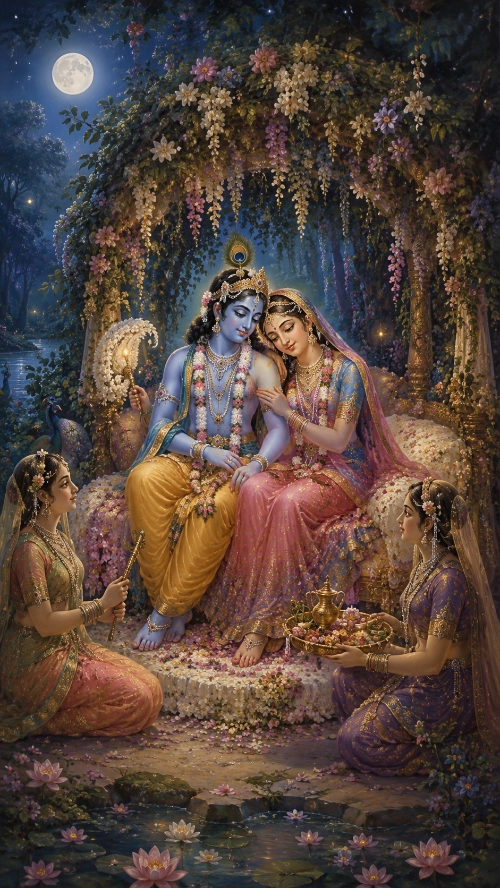
Deep in the night, during the eternal nakta-līlā of Vraja, Śrī Kṛṣṇa takes Rādhikā by the hand and leads Her toward a secluded flowering nikuñja. Vṛndā-devī has already prepared everything for the meeting of the Divine Couple. Within the bower lies a beautiful kusuma-śayana, a bed made of flowers. Nearby are fresh garlands, floral ornaments, fragrant water and refreshing drinks, tāmbūla, sandalwood paste, kuṅkuma, aguru, perfumes, fans, ornaments, and all the other articles that might be required for Their comfort and pleasure.
Śyāmasundara, overwhelmed by prema and pierced by the transcendental arrows of Kāmadeva, gently leads Rādhā to the flower bed. Rūpa Mañjarī and Tulasī follow at a respectful distance, carrying articles for service and anticipating whatever Svāminī may later require.
Hari lovingly helps Rādhikā sit upon the flower bed. Then He sits near Her soft lotus feet, takes them into His hands, and presses them affectionately to His chest, close to His heart. The mañjarīs behold the tenderness of the Divine Couple and think only of service. Their mood is captured beautifully in the prayer of Śrī Rūpa Gosvāmī:
kadāhaṁ seviṣye vratati-camarī-cāmara-marud-
vinodena krīḍā-kusuma-śayane nyasta-vapuṣau
daronmīlan-netrau śrama-jala-kaṇa-klidyad-alakau
bruvāṇāv anyonyaṁ vraja-nava-yuvānāv iha yuvām
“O ever-fresh youthful Couple of Vraja, when will I serve You by creating a gentle breeze with a cāmara of flowering vines as You recline upon the flower bed, Your eyes slightly opened, Your locks moistened with drops of perspiration, softly speaking to one another?”
The heart of this prayer is contained in just two words: kadāhaṁ seviṣye — “When will I serve?”
Before Their intimate meeting, the mañjarīs offer everything required. Rūpa Gosvāmī also speaks of offering mādhvīka, a sweet floral wine, as the Divine Couple prepare for Their playful amorous contest:
pramada-madana-yuddhārambha-sambhāvukābhyāṁ
caṣakam upahariṣye sādhu mādhvīka-pūrṇam
“When will I offer You a cup filled with mādhvīka as You joyfully prepare for the amorous contest?”
Tulasī gently fans the Divine Couple and places freshly prepared tāmbūla nearby. Then she and Rūpa withdraw from the immediate interior of the bower. The maidservant’s position is extraordinarily sensitive. She must remain close enough to know when service is required, yet never place herself at the center of the līlā. Viśvanātha Cakravartī Ṭhākura expresses this aspiration:
sthitvā bahir vyajana-yantra-nibaddha-ḍorī-
pāṇir vikarṣaṇa-vaśān mṛdu bījayāni
“Remaining outside, holding the cord attached to the fan, may I gently fan You.”
Standing outside the nikuñja, Tulasī lovingly advises Kṛṣṇa to be gentle with Rādhā: “I have brought delicate Rādhā to You with great effort. Take care of Her. Look at the patient bumblebee. It settles upon a flower without breaking its stem. Slowly it drinks the fragrant honey, making the blossom tremble only gently. You should behave in the same way. Please Her heart. If She is happy with You, She will come to You again and again.”
Rūpa and Tulasī then sit near the bower and begin preparing fresh garlands and other articles for Rādhā and Govinda. They speak softly of the sweetness of the Divine Couple, but eventually their conversation stops. Externally they become silent. Internally their service continues. Absorbed in antar-dṛṣṭi, inner vision, Tulasī prays:
“O Rūpa Mañjarī, when will you allow me to serve near the Divine Couple? When will I approach Them when They call? When will I fan Them with a flower fan? When will I prepare garlands, kuṅkuma, fragrant substances, mādhvīka and tāmbūla for Their pleasure? When will I satisfy Rādhā and Kṛṣṇa by serving under your guidance?”
The smallest objects become precious because each one can become an offering. Viśvanātha Cakravartī describes this intimate preparation:
mālyāni hāra-kaṭakādi-mṛjā vicitra-
vartiḥ śitāṁśu-ghusṛṇāguru-candanādi
vīṭīr lavaṅga-khapurādi-yutāḥ sakhībhiḥ
sārdhaṁ mudā viracayāni kalāṁ prakāśya
“Displaying my skill, may I joyfully prepare garlands together with the sakhīs, polish necklaces, bracelets and other ornaments, prepare fragrant substances of camphor, kuṅkuma, aguru and sandalwood, and make betel preparations containing cloves, camphor and other aromatics.”
Thus a garland, a bracelet, a box of kuṅkuma, a leaf of tāmbūla, a cup of fragrant water or a flower fan is never merely a decorative object. Each is an opportunity for sevā.
Within her heart, Tulasī beholds Svāminī resting in the moonlit nikuñja. The gentle Malaya breeze passes through the leaves and cools Her body. Rādhikā’s restless eyes gradually close. Her ornaments have become loosened. A pearl necklace lies disordered upon Her breast. Kṛṣṇa takes Her hand. They exchange sweet words. They become absorbed in one another.
Yet the secret of Their meeting, as understood in Gauḍīya theology, is not that each seeks personal gratification. Each desires the happiness of the other. This is the mystery concealed within the poetic language of madana-yuddha, the “battle of love.” Neither seeks merely to conquer. Each wishes to become conquered by the other’s prema.
Eventually neither can claim victory. Exhausted by Their loving play, Rādhā and Kṛṣṇa fall together upon the flower bed and rest in one another’s embrace. Their eyes close. Tiny drops of perspiration decorate Their bodies like pearls.
The mañjarīs understand that the moment for service has arrived. Rūpa and Tulasī quietly enter the bower. They begin fanning the Divine Couple with cāmaras made from flowering vines. The fragrance of the blossoms mingles with the delicate natural fragrance of Rādhikā. Kṛṣṇa slowly opens His eyes and beholds Her beauty. The scene that Tulasī had previously contemplated inwardly now appears directly before her.
Pearl necklaces have loosened or broken. Garlands are scattered across the flower bed. Garments and ornaments require rearrangement. Rūpa continues to fan the Divine Couple while Tulasī carefully collects the loosened ornaments. They offer fragrant water, soothing pastes and tāmbūla. Everything is done quietly and expertly. Rādhā and Govinda are pleased by the sensitivity of Their attendants.
Śyāma then appears overcome with fatigue. Sweetly yawning, He closes His eyes. Rādhikā rests upon His broad chest. The servant gazes upon Their forms and searches for comparisons. Śyāmasundara’s complexion defeats the beauty of a newly blossoming blue lotus. His chest resembles a vast sapphire. Upon Him, Rādhikā shines like molten gold.
Perhaps Rādhā is lightning and Kṛṣṇa a monsoon cloud. Perhaps She is a golden creeper entwined around the dark trunk of a tamāla tree. But every comparison ultimately fails. Ordinary lightning remains within the cloud only for a moment. The union of Rādhā and Kṛṣṇa, however, belongs to eternal rasa and prema. There is nothing in this world by which Their beauty can truly be measured.
After some time Rādhikā gives the mañjarīs a subtle signal with Her eyes. They immediately understand. Rūpa and Tulasī quietly leave the bower and wait nearby again, preparing whatever may next be needed. They restring pearl necklaces and arrange precious ornaments while remaining attentive to Svāminī’s service.
Rādhā, however, does not think only of Her own happiness. Out of affection for Her sakhīs, She also desires their happiness. She lovingly tells Śyāma that Her companions long for Him and encourages Him to fulfill their desires too. The exact words of this conversation vary in later devotional retellings, but the underlying mood is characteristic of the nocturnal līlā: Rādhā’s love is so generous that She takes pleasure in the happiness of Her beloved companions.
Śyāma quietly leaves the bower and later returns to Śrī Rādhikā. When She sees Him again, She smiles. Then Rādhā gently moves Her lotus foot. The bells of Her anklets ring softly. The attendants waiting nearby recognize the sound as a signal. They enter the nikuñja and help the Divine Couple rise.
Now begins prasādhana, the art of restoring and beautifying Their appearance. Garments are rearranged. Loose ornaments are restored. Fresh tilaka is applied. The eyes are renewed with collyrium. Fragrant pastes are used. Pearl necklaces and garlands are replaced. The signs of the nocturnal meeting are carefully concealed. This service is explicitly contemplated by Viśvanātha Cakravartī:
tvāṁ srasta-veṣa-vasanābharaṇāṁ sakāntāṁ
vīkṣya prasādhana-vidhau drutam udyatābhiḥ
śrī-rūpa-raṅga-tulasī-rati-mañjarībhiḥ
dṛṣṭāny ānayāni tava sammukham eva tāni
“Seeing You together with Your beloved, Your dress, garments and ornaments loosened, and seeing Rūpa, Raṅga, Tulasī and Rati Mañjarī immediately engaged in restoring Your adornment, may I quickly bring before You all the necessary articles.”
Śyāma Himself now desires to decorate His beloved. Taking musk and a delicate brush, Kṛṣṇa begins painting beautiful makara designs upon Rādhā. Śrī Rūpa Gosvāmī preserves Kṛṣṇa’s playful words to Her in his Stava-mālā:
sicayam udañcaya hṛdayād alpam
vilikhāmy adbhuta-makarākalpam
“Lift Your garment slightly from Your breast; I shall paint wonderful makara designs.”
iha na hi saṅkuca paṅkaja-nayane
veśaṁ tava karavai rati-śayane
“O lotus-eyed one, do not shrink away; let Me adorn You for the bed of love.”
rādhe dolaya na kila kapolam
citraṁ racayāmy aham avilolam
“Rādhā, do not move Your cheek; I shall draw a beautiful design upon it.”
tava vapur adya sanātana-śobham
janayati hṛdi mama kāñcana-lobham
“Today Your eternally beautiful form awakens intense longing within My heart.”
Rādhā allows Śyāma to decorate Her. But when He makes some small mistake while arranging an ornament near Her hairline, She manifests playful māna, loving contrariness. She gently strikes Mādhava with Her lotus hand and teases Him: “O dark rogue! You do not even know how to arrange a lalāṭikā properly!”
Soon the voices of the sakhīs are heard outside the nikuñja. They deliberately laugh and speak loudly, knowing that Rādhā and Kṛṣṇa have risen. The Divine Couple emerge from the bower and are immediately greeted by the refreshing rain of Their friends’ affectionate jokes.
The night continues. Music, laughter, affectionate teasing, forest pastimes and service flow into one another beneath the moon of Vṛndāvana. Yet beneath all these changing scenes lies one unchanging principle: sevā.
Vṛndā arranges. The sakhīs facilitate. Rūpa guides. The mañjarīs prepare. They bring water. They make tāmbūla. They string garlands. They polish ornaments. They prepare fragrances. They wait outside. They enter when called. They fan. They decorate. They repair. They conceal. They anticipate. Their own happiness is found in the happiness of Rādhā.
This is why even a flower fan can become the subject of profound meditation. Its spiritual significance does not lie merely in its flowers. It lies in the thought: “May this give pleasure to Svāminī.”
And therefore the deepest refrain of this entire current of devotional literature remains: kadāhaṁ seviṣye? When will I serve? Śrī Rādhā-Govinda ki jaya!