

The Family of Śrī Caitanya Mahāprabhu
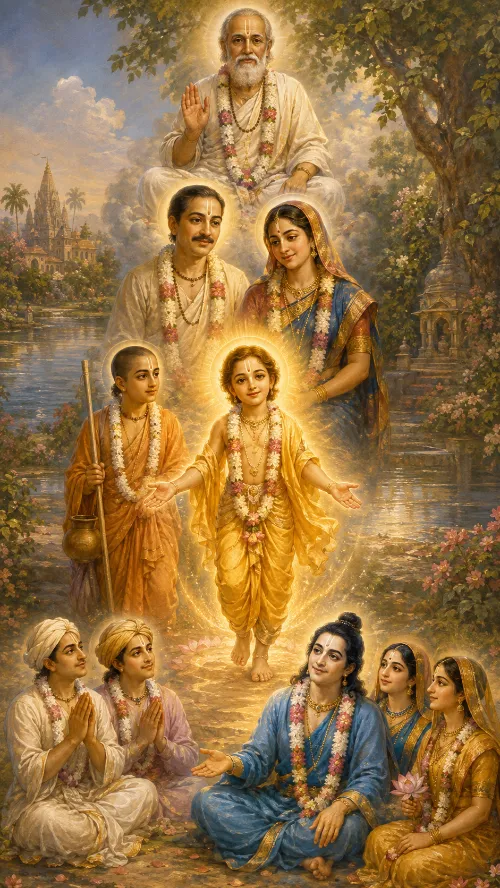
The Family of Śrī Caitanya Mahāprabhu: From Upendra Miśra to the Nityānanda Connection
The paternal family of Śrī Caitanya Mahāprabhu is more extensive — and more important to the later history of Gauḍīya Vaiṣṇavism — than the familiar sequence Jagannātha Miśra → Caitanya Mahāprabhu might suggest.
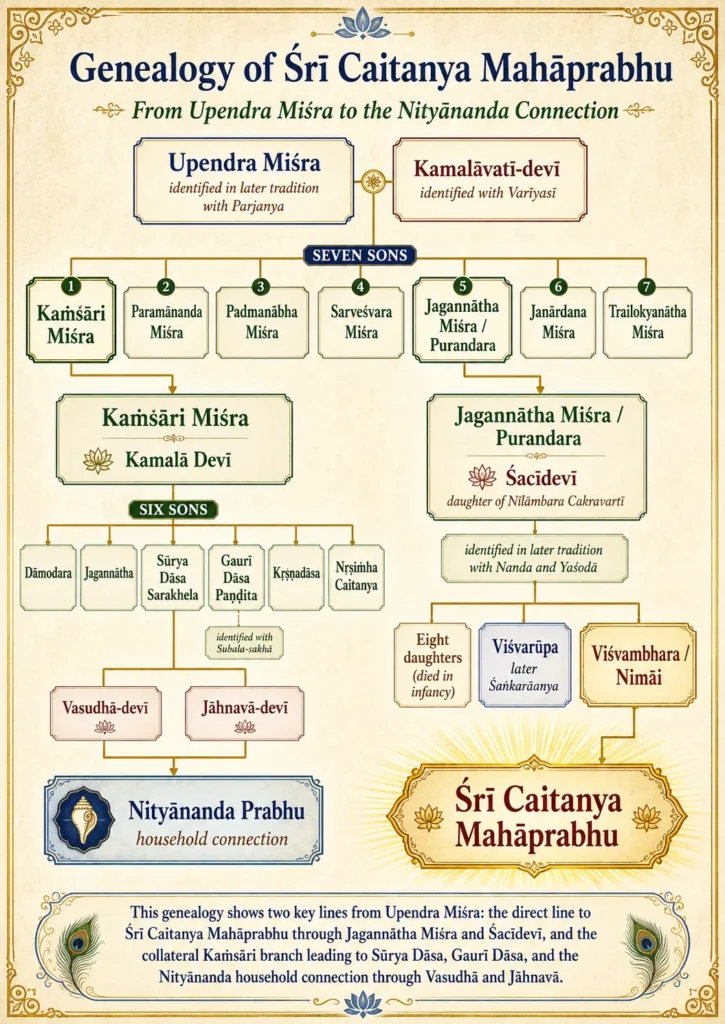
Upendra Miśra and Kamalāvatī-devī, the seven sons, the Kaṁsāri branch down to Vasudhā and Jāhnavā, and the direct line through Jagannātha Miśra and Śacīdevī to Śrī Caitanya Mahāprabhu.
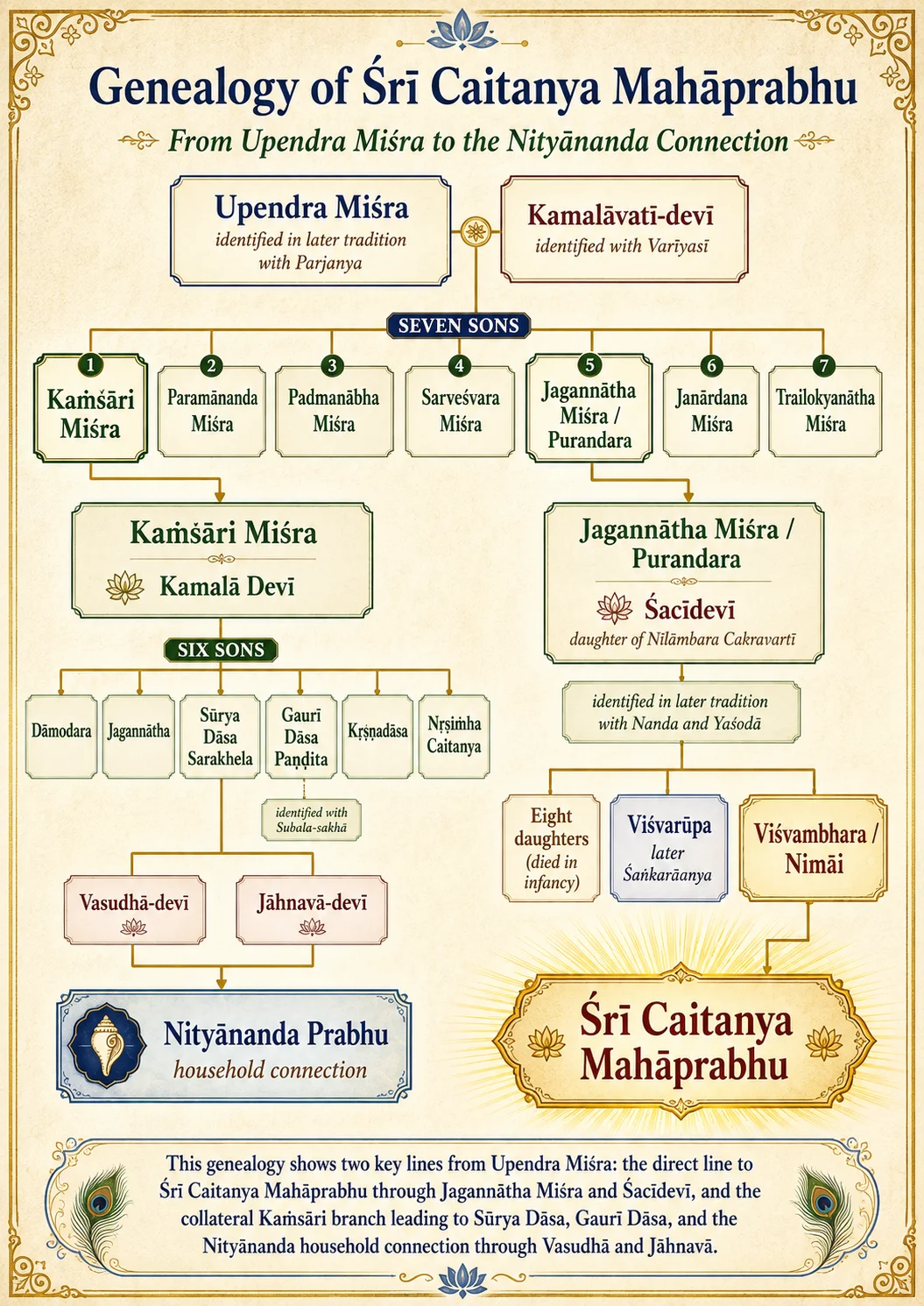
The Caitanya-caritāmṛta traces Caitanya’s paternal ancestry to Upendra Miśra of Śrīhaṭṭa, father of seven sons. One of those sons, Jagannātha Miśra, moved to Nadia and became the father of Viśvarūpa and Śrī Caitanya. Another son, Kaṁsāri Miśra, stands at the head of a collateral family line that later Gauḍīya genealogical sources connect with Sūrya Dāsa Sarakhela, Gaurī Dāsa Paṇḍita, Vasudhā-devī, Jāhnavā-devī, and ultimately the household of Nityānanda Prabhu.
The family is therefore significant on two different levels. Historically and genealogically, it connects several major personalities of early Gauḍīya Vaiṣṇavism. Theologically, later texts such as Kavi Karṇapūra’s Gaura-gaṇoddeśa-dīpikā interpret the family as the reappearance in Gaura-līlā of Kṛṣṇa’s own family and companions from Vraja.
A source-critical distinction runs through everything below: the seven sons of Upendra and the parentage of Jagannātha Miśra are stated directly in the Caitanya-caritāmṛta; the more detailed genealogy of Kaṁsāri Miśra comes from later Gauḍīya biographical and genealogical tradition.
Upendra Miśra of Śrīhaṭṭa
Kṛṣṇadāsa Kavirāja introduces Upendra Miśra in Caitanya-caritāmṛta, Ādi-līlā 13.56. The original is Bengali rather than Sanskrit:
śrīhaṭṭa-nivāsī śrī-upendra-miśra-nāma
vaiṣṇava, paṇḍita, dhanī, sad-guṇa-pradhāna
“There lived in Śrīhaṭṭa a man named Śrī Upendra Miśra, a Vaiṣṇava, learned scholar, prosperous man, and one endowed with excellent qualities.”
Śrīhaṭṭa corresponds broadly to the historical Sylhet region, now principally in Bangladesh. Later commentarial tradition more specifically associates Upendra with Dhākā-dakṣiṇa-grāma in Śrīhaṭṭa.
What is striking is that Upendra is not introduced merely as a genealogical name. He is already characterised by four qualities:
The family from which Caitanya appears is therefore presented from the outset as a learned and devotional Vaiṣṇava household.
The Seven Sons of Upendra Miśra
The following verses give the genealogy directly:
sapta miśra tāṅra putra — sapta ṛṣīśvara
kaṁsāri, paramānanda, padmanābha, sarveśvara
jagannātha, janārdana, trailokyanātha
nadīyāte gaṅgā-vāsa kaila jagannātha
“His seven sons were seven exalted Miśras: Kaṁsāri, Paramānanda, Padmanābha, Sarveśvara, Jagannātha, Janārdana and Trailokyanātha. Jagannātha went to live by the Gaṅgā at Nadia.” — Caitanya-caritāmṛta, Ādi 13.57–58
The seven brothers are therefore Kaṁsāri, Paramānanda, Padmanābha, Sarveśvara, Jagannātha, Janārdana and Trailokyanātha Miśra. Jagannātha is explicitly the fifth son. The spelling Trailokyanātha, rather than Trilokyanātha, follows the form preserved by Kṛṣṇadāsa Kavirāja.
UPENDRA MIŚRA
    ├── Kaṁsāri Miśra
    ├── Paramānanda Miśra
    ├── Padmanābha Miśra
    ├── Sarveśvara Miśra
    ├── Jagannātha Miśra
    ├── Janārdana Miśra
    └── Trailokyanātha Miśra
Upendra Miśra as Parjanya of Vraja
Later Gauḍīya theology adds another level to this genealogy. Kavi Karṇapūra’s Gaura-gaṇoddeśa-dīpikā identifies Caitanya’s associates and relatives with personalities of Kṛṣṇa-līlā. Verse 35 identifies Upendra Miśra with Parjanya, the paternal grandfather of Kṛṣṇa:
parjanyo nāma gopāla āsīt kṛṣṇa-pitāmahaḥ
upendra-miśraḥ sañjātaḥ śrīhaṭṭe sapta-putravān
“The cowherd named Parjanya, Kṛṣṇa’s grandfather, appeared in Śrīhaṭṭa as Upendra Miśra and became the father of seven sons.” — Gaura-gaṇoddeśa-dīpikā 35
The next verse identifies Parjanya’s wife Varīyasī with Kamalāvatī-devī in Caitanya-līlā. Later Gauḍīya tradition therefore gives the parental generation as Upendra Miśra and Kamalāvatī-devī, corresponding theologically to Parjanya and Varīyasī.
The name Kamalāvatī should be distinguished from Kamalā Devī, who appears in the later genealogy as the wife of Upendra’s son Kaṁsāri Miśra. They are two different women in two generations.
Jagannātha Miśra Moves to Nadia
Among the seven sons, Jagannātha Miśra becomes central because he leaves the ancestral Śrīhaṭṭa region and establishes himself in Nadia and Navadvīpa on the Gaṅgā. The Caitanya-caritāmṛta states it concisely:
nadīyāte gaṅgā-vāsa kaila jagannātha
“Jagannātha took up residence by the Gaṅgā at Nadia.”
This migration is crucial in the sacred geography of Caitanya’s life. The Miśra family thereby becomes part of Navadvīpa, at the time one of Bengal’s major centres of Sanskrit learning and later the birthplace of Caitanya’s saṅkīrtana movement.
Jagannātha Miśra as Purandara
Kṛṣṇadāsa Kavirāja next gives Jagannātha a second designation:
jagannātha miśravara — padavī ‘purandara’
nanda-vasudeva-rūpa sad-guṇa-sāgara
“The eminent Jagannātha Miśra bore the designation Purandara. Like Nanda and Vasudeva, he was an ocean of good qualities.” — Caitanya-caritāmṛta, Ādi 13.59
Jagannātha Miśra and Purandara are therefore not two people. Purandara is a title or designation associated with Jagannātha. The comparison with Nanda and Vasudeva, the two paternal figures of Kṛṣṇa’s Vraja and Mathurā-Dvārakā narratives, already anticipates the much more explicit theological identification found in the Gaura-gaṇoddeśa-dīpikā.
Śacīdevī and Her Father Nīlāmbara Cakravartī
Jagannātha Miśra married Śacīdevī. Kṛṣṇadāsa writes:
tāṅra patnī ‘śacī’-nāma, pativratā satī
yāṅra pitā ‘nīlāmbara’ nāma cakravartī
“His wife was named Śacī, a virtuous and devoted wife. Her father was named Nīlāmbara Cakravartī.” — Caitanya-caritāmṛta, Ādi 13.60
Caitanya’s maternal grandfather was therefore Nīlāmbara Cakravartī, an important learned brāhmaṇa associated with Navadvīpa. Later Gauḍīya tradition, again following the Gaura-gaṇoddeśa-dīpikā, identifies him with Garga Muni, the celebrated priest and astrologer associated with Kṛṣṇa’s family. This creates another Vraja–Gaura correspondence: Garga Muni → Nīlāmbara Cakravartī.
Jagannātha and Śacī as Nanda and Yaśodā
Kavi Karṇapūra makes the theological identity of Caitanya’s parents explicit:
purā yaśodā-vraja-rāja-nandau
vṛndāvane prema-rasākarau yau
śacī-jagannātha-purandarābhidhau
babhūvatus tau na ca saṁśayo ’tra
“Yaśodā and Nanda, king of Vraja, who were oceans of the rasa of love in Vṛndāvana, appeared as Śacī and Jagannātha Purandara. Of this there is no doubt.” — Gaura-gaṇoddeśa-dīpikā 37
The theological family correspondence is therefore symmetrical:
This is not intended as ordinary reincarnation genealogy in a modern historical sense. It is a theological reading of Gaura-līlā in which Caitanya’s associates embody and continue relationships already manifested in Kṛṣṇa-līlā.
Multiple Parental Identities in Gauḍīya Theology
The Gaura-gaṇoddeśa-dīpikā goes still further. After identifying Śacī and Jagannātha principally with Yaśodā and Nanda, it records another tradition according to which several earlier divine parental couples are also present within them. The Sanskrit begins:
amū āviśatām eva devāv aditi-kaśyapau
śrī-kauśalyā-daśarathau tathā śrī-pṛṣṇi-tat-patī
“Aditi and Kaśyapa entered them, as did Kauśalyā and Daśaratha, and Pṛṣṇi and her husband.”
The tradition then also connects them with Devakī and Vasudeva. The idea is that the various great parental manifestations of Bhagavān converge in Śacī and Jagannātha, because the same Supreme Lord who appeared through those earlier divine families now appears as Caitanya. The primary identification remains Jagannātha as Nanda and Śacī as Yaśodā, but Gauḍīya theology allows several divine parental identities to converge in them.
The Children of Jagannātha Miśra and Śacīdevī
Their family history contains considerable sorrow before the birth of Caitanya. The Caitanya-caritāmṛta recounts that eight daughters were born and died in infancy. After these losses, a son was finally born — Viśvarūpa:
tabe putra janamilā ‘viśvarūpa’ nāma
mahā-guṇavān teṅha — ‘baladeva’-dhāma
“Then a son named Viśvarūpa was born. He was greatly endowed with qualities and was the abode of Baladeva.” — Caitanya-caritāmṛta, Ādi 13.74
Viśvarūpa was therefore Caitanya Mahāprabhu’s elder brother. He later renounced household life, and in the received Gauḍīya tradition his sannyāsa name is identified as Śaṅkarāraṇya. This matters because Śaṅkarāraṇya sometimes appears in lists of Caitanya’s associates as though he were a completely separate person.
JAGANNĀTHA MIŚRA / PURANDARA
             +
          ŚACĪDEVĪ
             │
      eight daughters
      who died young
             │
       ┌─────┴─────┐
       │           │
 VIŚVARŪPA     VIŚVAMBHARA
 Śaṅkarāraṇya     Nimāi
                    │
             ŚRĪ CAITANYA
             MAHĀPRABHU
Viśvambhara, familiarly Nimāi, is the younger surviving son who later becomes Śrī Kṛṣṇa Caitanya.
The Other Great Branch: Kaṁsāri Miśra
The Caitanya-caritāmṛta names Kaṁsāri Miśra as Upendra Miśra’s first son but does not provide the same detailed account of his descendants. That detail is supplied in later Gauḍīya biographical and genealogical traditions, especially in material connected with the lives of Gaurī Dāsa Paṇḍita and Jāhnavā-devī. According to that tradition, Kaṁsāri Miśra and Kamalā Devī had six sons:
- Dāmodara
- Jagannātha
- Sūrya Dāsa
- Gaurī Dāsa
- Kṛṣṇadāsa
- Nṛsiṁha Caitanya
This six-son genealogy is later Gauḍīya biographical tradition. Unlike Upendra’s seven sons, it is not enumerated in Caitanya-caritāmṛta Ādi 13. Some later sources also associate the family with the Vātsa gotra and the family designation Ghoṣāla; such details belong to the later genealogical layer and should not be presented as though Kṛṣṇadāsa Kavirāja himself supplied them.
Why Kaṁsāri’s Family Matters
At first glance this appears to be merely a collateral branch: Kaṁsāri was Caitanya’s paternal uncle, and his sons were Caitanya’s paternal cousins. But two of those sons become extremely important — Sūrya Dāsa Sarakhela and Gaurī Dāsa Paṇḍita. Through them, Caitanya’s paternal extended family becomes intimately connected with Nityānanda Prabhu and with the expansion of the Caitanya movement in Bengal. That is the deeper significance of the genealogy.
Sūrya Dāsa Sarakhela
Sūrya Dāsa, the third son in this later genealogy, is better known as Sūrya Dāsa Sarakhela. Sarakhela was a title connected with administrative service, and later biographical tradition portrays him as a respected official and substantial householder. The Caitanya-caritāmṛta itself confirms his prominence in the Nityānanda branch:
sūryadāsa sarakhela, tāṅra bhāi kṛṣṇadāsa
nityānande dṛḍha viśvāsa, premera nivāsa
“Sūrya Dāsa Sarakhela and his brother Kṛṣṇadāsa possessed firm faith in Nityānanda and were abodes of divine love.”
The connection with Nityānanda is therefore not merely a later genealogical invention. Kṛṣṇadāsa Kavirāja himself places Sūrya Dāsa and Kṛṣṇadāsa among Nityānanda’s important associates.
Vasudhā and Jāhnavā: Sūrya Dāsa’s Daughters
Later Gauḍīya tradition states that Sūrya Dāsa had two celebrated daughters, Vasudhā-devī and Jāhnavā-devī, and that both became consorts of Nityānanda Prabhu. This creates a remarkable family connection:
UPENDRA MIŚRA
    ├── JAGANNĀTHA MIŚRA
    │       └── ŚRĪ CAITANYA MAHĀPRABHU
    │
    └── KAṀSĀRI MIŚRA
            └── SŪRYA DĀSA SARAKHELA
                    ├── VASUDHĀ
                    └── JĀHNAVĀ
                          └── NITYĀNANDA
Caitanya’s paternal extended family therefore becomes connected by marriage to Nityānanda’s household. The connection is especially striking because Caitanya and Nityānanda are already understood theologically as Kṛṣṇa and Balarāma. Here the devotional network becomes interwoven through historical family relationships as well.
Vasudhā and Jāhnavā in Gaura-līlā Theology
Kavi Karṇapūra’s theological tradition identifies the two women with personalities associated with Balarāma. A commonly transmitted Sanskrit reading states:
śrī-vāruṇī-revatyor aṁśa-sambhave
tasya priye śrī-vasudhā ca jāhnavā
“His beloved Vasudhā and Jāhnavā arose from the manifestations of Vāruṇī and Revatī.”
The family link is again interpreted through the pattern of Vraja and Kṛṣṇa-līlā identities reappearing in Gaura-līlā. Jāhnavā in particular later becomes far more than “Nityānanda’s wife”: in the post-Caitanya generation she emerges as an influential Vaiṣṇava teacher, organiser and spiritual authority. The Kaṁsāri–Sūrya Dāsa line therefore contributes directly to the later institutional history of the movement.
Gaurī Dāsa Paṇḍita
Kaṁsāri’s fourth son in the later family tradition is the celebrated Gaurī Dāsa Paṇḍita, one of Nityānanda’s major associates. The Caitanya-caritāmṛta praises him in unusually strong language:
gaurīdāsa paṇḍita yāṅra premoddaṇḍa-bhakti
kṛṣṇa-prema dite, nite, dhare mahāśakti
“Gaurī Dāsa Paṇḍita possessed intensely exalted devotion and great power both to receive and to distribute love of Kṛṣṇa.” — Caitanya-caritāmṛta, Ādi 11.26
The following verse describes his complete dedication to Caitanya and Nityānanda. Gaurī Dāsa is particularly associated with Ambikā-kālanā, where an important Gauḍīya devotional centre developed around him, and later tradition tells of his extraordinary attachment to Caitanya and Nityānanda and of the famous Gaura-Nitāi Deities connected with his house.
Gaurī Dāsa as Subala-sakhā
The theological interpretation of Gaurī Dāsa is equally important. Kavi Karṇapūra identifies him with Subala, one of Kṛṣṇa’s most intimate cowherd friends:
subalo yaḥ priya-śreṣṭhaḥ sa gaurīdāsa-paṇḍitaḥ
“He who was Subala, the foremost among Kṛṣṇa’s dear friends, became Gaurī Dāsa Paṇḍita.” — Gaura-gaṇoddeśa-dīpikā 128
This places Gaurī Dāsa within the important Gauḍīya concept of the dvādaśa-gopālas, the great cowherd companions of Kṛṣṇa who reappear among Nityānanda’s associates. Gaurī Dāsa therefore belongs simultaneously to several structures:
- Caitanya’s paternal extended family;
- Nityānanda’s devotional network;
- the Ambikā-kālanā regional centre;
- and the theological world of Kṛṣṇa’s Vraja-sakhās.
This is exactly why merely listing his name loses most of its meaning.
Kṛṣṇadāsa and Nṛsiṁha Caitanya
The later Kaṁsāri genealogy places Kṛṣṇadāsa and Nṛsiṁha Caitanya after Gaurī Dāsa as his younger brothers. These names require some caution, because both occur elsewhere in broader Gauḍīya lists. The Caitanya-caritāmṛta independently mentions Kṛṣṇadāsa Sarakhela as a brother of Sūrya Dāsa and an ardent follower of Nityānanda, which fits the later family tradition well; it also lists a devotee named Nṛsiṁha Caitanya among Nityānanda’s branches. However, because devotional names frequently recur in the literature, later lists of disciples or descendants should not automatically be assumed to refer to the same genealogical persons without examining their context.
The safest family statement is this: in the later genealogy followed here, Kṛṣṇadāsa and Nṛsiṁha Caitanya are sons of Kaṁsāri Miśra and therefore brothers of Sūrya Dāsa and Gaurī Dāsa. They should not automatically be turned into biological sons of Gaurī Dāsa merely because similar names occur in traditions associated with his śrīpāṭa.
Two Different Kamalās
A small but important clarification prevents a common genealogical confusion. There are two women with similar names, belonging to successive generations:
They must not be merged.
The Family in Its Theological Form
When the historical genealogy and the later Gaura-līlā identifications are placed side by side, an elegant structure appears:
At the collateral level, Kaṁsāri Miśra produces Sūrya Dāsa, Gaurī Dāsa and their brothers, with Gaurī Dāsa identified with Subala and Sūrya Dāsa’s daughters Vasudhā and Jāhnavā joining the household of Nityānanda, Caitanya’s Balarāma counterpart. The family is therefore interpreted not simply as biological ancestry but as a reappearance of relational patterns from Kṛṣṇa-līlā.
The Full Source-Conscious Genealogy
UPENDRA MIŚRA
identified in Gaura-gaṇoddeśa-dīpikā with PARJANYA
                    +
            KAMALĀVATĪ-DEVĪ
          identified with VARĪYASĪ
    │
    ├── KAṀSĀRI MIŚRA + KAMALĀ DEVĪ
    │       ├── Dāmodara
    │       ├── Jagannātha
    │       ├── SŪRYA DĀSA SARAKHELA
    │       │       ├── VASUDHĀ-DEVĪ
    │       │       └── JĀHNAVĀ-DEVĪ
    │       │             └── connected by marriage with
    │       │                 ŚRĪ NITYĀNANDA PRABHU
    │       ├── GAURĪ DĀSA PAṆḌITA
    │       │       ├── major associate of Nityānanda
    │       │       ├── associated with Ambikā-kālanā
    │       │       └── identified with SUBALA-SAKHĀ
    │       ├── Kṛṣṇadāsa
    │       └── Nṛsiṁha Caitanya
    │
    ├── Paramānanda Miśra
    ├── Padmanābha Miśra
    ├── Sarveśvara Miśra
    │
    ├── JAGANNĀTHA MIŚRA / PURANDARA
    │   identified principally with NANDA MAHĀRĀJA
    │                   +
    │               ŚACĪDEVĪ
    │   identified principally with YAŚODĀ
    │   daughter of NĪLĀMBARA CAKRAVARTĪ
    │       ├── eight daughters who died in infancy
    │       ├── VIŚVARŪPA
    │       │       └── ŚAṄKARĀRAṆYA after sannyāsa
    │       └── VIŚVAMBHARA / NIMĀI
    │               └── ŚRĪ KṚṢṆA CAITANYA MAHĀPRABHU
    │
    ├── Janārdana Miśra
    └── Trailokyanātha Miśra
The top-level seven sons and Jagannātha’s relocation to Nadia are directly documented in the Caitanya-caritāmṛta. The identities with Parjanya, Varīyasī, Nanda and Yaśodā belong to the Gaura-gaṇoddeśa-dīpikā. The detailed six-son genealogy beneath Kaṁsāri Miśra, including the name Kamalā Devī, belongs principally to later Gauḍīya biographical and genealogical tradition. That distinction should remain visible in any scholarly presentation.
Why This Genealogy Matters
The importance of the family goes far beyond discovering who Caitanya’s uncles and cousins were. It reveals how the early Gauḍīya movement was woven together by several overlapping types of relationship.
- Through Jagannātha Miśra, the family produces Śrī Caitanya Mahāprabhu.
- Through Kaṁsāri Miśra, it produces personalities closely connected with Nityānanda’s preaching branch.
- Through Sūrya Dāsa, it produces Vasudhā and Jāhnavā, bringing the extended Miśra family directly into the household world of Nityānanda.
- Through Gaurī Dāsa, it produces one of the most celebrated Vraja-sakhā-type associates of Caitanya and Nityānanda.
And through the theological interpretation of Kavi Karṇapūra, the whole family becomes a continuation of Kṛṣṇa’s own Vraja family network: Parjanya becomes Upendra, Nanda becomes Jagannātha, Yaśodā becomes Śacī, Subala becomes Gaurī Dāsa, and the companions of Balarāma reappear around Nityānanda.
Thus genealogy becomes theology. The Caitanya tradition does not merely ask “Who was related to whom?” It also asks: “What eternal relationship is being revealed through this earthly relationship?” That is the deeper significance of the Miśra family within Caitanya’s Tree.