

Kaśyapa’s Thirteen Wives
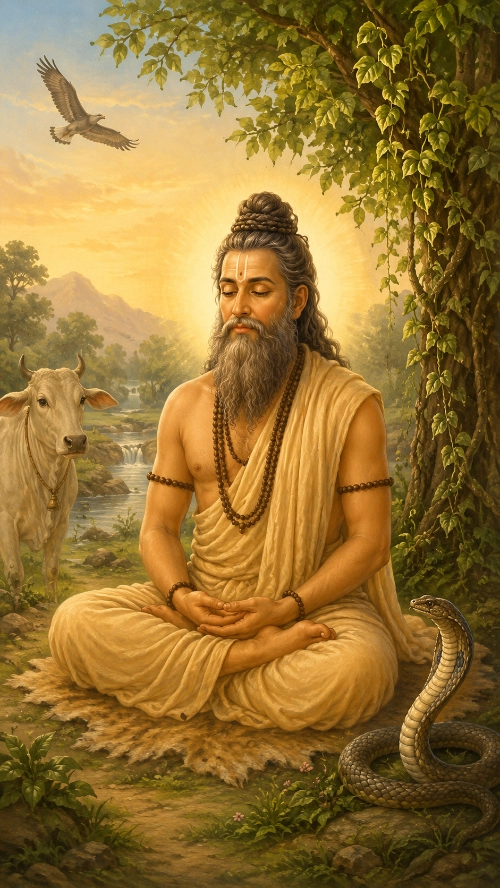
Kaśyapa's Thirteen Wives: A Purāṇic Family Tree of Gods, Asuras, Nāgas, Birds, Animals and Plants
Purāṇic cosmology rarely describes creation as a set of abstract biological categories. It describes it as a network of families. Gods, asuras, celestial musicians, serpents, birds, cattle, predators, trees and grasses are all placed within interconnected lines of descent — and one genealogy, that of Kaśyapa, accounts for an extraordinary share of the whole.
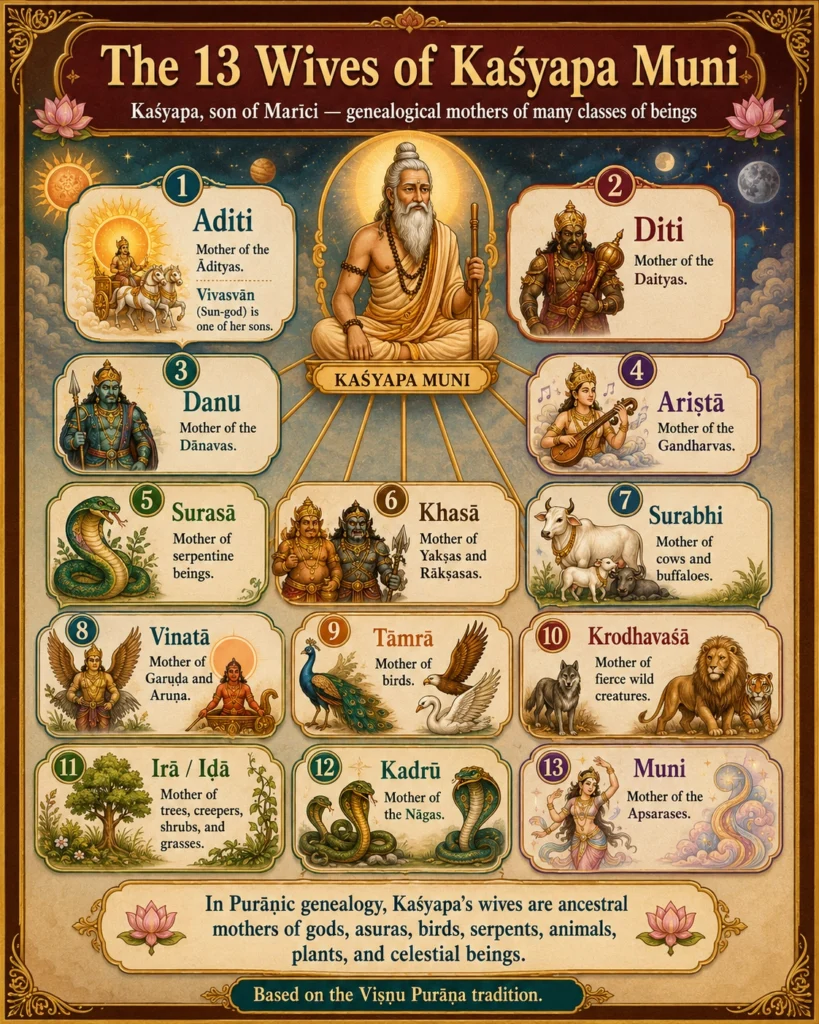
All thirteen on one sheet, in the order the Viṣṇu Purāṇa gives them, with the class of beings each mother brings into the world.
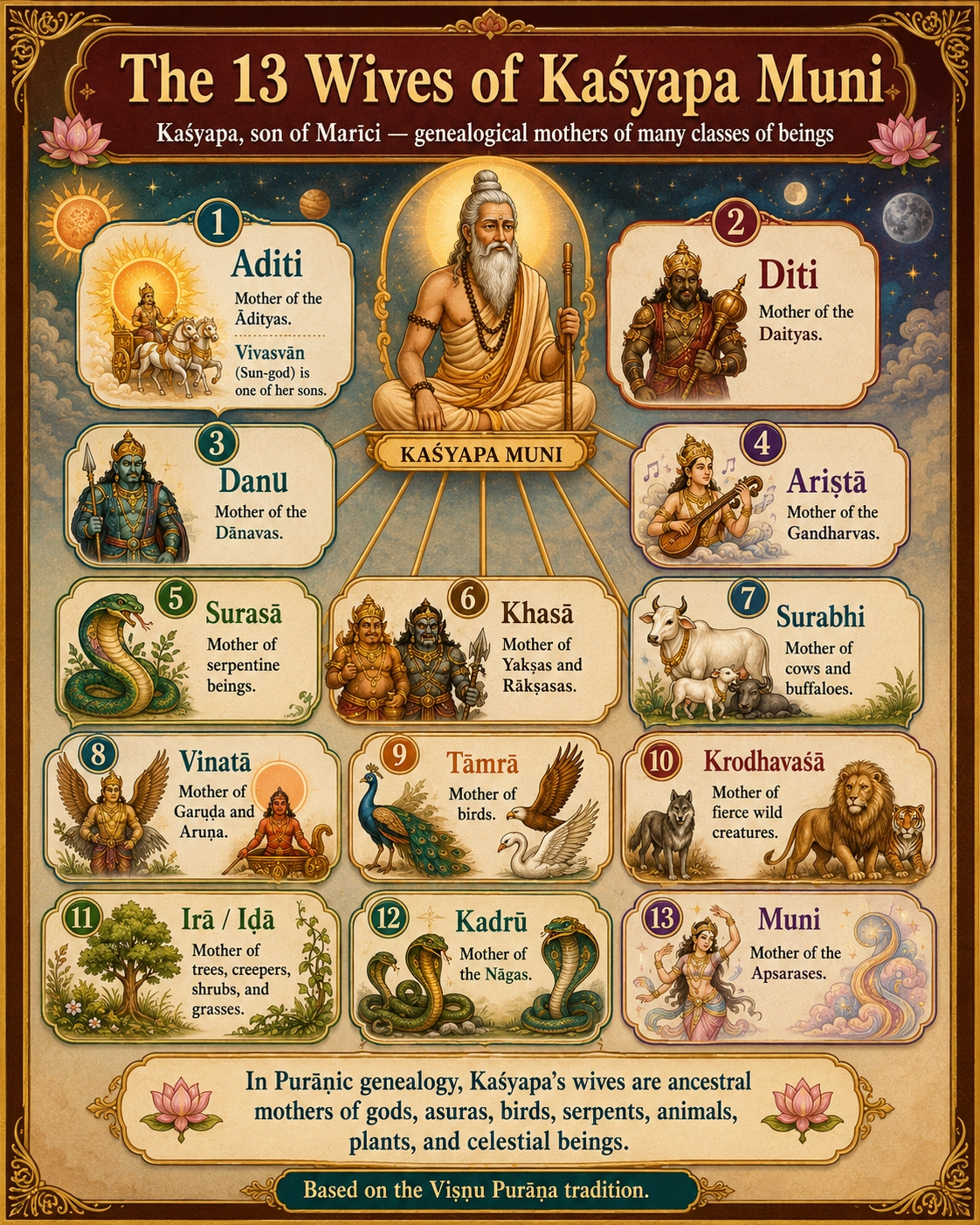
Kaśyapa is the son of the sage Marīci and one of the principal Prajāpatis — the progenitors through whom the diversity of living beings becomes manifest. According to the genealogy preserved in the Viṣṇu Purāṇa, he married thirteen daughters of Dakṣa:
अदितिर्दितिर्दनुश्चैवारिष्टा च सुरसा खसा ।
सुरभिर्विनता चैव ताम्रा क्रोधवशा इरा ।
कद्रुर्मुनिश्च धर्मज्ञ तदपत्यानि मे शृणु ॥
aditir ditir danuś caivāriṣṭā ca surasā khasā
surabhir vinatā caiva tāmrā krodhavaśā irā
kadrur muniś ca dharmajña tad-apatyāni me śṛṇu
“Listen now to the descendants of Aditi, Diti, Danu, Ariṣṭā, Surasā, Khasā, Surabhi, Vinatā, Tāmrā, Krodhavaśā, Irā, Kadrū and Muni.”
The Purāṇa itself sums up the scope of this family in a single phrase:
एते कश्यपदायादाः कीर्तिताः स्थाणुजङ्गमाः ।
ete kaśyapa-dāyādāḥ kīrtitāḥ sthāṇu-jaṅgamāḥ
“These descendants of Kaśyapa have been described — both the stationary and the moving.”
The genealogy deliberately reaches from mobile beings all the way to plant life.
Aditi — Mother of the Ādityas
Aditi is the most famous of the thirteen. She bears the twelve Ādityas, whom the Viṣṇu Purāṇa names as Viṣṇu, Śakra or Indra, Aryaman, Dhātṛ, Tvaṣṭṛ, Pūṣan, Vivasvān, Savitṛ, Mitra, Varuṇa, Aṃśa and Bhaga.
विवस्वान् सविता चैव मित्रो वरुण एव च ।
अंशो भगश्च…
vivasvān savitā caiva mitro varuṇa eva ca
aṃśo bhagaś ca…
She is therefore better described not simply as “mother of the gods” but as the mother of the twelve Ādityas — one principal class of devas among several.
Among her sons is Vivasvān, the solar deity whom Kṛṣṇa addresses in the Gītā:
इमं विवस्वते योगं प्रोक्तवानहमव्ययम् ।
imaṁ vivasvate yogaṁ proktavān aham avyayam
“I instructed this imperishable yoga to Vivasvān.”
Bhagavad-gītā 4.1
Aditi’s importance is greater still because Viṣṇu manifests as Vāmana, the dwarf-brāhmaṇa avatāra, as her son by Kaśyapa — the central figure of the Bali Mahārāja narrative.
The Viṣṇu Purāṇa also preserves the striking idea that the twelve Ādityas had existed in an earlier cosmic cycle as the gods known as the Tuṣitas. That illustrates a fundamental principle: birth within a genealogy does not necessarily mean that a divine personality has begun to exist. Cosmic beings may manifest again in new familial relationships during different manvantaras — which matters enormously when comparing genealogies that appear to disagree.
Diti — the Daityas, and the Forty-Nine Maruts
Diti gives her name to the Daityas: Daitya means “descendant of Diti.”
दित्याः पुत्रद्वयं जज्ञे कश्यपादिति नः श्रुतम् ।
हिरण्यकशिपुश्चैव हिरण्याक्षश्च दुर्जयः ॥
dityāḥ putra-dvayaṁ jajñe kaśyapād iti naḥ śrutam
hiraṇyakaśipuś caiva hiraṇyākṣaś ca durjayaḥ
Her two famous sons are Hiraṇyākṣa, slain by Viṣṇu as Varāha, and Hiraṇyakaśipu, the antagonist of the Nṛsiṁhadeva narrative and the father of the great devotee Prahlāda. From them descends one of the most important Purāṇic dynasties:
Kaśyapa + Diti
 └─ Hiraṇyakaśipu
     └─ Prahlāda
         └─ Virocana
             └─ Bali Mahārāja
                 └─ Bāṇa
विरोचनस्तु प्राह्लादिर्बलिर्जज्ञे विरोचनात् ।
virocanas tu prāhlādir balir jajñe virocanāt
“Virocana was Prahlāda’s son, and Bali was born from Virocana.”
This lineage teaches something the categories alone would hide. Being born among the Daityas does not determine spiritual character: Prahlāda is one of the greatest devotees in Vaiṣṇava scripture, and Bali becomes famous for surrendering everything to Vāmana. The Purāṇic categories are genealogical and cosmic — not a claim that an entire race is morally evil.
Diti also has a daughter — siṁhikā cābhavat kanyā — Siṁhikā, who later marries Vipracitti and so links the Daitya and Dānava dynasties.
The forty-nine Maruts
Diti’s story then takes an extraordinary turn. She desires a son powerful enough to defeat Indra, and Kaśyapa grants the wish on condition that she maintain extraordinary purity for a prescribed period. Indra eventually finds her sleeping in an impure condition and enters her womb, dividing the embryo into seven portions. When they cry, he says:
मा रोदीः
mā rodīḥ
“Do not cry.”
Each of the seven is divided again into seven, and so arise the forty-nine Maruts:
मरुतो नाम देवास्ते बभूवुरतिवेगिनः ।
maruto nāma devās te babhūvur ativeginaḥ
“They became the swift gods known as the Maruts.”
The irony is exact: Diti wanted a son who would destroy Indra, and her offspring become devas associated with Indra himself. Purāṇic genealogy refuses to fit a rigid “deva family versus demon family” scheme.
Danu — Mother of the Dānavas
Like Daitya, Dānava is a patronymic: a descendant of Danu. Among her descendants the Viṣṇu Purāṇa names Śambara, Tāraka, Vṛṣaparvan, Puloman, Vipracitti and Svarbhānu, among many others.
So Diti produces the Daityas while Danu produces the Dānavas. Both may be described broadly as asuras, but they are genealogically distinct — a distinction routinely lost in retellings where every adversary of the devas is simply called a demon.
A further qualification: these thirteen are the thirteen daughters of Dakṣa in this particular genealogy, not necessarily every wife Kaśyapa has in every Purāṇic narrative. Other passages connect him with Pulomā and Kālakā, whose descendants include the Paulomas and Kālakeyas. “Kaśyapa’s thirteen wives” should always mean his thirteen Dakṣa-born wives in this Viṣṇu Purāṇa list.
Ariṣṭā — Mother of the Gandharvas
अरिष्टा तु महासत्त्वान् गन्धर्वान् समजीजनत् ।
ariṣṭā tu mahāsattvān gandharvān samajījanat
“Ariṣṭā produced the mighty Gandharvas.”
The Gandharvas are celestial beings associated with music, singing, poetry, beauty, fragrance and the courts of the devas, appearing throughout the Mahābhārata, Rāmāyaṇa and Purāṇas as master musicians of the intermediate celestial worlds. With Muni, mother of the Apsarases, Ariṣṭā produces two complementary branches of celestial artistic culture — musicians and dancers.
Surasā — a Thousand Supernatural Serpents
सुरसायाः सहस्रं तु सर्पाणाममितौजसाम् ।
अनेकशिरसां ब्रह्मन् खेचराणां महात्मनाम् ॥
surasāyāḥ sahasraṁ tu sarpāṇām amitaujasām
aneka-śirasāṁ brahman khecarāṇāṁ mahātmanām
Surasā bears a thousand sarpas — extraordinarily powerful, many-headed, and even capable of moving through the sky.
This should not simply be merged with Kadrū’s descendants. The Viṣṇu Purāṇa deliberately preserves two serpent genealogies: Surasā’s thousand extraordinary sarpas, and Kadrū’s Kādraveya or Nāga line including Śeṣa, Vāsuki and Takṣaka. Terms such as sarpa, nāga, pannaga and uraga overlap in Sanskrit literature, but Purāṇic genealogies sometimes differentiate supernatural serpent populations in their own way.
Khasā — Yakṣas and Rākṣasas
खषा तु यक्षरक्षांसि
khaṣā tu yakṣa-rakṣāṁsi
“Khasā produced Yakṣas and Rākṣasas.”
But Rākṣasa does not automatically mean morally evil. The Rāmāyaṇa supplies the obvious counterexample in Vibhīṣaṇa, who although born among Rākṣasas becomes a devoted servant of Rāma. Species and lineage do not determine bhakti.
Surabhi — Mother of Cattle
गास्तु वै जनयामास सुरभिर्महिषीस्तथा ।
gās tu vai janayām āsa surabhir mahiṣīs tathā
“Surabhi produced cows and buffaloes.”
Surabhi represents the bovine branch of creation, and naturally recalls the broader complex surrounding Surabhi or Kāmadhenu — the celestial archetype of the cow, associated with nourishment, milk, abundance, fertility, yajña and agricultural prosperity.
It is best not to assume that every Purāṇic appearance of a figure named Surabhi represents exactly the same narrative individual; names and archetypes recur in different cosmic settings. The theological point stands regardless: the cow is given a sacred cosmic ancestry.
Vinatā — Garuḍa and Aruṇa
विनतायास्तु द्वौ पुत्रौ विख्यातौ गरुडारुणौ ।
vinatāyās tu dvau putrau vikhyātau garuḍāruṇau
“Vinatā had two famous sons, Garuḍa and Aruṇa.”
The distinction is worth holding: Vivasvān or Sūrya is the Sun deity, while Aruṇa is his charioteer. The two are sometimes confused.
The rivalry between Vinatā’s line and Kadrū’s is developed at length in the Mahābhārata. After Vinatā becomes enslaved through a wager with Kadrū, Garuḍa undertakes the extraordinary task of obtaining amṛta to secure his mother’s freedom. So what looks in the genealogy like a simple zoological opposition — bird against serpent — becomes a major epic drama of slavery, deception, sacrifice, immortality, and Garuḍa’s rise to divine status.
Tāmrā — Birds, and More
Tāmrā’s branch is more detailed than “mother of birds” suggests. The Viṣṇu Purāṇa names six daughters:
शुकी श्येनी च भासी च सुग्रीवी शुचिगृध्रिका ।
śukī śyenī ca bhāsī ca sugrīvī śuci-gṛdhrikā
Śukī, Śyenī, Bhāsī, Sugrīvī, Śuci and Gṛdhrikā.
Their descendants include parrots, birds of prey, hawks, kites, vultures and water birds. Yet one daughter produces a surprising terrestrial branch:
सुग्रीवी तु व्यजायत
अश्वानुष्ट्रान् गर्दभांश्च
sugrīvī tu vyajāyata
aśvān uṣṭrān gardabhāṁś ca
Sugrīvī gives rise to horses, camels and asses.
So Tāmrā is more accurately the ancestress of a broad animal branch dominated by birds but not restricted to them — an excellent example of why this genealogy should not be mistaken for modern biological taxonomy.
Krodhavaśā — the Predatory World
गणं क्रोधवशं विद्धि ते च सर्वे च दंष्ट्रिणः ।
स्थलजाः पक्षिणोऽब्जाश्च दारुणाः पिशिताशनाः ॥
gaṇaṁ krodhavaśaṁ viddhi te ca sarve ca daṁṣṭriṇaḥ
sthalajāḥ pakṣiṇo ’bjāś ca dāruṇāḥ piśitāśanāḥ
Krodhavaśā therefore represents something broader than “wild animals.” Her descendants occupy what we might call the predatory ecological niche across land, air and water — one of the places where the Purāṇic system comes surprisingly close to classifying creatures by mode of life and function, even while doing it through genealogy.
Irā — Mother of Vegetation
इरा वृक्षलतावल्लीस्तृणजातीश्च सर्वशः ।
irā vṛkṣa-latā-vallīs tṛṇa-jātīś ca sarvaśaḥ
Irā gives rise to vṛkṣa, trees; latā, creepers; vallī, climbing vines; and tṛṇa, grasses.
Irā represents the terrestrial plant kingdom, and her name occurs in textual variants as Irā or Iḍā, so both forms are worth noting. The theological implication is considerable: the Purāṇic family of life includes not merely beings who walk, fly, swim or speak. Trees and grasses belong to the world of living beings — which is exactly the distinction between sthāvara, stationary living beings, and jaṅgama, moving ones.
Kadrū — Mother of the Great Nāgas
काद्रवेयास्तु बलिनः सहस्रममितौजसः ।
kādraveyās tu balinaḥ sahasram amitaujasaḥ
The word Kādraveya means a descendant of Kadrū. Among the great serpent beings named in this tradition are Śeṣa, Vāsuki, Takṣaka, Śaṅkha, Śveta, Mahāpadma, Kambala, Aśvatara, Elāpatra, Karkoṭaka and Dhanañjaya, among many others.
The Nāgas are not merely ordinary snakes. They form an entire supernatural civilisation, with kings, dynasties, subterranean realms, immense wealth, supernatural powers and relationships with devas and human kings.
Muni — Mother of the Apsarases
मुनिरप्सरसस्तथा
munir apsarasas tathā
“And Muni produced the Apsarases.”
Here Muni is a proper name and should not be confused with the ordinary Sanskrit word muni, a sage.
The Apsarases are the celebrated celestial nymphs associated with beauty, dance, music, charm and the divine courts. Famous names in the wider tradition include Menakā, Rambhā, Urvaśī, Tilottamā and Ghṛtācī — though one should not assume that every famous Apsaras is explicitly made Muni’s daughter in every Purāṇa. Different textual traditions arrange their genealogies differently.
A Pattern of Complementary Families
Viewed together, the thirteen mothers repeatedly produce complementary or opposing domains:
The family becomes almost a cosmic matrix of complementary forms of existence.
Not Every Asura Is Evil
Purāṇic categories do not map cleanly onto modern moral labels. Being born a Daitya, a Dānava, a Rākṣasa or a Nāga does not automatically mean being spiritually condemned — Prahlāda is a Daitya and a mahā-bhāgavata; Bali Mahārāja is a Daitya king and a great devotee; Vibhīṣaṇa is a Rākṣasa and a devotee of Rāma. Conversely, devas themselves sometimes become proud, jealous or bewildered in Purāṇic narratives.
The deeper distinction is not deva good, asura bad, but the consciousness and devotion of the individual.
This Is Not Modern Taxonomy
Calling Kaśyapa’s genealogy a classification of creation is useful only if we understand what kind of classification it is. It is not an ancient equivalent of Linnaean taxonomy, genetics or evolutionary biology. It organises beings by several overlapping principles at once — physical form, habitat, cosmic function, genealogy, mythic role, ritual importance, spiritual relationship, behaviour.
Which explains the apparent oddities. Why can a mostly avian genealogy include horses and camels? Why do both Surasā and Kadrū produce serpent beings? Because the text is not trying to identify modern biological clades. It is answering a different question: to what cosmic family and sacred order does this being belong?
Why Different Purāṇas Give Different Lists
The thirteen-wife genealogy is specifically the Viṣṇu Purāṇa arrangement. The Śrīmad-Bhāgavatam 6.6 preserves a different list and distributes the descendants differently, including names such as Kāṣṭhā, Timi and Saramā that do not occupy the same place here — associating Timi with aquatic creatures, Saramā with fierce terrestrial animals, and Ilā with vegetation. Additional wives of Kaśyapa appear elsewhere in the same chapter.
So we should resist the temptation to build one universal spreadsheet and “correct” every Purāṇa until the names match. The texts belong to a cyclical cosmology, and that changes what disagreement means.
एष मन्वन्तरे सर्गो ब्रह्मन् स्वारोचिषे स्मृतः ।
eṣa manvantare sargo brahman svārociṣe smṛtaḥ
“This creation is remembered in relation to the Svārociṣa Manvantara.”
A manvantara is the period ruled by one Manu, and fourteen occur during one day of Brahmā. The Purāṇic universe is repeatedly manifested, reorganised, populated, withdrawn and manifested again — and the same divine personalities, offices or classes of beings can appear in different genealogical configurations in different cycles. Apparently contradictory genealogies may therefore represent different manifestations of cosmic history rather than simple scribal error.
Kaśyapa as a Prajāpati
Kaśyapa is best understood not as an unusually prolific patriarch but as a Prajāpati — from prajā, creatures or offspring, and pati, lord or progenitor. A Prajāpati is one of the great channels through whom Brahmā’s original creation becomes diversified into particular classes of living beings. Kaśyapa stands at the intersection of cosmology and genealogy.
His wives, correspondingly, are not incidental female characters. They are cosmic mothers, and through them whole domains of existence become manifest.
Creation as Kinship
Perhaps the deepest idea in the genealogy is that the universe is not a collection of unrelated objects. It is a family. The eagle and the serpent may be enemies — but they are relatives. The deva and the Daitya may fight — but they belong within one cosmic genealogy. Cows, predators, celestial musicians, birds and trees all arise within interconnected lines of ancestry.
That vision produces a very different relationship with the natural world. Vegetation is not merely matter. Animals are not merely resources. Even apparently terrifying supernatural beings belong within a larger sacred order — which is why the genealogy closes with sthāṇu-jaṅgamāḥ, the stationary and the moving. Everything living fits somewhere within the sacred family.
A Later Gauḍīya Perspective
A Gauḍīya Vaiṣṇava reading adds another dimension. The Purāṇas classify embodied beings by species, family and cosmic ancestry — but the ultimate identity of the conscious being is deeper than the temporary body.
জীবের ‘স্বরূপ’ হয়—কৃষ্ণের ‘নিত্য-দাস’ ।
jīvera ‘svarūpa’ haya—kṛṣṇera ‘nitya-dāsa’
“The constitutional nature of the living being is to be an eternal servant of Kṛṣṇa.”
Caitanya-caritāmṛta
Two levels of identity can therefore coexist: the Purāṇic genealogy, which says this being belongs to the family of Diti or Vinatā or Kadrū or Irā or Surabhi; and the spiritual ontology, in which the jīva’s deepest identity is not exhausted by that temporary cosmic embodiment. Which is how Prahlāda can arise among Daityas, or Vibhīṣaṇa among Rākṣasas.
There is also a resonance with another verse, where the same ancient classification — stationary and moving life — is transformed into a devotional vision:
স্থাবর জঙ্গম দেখে, না দেখে তার মূর্তি ।
সর্বত্র হয় নিজ ইষ্টদেব-স্ফূর্তি ॥
sthāvara-jaṅgama dekhe, nā dekhe tāra mūrti
sarvatra haya nija iṣṭa-deva-sphūrti
“The advanced devotee sees moving and non-moving beings, but does not merely see their external forms; everywhere he experiences the manifestation of his beloved Lord.”
Kaśyapa’s thirteen wives are much more than thirteen names in a mythological genealogy. Together they map a world: Ādityas and Daityas and Dānavas, Gandharvas and Apsarases, serpents of two distinct kinds, Yakṣas and Rākṣasas, cattle and predators, birds and horses, Nāgas and Garuḍa, trees and creepers and grasses.
The result is not a primitive biological textbook. It is sacred cosmology expressed through kinship — and because the Purāṇic universe unfolds cyclically through successive manvantaras, these genealogies need not remain identical in every Purāṇa or every cycle.
The family tree asks us to imagine the universe not primarily as a machine, but as a vast living household: a world in which even radically different forms of existence remain bound together by ancestry, by cosmic function, and ultimately by their dependence upon the Supreme.