

Keśava, the Elephant of Guruvāyūr
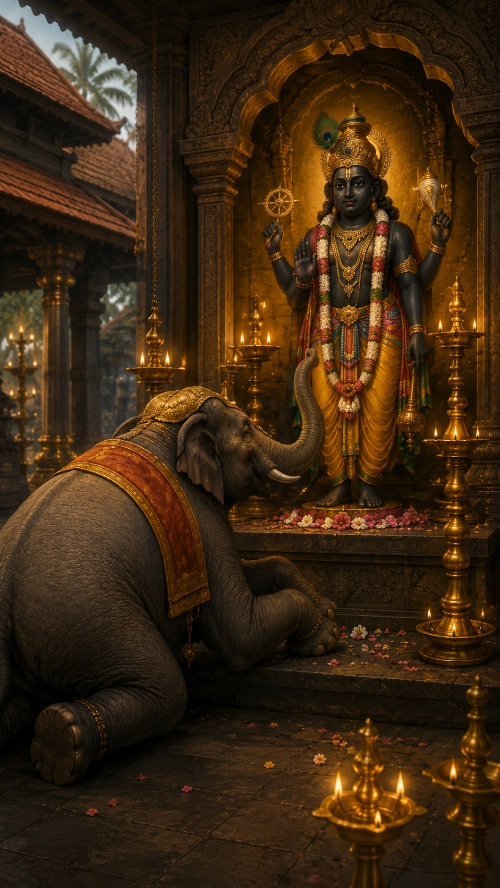
Keśava, the Elephant of Guruvāyūr: Simplicity, Service, and Fifty-four Years Before the Deity
A Kṛṣṇa-kathā class on Keśava, the elephant who served the Deity of Guruvāyūr for fifty-four years. The story is framed by a question the speaker raises first: what does it actually mean to be simple? Her answer is that simplicity is not a lack of intelligence but the absence of the armour a soul puts on once it stops depending on Kṛṣṇa — and that an animal who was never taught anything understood service better than those who were.
Hare Kṛṣṇa, dear devotees. Please accept my obeisances. Today we continue our Kṛṣṇa-kathā, and today we will tell the story of a particular Deity and of a devotee who served Him. And this was an unusual devotee, because this devotee was in the body of an elephant.
It is said that stories about Kṛṣṇa and stories about His devotees possess the same spiritual potency. By glorifying the devotees, and by glorifying Kṛṣṇa, we receive the same mercy — the remembrance of the Lord.
And it is amazing that we have now returned to the Ratha-yātrā in Śrī Kṣetra Purī, and my husband bought me a sari, and it turned out to have an elephant on it. I had already planned beforehand to tell this story about an elephant. And now the elephant manifested in this form on the sari.
Let us recite the auspicious prayers.
oṁ ajñāna-timirāndhasya
jñānāñjana-śalākayā
cakṣur unmīlitaṁ yena
tasmai śrī-gurave namaḥ
“I was born in the darkest ignorance, and my spiritual master opened my eyes with the torch of knowledge. I offer my respectful obeisances unto him.”
nama oṁ viṣṇu-pādāya
kṛṣṇa-preṣṭhāya bhū-tale
śrīmate bhaktivedānta-
svāmin iti nāmine
“I offer my respectful obeisances unto His Divine Grace A. C. Bhaktivedanta Swami, who is very dear to Lord Kṛṣṇa, having taken shelter at His lotus feet.”
namas te sārasvate deve
gaura-vāṇī-pracāriṇe
nirviśeṣa-śūnyavādi-
pāścātya-deśa-tāriṇe
“Our respectful obeisances unto you, O servant of Sarasvatī Gosvāmī. You are kindly preaching the message of Lord Caitanyadeva and delivering the Western countries, which are filled with impersonalism and voidism.”
This story was told by Bhaktivinoda Goswami Maharaja, and he heard it from Jayapatākā Swami, who lives and preaches here in Māyāpur. Before telling the story, Maharaja first gave its philosophical foundation. Every story teaches us certain qualities, a certain mood, a certain kind of devotion. And as an introduction, Maharaja explained what Kṛṣṇa consciousness actually is.
Kṛṣṇa Consciousness Is Simple for the Simple
Śrīla Prabhupāda used to say that Kṛṣṇa consciousness is a simple thing for simple people. When we possess a simple mind, that is a very great blessing, a tremendous gift. Because when our mind and intelligence become overly complicated and tangled, envy, duplicity and falsehood find a place within them.
Such an impure intelligence can become extremely sophisticated. It invents all kinds of justifications for itself and tries to defend itself through falsehood and deceit. But a pure and transparent intelligence greatly attracts the mercy of the Lord.
This impurity — deception and duplicity — is like armour behind which a weak and defenceless soul hides after it has ceased to hope in God and depend upon Him. A simple soul, however, is always completely open. Such a soul needs no protection and no armour because it feels the protection of Kṛṣṇa. And therefore cunning and duplicity are unknown to such a pure soul.
To be in Kṛṣṇa consciousness means to remember Kṛṣṇa. And how can we remember Him? Or rather, how could we possibly forget Him when the Lord is everywhere? How could we fail to remember Him when He is the kindest, the most simple, the most beautiful, and when He is constantly present within our heart? What could be simpler than remaining with such a Person within one’s consciousness and remembering Him?
In the spiritual world, in the kingdom of God, precisely such pure and guileless souls are gathered together. Their service consists in constantly remembering Kṛṣṇa and constantly being filled with wonder at Him. And this ability to be filled with wonder comes together with simplicity, when that black worm of envy leaves the heart.
Service to Kṛṣṇa in the spiritual world is not simply some kind of physical work. It is the gift of this heartfelt delight, this inner ecstasy, which is truly accessible only to simple and pure souls. Therefore our practice should be this: whatever we read, whatever we hear, we should learn to marvel at Kṛṣṇa — to admire Him as the Lord who is supremely kind and supremely caring.
Where the fall begins
The soul that has entered the material world loses this innocence and simplicity and loses this capacity for heartfelt wonder. Instead, it exchanges them for the sweet poison of envy. And this fall of the soul begins at the moment when, even for one tiny instant, the soul ceases to admire Kṛṣṇa. Why? Because it wants to admire itself.
And with this self-admiration begins our long sleep of material existence, in which we put on different costumes — sometimes very ridiculous ones — and begin admiring ourselves. A tiny soul that has entered the material world thinks: “Why am I any worse than God? God radiates light, and I radiate light. But why is everyone looking only at Him? Why does nobody pay attention to me?” That is the contaminated condition of the intelligence.
A tiny soul, a tiny firefly, suddenly decides that it wants to be noticed within the dazzling radiance of the Lord — of Kṛṣṇa — whose splendour is like billions of suns. The poor little soul wants to attract attention to itself. It wants to shine. It wants to eclipse others. And in this way the soul enters māyā. With its tiny, dim light it then attempts to disperse the darkness that has covered it.
But this is extremely difficult. The darkness, the gloom of material existence, swallows it more and more. Yet it is never too late to return to the light. For this, one simply has to begin serving the Lord with love and gratitude. Such service will drive from our heart all this impurity — duplicity, envy, fear. All of these things will disappear, and what will remain in the heart is simplicity, together with the ability to marvel at Kṛṣṇa and to love Him.
And with this introduction we come to the short story of a devotee who was an elephant and who served in the temple at Guruvāyūr.
The Elephants of Guruvāyūr
What is special about this temple? It is located in South India, in the state of Kerala, and many temples in South India have elephants. The Deity of Guruvāyūr has a large herd — no fewer than about fifty elephants. In order to feed them, large plantations of banana trees are cultivated, because a single elephant consumes an enormous quantity of fresh banana leaves and stalks every day. I remember being told that an elephant needs something like one hundred kilograms a day.
And this is the story of one such elephant who served in South India, serving the Deity of Guruvāyūr. It is an extraordinary and very touching story. The elephant’s name was Keśava, and he was presented to the Deity by the ruler of Nilambur.
The Deity who answers
Let us first say a little in glorification of the Deity of Kṛṣṇa. This Lord has four arms. He is famous for His generosity, and He answers the prayers of His devotees. It is said that He gives a special blessing to someone who offers Him an elephant. Thousands of pilgrims flock to this temple because the place is called a little Vaikuṇṭha on earth. They come to pray to the Deity that He fulfil their desires, free them from disease and relieve their suffering.
It is said that there is a story connected with Janamejaya. When Janamejaya performed the snake sacrifice, killing serpents in revenge for the death of his father, the sin of killing the snakes affected his body. It contaminated him, and he became ill and could not recover. Then a physician told him: “You must go and have darśana of the Deity of Guruvāyūr — of Kṛṣṇa.” And so Mahārāja Janamejaya came there and worshipped the Deity for four months during the rainy season, and afterward he was freed from his illness.
Kerala, where this Deity resides, is the kingdom of Āyurveda, and Kṛṣṇa there also manifests Himself as a healer. Even today pilgrims come and pray to Guruvāyūr Kṛṣṇa for deliverance from severe illnesses. Local people make small models of various organs of the human body out of gold or silver. You can find tiny golden livers, little silver hearts, kidneys and so on. If, for example, a pilgrim has a disease of the liver, he may purchase a golden representation of a liver and offer it to the Deity, praying to be freed from the disease. And it is believed that the Lord heals them.
Such is this astonishing Deity, who answers the prayers of His devotees. Yet at the same time the Lord is waiting for us to come to Him and ask Him in pure devotion.
How Keśava Came to Guruvāyūr
The ruler of Nilambur made a vow to Kṛṣṇa that if the Lord restored his wealth, he would offer Him one of his elephants. There had been a rebellion in his territory, and his wealth had been stolen. He prayed, and after some time everything was restored to him. This happened in 1922, more than one hundred years ago.
And so, in 1922, the ruler of Nilambur gave an elephant from his herd to the Lord. The elephant was eighteen years old. He was named Guruvāyūr Keśava, and they began training him to prepare him for service to the Deity.
There are as many as fifty elephants belonging to the Deity and engaged in service to Kṛṣṇa. Several times each day the utsava-mūrti — the smaller processional form representing the principal Deity in the temple, made of gold — is taken out of the temple and carried around the temple grounds. The entire procession takes place on elephants.
A particularly magnificent procession occurs in the evening, at around nine o’clock. There is a procession of three elephants decorated with splendid cloths. They carry the Deity and the brāhmaṇas accompanying the procession. Music is played, conch shells are blown, brāhmaṇas recite mantras, and a tremendous number of lamps — around ten thousand, it is said — illuminate the path of the Deity. Slowly and gracefully, filled with dignity, the elephants carry the Lord. It is an extraordinarily beautiful procession.
Here in Māyāpur such elephant processions have also taken place. Sometimes the elephants stop, raise their trunks, trumpet, and in this way proclaim the glory of the Deity they are carrying. These elephant processions are famous throughout India, and elephants are considered worthy of accompanying the Deity. And so Keśava was destined to become one of these temple elephants — a personal servant of Kṛṣṇa Himself.
The Elephant Who Could Not Be Trained
There was one difficulty. Although Keśava was very beautiful and very gentle, he turned out to be extraordinarily stubborn and remarkably unwilling to learn. No matter how hard his mahout tried to train him, Keśava did everything the opposite way. He did only what he himself wanted. Here was a stubborn and self-willed soul who had received the body of the strongest land animal on earth, yet refused to submit to anyone.
What is the traditional process of taming an elephant? The mahout first tries to break the elephant’s independent will so that the animal becomes dependent upon him. There is a practice in which the elephant is deprived of food. Then, after some time, when food is finally given to him, the grateful elephant becomes obedient to the person who fed him — his “saviour” — and begins to carry out his instructions.
But every attempt to train Keśava and force him into submission failed. No matter how long they kept him hungry, he simply refused to surrender his will to anyone else.
In a similar way, the spiritual master is trying to train us — us, who do not want to depend upon Kṛṣṇa and who are accustomed to relying on our own intelligence and strength. And at some point, if mercy comes, we will listen and surrender. Then an entirely different future awaits us.
Finally, the trainer complained to the chief brāhmaṇa, the head priest. He said: “This elephant is hopeless, despite all his beauty and his magnificent form.” And then the brāhmaṇa smiled and said something remarkable: “If you cannot tame the elephant, then let us give him for training to the One to whose flute the entire world dances.”
How beautiful. If you cannot tame him, give him to the Lord. He will do everything in the best possible way.
Kṛṣṇa Trains Keśava
So they stopped starving Keśava. Instead, every day they began giving him the water with which the Deity had been bathed — caraṇāmṛta. They gave him freshly churned butter that had been offered to the Deity — mahā-prasāda. They brought him to the temple for all the services and all the elephant processions, morning and evening.
Several months passed. Keśava drank caraṇāmṛta, ate mahā-prasāda, and participated in all the temple services. And the brāhmaṇa’s prophecy came true. Kṛṣṇa accomplished what the trainer had been unable to accomplish. The heart of the rebellious elephant melted. The elephant became attached to the Lord. And eventually he completely fell in love with Kṛṣṇa. Legends about this love between the elephant and God are still told today.
The Ancient Deity of Guruvāyūr
There is another short story about this Deity. This is an extraordinary and very ancient Deity. It is said that this Deity was once worshipped by Lord Brahmā Himself. When Sutapā and Pṛśni prayed for a son, Brahmā gave them this mūrti of Kṛṣṇa and told them: “If you worship Him, your desire will be fulfilled.”
For many years, following Brahmā’s instruction, Sutapā and Pṛśni worshipped this Deity. Eventually Lord Viṣṇu Himself appeared before them and said: “Three times in succession I will become your son.” And in three successive births of Sutapā and Pṛśni, the Lord fulfilled this promise and became their son.
First He appeared as Pṛśnigarbha. This was the manifestation of the Lord associated with Dhruva receiving the planet of the Pole Star. Then He appeared as Vāmana. And then He appeared as Kṛṣṇa. And in all three of these births, this arcā-vigraha form accompanied them. The Deity is a four-armed form of Kṛṣṇa, in which His sweetness is concealed beneath the majesty of aiśvarya.
In their third birth, the Lord appeared before Devakī and Vasudeva as Kṛṣṇa in the prison. This Deity was also with them and was later installed in one of the temples of Dvārakā. When the time approached for Kṛṣṇa to leave this world, He instructed Bṛhaspati and Vāyu, the god of the wind, to take care of this Deity.
We know that when the Lord prepared to depart and the Yadus also disappeared, Dvārakā was covered by the waves of the ocean. Vāyu and Bṛhaspati miraculously rescued the Deity from the turbulent ocean waves. Then Paraśurāma advised them: “Take this Deity to Kerala, to the south.”
And so the Deity came to dwell in a secluded place beside a huge lake overgrown with lotuses, not far from the ocean. Vāyu and Bṛhaspati entered meditation there. In meditation they perceived that the place to which Paraśurāma had sent them was a replica of the spiritual world — a Bhū-vaikuṇṭha, a Vaikuṇṭha on earth.
Long ago, the Pracetās had performed austerities beneath the water in this very place. And even today Lord Śiva is present there, worshipping Mahā-Viṣṇu. In honour of Lord Śiva, the lake is called Rudra-tīrtha. And on its banks Lord Kṛṣṇa resides as Guruvāyūrappan — the Lord worshipped by Guru Bṛhaspati and Vāyu.
It is amazing that just a couple of weeks ago I was speaking about the Pracetās from the Fourth Canto — about how they entered this body of water near the ocean and performed their austerities there. And now this story connected with the very same place has come to me — a story glorifying the devotee Keśava, the elephant who served this Deity.
The Story of Mañjulā
Classical dances and dramas are performed in the courtyard of the temple in the evenings. And one of the miracles associated with this Deity concerns Mañjulā, a young street sweeper. Her occupation immediately indicates that her family belonged to a social class that could be treated as untouchable, and people might easily have neglected or despised her. But before the Lord everyone is equal. He values neither wealth nor noble birth. He values sincerity and simplicity of heart.
This daughter of a sweeper, Mañjulā, would come to Guruvāyūr from her village every two weeks and bring a garland. She cultivated flowers herself, and from those flowers she made a garland for the Lord and brought it every two weeks.
One day, during the rainy season, the rains were extremely heavy. The roads had been washed out and were very difficult to walk upon. Because of this she was unable to reach the temple on time. She arrived late at night, when the temple had already been locked.
For two weeks this girl had lovingly meditated on her service. She had grown the flowers, watering them while meditating upon Guruvāyūr Kṛṣṇa. Then she made the garland, singing bhajanas that glorified the Lord. She had made it and carried it all this way with such effort. And now the temple was closed. She sank to the ground and simply began to cry. She cried and cried. It was already night.
Suddenly, out of the darkness appeared a brāhmaṇa. He asked: “Why are you crying so bitterly?” At first she could hardly explain. Then she told him: “I brought this garland. I made it for the Lord, but the temple is already closed. Now this garland is of no use to anyone.” And she continued crying.
The brāhmaṇa said: “There is no reason to cry. You should not remain outside here alone at night, young girl.” Then he told her: “Do not worry. Kṛṣṇa never rejects anything that His devotees offer Him. Hang the garland on the temple gate and go home.”
Mañjulā could hardly believe him and did not really want to leave the garland there, but she obeyed. She hung the garland on the temple gate and went away, eventually finding a house in which she could spend the night.
At three o’clock in the morning the pilgrims arrived for maṅgala-ārati. They waited in front of the temple gates for them to be opened. But Mañjulā could no longer see her garland hanging there. When the brāhmaṇa came and opened the great lock securing the temple, the pilgrims rushed toward the altar. And as they approached it, everyone gasped in amazement. There, upon Guruvāyūr Kṛṣṇa, was the fresh garland that Mañjulā had brought.
At night all the flower decorations are normally removed from the Deity. No one could understand how this garland had appeared there. But when Mañjulā saw it, she understood. The Lord had answered her. He had accepted her service. She began to weep with joy.
And this garland radiated the extraordinary fragrance of the transcendental love of this simple village girl. It is said that the garland did not wither for an entire month. For a whole month Kṛṣṇa showed everyone who came before Him what He was actually waiting for. He was waiting for this kind of simple love.
Tulābhāram — Offering One’s Own Weight
Another offering that pilgrims make to Guruvāyūr Kṛṣṇa, and which is considered very auspicious, is called tulābhāram, “equal weight.” Large scales are set up. The pilgrim sits on one side, while on the other side people place gold, silver, fruit, bananas, coconuts, sugar, rice, flour, or even large vessels filled with water. When the weight of the offering becomes equal to the weight of the pilgrim, the offering is considered extraordinarily generous.
We have even seen something similar here in Māyāpur during festivals for the Deities, when such scales were erected. And during Puruṣottama month we told the story of how Kṛṣṇa weighed Śrīmatī Rādhārāṇī, and in exchange gave a poor brāhmaṇa, who needed to arrange the marriage of his daughter, ornaments that the gopīs piled onto the scale until their weight equalled that of Śrīmatī Rādhārāṇī.
So Kṛṣṇa accepts these good offerings — the tulābhāram, the equal weight. But He is waiting for another kind of offering. He says, in essence: “I will accept everything you bring Me. But actually I do not need your gold. I do not need your coconuts. I need you — your entire self, without remainder.”
And that is what this story describes: the complete self-giving and love of a devotee in the body of an elephant. Not everyone is prepared for such devotion.
What Keśava Understood Without Being Taught
Although nobody explained anything to Keśava, he was one of those who understood what Kṛṣṇa wanted from him. He never attended lectures. He never read books. Yet he observed each of these things on his own.
Keśava somehow understood all of these things within his heart. He knew what pleased his Master. When the time of the procession approached, he would begin trembling with impatience. The chains around his legs would tighten as he strained forward, longing with all his heart to serve his Lord.
Eventually, because his desire to serve Kṛṣṇa was so powerful, he became the leading elephant of the herd. And he would not allow any other elephant to serve Kṛṣṇa. Only he could carry Kṛṣṇa during the procession. If the temple servants tried to place the Lord upon another elephant, Keśava would rush forward and drive the other elephant away. In his impatience to serve the Lord, he would escape from his stall, break his chains, and race toward the temple as if mad. Yet despite this, he was extremely gentle at heart. He never harmed anyone.
The leper on the road
One day, during a festival, Keśava broke the iron chains restraining him and rushed toward the temple. People saw an elephant racing toward them. He appeared to be mad. Everyone scattered in terror, clearing the road for him. But sitting in the road was a leper who lived by begging. The man was unable even to move himself out of the way.
When Keśava reached him, he stopped. Very gently, with his trunk, he lifted the man and moved him to the side of the road. Then he continued on his way. When he reached the temple, he circumambulated it five times, offered obeisances to the Deity, and then calmly stood waiting for the Lord to be brought out. Such spiritual love for Kṛṣṇa was raging within his heart.
Fifty-four Years of Service
For exactly fifty-four years, Keśava served the Lord every day. Without rest. Without weariness. Without expecting any reward. In 1973, for his golden jubilee, the temple organised a great celebration. The chief brāhmaṇa, the head priest of the temple, bestowed upon him the title Gajarāja — “King of the Elephants.” But Keśava did not need such a title. He had never served the Lord for titles, ranks or recognition.
The greatest festival is celebrated in winter, on Mokṣadā Ekādaśī, the day when Kṛṣṇa spoke the Bhagavad-gītā to Arjuna. And in 1976, on the previous evening, Keśava was brought to the temple. He bowed down before the Deity and bent his knees before Him. The Deity was placed upon his head.
But for the first time in all those years, Keśava could not stand up. His entire body trembled. He tried. He strained with all his strength to rise to his feet. But his old body, now more than seventy years of age, no longer obeyed him. And he began to cry. He cried from pain and sorrow because he could no longer serve.
Eventually the brāhmaṇas took him — or somehow helped him make his way — back to the place where he stayed. For the first time in all those fifty years, the Deity was placed upon another elephant. All night Keśava lay upon the ground. He would allow no one to approach him — not even a veterinarian or doctor.
The following day, he rose with great difficulty. Then he heard the conch shells announcing the beginning of the evening procession. With tremendous effort he gathered all his remaining strength. He broke out from his enclosure. And by some miracle, he made his way to the temple. Everyone understood: Keśava had come to say farewell to Kṛṣṇa.
When the Deity was brought out, Keśava bent his knees before Him for the last time. He lowered his enormous head to the ground and stretched his trunk toward his Lord. All the pilgrims saw this manifestation of his love. And there, before his Deity, accompanied by the sound of conch shells and the Vedic mantras chanted by the brāhmaṇas, Keśava left his temporary body and returned to the eternal kingdom of Vaikuṇṭha.
“Allow Me Only to Serve You”
Keśava needed nothing. Keśava asked for only one thing: allow me to serve You. No one had ever explained to him that the principal and eternal duty of the soul in relation to the Lord is service. Yet he understood it. Bhakti is simple because service to the Lord is the natural need of the soul.
The story of the elephant Keśava illustrates this eternal principle: sincere service to the Lord can awaken love of God within the heart of any living being — even one who is conditioned and contaminated — regardless of the body in which that soul happens to reside.
In honour of this great devotee, a huge statue approximately four metres high was erected near the ancient Guruvāyūr temple in Kerala. His enormous tusks also adorn the main entrance to the temple. And every year, in winter, on the anniversary of Keśava’s departure, thousands of pilgrims gather to honour the memory of this extraordinary devotee who lived in the body of an elephant.
On that day, the leader of the herd of elephants serving the Deity approaches Keśava’s statue. The leading elephant places a huge garland upon the statue and bends his knee before this great member of his own species — the one who demonstrated the importance of service and the power of love, regardless of the kind of body in which one lives.
The philosophical opening and the story are one argument. Simplicity was defined as the absence of armour — the state of a soul that has no need to defend, justify or display itself because it feels the Lord’s protection. Keśava is that definition given a body. He had no learning to be proud of and no reputation to protect, and so nothing stood between his heart and what pleased his Master.
The fall was described as the instant a soul stops admiring Kṛṣṇa in order to admire itself. Keśava’s life runs the other way: an animal who at first would submit to no one, and who was conquered not by hunger but by caraṇāmṛta and mahā-prasāda — by being given the Lord rather than being broken.
What an extraordinary story: heard from Jayapatākā Swami, retold by Maharaja, and centred upon this extraordinary Deity who responds to devotion and love. By hearing such histories, we too can become purified and become filled with the desire to serve the Lord — to do what He expects from us. Thank you very much, dear devotees. Hare Kṛṣṇa. Until we meet again.