

The Evening Service of Śrī Rādhā
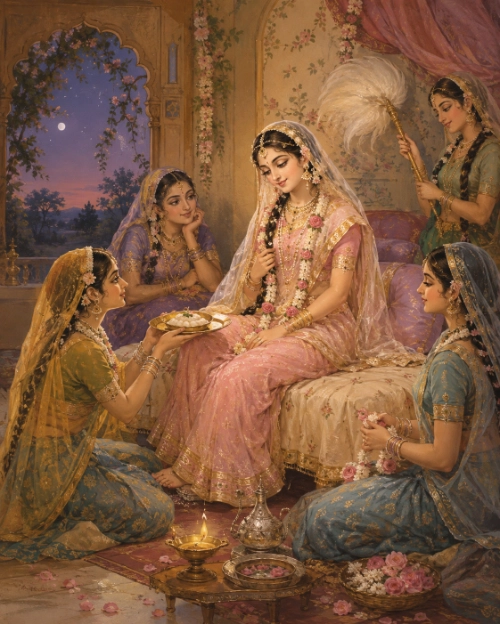
The Evening Service of Śrī Rādhā: Rādhā-dāsya in Śrī Vilāpa-kusumāñjali 46–57
Twelve prayers, Vilāpa-kusumāñjali 46–57, in which Raghunātha dāsa Gosvāmī asks for nothing except work: to carry the food Rādhā cooked to Kṛṣṇa’s house, to bring His remnants back to Her, to pour water, hold incense, place betel in Her mouth, prepare Her bed, and massage Her feet while Rūpa Mañjarī massages Her hands. Every verse begins with the same word — kadā, when? An introduction to the work and its logic comes first; the evening itself follows.
The text that follows is a meditation on Śrī Rādhā-dāsya — the intimate devotional service of Śrīmatī Rādhārāṇī — as expressed by Śrī Raghunātha dāsa Gosvāmī in his Vilāpa-kusumāñjali. More specifically, it develops a remarkably continuous sequence of prayers, verses 46–57, in which Raghunātha dāsa longs for a series of very concrete services: carrying food prepared by Rādhā to Kṛṣṇa, bringing Kṛṣṇa’s remnants back to Her, serving Rādhā and Her sakhīs during their meal, offering water, incense, fanning and tāmbūla, witnessing Lalitā’s ārati, preparing Rādhā’s resting place, massaging Her lotus feet under the guidance of Rūpa Mañjarī, and finally receiving Rādhā’s own remnants as an expression of Her intimate mercy.
The Sanskrit verses themselves are concise prayers. The flowing narrative that accompanies them belongs to the tradition of līlā-smaraṇa, devotional contemplation in which the brief indications of a stotra are unfolded into a living scene of Vraja. The distinction is important. Raghunātha dāsa may pray simply, “When will I bring before You the remnants from Kṛṣṇa’s lotus mouth?” A later contemplative meditation asks what such a moment would actually involve: how did the maidservant obtain those remnants? Who gave them to her? How did she carry them back to Yāvaṭa? What happened when Rādhā smelled the fragrance of Kṛṣṇa upon them? How did the sakhīs serve Her while She ate?
Thus the expanded narrative should not be mistaken for a verbatim translation of Vilāpa-kusumāñjali. It is better understood as the Sanskrit prayer experienced from within.
What Is Vilāpa-kusumāñjali?
The title may be understood as “A Bouquet of Flower-like Lamentations.” It is one of the most important works of Śrī Raghunātha dāsa Gosvāmī and one of the most concentrated expressions of Rādhā-dāsya in Gauḍīya Vaiṣṇava literature. Its emotional voice is that of an intimate maidservant who desires virtually nothing for herself. Her longing is directed toward one question: how may I serve Śrī Rādhā?
Again and again the verses employ the language of yearning — kadā, “when?” When will that day come? When will I prepare this for You? When will I bring this to You? When will I massage Your feet? When will You acknowledge me as Your servant? When will You bestow upon me some intimate token of Your mercy?
This repeated kadā gives the work its distinctive emotional character. Its vilāpa, or lamentation, is not despair in the ordinary sense. It is the pain produced by an intense desire for service that has not yet been fulfilled.
The Perspective of the Mañjarī
To understand the text properly, one must understand the role of the mañjarīs. In Gauḍīya devotional literature they are youthful intimate maidservants of Śrī Rādhā. Their spiritual identity is defined not by seeking an independent relationship with Kṛṣṇa, but by finding their highest happiness in Rādhā’s happiness.
They prepare. They carry messages. They bring food and water. They arrange ornaments. They prepare tāmbūla. They fan. They massage. They anticipate what Svāminī will require. And they assist Rādhā’s relationship with Kṛṣṇa without attempting to place themselves at its center.
This gives mañjarī-sevā a distinctive emotional logic. Kṛṣṇa is loved because He is Rādhā’s beloved. Kṛṣṇa’s happiness matters because it gives Rādhā happiness. And the servant’s own happiness consists in seeing Rādhā pleased. The entire sequence of Vilāpa-kusumāñjali 46–57 operates according to this principle.
Why Rūpa Mañjarī Matters
The maidservant does not imagine herself independently approaching Rādhā. Verse 55 places Rūpa Mañjarī beside her:
saṁvāhayiṣyati padau tava kiṅkarīyaṁ
hā rūpa-mañjarir asau ca karāmbuje dve
“When will this maidservant massage Your feet while Rūpa Mañjarī massages Your two lotus hands?”
This reveals an important principle called anugatya — service through following. The aspirant does not invent a private relationship with Rādhā. She serves under the guidance of those who already know Rādhā perfectly. For the devotional current represented by Raghunātha dāsa, Rūpa Mañjarī therefore becomes not merely another participant in the līlā but a model and guide for intimate service.
The Circle of Service
The verses form an especially elegant devotional movement. First Rādhā serves Kṛṣṇa: She prepares food for Him. Then the maidservant serves Rādhā by carrying Rādhā’s offering to Kṛṣṇa. After Kṛṣṇa eats, Dhaniṣṭhā gives His remnants to the maidservant. The servant then returns, and Kṛṣṇa’s prasāda is brought back to Rādhā. Rādhā tastes it and remembers Kṛṣṇa. The maidservants serve Her meal, water, incense, tāmbūla and other necessities. Then the current turns once more: the servant who carried Kṛṣṇa’s remnants to Rādhā now longs to receive Rādhā’s remnants herself.
The movement can therefore be expressed simply: Rādhā → Kṛṣṇa → Rādhā → the servant. Love moves outward as service and returns as mercy. This is one of the deepest structural beauties of the passage.
Why Are Food Remnants So Important?
A modern reader may initially find the emphasis on remnants — ucchiṣṭa or prasāda — unusual. Within Vaiṣṇava devotional culture, however, food that has been offered to or personally tasted by the beloved is no longer regarded merely as food. It bears a relation to that person.
Thus when Raghunātha prays for kṛṣṇa-vaktrāmbujocchiṣṭam, “the remnants from Kṛṣṇa’s lotus mouth,” the point is not culinary enjoyment. For Rādhā, these remnants carry the touch of Kṛṣṇa. His lips touched them. His hands touched them. They therefore become a tangible medium of remembrance during separation. Likewise, when the maidservant longs for Rādhā’s own remnants, the aspiration expresses intimacy and belonging. She desires what Svāminī has mercifully allowed to become available to Her own servants.
The deeper principle is that love transforms relationship into sacred contact.
“Because I Belong to You”
Two expressions from these verses reveal the heart of the entire meditation. In verse 47, Yaśodā asks about Rādhā’s welfare because she knows that the maidservant belongs to Her: tāvakatvāt, “because I am Yours.” Then verse 57 describes the servant herself as tvad-gata-cittā, “one whose heart has gone entirely to You.” These two phrases describe the outer and inner dimensions of Rādhā-dāsya.
Nothing remains separate. The servant does not merely perform services for Rādhā. Her very identity has become defined by Rādhā.
The Spiritual Meaning of Small Services
Another important feature of the text is its attention to apparently small things. A cup of scented water. A tooth-cleansing twig. A fan. Incense. Betel leaves. A prepared bed. Massaging the feet. Collecting remnants. None of these acts appears spectacular — and that is precisely the point. The passage does not define intimacy through grand mystical visions. It defines intimacy through perfect attention to the beloved.
Verse 51 contains the beautiful expression tat-kṣaṇa-yogyam, “whatever is appropriate at that particular moment.” That phrase could almost serve as a definition of intimate sevā. The perfect servant notices what is needed now. She does not serve according to her own preference. She perceives Svāminī’s condition and responds. Thus love becomes attentiveness.
The Ārati of Śrī Rādhā
One of the most unusual scenes occurs in verse 53. Lalitā performs ārati for Rādhā. The other sakhīs offer auspicious songs and flowers. But the maidservant prays to worship Her with prāṇārbudair api kacair api — “with millions of lives and even with my hair.”
The image expresses total self-offering. If she possessed ten million lives, all ten million would belong to Rādhā. Later meditation expands the reference to her hair into the beautiful image of a maidservant loosening her dark braid and offering it almost like a cāmara before Svāminī. Whether understood literally or poetically, the principle is the same: nothing is withheld.
This Is Not Primarily a Story About Prasāda
The outer narrative revolves around cooking, carrying food, eating, remnants, water and betel. But the actual subject is much deeper. It is the spiritual psychology of belonging completely to Śrī Rādhā. Food becomes the medium through which service travels from Rādhā to Kṛṣṇa. Kṛṣṇa’s remnants become the medium through which His presence returns to Rādhā. Rādhā’s remnants become the medium through which Her mercy descends upon Her maidservant.
Thus material objects become vehicles of relationship. The real subject is not the food. The real subject is prema expressed as sevā.
How to Read the Text That Follows
The Sanskrit verses should be understood as the foundation. The surrounding narrative is a contemplative unfolding of those verses. Where Raghunātha dāsa says “When will I serve You?” the meditation asks what that service would look like. Where he says “When will I bring Kṛṣṇa’s remnants?” the meditation follows the servant to Nanda-bhavana and back to Yāvaṭa. Where he says “When will Lalitā perform ārati?” the meditation fills the room with lamps, flowers and song. Where he asks “When will You give me nectar from Your own lotus mouth?” the meditation tries to imagine what such inconceivable intimacy and mercy would mean to the servant.
The resulting text is therefore best read neither as ordinary historical narration nor as free fantasy. It is sevā-smaraṇa rooted in the Sanskrit prayers of Raghunātha dāsa Gosvāmī. And its deepest movement can be summarized in three expressions:
Those three ideas provide the key to everything that follows.
The Evening Service of Śrī Rādhā
From Śrī Vilāpa-kusumāñjali 46–57.
The evening approaches in Vraja, and the hearts of Śrī Rādhā’s maidservants are absorbed in a single thought: how to serve their Svāminī, and how to assist Her love for Śrī Kṛṣṇa. At the request of Vrajeśvarī Yaśodā, Śrī Rādhā has carefully prepared many kinds of exquisite foods for Kṛṣṇa. Although She cannot openly go to Nanda-bhavana as His beloved, Her service reaches Him through the hands of Her trusted sakhīs and maidservants. Śrī Raghunātha dāsa Gosvāmī prays:
vraja-pura-pati-rājñyā ājñayā miṣṭam annaṁ
bahu-vidham ati-yatnāt svena pakvaṁ varoru
sapadi nija-sakhīnāṁ mad-vidhānāṁ ca hastair
madhumathana-nimittaṁ kiṁ tvayā sannidhāsyam
“O beautiful-thighed one! When, at the command of the Queen of Vraja, will You personally prepare with great care wide varieties of delicious food for Madhumathana and entrust them to Your own sakhīs and maidservants such as me?” — Vilāpa-kusumāñjali 46
The maidservants carry Rādhā’s preparations to Nanda-bhavana. They carry more than food. Each preparation has been touched by Rādhā’s hands and filled with Her desire to please Kṛṣṇa. Her love has taken the form of rice, sweets, vegetables and delicacies, and now that love enters the house of Nanda. When the maidservant arrives, the Queen of Vraja receives her with extraordinary affection.
nītānna-mad-vidha-lalāṭa-taṭe lalāṭaṁ
prītyā pradāya muditā vraja-rāja-rājñī
premṇā prasūr iva bhavat-kuśalasya pṛcchāṁ
bhavye vidhāsyati kadā mayi tāvakatvāt
“O auspicious one! When will the delighted Queen of Vraja lovingly place her forehead against the forehead of one like me who has brought the food and, like an affectionate mother, inquire about Your welfare because she knows that I belong to You?” — Vilāpa-kusumāñjali 47
The significant word is tāvakatvāt — “because I am Yours.” The maidservant has no independent identity before Yaśodā. She is known simply as someone who belongs to Rādhā.
Yaśodā affectionately asks about Rādhā’s welfare, and the servant experiences her tenderness almost as though Vrajeśvarī were her own mother. The preparations are offered, Kṛṣṇa takes His evening meal, and after He has eaten, the intimate servant Dhaniṣṭhā carefully preserves His remnants. She secretly gives them to Rādhā’s maidservant to carry back to Yāvaṭa.
kṛṣṇa-vaktrāmbujocchiṣṭaṁ
prasādaṁ param ādarāt
dattaṁ dhaniṣṭhayā devi
kim āneṣyāmi te ’grataḥ
“O Devī! When will I bring before You the prasāda remnants from Kṛṣṇa’s lotus mouth, respectfully given to me by Dhaniṣṭhā?” — Vilāpa-kusumāñjali 48
The maidservant returns to Yāvaṭa carrying this treasure. There Śrī Rādhā waits surrounded by Lalitā, Viśākhā and Her other intimate companions. The long hours of separation have exhausted Her. Her friends have tried to comfort Her by speaking about Kṛṣṇa, cooling Her body and keeping Her absorbed in His remembrance.
Now the maidservant approaches carrying kṛṣṇa-vaktrāmbujocchiṣṭam — food remaining after touching Kṛṣṇa’s lotus mouth. Its fragrance alone awakens Rādhā’s heart. She takes a morsel with trembling fingers. These are no longer merely sweets or grains of rice. Kṛṣṇa tasted them. His lips touched them. His hands touched them. Through His prasāda, separation becomes contact for a moment.
Rādhā tastes a small portion, and life seems to return to Her. The remaining prasāda is then mixed with many other delicious foods and drinks, and Rādhā sits to eat surrounded by Lalitā and Her companions. Raghunātha dāsa longs to serve Her personally:
nānā-vidhair amṛta-sāra-rasāyanais taiḥ
kṛṣṇa-prasāda-militair iha bhojya-peyaiḥ
hā kuṅkumāṅgi lalitādi-sakhī-vṛtā tvaṁ
yatnān mayā kim u tarām upabhojanīyā
“O Kuṅkumāṅgi! When will I carefully serve You, surrounded by Lalitā and Your other sakhīs, many varieties of foods and drinks like elixirs containing the very essence of nectar, mixed with Kṛṣṇa’s prasāda?” — Vilāpa-kusumāñjali 49
Lalitā sits close to Rādhā. Viśākhā and the other companions surround Her. The maidservants move quietly among them, knowing the tastes and preferences of each sakhī and placing the proper preparations before them. Yet Rādhā hardly experiences the meal as ordinary food. The flavor awakens remembrance. Through the remnants She remembers Śyāmasundara’s lips. Through their fragrance She remembers His bodily fragrance. Through their sweetness She remembers His smile.
Her eyes gradually become half-closed as the external meal awakens an internal meeting. The maidservants watch Svāminī’s face carefully. After so many hours of separation, she smiles again.
Service continues without interruption. A servant brings sweet drinking water delicately scented with fresh pāṭala flowers and camphor.
pānāya vāri madhuraṁ nava-pāṭalādi-
karpūra-vāsitataraṁ taralākṣi dattvā
kāle kadā tava mayācamanīya-danta-
kāṣṭhādikaṁ praṇayataḥ param arpaṇīyam
“O restless-eyed one! When will I lovingly give You sweet drinking water richly scented with fresh pāṭala flowers and camphor and, at the proper time, offer You water for rinsing Your mouth, a tooth-cleansing twig and the other necessary articles?” — Vilāpa-kusumāñjali 50
Nothing in this service is considered insignificant. A cup of water matters. A tooth-cleansing twig matters. A cloth matters. A fragrance matters. Everything connected with Svāminī becomes precious because everything can become sevā. While Rādhā eats, the maidservant lights excellent incense and gently fans Her.
bhojanasya samaye tava yatnād
devi dhūpa-nivahān vara-gandhān
vījanādyam api tat-kṣaṇa-yogyaṁ
hā kadā praṇayataḥ praṇayāmi
“O Devī! When, while You are eating, will I carefully and lovingly offer excellent fragrant incense, fan You, and perform whatever other services are appropriate at that moment?” — Vilāpa-kusumāñjali 51
The servant’s art lies in the words tat-kṣaṇa-yogyam — “that which is appropriate at that very moment.” She does not merely perform prescribed actions. She watches Rādhā. She understands Her. She anticipates Her needs before they are spoken. If Svāminī becomes warm, the fan is already moving. If She desires water, it is ready. If an ornament slips, a maidservant notices. If silence is needed, she becomes silent. If laughter arises among the sakhīs, she rejoices in their happiness. This sensitivity is the nature of intimate service.
When the meal is finished, and Rādhā has rinsed Her mouth, the maidservant prepares fragrant tāmbūla.
karpūra-pūra-paripūrita-nāga-vallī-
parṇādi-pūga-parikalpita-vīṭikāṁ te
vaktrāmbuje madhura-gātri mudā kadāhaṁ
protphulla-roma-nikaraiḥ param arpayāmi
“O Madhura-gātrī, O sweet-limbed one! When will I joyfully place into Your lotus mouth an excellent preparation of betel leaves and areca nut, abundantly filled with camphor, while all the hairs of my body stand erect in ecstasy?” — Vilāpa-kusumāñjali 52
The maidservant places the carefully prepared tāmbūla into Rādhā’s lotus mouth. Even such a simple action overwhelms her. Her hairs stand erect. Her body trembles. She is not merely serving betel. She is allowed to place something directly into the lotus mouth of the mistress to whom she has given her entire life.
Then Lalitā prepares to perform ārātrika for Rādhā. The sakhīs begin singing auspicious songs. Flowers are offered. The lamp is lit. Its golden light circles before Svāminī’s face, yet the flame seems insignificant beside the radiance of Rādhā Herself. Raghunātha dāsa prays:
ārātrikeṇa bhavatīṁ kim u devi devīṁ
nirmāñchayiṣyatitarāṁ lalitā pramodāt
anyālayaś ca nava-maṅgala-gāna-puṣpaiḥ
prāṇārbudair api kacair api dāsikeyam
“O Devī! When will delighted Lalitā lovingly perform ārātrika for You, while the other sakhīs worship You with fresh auspicious songs and flowers, and this maidservant worships You with her hair and with millions of lives?” — Vilāpa-kusumāñjali 53
The maidservant has little that she considers her own. So she offers herself: her hair, her breath, her heart, her life. Not merely one life — prāṇārbudaiḥ, millions of lives. If she possessed millions of lives, every one of them would be placed at Rādhā’s lotus feet. The sakhīs sing. Lalitā moves the lamp. The servants offer flowers. And within her heart the maidservant offers everything she is.
After ārati the mood becomes softer. Rādhā remains surrounded by Lalitā and Her intimate companions. They speak confidentially, teasing one another, remembering Kṛṣṇa and discussing the arrangements for future meetings. Their conversation is narma-goṣṭhī — intimate, affectionate, playful talk. Nearby, the maidservant has carefully prepared Rādhā’s resting place.
ālī-kulena lalitā-pramukhena sārdham
ātanvatī tvam iha nirbhara-narma-goṣṭhīm
mat-pāṇi-kalpita-mano-hara-keli-talpam
ābhūṣayiṣyasi kadā svapanena devi
“O Devī! When, while engaging in deeply playful and confidential conversation with Your companions headed by Lalitā, will You ornament with Your repose the charming pastime-bed prepared by my own hands?” — Vilāpa-kusumāñjali 54
The bed itself becomes beautiful only when Rādhā reclines upon it. Until then it is merely flowers and cloth. When Svāminī rests there, it becomes ornamented by Her presence.
The maidservants now approach for another cherished form of service. Rūpa Mañjarī sits beside Rādhā. The aspiring maidservant takes shelter of her guidance.
saṁvāhayiṣyati padau tava kiṅkarīyaṁ
hā rūpa-mañjarir asau ca karāmbuje dve
yasmin manojña-hṛdaye sadaye ’nayoḥ kiṁ
śrīmān bhaviṣyatitarāṁ śubha-vāsaraḥ saḥ
“O merciful, beautiful-hearted one! When will that supremely auspicious day come when this maidservant massages Your two feet while Rūpa Mañjarī massages Your two lotus hands?” — Vilāpa-kusumāñjali 55
The servant does not approach Rādhā independently. Rūpa Mañjarī is there. Rūpa massages Svāminī’s lotus hands. The maidservant massages Her lotus feet. This is anugatya — service performed by following those eternal associates who already know perfectly how Rādhā wishes to be served. To serve Rādhā means to learn service from Rūpa Mañjarī: to stand where Rūpa places one, to do what Rūpa indicates, to understand Svāminī through those who know Her heart.
And as the maidservant massages Rādhā’s feet, another secret longing rises within her. Earlier she had carried Rādhā’s preparations to Kṛṣṇa. Then she had carried Kṛṣṇa’s remnants back to Rādhā. Now she longs for Rādhā’s remnants herself.
tavodgīrṇaṁ bhojyaṁ sumukhi kila kallola-salilaṁ
tathā pādāmbhojāmṛtam iha mayā bhakti-latayā
ayi premṇā sārdhaṁ praṇayi-jana-vargair bahu-vidhair
aho labdhavyaṁ kiṁ pracuratara-bhāgyodaya-balaiḥ
“O Sumukhi, O beautiful-faced one! When, through the arising of immense good fortune, will I, this creeper of devotion, lovingly obtain together with Your intimate associates the remnants from Your mouth and the nectar connected with Your lotus feet?” — Vilāpa-kusumāñjali 56
To the maidservant these remnants are not ordinary discarded things. Anything connected with Rādhā becomes more precious than celestial nectar. She desires no independent enjoyment. Her deepest happiness is to receive what Svāminī has touched, used or mercifully left for Her servants. Then the prayer becomes still more intimate:
bhojanāvasare devi
snehena sva-mukhāmbujāt
mahyaṁ tvad-gata-cittāyai
kiṁ sudhās tvaṁ pradāsyasi
“O Devī! While You are eating, will You affectionately give me nectar from Your own lotus mouth — to me, whose heart has gone entirely to You?” — Vilāpa-kusumāñjali 57
Here the whole current of the prayer reaches its culmination. At the beginning the maidservant was identified by tāvakatvāt, “because I belong to You.” Now she is described as tvad-gata-cittā, “one whose heart has gone entirely to You.” She belongs to Rādhā externally. Her heart belongs to Rādhā internally. Nothing remains separate.
The Circle Closes
The entire evening has moved through a beautiful circle of service.
The movement is Rādhā → Kṛṣṇa → Rādhā → the maidservant. Love moves outward as service and returns as mercy.
And through every stage one truth remains unchanged: the maidservant desires nothing apart from Śrī Rādhā’s happiness. Her identity is tāvaka, “I am Yours.” Her inner condition is tvad-gata-cittā, “My heart has gone entirely to You.” And her entire spiritual aspiration can be expressed in the question that echoes throughout Vilāpa-kusumāñjali: kadā? When?
When will I carry Your service to Kṛṣṇa? When will I bring His prasāda back to You? When will I offer You water? When will I fan You? When will I place tāmbūla into Your lotus mouth? When will I worship You with millions of lives? When will I massage Your lotus feet under Rūpa Mañjarī’s guidance? When will You look upon me as Your own? When will Your mercy descend upon one whose heart has gone completely to You? Śrīmatī Rādhārāṇī ki jaya!