42
अत्रान्तरे च कुलटाकुलवर्त्मपात-
सञ्जातपातक इव स्फुटलाञ्छनश्रीः ।
वृन्दावनान्तरमदीपयदंशुजालै-
र्दिक्सुन्दरीवदनचन्दनबिन्दुरिन्दुः ॥ ४२ ॥
atrāntare ca kulaṭākula-vartma-pāta-
sañjāta-pātaka iva sphuṭa-lāñchana-śrīḥ |
vṛndāvanāntaram adīpayad aṁśu-jālair
dik-sundarī-vadana-candana-bindur induḥ || 42 ||
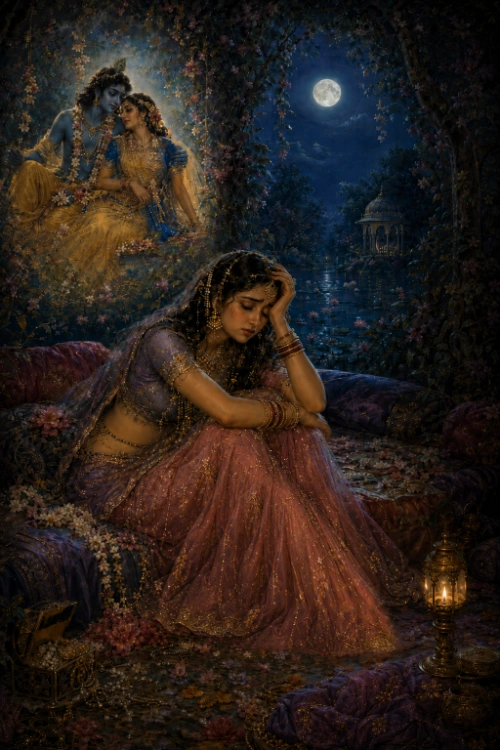
Meanwhile the moon rose— bearing his conspicuous dark mark as though it were the stain of sin acquired from falling upon pathways crowded with unchaste women— and illuminated the interior of Vṛndāvana with masses of rays. He appeared like a dot of sandal paste upon the face of the beautiful eastern direction.
Commentary
Even before Rādhā speaks, Jayadeva eroticizes the night. The moon is connected with the secret paths of women going to lovers. The word kulaṭā is deliberately provocative: it denotes a woman transgressing conventional sexual boundaries. Thus the moon does not merely illuminate the night. It illuminates the world of abhisāra. But for Rādhā the moon’s arrival is catastrophic. Night is advancing. Kṛṣṇa is late.
A freer rendering
Meanwhile the moon ascended. Its dark stain seemed almost like the mark of some secret transgression— as though it too had wandered the night-paths taken by women going secretly to their lovers. Its rays flooded Vṛndāvana. Against the face of the eastern sky the moon shone like a pale sandalwood mark.
Textual note
The reading followed here, kulaṭā-kula-vartma-pāta-, is that of the Nirṇaya Sāgara and Gauḍīya editions; the Kāvyamālā text prints -vartma-ghāṭa- and records -pāta- as a variant.
43
प्रसरति शशधरबिम्बे विहितविलम्बे च माधवे विधुरा ।
विरचितविविधविलापं सा परितापं चकारोच्चैः ॥ ४३ ॥
prasarati śaśadhara-bimbe vihita-vilambe ca mādhave vidhurā |
viracita-vividha-vilāpaṁ sā paritāpaṁ cakāroccaiḥ || 43 ||
As the disk of the moon spread its light and Mādhava continued to delay, the anguished Rādhā fell into torment and loudly uttered many different lamentations.
Commentary
The Appointed Hour Has Passed
The two events occur simultaneously: the moon advances and Mādhava does not. Every increase in moonlight measures Kṛṣṇa’s lateness. Rādhā therefore begins to lament.
Song 13
Kathita-samaye ’pi harir ahaha — mālava rāga — yati tāla
यामि हे कमिह शरणं
सखीजनवचनवञ्चिताहम्
yāmi he kam iha śaraṇaṁ
sakhī-jana-vacana-vañcitāham
Refrain: “To whom can I turn for refuge? I have been deceived by the words of my friends.”
Commentary
Whom Can I Turn to Now?
Rādhā’s first response to the broken appointment is not to blame Kṛṣṇa alone but the sakhīs who persuaded her to trust him. The refrain therefore opens the canto on betrayal rather than on longing — she came where she was told to come, and no one was there.
The song is set in mālava rāga to yati tāla, though the Rasamañjarī names the tāla pratimaṭha; the printed editions also give the refrain as sakhī-jana-vacana-vañcitā, without the aham read here.
S13.1
कथितसमयेऽपि हरिरहह न ययौ वनम् ।
मम विफलमिदममलरूपमपि यौवनम् ॥
kathita-samaye ’pi harir ahaha na yayau vanam |
mama viphalam idam amala-rūpam api yauvanam ||
Alas! Hari has not come to the forest even at the appointed time. My spotless beauty is useless. My youth itself is wasted. Whom can I turn to here for refuge? I have been deceived by the words of my friends.
Commentary
The pain is not simply: “Kṛṣṇa did not come.” Rādhā now questions the meaning of her own beauty. If the beloved for whom she adorned herself does not see her, then: विफलम् — viphalam it is fruitless. Beauty acquires meaning only through relationship.
S13.2
यदनुगमनाय निशि गहनमपि शीलितम् ।
तेन मम हृदयमिदमसमशरकीलितम् ॥
yad-anugamanāya niśi gahanam api śīlitam |
tena mama hṛdayam idam asama-śara-kīlitam ||
For his sake I ventured into this deep forest at night. And now because of that very Kṛṣṇa my heart has been pierced by the incomparable arrows of Love. To whom can I turn for refuge?
Commentary
Rādhā has already crossed the boundaries expected of her. She entered: darkness, forest, solitude, danger, secrecy. She took the risk because she trusted Kṛṣṇa. His non-arrival therefore feels like more than disappointment. It feels like betrayal of courage.
S13.3
मम मरणमेव वरमतिवितथकेतना ।
किमिति विषहामि विरहानलमचेतना ॥
mama maraṇam eva varam ati-vitatha-ketanā |
kim iti viṣahāmi virahānalam acetanā ||
Death itself would now be better for me. This appointed place has proved utterly false, and I am nearly senseless. Why should I continue enduring the fire of separation? To whom can I turn for refuge?
Commentary
Textual Note
This stanza has several old interpretive possibilities because ketana can denote a dwelling, place, sign or appointed location. The central sense remains clear: the meeting place that should have become the site of union has become a monument to Kṛṣṇa’s absence. The Kāvyamālā and Gauḍīya editions read kim iha viṣahāmi where the Nirṇaya Sāgara text, followed here, has kim iti viṣahāmi.
S13.4
मामहह विधुरयति मधुरमधुयामिनी ।
कापि हरिमनुभवति कृतसुकृतकामिनी ॥
mām ahaha vidhurayati madhura-madhu-yāminī |
kāpi harim anubhavati kṛta-sukṛta-kāminī ||
Alas! This sweet spring night only makes me more miserable. Some fortunate woman, surely blessed by great merit, must now be enjoying Hari. To whom can I turn for refuge?
Commentary
The Rival Appears
This is the decisive moment. Until now Rādhā knew only: Kṛṣṇa is absent. Now her imagination supplies an explanation: Kṛṣṇa is with another woman. And remarkably, Rādhā initially calls that woman: कृतसुकृतकामिनी — kṛta-sukṛta-kāminī “a woman who must have accumulated great merit.” Even jealousy cannot completely conceal the underlying theology: to obtain Kṛṣṇa is good fortune.
S13.5
अहह कलयामि वलयादिमणिभूषणम् ।
हरिविरहदहनवहनेन बहुदूषणम् ॥
ahaha kalayāmi valayādi-maṇi-bhūṣaṇam |
hari-viraha-dahana-vahanena bahu-dūṣaṇam ||
Alas! These bracelets and jeweled ornaments that I placed upon myself have become only sources of pain while I endure the burning fire of separation from Hari. To whom can I turn for refuge?
Commentary
The ornaments were originally signs of anticipated union. Now they become evidence of failed expectation. This is the same reversal seen earlier with sandalwood and moonlight: an ornament becomes an affliction.
S13.6
कुसुमसुकुमारतनुमतनुशरलीलया ।
स्रगपि हृदि हन्ति मामतिविषमशीलया ॥
kusuma-sukumāra-tanum atanu-śara-līlayā |
srag api hṛdi hanti mām ati-viṣama-śīlayā ||
My body is more delicate than a flower, yet even my flower garland strikes my heart like one of the cruel arrows of bodiless Kāma. To whom can I turn for refuge?
Commentary
The flower is simultaneously: ornament and Kāma’s weapon. Nothing around Rādhā remains innocent.
S13.7
अहमिह निवसामि नगणितवनवेतसा ।
स्मरति मधुसूदनो मामपि न चेतसा ॥
aham iha nivasāmi na-gaṇita-vana-vetasā |
smarati madhusūdano mām api na cetasā ||
Here I remain, heedless even of the forest and its dangers. Yet Madhusūdana does not remember me— not even in his thoughts. To whom can I turn for refuge?
Commentary
Rādhā’s conclusion is psychologically harsher than the facts justify. Kṛṣṇa’s absence becomes: “He has forgotten me.” This is how wounded love interprets silence.
S13.8
हरिचरणशरणजयदेवकविभारती ।
वसतु हृदि युवतिरिव कोमलकलावती ॥
hari-caraṇa-śaraṇa-jayadeva-kavi-bhāratī |
vasatu hṛdi yuvatir iva komala-kalāvatī ||
May the poetry of Jayadeva, who has taken refuge at Hari’s feet, dwell within the heart like a graceful young woman endowed with delicate arts.
44
तत्किं कामपि कामिनीमभिसृतः किं वा कलाकेलिभि-
र्बद्धो बन्धुभिरन्धकारिणि वनोपान्ते किमु भ्राम्यति ।
कान्तः क्लान्तमना मनागपि पथि प्रस्थातुमेवाक्षमः
सङ्केतीकृतमञ्जुवञ्जुललताकुञ्जेऽपि यन्नागतः ॥ ४४ ॥
tat kiṁ kām api kāminīm abhisṛtaḥ kiṁ vā kalā-kelibhir
baddho bandhubhir andhakāriṇi vanopānte kim u bhrāmyati |
kāntaḥ klānta-manā manāg api pathi prasthātum evākṣamaḥ
saṅketīkṛta-mañju-vañjula-latā-kuñje ’pi yan nāgataḥ || 44 ||
Why has my beloved not come to the beautiful vañjula-vine bower appointed for our meeting? Has he gone to meet some other woman? Has he been detained by friends absorbed in playful arts? Is he wandering somewhere at the edge of the dark forest? Or has his mind become so exhausted that he is incapable even of setting out upon the path?
Commentary
Rādhā Tries to Explain Kṛṣṇa’s Absence
After lamenting, she begins constructing possibilities.
Rādhā momentarily gives Kṛṣṇa several possible excuses. But notice the order. Her first possibility is: कामपि कामिनीम् अभिसृतः kām api kāminīm abhisṛtaḥ “He has gone to another woman.” Jealousy has already taken root.
45
अथागतां माधवमन्तरेण सखीमियं वीक्ष्य विषादमूकाम् ।
विशङ्कमाना रमितं कयापि जनार्दनं दृष्टवदेतदाह ॥ ४५ ॥
athāgatāṁ mādhavam antareṇa sakhīm iyaṁ vīkṣya viṣāda-mūkām |
viśaṅkamānā ramitaṁ kayāpi janārdanaṁ dṛṣṭavad etad āha || 45 ||
Then Rādhā saw her friend return without Mādhava, silent with dejection. Suspecting that she had seen Janārdana enjoying himself with another woman, Rādhā spoke as though that scene were already before her eyes.
Commentary
The Sakhī Returns Alone
This verse explains everything that follows. Rādhā has not actually seen Kṛṣṇa with the rival. Jayadeva explicitly says: विशङ्कमाना — viśaṅkamānā “suspecting.” Yet she describes the imagined woman with astonishing precision. Jealous imagination becomes almost visionary.
Song 14
Smara-samarocita-viracita-veśā — vasanta rāga — yati tāla
कापि मधुरिपुणा विलसति युवतिरधिकगुणा
kāpi madhu-ripuṇā vilasati yuvatir adhika-guṇā
Refrain: “Some young woman, surely more fortunate than I, is sporting with the enemy of Madhu.”
Commentary
Rādhā Imagines the Woman Who Has Kṛṣṇa
The rival appears. Jayadeva has been careful to say viśaṅkamānā, “suspecting” — Rādhā has seen nothing. Yet from this song onward she describes the other woman with a precision that grows steadily more certain, and the hypothesis hardens into a person.
S14.1
स्मरसमरोचितविरचितवेशा ।
गलितकुसुमदरविलुलितकेशा ॥
smara-samarocita-viracita-veśā |
galita-kusuma-dara-vilulita-keśā ||
Some young woman must now be sporting with Madhuripu— dressed for the battle of Love, her hair loosened and disordered, its flowers beginning to fall.
Commentary
Jayadeva calls erotic union: स्मरसमर — smara-samara “the battle of Love.” The rival’s disordered hair functions as visible evidence that the “battle” has begun.
S14.2
हरिपरिरम्भणवलितविकारा ।
कुचकलशोपरि तरलितहारा ॥
hari-parirambhaṇa-valita-vikārā |
kuca-kalaśopari taralita-hārā ||
She is transformed by Hari’s powerful embrace, while her necklace trembles and moves upon the rounded vessels of her breasts.
Commentary
Rādhā imagines not merely the rival’s body, but the effect of Kṛṣṇa upon it. That is what makes the jealousy so painful.
S14.3
विचलदलकललिताननचन्द्रा ।
तदधरपानरभसकृततन्द्रा ॥
vicalad-alaka-lalitānana-candrā |
tad-adhara-pāna-rabhasa-kṛta-tandrā ||
Her moonlike face is beautiful beneath disordered curls, and she has become languid from the passionate drinking of Kṛṣṇa’s lips.
S14.4
चञ्चलकुण्डलदलितकपोला ।
मुखरितरसनजघनगतिलोला ॥
cañcala-kuṇḍala-dalita-kapolā |
mukharita-rasana-jaghana-gati-lolā ||
Her swinging earrings strike against her cheeks. Her jeweled girdle rings aloud as her hips move restlessly in love-play.
Commentary
Once again Jayadeva makes sound part of erotic experience: earrings move, girdle rings, ornaments testify to bodily motion.
S14.5
दयितविलोकितलज्जितहसिता ।
बहुविधकूजितरतिरसरसिता ॥
dayita-vilokita-lajjita-hasitā |
bahu-vidha-kūjita-rati-rasa-rasitā ||
When her beloved looks upon her, she smiles bashfully. She is filled with the rasa of love, expressing it through many soft, indistinct sounds.
S14.6
विपुलपुलकपृथुवेपथुभङ्गा ।
श्वसितनिमीलितविकसदनङ्गा ॥
vipula-pulaka-pṛthu-vepathu-bhaṅgā |
śvasita-nimīlita-vikasad-anaṅgā ||
Her body is covered with abundant horripilation and broken by powerful trembling. She breathes deeply, closes her eyes, and Love unfolds completely within her.
Commentary
The body now displays involuntary signs familiar throughout the Gīta-govinda: pulaka — horripilation vepathu — trembling śvasita — heavy breathing nimīlita-netra — closing eyes Rādhā imagines her rival reaching precisely the state she herself longs to experience.
S14.7
श्रमजलकणभरसुभगशरीरा ।
परिपतितोरसि रतिरणधीरा ॥
śrama-jala-kaṇa-bhara-subhaga-śarīrā |
paripatitorasi rati-raṇa-dhīrā ||
Her beautiful body is covered with beads of perspiration. Bold in the battle of love, she collapses upon Kṛṣṇa’s chest.
S14.8
श्रीजयदेवभणितहरिरमितम् ।
कलिकलुषं जनयतु परिशमितम् ॥
śrī-jayadeva-bhaṇita-hari-ramitam |
kali-kaluṣaṁ janayatu pariśamitam ||
May this description by Śrī Jayadeva of Hari’s love-play bring the impurities of the Kali age to complete pacification.
Commentary
The Cruelty of Rādhā’s Imagination
Nothing in Aṣṭapadī 14 is directly witnessed. That fact is essential. Rādhā creates: the rival’s clothing, her loosened hair, her breasts, her necklace, her curls, her earrings, her girdle, her smile, her sounds, her perspiration, her trembling, and finally her collapse upon Kṛṣṇa. Jealousy has transformed imagination into a form of self-torture. Rādhā supplies herself with every detail capable of hurting her.
46
विरहपाण्डुमुरारिमुखाम्बुज-
द्युतिरयं तिरयन्नपि वेदनाम् ।
विधुरतीव तनोति मनोभुवः
सुहृदये हृदये मदनव्यथाम् ॥ ४६ ॥
viraha-pāṇḍu-murāri-mukhāmbuja-
dyutir ayaṁ tirayann api vedanām |
vidhur atīva tanoti manobhuvaḥ
suhṛd aye hṛdaye madana-vyathām || 46 ||
O friend! This moon resembles the pale lotus-face of Murāri when he too suffers separation. For a moment that resemblance seems to soothe my pain— yet because the moon is the friend of Manobhava, the god of Love, it only increases the anguish of desire within my heart.
Commentary
Even the Moon Torments Her
The moon itself becomes ambiguous. It resembles Kṛṣṇa. Therefore Rādhā looks at it. But the moon is traditionally Kāma’s ally. Therefore looking at it deepens longing.
Song 15
Samudita-madane ramaṇī-vadane — gurjarī rāga — ekatālī tāla
रमते यमुनापुलिनवने विजयी मुरारिरधुना
ramate yamunā-pulina-vane vijayī murārir adhunā
Refrain: “Victorious Murāri is now sporting in the forest upon the sandy bank of the Yamunā.”
Commentary
Rādhā Imagines Kṛṣṇa Adorning the Rival
The imagination moves past the union itself to what follows it. Kṛṣṇa paints the other woman’s forehead, arranges her hair, sets ornaments on her breasts and arms and feet. That the tenderness of the aftermath should be the hardest thing to picture is the psychological point of the song.
S15.1
समुदितमदने रमणीवदने चुम्बनवलिताधरे ।
मृगमदतिलकं लिखति सपुलकं मृगमिव रजनीकरे ॥
samudita-madane ramaṇī-vadane cumbana-valitādhare |
mṛgamada-tilakaṁ likhati sa-pulakaṁ mṛgam iva rajanīkare ||
Upon the face of that woman, whose desire has fully awakened and whose lips have been reddened and altered by kissing, Kṛṣṇa joyfully paints a musk tilaka— like the dark mark upon the moon. Victorious Murāri must now be sporting on the Yamunā’s sandy bank.
Commentary
Rādhā imagines Kṛṣṇa performing a tender post-amorous act: decorating the woman himself. This will become extremely important later in the poem.
S15.2
घनचयरुचिरे रचयति चिकुरे तरलिततरुणानने ।
कुरबककुसुमं चपलासुषमं रतिपतिमृगकानने ॥
ghana-caya-rucire racayati cikure taralita-taruṇānane |
kurabaka-kusumaṁ capalā-suṣamaṁ rati-pati-mṛga-kānane ||
In her dark mass of hair, beautiful like gathered clouds, Kṛṣṇa places bright kurabaka blossoms— flashing like lightning above her youthful face, within the forest where the god of Love roams like a deer.
S15.3
घटयति सुघने कुचयुगगगने मृगमदरुचिरूषिते ।
मणिसरममलं तारकपटलं नखपदशशिभूषिते ॥
ghaṭayati sughane kuca-yuga-gagane mṛgamada-rucirūṣite |
maṇi-saram amalaṁ tāraka-paṭalaṁ nakha-pada-śaśi-bhūṣite ||
Across the firmament of her full breasts, fragrant and beautiful with musk, he places a pure jeweled necklace like a constellation of stars. The marks left by his nails shine there like crescent moons.
Commentary
The Body as Cosmos
The rival’s torso becomes a night sky: breasts — sky; jewels — stars; nail marks — moons. Rādhā’s jealous imagination is also extraordinarily poetic. Her suffering generates beauty.
S15.4
जितबिसशकले मृदुभुजयुगले करतलनलिनीदले ।
मरकतवलयं मधुकरनिचयं वितरति हिमशीतले ॥
jita-bisa-śakale mṛdu-bhuja-yugale karatala-nalinī-dale |
marakata-valayaṁ madhukara-nicayaṁ vitarati hima-śītale ||
Upon her two soft arms, more delicate than lotus fibres, ending in cool lotus-like hands, he places emerald bracelets like clusters of dark bees.
S15.5
रतिगृहजघने विपुलापघने मनसिजकनकासने ।
मणिमयरसनं तोरणहसनं विकिरति कृतवासने ॥
rati-gṛha-jaghane vipulāpaghane manasija-kanakāsane |
maṇimaya-rasanaṁ toraṇa-hasanaṁ vikirati kṛta-vāsane ||
Around her broad hips—the dwelling of love, the golden throne of Manasija— he fastens a jeweled girdle, shining like a decorative archway at the entrance to Love’s chamber.
Commentary
Jayadeva’s metaphor becomes architectural: the woman’s body itself is the temple or palace of erotic rasa.
S15.6
चरणकिसलये कमलानिलये नखमणिगणपूजिते ।
बहिरपवरणं यावकभरणं जनयति हृदि योजिते ॥
caraṇa-kisalaye kamalānilaye nakha-maṇi-gaṇa-pūjite |
bahir-apavaraṇaṁ yāvaka-bharaṇaṁ janayati hṛdi yojite ||
Upon her tender leaf-like feet, lotus-abodes adorned by jewel-like nails and drawn close to his heart, he applies the red colour of lac as a beautiful outer ornament.
Commentary
Rādhā now imagines Kṛṣṇa literally decorating another woman’s feet. This is striking because the feet will later become one of the most powerful symbols of Kṛṣṇa’s submission to Rādhā.
S15.7
रमयति सुदृशं कामपि सुभृशं खलहलधरसोदरे ।
किमफलमवसं चिरमिह विरसं वद सखि विटपोदरे ॥
ramayati sudṛśaṁ kām api subhṛśaṁ khala-haladhara-sodare |
kim aphalam avasaṁ ciram iha virasaṁ vada sakhi viṭapodare ||
That wicked younger brother of Haladhara must be delighting some beautiful woman intensely. Tell me, friend— why should I remain here so long, fruitlessly and joylessly, inside this bower?
Commentary
Haladhara is Balarāma, “the bearer of the plough.” Kṛṣṇa is therefore: हलधरसोदर — haladhara-sodara “the brother of Haladhara.” But Rādhā adds: खल — khala “wicked,” “rogue,” “scoundrel.” Divine epithets and angry accusations now collide.
S15.8
इह रसभणने कृतहरिगुणने मधुरिपुपदसेवके ।
कलियुगचरितं न वसतु दुरितं कविनृपजयदेवके ॥
iha rasa-bhaṇane kṛta-hari-guṇane madhu-ripu-pada-sevake |
kali-yuga-caritaṁ na vasatu duritaṁ kavi-nṛpa-jayadevake ||
May the evils characteristic of the Kali age find no dwelling in Jayadeva, king among poets, servant of Madhuripu’s feet, who here speaks rasa and sings Hari’s qualities.
47
नायातः सखि निर्दयो यदि शठस्त्वं दूति किं दूयसे
स्वच्छन्दं बहुवल्लभः स रमते किं तत्र ते दूषणम् ।
पश्याद्य प्रियसङ्गमाय दयितस्याकृष्यमाणं गुणै-
रुत्कण्ठार्तिभरादिव स्फुटदिदं चेतः स्वयं यास्यति ॥ ४७ ॥
nāyātaḥ sakhi nirdayo yadi śaṭhas tvaṁ dūti kiṁ dūyase
svacchandaṁ bahu-vallabhaḥ sa ramate kiṁ tatra te dūṣaṇam |
paśyādya priya-saṅgamāya dayitasyākṛṣyamāṇaṁ guṇair
utkaṇṭhārti-bharād iva sphuṭad idaṁ cetaḥ svayaṁ yāsyati || 47 ||
Friend, if that merciless rogue has not come, why should you, his messenger, be distressed? He has many beloved women. Let him enjoy them as he pleases. What fault of yours is there in that? But look— my heart is being drawn by the qualities of my beloved and is almost bursting under the weight of longing. It seems that my heart itself will now go to meet him.
Commentary
Rādhā Turns on the Messenger
Her jealousy now briefly touches even the sakhī.
The Central Paradox
This verse contains the emotional essence of Sarga VII. Rādhā says: He is cruel. He is a rogue. He has many women. Let him do what he wants. And then immediately: दयितस्य गुणैराकृष्यमाणं चेतः “My heart is being drawn by the virtues of my beloved.” She cannot maintain the accusation. Her anger and love occupy the same consciousness simultaneously.
Song 16
Anila-tarala-kuvalaya-nayanena — deśa-varāḍī rāga — rūpaka tāla
सखि या रमिता वनमालिना
sakhi yā ramitā vanamālinā
Refrain: “Friend, she who has been loved by Vanamālī …”
Commentary
The Woman Who Has Been Loved by Vanamālī
Rādhā now imagines how fortunate the rival must be. The song is built on a cruel contrast. Everything that tortures Rādhā would be harmless to the woman who possesses Kṛṣṇa.
The last of the four songs turns to comparison. Rādhā measures her own condition against the imagined happiness of the rival, and the refrain breaks off unfinished each time — the sentence she cannot complete is the one in which someone else is happy.
Miller and the Rasamañjarī name the rāga deśākhya rather than deśa-varāḍī.
S16.1
अनिलतरलकुवलयनयनेन ।
तपति न सा किसलयशयनेन ॥
anila-tarala-kuvalaya-nayanena |
tapati na sā kisalaya-śayanena ||
Friend, the woman who has been loved by Vanamālī— whose lotus-eyes tremble like blue lilies stirred by the wind— does not burn upon a bed of tender leaves.
Commentary
For Rādhā, the leaf-bed became fire. For the woman embraced by Kṛṣṇa, the same bed is truly soft. The external object has not changed. Presence or absence of Kṛṣṇa changes its nature.
S16.2
विकसितसरसिजललितमुखेन ।
स्फुटति न सा मनसिजविशिखेन ॥
vikasita-sarasija-lalita-mukhena |
sphuṭati na sā manasija-viśikhena ||
She who has been loved by him whose beautiful face resembles a fully opened lotus is not pierced apart by the arrows of Manasija.
S16.3
अमृतमधुरमृदुतरवचनेन ।
ज्वलति न सा मलयजपवनेन ॥
amṛta-madhura-mṛdutara-vacanena |
jvalati na sā malayaja-pavanena ||
She who hears his words, softer and sweeter than nectar, is not burned by the sandal-scented breeze from Malaya.
Commentary
Earlier that same Malaya breeze tortured both Rādhā and Kṛṣṇa. For the woman who possesses him, it becomes only a breeze again.
S16.4
स्थलजलरुहरुचिकरचरणेन ।
लुठति न सा हिमकरकिरणेन ॥
sthala-jalaruha-ruci-kara-caraṇena |
luṭhati na sā himakara-kiraṇena ||
She who has been loved by him whose beautiful feet rival lotuses does not writhe beneath the rays of the moon.
S16.5
सजलजलदसमुदयरुचिरेण ।
दलति न सा हृदि चिरविरहेण ॥
sajala-jalada-samudaya-rucireṇa |
dalati na sā hṛdi cira-viraheṇa ||
She who has been loved by him whose beauty resembles a mass of rain-laden clouds does not have her heart torn apart by long separation.
Commentary
The irony is obvious: she does not suffer separation precisely because she has him.
S16.6
कनकनिकषरुचिशुचिवसनेन ।
श्वसति न सा परिजनहसनेन ॥
kanaka-nikaṣa-ruci-śuci-vasanena |
śvasiti na sā parijana-hasanena ||
She who has been loved by him whose pure yellow garment shines like gold upon a touchstone does not sigh beneath the laughter of her companions.
Commentary
कनकनिकष — kanaka-nikaṣa is the bright streak a piece of gold leaves when it is rubbed against the dark touchstone by which its purity is tested. Kṛṣṇa’s yellow silk against his dark body is exactly that streak, so the image carries the colour contrast and the idea of proof at once. The second line turns back on Rādhā herself: the companions whose laughter makes a woman sigh are her own sakhīs, and the humiliation of the vipralabdhā is public.
S16.7
सकलभुवनजनवरतरुणेन ।
वहति न सा रुजमतिकरुणेन ॥
sakala-bhuvana-jana-vara-taruṇena |
vahati na sā rujam ati-karuṇena ||
She who has been loved by that supreme youth among all beings in all the worlds bears no unbearable anguish.
Commentary
Rādhā’s jealousy cannot prevent praise. The man she has just called a rogue becomes: सकलभुवनजनवरतरुण — sakala-bhuvana-jana-vara-taruṇa “the supreme youth among all beings of all worlds.” This is characteristic of Rādhā throughout the Gīta-govinda. Her anger can accuse Kṛṣṇa’s behaviour. It cannot diminish his beauty.
S16.8
श्रीजयदेवभणितवचनेन ।
प्रविशतु हरिरपि हृदयमनेन ॥
śrī-jayadeva-bhaṇita-vacanena |
praviśatu harir api hṛdayam anena ||
Through these words spoken by Śrī Jayadeva, may Hari himself enter the heart.
48
मनोभवानन्दन चन्दनानिल प्रसीद रे दक्षिण मुञ्च वामताम् ।
क्षणं जगत्प्राण विधाय माधवं पुरो मम प्राणहरो भविष्यसि ॥ ४८ ॥
manobhavānandana candanānila prasīda re dakṣiṇa muñca vāmatām |
kṣaṇaṁ jagat-prāṇa vidhāya mādhavaṁ puro mama prāṇa-haro bhaviṣyasi || 48 ||
O sandal-scented wind, delight of Manobhava, have mercy! O southern breeze, abandon your hostility. O life-breath of the world— place Mādhava before me for just one moment. After that, if you wish, you may take away my life.
Commentary
Rādhā Appeals to the Malaya Wind
The jealousy now exhausts itself into despair.
Wordplay
The southern breeze is called: दक्षिण — dakṣiṇa which can mean both: “southern” and “kind, gracious, favourable.” Rādhā says, in effect: “You are called dakṣiṇa—then behave like one. Stop being contrary.”
49
रिपुरिव सखीसंवासोऽयं शिखीव हिमानिलो
विषमिव सुधारश्मिर्यस्मिन्दुनोति मनोगते ।
हृदयमदये तस्मिन्नेवं पुनर्वलते बलात्
कुवलयदृशां वामः कामो निकामनिरङ्कुशः ॥ ४९ ॥
ripur iva sakhī-saṁvāso ’yaṁ śikhīva himānilo
viṣam iva sudhā-raśmir yasmin dunoti mano-gate |
hṛdayam adaye tasminn evaṁ punar valate balāt
kuvalaya-dṛśāṁ vāmaḥ kāmo nikāma-niraṅkuśaḥ || 49 ||
When he is absent from my mind’s sight, even the company of friends torments me like an enemy. The cool breeze burns like fire. Moonlight, though made of nectar, becomes poison. Yet my heart forcibly turns again toward that merciless one. How contrary and utterly uncontrollable is the love of lotus-eyed women!
Commentary
Her Heart Still Turns Toward Kṛṣṇa — the Essence of Sarga VII
This is perhaps the single most important verse in the canto. Rādhā has constructed the strongest possible case against Kṛṣṇa. Yet: पुनर्वलते बलात् punar valate balāt her heart “turns toward him again by force.” Love is not functioning as a rational decision.
A freer rendering
My friends feel like enemies. The cool wind burns like flame. Moonlight tastes like poison. And still— still— my heart goes back to him. To the same cruel Kṛṣṇa. What power is this love? How rebellious. How completely beyond control.
50
बाधां विधेहि मलयानिल पञ्चबाण प्राणान् गृहाण न गृहं पुनराश्रयिष्ये ।
किं ते कृतान्तभगिनि क्षमया तरङ्गैरङ्गानि सिञ्च मम शाम्यतु देहदाहः ॥ ५० ॥
bādhāṁ vidhehi malayānila pañcabāṇa prāṇān gṛhāṇa na gṛhaṁ punar āśrayiṣye |
kiṁ te kṛtānta-bhagini kṣamayā taraṅgair aṅgāni siñca mama śāmyatu deha-dāhaḥ || 50 ||
O Malaya wind—torment me. O Five-Arrowed Kāma—take my life. I will not return home again. And you, Yamunā, sister of the god of death—what use is your mercy? Cover my limbs with your waves. Let the burning of my body finally be extinguished.
Commentary
Rādhā Calls Upon Kāma, the Wind and Yamunā
Pañcabāṇa, “the Five-Arrowed One,” is Kāma. Kṛtānta, “the Ender,” is Yama, god of death. Yamunā is therefore addressed as: कृतान्तभगिनी — kṛtānta-bhaginī “sister of Death.” The imagery has become deliberately extreme. Rādhā feels she cannot: return home, remain in the bower, tolerate the wind, tolerate moonlight, reach Kṛṣṇa, or free herself from love. She asks the Yamunā itself to extinguish her burning.
Benediction
प्रातर्नीलनिचोलमच्युतमुरःसंवीतपीताम्बरं
राधायाश्चकितं विलोक्य हसति स्वैरं सखीमण्डले ।
व्रीडाचञ्चलमञ्चलं नयनयोराधाय राधानने
स्वादुस्मेरमुखोऽयमस्तु जगदानन्दाय नन्दात्मजः ॥
prātar nīla-nicolam acyutam uraḥ-saṁvīta-pītāmbaraṁ
rādhāyāś cakitaṁ vilokya hasati svairaṁ sakhī-maṇḍale |
vrīḍā-cañcalam añcalaṁ nayanayor ādhāya rādhānane
svādu-smera-mukho ’yam astu jagad-ānandāya nandātmajaḥ ||
In the morning, when the circle of sakhīs sees Achyuta wearing Rādhā’s blue garment and Rādhā’s breast covered with his yellow cloth, they laugh freely in astonishment. Kṛṣṇa casts a shy, restless sidelong glance toward Rādhā’s face and smiles sweetly. May that son of Nanda bring joy to the world.
Commentary
A Recensional Closing Benediction
Some textual traditions preserve an additional verse at the end of the canto.
Textual Note
This verse is explicitly marked in some modern editions as occurring only in certain recensions. It anticipates the eventual exchange and intimacy of the lovers rather than continuing the immediate despair of Rādhā’s present scene. It is therefore best kept separate from the securely transmitted dramatic core. The reading pītāmbaraṁ followed here is that of the Nirṇaya Sāgara edition; the Kāvyamālā and Gauḍīya texts print pītāṁśukaṁ.
Colophon
इति श्रीगीतगोविन्दे विप्रलब्धावर्णने नागरनारायणो नाम सप्तमः सर्गः ॥ ७ ॥
iti śrī-gīta-govinde vipralabdhā-varṇane nāgara-nārāyaṇo nāma saptamaḥ sargaḥ || 7 ||
Thus ends the seventh sarga, named Nāgara-Nārāyaṇa, in the description of the vipralabdhā heroine, of the illustrious Gīta-govinda.
Commentary
Who Is the Vipralabdhā?
The colophon is extremely important: विप्रलब्धावर्णन — vipralabdhā-varṇana “Description of the Deceived Heroine.” The vipralabdhā is one of the classical aṣṭa-nāyikās, the eight states or types of heroine in Sanskrit aesthetics. She is the woman who receives an appointment from her lover; prepares herself; goes to the agreed place; waits; and discovers that he has not come. This is different from simple separation. The pain contains an additional element: broken expectation. Rādhā has not merely lost Kṛṣṇa. She feels that Kṛṣṇa gave her reason to expect him and then failed her.
The Four Movements of Sarga VII
The canto develops in four distinct psychological stages.
1. “He has not come.” Aṣṭapadī 13. Rādhā feels abandoned and deceived.
2. “He must be with another woman.” Aṣṭapadī 14. The imagined rival appears.
3. “He must be adorning her now.” Aṣṭapadī 15. Jealous imagination constructs an entire post-amorous scene.
4. “How fortunate she must be.” Aṣṭapadī 16. Rādhā begins comparing her own suffering with the imagined happiness of the rival.
This progression is psychologically brilliant. The rival begins as a hypothesis. By the end, Rādhā speaks of her almost as though she were unquestionably real.
The Imagined Rival Is Also Rādhā’s Mirror
There is a deeper layer. Look carefully at the woman Rādhā imagines. Her hair becomes disordered. Her garland moves. She trembles. She perspires. She closes her eyes. Her ornaments are loosened. Kṛṣṇa paints her forehead. He decorates her hair. He places ornaments upon her breasts and arms. He adorns her feet. This woman is not merely “someone else.” She represents everything Rādhā herself desires from Kṛṣṇa. Rādhā therefore constructs the rival from her own longing. The imaginary woman is, psychologically, a second Rādhā— Rādhā enjoying the union that the real Rādhā has been denied. That is why the vision is so painful.
Anger Cannot Destroy Praise
Sarga VII contains a remarkable contradiction. Rādhā calls Kṛṣṇa nirdaya — merciless; śaṭha — deceitful rogue; bahu-vallabha — lover of many women; khala — scoundrel. Yet she simultaneously describes him as lotus-eyed, lotus-faced, sweet-voiced, beautiful as rain clouds, golden-robed, and finally: सकलभुवनजनवरतरुण “the supreme youth among all beings of all worlds.” Her anger modifies her judgement of his conduct. It does not modify her perception of his beauty. That is crucial to Jayadeva’s conception of māna, offended love. Rādhā’s anger exists inside love, not outside it.
“My Heart Will Go to Him by Itself”
The most revealing confession may be: चेतः स्वयं यास्यति cetaḥ svayaṁ yāsyati “My heart itself will go to him.” The body remains in the bower. Pride says: “I will not go.” Anger says: “He is faithless.” Reason says: “He has chosen another.” But the heart simply ignores all three. It moves toward Kṛṣṇa on its own. This is why Jayadeva can end the canto’s psychological analysis with: कामो निकामनिरङ्कुशः kāmo nikāma-niraṅkuśaḥ — Love is utterly without reins.
Why Nāgara-Nārāyaṇa?
The canto-title is deliberately ironic. Nārāyaṇa suggests the supreme Lord. Nāgara suggests the consummately sophisticated lover. Rādhā now sees the dangerous side of that perfection. A man who perfectly understands women, beauty, speech, adornment, secret rendezvous, erotic play, and post-amorous tenderness is capable of giving immeasurable happiness. But if his love is directed elsewhere, the same perfection becomes a source of immeasurable jealousy. Thus Nāgara-Nārāyaṇa is both praise and accusation. Kṛṣṇa is the supreme lover. And Rādhā fears that someone else is presently receiving the benefit of his supremacy.
The Great Irony of Sarga VII
Rādhā believes: Kṛṣṇa has forgotten me. But the reader knows something she does not. We have already heard Kṛṣṇa in Sarga III. He said: तामहं हृदि सङ्गतामनिशं भृशं रमयामि tām ahaṁ hṛdi saṅgatām aniśaṁ bhṛśaṁ ramayāmi “I unite with her constantly within my heart.” He abandoned the other gopīs. He searched for Rādhā. He repented. He begged forgiveness. He imagined her before him. Therefore Rādhā’s certainty that Kṛṣṇa has simply forgotten her cannot be the whole truth. Jayadeva gives the reader more knowledge than Rādhā possesses. That dramatic irony makes her accusations even more poignant.
From Sarga VII to Sarga VIII
But something is about to change. Until now the other woman has existed principally in Rādhā’s imagination. In the next canto Kṛṣṇa finally appears before Rādhā. And Rādhā looks at him. She sees physical signs upon his body. His eyes are reddened. His lips bear traces. His body carries marks. And she interprets those signs as proof that her worst suspicion was correct: he has spent the night with another woman.
This leads directly into Sarga VIII — Vilakṣya-Lakṣmīpati, the Abashed Lord of Lakṣmī. There Rādhā no longer merely laments Kṛṣṇa’s absence. She confronts Kṛṣṇa himself. And one of the most famous refrains of the entire Gīta-govinda appears: याहि माधव याहि केशव मा वद कैतववादम् yāhi mādhava yāhi keśava mā vada kaitava-vādam “Go, Mādhava! Go, Keśava! Do not speak your deceitful words to me.”
The emotional movement therefore becomes: in Sarga VI Rādhā waits; in Sarga VII Kṛṣṇa fails to appear and Rādhā imagines betrayal; in Sarga VIII Kṛṣṇa finally appears—and Rādhā confronts him as though the betrayal has been proved. The pain of absence is about to become the fury of direct accusation.