

From “Give Me” to “Let Me Serve You”
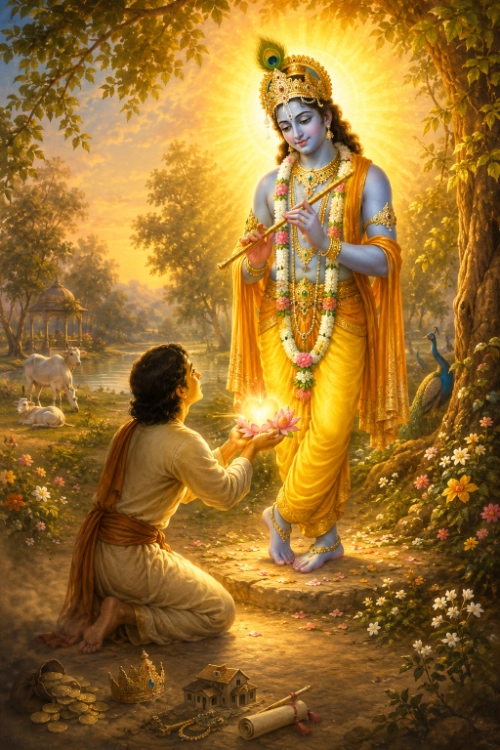
Material Boons, Temporary Gains, and the Meaning of Pure Bhakti in Gauḍīya Vaiṣṇavism
A brief prayer cited by A.C. Bhaktivedanta Swami Prabhupāda in his purport to Śrīmad-Bhāgavatam 5.18.22 provides a useful doorway into one of the deepest themes of Gauḍīya Vaiṣṇava theology:
धनं देहि रूपं देहि रूपवतीं भार्यां देहि
dhanaṁ dehi rūpaṁ dehi rūpavatīṁ bhāryāṁ dehi
“Give me wealth; give me beauty; give me a beautiful wife.”
Prabhupāda presents such petitions as representative of a material boon-seeking attitude toward Durgā. In his lectures he sometimes expands the formula with yaśo dehi — “give me fame” — and summarises the mentality by repeating dehi, dehi, dehi: “give, give, give.”
The precise Sanskrit formula is not itself the text of Śrīmad-Bhāgavatam 5.18.22, and its textual relationship to the various Caṇḍī prayer traditions is a separate question. What matters here is why Prabhupāda invokes it. His real subject is not Durgā. It is desire.
What happens when religion becomes a means for acquiring wealth, beauty, health, success, family, social standing, power, security, or even heavenly enjoyment? Is there anything intrinsically wrong with these things? If someone still desires them, should that person stop worshipping Bhagavān? Does becoming a devotee require becoming poor? Can Bhagavān sometimes refuse a prayer out of mercy? And what does a Gauḍīya Vaiṣṇava finally ask from Kṛṣṇa when material boons no longer occupy the centre?
The answer runs through the Bhagavad-gītā, Śrīmad-Bhāgavatam, Rūpa Gosvāmī, Caitanya Mahāprabhu, Narottama Dāsa Ṭhākura, Bhaktivinoda Ṭhākura and Prabhupāda. It ultimately describes a transformation from “what can Bhagavān give me?” to “what can I give Bhagavān?”.
The Actual Context of Śrīmad-Bhāgavatam 5.18.22
The Bhāgavata verse to which Prabhupāda attaches the Durgā example is actually a prayer spoken by Lakṣmīdevī:
मत्प्राप्तयेऽजेशसुरासुरादयस्
तप्यन्त उग्रं तप ऐन्द्रिये धियः ।
ऋते भवत्पादपरायणान्न मां
विन्दन्त्यहं त्वद्धृदया यतोऽजित ॥
mat-prāptaye ’jeśa-surāsurādayas
tapyanta ugraṁ tapa aindriye dhiyaḥ
ṛte bhavat-pāda-parāyaṇān na māṁ
vindanty ahaṁ tvad-dhṛdayā yato ’jita
Śrīmad-Bhāgavatam 5.18.22
In essence Lakṣmī says that even great beings may perform severe austerities desiring her favour while their minds remain directed toward sensory enjoyment, yet she gives herself truly to those devoted to the Lord’s feet.
That distinction is fundamental.
The Merchant and the Servant
Perhaps the strongest Bhāgavata statement explaining Prabhupāda’s criticism of boon-centred religion comes from Prahlāda Mahārāja. After Nṛsiṁhadeva offers him a benediction, Prahlāda responds:
नान्यथा तेऽखिलगुरो घटेत करुणात्मनः ।
यस्त आशिष आशास्ते न स भृत्यः स वै वणिक् ॥
nānyathā te ’khila-guro
ghaṭeta karuṇātmanaḥ
yas ta āśiṣa āśāste
na sa bhṛtyaḥ sa vai vaṇik
“One who desires benedictions from You in exchange for service is not truly a servant; he is a merchant.”
Śrīmad-Bhāgavatam 7.10.4
The final words are devastatingly concise:
न स भृत्यः स वै वणिक्
na sa bhṛtyaḥ sa vai vaṇik
“He is not a servant; he is a merchant.”
This goes directly to the heart of the matter. The deepest problem with boon-seeking religion is not that money or health are evil. The problem is the commercial structure of the relationship: “I perform worship. You give me something in exchange.” Bhagavān becomes a supplier. Religion becomes a transaction. The devotee becomes a customer.
Prabhupāda repeatedly invoked Prahlāda’s attitude in precisely this sense, contrasting pure service with the mentality of exchanging service for reward. In one lecture he paraphrased Prahlāda’s position with the memorable phrase: “I am not a merchant.”
The distinction is therefore not fundamentally between religious and irreligious people. It is between transaction and love.
From “You Give Me” to “I Serve You”
Materialistic religion asks: “what will God do for me?” Bhakti gradually reverses the direction: “what may I do for God?” This does not happen all at once. The Bhāgavata recognises that people approach Bhagavān with many different motives — and indeed encourages them to do so.
Even If You Have Material Desires — Worship Bhagavān
One of the most generous verses in the Bhāgavata says:
अकामः सर्वकामो वा मोक्षकाम उदारधीः ।
तीव्रेण भक्तियोगेन यजेत पुरुषं परम् ॥
akāmaḥ sarva-kāmo vā
mokṣa-kāma udāra-dhīḥ
tīvreṇa bhakti-yogena
yajeta puruṣaṁ param
“Whether one is without material desire, full of material desires, or desires liberation, one who possesses broad intelligence should worship the Supreme Person through intense bhakti-yoga.”
Śrīmad-Bhāgavatam 2.3.10
Three conditions are recognised:
And all three receive the same instruction:
यजेत पुरुषं परम्
yajeta puruṣaṁ param
“Worship the Supreme Person.”
This is crucial for understanding the Gauḍīya attitude. The teaching is not “first purify yourself completely and only then approach Kṛṣṇa.” Rather: “approach Kṛṣṇa even with your imperfect desires.” Bhakti itself has the power to transform what a person wants.
Do Not Pretend to Be Desireless
This makes Gauḍīya spirituality psychologically realistic. Suppose someone wants financial security, a child, marriage, relief from illness, success, protection, or freedom from a crisis. The tradition does not require the person to pretend: “I have absolutely no material concerns.” One may bring those concerns before Kṛṣṇa.
But something can happen in the process of worship. Initially, “I want something, therefore I approach Kṛṣṇa.” Later, “I have begun to want Kṛṣṇa more than the thing for which I approached Him.” That transformation is illustrated perfectly by Dhruva Mahārāja.
Dhruva: Looking for Glass, Finding a Jewel
Dhruva began his spiritual quest with an unmistakably material ambition. He wanted a magnificent position greater than that possessed by his ancestors. But after seeing Bhagavān, the entire scale of value changed. A famous verse attributed to Dhruva and quoted twice by Kṛṣṇadāsa Kavirāja says:
स्थानाभिलाषी तपसि स्थितोऽहं
त्वां प्राप्तवान् देवमुनीन्द्रगुह्यम् ।
काचं विचिन्वन्नपि दिव्यरत्नं
स्वामिन् कृतार्थोऽस्मि वरं न याचे ॥
sthānābhilāṣī tapasi sthito ’haṁ
tvāṁ prāptavān deva-munīndra-guhyam
kācaṁ vicinvann api divya-ratnaṁ
svāmin kṛtārtho ’smi varaṁ na yāce
“Desiring a high position, I undertook austerity. But now I have obtained You, who are difficult even for great devas and sages to attain. Seeking a piece of glass, I have found a divine jewel. My Lord, I am fulfilled; I ask no boon.”
Hari-bhakti-sudhodaya 7.28; quoted in Caitanya-caritāmṛta Madhya 22.42 and 24.219
The final line could almost serve as the motto of the whole theology:
स्वामिन् कृतार्थोऽस्मि वरं न याचे
svāmin kṛtārtho ’smi varaṁ na yāce
“My Lord, I am fulfilled. I ask no boon.”
At the beginning Dhruva wanted the gift. At the end he had encountered the Giver. The gift suddenly looked like glass. Bhagavān looked like the jewel.
Higher Experience Does Not Suppress Desire — It Revalues It
This is an important distinction. Dhruva did not mechanically repress his former ambition. He did not simply tell himself, “wanting a kingdom is sinful, therefore I must force myself not to want it.” He encountered something greater, and his earlier desire lost its power because his perception of value changed.
That is a characteristic Gauḍīya principle: lower desire is most deeply conquered not merely by prohibition, but by higher rasa. When greater sweetness appears, lesser sweetness loses its tyranny.
Bhagavān May Give the Thing You Ask For
The Bhāgavata acknowledges that Bhagavān can satisfy a devotee’s request. But then it says something extraordinary:
सत्यं दिशत्यर्थितमर्थितो नृणां
नैवार्थदो यत्पुनरर्थिता यतः ।
स्वयं विधत्ते भजतामनिच्छता-
मिच्छापिधानं निजपादपल्लवम् ॥
satyaṁ diśaty arthitam arthito nṛṇāṁ
naivārtha-do yat punar arthitā yataḥ
svayaṁ vidhatte bhajatām anicchatām
icchā-pidhānaṁ nija-pāda-pallavam
Śrīmad-Bhāgavatam 5.19.27
The logic deserves careful attention. First:
सत्यं दिशत्यर्थितम्
satyaṁ diśaty arthitam
“Yes, He may indeed give what has been requested.”
But then comes the problem. A requested object may simply produce another request:
पुनरर्थिता
punar arthitā
“another request.”
The pattern of material desire is: “if only I had this…” Then one gets it. Soon: “now I need that.” Then another. And another. The content changes; the wanting continues.
The Greater Gift Is the End of the Endless Request
The verse therefore says that Bhagavān may give something entirely different:
स्वयं विधत्ते … निजपादपल्लवम्
svayaṁ vidhatte … nija-pāda-pallavam
He gives His own lotus feet.
They are described as:
इच्छापिधानम्
icchā-pidhānam
That which covers, supersedes, overwhelms, or eclipses other desires.
This is one of the deepest statements about divine mercy in the Bhāgavata. The highest mercy is not merely “Kṛṣṇa fulfilled my desire.” It is “Kṛṣṇa gave me something so great that my former desire ceased to govern me.” Bhagavān does not merely satisfy desire. He can transform the desirer.
Prabhupāda’s “Don’t Dictate God”
This is the theological background to one of Prabhupāda’s characteristically direct statements: “Don’t dictate God.” He then invokes the familiar dhanaṁ dehi, rūpaṁ dehi, yaśo dehi … dehi, dehi as an example of approaching divinity primarily through demands.
His criticism is not aimed at the Sanskrit grammatical imperative dehi itself. Devotees constantly ask Kṛṣṇa for mercy, bhakti, remembrance, shelter and service. The issue is what is being requested and why. Material consciousness says, “God should arrange reality according to my desires.” Bhakti says, “let my desires become aligned with Bhagavān.”
The Pure Devotee Is Called Niṣkāma
Kṛṣṇadāsa Kavirāja writes:
কৃষ্ণভক্ত — নিষ্কাম, অতএব ‘শান্ত’ ।
ভুক্তি-মুক্তি-সিদ্ধি-কামী — সকলি ‘অশান্ত’ ॥
kṛṣṇa-bhakta—niṣkāma, ataeva ‘śānta’
bhukti-mukti-siddhi-kāmī—sakali ‘aśānta’
“The Kṛṣṇa-bhakta is niṣkāma and therefore peaceful. Those who desire bhukti, mukti or siddhi are all unpeaceful.”
Caitanya-caritāmṛta, Madhya 19.149
Three ambitions are grouped together: bhukti, material enjoyment; mukti, liberation; and siddhi, supernatural or yogic perfection. This is an extraordinary classification, because mukti is not an ordinary material pleasure. Yet from the standpoint of pure bhakti, all three can contain the same structure: “what will I obtain?”
Why Even Liberation Can Become a Self-Centred Desire
Consider the three orientations.
Pure bhakti asks a different question: “how may Kṛṣṇa be pleased?” Thus Gauḍīya Vaiṣṇavism does not define purity merely as rejection of gross pleasures. Even the very exalted aspiration for liberation can become secondary when compared with service itself.
“Desireless” Does Not Mean Having No Desire
This deserves particular emphasis. When a Kṛṣṇa-bhakta is called niṣkāma, “desireless,” Gauḍīya theology does not mean the devotee has become psychologically inert. A devotee may intensely desire:
- Kṛṣṇa’s name,
- Kṛṣṇa’s remembrance,
- Kṛṣṇa’s service,
- Kṛṣṇa’s pleasure,
- association with Vaiṣṇavas,
- residence in Vraja,
- or a particular eternal service.
Indeed, prema is full of desire. What has disappeared is the independent self-centred agenda. This is why Prabhupāda explains akāma not as stone-like absence of will, but as desire whose happiness is centred upon the happiness of the Supreme Lord.
Rūpa Gosvāmī: Anyābhilāṣitā-śūnyam
Rūpa Gosvāmī expresses this with extraordinary precision:
अन्याभिलाषिताशून्यं ज्ञानकर्माद्यनावृतम् ।
आनुकूल्येन कृष्णानुशीलनं भक्तिरुत्तमा ॥
anyābhilāṣitā-śūnyaṁ
jñāna-karmādy-anāvṛtam
ānukūlyena kṛṣṇānu-
śīlanaṁ bhaktir uttamā
“Uttama-bhakti is favorable cultivation directed toward Kṛṣṇa, free from extraneous desires and unobscured by jñāna, karma and other pursuits.”
Bhakti-rasāmṛta-sindhu 1.1.11; quoted in Caitanya-caritāmṛta Madhya 19.167
The exact wording matters. Rūpa does not merely say abhilāṣa-śūnyam, “without desire.” He says anyā-abhilāṣitā-śūnyam — free from the cultivated orientation toward other desires. And then he immediately supplies the positive content, ānukūlyena kṛṣṇānuśīlanam: favourable cultivation of Kṛṣṇa-centred service.
Bhakti therefore does not annihilate the faculty of desire. It reorients it.
The “Witches” in the Heart
Rūpa gives an even more dramatic image:
भुक्तिमुक्तिस्पृहा यावत् पिशाची हृदि वर्तते ।
तावद्भक्तिसुखस्यात्र कथमभ्युदयो भवेत् ॥
bhukti-mukti-spṛhā yāvat
piśācī hṛdi vartate
tāvad bhakti-sukhasyātra
katham abhyudayo bhavet
“As long as hankering for enjoyment and liberation remains in the heart like a witch, how can the happiness of bhakti arise there?”
Bhakti-rasāmṛta-sindhu 1.2.22; quoted in Caitanya-caritāmṛta Madhya 19.176
The key word is:
स्पृहा
spṛhā
Hankering, craving, longing to possess.
Again, the issue is not that one happens to have a house or money. The issue is what the heart imagines will finally make it complete. As long as the heart says, “my fulfilment depends upon acquiring something other than Kṛṣṇa,” the independent craving competes with the happiness of bhakti.
Mahāprabhu’s Radical Prayer: “No Wealth”
The fourth verse of Śrī Caitanya’s Śikṣāṣṭaka expresses the positive alternative:
न धनं न जनं न सुन्दरीं
कवितां वा जगदीश कामये ।
मम जन्मनि जन्मनीश्वरे
भवताद्भक्तिरहैतुकी त्वयि ॥
na dhanaṁ na janaṁ na sundarīṁ
kavitāṁ vā jagad-īśa kāmaye
mama janmani janmanīśvare
bhavatād bhaktir ahaitukī tvayi
“O Lord of the universe, I do not desire wealth, followers, sensual beauty or worldly distinction. Birth after birth, let there simply be causeless bhakti unto You.”
Śikṣāṣṭaka 4; Caitanya-caritāmṛta Antya 20.29
The opening could hardly contrast more directly with dhanaṁ dehi, “give me wealth.” Mahāprabhu says na dhanam, “not wealth.” But He goes much further.
“Birth After Birth”
The decisive phrase is:
मम जन्मनि जन्मनि
mama janmani janmani
“birth after birth.”
This means the prayer is not even “give me liberation so that I never have to be born again.” Mahāprabhu does not place liberation as the condition of devotion. Instead: “wherever I am, let bhakti remain.”
This is astonishing. It places service above comfort, status, worldly success, and even the desire to escape saṁsāra for one’s own sake. The highest prayer becomes: “Do not give me something instead of bhakti. Give me bhakti itself.”
Bhaktivinoda Ṭhākura Expands Mahāprabhu’s Prayer
Bhaktivinoda Ṭhākura makes the implications extremely concrete in Bhajana-rahasya:
গৃহ দ্রব্য শিষ্য পশু ধান্য আদি ধন ।
স্ত্রী পুত্র দাস দাসী কুটুম্বাদি জন ॥
…
এই সব পাইবার আশা নাহি করি ।
শুদ্ধভক্তি দেহ মোরে কৃষ্ণ কৃপা করি ॥
gṛha dravya śiṣya paśu dhānya ādi dhana
strī putra dāsa dāsī kuṭumbādi jana
…
ei saba pāibāra āśā nāhi kari
śuddha-bhakti deha more kṛṣṇa kṛpā kari
“House, possessions, disciples, animals, grain and wealth; wife, children, servants and family—I do not aspire after these. O Kṛṣṇa, mercifully give me pure bhakti.”
Bhajana-rahasya, Chapter 4
Notice what happens to the word deha / dehi. The devotee still asks — but the request has changed. Not “give wealth,” but instead:
শুদ্ধভক্তি দেহ মোরে
śuddha-bhakti deha more
“Give me pure bhakti.”
This is one of the clearest expressions of the entire transformation.
Pure Bhakti Does Not End Prayer
The devotee still cries “give!” But now:
- “Give remembrance.”
- “Give service.”
- “Give attachment to Your name.”
- “Give Vaiṣṇava association.”
- “Give me shelter.”
- “Give me prema.”
Therefore the transition from materialistic religion to pure bhakti is not the transition from prayer to no prayer. It is the purification of what prayer seeks.
Bhaktivinoda: From “Give Me” to “Everything I Have Is Yours”
Bhaktivinoda’s Śaraṇāgati takes the movement still further:
মানস দেহ গেহ যো কিছু মোর ।
অর্পিলুঁ তুয়া পদে নন্দকিশোর ॥
mānasa deha geha yo kichu mora
arpilūṅ tuyā pade nanda-kiśora
“Mind, body, home—whatever is mine—I offer at Your feet, O Nanda-kiśora.”
The direction of possession has now completely reversed.
The next lines are even stronger:
মারবি রাখবি — যো ইচ্ছা তোহারা ।
নিত্যদাস প্রতি তুয়া অধিকার ॥
mārabi rākhabi—yo icchā tohārā
nitya-dāsa prati tuyā adhikārā
“Whether You kill me or preserve me—whatever You desire. You have every right over Your eternal servant.”
Śaraṇāgati, “Mānasa Deha Geha”
This is not fatalism. It is the theological opposite of trying to manipulate Bhagavān into arranging only favourable circumstances. The devotee says: “My relationship with You is more important than whether circumstances satisfy me.” Prabhupāda frequently cited these lines as the essence of surrender.
The Ultimate Reversal
We can now express the transformation very simply.
At first the individual stands at the centre. Eventually Bhagavān stands at the centre. This is the spiritual revolution taking place underneath Prabhupāda’s seemingly simple criticism of dehi, dehi, dehi.
Narottama Dāsa Ṭhākura: Do Not Divide Your Shelter
Narottama Dāsa Ṭhākura makes another aspect of this principle explicit:
ভাগবত-শাস্ত্র-মর্ম, নব-বিধ-ভক্তি-ধর্ম,
সদাই করিব সুসেবন ।
অন্যদেবাশ্রয় নাই, তোমারে কহিল ভাই,
এই ভক্তি পরম-কারণ ॥
bhāgavata-śāstra-marma, nava-vidha-bhakti-dharma
sadāi kariba susevana
anya-devāśraya nāi, tomāre kahila bhāi
ei bhakti parama-kāraṇa
“Always cultivate the ninefold bhakti that is the essence of Bhāgavata-śāstra. Do not take separate shelter of other devas; brother, this bhakti is the supreme means.”
Prema-bhakti-candrikā 11
The central word is āśraya — shelter. The issue is not merely whether other divine beings exist. It is: “where is my ultimate dependence placed?” For the Gauḍīya Vaiṣṇava, Kṛṣṇa ceases to be one spiritual provider among several whom one approaches according to different needs. He becomes the single centre of shelter.
Prabhupāda’s Practical Advice: If You Still Want Something, Ask Kṛṣṇa
This point prevents the theology from becoming harsh. Prabhupāda repeatedly stressed that even if someone still has material desires, the person should nevertheless worship Kṛṣṇa. Why? Because Kṛṣṇa can satisfy the desire if He chooses — but simultaneously increase the devotee’s attachment to Himself. This is exactly the logic of akāmaḥ sarva-kāmo vā… yajeta puruṣaṁ param.
The beginner may come saying, “Kṛṣṇa, I need this.” Bhakti may eventually bring the person to, “Kṛṣṇa, what I really needed was You.” Thus an imperfect motive does not make approaching Kṛṣṇa pointless. Approaching Kṛṣṇa can purify the motive itself.
Bhagavān May Answer “Yes”
Bhagavān may give money, a job, a family, protection, health, success. Such a gift is not automatically spiritually harmful. Everything depends upon what happens to the recipient’s consciousness.
The object alone does not answer the question. Its relationship to Bhagavān does.
Bhagavān May Also Answer “No”
But bhakti theology introduces a far more difficult possibility. Sometimes divine mercy may take the form of not receiving what one requested. If a requested object would intensify false independence, ego, forgetfulness, or endless craving, then refusal may serve the devotee more deeply than fulfilment.
Śrīmad-Bhāgavatam 5.19.27 already contains this principle: Kṛṣṇa may decline merely to feed punar arthitā — the cycle of repeated asking — and instead give His feet. The point is not “God refuses because He does not care.” It may be: “God sees a good greater than the object I can presently imagine.”
Bhagavān May Even Remove What One Already Has
An even more unsettling Bhāgavata verse says:
श्रीभगवानुवाच
यस्याहमनुगृह्णामि हरिष्ये तद्धनं शनैः ।
ततोऽधनं त्यजन्त्यस्य स्वजना दुःखदुःखितम् ॥
śrī-bhagavān uvāca
yasyāham anugṛhṇāmi hariṣye tad-dhanaṁ śanaiḥ
tato ’dhanaṁ tyajanty asya sva-janā duḥkha-duḥkhitam
“The Lord said: When I especially favor someone, I may gradually take away his wealth; then, when he becomes poor and distressed, even his relatives may abandon him.”
Śrīmad-Bhāgavatam 10.88.8
This verse is intentionally severe. It destroys the simplistic equation prosperity = God’s favour and loss = God’s displeasure. Prabhupāda sometimes cited it to explain that Kṛṣṇa may remove the very supports upon which a devotee is trying to remain independently secure.
A Necessary Safeguard
This verse should never become a weapon for explaining someone else’s suffering. It would be presumptuous to look at another person’s poverty, illness, bereavement, failure or disaster and announce, “Kṛṣṇa is specially blessing you.” We do not know the karmic, providential or personal meaning of another person’s suffering. The verse functions best as a way for the devotee to interpret his or her own dependence upon Bhagavān, not as a licence to pronounce judgments on others.
Material Loss Can Reveal Hidden Dependence
Why might loss sometimes deepen spiritual life? Because a person may discover:
- “I thought my security was Kṛṣṇa, but actually my security was my money.”
- “I thought my identity was devotional, but it depended upon social recognition.”
- “I trusted Bhagavān as long as events followed my plan.”
Loss can expose where one’s real āśraya lies. This is spiritually painful — but potentially illuminating.
Yet Gauḍīya Vaiṣṇavism Does Not Glorify Poverty for Its Own Sake
This qualification is essential. The Gauḍīya conclusion is not wealth = evil and poverty = holiness. Prabhupāda himself emphasised that Dhruva and Prahlāda possessed extraordinary opulence while remaining great devotees. Resources are not automatically māyā-sukha simply because they are material resources. The decisive question is: who is the enjoyer?
Kuntī: The Danger Is Intoxication
Kuntī-devī prays:
जन्मैश्वर्यश्रुतश्रीभिरेधमानमदः पुमान् ।
नैवार्हत्यभिधातुं वै त्वामकिञ्चनगोचरम् ॥
janmaiśvarya-śruta-śrībhir
edhamāna-madaḥ pumān
naivārhaty abhidhātuṁ vai
tvām akiñcana-gocaram
“A person whose intoxication increases through high birth, opulence, learning and beauty cannot easily approach You in genuine feeling, for You are accessible to the akiñcana.”
Śrīmad-Bhāgavatam 1.8.26
The problem is not wealth, education, beauty or noble birth in themselves. The dangerous phrase is:
एधमानमदः
edhamāna-madaḥ
“Increasing intoxication.”
An advantage becomes spiritually dangerous when it produces: “I am independent.” “I am superior.” “I do not need shelter.”
What Does Akiñcana Really Mean?
Akiñcana literally suggests one who has “nothing.” But Gauḍīya teachers often give this a deeper devotional meaning: nothing held separately from Bhagavān.
A person may possess almost nothing yet be consumed by acquisition. Another may manage extensive resources while inwardly seeing them as Kṛṣṇa’s property. Thus genuine akiñcanatā is not measured only by one’s bank balance. It is measured by: “what do I still insist belongs independently to me?”
Wealth Can Become Sevā
This leads to an important Gauḍīya principle of transformation. The same object can stand on either side of a single line.
The world does not always need to be destroyed. Its relationship to Bhagavān must change.
Renunciation Without Relationship Is Not the Final Goal
This is why Rūpa Gosvāmī’s bhakti is neither hedonism nor mere rejection. The aim is not simply “have nothing.” The aim is “let nothing be independent of Kṛṣṇa.” That is a subtler spiritual revolution.
The problem is not possession alone. It is proprietorship. Not “this exists,” but “this exists for me.” Bhakti changes that to: “this belongs to Kṛṣṇa; how may it serve Him?”
Heaven, Liberation and Hell Become Secondary
The logic reaches an astonishing climax in another Bhāgavata verse:
नारायणपराः सर्वे न कुतश्चन बिभ्यति ।
स्वर्गापवर्गनरकेष्वपि तुल्यार्थदर्शिनः ॥
nārāyaṇa-parāḥ sarve
na kutaścana bibhyati
svargāpavarga-narakeṣv
api tulyārtha-darśinaḥ
“Those wholly centred upon Nārāyaṇa fear no condition. Heaven, liberation and hell are regarded by them as equal in relation to their devotion.”
Śrīmad-Bhāgavatam 6.17.28
This does not mean that pain feels identical to pleasure. It means that neither pleasure nor pain determines whether the relationship with Bhagavān has succeeded. The devotee’s fundamental question becomes: “can I remember and serve Bhagavān here?”
Heaven Is No Longer Automatically Success
Ordinary religious thinking may assume that a comfortable world is a reward and a painful world a punishment. But the nārāyaṇa-para devotee has another measure. If heaven produces forgetfulness, its comfort loses spiritual value. If hardship produces deep dependence upon Bhagavān, hardship need not mean spiritual defeat. The value of circumstances becomes relational.
This Explains Māyā-sukha
Prabhupāda frequently uses the expression māyā-sukha for happiness based upon temporary material arrangements. This should not be misunderstood. Māyā-sukha does not mean that the experience of pleasure is imaginary in the sense of nonexistent. A luxurious house really can be comfortable. Money really can solve many practical problems. Beauty really can bring social advantages. Status really can provide influence.
But such happiness is dependent, temporary, unstable, incapable of satisfying the self finally, and liable to produce further craving. The Bhagavad-gītā states the essential limitation:
अन्तवत्तु फलं तेषां तद्भवत्यल्पमेधसाम् ।
देवान्देवयजो यान्ति मद्भक्ता यान्ति मामपि ॥
antavat tu phalaṁ teṣāṁ
tad bhavaty alpa-medhasām
devān deva-yajo yānti
mad-bhaktā yānti mām api
Bhagavad-gītā 7.23
The key word is:
अन्तवत्
antavat
“Having an end.”
That is the deepest problem with temporary boons. They end. And because they end, the desire-machine starts again.
The Contrast Is Not “Pleasure Versus Misery”
The true contrast is finite reward versus enduring relationship with Bhagavān. A finite reward is not necessarily wicked. It is simply incapable of bearing the weight of ultimate hope.
Material goods become spiritually distorted when they are asked to provide what only relationship with Bhagavān can provide.
Bhakti Reorders Rather Than Merely Eliminates Desire
We can therefore identify several stages.
Prabhupāda’s “Merchant” Critique in Its Proper Place
Seen this way, Prabhupāda’s criticism of asking divinity for dhanaṁ dehi, rūpaṁ dehi… is not an attack on ordinary people for having needs. It is a critique of remaining forever at the transactional level of religion. A person may begin there. But bhakti is meant to lead somewhere else — from “I need God because I need something,” to “I need God,” and eventually to “let me belong to God.”
The Most Beautiful Gauḍīya Reversal
The entire transformation can perhaps be expressed through three prayers. First, the boon-seeker:
धनं देहि
dhanaṁ dehi
“Give me wealth.”
Then Bhaktivinoda:
শুদ্ধভক্তি দেহ মোরে
śuddha-bhakti deha more
“Give me pure bhakti.”
And finally, complete surrender:
অর্পিলুঁ তুয়া পদে
arpilūṅ tuyā pade
“I have offered it at Your feet.”
The same spiritual vocabulary of giving remains. But the direction changes. First, “you give something to me.” Then, “give me devotion to You.” Finally, “I give myself to You.”
Mahāprabhu’s Final Standard: Ahaitukī Bhakti
The word in Śikṣāṣṭaka 4 is:
अहैतुकी
ahaitukī
Without an ulterior cause or bargaining motive.
bhavatād bhaktir ahaitukī tvayi
“Let there be causeless bhakti unto You.”
Why do I serve? Not because Kṛṣṇa makes me rich. Not because Kṛṣṇa keeps me healthy. Not because Kṛṣṇa guarantees social success. Not even because Kṛṣṇa must liberate me according to my timetable. The deepest answer becomes: “because He is Kṛṣṇa, and service to Him is itself my fulfilment.”
This Does Not Mean a Devotee Never Prays for Help
A crucial practical qualification remains. The Bhāgavata is full of devotees crying to Bhagavān in distress. There is nothing inherently impure about saying:
- “Kṛṣṇa, please protect me.”
- “Please help my family.”
- “Please give me strength.”
- “Please remove this obstacle if it is good for my bhakti.”
The difference lies in whether the relationship depends upon the answer. Transactional religion says, “if You do not give me this, You have failed me.” Bhakti increasingly says, “this is what I hope for — but I remain Yours.” That is a very different prayer.
Desire Can Be Offered Before It Is Overcome
A mature Gauḍīya practice therefore does not require hypocrisy. One may tell Kṛṣṇa honestly, “I want this,” and then add, “but I want You more.” Or even: “at present I do not yet want You more. Please change my heart.” That itself can be bhakti. The transformation of desire may become part of the prayer.
Bhagavān Is Not Merely the Fulfiller of Desire — He Is the Educator of Desire
This may be one of the deepest theological conclusions. If Bhagavān’s role were simply to deliver requested objects, divine grace would be measured by successful acquisition. But the Bhāgavata presents Bhagavān as doing something greater. He may give the object, withhold the object, remove another object, or give Himself. All four can potentially belong to divine reciprocity.
What makes the difference is not simply whether the devotee’s immediate plan succeeds. It is whether the relationship moves toward bhakti.
The Supreme Boon Is Bhagavān Himself
This is where Dhruva’s realisation returns with full force:
काचं विचिन्वन्नपि दिव्यरत्नम्
kācaṁ vicinvann api divya-ratnam
“I was searching for glass and found a divine jewel.”
The material boon is not condemned because it is completely meaningless. Glass has value. But when placed beside a jewel, its relative value becomes clear. Likewise wealth, fame, beauty, family, health, power, even heavenly pleasure may all possess relative value. But Bhagavān possesses another order of value entirely. Once that becomes experientially real, the devotee says:
स्वामिन् कृतार्थोऽस्मि वरं न याचे
svāmin kṛtārtho ’smi varaṁ na yāce
“My Lord, I am fulfilled. I ask no boon.”
The Central Gauḍīya Principle
The Gauḍīya perspective on material boons can therefore be summarised carefully. It does not teach that money is evil; that poverty is holiness; that asking God for help is forbidden; that all material blessings are signs of illusion; that all suffering is divine punishment; or that one must have no desires whatsoever. Rather, it teaches:
- temporary objects cannot provide permanent fulfilment;
- bhakti should not remain a commercial transaction;
- one may approach Kṛṣṇa even while materially motivated;
- Kṛṣṇa can purify the motivation through bhakti itself;
- prosperity can become sevā when offered to Bhagavān;
- loss can sometimes deepen surrender;
- liberation itself is secondary to loving service;
- and the highest desire is the desire to please Kṛṣṇa.
From “What Can God Give Me?” to “What Gives Kṛṣṇa Happiness?”
That is ultimately the journey. At first, “what can divinity do for me?” Then, “can Kṛṣṇa fulfil my needs?” Then, “what is Kṛṣṇa giving me that is greater than the thing I asked for?” Then, “I want Kṛṣṇa Himself.” And finally, in the mature logic of prema: “what will make Kṛṣṇa happy?”
The centre has moved. That movement is bhakti.
The Final Reversal: From Acquisition to Offering
The material consciousness represented by dehi says “give me.” Mahāprabhu replies na dhanaṁ na janam — “not wealth, not followers.” Bhaktivinoda prays śuddha-bhakti deha more — “give me pure bhakti.” Then surrender reaches its culmination:
mānasa deha geha yo kichu mora
arpilūṅ tuyā pade nanda-kiśora
“Mind, body, home—whatever I have—I offer at Your feet.”
This is the full arc. The devotee begins by approaching Bhagavān because he wants something. Bhagavān patiently accepts the approach. Bhakti purifies the heart. The desired object becomes smaller. Bhagavān becomes larger. Eventually the devotee no longer asks “what will You give me?” He says: “I am Yours.”
And this is why Prabhupāda’s apparently simple criticism of dhanaṁ dehi, rūpaṁ dehi reaches much deeper than a criticism of worldly prosperity. It is a criticism of making oneself the centre of religion. Gauḍīya bhakti replaces that centre with Bhagavān.
The highest boon is no longer wealth, beauty, fame, health, heaven, power, or even liberation. The highest boon is bhakti itself.
And ultimately, the deepest gift is not something Kṛṣṇa possesses. It is Kṛṣṇa Himself.
Principal Scriptural and Gauḍīya Sources
Online Text Editions and Resources Consulted
For formal publication, Sanskrit and Bengali passages should finally be checked against the specific printed editions of the Bhāgavata, Bhakti-rasāmṛta-sindhu, Caitanya-caritāmṛta, Bhajana-rahasya, Śaraṇāgati and Prema-bhakti-candrikā selected by the editor. On where independent reasoning reaches its limit in such matters, see The Limits of Independent Reasoning.