

Kṛṣṇa’s Sweetness Becomes Accessible on the Path of Rāga
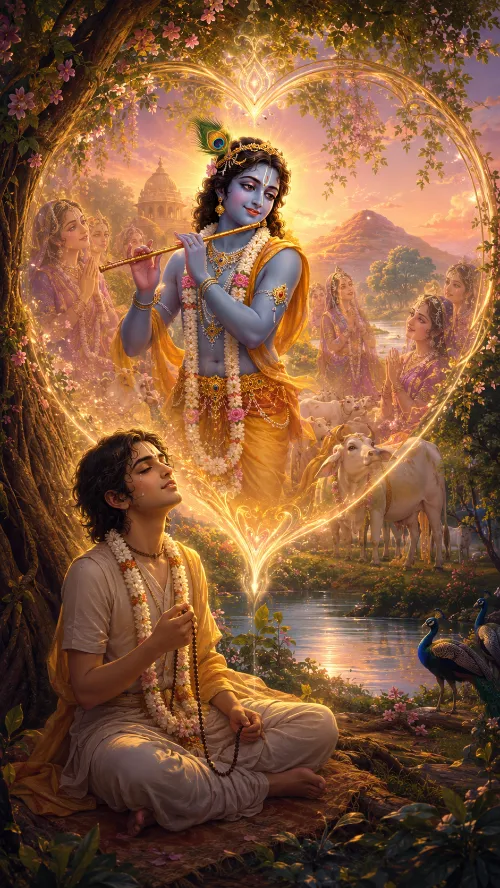
When Devotion Stops Being a Duty and Becomes Love
In the twenty-first chapter of the Madhya-līlā, Śrī Caitanya Mahāprabhu tells Sanātana Gosvāmī that Kṛṣṇa’s sweetness is hard to reach through karma, austerity, yoga, knowledge, regulated devotion, japa or meditation — and readily accessible to one who worships Him with loving attachment on the path of rāga. The verse is short, and it is easily misread.
কর্ম, তপ, যোগ, জ্ঞান, বিধি-ভক্তি, জপ, ধ্যান,
ইহা হৈতে মাধুর্য দুর্লভ ।
কেবল যে রাগমার্গে, ভজে কৃষ্ণে অনুরাগে,
তারে কৃষ্ণমাধুর্য সুলভ ॥
karma, tapa, yoga, jñāna, vidhi-bhakti, japa, dhyāna,
ihā haite mādhurya durlabha
kevala ye rāga-mārge, bhaje kṛṣṇe anurāge,
tāre kṛṣṇa-mādhurya sulabha
“Through karma, austerity, yoga, jñāna, rule-governed devotion, japa and meditation, this mādhurya is difficult to attain. But for one who worships Kṛṣṇa with loving attachment on the path of rāga, Kṛṣṇa’s mādhurya becomes readily accessible.”
Śrī Caitanya-caritāmṛta, Madhya 21.119
The line is built around a single deliberate contrast, and everything that follows here depends on it.
Yet the verse can easily be misunderstood. Why should Mahāprabhu say that even vidhi-bhakti, japa and dhyāna do not readily disclose Kṛṣṇa’s mādhurya? Does Gauḍīya Vaiṣṇavism not teach chanting, remembrance, meditation, regulated sādhana and obedience to śāstra? Of course it does. Rūpa Gosvāmī explicitly teaches that practitioners of rāgānugā-bhakti continue to hear, chant, remember, worship and perform the ordinary limbs of devotional practice.
The contrast of Madhya 21.119 is therefore not practice versus spontaneity, nor chanting versus not chanting. The distinction is deeper: what moves the practice, and toward what form of relationship with Kṛṣṇa is it directed?
The Immediate Context: Kṛṣṇa’s Sweetness and the Gopīs’ Love
Madhya 21.119 should not be read in isolation. The preceding verse says:
গোপীভাব-দরপণ, নব নব ক্ষণে ক্ষণ,
তার আগে কৃষ্ণের মাধুর্য ।
দোঁহে করে হুড়াহুড়ি, বাড়ে, মুখ নাহি মুড়ি,
নব নব দোঁহার প্রাচুর্য ॥
gopī-bhāva-darapaṇa, nava nava kṣaṇe kṣaṇa,
tāra āge kṛṣṇera mādhurya
doṅhe kare huḍāhuḍi, bāḍe, mukha nāhi muḍi,
nava nava doṅhāra prācurya
“The gopīs’ bhāva is like a mirror that becomes new at every moment. Before that mirror Kṛṣṇa’s mādhurya appears, and the two compete with one another, each constantly increasing.”
Caitanya-caritāmṛta, Madhya 21.118
This is one of Kṛṣṇadāsa Kavirāja’s most beautiful theological images. The gopīs’ love is a mirror; Kṛṣṇa’s mādhurya appears before it; and neither remains static. His sweetness awakens still greater love, that greater love becomes capable of perceiving still more of His sweetness, and the newly perceived sweetness intensifies love again — mādhurya to prema to deeper mādhurya to deeper prema, without end.
Verse 21.119 then asks what kind of consciousness becomes capable of entering that ever-deepening revelation of Kṛṣṇa. Mahāprabhu answers: rāga-mārga. And immediately afterward He says:
সেইরূপ ব্রজাশ্রয়, ঐশ্বর্য-মাধুর্যময়,
দিব্যগুণগণ-রত্নালয় ॥
sei-rūpa vrajāśraya, aiśvarya-mādhuryamaya,
divya-guṇa-gaṇa-ratnālaya
“That form has Vraja as its abode, is filled with aiśvarya and mādhurya, and is the treasury of the jewels of divine qualities.”
Madhya 21.120
The three verses therefore form a coherent sequence.
The subject is therefore not the general question “How does one attain God?” It is much more specific: what kind of devotion makes Kṛṣṇa’s intimate Vraja-mādhurya accessible?
A Note on the Familiar English Translation
A.C. Bhaktivedanta Swami Prabhupāda translates Madhya 21.119:
“The transcendental mellows generated from the dealings between the gopīs and Kṛṣṇa cannot be tasted by means of fruitive activity, yogic austerities, speculative knowledge, regulative devotional service, mantra-yoga or meditation. This sweetness can be tasted only through the spontaneous love of liberated persons who chant the holy names with great ecstatic love.”
This successfully communicates the theological direction of the passage, especially its immediate connection with the gopīs. But it is not a strictly word-for-word rendering, and three details are worth noticing.
The familiar translation is therefore best understood as a theological exposition of the verse rather than its closest grammatical rendering. That distinction becomes important once we ask precisely what Mahāprabhu means by rāga-mārga.
Vaidhī-bhakti: Devotion Moved by Scriptural Injunction
Rūpa Gosvāmī defines vaidhī-bhakti:
तत्र वैधी —
यत्र रागानवाप्तत्वात् प्रवृत्तिरुपजायते ।
शासनेनैव शास्त्रस्य सा वैधी भक्तिरुच्यते ॥
tatra vaidhī —
yatra rāgānavāptatvāt pravṛttir upajāyate
śāsanenaiva śāstrasya sā vaidhī bhaktir ucyate
“Where engagement in bhakti arises because rāga has not yet been attained, and therefore arises principally through the injunction of śāstra, that is called vaidhī-bhakti.”
Bhakti-rasāmṛta-sindhu 1.2.6
This definition requires care. Vaidhī does not mean false devotion, artificial worship, or devotion performed by spiritually inferior people. It means that the principal impetus of one’s practice is still something like: “Bhagavān and śāstra instruct me to do this, therefore I shall do it.”
That is entirely legitimate sādhana; indeed, disciplined devotion ordinarily depends heavily upon such instruction. The distinction concerns the impelling force. What happens when the heart is no longer moved principally by injunction, but by attraction? For that we have to understand rāga.
What Is Rāga?
Rūpa Gosvāmī defines it:
इष्टे स्वारसिकी रागः परमाविष्टता भवेत् ।
तन्मयी या भवेद् भक्तिः सात्र रागात्मिकोदिता ॥
iṣṭe svārasikī rāgaḥ paramāviṣṭatā bhavet
tan-mayī yā bhaved bhaktiḥ sātra rāgātmikoditā
“Rāga is a natural, deeply relishable absorption in one’s beloved object of devotion. Bhakti completely permeated by that rāga is called rāgātmikā-bhakti.”
Bhakti-rasāmṛta-sindhu 1.2.272
Two expressions in that definition matter especially.
Rāga is therefore much more than “I like Kṛṣṇa.” It is an intensely absorbing loving orientation in which the beloved becomes the natural center of consciousness. But here an important distinction must immediately be made.
Rāgātmikā and Rāgānugā Are Not the Same
Strictly speaking, the spontaneous love naturally possessed by Kṛṣṇa’s eternal associates in Vraja is called rāgātmikā-bhakti. This is the love of personalities such as:
- Nanda and Yaśodā;
- the cowherd boys;
- Śrī Rādhā;
- and the Vraja-gopīs.
The sādhaka does not simply announce, “I possess the same spontaneous love as Yaśodā.” Rather, one follows after that love — rāga plus anugā, “that which follows rāga.” Rūpa says:
विराजन्तीमभिव्यक्तां व्रजवासिजनादिषु ।
रागात्मिकामनुसृता या सा रागानुगोच्यते ॥
virājantīm abhivyaktāṁ vraja-vāsi-janādiṣu
rāgātmikām anusṛtā yā sā rāgānugocyate
“That devotion which follows the rāgātmikā-bhakti splendidly manifested among the residents of Vraja is called rāgānugā.”
Bhakti-rasāmṛta-sindhu 1.2.270
Thus the Vrajavāsīs possess rāgātmikā, while the practitioner follows their rāga through rāgānugā. This prevents a fundamental misunderstanding. Rāgānugā does not mean “I spontaneously do whatever I feel.” It means “my devotion follows the rāga manifested in Kṛṣṇa’s eternal associates in Vraja.” The defining principle is not self-invention. It is following.
Who Is Qualified for Rāgānugā?
Rūpa gives a striking answer:
रागात्मिकैकनिष्ठा ये व्रजवासिजनादयः ।
तेषां भावाप्तये लुब्धो भवेदत्राधिकारवान् ॥
rāgātmikaika-niṣṭhā ye vraja-vāsi-janādayaḥ
teṣāṁ bhāvāptaye lubdho bhaved atrādhikāravān
“One who becomes intensely desirous of attaining the bhāva of the residents of Vraja, who are exclusively established in rāgātmikā-bhakti, possesses qualification for this path.”
Bhakti-rasāmṛta-sindhu 1.2.291
The crucial word is lubdha — “greedy,” “intensely desirous,” “filled with longing” — and its corresponding noun is lobha. This is not material greed. It is the response: “If love of Kṛṣṇa like this exists, I want to enter its current.” It is attraction to a bhāva. Rūpa continues:
तत्तद्भावादिमाधुर्ये श्रुते धीर्यदपेक्षते ।
नात्र शास्त्रं न युक्तिं च तल्लोभोत्पत्तिलक्षणम् ॥
tat-tad-bhāvādi-mādhurye śrute dhīr yad apekṣate
nātra śāstraṁ na yuktiṁ ca tal-lobhotpatti-lakṣaṇam
“When one hears of the sweetness of those particular bhāvas and the intelligence longs for them without requiring scriptural injunction or logical persuasion, that is the symptom of the arising of lobha.”
Bhakti-rasāmṛta-sindhu 1.2.292
Kṛṣṇadāsa Kavirāja also quotes this verse in Caitanya-caritāmṛta Madhya 22.155. It does not mean that rāgānugā devotees disregard scripture — quite the opposite. The longing arises after one has heard of the sweetness of these bhāvas; śāstra reveals the world that awakens the attraction. The point is simply that once genuine attraction arises, the practitioner no longer needs a command telling him that he ought to desire it.
Suppose someone hears how Yaśodā loves Kṛṣṇa. One response might be: “Śāstra teaches that remembering Yaśodā is spiritually beneficial, therefore I should do so.” Another response is: “This love is extraordinary. I want to serve Kṛṣṇa in the wake of such love.” Śāstra remains indispensable in both. But in the second the heart is no longer moved merely by command; it has begun to be moved by attraction.
The Meaning of Anurāga in Madhya 21.119
Kṛṣṇadāsa Kavirāja does not merely say rāga-mārge bhaje, “worships on the path of rāga.” He adds bhaje kṛṣṇe anurāge, “worships Kṛṣṇa with anurāga.”
The word anurāga is related to the root √rañj — to color, dye, delight, or become deeply attached. In general devotional language it can indicate intense affection or loving attachment. Within highly developed rasa-śāstra it also becomes a technical stage within the progressive intensification of prema, but it is better not to force that entire technical hierarchy into this particular Bengali line.
Here the natural force of anurāga is deep loving attachment, affectionate passion, intense devotional feeling. So rāga-mārge … anurāge does not merely mean “belonging to a religious system called rāgānugā.” It describes a form of worship becoming inwardly drawn toward Kṛṣṇa through love.
What Is Mahāprabhu Contrasting With Rāga?
Now the opening list becomes clearer: karma, tapa, yoga, jñāna, vidhi-bhakti, japa, dhyāna. Mahāprabhu is not condemning every element in that list as spiritually useless — some of them, especially japa, meditation and regulated bhakti, remain integral to Gauḍīya sādhana. The deeper issue is that no spiritual technique, considered merely as technique, can mechanically compel Kṛṣṇa to disclose the intimate sweetness of Vraja. That is the common principle behind the list.
Karma
In the contrast relevant here, karma is structured around prescribed activity and its results. Vraja-prema is oriented differently: its fundamental question is not “What shall I obtain from this?” but “What will bring happiness to Kṛṣṇa?” The gopīs represent the extreme opposite of transactional spirituality: their love is celebrated precisely because concern for Kṛṣṇa displaces calculation about their own gain.
Tapa
Austerity may discipline the senses, increase concentration and strengthen determination. But austerity cannot mechanically manufacture love. Prema is not a wage paid in proportion to the amount of suffering one voluntarily undergoes.
Yoga
Yoga can steady consciousness and produce extraordinary concentration. But Vraja-mādhurya is not simply an object captured by concentrated attention; it is revealed within relationship. Yaśodā does not bind Kṛṣṇa because she has perfected breath control. She binds Him because He submits to her love.
Jñāna
Jñāna can disclose profound truths concerning Brahman, consciousness, māyā and the distinction between self and matter. Yet conceptual knowledge of Kṛṣṇa’s supremacy does not itself produce the intimacy in which He becomes someone’s child, someone’s equal friend, or someone’s beloved. Indeed, excessive foreground awareness of His majesty may inhibit precisely the intimacy characteristic of Vraja.
Japa and Dhyāna
Neither chanting nor meditation is being rejected. The issue is whether they are treated merely as religious technologies. One can repeat a mantra and one can concentrate the mind, but one cannot force anurāga. The same japa becomes something qualitatively different when it is increasingly filled with longing for Kṛṣṇa and for service within the devotional current of Vraja. The instrument may remain the same; the interior orientation changes.
Bhakti Alone Reaches Bhagavān in This Personal Way
The Śrīmad-Bhāgavatam states the larger principle very strongly. Kṛṣṇa tells Uddhava:
न साधयति मां योगो न सांख्यं धर्म उद्धव ।
न स्वाध्यायस्तपस्त्यागो यथा भक्तिर्ममोर्जिता ॥
na sādhayati māṁ yogo
na sāṅkhyaṁ dharma uddhava
na svādhyāyas tapas tyāgo
yathā bhaktir mamorjitā
“O Uddhava, neither yoga, nor Sāṅkhya, nor religious duties, nor Vedic study, austerity or renunciation brings Me under control as does powerful devotion unto Me.”
Śrīmad-Bhāgavatam 11.14.20
The remarkable expression is na sādhayati mām: none of these means brings Kṛṣṇa under its influence in the way intense bhakti does. The next verse says:
भक्त्याहमेकया ग्राह्यः श्रद्धयात्मा प्रियः सताम् ।
भक्तिः पुनाति मन्निष्ठा श्वपाकानपि सम्भवात् ॥
bhaktyāham ekayā grāhyaḥ
śraddhayātmā priyaḥ satām
bhaktiḥ punāti man-niṣṭhā
śva-pākān api sambhavāt
“I am attainable through bhakti alone, joined with faith. Bhakti fixed exclusively upon Me purifies even those born in the lowest circumstances.”
Śrīmad-Bhāgavatam 11.14.21
The declaration — bhaktyāham ekayā grāhyaḥ, “I am attainable through bhakti alone” — provides an older Sanskrit foundation for the logic expressed in Madhya 21.119. The issue is not merely what spiritual discipline can accomplish within the practitioner. The deeper question is what causes Bhagavān to give Himself, and the Bhāgavata’s answer is bhakti.
Yaśodā as the Proof
The Dāmodara narrative provides an especially powerful illustration. After Yaśodā binds Kṛṣṇa with rope, Śukadeva says:
नायं सुखापो भगवान् देहिनां गोपिकासुतः ।
ज्ञानिनां चात्मभूतानां यथा भक्तिमतामिह ॥
nāyaṁ sukhāpo bhagavān
dehināṁ gopikā-sutaḥ
jñānināṁ cātma-bhūtānāṁ
yathā bhaktimatām iha
“Bhagavān, the son of the gopī Yaśodā, is not so easily attained by those absorbed in bodily existence, nor even by self-realized jñānīs, as He is by those endowed with bhakti.”
Śrīmad-Bhāgavatam 10.9.21
The name chosen is significant: gopikā-sutaḥ, “the son of the gopī.” The verse is not speaking only about attaining an abstract Supreme Being. It points specifically toward Bhagavān in a form of astonishing intimacy — Kṛṣṇa as Yaśodā’s child. That is precisely the world of Vraja-mādhurya.
Knowledge can tell us that this child is Bhagavān. But Yaśodā’s love does something knowledge alone cannot do: it makes Bhagavān willing to be bound by her rope.
Why Vidhi-bhakti Is Included in the Verse
This is the most delicate element in Madhya 21.119. How can Mahāprabhu include vidhi-bhakti among the processes through which this mādhurya is difficult to attain? The answer is not that vaidhī-bhakti is somehow non-devotional. It is genuine bhakti. The issue is the specific mode of realization being discussed.
The context is Vraja. The preceding verse concerns the gopīs’ ever-increasing love; the following verse identifies Kṛṣṇa’s form as vrajāśraya, having Vraja as its abode. So verse 119 does not ask whether vaidhī-bhakti can lead to Bhagavān. It asks which mode of devotion corresponds to the intimate mādhurya of Vraja — and those are not the same question.
A mode of worship strongly governed by awareness of command, reverence and divine majesty differs inwardly from the spontaneous intimacy manifested by the Vrajavāsīs. The issue is therefore not the authenticity of vaidhī-bhakti. It is the relationship between bhāva and revelation.
Vaidhī and Rāgānugā Are Both Sādhana
Another essential correction is needed here. Rāgānugā-bhakti is not the opposite of sādhana. Rūpa Gosvāmī says:
वैधी रागानुगा चेति सा द्विधा साधनाभिधा ।
vaidhī rāgānugā ceti sā dvidhā sādhanābhidhā
“Sādhana-bhakti is of two kinds: vaidhī and rāgānugā.”
Both involve practice, discipline and the cultivation of devotional life. The difference concerns the principal motivation and the bhāva toward which the practice is directed. This is crucial, because the word “spontaneous” can easily mislead: rāgānugā is spontaneous in its attraction, not casual, undisciplined or ruleless in its behavior.
Rāgānugā Still Includes Hearing and Chanting
Rūpa makes this explicit:
श्रवणोत्कीर्तनादीनि वैधभक्त्युदितानि तु ।
यान्यङ्गानि च तान्यत्र विज्ञेयानि मनीषिभिः ॥
śravaṇotkīrtanādīni vaidha-bhakty-uditāni tu
yāny aṅgāni ca tāny atra vijñeyāni manīṣibhiḥ
“The wise should understand that the limbs described in connection with vaidhī-bhakti—such as hearing and chanting—are also limbs here in rāgānugā-bhakti.”
Bhakti-rasāmṛta-sindhu 1.2.296
This verse resolves a major misunderstanding of Madhya 21.119. Mahāprabhu’s mention of japa does not mean that rāgānugā devotees do not chant. They do. They hear, chant, remember and worship; they serve guru and Vaiṣṇavas; they perform devotional sādhana. What changes is the interior trajectory of these activities.
Two practitioners may chant the same mantra. One may think mainly: “Śāstra commands this. This is my duty. I must complete my prescribed practice.” Another may perform the same discipline while increasingly longing: “May this chanting deepen my service to Rādhā and Kṛṣṇa in the wake of Their Vraja associates.” The outward act may look almost identical; the inner movement is different.
Thus Madhya 21.119 does not reject the instrument. It distinguishes the consciousness with which the instrument is employed.
Rāgānugā Is Not Lawlessness
Rūpa’s definition of lobha says that when genuine attraction arises, the practitioner no longer requires scriptural injunction as the reason for desiring the bhāva. It does not say that rules no longer apply, that whatever emotion appears in the mind is rāga, or that one may invent a private spiritual method.
Rūpa’s treatment of rāgānugā appears in a highly systematic Sanskrit theological work and includes explicit instructions concerning what the practitioner actually does. The path is spontaneous in motivation but disciplined in practice. That paradox is essential.
What Does a Rāgānugā Practitioner Actually Do?
Rūpa gives a remarkably concrete instruction, which Kṛṣṇadāsa Kavirāja quotes in Madhya 22.160:
कृष्णं स्मरन् जनं चास्य प्रेष्ठं निजसमीहितम् ।
तत्तत्कथारतश्चासौ कुर्याद्वासं व्रजे सदा ॥
kṛṣṇaṁ smaran janaṁ cāsya
preṣṭhaṁ nija-samīhitam
tat-tat-kathā-rataś cāsau
kuryād vāsaṁ vraje sadā
“One should remember Kṛṣṇa and a beloved associate of His corresponding to one’s desired devotional relationship, remain absorbed in narrations concerning them, and always reside in Vraja.”
Bhakti-rasāmṛta-sindhu 1.2.294
It contains several distinct elements.
This is considerably more precise than saying “be spontaneous.” The path has an object, a direction, a devotional culture, and exemplars whom one follows.
Following the Residents of Vraja
Rūpa continues:
सेवा साधकरूपेण सिद्धरूपेण चात्र हि ।
तद्भावलिप्सुना कार्या व्रजलोकानुसारतः ॥
sevā sādhaka-rūpeṇa
siddha-rūpeṇa cātra hi
tad-bhāva-lipsunā kāryā
vraja-lokānusārataḥ
“One who longs for that bhāva should perform service, following the inhabitants of Vraja, in the sādhaka form and in the internally contemplated perfected form appropriate to that service.”
Bhakti-rasāmṛta-sindhu 1.2.295
The key expression is vraja-lokānusārataḥ, “following the people of Vraja.” Again: not invention, not arbitrary imagination, not external imitation, but anusaraṇa — following.
Following Is Not Imitating
This distinction is indispensable. Rāgānugā means following the bhāva of Kṛṣṇa’s eternal associates. It does not mean theatrical imitation of their transcendental actions. One does not become Yaśodā by buying rope and pretending to bind Kṛṣṇa, and one does not become a gopī by imitating rāsa-līlā externally.
What the practitioner follows is their dedication, their orientation toward Kṛṣṇa, their mood of service, their freedom from selfish calculation, and the particular devotional relationship that awakens genuine longing. Vraja-līlā provides the archetype of love; sādhana cultivates eligibility to follow within that current.
Rāga-mārga Is Specifically Vraja-Oriented
Rāga-mārga should therefore not be reduced to “feeling emotionally enthusiastic about God.” It has a specific Gauḍīya theological meaning: following the spontaneous devotional relationships manifested perfectly by the Vrajavāsīs. These include four principal relational currents — and the paradigms are not abstract categories, they are persons.
Rāgānugā means entering the current of their devotion, not constructing a private spirituality.
Why the Gopīs Matter So Much Here
Within Madhya 21 the gopīs are especially important because Mahāprabhu is describing the highest manifestation of Kṛṣṇa’s sweetness. Their relationship with Him is not primarily governed by fear, duty, desire for liberation, religious reward, or foreground awareness of His divine majesty. It is characterized by extraordinary intimacy and freedom from calculation.
That is why the gopīs become, within Gauḍīya theology, the supreme demonstration that prema perceives dimensions of Bhagavān that spiritual technique alone cannot disclose.
This does not mean that anyone who hears about rāga-mārga should immediately declare himself spiritually situated in gopī-bhāva. Rūpa speaks of genuine lobha, and at the same time prescribes hearing, chanting, remembering, absorption in Kṛṣṇa-kathā, residence in Vraja externally or internally, following Kṛṣṇa’s eternal associates, and continued devotional discipline. Authentic rāgānugā therefore deepens sādhana rather than abolishing it.
The External Practice and the Internal Direction
We can now resolve the apparent paradox of Madhya 21.119. The same external practices may appear in both vaidhī and rāgānugā sādhana:
- chanting and mantra-japa;
- hearing scripture;
- deity worship;
- meditation;
- guru-sevā and Vaiṣṇava-sevā;
- remembrance;
- pilgrimage;
- and regulated daily practice.
The distinction lies primarily in the internal direction. Rāgānugā is characterized by attraction to Kṛṣṇa specifically in Vraja, longing for the devotional bhāva of His Vraja associates, following an appropriate Vrajavāsī exemplar, remembering Kṛṣṇa within that relational world, and sādhana increasingly moved by affection rather than merely by obligation. The practices are not discarded; they are gradually filled with another interior life.
From Obligation Toward Attraction
A simple contrast can help.
The second does not invalidate the first, nor should it be imagined as an automatic progression that simply occurs after enough years of practice: in Rūpa Gosvāmī’s definition, qualification for rāgānugā specifically requires the arising of lobha for Vraja-bhāva. But where such attraction genuinely awakens, duty begins to be suffused with taste, obligation becomes increasingly permeated by longing, and practice becomes more personally relational.
Why Śāstra Remains Essential
There is a beautiful paradox here. Rāgānugā is not principally awakened by scriptural command — yet how does the sādhaka first encounter the love of Vraja? Through hearing. Rūpa’s own definition says tat-tad-bhāvādi-mādhurye śrute, “when the sweetness of those particular bhāvas has been heard.”
Śāstra therefore performs two functions. First it reveals the world of Vraja; then, if the heart becomes deeply attracted, the practitioner no longer needs to be commanded to desire its love. A person does not require legislation ordering him to find beauty beautiful. Once beauty is truly perceived, beauty itself attracts. That is the logic of rāga.
Achievement and Relationship
This brings us back to the structure of Madhya 21.119. Its first half names several processes that can easily be understood in terms of spiritual method — karma, tapa, yoga, jñāna, vidhi-bhakti, japa, dhyāna. Its second half suddenly changes the vocabulary to rāga and anurāga. The movement is from method toward relationship.
The verse does not say that method is worthless. Method can purify, stabilize and discipline; it can create habits of hearing, chanting and remembrance; it can prepare the heart. But Kṛṣṇa-mādhurya is not finally an achievement produced by technique. It is a form of self-revelation within relationship. One cannot mechanically conquer intimacy. One must become capable of intimacy.
Durlabha and Sulabha
The verse itself makes a careful distinction. It does not say asambhava, “impossible.”
And sulabha is qualified by the whole phrase, rāga-mārge bhaje kṛṣṇe anurāge. The sweetness is accessible specifically to one whose worship moves within the current of rāga and loving attachment.
Why Love Reveals More Than Power
Vraja-mādhurya cannot be reached merely by changing the object of one’s meditation from majestic Nārāyaṇa to two-armed Kṛṣṇa. The relationship itself must change. It is not enough to visualize a flute, a peacock feather, Govardhana, the Yamunā or Vṛndāvana: Vraja-mādhurya corresponds to Vraja-bhāva.
That is why Madhya 21.119 follows immediately after the description of the gopīs’ ever-expanding love. Kṛṣṇa’s most intimate sweetness becomes visible in the consciousness that loves Him most intimately.
Prema Is the Organ With Which Mādhurya Is Seen
This suggests a useful theological formulation: the eye sees form, the intellect understands doctrine, but prema perceives mādhurya.
This does not mean that devotees invent Kṛṣṇa’s sweetness through subjective projection. Gauḍīya theology understands Bhagavān as reciprocally self-revealing. Kṛṣṇa says:
ये यथा मां प्रपद्यन्ते तांस्तथैव भजाम्यहम् ॥
ye yathā māṁ prapadyante
tāṁs tathaiva bhajāmy aham
“As they approach Me, I reciprocate with them accordingly.”
Bhagavad-gītā 4.11
In Vraja this principle reaches extraordinary intimacy. Kṛṣṇa becomes the child of those who love Him as their child, the equal companion of those who love Him as a friend, and the beloved of those whose devotion reaches the highest mādhurya. The deeper the intimacy of love, the deeper the mode in which Bhagavān allows Himself to be known.
The Deepest Meaning of Madhya 21.119
The verse is therefore not a rejection of austerity, yoga, knowledge, regulation, chanting or meditation. It says something subtler: none of these processes, considered merely as spiritual technologies, can compel Kṛṣṇa to reveal the intimate sweetness of Vraja. That sweetness corresponds to love, and therefore it becomes especially accessible through a consciousness formed in the current of the spontaneous love of Vraja.
Mahāprabhu’s contrast is not simply bad practice versus good practice. It is method without the corresponding Vraja-bhāva versus devotion animated by rāga and anurāga. The first half of the verse gives the vocabulary of method; the second gives the vocabulary of love.
Method is not worthless. It prepares, purifies, stabilizes and nourishes. But it cannot substitute for the reality toward which bhakti ultimately moves: loving attachment to Kṛṣṇa. Where genuine Vraja-oriented longing awakens, sādhana is not abandoned; it becomes increasingly filled with personal attraction, and “I serve because I ought to” is gradually permeated by “I want to serve because Kṛṣṇa has become deeply dear to me.”
And the supreme Vraja ideal goes beyond even concern for one’s own spiritual attainment. Its governing question becomes: “What will give Kṛṣṇa happiness?” That is the devotional world toward which Mahāprabhu points.
kevala ye rāga-mārge
bhaje kṛṣṇe anurāge
tāre kṛṣṇa-mādhurya sulabha
“For one who worships Kṛṣṇa with loving attachment on the path of rāga, Kṛṣṇa’s mādhurya becomes readily accessible.”
Principal Scriptural Sources
The passages drawn on above, gathered by text. Each is quoted in full — in its own script, with transliteration and translation — at the point where it is discussed.
Śrī Caitanya-caritāmṛta
Śrīmad-Bhāgavatam
Bhagavad-gītā
Rūpa Gosvāmī — Bhakti-rasāmṛta-sindhu
The last of these is indispensable for reading Madhya 21.119 correctly: the path of rāga does not abolish sādhana. It gives sādhana a different interior orientation.