

From Vidhi-Bhakti to Vaikuṇṭha
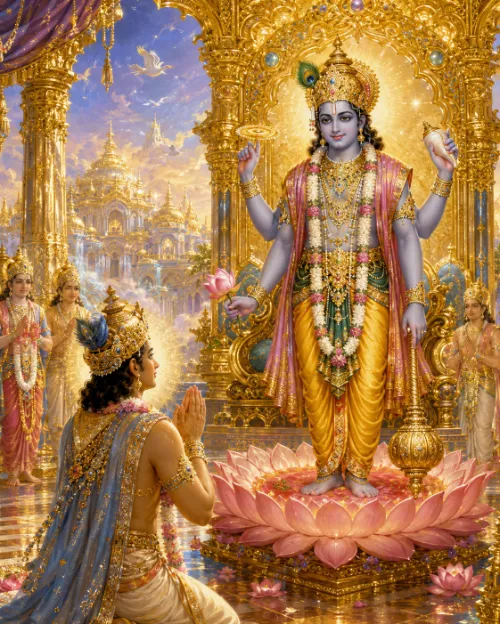
Why Reverence Is Not a Lesser Love
In the twenty-fourth chapter of the Madhya-līlā, Śrī Caitanya Mahāprabhu explains the Ātmārāma verse of the Śrīmad-Bhāgavatam to Sanātana Gosvāmī, distinguishing different devotional orientations and the corresponding forms in which Bhagavān is approached and attained. One of His most compact statements is this:
বিধিভক্ত্যে পার্ষদদেহে বৈকুণ্ঠেতে যায় ॥
vidhi-bhaktye pārṣada-dehe vaikuṇṭhete yāya
“Through vidhi-bhakti, one goes to Vaikuṇṭha in the body of an associate.”
Śrī Caitanya-caritāmṛta, Madhya 24.87
A.C. Bhaktivedanta Swami Prabhupāda translates:
“By executing regulative devotional service, one becomes an associate of Nārāyaṇa and attains the Vaikuṇṭhalokas, the spiritual planets in the spiritual sky.”
The Bengali deserves unpacking, because Mahāprabhu compresses an entire theology of liberation into three expressions.
The statement is therefore not merely “follow religious rules and go to heaven.” It is describing the culmination of a personal devotional relationship.
The Immediate Context: Vraja and Vaikuṇṭha
The verse completes a contrast Mahāprabhu establishes a few lines earlier:
রাগভক্তি, বিধিভক্তি হয় দুইরূপ ।
‘স্বয়ং-ভগবত্ত্বে’, ভগবত্ত্বে — প্রকাশ দ্বিরূপ ॥
rāga-bhakti, vidhi-bhakti haya dui-rūpa
svayaṁ-bhagavattve, bhagavattve — prakāśa dvi-rūpa
“Rāga-bhakti and vidhi-bhakti are two forms of devotion; correspondingly there are two modes of divine manifestation—as Svayaṁ-Bhagavān and as Bhagavān.”
Madhya 24.84
Then:
রাগভক্ত্যে ব্রজে স্বয়ং-ভগবানে পায় ॥
rāga-bhaktye vraje svayaṁ-bhagavāne pāya
“Through rāga-bhakti one attains Svayaṁ-Bhagavān in Vraja.”
Madhya 24.85
Within the theological contrast He develops here, the pattern is deliberate and parallel.
But this must be read carefully. It does not mean “anyone who follows devotional rules goes to Vaikuṇṭha.” Rāgānugā practitioners also hear, chant, worship, follow scripture, serve guru and observe devotional regulations. Regulation itself does not determine the destination. The deeper question is what devotional relationship governs the practice — Mahāprabhu is contrasting dominant bhāvas and devotional impulses, not quantities of rules.
What Is Vidhi-Bhakti?
The Bengali vidhi-bhakti corresponds to Rūpa Gosvāmī’s technical Sanskrit term:
वैधी-भक्ति
vaidhī-bhakti
The word vaidhī derives from:
विधि
vidhi
— rule, injunction, prescription, authoritative instruction. Rūpa first divides sādhana-bhakti into two broad forms:
वैधी रागानुगा चेति सा द्विधा साधनाभिधा ॥
vaidhī rāgānugā ceti sā dvidhā sādhanābhidhā
“Sādhana-bhakti is of two kinds: vaidhī and rāgānugā.”
Bhakti-rasāmṛta-sindhu 1.2.5
He then defines the first of them:
तत्र वैधी —
यत्र रागानवाप्तत्वात् प्रवृत्तिरुपजायते ।
शासनेनैव शास्त्रस्य सा वैधी भक्तिरुच्यते ॥
tatra vaidhī —
yatra rāgānavāptatvāt pravṛttir upajāyate
śāsanenaiva śāstrasya sā vaidhī bhaktir ucyate
“Where engagement in bhakti arises because rāga has not yet been attained and therefore arises principally through the injunction of śāstra, that is called vaidhī-bhakti.”
Bhakti-rasāmṛta-sindhu 1.2.6
The decisive phrase is:
शासनेनैव शास्त्रस्य
śāsanenaiva śāstrasya
— “through the authoritative direction of scripture.” That is much more precise than simply saying “regulated devotion.”
Vaidhī-Bhakti Is Not Mechanical Religion
The English word “regulative” can easily produce the wrong impression. Vaidhī-bhakti does not mean emotionless worship, mere ritualism, blind obedience, external religion or spiritually insignificant practice. It means that the principal initial impetus is something like: “Śāstra teaches that this is how Bhagavān should be served; therefore I shall serve Him in this way.”
A devotee may therefore perform hearing, chanting, deity worship, remembrance, prayer, guru-sevā, Vaiṣṇava-sevā, pilgrimage and the other limbs of bhakti because they are taught by scripture and the Vaiṣṇava tradition. This is genuine bhakti. It purifies consciousness, it nourishes attachment to Bhagavān, and it can develop into profound love. Indeed the verse itself describes its exalted culmination: a spiritual form as Bhagavān’s eternal associate.
The Difference Is Not “Rules Versus No Rules”
This point is crucial. A simplistic contrast would be vaidhī = rules and rāgānugā = spontaneity without rules. Rūpa explicitly rejects such a reading:
श्रवणोत्कीर्तनादीनि वैधभक्त्युदितानि तु ।
यान्यङ्गानि च तान्यत्र विज्ञेयानि मनीषिभिः ॥
śravaṇotkīrtanādīni vaidha-bhakty-uditāni tu
yāny aṅgāni ca tāny atra vijñeyāni manīṣibhiḥ
“The wise should understand that the limbs taught in connection with vaidhī-bhakti—such as hearing and chanting—also apply here.”
Bhakti-rasāmṛta-sindhu 1.2.296
Both paths can therefore involve śravaṇa, kīrtana, smaraṇa, arcana, vandana, service to guru and Vaiṣṇavas, holy-name practice and disciplined observance. The distinction lies principally in the impelling devotional orientation.
The outward activity may be identical. The inner direction differs.
What Does Pārṣada Mean?
The next crucial term is:
पार्षद
pārṣada
It can mean attendant, companion, associate, member of a divine retinue — one standing in personal relation to Bhagavān. So pārṣada-deha means the body or form of an associate, and this may be the most important expression in the whole verse. Mahāprabhu is not describing liberation merely as escaping matter, ending rebirth or ceasing to suffer. The devotee attains a positive spiritual identity suited to personal service.
Liberation as Relationship
Gauḍīya Vaiṣṇava theology does not understand the highest spiritual fulfillment merely as “I no longer suffer,” or “I will never again be born,” or “I dissolve into undifferentiated being.” Its positive center is sevā, loving service — and service requires Bhagavān, the devotee, a relationship, reciprocity and rasa.
The word pārṣada is therefore profoundly significant. A pārṣada is not an anonymous liberated consciousness; a pārṣada is someone in relationship with Bhagavān. Liberation is not the destruction of personhood. It is personhood freed from material conditioning and perfected for love.
The Residents of Vaikuṇṭha Possess Spiritual Forms
The Śrīmad-Bhāgavatam describes them directly:
वसन्ति यत्र पुरुषाः सर्वे वैकुण्ठमूर्तयः ।
येऽनिमित्तनिमित्तेन धर्मेणाराधयन् हरिम् ॥
vasanti yatra puruṣāḥ
sarve vaikuṇṭha-mūrtayaḥ
ye ’nimitta-nimittena
dharmeṇārādhayan harim
“There dwell persons who all possess Vaikuṇṭha forms, having worshiped Hari through devotion free from ulterior motive.”
Śrīmad-Bhāgavatam 3.15.14
The striking phrase is:
सर्वे वैकुण्ठमूर्तयः
sarve vaikuṇṭha-mūrtayaḥ
— “all possessing Vaikuṇṭha forms.” This gives an excellent scriptural background for pārṣada-deha. The devotee does not enter Vaikuṇṭha as a formless spectator, but with a spiritual form suited to participation in Bhagavān’s eternal world.
Does deha mean a material body? No. The temporary material body is not simply transported into Vaikuṇṭha — material embodiment belongs to conditioned existence, while the pārṣada-deha belongs to the spiritual order. It is a form suited to seeing Bhagavān, serving Him, speaking with Him, worshiping Him, moving within His realm and participating in eternal relationship. Personal identity remains; material conditioning does not.
Nor should the glorious forms of Vaikuṇṭha’s residents be misunderstood as implying ontological identity with Nārāyaṇa. Bhagavān remains Bhagavān and the devotee remains His devotee; individuality remains meaningful because relationship remains meaningful. If all distinction disappeared, the very idea of becoming an “associate” would lose its meaning. The perfection described here is not the erasure of relationship but eternal participation in it.
What Is Vaikuṇṭha?
The Sanskrit name:
वैकुण्ठ
Vaikuṇṭha
refers to the transcendental realm of Bhagavān, particularly Śrī Nārāyaṇa and His eternal associates. It should never be confused with Svarga.
The verse is therefore not promising a heavenly reward for following religious regulations. It is describing transcendent personal liberation through bhakti.
Why Nārāyaṇa Appears in the Traditional Translation
The Bengali does not literally say Nārāyaṇa. It says:
pārṣada-dehe vaikuṇṭhete yāya
— “one goes to Vaikuṇṭha in a pārṣada-form.” Yet rendering this as “one becomes an associate of Nārāyaṇa” is contextually natural, because Madhya 24.84–87 contrasts Svayaṁ-Bhagavān in Vraja with Bhagavān in Vaikuṇṭha, and within Gauḍīya theology the paradigmatic form of Bhagavān in Vaikuṇṭha is Śrī Nārāyaṇa. Prabhupāda’s translation is explanatory rather than mechanically literal.
The Next Quotation Prevents a Dry Reading
Immediately afterward, Mahāprabhu quotes a verse from the Bhāgavata’s description of Vaikuṇṭha:
यच्च व्रजन्त्यनिमिषामृषभानुवृत्त्या
दूरे यमा ह्युपरि नः स्पृहणीयशीलाः ।
भर्तुर्मिथः सुयशसः कथनानुराग-
वैक्लव्यबाष्पकलया पुलकीकृताङ्गाः ॥
yac ca vrajanty animiṣām ṛṣabhānuvṛttyā
dūre yamā hy upari naḥ spṛhaṇīya-śīlāḥ
bhartur mithaḥ su-yaśasaḥ kathānurāga-
vaiklavya-bāṣpa-kalayā pulakī-kṛtāṅgāḥ
Śrīmad-Bhāgavatam 3.15.25
quoted in Caitanya-caritāmṛta, Madhya 24.88
This is an important corrective. The devotees described here are deeply attached to discussing the glorious qualities of their Lord, and their devotion produces tears and pulaka, horripilation. The immediate scriptural context does not portray Vaikuṇṭha devotion as cold, bureaucratic or emotionally sterile. Vaidhī-bhakti can mature into profound love. The real contrast with Vraja is therefore not love versus no love. It is different modes of love.
Aiśvarya and Mādhurya
That reverence is not terror. Vaikuṇṭha devotees are not frightened subjects before a cosmic monarch: they love Bhagavān’s beauty, compassion, power, sovereignty, names, qualities and presence. Their reverence is itself devotional. And in Vraja, divine majesty does not disappear ontologically — it recedes from the foreground of consciousness so that intimacy can flourish.
Unity in Tattva, Distinction in Rasa
This comparison must be made carefully, and Rūpa Gosvāmī supplies the safeguard:
सिद्धान्ततस्त्वभेदेऽपि श्रीशकृष्णस्वरूपयोः ।
रसेनोत्कृष्यते कृष्णरूपमेषा रसस्थितिः ॥
siddhāntatas tv abhede ’pi
śrīśa-kṛṣṇa-svarūpayoḥ
rasenotkṛṣyate kṛṣṇa-rūpam
eṣā rasa-sthitiḥ
“Although according to philosophical conclusion there is non-difference between the forms of Śrīśa [Nārāyaṇa] and Kṛṣṇa, Kṛṣṇa’s form excels through rasa. Such is the nature of rasa.”
Bhakti-rasāmṛta-sindhu 1.2.59
So there is abheda in tattva but particularity in rasa. Nārāyaṇa is fully Bhagavān; Kṛṣṇa is fully Bhagavān. The difference is not “Nārāyaṇa is ninety per cent God and Kṛṣṇa is a hundred” — that would be a caricature. The difference concerns self-revelation within relationship: Nārāyaṇa manifests divine majesty, while Kṛṣṇa of Vraja manifests modes of intimacy that do not remain equally foregrounded in the majestic atmosphere of Vaikuṇṭha.
The Geography Corresponds to Relationship
Vraja and Vaikuṇṭha should therefore not be imagined merely as two locations on a spiritual map. They are also relational worlds. Vaikuṇṭha is the world in which Bhagavān is magnificently experienced as the Supreme Lord and beloved master; Vraja is the world in which Kṛṣṇa becomes son, friend and beloved.
Consider Yaśodā. For her vātsalya to function fully she cannot remain constantly dominated by the thought “this child is the omnipotent ruler of all universes” — if that awareness stayed perpetually foregrounded, her motherly impulses to feed Him, protect Him, discipline Him and worry about Him would be inhibited. Likewise Kṛṣṇa’s cowherd friends must be free to challenge Him, climb upon Him, defeat Him and joke with Him. Vraja manifests a relational environment in which aiśvarya becomes concealed beneath intimacy; Vaikuṇṭha manifests another perfect balance, in which reverence remains prominent.
The Orientation Points Toward the Perfected Relationship
This is one of the deepest principles behind the pair of verses. The spiritual destination is not an arbitrary reward assigned after death: the devotional orientation cultivated in sādhana points toward the corresponding perfected relationship. Reverential devotion centered upon Nārāyaṇa finds its natural fulfillment in Vaikuṇṭha; rāgānugā longing directed toward Vraja points toward Vraja.
This does not mean that every person following regulations is automatically Vaikuṇṭha-oriented, nor that emotional intensity proves rāgānugā. The determining issue is the predominant bhāva, the object of longing, and the relational aspiration.
Vaikuṇṭha Is Not a Consolation Prize
This qualification is essential. One should not speak as though Vaikuṇṭha were merely the destination of devotees who “failed to reach Vraja.” A devotee whose eternal love is directed toward majestic Śrī Nārāyaṇa does not experience Vaikuṇṭha as a disappointing alternative. If the heart eternally longs, “may I behold Śrī Nārāyaṇa and serve Him with reverence and love,” then Vaikuṇṭha is not deprivation. It is the perfect fulfillment of that relationship.
The theology concerns correspondence between love and revelation, not a crude ranking of devotees. The general principle appears in the Bhagavad-gītā:
ये यथा मां प्रपद्यन्ते तांस्तथैव भजाम्यहम् ॥
ye yathā māṁ prapadyante
tāṁs tathaiva bhajāmy aham
“As people approach Me, I reciprocate with them accordingly.”
Bhagavad-gītā 4.11
Gauḍīya theology takes this reciprocity very seriously. Bhakti is not merely the devotee moving toward Bhagavān; Bhagavān also reveals Himself according to the relationship through which He is approached. The path is intrinsically relational.
Why Pārṣada-Deha Matters So Much
We can now return to the heart of the verse. The expression reveals that liberation possesses form, identity, service and relationship. The devotee does not merely attain “eternity” — the devotee becomes eternally capable of participating.
- Eyes behold Bhagavān.
- A voice praises Him.
- Hands serve Him.
- The devotee approaches Him.
- Associates speak with one another about Him.
There is movement, beauty, personality, environment, service and reciprocal affection. The spiritual form is not an obstacle to liberation. It is the perfected instrument of love.
Two Symmetrical Mistakes
Does every rule-following devotee go to Vaikuṇṭha? No — and this must remain explicit. A practitioner aspiring toward Vraja may rise at regulated times, chant a fixed number of names, observe Ekādaśī, worship the deity, follow scriptural principles, serve guru, study śāstra and live a highly disciplined devotional life. None of those practices by themselves make the destination Vaikuṇṭha, because Rūpa explicitly teaches that rāgānugā practitioners continue the major limbs of bhakti described under vaidhī. Regulation is a feature of sādhana; it is not necessarily the source of the sādhaka’s longing.
The opposite mistake is equally serious. Someone may cry, sing passionately, reject formal discipline or describe himself as “spontaneous” — and none of that establishes rāgānugā-bhakti, which has a precise theological definition: it follows the rāgātmikā-bhakti of the eternal Vrajavāsīs. The real contrast is not disciplined versus emotional. It is vidhi as the predominant impelling force versus rāga or lobha toward a Vraja-bhāva as the predominant impelling force.
Two Ways to Translate the Verse
What the Verse Does Not Mean
All of these flatten Mahāprabhu’s theology. What the verse actually teaches is that a particular devotional orientation reaches fulfillment in a corresponding divine relationship. Where devotion is principally structured by reverential, śāstra-guided service, its perfection can be Vaikuṇṭha — and there the devotee receives a spiritual form suited to eternal association and service. The destination is not impersonal, not material, not temporary, and not merely freedom from pain. It is eternal loving service.
Two Perfections of Relationship
Neither realm is material. Neither form of devotion is false. Neither requires belief in separate competing Gods. They are distinct revelations of divine relationship within different rasas.
The verse is much more than a statement about where people who “follow regulations” go after death. Its meaning is closer to this: bhakti forms a relationship, and that relationship has a corresponding eternal expression. A devotee whose sādhana is principally governed by vidhi does not merely complete a religious program; through hearing, chanting, worship, remembrance and service, consciousness becomes increasingly oriented toward Bhagavān, and where that relationship is structured by reverential devotion toward the majestic Lord, its perfected realization is Vaikuṇṭha.
There the devotee does not disappear. The devotee becomes fully capable of eternal relationship — not as a conditioned material personality, but as a pārṣada, an eternal associate possessing spiritual form and engaged in loving service. Read vidhi-bhaktye pārṣada-dehe vaikuṇṭhete yāya alongside its companion line:
rāga-bhaktye vraje svayaṁ-bhagavāne pāya
“Through rāga-bhakti one attains Svayaṁ-Bhagavān in Vraja,”
— and a deeper Gauḍīya principle becomes visible. The devotional orientation of the path, the bhāva of the devotee, the mode in which Bhagavān reveals Himself, and the eternal world of service all correspond to one another.
Principal Scriptural and Theological Sources
The passages drawn on above, gathered by text. Each is quoted in full — in its own script, with transliteration and translation — at the point where it is discussed.
Śrī Caitanya-caritāmṛta
Rūpa Gosvāmī — Bhakti-rasāmṛta-sindhu
Śrīmad-Bhāgavatam
Bhagavad-gītā
The Sanskrit of the Bhakti-rasāmṛta-sindhu circulates in several printed and electronic recensions whose readings and numbering differ in small particulars. The verses above are reproduced as supplied; anyone citing them in formal scholarship should check them against the specific edition they are working from.