

The Gift and the Giver
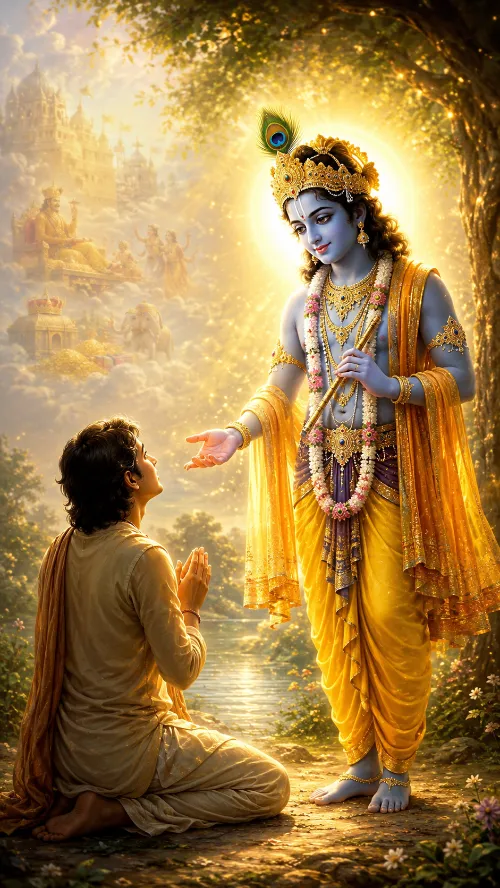
Do You Want the Fruit, or the Source of Every Fruit?
A verse in the Seventh Chapter of the Bhagavad-gītā is often read as a flat dismissal of worshiping any deity other than Kṛṣṇa. Read closely, it says something considerably more interesting — and considerably harder to dismiss. Kṛṣṇa grants that such worship works. His objection is about what one is asking for.
अन्तवत्तु फलं तेषां
तद्भवत्यल्पमेधसाम् ।
देवान्देवयजो यान्ति
मद्भक्ता यान्ति मामपि ॥
“But the fruit obtained by them is finite; such is the result of those whose discernment is limited. The worshipers of the devas go to the devas, whereas My devotees come to Me.”
Bhagavad-gītā 7.23
A familiar Vaiṣṇava rendering puts it more interpretively:
“The worshipers of the demigods receive temporary results and go to the planets of those demigods, whereas My devotees attain My supreme abode.”
That expresses the traditional theology accurately enough, but two distinctions in the Sanskrit are worth keeping, because both make the verse sharper rather than softer.
अल्पमेधसाम्
alpa-medhasām
does not simply mean that deva-worshipers are stupid. It describes those whose discernment is limited — whose spiritual horizon is short. And the word rendered “My supreme planet” is only:
माम्
mām
— “Me.” The supreme abode is an explanatory gloss on what attaining Kṛṣṇa means, not a translation of the word itself. So the contrast the verse actually draws is not one deity against another. It is temporary fruit against the eternal source: the divine gift against the divine Giver.
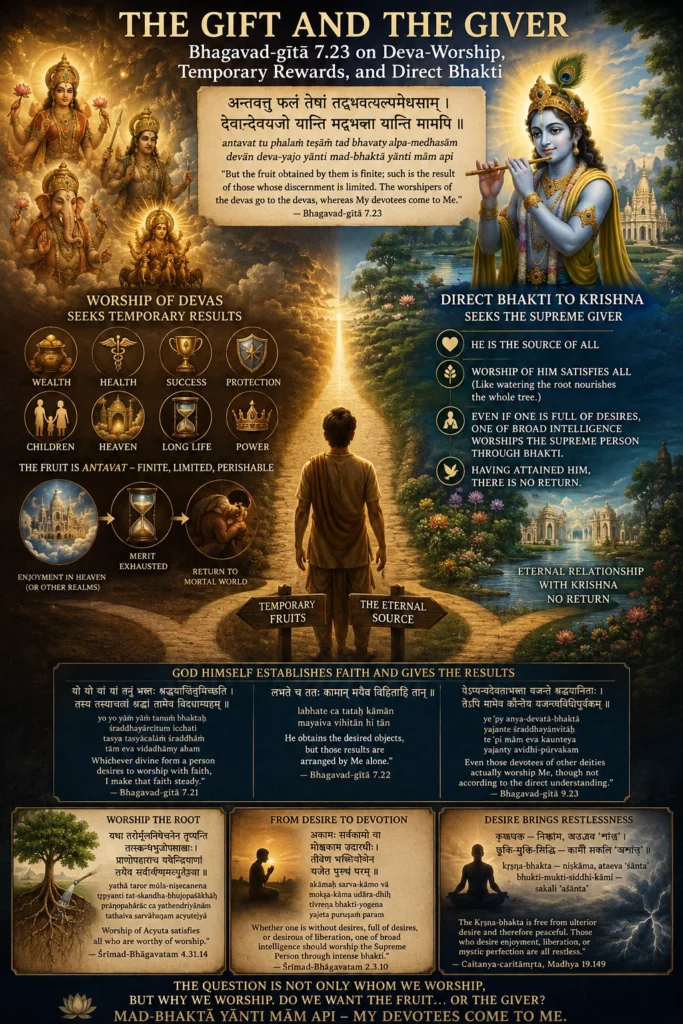
The whole argument on one sheet: the finite results sought through deva-worship on one side, direct bhakti to the supreme Giver on the other, the verses in which Kṛṣṇa Himself stabilizes the worshiper's faith and sanctions the result, and the root-of-the-tree analogy beneath.
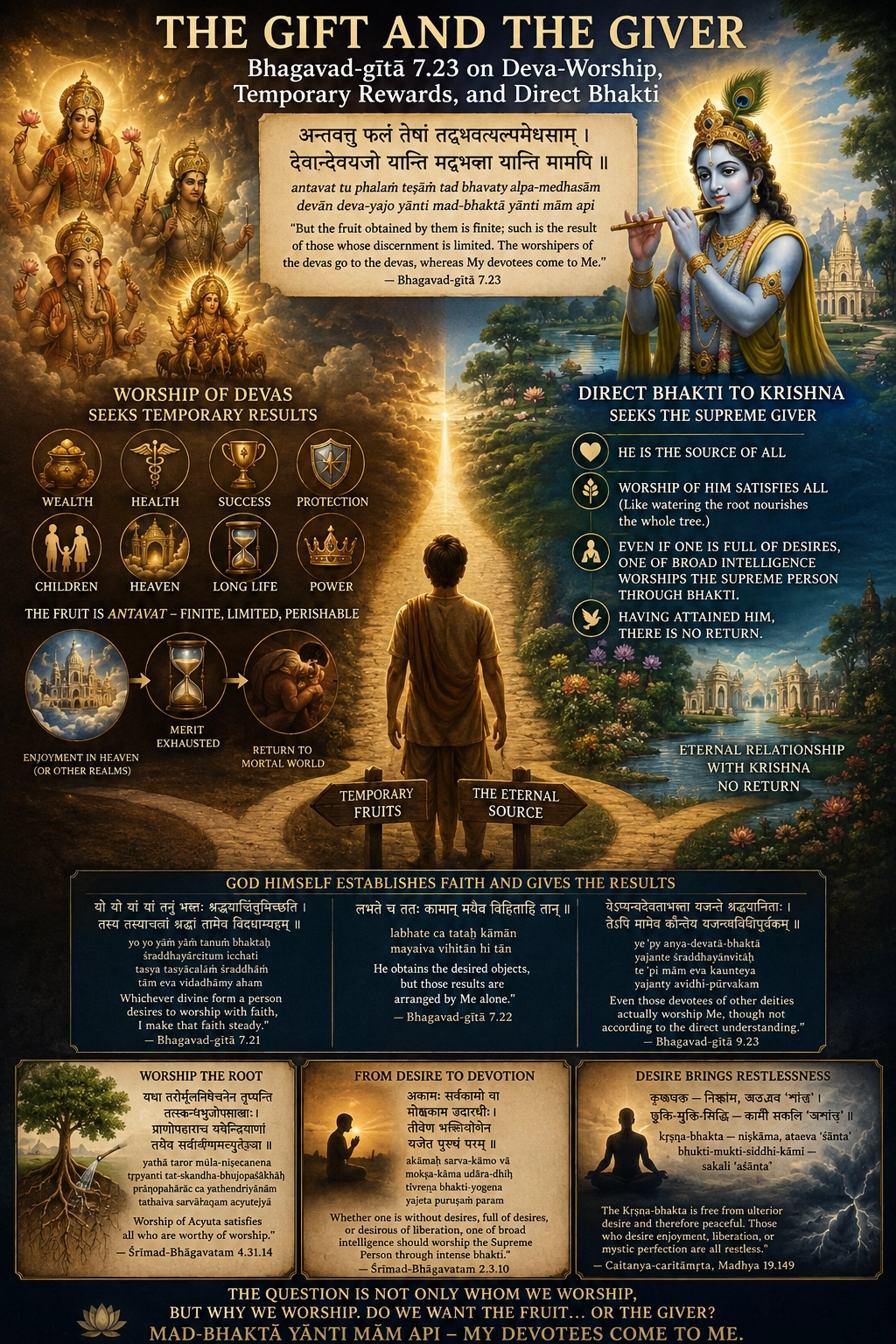
The Verse Is the End of a Four-Verse Argument
Taken alone, 7.23 sounds like a verdict. In place, it is a conclusion — and the three verses leading to it do most of the theological work. Kṛṣṇa begins by explaining why people approach various devas at all:
कामैस्तैस्तैर्हृतज्ञानाः
प्रपद्यन्तेऽन्यदेवताः ।
तं तं नियममास्थाय
प्रकृत्या नियताः स्वया ॥
“Those whose discernment has been carried away by various desires take shelter of other deities, following the corresponding regulations according to their own conditioned nature.”
Bhagavad-gītā 7.20
Then He says something genuinely surprising:
यो यो यां यां तनुं भक्तः
श्रद्धयार्चितुमिच्छति ।
तस्य तस्याचलां श्रद्धां
तामेव विदधाम्यहम् ॥
“Whichever divine form a person desires to worship with faith, I make that faith steady.”
Bhagavad-gītā 7.21
स तया श्रद्धया युक्तस्
तस्याराधनमीहते ।
लभते च ततः कामान्
मयैव विहितान्हि तान् ॥
“Endowed with that faith, that person worships the chosen deity and obtains the objects of desire—but those results are actually arranged by Me alone.”
Bhagavad-gītā 7.22
Only after all of that does He conclude:
अन्तवत्तु फलं तेषाम्
antavat tu phalaṁ teṣām
“But their fruit has an end.”
So the sequence is not “the devas are false and their worship produces nothing.” It is nearly the opposite. The worship may produce a real result. The result is simply antavat — finite.
Antavat: Possessing an End
अन्तवत्
antavat
The word is built from anta — end, limit, boundary — and the suffix -vat, possessing. So it means having an end: finite, limited, perishable. Which makes Kṛṣṇa’s criticism unusually precise. He does not say the fruit is imaginary. He says the fruit expires.
A worshiper may want wealth, health, children, victory, rain, protection, long life, social power, or elevation to a higher realm — and the Gītā has no need to deny that these can have real value. Its question comes afterward: what happens once the result has been consumed? Temporary happiness may be genuine happiness; heavenly pleasure may far exceed the earthly kind; prosperity may genuinely make life easier. The question is whether a temporary result can satisfy the deepest need of a being that does not end. The answer given is no — the result may be valuable within time, and time takes it back.
It Begins With Desire, Not With Theology
कामैस्तैस्तैर्हृतज्ञानाः
kāmais tais tair hṛta-jñānāḥ
“those whose discernment has been carried away by various desires.”
This phrase governs the whole passage. Kṛṣṇa’s criticism is not a complaint about religious diversity; it is a diagnosis of what desire does to spiritual intelligence. Desire asks which divine power can satisfy this particular need? Discernment asks something prior: what is highest, and what is ultimately worth seeking? The trouble is not that the desired object is bad. It is that desire can shrink the horizon until a temporary result starts to look ultimate.
Which is what the much-quoted phrase actually means. Alpa is small or limited; medhas is intelligence, understanding, discernment. “Those whose discernment is limited” need not lack ordinary intelligence at all — a person may have education, memory, business skill, scientific reasoning, political sophistication and practical cleverness, and still operate on a short spiritual horizon. One can be exceptionally good at answering how do I get what I want? and never ask what is worth wanting?
The first evaluates means; the second examines the end itself. Discernment is called limited when the calculation stops at a temporary reward.
Why Deva-Worship Is Attractive
Kṛṣṇa gives the practical reason elsewhere, and it is disarmingly honest:
काङ्क्षन्तः कर्मणां सिद्धिं
यजन्त इह देवताः ।
क्षिप्रं हि मानुषे लोके
सिद्धिर्भवति कर्मजा ॥
“Those who desire success in their activities worship the devas, for results produced by such action are obtained quickly in the human world.”
Bhagavad-gītā 4.12
The operative word is:
क्षिप्रम्
kṣipram
“quickly.”
Deva-worship can be highly specialized — a particular desire corresponds to a particular cosmic function, the appropriate deity is approached, and a result may follow. So the contrast is not effective against ineffective. It is quick against ultimate.
The Gītā Does Not Deny the Devas
This matters for a modern reader, because 7.23 is often reduced to “Kṛṣṇa says the other gods are fake.” The text says nothing of the kind. It presupposes throughout that the devas exist, hold real cosmic functions, receive real worship, inhabit real realms, and can confer real benefits. The distinction being drawn is hierarchy, not existence.
देव
deva
The Sanskrit word has a broader and more dignified range than “demigod” sometimes suggests — deity, god, celestial being, luminous being. “Demigod” entered Vaiṣṇava English to stress that a deva is not the Supreme Bhagavān, which is a fair point, but for general readers deva or celestial deity is usually clearer and less dismissive than the tone the English word now carries.
Nor is such worship treated as morally degraded. The Gītā’s own classification puts it in the highest of the three modes:
यजन्ते सात्त्विका देवान्
यक्षरक्षांसि राजसाः ।
प्रेतान्भूतगणांश्चान्ये
यजन्ते तामसा जनाः ॥
“Those situated in sattva worship the devas; those in rajas worship yakṣas and rākṣasas; others situated in tamas worship ghosts and spirits.”
Bhagavad-gītā 17.4
So the criticism in 7.23 is not that deva-worship is wicked. It is subtler and more uncomfortable: even a refined, legitimate, sāttvika religious pursuit may still be aimed at a finite fruit.
Earlier still, Kṛṣṇa describes the reciprocity between human beings and devas as a working part of the cosmic order:
देवान्भावयतानेन
ते देवा भावयन्तु वः ।
परस्परं भावयन्तः
श्रेयः परमवाप्स्यथ ॥
“Through sacrifice nourish the devas, and may the devas nourish you. By mutually supporting one another, you will attain prosperity.”
Bhagavad-gītā 3.11
इष्टान्भोगान्हि वो देवा
दास्यन्ते यज्ञभाविताः ।
“The devas, satisfied through sacrifice, will provide the desired enjoyments.”
Bhagavad-gītā 3.12
The relationship is treated as real. The Seventh Chapter simply asks a further question about it: is reciprocity within the material cosmos the highest available relationship with the divine?
Kṛṣṇa Stabilizes the Worshiper’s Faith
Here the passage makes a claim that is easy to read past:
तस्य तस्याचलां श्रद्धां
तामेव विदधाम्यहम्
“I establish that person’s firm faith.”
Even deva-worship, in other words, does not operate outside Kṛṣṇa’s sovereignty. The worshiper may imagine an independent divine authority, but the capacity for steady faith itself is described as existing within His arrangement. And the following verse goes further:
मयैव विहितान्हि तान्
mayaiva vihitān hi tān
“Those results are arranged by Me alone.”
The devas are therefore not portrayed as rival absolutes operating independently. They function within a larger divine order.
Vaiṣṇava teachers often explain this by analogy with government. A minister may hold genuine authority, administer a department, distribute resources and grant permissions within a sphere — and that authority is real, but delegated; it is not sovereign apart from the government it belongs to. The analogy should not be pressed too literally, but it captures the distinction between a delegated function and an ultimate source.
Watering the Root
The Śrīmad-Bhāgavatam supplies the most elegant image for why direct worship is considered comprehensive rather than exclusive:
यथा तरोर्मूलनिषेचनेन
तृप्यन्ति तत्स्कन्धभुजोपशाखाः ।
प्राणोपहाराच्च यथेन्द्रियाणां
तथैव सर्वार्हणमच्युतेज्या ॥
“Just as watering the root of a tree nourishes its trunk, branches, and twigs, and just as supplying nourishment to the life-center sustains all the senses, so worship of Acyuta satisfies all who are worthy of worship.”
Śrīmad-Bhāgavatam 4.31.14
with its concluding principle:
तथैव सर्वार्हणमच्युतेज्या
tathaiva sarvārhaṇam acyutejyā
“In the same way, worship of Acyuta is worship of all.”
Which is the crucial nuance: watering the root does not insult the branches. It nourishes them through their source. The devas need not be despised in this theology — they are understood in relation to the whole.
Kṛṣṇa makes the same inclusive-yet-hierarchical move directly:
येऽप्यन्यदेवताभक्ता
यजन्ते श्रद्धयान्विताः ।
तेऽपि मामेव कौन्तेय
यजन्त्यविधिपूर्वकम् ॥
“Even those devotees of other deities who worship with faith are actually worshiping Me, O Kaunteya, though not according to the direct or proper understanding.”
Bhagavad-gītā 9.23
He does not say their worship has no relation to Him. He says it reaches:
मामेव
mām eva
“Me alone”
— and then adds the qualifier:
अविधिपूर्वकम्
avidhi-pūrvakam
indicating worship performed without a complete grasp of the theological order it belongs to. The next verse states what that order is:
अहं हि सर्वयज्ञानां
भोक्ता च प्रभुरेव च ।
न तु मामभिजानन्ति
तत्त्वेनातश्च्यवन्ति ते ॥
“I am indeed the enjoyer and Lord of all sacrifices, but they do not know Me in truth; therefore they fail to attain the highest result.”
Bhagavad-gītā 9.24
— bhoktā, the ultimate recipient, and prabhuḥ, the Lord. Legitimate worship, on this account, already exists inside an overarching unity; what varies is whether the worshiper knows it.
Destination Follows Worship
देवान्देवयजो यान्ति
devān deva-yajo yānti
“The worshipers of the devas go to the devas.”
The principle is stated more fully in the Ninth Chapter:
यान्ति देवव्रता देवान्
पितॄन्यान्ति पितृव्रताः ।
भूतानि यान्ति भूतेज्या
यान्ति मद्याजिनोऽपि माम् ॥
“Those devoted to the devas go to the devas; those devoted to the ancestors go to the ancestors; those who worship other beings go to them; and those who worship Me come to Me.”
Bhagavad-gītā 9.25
Read cosmologically, this says the object of worship determines the corresponding destination. But it also describes something psychological and immediately recognizable: worship shapes attention, desire, memory, values, identity and longing. What a person repeatedly venerates becomes progressively more central to their consciousness. One moves toward what one worships because worship itself forms orientation.
As for why those realms are temporary, the Gītā’s cosmology answers plainly:
आब्रह्मभुवनाल्लोकाः
पुनरावर्तिनोऽर्जुन ।
मामुपेत्य तु कौन्तेय
पुनर्जन्म न विद्यते ॥
“From the realm of Brahmā downward, all worlds are places from which one returns, O Arjuna. But having attained Me, there is no further birth.”
Bhagavad-gītā 8.16
which may be the clearest commentary on antavat anywhere in the text: even the highest material realm is punar-āvartin, subject to return. And the mechanism is spelled out:
ते तं भुक्त्वा स्वर्गलोकं विशालं
क्षीणे पुण्ये मर्त्यलोकं विशन्ति ।
एवं त्रयीधर्ममनुप्रपन्ना
गतागतं कामकामा लभन्ते ॥
“Having enjoyed the vast heavenly world, when their merit is exhausted they enter the mortal world again. Thus those who follow the ritualistic path while desiring enjoyment undergo repeated coming and going.”
Bhagavad-gītā 9.21
with the decisive phrase:
क्षीणे पुण्ये
kṣīṇe puṇye
“when the merit is exhausted.”
The celestial experience lasts as long as the merit supporting it lasts. When that is spent, the result ends.
None of which makes temporary things worthless, and the distinction is worth guarding. A healthy body is temporary and valuable; rainfall is temporary and necessary; economic stability is temporary and useful. Family life, education, work and social order all exist within time. The Gītā’s point is not that temporary things have no value — it is that relative value should not be mistaken for ultimate value. The finite can serve a life. It cannot be the foundation of one.
“My Devotees Come to Me”
Against devān deva-yajo yānti, Kṛṣṇa sets:
मद्भक्ता यान्ति मामपि
mad-bhaktā yānti mām api
“My devotees come to Me.”
The simplicity is the point. He does not promise His devotees a more luxurious reward than the devas can offer. He says they attain Him — and that is the real contrast of the verse. Reward-centered worship seeks phala, fruit. Bhakti seeks Bhagavān.
This is also why the interpretive translation, though sound, should not replace the literal one. That Vaiṣṇava reading is well supported:
मामुपेत्य तु कौन्तेय
पुनर्जन्म न विद्यते
“Having attained Me, O Kaunteya, there is no further birth.”
Bhagavad-gītā 8.16
But the word in 7.23 is simply mām, “Me.” A translation does best to preserve that bareness and let commentary explain what attaining Kṛṣṇa implies.
Bring the Desires Directly
The Bhāgavatam then makes a recommendation that cuts against most expectations of what devotion requires:
अकामः सर्वकामो वा
मोक्षकाम उदारधीः ।
तीव्रेण भक्तियोगेन
यजेत पुरुषं परम् ॥
“Whether one is without material desire, filled with all desires, or desirous of liberation, one of broad intelligence should worship the Supreme Person through intense bhakti-yoga.”
Śrīmad-Bhāgavatam 2.3.10
The phrase describing such a person is:
उदारधीः
udāra-dhīḥ
— one of broad, expansive, generous intelligence, which forms a deliberate contrast with alpa-medhas, limited discernment. The person of short horizon asks which divine power can satisfy this particular desire. The person of broad intelligence asks a different question: whatever my present condition, why not approach the ultimate source directly?
And remarkably, the verse does not require becoming desireless first:
सर्वकामो वा
sarva-kāmo vā
“even if one is full of desires.”
Bring them, whatever they are, to:
पुरुषं परम्
puruṣaṁ param
“the Supreme Person.”
Bhakti can then begin purifying what one wants. Which produces a strikingly relational theology: one need not approach Bhagavān pretending to have no material desires. A more honest path often begins with please help me — and relationship changes desire over time. Please give me this becomes please give me what brings me closer to You, and eventually let me serve You. That is the movement from transaction to relationship.
Kṛṣṇadāsa Kavirāja states the same psychology compactly:
কৃষ্ণভক্ত — নিষ্কাম, অতএব ‘শান্ত’ ।
ভুক্তি-মুক্তি-সিদ্ধি — কামী সকলি ‘অশান্ত’ ॥
“The Kṛṣṇa-bhakta is free from ulterior desire and therefore peaceful. Those who desire enjoyment, liberation, or mystic perfection are all restless.”
Caitanya-caritāmṛta, Madhya-līlā 19.149
All three remain things the practitioner is trying to get. The mature devotee’s orientation has moved to sevā, and to Bhagavān Himself.
Direct Bhakti Does Not Require Hostility
This is a necessary safeguard, and the tradition states it clearly. Vaiṣṇava theology does not require insulting the devas, who may be honored respectfully as exalted beings and empowered authorities within Bhagavān’s cosmos. The distinction is between honor and ultimate surrender: one may honor Śiva, Brahmā, Indra, Sūrya, Gaṇeśa and others without making temporary boons the goal of spiritual life.
Very Long Is Not Eternal
A deva’s realm may endure for spans of time barely imaginable to a human being. But very long and eternal are not degrees of the same thing; there is an absolute difference between what ends and what does not. However extraordinary a celestial experience may be, if it ends it is antavat.
Which lets the logic of the verse extend well past its immediate subject. Everything inside material time is antavat — wealth, youth, beauty, fame, political power, professional achievement, possessions, and celestial pleasure alike. So the verse ends up asking something uncomfortably personal: how much of one’s deepest energy is invested in things whose defining characteristic is that they end?
Not that bhakti demands hatred of temporary things. It changes their position rather than their value. Money can be used, the body cared for, skills developed, family duties fulfilled, work performed responsibly. The difference is between using temporary resources and making them the final purpose of consciousness — between phala as something received and phala in the place where Bhagavān should be.
Whom Do I Worship, and Why?
The verse finally asks two questions, and the second is the harder one. A person may outwardly worship Kṛṣṇa while inwardly thinking only give me the result I want — which is still the transactional structure described in 7.20–23, merely with a different name attached. Direct bhakti matures as the relationship itself becomes the point.
So the decisive transition is not from one deity to another. It is from transaction to relationship — and that is what the whole four-verse argument has been building toward.
The Argument, End to End
Which makes this rather more than a critique of polytheism. It is a compressed theology of desire, faith, divine hierarchy, ritual, sanction, karma, destination and bhakti at once.
Kṛṣṇa acknowledges a cosmos of genuine devas, acknowledges their worship, acknowledges that the benefits sought may actually be received, says that He Himself stabilizes the worshiper’s faith, and says the results come under His own sanction. Only then does He name the limitation — and it is not that the fruit is unreal, but that it cannot last. The person of alpa-medhas is not being called a fool. The limitation is in choosing a finite horizon when an eternal relationship is on offer. One path asks which divine power can supply the fruit it wants. Bhakti asks whether the Giver might be greater than every gift.