

When Compassion Is Clouded by Grief
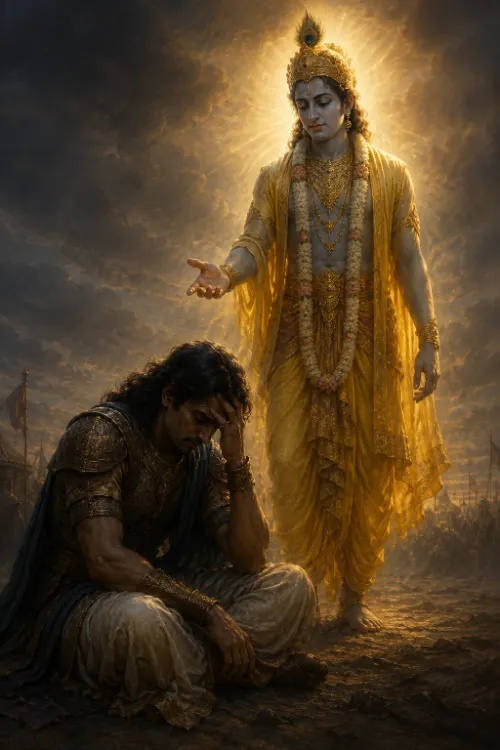
Kṛṣṇa’s Call to Spiritual Clarity at the Opening of the Gītā
The Gītā’s opening rebuke is routinely read as Kṛṣṇa telling a frightened man to pull himself together. But the text has already told us what is actually wrong with Arjuna, and it is not cowardice — it is that his compassion has become inseparable from grief. What Kṛṣṇa questions is not his heart. It is what grief has done to his judgment.
श्रीभगवानुवाच ।
कुतस्त्वा कश्मलमिदं
विषमे समुपस्थितम् ।
अनार्यजुष्टमस्वर्ग्यम्
अकीर्तिकरमर्जुन ॥
śrī-bhagavān uvāca
kutas tvā kaśmalam idaṁ
viṣame samupasthitam
anārya-juṣṭam asvargyam
akīrti-karam arjuna
“The Blessed Lord said: O Arjuna, from where has this bewilderment come upon you at such a critical moment? It is unworthy of the noble, does not lead to heaven, and brings dishonor.”
Bhagavad-gītā 2.2
Śrīla A. C. Bhaktivedanta Swami Prabhupāda renders it: “My dear Arjuna, how have these impurities come upon you? They are not at all befitting a man who knows the value of life. They lead not to higher planets but to infamy.” Both carry the same force with slightly different emphasis, since the Sanskrit is unusually elastic here:
But the real question runs deeper than translation. Kṛṣṇa is not saying “stop feeling sad and fight.” He is asking something far more searching: has Arjuna’s compassion become so entangled with grief, attachment and confusion that he can no longer perceive dharma clearly? That question opens the entire Bhagavad-gītā.
The Crisis Begins With Compassion
The verse immediately before the rebuke is the one that settles how to read it:
सञ्जय उवाच ।
तं तथा कृपयाविष्टम्
अश्रुपूर्णाकुलेक्षणम् ।
विषीदन्तमिदं वाक्यम्
उवाच मधुसूदनः ॥
sañjaya uvāca
taṁ tathā kṛpayāviṣṭam
aśru-pūrṇākulekṣaṇam
viṣīdantam idaṁ vākyam
uvāca madhusūdanaḥ
“Sañjaya said: To Arjuna, who was thus overwhelmed by compassion, whose eyes were filled with tears and disturbed by grief, Madhusūdana spoke these words.”
Bhagavad-gītā 2.1
The crucial word is the text’s own diagnosis:
कृपयाविष्टम्
kṛpayāviṣṭam“overwhelmed by compassion.”
Scripture itself identifies compassion as part of Arjuna’s condition — which immediately forecloses the crude reading. Kṛṣṇa is not teaching that compassion is weakness. Later in the same text He names it as a mark of the devotee He loves:
अद्वेष्टा सर्वभूतानां
मैत्रः करुण एव च ।
निर्ममो निरहङ्कारः
समदुःखसुखः क्षमी ॥
adveṣṭā sarva-bhūtānāṁ
maitraḥ karuṇa eva ca
nirmamo nirahaṅkāraḥ
sama-duḥkha-sukhaḥ kṣamī
“One who hates no living being, who is friendly and compassionate toward all, free from possessiveness and ego, equipoised in happiness and distress, and forgiving—such a devotee is dear to Me.”
Bhagavad-gītā 12.13
So compassion is not the problem. The problem is compassion mixed with śoka, grief; moha, delusion; attachment, fear, and uncertainty about duty. Kṛṣṇa does not harden Arjuna’s heart. He educates it.
He Is Not Afraid to Die
The collapse is often reduced to cowardice, and the first chapter rules that out. Seeing his relatives arrayed for battle:
दृष्ट्वेमं स्वजनं कृष्ण
युयुत्सुं समुपस्थितम् ।
सीदन्ति मम गात्राणि
मुखं च परिशुष्यति ॥
dṛṣṭvemaṁ sva-janaṁ kṛṣṇa
yuyutsuṁ samupasthitam
sīdanti mama gātrāṇi
mukhaṁ ca pariśuṣyati
“Seeing my own people, O Kṛṣṇa, assembled here desiring to fight, my limbs are failing and my mouth is drying up.”
Bhagavad-gītā 1.28–29
स्वजनम्
sva-janam“my own people.”
Arjuna is not primarily thinking they may kill me. He is thinking how can I kill them? His anxiety is about the death of elders, the destruction of family lineages, the collapse of traditional duty, social corruption, sin, and the moral cost of winning. And he says so as plainly as it can be said:
यदि मामप्रतीकारम्
अशस्त्रं शस्त्रपाणयः ।
धार्तराष्ट्रा रणे हन्युस्
तन्मे क्षेमतरं भवेत् ॥
yadi mām apratīkāram
aśastraṁ śastra-pāṇayaḥ
dhārtarāṣṭrā raṇe hanyus
tan me kṣemataraṁ bhavet
“It would be better for me if the sons of Dhṛtarāṣṭra, weapons in hand, were to kill me in battle while I remained unarmed and did not resist.”
Bhagavad-gītā 1.46
That is not a man trying to save his own life. Arjuna is willing to die. His crisis is not self-preservation but moral disorientation — and the first chapter closes on the physical image of it:
एवमुक्त्वार्जुनः सङ्ख्ये
रथोपस्थ उपाविशत् ।
विसृज्य सशरं चापं
शोकसंविग्नमानसः ॥
evam uktvārjunaḥ saṅkhye
rathopastha upāviśat
visṛjya sa-śaraṁ cāpaṁ
śoka-saṁvigna-mānasaḥ
“Having spoken thus on the battlefield, Arjuna cast aside his bow together with his arrows and sat down upon the chariot, his mind overwhelmed by grief.”
Bhagavad-gītā 1.47
शोकसंविग्नमानसः
śoka-saṁvigna-mānasaḥ“his mind profoundly disturbed by grief.”
Kṛṣṇa’s question — kutas tvā kaśmalam idam, from where has this bewilderment come? — has to be heard against exactly that background.
What Kaśmalam Means
Viśvanātha Cakravartī Ṭhākura glosses the words directly:
कश्मलं मोहः । विषमेऽत्र सङ्ग्रामसङ्कटे ।
अनार्यजुष्टं सुप्रतिष्ठितलोकैरसेवितम् ।
kaśmalaṁ mohaḥ; viṣame ’tra saṅgrāma-saṅkaṭe;
anārya-juṣṭaṁ supratiṣṭhita-lokair asevitam
“Kaśmalam means bewilderment. Viṣame means here, at the crisis of battle. Anārya-juṣṭam means something not practiced by people firmly established in noble conduct.”
Sārārtha-varṣiṇī ṭīkā on Bhagavad-gītā 2.2
So Arjuna has not suddenly become wicked. Something has clouded his discernment. His compassion contains truth; his fear of committing wrong contains truth; his horror at killing people he loves contains human truth. What has become unreliable are his conclusions, because they are passing through a mind overwhelmed by grief and attachment. And Kṛṣṇa marks the timing:
विषमे
viṣame“at a crisis,” “at a dangerous juncture,” “in a critical moment.”
— which gives the verse its urgency. The question is not only “why are you upset,” but why this confusion has arisen precisely now, when clarity is most required.
The Gītā does not teach that emotion is irrelevant. It teaches that emotion alone cannot determine dharma, because even morally attractive feelings distort when knowledge does not illumine them. Mercy can become enabling. Humility can become paralysis. Tolerance can become an unwillingness to protect others. Renunciation can become avoidance of responsibility. Loyalty can become complicity. The presence of sincere feeling does not by itself prove the action flowing from it is right.
Why “Unworthy of the Noble”
अनार्यजुष्टम्
anārya-juṣṭam
The expression combines an-ārya — not noble, not befitting refined character — with juṣṭam, practiced or resorted to. And ārya here should not be read through modern racial theory; in classical Sanskrit it means noble, honorable, civilized, ethically elevated. Prabhupāda’s “not at all befitting a man who knows the value of life” catches the theological force. The point is not that Arjuna feels pain, but that his present collapse does not match the discernment and responsibility expected of him.
Which raises the hardest question in the passage: how can a refusal to kill be called ignoble? Why does Kṛṣṇa not simply praise Arjuna for renouncing violence? Because the Gītā declines to judge morality by the surface appearance of an act. If nonviolence were, in every situation and without qualification, always the highest answer, the text could end here — Arjuna could walk away. Kṛṣṇa continues because the real issue is not which option looks gentler but what dharma actually requires in this concrete circumstance.
And the circumstance is specific. Kurukṣetra is not a war of ambition; it follows repeated injustice, deceit, abuse, attempted murder, exile, political usurpation and failed peace efforts. Arjuna’s withdrawal would not affect only his own conscience — it would affect justice, public order and responsibility toward others.
अथ चेत्त्वमिमं धर्म्यं
सङ्ग्रामं न करिष्यसि ।
ततः स्वधर्मं कीर्तिं च
हित्वा पापमवाप्स्यसि ॥
atha cet tvam imaṁ dharmyaṁ
saṅgrāmaṁ na kariṣyasi
tataḥ sva-dharmaṁ kīrtiṁ ca
hitvā pāpam avāpsyasi
“But if you do not undertake this dharmic battle, then abandoning your own duty and honor, you will incur sin.”
Bhagavad-gītā 2.33
धर्म्यम्
dharmyam“in accordance with dharma.”
The operative word is dharmyam: Kṛṣṇa is not issuing a general endorsement of violence but speaking of this battle, in this moral situation, as Arjuna’s duty. The Gītā is not a blank cheque for war.
Weakness of Heart Is Not the Same as Having a Heart
क्लैब्यं मा स्म गमः पार्थ
नैतत्त्वय्युपपद्यते ।
क्षुद्रं हृदयदौर्बल्यं
त्यक्त्वोत्तिष्ठ परन्तप ॥
klaibyaṁ mā sma gamaḥ pārtha
naitat tvayy upapadyate
kṣudraṁ hṛdaya-daurbalyaṁ
tyaktvottiṣṭha parantapa
“Do not yield to this impotence, O Pārtha; it does not befit you. Abandon this petty weakness of heart and arise, O scorcher of enemies.”
Bhagavad-gītā 2.3
हृदयदौर्बल्यम्
hṛdaya-daurbalyam“weakness of heart.”
Kṛṣṇa does not say abandon the heart. He says abandon the weakness that has overtaken it — and the distinction carries the whole ethic. The Gītā’s ideal is not emotional deadness, not cold duty stripped of feeling, but a heart strong enough to feel deeply without losing discrimination.
The Turning Point: “I Am Confused About Dharma”
Arjuna eventually reaches the point where he can no longer trust his own reasoning:
कार्पण्यदोषोपहतस्वभावः
पृच्छामि त्वां धर्मसम्मूढचेताः ।
यच्छ्रेयः स्यान्निश्चितं ब्रूहि तन्मे
शिष्यस्तेऽहं शाधि मां त्वां प्रपन्नम् ॥
kārpaṇya-doṣopahata-svabhāvaḥ
pṛcchāmi tvāṁ dharma-sammūḍha-cetāḥ
yac chreyaḥ syān niścitaṁ brūhi tan me
śiṣyas te ’haṁ śādhi māṁ tvāṁ prapannam
“My natural strength is overcome by weakness, and my consciousness is confused concerning dharma. Tell me decisively what is truly best. I am Your disciple; instruct me, for I have taken refuge in You.”
Bhagavad-gītā 2.7
This confirms the diagnosis. The problem was never I care too much. It is I no longer know what right caring requires — a far subtler crisis, and the moment the Gītā actually begins. Arjuna’s transformation becomes possible when he stops defending his emotional position and becomes teachable. Until then he has arguments. Now he becomes a disciple.
The Correction Starts With the Self
अशोच्यानन्वशोचस्त्वं
प्रज्ञावादांश्च भाषसे ।
गतासूनगतासूंश्च
नानुशोचन्ति पण्डिताः ॥
aśocyān anvaśocas tvaṁ
prajñā-vādāṁś ca bhāṣase
gatāsūn agatāsūṁś ca
nānuśocanti paṇḍitāḥ
“You grieve for those who should not be grieved for, yet you speak words that sound wise. Those who truly know do not grieve in this way for either the dead or the living.”
Bhagavad-gītā 2.11
A remarkable statement: Arjuna’s arguments sound noble, appealing to family, morality, social order, compassion and renunciation, and Kṛṣṇa does not deny that they sound wise. He says they only sound wise, because they rest on incomplete vision. Moral vocabulary is not the same thing as moral clarity. Then comes the distinction the rest of the chapter is built on:
देहिनोऽस्मिन्यथा देहे
कौमारं यौवनं जरा ।
तथा देहान्तरप्राप्तिर्
धीरस्तत्र न मुह्यति ॥
dehino ’smin yathā dehe
kaumāraṁ yauvanaṁ jarā
tathā dehāntara-prāptir
dhīras tatra na muhyati
“Just as the embodied self passes within this body from childhood to youth to old age, so it passes into another body; a sober person is not bewildered by this.”
Bhagavad-gītā 2.13
Arjuna has been seeing everything through immediate bodily relationship — my grandfather, my teacher, my cousins, their deaths, my grief. Kṛṣṇa does not deny those relationships; He enlarges the framework beneath them, so that both deha, the body, and dehin, the embodied self, are in view. This does not make killing trivial, and the Gītā never trivializes action, consequence or duty. It widens the field in which duty has to be understood.
And Not With Hatred
सुखदुःखे समे कृत्वा
लाभालाभौ जयाजयौ ।
ततो युद्धाय युज्यस्व
नैवं पापमवाप्स्यसि ॥
sukha-duḥkhe same kṛtvā
lābhālābhau jayājayau
tato yuddhāya yujyasva
naivaṁ pāpam avāpsyasi
“Having made happiness and distress, gain and loss, victory and defeat equal, then engage in battle; acting in this way you will not incur sin.”
Bhagavad-gītā 2.38
Kṛṣṇa never tells Arjuna to become angry, hateful or bloodthirsty, and never asks him to fight for revenge or ambition. He asks him to act without attachment to pleasure and pain, gain and loss, victory and defeat — which is where karma-yoga begins. The text rejects both available extremes:
The Architecture: Bewilderment to Clarity
The beginning and the end of the Gītā mirror each other. Kṛṣṇa opens by asking where the bewilderment came from; Arjuna admits he is confused about dharma; and after the whole teaching has been heard:
नष्टो मोहः स्मृतिर्लब्धा
त्वत्प्रसादान्मयाच्युत ।
स्थितोऽस्मि गतसन्देहः
करिष्ये वचनं तव ॥
naṣṭo mohaḥ smṛtir labdhā
tvat-prasādān mayācyuta
sthito ’smi gata-sandehaḥ
kariṣye vacanaṁ tava
“My delusion has been destroyed, and my understanding has been restored by Your grace, O Acyuta. I now stand firm, free from doubt. I shall act according to Your word.”
Bhagavad-gītā 18.73
That is the movement of the entire text — bewilderment, confession of confusion, discipleship, knowledge of the self, clarification of dharma, detachment from personal gain, devotion, surrender, and finally responsible action. What changes is not compassion becoming cruelty. It is grief-clouded compassion becoming spiritual clarity, and clarity becoming action.
Arjuna’s closing words, kariṣye vacanaṁ tava, are the same ones that anchor the Gītā’s teaching on surrendering the ownership of action — treated at length in the discussion of Bhagavad-gītā 18.57. The two passages meet at exactly this point.
And the disposition finds a later devotional echo. Bhaktivinoda Ṭhākura sings:
মানস, দেহ, গেহ, যো কিছু মোর
অর্পিলুঁ তুয়া পদে, নন্দ-কিশোর ॥
mānasa, deho, geho, jo kichu mor
arpiluṅ tuyā pade, nanda-kiśor
“Mind, body, home—whatever may be mine—I have offered at Your feet, O youthful son of Nanda.”
Śaraṇāgati, Ātma-nivedana, Song 3
This is not a commentary on Bhagavad-gītā 2.2, and should not be presented as one. It expresses the principle the Gītā moves toward: not the rule of unexamined feeling, but the offering of one’s whole life into alignment with Bhagavān.
The verse is often treated as a simple rebuke to weakness, and it is doing something much more interesting. Arjuna has already been described as kṛpayāviṣṭa, overwhelmed by compassion; his eyes are full of tears; he would rather die than kill his own people. And his compassion has become inseparable from grief, attachment, bewilderment and confusion about duty. So Kṛṣṇa does not begin by praising the emotional conclusion. He begins by questioning its source — and then teaches Arjuna who the self is, what death is, how duty works, how attachment distorts judgment, how action can be spiritualized, and what surrender means. By the end Arjuna does not say I no longer care. He says his delusion is destroyed and he will act. That is the real movement of the Gītā: not compassion into cruelty, but compassion clouded by grief becoming compassion illumined by truth. Kṛṣṇa does not destroy Arjuna’s humanity. He teaches the heart how to see.